
I listen to Chapo Trap House and Hell on Earth, and those lads often coin a phrase – Maga Chud, Hot Couch Guy, Lanyard, etc. One of the little phrases they have pioneered on there, especially with reference to the podcast Blowback, is the idea that guys or weird little guys are a big part of what makes history interesting. They mean, basically, a character. A guy is some outrageous, fascinating, usually horrible individual, almost always a literal guy: Macarthur; Charlie Wilson in Afghanistan; Von Manstein and Gustavus Adolphus in the Thirty Years’ War. I think the ‘Great Man’ Theory of History is bullshit but I believe in the explanatory power of biography, particularly of the not-so-great man. An individual character can be a strong nail on which to hang a narrative.
My writing has progressed from an obsession with the Celts and the Gaels to an even deeper obsession with the Russian Civil War. That has involved wading through a sea of colourful characters. That’s no surprise: an empire collapsed, and with all institutions turned to dust, the force of personality briefly became a real material force. Any half-way charismatic character could ‘shark up a band of lawless resolutes’ and just have a go at conquering Russia.
I’m going to try and narrow it down to the five most interesting guys I’ve come across. But we can’t go with the obvious big names – Lenin, Trotsky, Kolchak or Denikin. For all their differences and their interesting features, these characters are straightforward. ‘Guys’ are hard to define but they have to defy expectations, or even to defy the laws of political gravity. It’s also difficult to rank them. Below, number 1 is definitely number 1 but the other four are joint second. Here goes.
5: Ataman Nikifor Hryhoriiv, aka Grigoriev, aka Servetnik
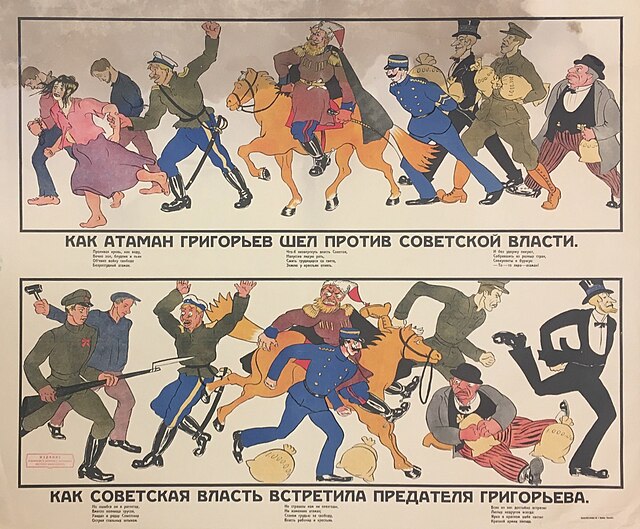
Grigoriev was the pure distillation of the contemporary warlord. He fought for, or at least flirted with, literally every side that was active on his front of the war. Let’s go through the list. From the Tsarist Army he went to the Ukrainian Nationalist Rada (check); he helped overthrow them on behalf of the German-backed Hetman Skoropadsky (check); then he rejoined the Rada and helped overthrow Skoropadsky. Then he linked up with the Ukrainian Left SRs (check); next he brought his partisan horde into the Red Army and captured Odessa for them (check). In May 1919 he set up shop on his own when he launched a massive revolt against the Soviet power which covered about a third of Ukraine and which was accompanied by vicious anti-Jewish pogroms. After his revolt was put down he tried to make an alliance with Makhno and the Anarchists (check). They discovered that he had made a secret alliance with the Whites (check), so they killed him and brought his followers into their army.
Grigoriev is an easy pick for this list. He was notably rude and charmless, and he was pissed as a newt when he took Odessa. Frequently to be found RHUI – Riding a Horse Under the Influence – but he led from the front and for this he was admired by his men. In his drunken, fearless, martial, bigoted figure he embodied the chaos of his land in 1919. If the Reds had followed through on their plan to send him and his army to help the Hungarian Soviet, he probably would have ended up joining the Slovakians or something.
4: Larissa Reissner
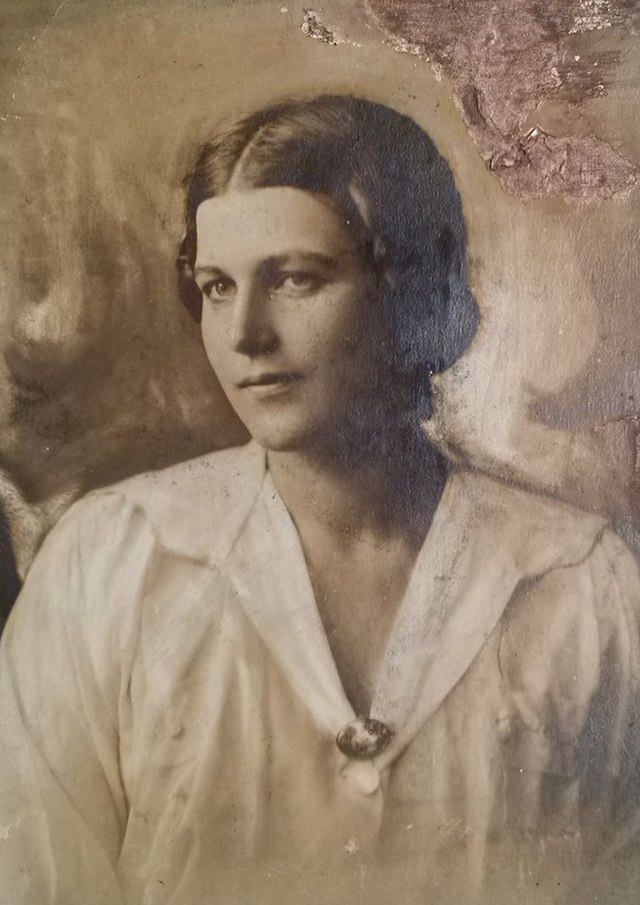
Larissa Reissner was one of thousands of women who volunteered to fight in the Red Army, not to mention those who fought in, and even led, Red partisan forces.
She was also a great writer, and she left behind ‘Svyazhsk,’ an eyewitness account of the Battle of Kazan – in my opinion one of the best-written first-hand documents we have from this war.
After fighting in and writing about that battle, she went on to spy behind the Japanese lines in Siberia, disguised as a peasant woman. She was captured, because her disguise was utterly unconvincing, but she escaped. Along with her husband Raskolnikov (aka Ilyin, another contender for ‘guy’ status), she went to Kabul and negotiated a diplomatic agreement with the King of Afghanistan.
She knew many famous writers and artists, from Mandelstam to Akhmatova. Most Bolsheviks’ personal lives appear to have consisted of drinking tea and country hikes, but Reissner’s was far more interesting and colourful. Of how many people can we say that they conversed about poetry with Anna Akhmatova, and also spent a month in the squalor and danger of the frontlines at Kazan?
Larissa Reissner died young of typhus in 1926.
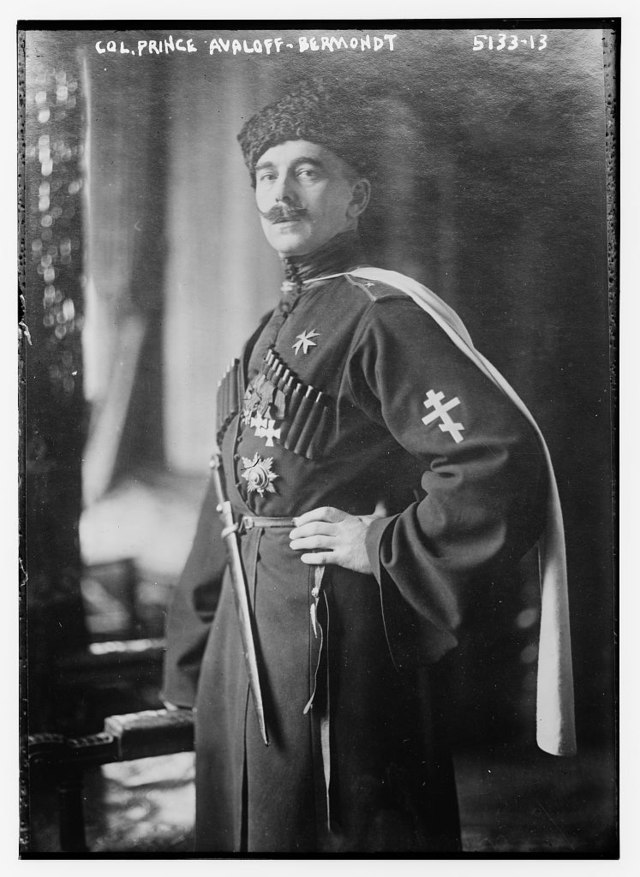
3: Prince Pavel Rafalovich Bermondt-Avalov
This was a complex war, with foreign powers (Germany, Britain, Japan…) layered on top of national and ethnic movements (Estonians, Bashkirs, Armenians…), themselves layered on top of class factions (workers, peasants, intelligentsia, capitalists, landlords…). On top of that, people switched sides a lot (General X was a pro-German monarchist who was in favour of independence for Y nationality, now he’s a pro-Allied SR; tomorrow he will be a Red military specialist, but preparing a mutiny on behalf of the Green partisans…) For every political orientation, for every trajectory through this mess, there was an individual character, a guy.
Bermondt-Avalov is the best example. ‘Bermondtian’ came to mean a pro-German, anti-Baltic Nationalities anti-communist. He built up a White Army by recruiting Russian soldiers from German prison camps. As you might have guessed, he was a protégé of the German government, and became one of their instruments in trying to build up a Baltic German Empire in 1919 (Yes, after the war the Allies gave the Germans a chance to conquer the Baltic, just to have a go at the Soviets). For a time Bermondt-Avalov and co had to play nice with the British and the British-backed Latvian and Estonian Nationalists. But his German-backed Whites were very distinct from the Allied-backed Whites. While the latter marched on Petrograd, he decided it would be a great time to march on Riga – ie, to declare war on the British-backed Latvian government. The Latvian and Estonian Nationalists defeated him, but his war undermined the White attack on Petrograd.
I chose Bermondt-Avalov not because I know a whole lot about his personality, temperament, etc, but because he raised an army to fight the Reds and ended up fighting other anti-communists. He may have been more interested in establishing Baltic German power than in fighting communism, but the two were not necessarily mutually exclusive. The way things turned out, German-oriented Whites were a historical curiosity. But if the Allies had not intervened, or if the Germans had come out of World War One stronger, then the Bermondt-Avalovs would have represented something different.
He fled to Germany, served the Nazis, for some reason was deported to Yugoslavia in 1941, and went to the United States where he died in the 1970s.
2: Jukums Vacietis
Vacietis, AKA Vatsetis, is another guy who stood in the thick of the raging national and class cross-currents.
He was a son of farm labourers who rose through the ranks of the Latvian Rifles, an all-Latvian unit of the Tsar’s army. Unlike most of the soldiers of the Tsar they had strong and bitter reasons to resist Germany right to the end: if Germany conquered Latvia, then the arrogant Baltic German barons would oppress them and push them around even more than before. So even while revolutionary consciousness spread among the Latvians, their discipline and spirit did not diminish.
Vacietis and the Latvians were big supporters of the October Revolution. 72% of Latvian voters opted for the Bolsheviks in the Constituent Assembly elections of 1917. In the early months of the Soviet Union the Latvian Rifles were pretty much its only trained and cohesive military unit.
And after the mutiny of Muraviev (a guy in his own right: adventurer, anti-Ukrainian chauvinist, Left SR, briefly head honcho in the Red Army – he mutinied against the Reds and tried to bring Red and White armies together to fight the Germans) … Where was I? After the mutiny of Muraviev, Vacietis was effectively commander-in-chief of the Red Army. He never joined the Communist Party but though he was a ‘non-party man’ there were few more reliable than him in the eyes of the military commissar Trotsky. He was a big heavyset guy in a flat cap, grumpy, hard to get on with, but unflappable, full of energy. He was chased out of Kazan, fleeing room-to-room from the Whites and Czechs after his staff mutinied. He had to flee across the river in a rowboat. But where he landed, an army cohered around him. He was key to the operations to retake the city a month later.
He got in hot water in 1919 – partly for losing a debate over strategy, and partly because he fantasized out loud in front of his comrades about maybe someday being the next Napoleon. He was replaced with the less temperamental Sergei Kamenev (another non-party military officer who gets too little credit). He became a professor at the Red Army military academy after capital charges against him were proved false. But like most of his contemporaries in the Red Army, he did not survive the Stalinist terror of the late 1930s.
1: Baron Roman Von Ungern-Sternberg

What can one say about the ‘Mad Baron’? Where do you start?
Ungern was one of those Baltic Germans that the Latvians were so worried about. If he’s anything to go by, they were right.
He was the most violent and cruel figure in this whole continent-spanning war. That’s saying something. He punished and killed people in painful and elaborate ways that you wouldn’t even think of if you put your mind to it. Murder without process was an everyday occurrence in his domains, and military discipline was like something from Saw. But it’s not obvious that he was a sadist, exactly; his motivations were even more twisted and demented.
He was a Buddhist of some kind, also influenced by Theosophy, but Lutheran in origin, Orthodox insofar as he served Tsarism. He believed in magic and occult secrets. Other White Guards looked to Europe to save them from Revolution, but Ungern saw Europe as the epicentre of the revolutionary earthquake. I am obliged to give him grudging points for consistency and rigour in that he rejected the whole Enlightenment and modernity along with the October Revolution.
His remedy for the revolutionary storm in the West? In the words of one of his disciples: ‘Here in these historic plains [Mongolia and adjacent parts of China and Russia] we will organize an army as powerful as that of Genghis Khan. Then we will move, as that great man did, and smash the whole of Europe. The world must die so that a new and better world may come forth, reincarnated on a higher plane’ (Alioshin, Dmitri. Asian Odyssey, H Holt and Company, New York, 1940, p 15).
Unlike most other White warlords, he did not get drunk, have orgies, or amass a fortune. He gave his own money to support his soldiers. He liked animals, or at least hated humans; if someone served bad food to the horses, he would lock them up and force them to eat it for days. He hated the Chinese, but idolized the Mongolians with an extreme romanticism.
It is sometimes said that he believed himself to be the reincarnation of Ghengis Khan. That’s probably not true. But the Mongolian theocracy declared that he was the reincarnation of another important figure from Mongolian history. They were grateful to him because he drove out the Chinese occupying forces from Mongolia – in the process carrying out an unbelievable sack and slaughter in the Mongolian capital city. So far, things were going well for his dreams of world conquest. But Mongolian communists, backed by the Soviets, soon defeated him, and he was tried and executed on Soviet soil.
There are too many other big characters to name or describe, and I will probably want to revise this list on further reading and reflection.
Honourable mentions to Shkuro, Mai-Maevskii, Frunze, Tukhachevsky… and at least twenty others.
 The 1919 Review