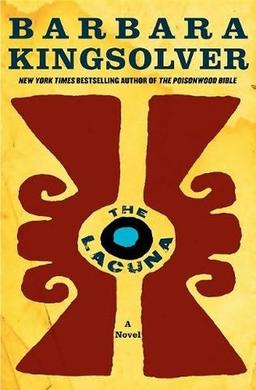
The Lacuna is a 2009 novel by Barbara Kingsolver about a young Mexican-American man, Harrison Shepherd, growing up in the early 20th Century. During his fictional life, spent back and forth between Mexico and the USA, he encounters real events and people, such as when he sees the Bonus Marchers beaten and gassed off the streets of Washington DC in 1932, makes friends with Diego Rivera and Frieda Kahlo in Mexico City, and back in the US finds himself in the firing line of the McCarthy Red Scare.
It’s a great novel that deserves all the praise and prizes that it got. In this brief post I want to zoom in on one interesting feature: its depiction of the Russian revolutionary Leon Trotsky. Trotsky, who lived in exile in Mexico city from 1937 until his murder in 1940, occupies a prominent place in the story. His depiction is something I’m going to praise but also criticize.
Kingsolver, who cut her teeth writing about miners’ strikes, treats the workers’ leader Trotsky with great sympathy. He appears to Harrison as a short, strong man with the dignified appearance of an older peasant, who is passionate about animals, nature and literature as well as politics. He employs Harrison as a secretary and, when he stumbles upon the young man moonlighting as a writer, gives him precious encouragement. An exile from Stalin’s Soviet Union, Trotsky is more melancholy than angry. Harrison is a witness to Trotsky’s murder and is haunted by the experience.
As an example of how she depicts Trotsky, in his affair with Frieda Kahlo (they did the dirt on their respective partners, Natalia Sedova and Diego Rivera), Kahlo comes out looking a lot worse than him. Harrison is Kahlo’s friend and confidante, and he judges her more harshly, probably because he knows her better; Trotsky is up on a pedestal and largely escapes judgement.
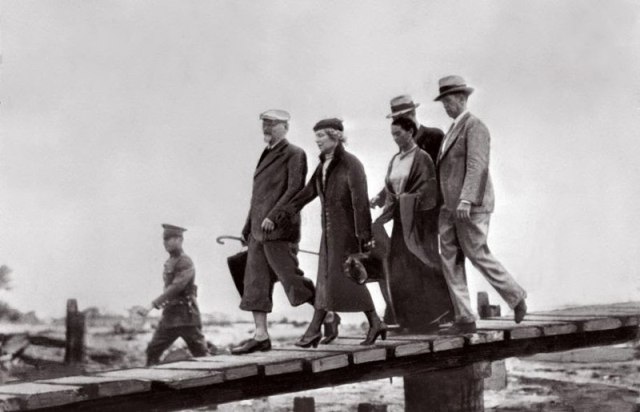
Trotsky, Natalia Sedova arriving in Mexico, escorted by Kahlo
Kingsolver is interested in Trotsky but far more interested in Kahlo. We see Kahlo’s sharp edges, we are invited to judge her at times. But I guess this is because the author decided to make her a central character, to spend more time and energy on her. Trotsky gets comparatively less attention from the author, so we get a simpler picture of him. This is all fair enough. But this leads the novel into some avoidable missteps.
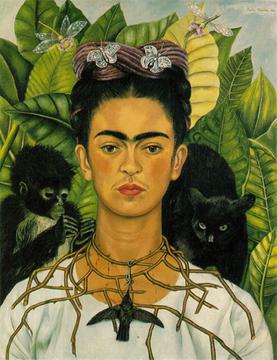
Self-portrait by Frida Kahlo
Funerals
It’s not impossible that Trotsky would have employed Harrison as a secretary. Harrison is a veteran of the Bonus March, a supporter of ‘the dictatorship of the proletariat,’ (understood by him to mean democratic workers’ power) and a member of the leftist artsy milieu in Mexico City. Harrison is also young, and Trotsky was more politically tolerant toward younger comrades. But Harrison is, for all this, not very knowledgeable about or active in politics. I think Trotsky would have sooner entrusted such a key role to members of his own organisation, the Fourth International.
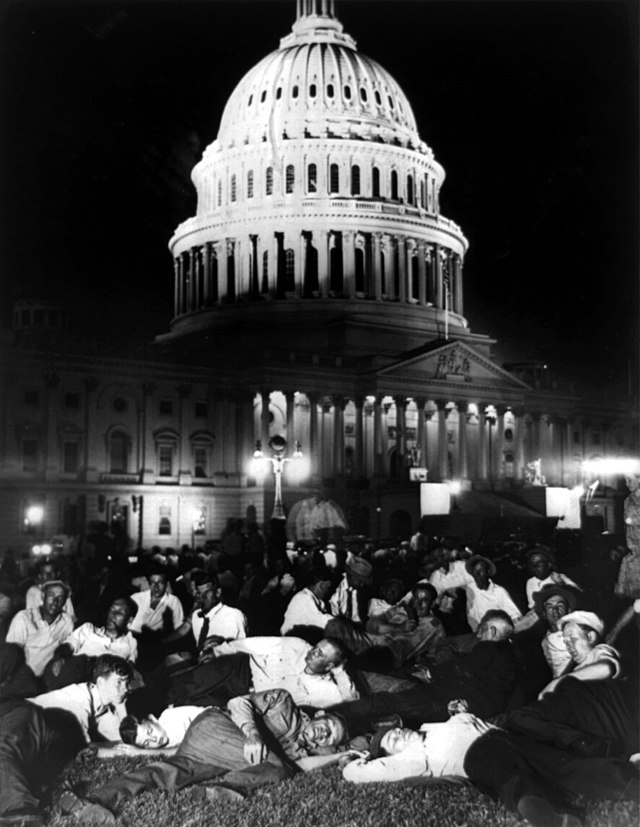
The 1932 ‘Bonus March.’ Jobless veterans camped out in Washington DC were subjected to a violent military crackdown.
So it’s a very strange moment when Harrison asks how Stalin and not Trotsky ended up in charge of the Soviet Union. This should be something which Harrison already knows about and has developed opinions about, if he’s living and working in a trusted position in Trotsky’s household.
It’s a problematic moment in a bigger way, too. The real Trotsky wrote entire books about Stalin’s rise to power, so we know what he would have said. The explanation he gives in The Lacuna is wide of the mark. Trotsky, earnest and visibly pained by the memory, tells Harrison that he missed Lenin’s funeral because of a devious prank by Stalin. And so Stalin took centre stage at the funeral, and so, in this version of events, he became the sole possible successor to Lenin. I remember being told this by my school history teacher as an aside, as a touch of pop-history anecdote material, but I haven’t come across it anywhere since. Maybe it’s true as far as it goes, but it doesn’t answer the question.
And it’s definitely not the first answer Trotsky would give. In real life, Harrison would want to put the kettle on and pull up a comfortable chair before he asks Trotsky how Stalin ended up in power. Trotsky would not have spoken of personal intrigues; he was far more partial to grand socio-economic analysis and theoretical debates. If you open up his key book on the subject, The Revolution Betrayed, you can see this in the title of the first chapter; it’s not ‘Stalin: Devious Bastard’ but ‘The Principle Indices of Industrial Growth’.
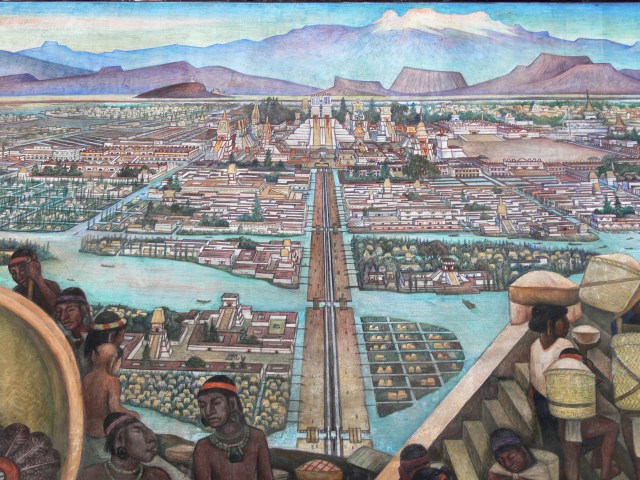
A mural by Diego Rivera depicting Tenochtitlan. Harrison’s stories are set in the same era as this painting
Yeoman farmers
In another strange scene, Trotsky laments the latest news from Russia: now Stalin is going after the ‘Yeoman farmers.’ But Stalin had started in on the ‘Yeoman farmers’ (kulaks) in earnest from 1929, and this conversation is happening around ten years later! In the early 1930s forced collectivisation and the ‘liquidation of the kulaks’ led to famine and terror on a huge scale. It was one of the most traumatic episodes in Soviet history and Trotsky wrote about it at the time. It wouldn’t have been news to him by the time he was in Mexico. In any case by then there were no kulaks left.
Trotsky in The Lacuna seems to regard these ‘Yeoman farmers’ as a key constituency whom nobody should mess with. This wasn’t the case. While Trotsky condemned Stalin’s onslaught on the peasantry and national minorities, he would still have used the derogatory term ‘kulaks’ rather than ‘Yeoman farmers.’ He saw the kulaks as a problem (though he advocated gradual and peaceful solutions) and earlier (in the mid-1920s) he condemned his opponents, including Stalin, for enacting policies that enriched and empowered this social layer.
‘pedantic and exacting’
In 1938 Trotsky’s son and close comrade Leon Sedov died in Paris, likely poisoned by Soviet agents during a routine surgery. In a powerful obituary, Trotsky expressed regret over his own often difficult personality:
I also displayed toward him the pedantic and exacting attitude which I had acquired in practical questions. Because of these traits, which are perhaps useful and even indispensable for work on a large scale but quite insufferable in personal relationships people closest to me often had a very hard time.
A more rounded novelistic portrayal of Trotsky would show us this ‘pedantic and exacting’ side, which was not a figment of Trotsky’s imagination – and perhaps his own occasional pang of regret over it. As his secretary, transcribing his extensive writings, Harrison would not only experience on occasion this ‘very hard time’ but would read practically every word Trotsky wrote. Someone as raw and open as Harrison would (rightly or wrongly is of no concern here) see some of Trotsky’s writings as ultra-principled or hair-splitting. This would especially be the case in the late 1930s; the extermination of all his allies and supporters back in the Soviet Union left Trotsky isolated, debating with the few survivors over questions which had no easy answers.
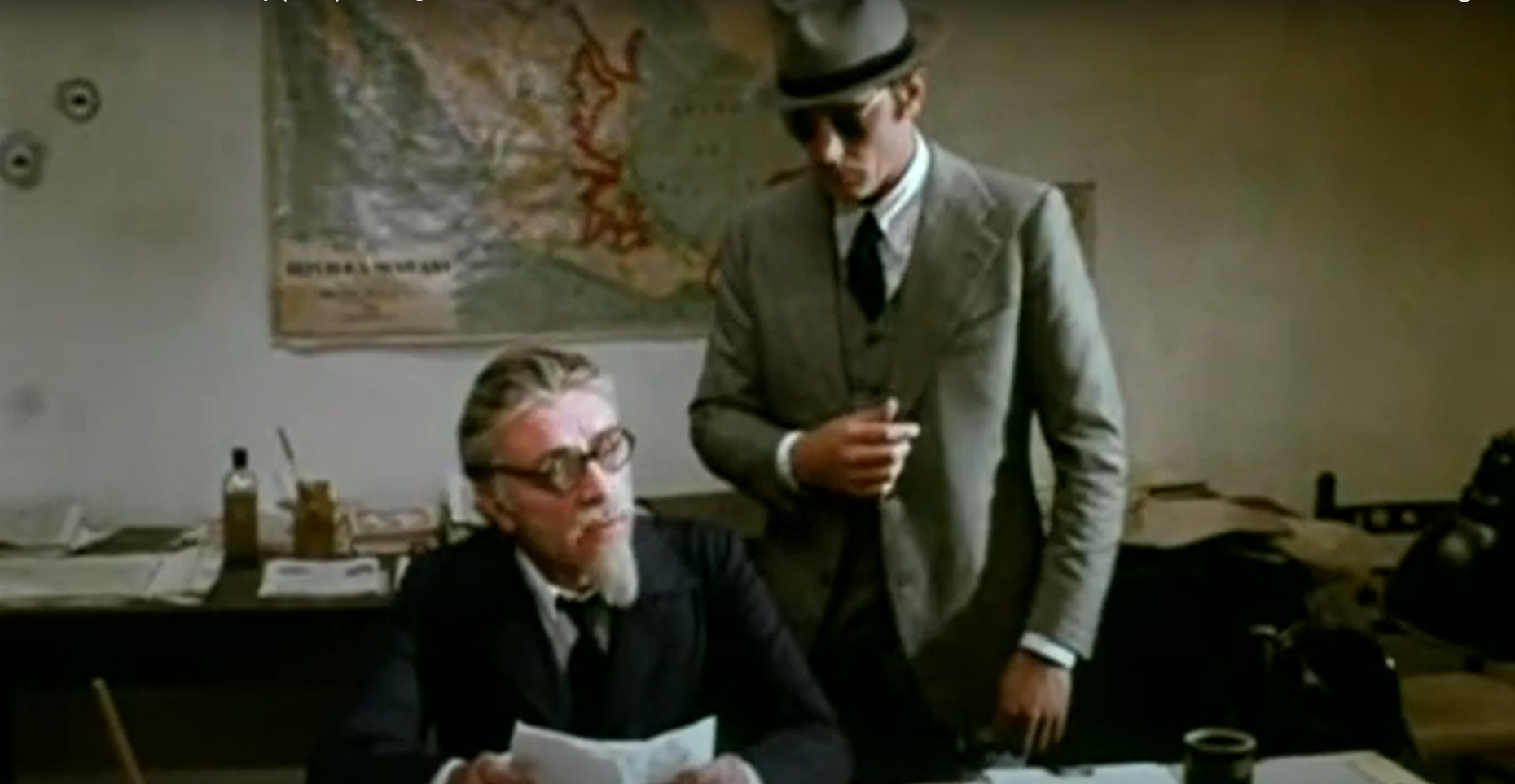
Trotsky with Ramón Mercader moments before the assassination. From The Assassination of Trotsky (1972, dir. Joseph Losey)
It’s believable and accurate that Harrison would encounter Trotsky and see a kind, curious, haunted man. But since he lived with him for a few years, he would see that like many great leaders and writers, Trotsky had his more negative personal traits. A more nuanced Trotsky, like the multi-faceted Kahlo we come to know in The Lacuna, would be all the more sympathetic for our having seen various sides of him.
But that doesn’t mean they did nothing wrong. For the first half of this post we’re going to look at the question of terror. Finally, we’re going to ask whether the Civil War led to Stalinism.
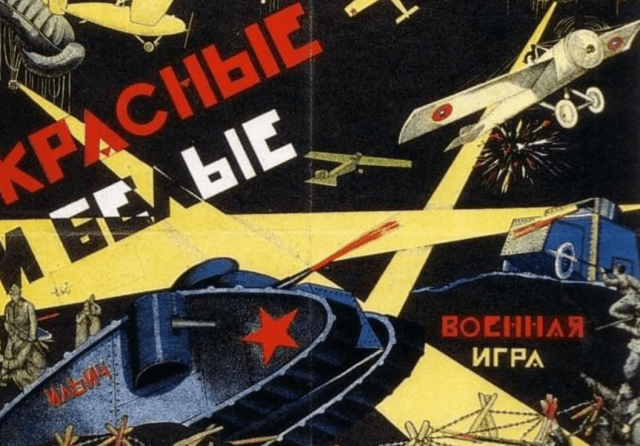
Cover art for a 1920s Soviet board game called ‘Red vs White: War Game’
Terror
The most disturbing part of the Civil War is the use of terror by the winning side. ‘After the outbreak of Civil War,’ writes Fitzpatrick, ‘the Cheka became an organ of terror, dispensing summary justice including executions, making mass arrests, and taking hostages.’ According to Fitzpatrick, terror encompassed ‘not only summary justice but also random punishment, unrelated to specific guilt […].’ [1]
Deutscher sums up the violence in a vivid phrase: ‘terror and counter-terror inexorably grew in a vicious and ever-widening spiral.’ But he does not elaborate much beyond saying that the Reds ‘did not shrink from the shooting of hostages’. [2]
Smith writes that ‘the extent to which the new [Soviet] regime relied on violence is now much clearer than it once was’ – for example, in Deutscher’s time. But he adds that it is also better understood to what extent all sides relied on violence. [3]
My own reading bears this out. There’s no indication that Red Terror was in any sense worse than White Terror. All sides, from Makhno to Piłsudski and from the Soviet regime to peasant insurgents, used terror as a weapon. These were the grisly rules of this war.
The question is: Who wrote the rulebook? Who were the instigators of the unconstrained use of violence?
Late in 1917 White Guards massacred Red Guards within the walls of the Kremlin. Even before the start of Civil War proper the two foremost leaders of the White armies, Alexeev and Kornilov, defended the practise of shooting all Red prisoners. Kornilov was public and outspoken, calling for as much terror as possible and declaring that he was ready to kill most of the population if necessary.
From May, we have the Civil War proper. Unrestrained terror against ‘Bolsheviks’ was the rule during the White risings of Spring-Summer 1918. At Omsk, according to a Right SR witness, 2,500 captive Red soldiers and workers were massacred. At the hands of Ataman Dutov, hundreds were buried alive. These are just a few examples of many to show that the Whites got a big head-start on terror. White terror was decentralized and unsystematic throughout the war, but practically every faction engaged in it.
The White head-start on terror is an obvious and clear fact to me when I look at the timeline. But none of my sources talk about it.
The Soviet regime’s violence was not premeditated. It was a response to a crisis not of its making. Most of the country’s territory had been seized – not by a popular revolt against ultra-left excesses, but by a well-armed minority and by foreign armies. The insurgents were killing Soviet-aligned soldiers and civilians by the thousand long before the Soviets responded in kind.
The case for Red Terror was made openly. The Communists justified it by pointing to the crimes of their enemies, and promised it would be set aside as soon as possible:
The proletariat who strive for equality of all human beings, have no longing for dictatorship with terrorism, and do not themselves choose that tactical course. As soon as the situation permits of it they will forego it. In the process of the Socialist revolution they will always seek to discover whether this or that section of the bourgeoisie can be induced to join with them in the exercise of power, whether the circle of those possessing equal rights is not capable of extension, and they will greet the day with ringing of bells and shouts of joy in which all chains will disappear […]
Radek also emphasized that the curtailing of soviet democracy and the security measures in his own country were not a model for other countries to follow.
Two dreadful massacres early in 1918, at Kokand and Kyiv, were outliers: carried out by non-Bolsheviks in peripheral places far from central oversight. But it is a problem that they are neglected in any Soviet sources I’ve come across.
Some of the worst excesses, including the above, occurred in regions that were not predominantly Russian – such as Astrakhan and Crimea. The Bolsheviks took an inspiring stand on the question of national liberation – but the age-old racism and chauvinism of the Russian state found expression in the severity with which some of the agents of the Revolution acted when surrounded by non-Russians.
Revolutionary movements in the future must not take the same road. Terror had a brutalizing effect on the Soviet state and on its supporters. The Red side never endorsed torture – but there is evidence that it happened in some places. Can that be a surprise, when the Communist paper in Petrograd in September 1918 literally called for blood? On the pretext of deterring counter-revolutionaries, violence could be used maliciously. It was often counter-productive, triggering revolt. All this is on top of the cruelty and waste, which go without saying.
‘Ideas learned under fire’ included many negative and paranoid ideas – in other words, trauma. The idea learned from Baku or Omsk in 1918 – that one must take ruthless measures against any stirring of counter-revolution – was a very harmful idea when applied generally.
The Soviet regime was under unimaginable threats and pressures. This popular and progressive government had a right to fight for its survival. Ultimately these pressures and threats caused it to stoop to inhumane and counterproductive measures when it should have held firm to a line which might have better balanced security concerns with humanitarian principles.
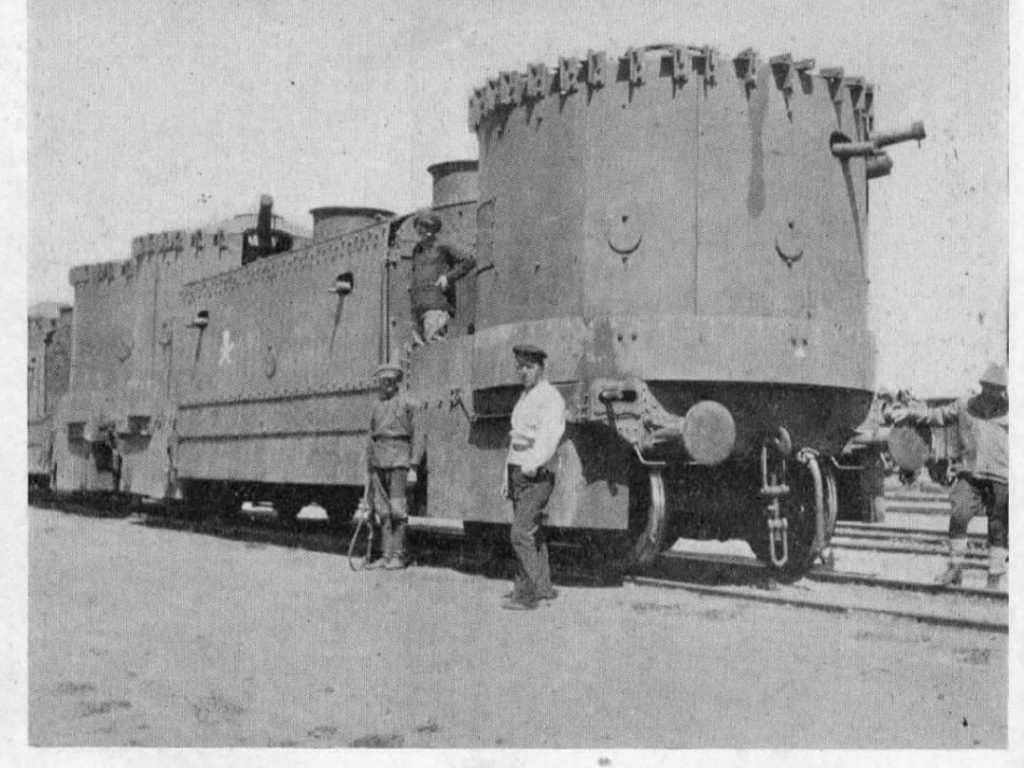
Red Armoured Train No. 17, named ‘Victory or Death.’ From the US labour paper The Toiler, shared online by a great page called Revolution’s Newsstand
Did the Civil War lead to Stalinism?
Repression dismantled
Some accounts narrate the executions in Crimea and after Kronstadt in a way that leaves the reader believing that the repressive apparatus built up during the Civil War was kept in place afterwards. In fact, the Cheka was radically cut down, most of its staff let go and its powers curtailed. The use of executions ‘diminished into insignificance.’ The system of prison camps used during the Civil War was shut down; there is no direct continuity between it and the notorious Gulag system. The Cheka, renamed OGPU, was left in charge of only a small number of prisons.
The criminal justice system in the Soviet Union in the 1920s was progressive and lenient. Exile was abolished, prison sentences cut down, crimes caused by poverty judged lightly, non-custodial sentences preferred. Prisoners were paid for work, educated, and often allowed to live outside the prison. The imprisoned population in the whole Soviet Union was under 200,000 in 1927 – likely an overcount as many sentences were shorter than a year.
In other words, repression actually was a Civil War emergency measure.
There were also around 8,500 people in harsher OGPU-run facilities. In 1929, the year Stalin’s regime began its notorious campaign of forced collectivization, 60,000 were transferred from the prisons to new OGPU unpaid labour camps. ‘[T]he network of camps grew to embrace 662,000 by the middle of 1930, and it was to grow within another couple of years to nearly two million.’ [4]
From 8,500 to two million in a few years – that’s a historic rupture.
This leads us on to the second main point of this post. The society which emerged from the war fell a long way short of, say, what Lenin envisaged in The State and Revolution. But it fell even further short of totalitarian Stalinism. The devastation of the war was only one condition, and not by itself a sufficient one, for the descent into the totalitarian nightmare.
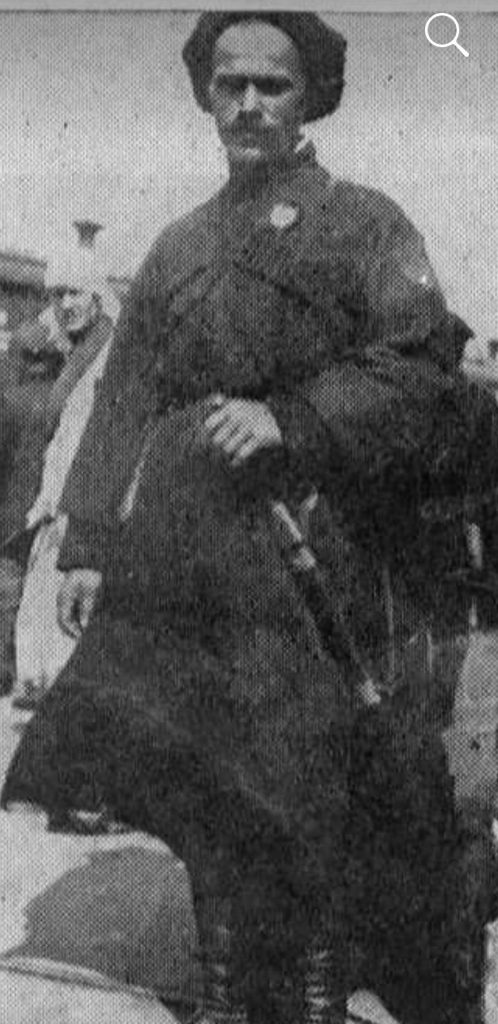
A Red Cossack. Again, from The Toiler
Red Army demobilised
As early as the start of 1920 the Red Army started demobilizing. ‘Lenin and the majority of the party’s leadership were obsessed with the recovery of the economy,’ (not fanatical world conquest) so 90% of the Red Army was sent home. There were 5.3 million personnel in 1921 – and just 562,000 by 1924, structured as a territorial militia.
This was very much army of a new type – commanders and rank-and-file soldiers were drawn from the same social classes; their uniforms were nearly identical; ranks were abolished; revolutionary discipline forbade corporal punishment and appealed to conscience. [5]
This army was wrenched away from its egalitarian and liberatory origins – but again the rupture came in the 1930s, not in the Civil War era.
The Red Army changed radically in the Stalinist period. Ranks were reinstated. Commissars were abolished, only to return later in a more inquisitorial form. Forced collectivization stunned the rank-and-file soldiers; the Great Terror decimated and terrorized the officers. The Soviet Union entered World War Two with a severely demoralized and fundamentally changed Red Army.
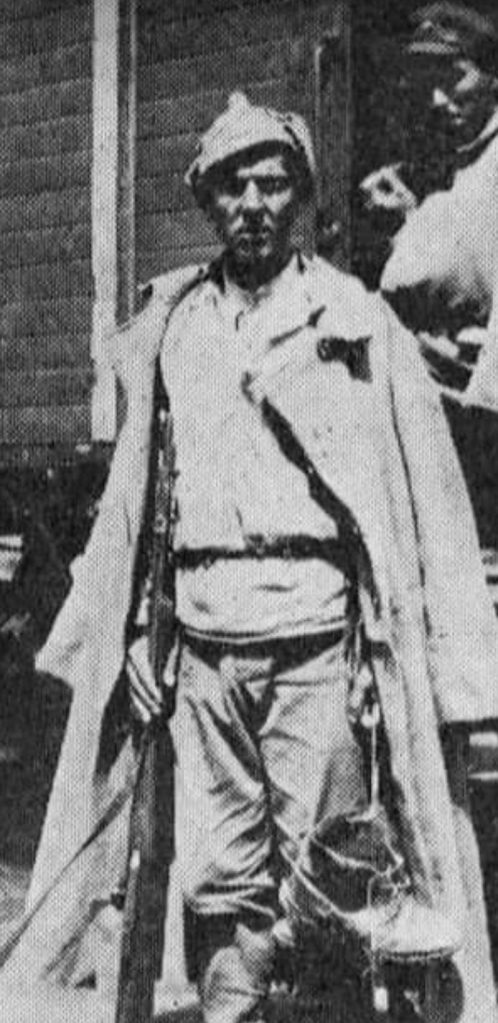
From The Toiler – A Red Army soldier
Living conditions
In 1921, after fighting on several fronts throughout the Civil War, Eduard Dune returned to the factory where he had been working when he first became a Bolshevik in 1917. The place was silent and shuttered. A handful of the old workers were minding the place, living off potatoes they grew on the grounds. But on the inside, the factory was perfectly preserved in the hope of economic recovery. [6] This is an image of promised renewal and reconstruction.
The promise was fulfilled. Contrary to the clichéd fatalistic aphorisms about how socialism only ‘shares out misery more equally,’ ‘runs out of other people’s money’, etc, in the 1920s working-class people saw huge benefits. City dwellers could now avail of free healthcare and far cheaper housing. Workers had a generous social insurance scheme. The countryside was far less penetrated by new social services, but appreciated the absence of landlords. A generation of worker and peasant youth benefited from much wider access to education. Smith (Russia in Revolution, p 320 and following) emphasizes the achievements in healthcare, in spite of scarce resources.
It is significant that, as soon as the Civil War was over, economic recovery began. This backs up the idea that war conditions, not Bolshevik policies, caused economic crisis.
Soviet democracy
The regime in the immediate aftermath of the Civil War was far more pluralist than one might expect in a country utterly devastated by war. It was a rich period culturally – Soviet youth experimented with free love; nudists jumped onto trams in Moscow; Esperanto speakers organized themselves; Soviet artists were at the cutting edge globally.
Contrary to another cliché, the Communists never actually abolished workers’ control in the factories. What emerged by the end of the Civil War was a compromise (there’s that word again). Some factories were run by elected committees, others by a centrally-appointed manager (a communist, a former manager, a chief engineer, or even in some cases the former owner), others still by a worker or group of workers from the plant appointed to run it. The latter was ‘often the most successful’ arrangement. [7] In other words, where workers’ control functioned well, it was kept. Where it turned out badly (and there are many reasons it might, in a context of economic collapse and war), the state stepped in and either modified it or ended it.
In practically every ‘democratic’ country at the time, poor people, minorities and women were excluded from voting. By contrast, the Soviets were elected by all men and women over 18. Those deemed to be exploiting others were denied the vote; this amounted to a tiny percentage of people.
The Soviet regime is sometimes accused of lacking ‘checks and balances’ necessary to prevent tyranny. In 1917-18 it was nothing but checks and balances. However, it’s true that the state which emerged from the Civil War was authoritarian and dysfunctional.
The Mensheviks had by this stage positioned themselves as a loyal opposition. Lenin and his old comrade, the Menshevik leader Martov (according to Tariq Ali in The Dilemmas of Lenin) were warmly reconciled before their deaths. Nonetheless the Soviet state subjected the Mensheviks to a severe crackdown in 1921, with thousands of them arrested. There was a parallel crackdown against oppositionists inside the Communist Party – Shlyapnikov and Kollontai were not arrested, but their faction was shut down. These measures were supposed to be temporary, to be reviewed after the Soviet Union had put a few years of urgent reconstruction behind it. But as the 1920s went on the Left Opposition, which included many of the most prominent Old Bolsheviks, found itself having to campaign for a restoration of democracy, amid increasing crackdowns from the party apparatus.
Though Lenin supported the crackdown on Mensheviks and the ban on internal party factions, he sounded the alarm early about the Soviet state and, in his final writings, took a democratic turn – for example on Georgia and on cooperatives. In 1920 he cautioned: ‘ours is a workers’ state with bureaucratic distortions.’ ‘Later,’ writes Faulkner, ‘alarmed at the influence of former Tsarist officials and newly appointed careerists in the government apparatus, he posed the question: ‘This mass of bureaucrats – who is leading whom?’ [8]
The bureaucrats included the former Mensheviks Beria and Vyshinskii. Beria would later serve as the notorious head of Stalin’s secret police. Vyshinskii, as prosecutor in the Moscow show trials later in life, would call for the ‘mad dogs’ (the defendants) to be shot.
Be conscious of how much heavy lifting is being done by this word ‘later.’ Here as with other topics, the decisive break came not in the Civil War but after 1928.
We have to note, however, that with the political regime, the curve is less dramatic, the rupture less obvious. Terrible damage was done in the Civil War, and the cost of economic recovery in the 1920s was a growth of bureaucracy and ‘NEPmen’, develoments which helped Stalin’s rise to power. Faulkner writes: ‘The revolution had been hollowed out. And, in one of history’s most bitter twists, another species of counter-revolution […] was growing, a malignant embryo, inside the revolutionary regime itself.’
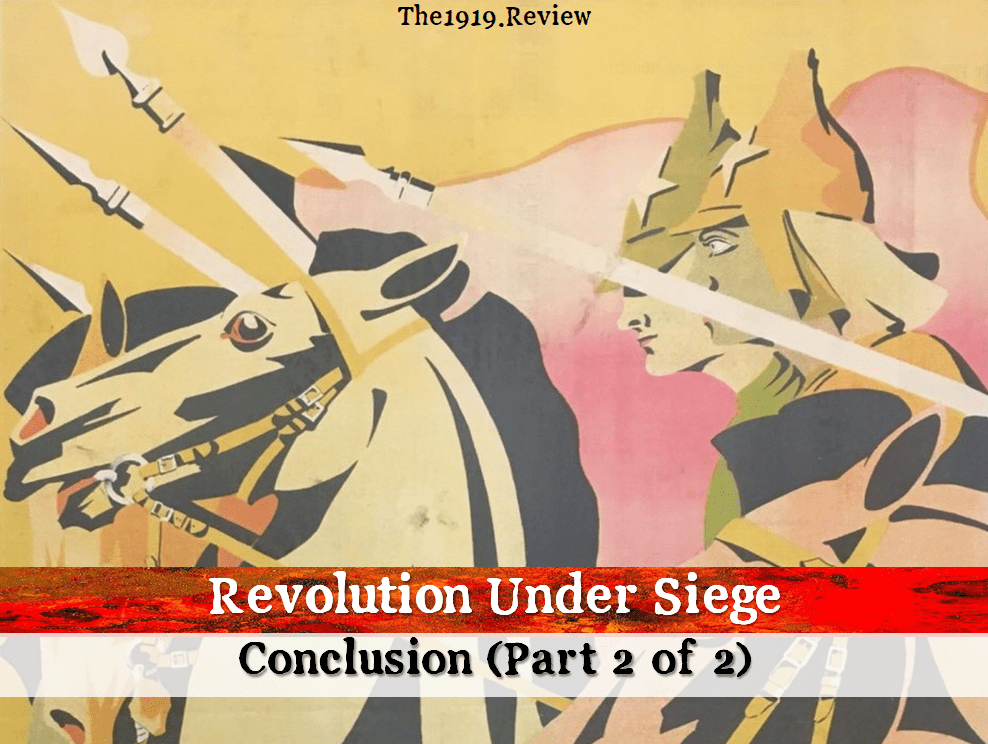
Today’s cover image. Caption copied directly from WIkimedia Commons: ‘Russian_Revolutionary_Poster,_Red_Cavalry kiev Russian Revolutionary Poster Mount your horses, workers and peasants! The Red Cavalry is the guarantee of victory. Designer unknown, 1919.’
To be or not to be
We can’t hope to understand the Soviet Union without understanding that it was engulfed in its formative years by a cataclysm not of its making. This, alongside the country’s underdevelopment and isolation, created the authoritarian and bureaucratic tendencies, personified in Stalin, which would later seize power. So if people want to know where the Soviet Union’s siege mentality came from, they should probably read up on the siege.
We can’t hope to understand how the Soviet Union survived this cataclysm without appreciating that the October Revolution was genuinely popular.
It might be objected that if the Red soldiers could have seen the future, the cynicism and brutality of Stalinism, they would have lost the will to fight.
Maybe, maybe not. People at the time did consider the possibility of something like Stalinism; they had historical precedents in Cromwell and Bonaparte. In Victor Serge’s novel Conquered City, written in the 1930s but set during the Russian Civil War, two characters discuss the possibility that the Revolution might one day be hijacked by a dictator.
‘It wouldn’t be worth it, no…’ says Kirk. ‘It would be better, for the Revolution, to perish and leave a clear memory.’
Osipov responds: ‘No, no no, no! Get rid of those ideas, comrade. They’ve been beaten into us with billy clubs, I mean with defeats. No beautiful suicides, above all!’ [9]
I reckon western opinion of the Russian Revolution would be kinder if the revolutionaries had had the decency and good sense to be defeated and to die horrible deaths. The memory of the Soviet regime would be ‘clear.’ What’s not clear is what great service would be rendered to humanity by another epic of popular revolt and cruel defeat – another Paris Commune, Finnish Soviet, Spanish Republic, Indonesia 1965-66, or Chile 1973.
Osipov’s phrase ‘No beautiful suicides!’ brings to my mind the speech in Shakespeare’s Hamlet – ‘to be or not to be…’ In Malcolm X’s reading, the Danish prince was deciding, in that speech, whether to suffer in silence or to risk death and damnation by resistance. [10] The Russian Revolution was a moment of liberation and creativity when humble working people exercised real power. They were brave to take arms against a sea of troubles, to defend their new socialist republic by every means consistent with that end.
The Revolution lit a beacon of liberation and creativity. Revolution Under Siege set out to trace what happened to this flame. It is not surprising that the Revolution fell short of its promise. What is surprising is that even after the years of hunger, typhus, shellfire and blood, there survived still a spark emitting the light of social justice and the warmth of human solidarity.
Osipov, in the trenches before Petrograd in 1919, continues his debate with Kirk:
‘We’re here to stay, by God! to hold on, to work, to organise […] To live, that’s what the flesh-and-blood working class wants, that great collection of hungry people behind us whom we seem to be leading but who in reality are pushing us forward. Whenever there is a choice – give up or continue – they continue. Let’s continue, let’s get into the habit of living.’
References
[1] Fitzpatrick, 77-78
[2] Deutscher, Stalin, 192
[3] Smith, 383
[4] Solomon, Peter H. ‘Soviet Penal Policy, 1917-1934: A Reinterpretation.’ Slavic Review, Vol 39, No 2. Jul 1980. P 199, 202, 210.
On the Cheka being cut down, see Smith, Russia in Revolution, p 296: ‘At the end of 1921 there were 90,000 employees on the official payroll of the Cheka, but by end of 1923 only 32,152 worked in OGPU. In the same period the number of those working clandestinely for the political police fell from 60,000 to 12,900, and by late 1923 the total number in the internal troops, border guards, and escort troops had fallen from 117,000 to 78,400.’A
A note on the structure of the post-war Red Army:
In 1921 Trotsky argued for the replacement of the standing army by a territorial militia – a more traditional socialist position which had been favoured until the military emergencies of 1918. What emerged was a compromise: a small Red Army backed up by a large territorial militia. In 1934, at the height of this hybrid system, 74% of personnel were in the territorial militia. Men were drafted to serve for five years, during which time they would be soldiers for a few days a month, or a month or two in the summer. After their five years, they would be subject to recall in wartime.
Access to this article is limited to paying supporters. If you already subscribe by email, thank you. But if you want to become a paying supporter, please hit ‘Subscribe’ below.
Give me less than the price of a coffee, and you can access everything on this blog for one year.
This post tells how the White Guards fled South Russia in a state of complete chaos, but survived and established a new base in Crimea. This is Series 4, part 3 of Revolution Under Siege, an account of the Russian Civil War.
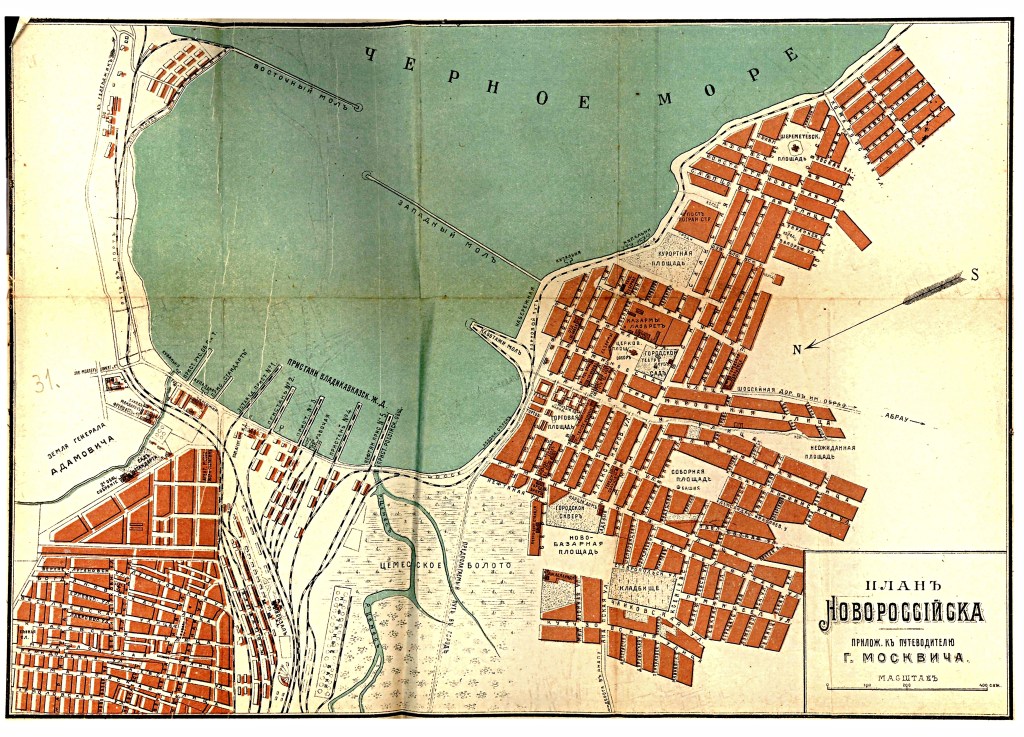
A Red soldier named Eduard Dune was captured during Denikin’s advance on Moscow. Among other terrible ordeals in captivity, he succumbed to typhus. Thirst and headaches gave way to two long comas; the second time, he woke up in the war-scarred city of Tsaritsyn, far away from where he’d passed out, and was soon loaded on a train bound for Novorossiysk. There he slowly recovered in an infirmary near the Black Sea port city, and as his faculties returned, he got active in underground work.
There were partisans in the hills near town, and he stole medical supplies from the infirmary and passed them to these ‘Green’ guerrillas. This close to the port of Novorossiysk, the supplies sent by the British government were piled up.
There was so much in storage that food supplies were lying under the open sky, and still the English continued to send more in ship after ship. Now that the White Army had their backs to the sea, the English had begun to supply all that had been promised when the army had stood near Moscow. The prisoners’ infirmary now enjoyed bed linens and other English hospital linen. In our storeroom lay trunks packed with English food products, including cocoa and dried vegetables. There was more than our cook could cope with.
There was a sand spit within sight of the infirmary where the Whites regularly took people for executions. The patients kept watch on this spot, collected intel and helped escapees. Dune and his fellow captive invalids stole papers from comatose typhus-inflicted Whites and supplied them to Red and Green agents in the city. They had a workshop on hospital grounds where they turned out false documents.
Novorossisyk had already been the site of things so strange and terrible they are difficult to visualise; way back in the fourth episode of this series, we followed the Bolshevik sailor Raskolnikov on his mission to scuttle the Black Sea Fleet. Very soon after that, the port fell to the Whites. Now, less than two years later, it was to witness one of the most surreal and pitiful scenes of the war.
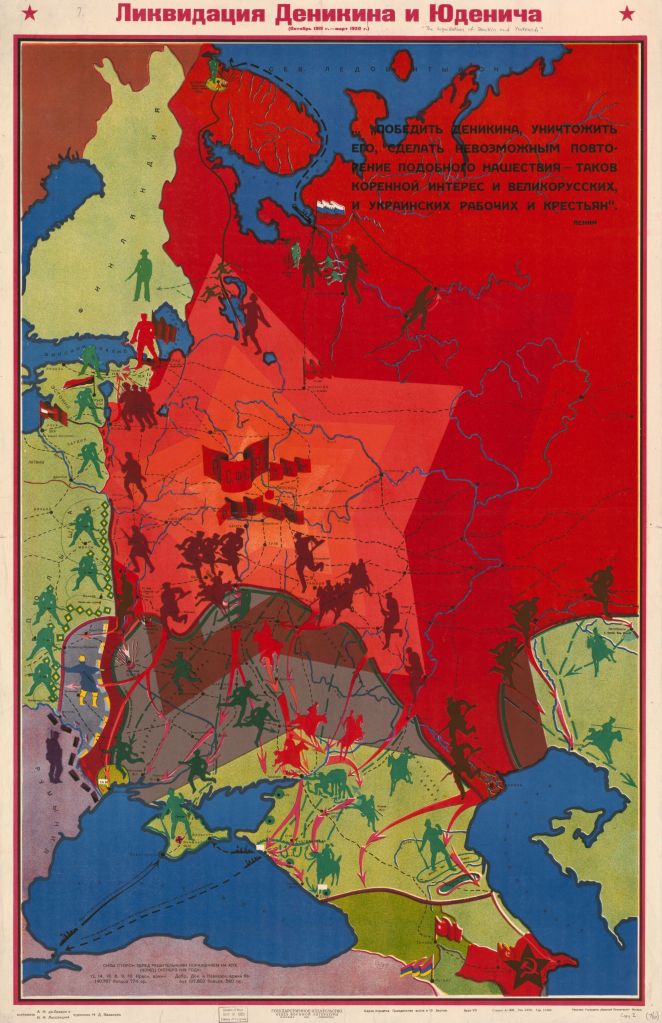
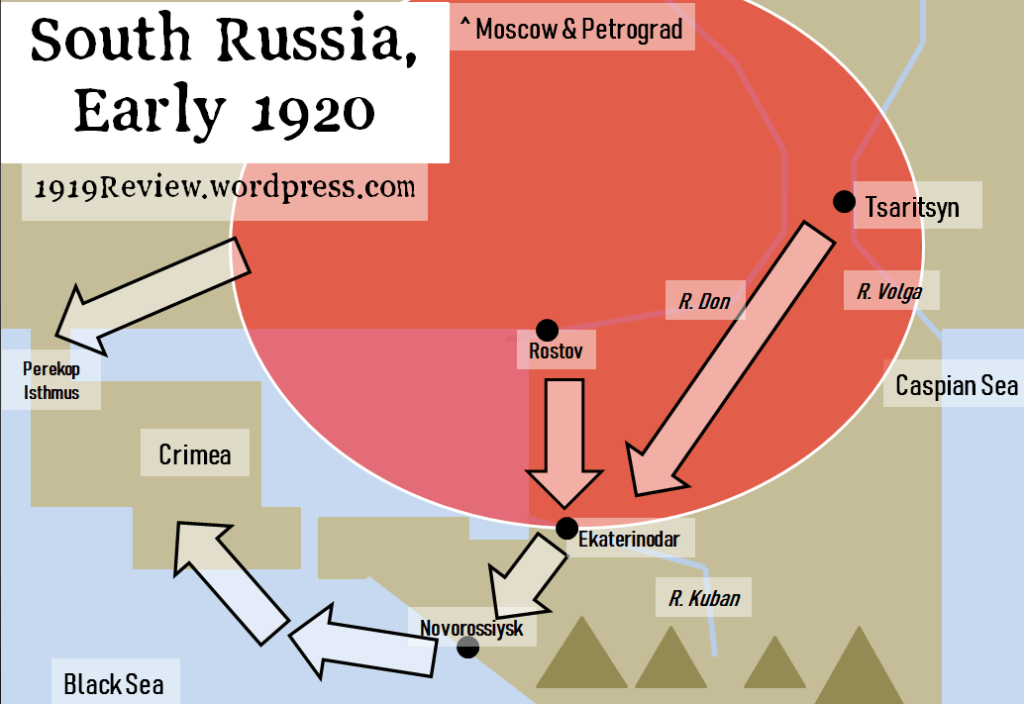
Russian Civil War pictorial map number 7, ‘Liquidation of Iudenich and Denikin.’ The White Guards (coloured green) are pursued southward. Trace the Red arrows across the Don River, over the Kuban steppe, and down the Black Sea coast. Note also in the map two things we’re not going to deal with in much detail here: the final victory in North Russia and the rise of Soviet power around Baku, Azerbaijan.
Rostov
Meanwhile the war was raging on, the Whites falling back, the Reds surging southward: in January Tsaritsyn (later Stalingrad, now Volgograd) saw its last battle of the Civil War when it fell to the Reds. But when the Whites reached their old base area of the Don and Kuban Countries, they rallied. The river Don, as if it was in sympathy, froze to let the Whites retreat across it, then thawed before the Reds could. Alongside this military recovery, the White civilian government, such as it was, promised reforms and tried to juice up some popular support. The Red Army hit the moat of the Don in disarray from its long advance, overstretched and agitated with internal disputes.
The Whites recaptured Rostov-on-Don on February 20th. But the Reds were by this time over the worst of their confusion, and it was the Whites’ turn to have some internal disputes. Denikin had made concessions to the Kuban Cossacks – not enough to stop them deserting, but enough to enrage the White officers. ‘What are we?’ they demanded. ‘Cannon fodder for the defence of the hated separatists?’
The First Red Cavalry Army (which by this time boasted 16,000 riders, 238 machine-guns, nineteen artillery pieces and eight armoured trains) crossed the Don and threatened the rear of Rostov; there was nothing for it but to abandon the town and fall back to Ekaterinodar (the city outside which a shell had killed the Whites’ chief inspirer Kornilov two years earlier) and then, after a short hopeless struggle, on to Novorossiysk.[1]
One of many grim chapters in Beevor’s recent book deals with the entry of the Reds into Ekaterinodar. He describes the summary murder of men falsely identified as officers, Kalmyks being massacred for no apparent reason, and dead White Guards being mounted on a locomotive as trophies. Beevor appears to be repeating contemporary rumours which his source’s author heard second-hand, which is consistent with some of my criticisms of the book. [2] But even allowing for exaggeration and rumour-mongering, such excesses probably did form a part of the picture of the Red Army’s advance in some areas.
1st Red Cavalry Army
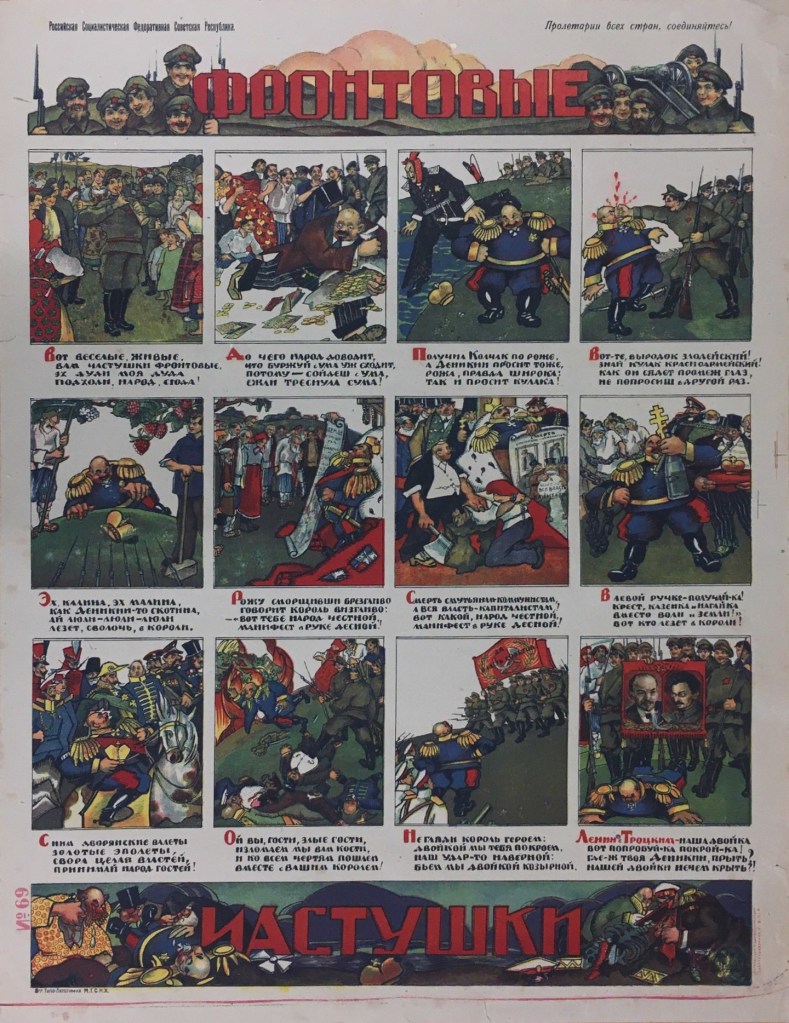
The cover image is a detail from this 1921 Soviet poster. Of the text, all I can tell you is that the heading means a frontline soldier. Thankfully the images are self-explanatory.
Novorossisk
The resumption of Red advance translated into rumours heard by Dune in the Novorossiysk infirmary: ‘The Whites had won victories with the aid of their cavalry, but ever since Trotsky had said, “Proletarians, to horse!” we too fielded a cavalry, and ours beat the Cossacks all hollow. The Red cavalry had captured all the English tanks.’
This was confirmed by what Dune could see with his own eyes; White Guard Russia was visibly shrinking and contracting around him. First, discipline grew lax, and he could get out into the city on errands. Once there he saw the streets fill up with a strange juxtaposition of affluence and squalor: cartloads of expensive household goods, and huge numbers of typhus-stricken refugees. White officers began taking entire battalions to join the Greens. Back at the infirmary, White Army supplies were stolen wholesale now instead of retail.
Moving away and up the chain of command from the humble soldier Dune, the British General Bridges was disgusted: ‘the whole affair was a degrading spectacle of unnecessary panic and disorder, and I urged the government by cable to dissociate themselves from the White Russians who had no prospects and little fight left in them.’ But Winston Churchill, Secretary of State for War and Air, overruled him. So the British remained and took responsibility for the evacuation of White officers and their wives and children. [3]
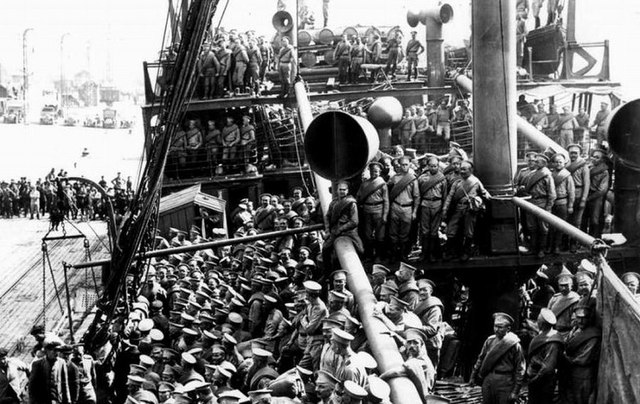
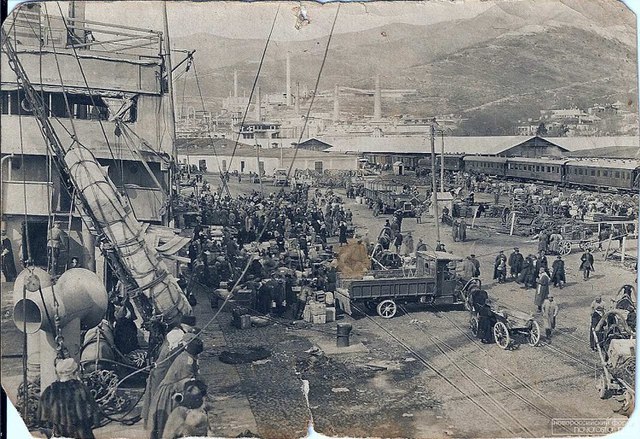
Suddenly the British project of pumping in great quantities of supplies and war materiel had to go into reverse: now the British were evacuating White officers and their families, and anyone else who could be crammed on board. At the quays, crowds pressed against the British Army cordon and the ships heaved with people. A tank drove slowly over a row of thirteen British aeroplanes, turning them to matchwood so that the Reds couldn’t use them. Then, of course, the tank itself was abandoned. Other engines of war littered the sea floor where they had been dumped. Tearful Cossacks shot their horses.
The other White naval evacuations were disasters, but Novorossiysk was the worst. [4] It was so bad, Denikin resolved to resign as soon as it was all over. The misery, destruction and desperation were extraordinary:
…the waterfront was black with people, begging to be allowed on board the ships… Conditions were appalling. The refugees were still starving and the sick and the dead lay where they had collapsed. Masses of them even tried to rush the evacuation office and British troops had to disperse them at bayonet point. Women were offering jewels, everything they possessed – even themselves – for the chance of a passage. But they hadn’t the ghost of a chance. The rule was only the White troops, their dependants and the families of men who had worked with the British were allowed on board. [5]
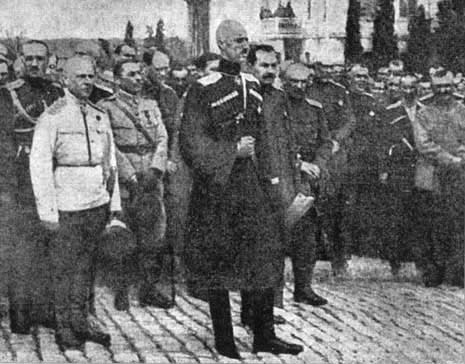
Above: the chaos at Novorossiysk.
The 2nd Royal Scots Fusiliers acted as a rear guard, supported by a naval bombardment (one of the ships firing was the Waldeck-Rousseau, which had mutinied the year before). On March 27th the Red Army arrived, lobbing shells after the fleeing ships. By then, 34,000 had been evacuated (A disproportionate number were Volunteers, which suggests the Don Cossacks got shafted).
The Reds found on the quays an indescribable landscape of dead horses and destroyed equipment – but also heaps of intact supplies, such as one million pairs of socks. General Bridges had not been permitted to abandon the Whites, but he had left food and clothing to try to alleviate the suffering of ordinary people in war-torn South Russia. The Reds captured 22,000 White Guards in the town, and 60,000 later surrendered further down the coast at Sochi.
Other Whites fled into the Kuban steppe, where they waged a guerrilla war. As for the Green armies, at the moment of victory they suffered a split between the pro-Communist elements and the various other forces who were in the mix, and soon dissolved. [6]
London
Meanwhile in London, time of death was called on the White cause. Field Marshal Henry Wilson wrote in his diary: ‘so ends in practical disaster another of Winston’s attempts. Antwerp, Dardannelles, Denikin. His judgement is always at fault.’
Several days later he wrote: ‘cabinet at 6pm. We decided, Curzon leading, finally to tell Denikin to wind up affairs and come to terms with the Soviet government. Great joy. Winston fortunately absent.’ [7]
It was neither the first nor the last time the British had decided to withdraw from the Russian Civil War. They were sick of being on the sidelines of the bloody mess, acting as referee and sponsor, and occasionally stepping onto the pitch to play midfield, only to be frustrated again and again by the unexpected strength of the opposition and the shocking failures of their own side. In spite of all this, British intervention continued while the Whites made another throw of the dice. The fact that some tens of thousands of White Guards had escaped in one piece, plus an accident of geography and miitary fortune, gave the Whites an opportunity.
During the chaotic White retreat across Ukraine, one White officer had fought his way through Makhno’s anarchists to reach Crimea. There he held the Perekop Isthmus, the narrow strip of land connecting Crimea to the mainland. This officer, who had entered Ukraine as one of Shkuro’s notorious ‘White Wolves,’ bore the evocative name Slashchev.
Because of Slashchev’s feat the Whites held onto Crimea, an area 27,000 square kilometres in size, or one-third the size of Ireland. The Reds had no fleet on the Black Sea and the Allies had, so Crimea was a natural fortress as well as a base area of manageable size and with a population of over a million. That’s where the British fleet obligingly left those 35,000 evacuated White Guards. We have the strange picture of masses of hardened veterans disembarking at seaside resort towns.
Crimea
The first item on the agenda was leadership. At a Council of War in April, power passed from Denikin to his rival and critic, the ‘Black Baron’ Wrangel. The military chieftains objected on principle to electing Wrangel. To be clear, they did not object to Wrangel himself, only to the idea of electing a leader. So they insisted Denikin appoint him. After the galling experience of handing power to his rival, Denikin had nothing left to do but depart for Constantinople on a British destroyer, never to return. [8]
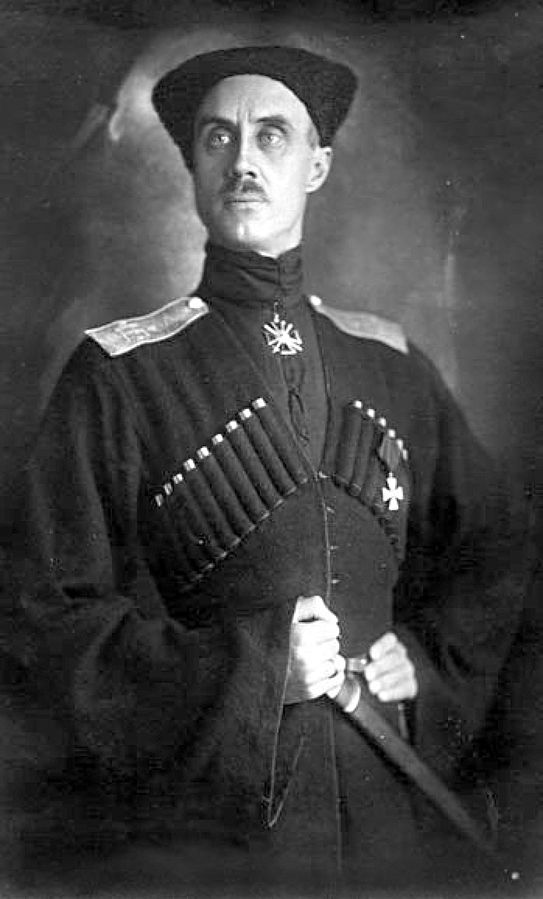
Above: photographs and a poster depicting Wrangel
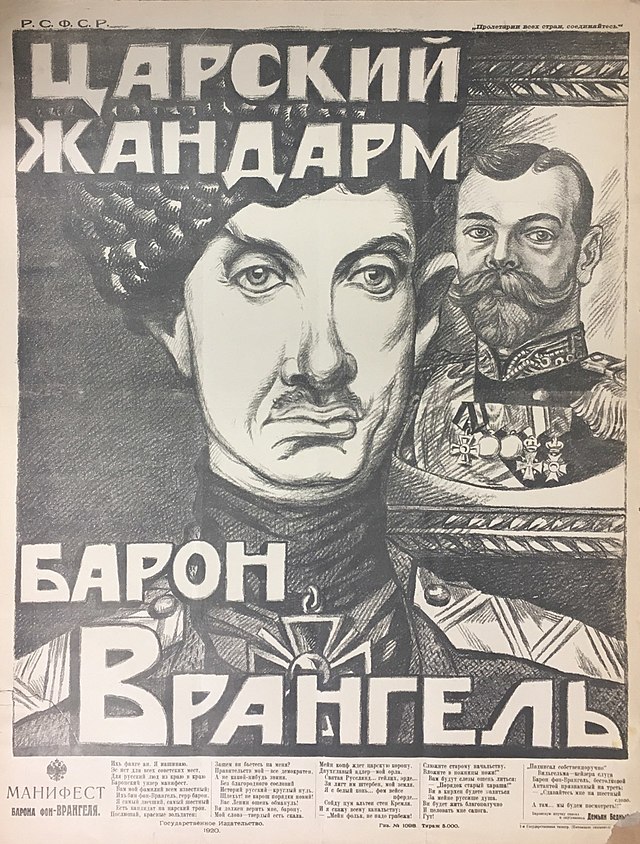
Wrangel was not a graduate of Bykhov prison-monastery or a survivor of the Kuban Ice March, not at all one of the original Kornilov club. But with his height and striking features, he looked the part more than any other major White leader; Soviet cartoons and posters got great mileage out of him.
But there was still a line of continuity going all the way back to those origins as ‘the saga of the Volunteer Army continued in the Crimea.’ The elite ‘colourful units’ that were named after Markov, Alexeev, Kornilov and the others still existed as I Corps. [9] Like his predecessors, Wrangel called himself ‘Ruler’ and his army the ‘Russian Army.’
One of the themes that keeps popping up in this series is the role of the individual in history. Wrangel is a striking case study, because under him a new and distinct White Guard regime emerged in Crimea. Whereas Denikin’s regime was overstretched, ragged and undisciplined, Wrangel’s was every bit as lean and severe as he was.
In contrast to the previous White regimes, there was a functioning government and strict discipline. Reds who deserted were given a fair hearing. Looters were shot. Wrangel’s government would even pass a law redistributing landlords’ holdings to peasants – yes, the Whites were finally ready to cut their losses on that one, and the irony is that Wrangel, unlike Denikin, was actually of the land-owning nobility. His regime also made overtures to Tatars and Ukrainians, and cooperated with the Poles.
(L) Wrangel inspecting White pilots, and (R) his functioning government
Was this all down to Wrangel’s personality?
Perhaps not so much. Actually, the Baron had been a champion of the conservatives within the White movement against the more ‘liberal’ Denikin. Wrangel spoke of the need ‘to make leftist policies with rightist hands’ and pronounced a policy of ‘With the Devil, but for Russia and against the Bolsheviks.’ [10] Every living White Guard, one assumes, had learned extremely harsh lessons in 1919. Popular opinion and practical common sense would have favoured this new approach.
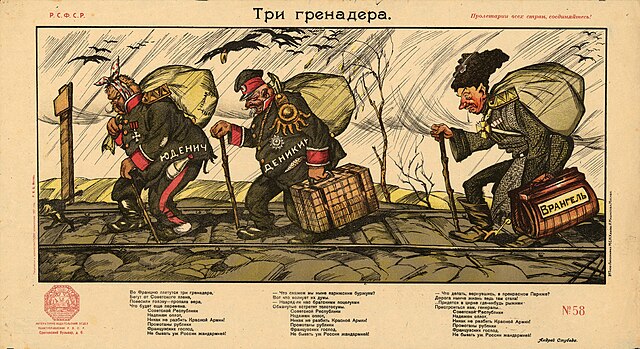
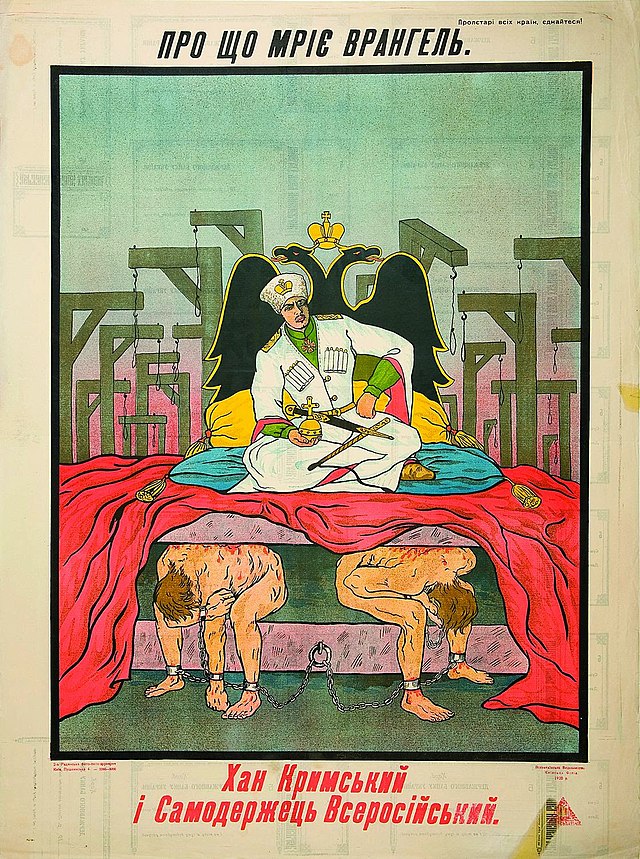
Above, images of Wrangel from the Soviet point of view. ‘Three grenadiers’ labelled Iudenich, Denikin and Wrangel; Wrangel as Khan of the Crimea; and ‘The Tsarist gendarme, Baron Wrangel’
What made this approach possible was the fact that an overwhelming mass of White Guards were now concentrated in a stable, small, self-contained base area. Just as one example of how Crimea insulated the Whites from the chaos that had messed things up before, the Cossacks could no longer do the old loot-and-desert routine. They didn’t have horses anymore, let alone horses that could swim across the Black Sea. The character of the new regime had more to do with the new base than with any other factor. But it is one of those interesting moments when so many things, right down to the physical appearance of the leader, produce the same impression: this was a White army, but leaner and smarter, confronting Moscow with a new type of challenge.
[1] Mawdsley, pp 302-309. Special thanks are due to Mawdsley, on whose book I relied heavily for this post. Dune, 180-198
[2] Beevor, pp 431-2
[3] Kinvig, p 311
[4] Smele,p 140
[5] Kinvig, p 309
[6] Smele, p 140. Dune, p 211. On the Greens, see the notes from Diane Koenker and SE Smith in Dune’s memoirs, p 187
[7] Kinvig, p 312
[8] Mawdsley, p 309
[9] Mawdsley, p 364
[10] Ibid, p 363
The new texture behind the ‘Revolution Under Siege’ text is from the Wikimedia Commons image ‘Rust and dirt’ by Roger McLassus. Not that anyone is eagle-eyed enough to notice, but it is important to credit people
We started this series by looking at what James Connolly had to say about early Irish history and asking, ‘Was Gaelic Irish society in any meaningful sense socialist? Or was this just one of those unfortunate examples of Connolly giving ground to romantic nationalism?’
In parts 1 and 2 we looked mostly at customs around kingship in the years 800-1200 CE, drawing out examples of the democratic and egalitarian features of Gaelic Ireland. As one of my readers summed it up:
Become a paying supporter to get access
Access to this article is limited to paying supporters. If you already subscribe by email, thank you. But if you want to become a paying supporter, please hit ‘Subscribe’ below.
Donate less than the price of a coffee, and you can access everything on this blog for one year.
If you don’t feel like donating, most of my posts are still 100% free, so browse away, and thanks for visiting.
In Part One we began a critical look at James Connolly’s claim that Gaelic Irish society was basically socialist. We focused on the period from about 800 to the late 12th Century, and in particular on the question of kingship.
We have seen that Irish kings were elected from a wide pool of candidates and by a wide electorate; that they were neither sacred nor above the law, and that the people were their clients and electors, not their subjects. In short, they don’t look much like our traditional idea of kings and appear more like elected officials or public servants.
Today we’re going to look at warfare and hospitality, two very different subjects that both tell us a lot about kingship and Irish society in the early Middle Ages.
So far, so wholesome. But before we begin….
A word of warning
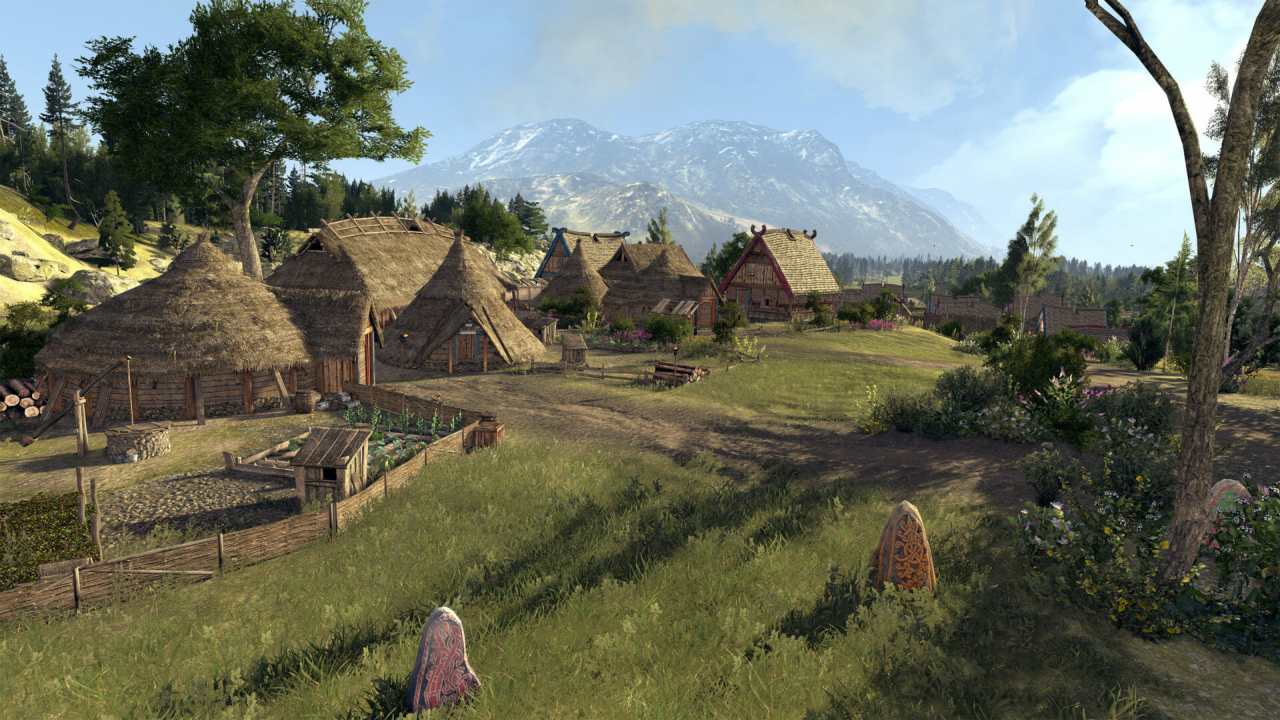
We are not here to romanticise Gaelic Ireland. I have little patience for ‘noble savage’ or ‘Fremen mirage’ tropes. No pre-modern society presents us with a tradition which modern people can or should attempt to copy. I’m also impatient with claims that the way X or Y people lived two hundred or even two thousand years ago was a more ‘authentic’ or ‘organic’ way of life than modernity. A lot of commentators like to put nationalities or religions (or even points of the compass like ‘The West’) in separate boxes, as if they were or factions in a videogame. For centuries every scholar pretended that there was some essential continuity between the Germans of Tacitus and modern German people.
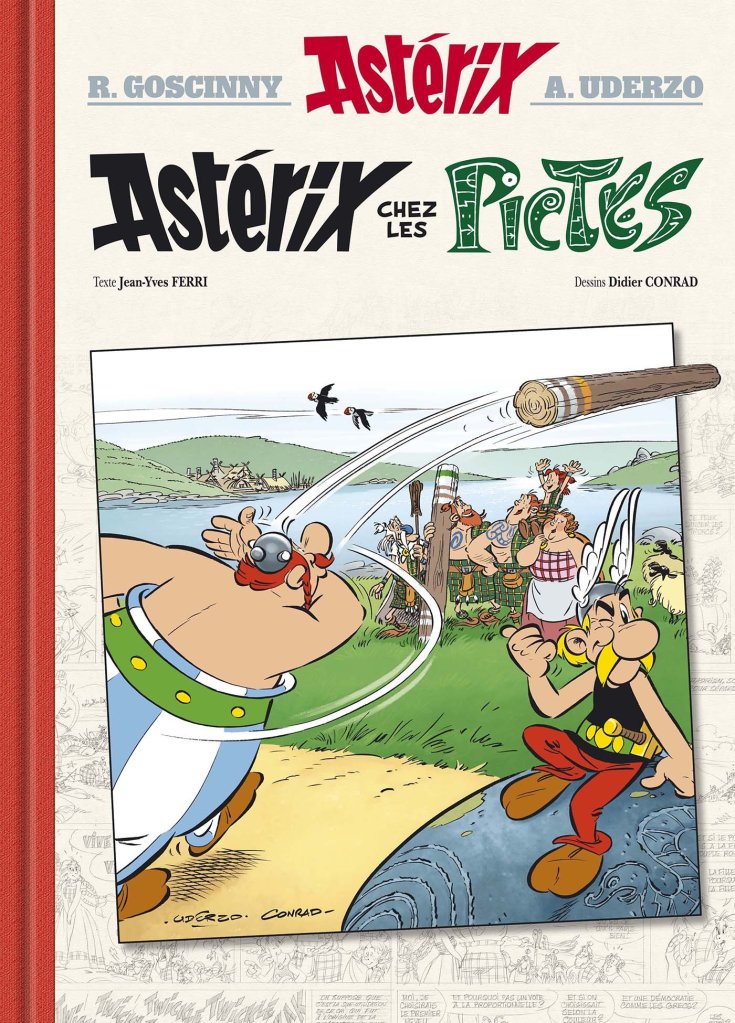
Except when it’s done as a joke in a children’s comic… in fact, I like this trope when it’s just a joke
So let’s not come at Gaelic Ireland from that kind of angle.
In most countries, go back even three hundred years and 90%+ of the folks you’d meet would be illiterate toiling people confined to small rural communities. In their daily lives, ambitions and morality they would be very different from any modern person. If the past is another country, then the pre-industrial, pre-Enlightenment past is another planet.
Even if, somehow, there existed some utopia in amid all the scarcity and violence and narrow horizons of the pre-industrial past, we couldn’t bring it back. And if modern people could dismantle modernity and return to that past, they would find they don’t like having to make every stitch of clothing by hand, or sleeping in a dim close hall with ten other people and a few cows and dogs, able to hear every fart and snore; or toiling away at crops and livestock for your entire life, never more than a few steps away from ruin.
It’s important to start with these sobering thoughts, because last week and again this week the focus is on the more egalitarian features of Gaelic Ireland. A lot of people, me included, find this stuff appealing. But as we touched on last week, Gaelic Irish society also had features that modern eyes would find hideous – features which challenge Connolly’s assertion that this society was ‘as Socialistic as the industrial development of their time required.’ Part 3 will deal with this sinister stuff more fully, and draw some conclusions from it.
If you want to get an email update when Part 3 goes up, subscribe – drop your email into the box below.
‘Those who make war’
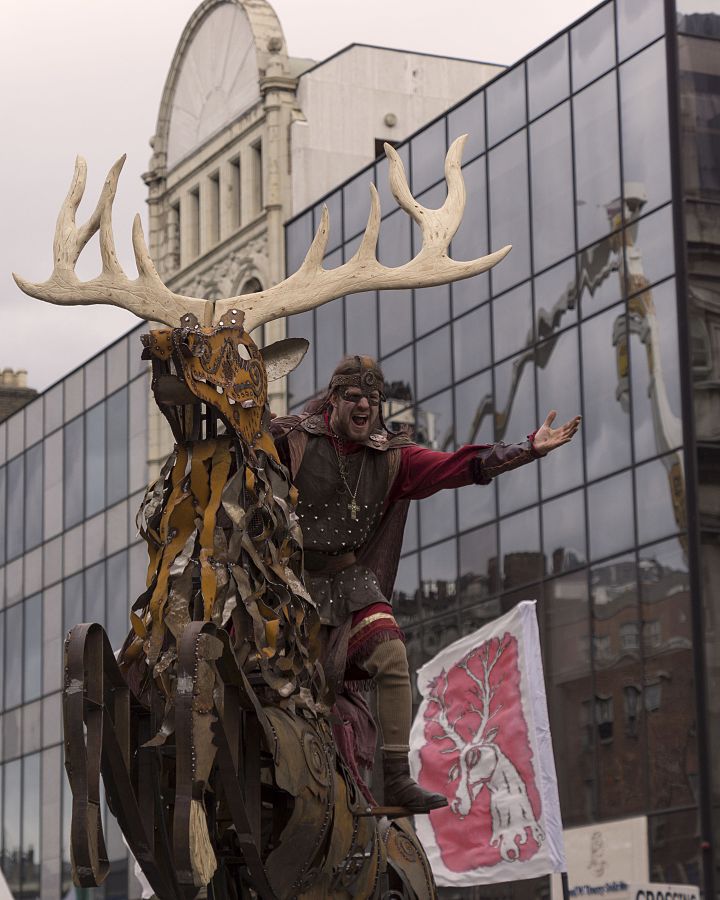
From a St Patrick’s Day parade in Dublin, 2014, part of an imaginative depiction of the Battle of Clontarf 1000 years before. No, the medieval Irish did not ride on stags, but it’s a cool image
Warfare was generally of a low intensity in Gaelic Ireland – raids, skirmishes, cattle theft. There was no warrior class and there were no housecarles or king’s bodyguards. There was no fyrd or militia, no custom of holding land in exchange for military service and no landless professional warriors.[i] A king did not have the means to maintain armed forces at his own expense, and billeting them on his people or on allies was politically fraught; he could do it, but it was a great way to lose friends and resources.[ii]
The only armed forces he could call upon were his electors. It was the duty of all free and able members of the tuath (people, territory or petty kingdom) to carry arms, and they assembled and fought only for limited periods.[iii]
By contrast, the nobles of medieval Europe had war at the heart of their identity. Knights were a special class elevated above the others. They held their land in exchange for an oath that they would fight. When contemporary writers chose just one word to describe the nobility, bellatores was the word they used – ‘those who make war.’[iv] But the Irish flaith (nobles/officials) were not a warrior class. In fact, I’m not sure they were even a class full stop.
The Irish king had no armed force loyal to himself. His armed forces were the same people who had a duty to depose him if he should fail in his duties. Military leadership was only one criterion, and not the foremost, on which contemporary sources judged kings; it was more important that they be wise, generous, cheerful, sound judges of disputes, etc.
War… War actually does change
Like a lot of things, this changed later in the period under discussion.
The Normans arrived from 1169 or so, with their ruthless hierarchies of knights and lords and their castles and their armies of knights and archers. Then came the gallóglaigh (foreign soldiers, often anglicised as ‘gallowglasses’), heavy infantry fighters from the Isles of Scotland who came to Ireland from the 13th Century on and revolutionised warfare.
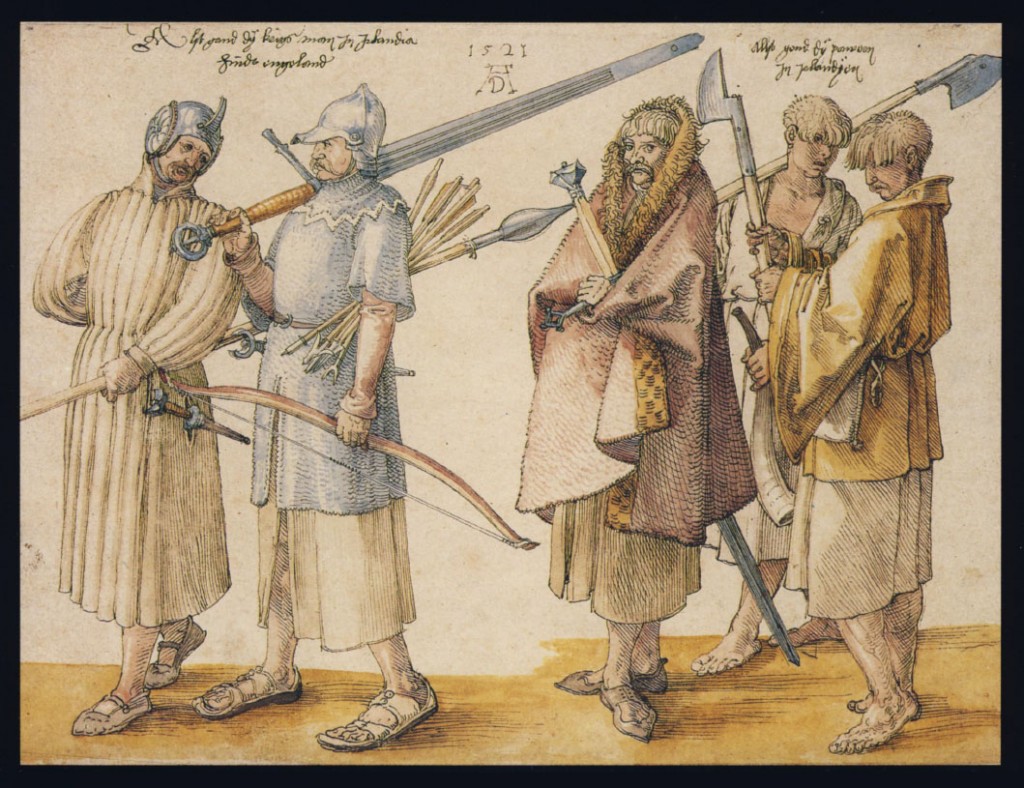
Gallóglaigh and peasants in a 16th Century image by Albrecht Durer
From this point on Gaelic Irish kings tended to become more like lords and less like elected chiefs. As Simms writes in From Kings to Warlords: ‘A leader whose military strength was based on a professional army rather than on a hosting of his own free subjects had little need to consult the wishes of those subjects, except the half-dozen or so chief vassals who, like himself, controlled hired troops.’ Elections became a formality.[v]
This is why I chose the late 12th Century as a cut-off point. From here on Ireland is a country under conquest. Those natives who do not bend the knee adapt to the presence of the conquerors.
But even before the Normans and gallóglaigh, things were changing. My intuitive guess would be that the gallóglaigh came as a response to changes in Ireland; suddenly there was a market for mercenaries in Ireland. Why? Because from around 1000, beginning with Brian Boru, provincial kings arrogated more power from the rí tuaithe to themselves. As we noted last week, they fielded greater armies for longer periods, built fleets and fortresses, and placed heavier burdens on the people to pay for it all. They enjoyed the revenues of Scandinavian ports like Dublin and Limerick (which means they made a mint on the slave trade – of which, more next week). They billeted troops on their ‘allies,’ who no longer dared to resist or to complain. From around this time, people tended to start calling the rí tuath (petty king) a taoiseach (chief), reflecting a loss of status and sovereignty.
The social order in Ireland was changing even before the conquest. The kings and flaiths were developing into an unaccountable ruling class with a monopoly on violence. But they were still a long way off. These changes had not yet added up to a total transformation.
From Noho.ie – the Viking port of Dublin (The area occupied today by the space between Dame Street and Hawkins Street, I think). A slave trading centre which shaped Irish development – more on that next week.
Hospitality
O’Sullivan’s Hospitality in Medieval Ireland is a fascinating read. All pre-modern societies placed an emphasis on hospitality but Gaelic Ireland went further. Every ‘free law-abiding Irishman’ was entitled to entertainment and a night’s lodging.[vi] Everyone above the rank of ócaire (a humble farmer) was obliged to host. ‘Expulsion’ or ‘Refusal’ of a guest was a civil crime. To provide uncomfortable lodgings or bad food left the host open to the dreaded satire of the poets. Generosity was a solemn precondition for kingship: ‘the Old Irish gnomic text Tecosca Cormac maintains that the most shameful thing a king could do was give a banquet without brewing beer.’[vii]
I believe this custom was an extension of the king’s obligation to redistribute wealth. Each farmer or artisan having their own specialisation and limited means of exchange, the role of the king or flaith, the reason such official positions existed, was to receive and redistribute the various products.[viii]
Receiving and redistributing could take many forms, including tributes, gifts and the king’s many obligations to his tuath: maintenance of roads, bridges, ferries, common mills and common fishing-nets; and the cumal senorba, the portion of the common property that was set aside for the elderly, the disabled and the sick.
Remains of a fortified household or rath. These dot the landscape in Ireland
One of the key signs that kings and chiefs were getting more arrogant later in this period, and more decisively after the Norman conquest, is that their demands in terms of billeting and the annual ‘coshering circuit’ grew heavy – less of the redistribution, more of the extraction. These demands were necessary to keep up the kind of relentless military campaigns, year after year, that the 11th and 12th century provincial kings engaged in.
Hospitality was a natural extension of a king’s obligations. A satire on an inhospitable king was not simply a condemnation of his personal stinginess. It was a political attack; the king in question had neglected his duties as surely as if he had fled from battle or allowed a bridge to fall into disrepair.
Brett Devereux’s blog explains the role of nobles or ‘big men’ in agrarian societies the world over and how they helped to redistribute the surplus (although on terms that benefited themselves more than anyone else). So this is by no means confined to Ireland. But my argument is that the Irish king did a hell of a lot more of the redistributing and a lot less of the fighting compared to nobles in England and further afield. Redistribution was so central to the role of Irish kings that flaithiúl, ‘lordly,’ remains the modern Irish word for ‘generous’ – which is a long way from bellatores.
Gods without notions
To round off this week’s post, let’s look at two Irish legends that were popular around this period and that shed some more light on the question of hospitality. Of course, these are fictional stories told in a culture that took delight in the most extravagant exaggeration. But these are the stories that the people (or more cynically, the powerful patrons of culture) wanted to hear. They tell us a lot about people’s expectations and values.
Dagda was a god; people sometimes say that he was the Irish equivalent of Zeus or Odin but I don’t buy that (for reasons I’ll touch on below).
Cridenbel, ‘an idle blind man,’ used to ask for part of Dagda’s food every day:
‘For the sake of your good name let the three best bits of your share be given to me.’
It would have been dishonourable for Dagda to refuse, so every day he parted with most of his dinner. At this time Dagda was working at digging ditches and building raths (fortified households) so he had quite an appetite. Deprived of one-third of his food every day, he began to starve. But there was no way out of this sticky situation; it was better to starve than to refuse a request. At last Dagda’s son Angus Óg came up with a clever plan. Dagda put three pieces of gold on his plate and, when Cridenbel asked for the ‘three best bits’ of the meal, Dagda gave him the pieces of gold to eat. ‘And no sooner had Cridenbel swallowed down the gold than he died.’[ix]
Another story, related in O’Sullivan’s book, told of a kind one-eyed king who would never refuse anyone anything. A poet who was his guest decided to test his kindness. He asked the king to give him his eye for a gift. The king had no choice but to hand it over, leaving the poet with three eyes and himself with a total of none.
These stories reflect social mores. In them, hospitality is an obligation, not a gift. It is less dishonourable for Dagda to murder Cridenbel (!) than to refuse any request he might make.
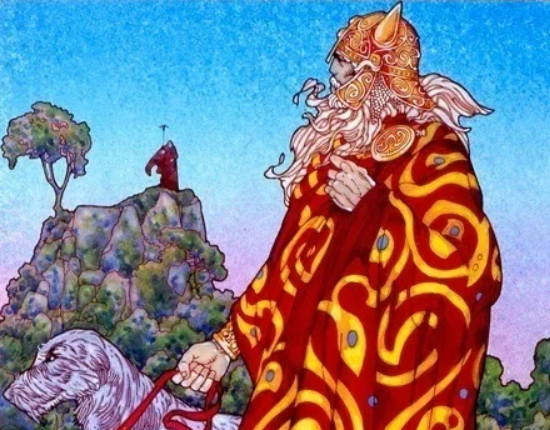
In a call-back to points in Part 1 about how Irish kings could be deposed, note that the incident with Cridenbel and Dagda occurs in a context of austerity, brought about by the stinginess of King Bres. Though Bres is not without merit as a king (he is easy on the eyes), his lack of generosity is not long tolerated; the people overthrow him and drive him out of Ireland.
Bres imagined by, once again, the great Jim Fitzpatrick. Detail from Breas.Cú Brea
(While we’re at it, let’s take a slightly closer look at Dagda. In other stories we see him unable to restrain his appetites: eating and drinking until he vomits and passes out; going on an important mission only to be seduced by two different women; falling on his bare arse and staggering about with his ‘enormous penis’ trailing on the ground.[x] He’s more of a pintsman than a patriarch of Olympus. Irish kings were less exalted than kings elsewhere, and the same goes for Irish gods.)
Until next time…
Again, so far so wholesome, apart from the blinding, murder and binge drinking. When we look at the period between 800 and 1200, there’s actually a lot of evidence for the claim that an Irish king was something like a public servant.
However, we have only established that the king was a public servant in relation to the free heads of household – presumably men – of the tuath. What about women? What about the unfree, the slaves? Next week’s post will address these questions, adding plenty of darker shades to our picture of Gaelic society.
[i] Hayes-McCoy, GA. Irish Battles: A Military History of Ireland, Gill & Macmillan 1969 (1980), p 48
[ii] O’Sullivan, Catherine Marie. Hospitality in Medieval Ireland 900-1500, Four Courts Press, 2004, p 50-51
[iii] Jaski, Bart. Early Irish Kingship and Succession, Four Courts Press, 2000. p 99
[iv] Bishop Adalbero of Laon famously summed up the nobility, clergy and peasants as bellatores, oratores et laboratores -those who fight, those who pray and those who work. ‘Adelbero Ascelin’ in World Heritage Encyclopedia, Project Gutenberg, http://self.gutenberg.org/articles/Adalbero_Ascelin, accessed 17 May 2021
[v] Simms, Katharine, From Kings to Warlords, The Boydell Press, 1987 (2000), pp 19-20
[viii] Woolf sums this up as ‘the practise of redistributive chieftaincy that characterised the Irish political system.’ Woolf, Alex. ‘The Scandinavian Intervention’ in Smyth, Brendan (ed), The Cambridge History of Ireland, Cambridge University Press, 2018, p. 117.
[ix] Gregory, Augusta. Gods and Fighting Men, Colin Smythe Limited, 1904 (1970), 32-33
[x] The detail about Dagda’s member comes from The Silver Arm (Butler Sims (1981, 1983) written and illustrated by Jim Fitzpatrick, Ed. Pat Vincent. P 65. I don’t recall coming across that particular detail in Gregory’s book.











 The 1919 Review