Access to this article is limited to paying supporters. If you already subscribe by email, thank you. But if you want to become a paying supporter, please hit ‘Subscribe’ below.
Donate less than the price of a coffee, and you can access everything on this blog for one year.
If you don’t feel like donating, most of my posts are still 100% free, so browse away, and thanks for visiting.
Over the first year of Covid I went through the back catalogue of 2000AD’s Sláine, for the most part reading the digital graphic novels on my tablet. At first I dipped in out of curiosity, but found myself enjoying it so much that I read fifteen titles cover to cover.
And I did not think it too many.
This is the first part of a three-part commentary tracing the high points and low points of the comic over the forty years of its existence. I will comment on each title in the series. The high points are magnificent and the lows are pretty shocking. My opinions will not be popular.
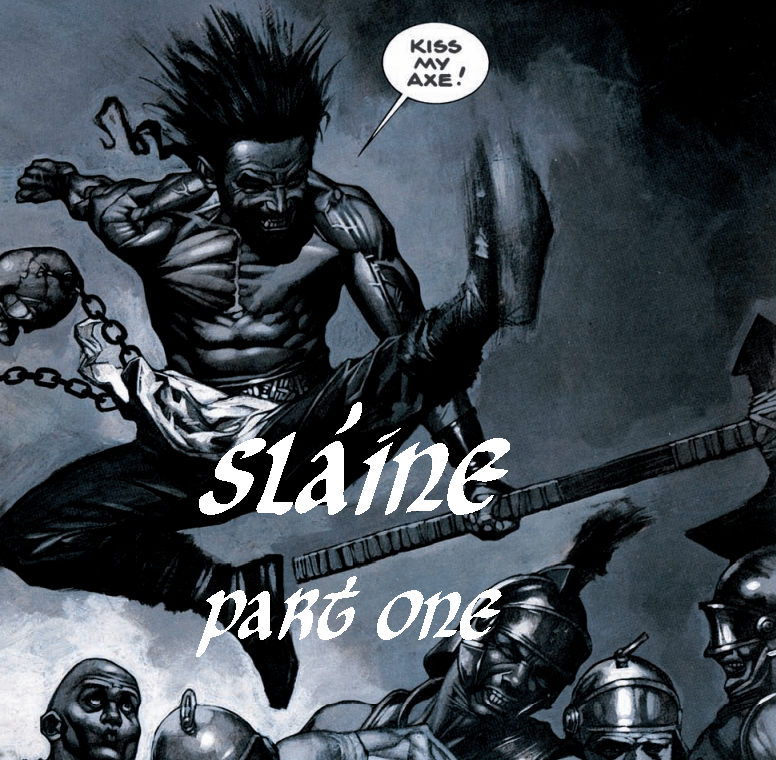
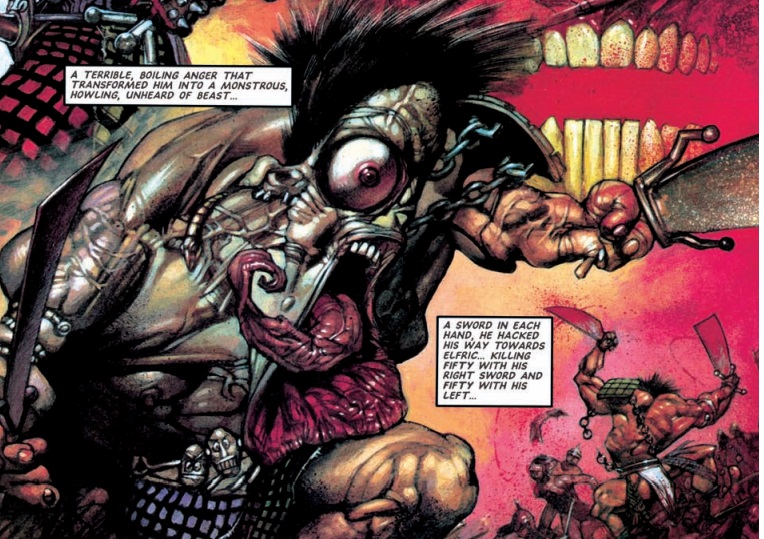
Sláine. I’d imagine most British people pronounce it as ‘Slain’ and, you know what, that’s fine. But it’s Slaw-nyah. However you say his name, he’s a character in the British comic 2000AD. He is a warrior with an axe who roams around Celtic Europe, leaping, shouting and chopping up bad guys. Roughly once per graphic novel, when chopping and shouting does not suffice, the raw power of the Earth goddess surges through him in a raging ‘warp-spasm,’ and he transforms into a grotesque and unstoppable beast.
From Demon Killer, written by Pat Mills, art by Glenn Fabry, Greg Staples, Dermot Power
But (at its best) there’s a lot more to it than that. Sláine is not a Viking or a Spartan or a medieval knight; he is a Celtic warrior, and that means he doesn’t fit neatly into the macho mould you might expect. He’s difficult to pin down and he’s got a lot going on. The two sides of Sláine are captured in The Horned God, when in a flash-forward Sláine’s chroniclers debate his legacy:
Ukko: Nah… Readers aren’t interested in all that fancy stuff. What they want is plenty of hacking and slaying.
Mor Runne the Dung Collector: Yurrr… I like hacking and slaying.
Nest: But there’s always been more to Sláine than just some muscle-bound barbarian. It’s an attempt to redefine the hero. To convey the matriarchal origin of myth.
Ukko: Take a tip from an old hack, dear, and stick to Sláine chopping off brainballs!
Mor Runne the Dung Collector: Yurr! I don’t like the comp… comp… complicated bits. I only like it when he’s killing people.
There are plenty of violent battles in Sláine – with Fomorians, Skull-Swords, Trojans and all kinds of demons and monsters. But the battle between a basic barbarian action hero and a deep, obscure Celtic soul is the most interesting of all. Over the next three posts I will examine this struggle. Part 1 will look at the first twenty years or so, Part 2 will take a deep look at one particular graphic novel, and Part 3 will deal with the latter half of Sláine’s career (including the really controversial bits).
The early stories from the 80s are collected in the graphic novel Warrior’s Dawn.
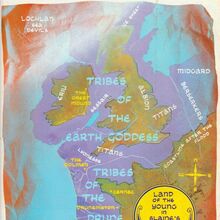
Sláine is a wandering exile in a mythical Celtic Europe called the Land of the Young – so named because few live to grow old. It’s a place as chaotic and fun as 2000AD’s Mega-City One. Flying ships powered by standing-stones ply the skyways. Dark magic corrupts the fields and forests into sourland, where prehistoric and inter-dimensional monsters roam. A stinking corpse named Slough Feg is the leader of a death-cult which burns captives in tribute to the maggot god. Sláine seeks to return to his own people, the Tribes of the Earth Goddess, a strange but relatively wholesome crowd whom Slough Feg seeks to conquer.
Writer Pat Mills does his homework when it comes to the Celts; many elements of this setting are derived from real history or myth. Not just Cuchulain’s riastradh, or warp-spasm. Whenever Sláine kills some great number of people and boasts that he ‘did not think it too many,’ he is quoting from the stories of the Fianna cycle. Part 2 will give further examples.
Sláine is not a boy scout. He is governed by obscure drives, sometimes dark or shallow, sometimes profound and selfless. His enemies – the Guledig, Slough Feg – are those who despise human pleasure, and the natural and material world which Sláine champions. He succeeds not through domination and destruction, but through submitting to the sublime chaos of the pagan world.
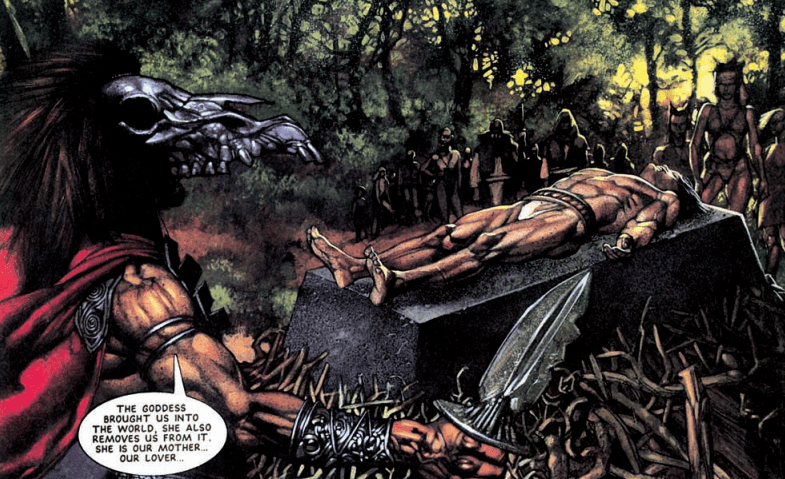
Sláine’s anti-authoritarian tendencies are not founded on ‘noble savage’ tropes or ‘don’t tread on me’ hypocrisy, but in an egalitarian, feminist and ecological spirit. Later in The Horned God we see that among the tribes of the Earth Goddess, marriages last for one year. The land is shared out equally and some set aside for the old and the sick. Kings (Sláine included) are sacrificed after a seven-year term so that they don’t get too big for their boots. Empires are seen as barbaric. Sláine makes no pretense that it is historical, but this depiction of Celtic society has plenty of foundation in the sources.
It is a myth of its own time. The Celts dress like punks (in later numbers more like metalheads). Ukko the dwarfish thief hates the egalitarian ways of the Celts, which he criticises in distinctly Thatcherite terms. Keep in mind that it’s the late ’80s, early ’90s, and the main bad guys, the Fomorians, are ruthless, callous tax collectors; we are duly informed that they live in a place called Tory Island (a real island off the coast of Donegal where, yes, the Fomorians of myth had their base). The hunger strike is portrayed as a venerable and ancient custom – just a few years after the 1981 hunger strikes in Ireland.
A lot of the above comes later, especially in The Horned God. But even in early Sláine, not a single episode goes by without some cool element of Irish, Welsh or Gallic myth figuring into the story somehow or other.
I like Sláine because (again with the qualifier, ‘at its best’) it chimes with what Michael Moorcock wrote about the great novels of Henry Treece. It is able
to capture the sense of raw passion of adult men and women who are not always mystically inclined yet dwell in a world of mysticism… [magic] is as much a part of life as the wild landscapes… as the stones and hills, the forests and the seas, the fortified townships and isolated villages dwarfed by the great grey skies.
Sláine is at its strongest when character and setting have room to breathe. It is at its weakest when it becomes simply a story of a man chopping up a succession of ugly monsters.
His time as king of his people is up, so he must be killed. From Demon Killer, written by Pat Mills, art by Glenn Fabry, Greg Staples, Dermot Power
2 and 3: Time Killer and The King
The stories collected in the second and third graphic novels (Time Killer and The King) see Sláine journey home and become the leader of his people, but for a while the reader is taken away on a bizarre detour. Sláine encounters the Cyth, inter-dimensional aliens who secretly control the destiny of humanity… and there’s a temple, a temple of terror or something… *yawns* … where was I? To cut a very long and jarringly episodic story short, Sláine travels through alternate dimensions, encounters strange aliens and trades his axe for a leyser gun. Yes, leyser. Like ley-lines. Get it?
It probably responded to some editorial and/or commercial need at the time, but I found the detour tiresome, a grind with no connection to the character or the setting I had become invested in.
No doubt some are reading this post to find out what are the best Sláine comics, which to start with, which ones not to bother with, etc. They might ask, ‘Should I just skip Two and Three?’
Ah, I must warn against it. The people on the business end of 2000AD have gerrymandered the graphic novels in a fiendish way. The sci-fi stuff is split fifty-fifty between the second half of Two and the first half of Three. If you pass on Two, you miss, among other great episodes, Sláine’s time-travelling intervention at the Battle of Clontarf. If you pass on Three, you miss out on Sláine’s return to the Tribes of the Earth Goddess, the story of how he becomes king of his tribe and of the first battles with the Fomorian sea demons. So the publishers have us in a bind.
Edit: see here for a very different (perhaps fairer) take on Tomb of Terror:
Classic 1980s black–and-white Sláine. From Time Killer, Written by Pat Mills, art by Massimo Belardinelli, Glenn Fabry, David Pugh, Bryan Talbot
4: The Horned God
This brings us to the pinnacle of the whole saga. The Horned God is the story of how Sláine unites the Tribes of the Earth Goddess to resist Slough Feg. More than that, it is a spiritual journey for Sláine as he submits to the Earth Goddess and becomes her faithful champion. Simon Bisley’s full-colour art is really beautiful.
The Horned God is deliberately slow to start, laying a solid thematic basis. Nothing in this story feels unearned. The story explores the motivations of Slough Feg and his death-cult. There’s a kind-of feminist theme as Sláine triumphs through becoming the Horned God, the champion of the Earth Goddess.
This champion ‘sees the ridiculousness of life. He never takes its pressures too seriously… Whereas the sun god is so serious… is obsessed with authority… with conquering everything… those heroes who follow his path are usually mindless and violent.’
The ingredients are in the right balance: action and spectacle combined with thematic depth and character development. There are stories within the story – such as the return of the Avanc, last survivor of an indigenous people wiped out by one of the Tribes of the Earth Goddess. Some parts are laugh-out-loud funny, but there are moments of real pathos – like when Sláine says goodbye to his son.
The Horned God is amazing.Despite some elements which have not aged well (including the male gaze stuff that I will deal with next week) it rewards reading and re-reading.
5, 6 and 7: Demon Killer, Lord of Misrule and Treasures of Britain
Pat Mills appears to be deft at pleasing his editors while also remaining true to his creations. As noted above, for some reason Sláine became an inter-dimensional battler of aliens for a while in the 80s – but rather than retconning or pretending it never happened, Mills does a graceful job of integrating the silly alien stuff into the story while keeping the focus on the themes and characters we actually care about. This enriches the stories collected in the next few graphic novels. In Demon Killer, Lord of Misrule and Treasures of Britain, Sláine travels through history and myth and time. These stories feature Boudicca, Robin Hood and King Arthur. Along the way he battles with old enemies: the Guledig and the sadistic demon Elfric.
From Demon Killer, written by Pat Mills, art by Glenn Fabry, Greg Staples, Dermot Power
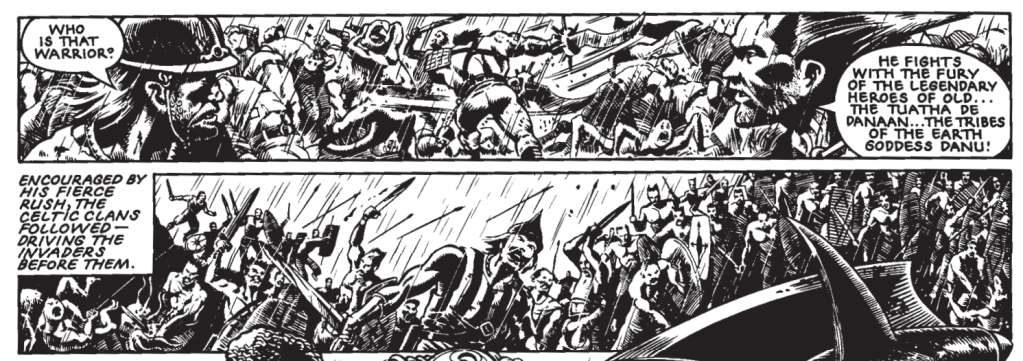
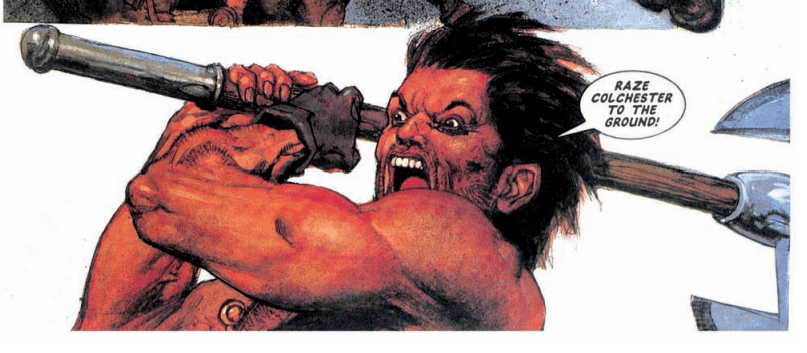
Demon Killer puts the moral ambiguity of Sláine to the fore. Alongside Boudicca, he loots and razes a Roman city, killing masses of innocent people. Mills justifies this in the introduction (justifies it as an artistic choice, I hasten to add) convincingly in my view:
In many comics he would have doubtless made an excuse and left or tried to stop the massacre with some appalling hindsight speech: “No! No! Spare the women and children!” Fortunately, on 2000 AD, we don’t make such unconvincing compromises. The reality is that, as a Celtic warrior, Sláine would have participated because his people were driven to a fury after the Romans ethnically cleansed their land. And I feel this uncomfortable truth is preferable to reassuring but bullshit fiction.
(Pat Mills, from the introduction to Demon Killer)
It is consistent with Sláine’s character and his motivations. I said he wasn’t a boy scout. He is compelling because he attracts and then alienates our sympathies. But we’ll be taking a closer look at Demon Killer next week.
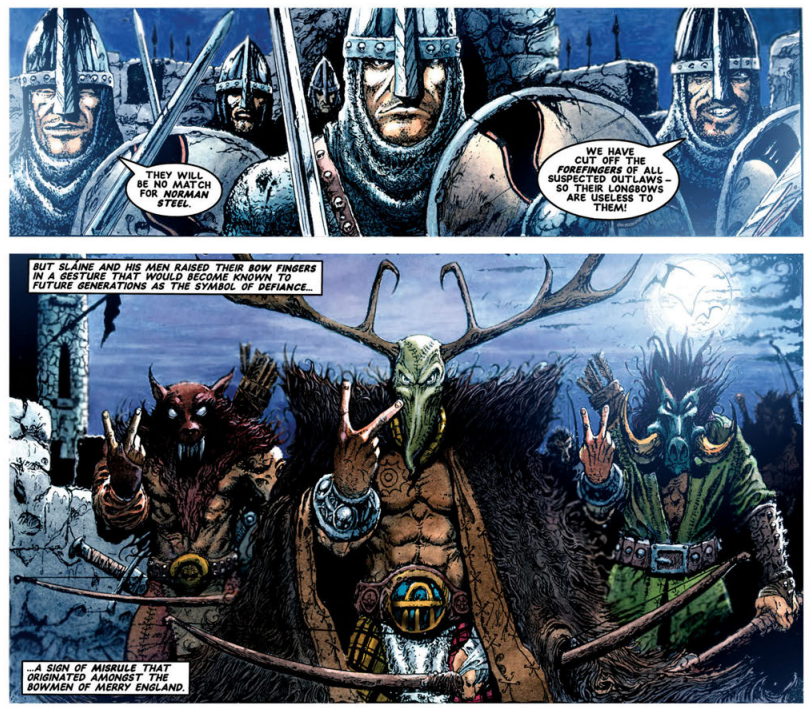
Lord of Misrule contains a moment very characteristic of Mills’ writing:
From Lord of Misrule, written by Pat Mills, art by Clint Langley, Greg Staples, Jim Murray
I don’t know if this is true or just a myth, and I don’t care. I like these little asides, and how they are well-integrated into the story.
In Treasures of Britain I found the story a bit unfocused. But the artwork is the most beautiful of these three comics, and there are many astute comments on Arthurian legend.
These are fun adventures, beautifully drawn, with thematic depth and character. I heartily recommend them.
That’s it for this week. Subscribe by email to get a notification when Part Two goes up. Next week we’ll look in depth at Sláine: Demon Killer. We’re getting into darker material in Part 3: some of the dodgy shit that has made its way onto the pages of Sláine, and why I hated Book of Invasions. But we’re also going to appreciate the finest artwork of the whole saga and take a look at my recommendations for the top five Sláine comics.
Maybe you enjoy reading about Sláine, and you didn’t think that too many. You should check out this great blog where the author Alex compiles a full list and ranking of all Sláine stories: slaineranked.blogspot.com


 The 1919 Review