
What I’m Reading: Second Foundation by Isaac Asimov

Second Foundation is the third volume of the original Foundation trilogy so before I get into it I’ll sum up what I wrote here on this blog about volumes 1 and 2, Foundation and Foundation and Empire.

I liked the deterministic mid-century materialism of Foundation. On the other hand, it could be smug and cynical and it was extremely of its time (imagine, someone probably died in combat on Iwo Jima knowing what the Seldon Plan was). It was quite dry, to-the-point, talky and minimalist.though it got more flashy and dramatic as it went on. Then at the midpoint of Foundation and Empire Asimov threw the old formula out the window. So long, mid-century determinist fable – don’t let the vast socio-economic forces hit you in the arse on the way out – it’s time for a fun swashbuckling adventure about a villain who can do mind control. This new formula boasted better characterisation and pacing, but overall I missed the tweedy old Foundation.

Second Foundation, like Foundation and Empire, contains two stories separated by a few decades. The first story concludes the story of the Mule, the psychic warlord introduced in the previous volume. He searches for and struggles with the Second Foundation. At last towards the end we get a glimpse of this mysterious institution.

Skirting around spoilers, we don’t see any more of the Mule in the next story. ‘Good,’ I said to myself. ‘We’re back on track. No more Space Yuri. We’re back to the Seldon Plan. Amoral characters as unwitting agents of vast historical forces. Empires hobbled by their own overextension. Kingdoms brought low by atomic hairdryers.’ But I ended up disappointed; this too was a story about psychic powers and mind control. We are focused on the Second Foundation in this story, and they just so happen to be a bunch of psychics like the Mule. Asimov labours to tie it in with the whole idea of psychohistory.
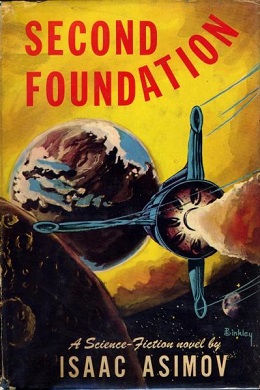
Dust jacket of 1953 edition

The Magneto in the High Castle

To get a sense of how I feel about this, imagine if half-way through The Man in the High Castle Philip K Dick had suddenly introduced Magneto from the X-Men. For the uninitiated, Magneto is, like the Mule, a mutant with special powers; he can control metal with his mind. So imagine if a good chunk of The Man in the High Castle is about Magneto picking up panzers and flinging them around squishing prominent Nazi leaders. Dick’s counterfactual 1960s Nazis are developing plastics, so I suppose they  finally build a plastic tank and squish Magneto in turn. After Magneto is vanquished, there is one final episode in the story, concerning the Japanese Emperor, who it is revealed also has magnetic powers. Dick goes out of his way to explain this, somehow, with reference to the I Ching, in order to tie this absolute nonsense back into the original ideas of the story.

However fun this scenario would be, it would kind of distract from the fascinating questions that Dick uses his alternate history to ponder. To take another example, just for fun, imagine if half-way through The Dark Forest by Cixin Liu, when we are invested in wondering how humanity is going to hold off an alien invasion, the clouds part and Jesus descends, turns a lot of water into wine, and dies on a cross somewhere half-way through Death’s End.

This is kind of what happens with the original Foundation trilogy. Its second half is fun and not by any means devoid of the interesting ideas we find in the first half. The mysteries – where is the Second Foundation? Who are its secret agents? Who is its mysterious leader, the First Speaker? – are solid with good development and payoffs. But they are mechanical. They have more to do with the craft of storytelling than with the science of psychohistory.

And, I mean… no doubt Dick would have written Magneto pretty well too, and would have found some time to ponder the nature of reality itself in between the scene where Bormann gets squashed by a panzer and the scene where Goebbels gets boa constricted by a lamp-post. But it would still have been a wild and irrelevant departure from a promising story.
The spiral galaxy Messier 83. Credit: NASA, ESA, and the Hubble Heritage Team (STScI/AURA)
Acknowledgement: William Blair (Johns Hopkins University)

Motivations

The second half of this volume presented some problems for me, even aside from all that. In this story a group of private citizens from the Foundation are hunting for the Second Foundation, because some people’s brainwaves have started to show up a little strange on the mind-reading machines, and it is suspected that the Second Foundation is interfering.

The motivations of this group of private citizens don’t make much sense. The Second Foundation saved them and it is part of the Seldon Plan, which is their secular religion. And then during the story, agents of the Second Foundation save their arses again and again.  The two Foundations have no basis for conflict at all. In spite of all this, our Foundation characters remain determined to root out the Second Foundation and its agents with extreme prejudice. Not only does it seem perverse, it doesn’t seem urgent at all. There is no existential threat to the Foundation here. The story lacks urgency, unless it is our desire to see how the Second Foundation will stop these gobshites, but the author doesn’t really commit to that either.

It gets worse (and spoilers follow). When the Foundationers identify one Second Foundation agent in their own circle, they immediately torture and restrain him (p. 229, 1994 HarperCollins Voyager edition). When the Foundation crowd believe they have found fifty agents of the Second Foundation, they do not take long to decide on their narrow range of options:

‘What will we do with all of them… these Second Foundation fellas?’

‘I don’t know,’ said Darell, sadly. ‘We could exile them, I suppose. There’s Zoranel, for instance. They can be placed there and the planet saturated with Mind Static. The sexes can be separated or, better still, they can be sterilized – and in fifty years, the Second Foundation will be a thing of the past. Or perhaps a quiet death for al of them would be kinder.’ (p 232)

A subsequent scene confirms that one of these fates has indeed befallen the fifty agents. Though we are not told which one, it hardly makes a difference!

The early-1950s viewpoint of the author offers some sources of interest and amusement, and, occasionally for me, mild disgust. But I was struck in a nice way by this description of an automatic ticket machine as a futuristic wonder:

‘You put a high denomination bill into the clipper which sank out of sight. You pressed a button below your destination and a ticket came out with your ticket and the correct change as determined by an electronic scanning machine that never made a mistake. It is a very ordinary thing[…]’ (p 169-170)

We have that now, and the only abnormal thing there is using cash instead of card. My knee-jerk reaction is to think, ‘how quaint.’ But on reflection, what prescience.

Conclusion

So that’s how I felt about Second Foundation: enjoyed it, recommend it, but expected more and felt it could have been more.

My verdict on the whole Foundation trilogy (I haven’t read the prequels and sequels written forty years later, so for me it is still a trilogy): “The General” in Foundation and Empire and the first few dozen pages of “The Mule” in the same volume represent a kind of peak Foundation for me. It’s lost some of the excessive dryness of the first volume without yet taking on all the extraneous psychic stuff. After this point, it never stops being entertaining or having good ideas; to its credit, it never retcons; and in some ways the writing improves… But it loses touch with its basic theme. The author seems to have lost interest in the question of predicting and planning the future through mathematics and psychology.

No wonder it ends unfinished, only half-way through Seldon’s thousand-year interregnum. Maybe that’s for the best. The rise of the Foundation into a new Galaxy-wide empire would not have been half as interesting as its early struggles for survival. Let’s remember the assumptions the series is built on: that empires are good and interregna are bad. Later stories would have had to go back and deconstruct a lot of that, if they wanted to remain thoughtful and interesting.

Home Page/ Archives

What I’m reading: Foundation and Empire by Isaac Asimov

Last year I wrote about Isaac Asimov’s novel Foundation (1951), in which a small community struggles to preserve culture and technology on the fringe of a collapsing galaxy-wide empire. Hari Seldon, the man whose command of the science of psychohistory allowed him to predict the collapse, has laid out a plan for this community, the Foundation, to unite the Galaxy in ‘only’ a thousand years or so. Foundation is episodic, as every 50-100 years the Foundation is presented with a new existential threat and the question is ‘How will the immortal science of Marxism-Seldonism get them out of this one?’

The sequel Foundation and Empire consists of just two longer episodes, ‘The General’ and ‘The Mule.’ They’re both good and they’re both set in the same world, one after the other. But in tone, theme and style they are two completely different novels. With ‘The Mule,’ we can see Asimov completely throwing out the old formula and introducing a new one. His story about interstellar socio-economics becomes a boisterous space opera about psychics and mind control.

Featured image: ‘Laser Towards Milky Way’s Centre’ by Yuri Beletsky. From Wikimedia Commons. https://apod.nasa.gov/apod/ap100906.html

The General

The first part of the book is peak ‘old-formula’ Foundation. I unambiguously love it. General Bel Riose, the most capable military leader in the decaying rump of the Empire, sets out to conquer the Foundation. His will, his ability and the forces at his disposal are all more than sufficient to the task. How can he possibly fail? 

The main characters are two captives of Bel Riose: the old Imperial aristocrat Ducem Barr and a Foundation trader named Lathan Devers, who are trying to spoil the General’s design. Their mission centres on an apparent contradiction: they must pursue this task with urgency and initiative even as they maintain their faith in the inevitability of a Foundation victory through the Seldon Plan.

A part of my pleasure in this story came from the way our two main characters speak with very distinct voices. Here’s Lathan Devers on page 37 (2016 HarperCollins edition), faking indifference but with some measure of genuine conviction:

Listen […] what’s defeat? I’ve seen wars and I’ve seen defeats. What if the winner takes over? Who’s bothered? Me? Guys like me? […] Get this […] there are five or six fat slobs who usually run an average planet. They get the rabbit punch, but I’m not losing peace of mind over them. See. The people? The ordinary run of guys? Sure, some get killed, and the rest pay extra taxes for a while. But it settles itself out; it runs itself down. And then it’s the old situation again with a different five or six.

I’ve gone into Foundation’s influences on Star Wars before, but it’s so clear in this book, right down to the characters’ voices and attitudes. There are whole pages where we might as well be in the company of Obi-Wan Kenobi and Han Solo; Ducem Barr does a good line in traumatised reminiscences and holding forth about psychohistory the way old Ben does about the Force, and Lathan Devers would have you believe that he’s in it for the money, doesn’t give a damn about your struggle for freedom, and doesn’t have any time for far-fetched ancient belief systems.

Devers, however, is in it for the revolution. He tells the leaders of the Foundation that he wants to ‘spread the wealth a bit, and keep it from concentrating too much out of the hands that work for it.’ (78) And in the next episode we learn that ‘Devers died in the slave-mines […] because he lacked wisdom but didn’t lack heart.’ (89) This is part of a satisfying pattern where each episode by the way refers back to the characters in the previous one.

Compared with the earlier Foundation stories, this one has more detail, more drama, more interstellar travel, and more character. It even has some action. We get a few scenes with the Galactic Emperor himself. It’s still a very talky piece, as if Asimov wrote it with an eye to royalties from a radio play adaptation. But it’s a development.

The contradiction between individual initiative and historical inevitability is resolved very well. Without getting into spoilers, maybe the actions of our main characters were just part of a more general movement which could be predicted mathematically, or maybe they are there only to illustrate the broader trend. They didn’t solve the problem by their own actions – Ducem Barr remarks after the event that ‘through all this wild threshing up of tiny ripples, the Seldon tidal wave continued onward, quietly – but quite irresistibly.’ (76) But that doesn’t mean their actions didn’t matter.

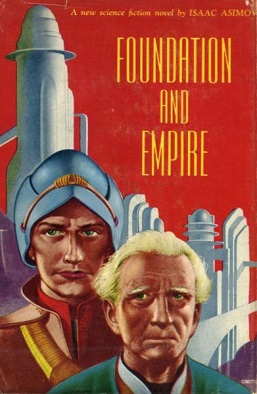
First edition cover. From Wikipedia.org

The Mule

I grumbled about Foundation being very dry, talky and un-visual, and having almost zero women in it. The second half of Foundation and Empire blows all these complaints out of the water. The lead character, Bayta Darrell, is a strong and smart woman; there is more humour, travelogue, spectacle, more set-pieces. The narrator becomes sassy and sardonic.

At the same time it might be a case of “be careful what you wish for.”

There are things that would have been impossible in previous Foundation stories, not all of it good. Asimov moves from the version of sexism where you pretend there are no women in the entire Galaxy to the version of sexism where you describe women’s appearances more than you really need to, or have supposedly sympathetic men say patronizing shit to them. There is hack stuff, whimsical stuff, clichés: a silly clown who talks Shakespearian; a scene which is just making fun of the way women in a typing pool talk to each other; a psychedelic bit where a special musical instrument triggers hallucinations; an episode in which a villainous nobleman captures all the main characters because he wants to have sex with Bayta.

All in all, this story is written more like a traditional novel of its time. So on the one hand it’s better-crafted and easier to get into. On the other hand, it’s less distinctive. It becomes less about the things Foundation is about.

It starts very good, with all the strengths of the new formula on display. Asimov does a neat job of showing us how the Foundation has grown authoritarian and how its outside colonies of traders chafe under its rule and long for independence (as predicted by Hober Mallow and Lathan Devers). ‘Every vice of the Empire has been repeated in the Foundation. Inertia! Our ruling class knows one law; no change. Despotism! They know one rule; force. Maldistribution! They know one desire; to hold what is theirs.’ (89) Instead of giving us a page from the Encyclopedia Galactica explaining it all, the author conveys it through a sequence where a newlywed couple, one from the Foundation and one a trader, go on a family visit and end up being recruited by the Traders’ resistance movement.

So far, so good: we have a Foundation story but told in a more balanced and engaging way. It is setting us up for a story of class warfare and social revolution. Then all of a sudden it ceases to be a story about sociology or economics or politics and becomes a story about mind control. The Seldon plan is thrown into disarray by the appearance of a man who can hypnotize people. Haha! You didn’t consider that possibility, did you Hari Seldon? You dumbass.

Before I get into criticism of the Yuri’s Revenge turn, let’s just clarify that the story is good and fun and intelligent. The mysteries and twists are one step ahead of the reader. But it’s not a spoiler to say that for the rest of the trilogy the mind control never really takes a back seat. And I just didn’t get as much out of this series from here on out.

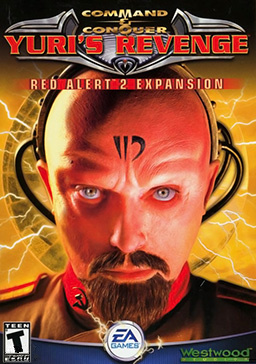
Suddenly it all gets a bit ‘Your command is my wish.’ Cover art for Command and Conquer Red Alert 2 Yuri’s Revenge (2001) featuring Udo Kier, a great German actor who passed away this year. Was the Mule a model for Yuri?

What’s my problem with the mind control? Science fiction stories are generally based on “what ifs.” In this case: what if we could predict (and subtly shape) the future development of society through psychology and mathematics? But half-way through the trilogy Asimov suddenly asks, ‘And what if, also, there was a magical guy who could permanently control the emotions of everyone he met?’ It complicates and obscures the original ‘what if’ question.

A defence of Asimov here would be to say that psychohistory deals only with masses of humans, so the mind control stuff is relevant because it’s something happening on the individual level that psychohistory can’t predict. This is stated explicitly a few times. But I just don’t buy it. There’s got to be a more subtle way of interrogating the role of the individual in history and the potential weaknesses of the Seldon Plan. Say, introduce a guy who’s really charismatic, or a small organisation that’s really disciplined. There’s a lot that can happen on a level lower than the actions of billions. Introducing magical mind control, no matter how much Asimov labours to explain it and tie it into psychohistory, doesn’t further explore the concept. It just takes the story somewhere else entirely.

The mysteries are no longer like “how will the Foundation exploit atomic gadgets to control their stronger neighbours?” and more like “Which of these characters is the big baddie in disguise?” and “Which of these planets is the secret base of the Second Foundation?”

I want to re-emphasize that this story is better on a craft level than what came before. My friends who read Foundation at the same time as me didn’t like it, because of the very shortcomings that are addressed in Foundation and Empire. But from my point of view Asimov threw out the baby with the bathwater here. My enjoyment of ‘The Mule’ was tinged with disappointment.

I’ve also read the third novel in the series, Second Foundation, and I will be sharing my thoughts some day soon. Stay tuned.

I’m Finally Reading… Ruth Rendell

Or, the housing arrangements of psychopaths

A Demon in my View (1976), The Face of Trespass (1974), Dark Corners (2015)

My first knowledge of Ruth Rendell was probably of seeing her name on library paperbacks around the house when I was a kid. I didn’t read her stuff until many years later after reading some glowing endorsements of her by authors I like. The only title of Rendell’s available that day on my library audiobook app was one called A Demon in My View. So I went ahead and downloaded it. That was back in March; by August I had read three out of her many dozens of novels published across nearly fifty years. I’ll give a run-down of each of the three, in the order in which I read them.

I should add that I listened to these novels as audiobooks, performed by Julian Glover (A Demon in my View) and Rick Jerrom (The Face of Trespass and Dark Corners), who both do a great job.

By the way, the reviews below contain some spoilers.

A Demon in My View

I was hooked on this story, right from the fucked-up start to the ironic and satisfying finish. A Demon in My View is about a man who once terrorised his fictional London suburb as a serial killer, but who has settled into a safer middle age by getting his kicks repeatedly ‘murdering’ a mannequin who lives in the neglected cellar of his shared, rented house.

The killer is a despicable sadist but Rendell manages to get us into his head, convinces us to feel an iota of sympathy for the wretch. He was raised by an aunt who judged him because he was born outside wedlock. There is something pitiable in his uptight, timid, neurotic narrative voice. But this timidity is the flip side of his murderous compulsions; he has a drive to feel power over others by causing fear and pain. The most horrifying example is the flashback scene involving the baby, which nobody who reads this book will ever forget until the day they die.

The whole story revolves around the tension between his hidden world and the intrusive realities of a shared housing arrangement. What we’ve got here is a story that’s fundamentally about housing, a theme that is important in all three books of Rendell’s that I have read.

The story is firmly rooted in its time and place, not in a way that dates it but in a way that enriches it. A new flatmate moves in; he has a very similar name to the secret serial killer, which provides all kinds of opportunities for confusion and subterfuge. In the 1970s, when this story is set, the post was crucial to people’s social lives and communications, and the only phone in a shared house word likewise be a shared one. The new arrival is really our main narrator and protagonist, but the long agony and final comeuppance he inflicts on our serial killer is unintentional and indirect.

Here is a writer, I thought, who can keep me in suspense, craft a believable social and cultural world, invest me in the practical limitations of comms in the 1970s, and horrify me with a rounded portrait of a human monster.

The Face of Trespass

The Face of Trespass is about a young writer living semi-feral in his friend’s cottage on the wooded margin of London while his girlfriend, a married woman, tries to convince him to murder someone. The story is bookended by a brilliant introduction and conclusion which involve a completely different cast of characters but which provide a resolution to the story. The day is not saved, but at least we get a significant consolation at the very end and from an unexpected source.

Murder is of course not relatable. But Rendell surrounds it, links it intimately, with things that are closer to our everyday lives. There’s lust, greed, envy. Again, housing. Scarcity of funds. An elderly mother living in another country and slowly dying; linked to this, a stepfather with emotional baggage and a language barrier.  Aunts and old school friends. Pets. Obligations.

Apart from the aforementioned bookends, we stay in the point of view of the main character, the struggling young writer. Everyone reading The Face of Trespass will be able to see clear as day how our main character is being set up. I found this a little frustrating; we hate protagonists who are fools, who walk blithely into trouble. But in the end all was forgiven. Rendell’s playing a deeper game. The girlfriend is out to set him up – that’s obvious. What’s not so obvious (though all the clues are there) is (spoiler alert) how he will get out of it in the end.

Even more so than in A Demon in my View, seventies comms are central to the novel; much of it revolves around people waiting by phones.

One surprising highlight of this novel is the stepfather. I don’t know if I would pick up a book based on some blurb about a stepfather-stepson relationship. But the murder/mystery/thriller genre here serves as a vehicle for an amusing and, in the end, quietly moving sub-plot.

Dark Corners

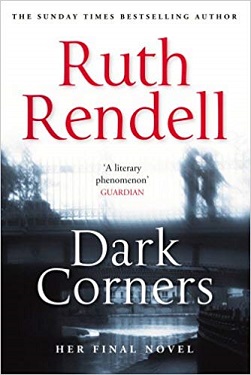
Dark Corners was Rendell’s last novel, written decades after the other two above. It is still very good and gripping, but rougher around the edges.

At one point in the novel the main character, again a writer, laments that the characters in his work-in-progress all speak like they come from the middle of the century. This must be Rendell’s little dig at herself; the characters speak and often act like they just walked out of the much more affordable London of A Demon in my View. Modern things like the internet are mentioned a lot, but usually bracketed with some comment like, ‘Johnny supposed that this was the way things were these days’ – as opposed to thirty years ago, before Johnny was born.

Like The Face of Trespass, pets and vets come into it. But it’s housing that’s at the heart of the novel, in ways that highlight how the issue has changed radically since the 1970s. The landlord in A Demon in my View is a rather greasy and selfish character; the landlord here is a struggling writer renting out the upstairs of his late Dad’s house so that he can work full-time on his novel. But his tenant proves to be far more trouble than he’s worth. He refuses to pay the rent and refuses to move out.

Meanwhile a rudderless young woman finds her rich friend dead, and proceeds to occupy her apartment and wear her clothes. But impersonating a rich person, like taking in a tenant, proves to be more trouble than it’s worth. In this case, that’s putting it mildly: she is brutally abducted and held for ransom.

These two characters are a few degrees of separation from one another and only meet toward the end, in a very fateful encounter.

Again, the literal setting is London – and there’s a powerful sense of place – but on a deeper level the setting is the human mind struggling with fear and longing. Rendell’s home turf is psychology. As in A Demon in My View, we see the murderer from the inside out, and he is wretched and pitiful. Unfortunately, like The Face of Trespass but more so, we have a struggling writer who spends a chunk of the novel just frustrating us with his passivity and short-sightedness.

There is a third, and subordinate, storyline about a retired man who rides buses for fun (Yes, a third storyline. All three of these books are very slight, but it’s amazing how much is crammed into Dark Corners). This storyline is fun, but its culmination is the retiree very suddenly foiling a terrorist bomb plot. Rendell has this humane side that allows her to write stories where a modest older man becomes a hero thanks to his eccentric hobby, and that is satisfying. The problem is that the bombing has nothing to do with anything else in the novel, and has no impact on subsequent events.

This is one of many strange improbabilities and coincidences that, to my mind, constitute gaps in the fabric of the novel. It’s all the more obvious when compared to how tight-knit the other two books are. It appears the novel is kind of about coincidences – stories criss-crossing in a Pulp Fiction kind of a way. Coincidence played a role in the others, but to a lesser degree, and with more subtlety, and to better effect.

Dark Corners is readable and satisfying, but rough and flawed. In addition to its other virtues, it is rough and flawed in interesting ways.

First and foremost, these were gripping thrillers that passed the time for me while I did chores or drove. But the contrasts between the younger writer and the older, between the younger London and the older, added a great deal to the experience for me.

Home Page/ Archives