Access to this article is limited to paying supporters. If you already subscribe by email, thank you. But if you want to become a paying supporter, please hit ‘Subscribe’ below.
Donate less than the price of a coffee, and you can access everything on this blog for one year.
If you don’t feel like donating, most of my posts are still 100% free, so browse away, and thanks for visiting.
Access to this article is limited to paying supporters. If you already subscribe by email, thank you. But if you want to become a paying supporter, please hit ‘Subscribe’ below.
Donate less than the price of a coffee, and you can access everything on this blog for one year.
If you don’t feel like donating, most of my posts are still 100% free, so browse away, and thanks for visiting.
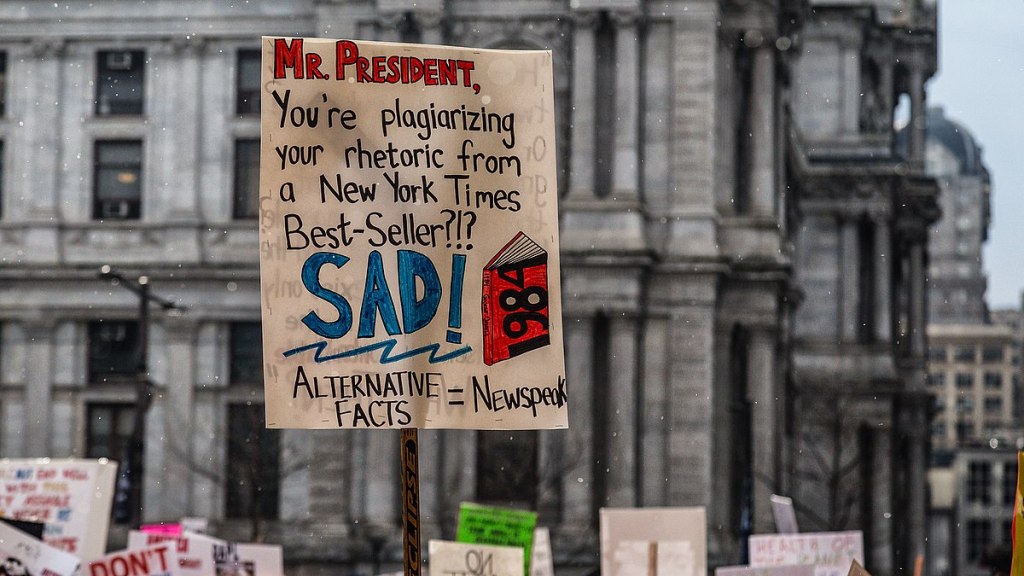
During the first year of the Covid pandemic, a spray-painted slogan appeared on a road sign near Galway in the west of Ireland. Above the words ‘Monivea 23km’ was sprayed ‘G ORWELL 1984.’ Either someone had a grudge against the village of Monivea, or someone was trying to say that we were living in 1984, presumably because of Covid restrictions. If we Google George Orwell’s dystopian classic 1984, we get the same message repeated a thousand times: ‘We are living in 1984.’
I have recently re-read some f***ing Orwell, namely 1984. It’s a good story, if like me you have a high tolerance for relentless misery. But no, 1984 has not happened – anywhere, ever. Not in Galway in 2020, not on pre-Musk Twitter and no, not even in the Soviet Union at the height of the Stalinist terror.
This is the first post in a series about Orwell’s 1984. Future posts will look at why I think it’s a good novel even though it’s implausible, the timeline, and the enigmatic character of Goldstein. All page references are from the 2008 Penguin paperback.
In 1980 the Science Fiction writer Isaac Asimov wrote a caustic dismissal of 1984. He gets a few things wrong, and I suspect he only skimmed the novel on the re-read. Contrary to what he says, there is no way to tell if one is being spied on via telescreen at any given time (4). He claims that Britain is the seat of power in Oceania, but it’s pretty obvious that Britain has been reduced to a province of a US-based empire: it’s been renamed Airstrip One (which is funny satire but ridiculous worldbuilding), its anthem is ‘Oceania, ‘tis for thee,’ and its people use dollars (5, 8).
But Asimov is correct in his overall point that the real world has not developed in a 1984 direction. It has developed in the opposite direction. The coercive powers of states have grown, but it is not in some Stalinist way. It’s all in the service of corporate power and profits. We can be spied on through devices we carry around with us, but this technology is mostly used to sell us crap. In Oceania, there is no more racial division or religion, which is not the situation we face. The militarised cops and fedsbin the US don’t use their weapons to disappear anyone who commits ‘thoughtcrime.’ They use all that hardware to kill black people, to police the borders, or to infiltrate and entrap.
Multi-lithic world
In Oceania, the world has become nightmarishly uniform and monolithic. Anyone who is not ‘orthodox’ is liquidated. Our world is the opposite. What should we call it – multi-lithic? Everyone lives in their own extreme algorithm-curated bubble. Trump supporters and Q Anon types live in a different reality where they won the 2020 election. We now have cranks who run around filming themselves all day as they harass political opponents and tear up library books, all the while claiming that they live in a 1984 dystopia. In reality they would be the first to sign up for Ingsoc – they’d get to have cameras pointed at them all day.
People are not coerced into morning calisthenics, evenings at the community centre or mass rallies. Such ‘horrors’ seem quaint. Instead people live in a world where the public and social spheres are withering away and all relationships are monetised.
We don’t all gather for ‘Two Minutes’ Hate’ or ‘Hate Week’ against a state-approved enemy. We line up and write vitriolic messages at each other’s thumbnails, usually over trivial stuff. We are not prohibited from debating; we are encouraged to debate endlessly, feeding the algorithm and muddying the waters. But we are prevented, as far as possible, from exercising any real power over events. We can think what we like. But we are not to organise.
All these trends predated the internet, and were certainly discernible by the real-life year 1984.
But we are not simply talking about whether 1984 resembles the present day. We are asking whether it is plausible. And doesn’t the world of 1984 resemble certain societies from history, such as the Soviet Union?
Actually it doesn’t.
When reading this book as a teenager I took Oceania as a ‘more extreme’ version of the Soviet Union. That seems to be what Orwell intended. But since then I’ve done a bit of reading, and now I can tell you that Oceania is actually something completely different.
It would not be difficult to list superficial similarities between Big Brother and Stalin, Goldstein and Trotsky, Oceania and Soviet Russia. But that’s actually where the problem lies. In the ways Oceania should be like the USSR, it isn’t. In the ways it shouldn’t be like the USSR, it is.
Contempt for ‘proles’
Let’s start with the ‘proles.’ The Party believe that ‘proles and animals are free.’ (53-55) There are separate uniforms and even separate drinks for ‘proles’ (beer) and Outer Party (gin). There is open contempt for the ‘proles.’ In the USSR there was never a rhetorical dehumanisation of working-class and poor people. Exactly the opposite: workers were idealised and put on a pedestal. It was often hypocrisy (as when they crushed a workers’ uprising in Budapest ‘in the name of the working class‘), but that’s beside the point. Such open contempt would have been unimaginable. Trotsky in 1936 was scandalised even to hear that a manager had used the wrong form of address with a worker.
Social engineering
The Soviet Union is associated with (we might say ‘notorious for’) social engineering. Ingsoc has no such ambitions, beyond the ranks of the Party. It basically leaves the ‘proles’ to their own devices. There is no attempt to change their culture, to improve their health and living conditions, no attempt to provide healthcare or education. We are explicitly told there is less social mobility and poorer education than before the Revolution. Ingsoc has left people to rot in buildings that have been standing since Victoria; the USSR built entire cities. Even if we take the Soviet Union at its very worst, this was the opposite of its approach. Access to education was widened a hundredfold and there was free healthcare.
A less benevolent example: in the late ’20s – early ’30s the Stalin regime set about forcibly collectivising all the farms in the country. This led to a terrible famine and a fierce campaign of repression. But such an ambitious project is unimaginable in Oceania, where the state leaves 85% of the population to be Del Boy and Rodney.
Culture
What about culture? Ingsoc destroys books, translates Shakespeare and Milton into horrible Newspeak, destroys words, disdains beauty. The Soviet Union invented new words by the dozen, but it did not destroy old ones. Literary classics were made far more widely available and affordable across the Soviet Union and Stalinist Eastern Europe. Not-for-profit publishing meant there was actually much more emphasis on acquainting the people with what isboften called ‘high culture.’ In Oceania, separate media are produced for ‘proles.’ Michael Parenti points out that it was in fact after the return of capitalism, in the 1990s, that books were destroyed in industrial quantities, and the standard of literacy plummeted.
Science
There is no scientific progress under Ingsoc. Even military research consists of white elephants. In relation to the real Soviet Union, I have two words for you: Sputnik, AK-47. The USSR promoted Marxism, which is a materialistic philosophy. Ingsoc openly rejects ’19th century ideas about the laws of nature’ (277-8) and embraces a totally relativistic ideology – matter only exists in the human mind.
Sex
There is no evidence whatsoever that there has been any advance for women under Ingsoc. Around page 15 we have the unintentionally amusing phrase ‘girl, of about twenty-seven.’ In Part 2 Chapter VIII O’Brien assumes that Winston speaks for Julia. Also, the party hates sex. But for the first 15 years after the revolution, the Soviet Union had the most socially liberal regime in the world when it came to sex and the liberation of women.
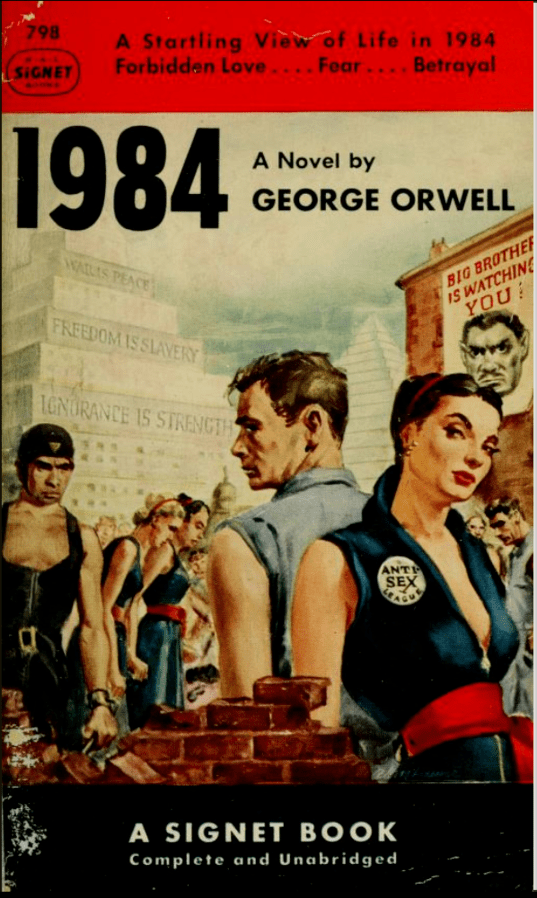
This paperback was obviously marketed in a certain way – spare a thought for the poor divil who bought this book expecting a lot of sex and, 50 pages in, was utterly traumatised
Permanent Warfare
The Soviet Union, like Oceania, was hampered by huge military expenses. But the Russian Revolution was born out of an anti-war movement. The Reds were far keener on peace proposals than the Whites during the Civil War. The Polish-Soviet War lasted less than a year. There were no external conflicts between 1921 and 1938. The consistent foreign policy from the Stalin period on was to seek stability, even to the point of hesitating to support the Spanish Republic and North Korea.
Oceania is not the USSR
All the above shows that Oceania and Stalinist Russia are actually very different places, not just in degree but in kind. Most of the creepy Stalinesque detail about censorship is drawn from Orwell’s own experience doing censorship for the British state during World War Two. Doublethink is a powerful concept, and I value Orwell’s description of it. It’s an example of how this book has contributed a useful political vocabulary. But doublethink is a satire on extreme political partisanship generally. The grisly history of Stalinism gives many compelling examples of doublethink, but you can find examples in a lot of other places too. In other words: what does apply to the USSR often doesn’t apply uniquely to it.
But the ways Oceania is similar to the specifics of Soviet Union are even worse.
Oceania is a massive state encompassing three continents plus swathes of Africa and Asia, including four of the most developed industrial countries on planet Earth: the UK, the US, Canada and Australia. It is not isolated. It is not poor.
And yet: ‘very likely no boots had been produced at all,’ and ‘perhaps half the population of Oceania went barefoot’(44). No boots at all! There are shortages of razor-blades, darning-wool, buttons and shoelaces (52). ‘Prole’ women fight one another for saucepans (73). The people of London live in ‘patched-up nineteenth-century houses.’ O’Brien gives Winston a mysterious drink he has never seen before and says, ‘It is called wine’ (178). According to Goldstein’s book, ‘The fields are cultivated with horse-ploughs.’ Winston works a 60-hour week and sometimes has to pull extra shifts on top of that (Part 2, Chapter III).
OK: the real Soviet Union was characterised by exactly these kinds of shortages and, yes, the fields were cultivated with horse-ploughs. With Stakhanovism and Subbotniks (‘voluntary’ Sunday work), Soviet people in the 1930s worked very long hours.
But Russia had horse-ploughs, long hours and shortages before the Revolution. It was in the decades after the Revolution that the horse was replaced with the tractor and consumer goods were made widely available for the first time. As for work – well, the stereotype of the Soviet worker in the 1980s was not that he was some overworked Stakhanovite, but that you’d see him drinking beer and playing cards next to the roadworks he was supposed to be doing.
The missing links in Orwell’s worldbuilding are clear from the novel’s treatment of two drinks: tea and coffee.
Julia is able to find tea on the black market because Oceania has conquered parts of South Asia. Good! That makes sense. But for some reason coffee and chocolate are always difficult to find, even though all of South and Central America have been core territories of Oceania for 35 years.
Underdevelopment
Unlike the USSR, Oceania is not a semi-feudal economy cut off from the markets and resources of the world. Unlike the USSR, it is not a country going through an industrial revolution in a decade. It has no business being so extravagantly poor. The ugly trappings of the ‘grimy landscape’ (5) of Oceania are out of their proper place. They belong to early-twentieth-century Russia – or, more precisely, to the underdeveloped parts of the world. They are not features of ‘communism’ but of underdeveloped countries, whether communist, capitalist or feudal.
The open brutality of the secret police, and the crudeness of government propaganda – these, too, are borrowed clothes which hang awkwardly on Oceania. They are features, again, not of ‘communism’ but of underdevelopment. They are not a sign of a regime with unshakeable foundations but of a precarious regime.
You might object that Spain, Italy and Germany all went totalitarian. So why not Britain? But Spain, Italy and Germany went fascist, and fascism has completely different origins which it’s not worth getting into here. Oceania very clearly follows the pattern of the USSR, not Spain, Italy or Germany. As Asimov points out, the trappings are all communist, the parallels all Soviet.
‘I do not understand why‘
Goldstein’s book-within-a-book finally explains this great mystery. Ingsoc spends all the money on war, so as to deliberately keep the people poor, so as to maintain control. But for 90% of readers, this explanation is not necessary. They already know (or think they know) why Oceania is poor: because of communism. And Orwell has done absolutely nothing to clear up the misunderstanding.
This explanation, by the way, is coherent on its own terms, but that doesn’t mean it’s plausible.
Winston writes, ‘I understand how [the system oppresses the people]. I do not understand why.’ Towards the end of the book he gets the following answer: humanity could have superabundance, equality and democracy; but 2% of the population, the Inner Party, have taken control, and are deliberately wasting all the wealth, just so that they can maintain poverty, and with it inequality, and with it their own power (216-217).
This explanation rests on certain important insights about the relationship between scarcity and tyranny, between economic equality and political equality. But it puts the cart before the horse. In the USSR, scarcity created the dictatorship. In Oceania, the dictatorship deliberately creates scarcity.
But how such a dictatorship was able to entrench itself in the first place is not clear. Britain after World War Two was an advanced capitalist country with a high level of education, an abundance of material goods and solid infrastructure (to say nothing of the huge empire). Moreover, this advanced country and empire are part of a federation with, well, the entire Western Hemisphere. Oceania is not poor and it is not isolated. You can’t copy-and-paste Stalin into this setting. He doesn’t belong there any more than does the horse-plough or shoelace rationing.
You might argue (as Orwell does) that all revolutionary leaders secretly want to be sadistic tyrants (275-276). I don’t think that’s true, but even if it was it wouldn’t matter. These crypto-dictators wouldn’t be able to take and hold power after a popular revolution unless the extraordinary conditions prevailing in Russia were somehow duplicated in Britain.
What to expect in the next post
Oceania is not a plausible setting. But there is one reading of the novel which makes it plausible. I’m going to go into that next week, along with some other positive things about 1984. Or i might decide to publish a timeline of Oceania. We’ll see.
But as a short answer to the question posed in this post – no, 1984 is not plausible. Thankfully, it has never happened anywhere, ever.



 The 1919 Review
.jpg)
