What makes a good historical movie?

I’m folding my promised conclusion on Dr Zhivago into this broader post on history in movies, dealing with it along with Kingdom of Heaven, Platoon and A Complete Unknown.

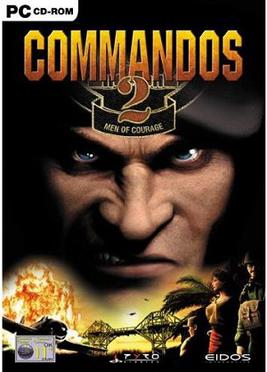
There was a game called Commandos 2 (Pyro Studios, 2001), a stealth adventure set in the Second World War. The game’s own manual contained a long bullet-point list of its own inaccuracies, ranging from ‘the bridge on the River Kwai was made of metal, and it was never blown up’ to ‘there are no penguins at the North Pole.’ It has stuck in my mind because I’ve never seen anything like it since, not in movies or games or TV shows, though now and then the afterword of a novel will include one or two confessions. But what an excellent idea: for a text to own its inaccuracies, to be deliberate about them, to signal, “What you are about to experience is part fantasy.” It takes a lot of confidence and maturity for the authors to risk undermining their own authority like this.
I wonder why this isn’t standard practise, why no government has obliged producers of historical movies to release an ‘accuracy statement’ for me to pore over. Maybe the answer is that a lot of history is open to debate, so these statements would open a can of worms. In a recent series I asked of the 1965 epic movie Dr Zhivago, ‘is it accurate?’ I couldn’t answer that question without getting into my own opinions and understanding of the era.

It’s not as simple as asking ‘Did what happens in X movie actually happen?’ The answer is going to be ‘mostly, no.’ But here are some questions to which we can give more interesting answers: ‘What is this movie saying about history?’ ‘How well is it getting this message across?’ and ‘Is that message accurate and fair?’
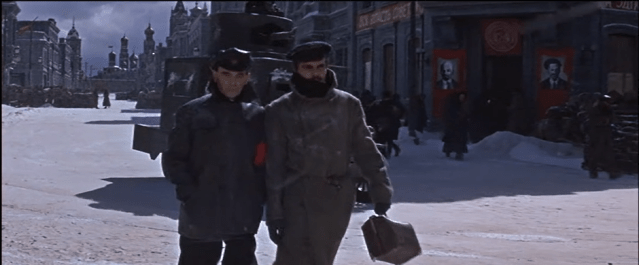
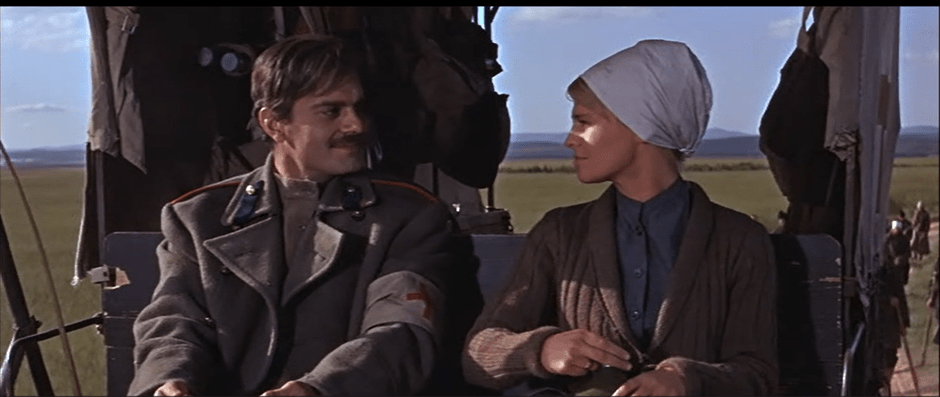
From Dr Zhivago (1965, dir David Lean)

Dr Zhivago

Let’s ask these questions of Dr Zhivago.

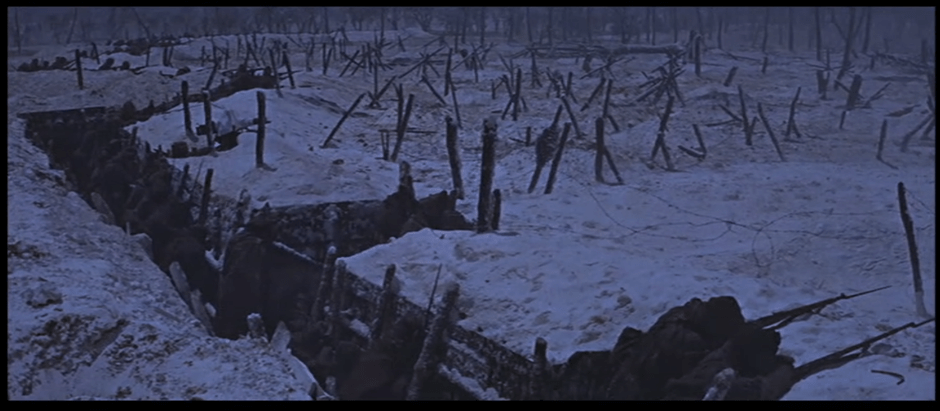
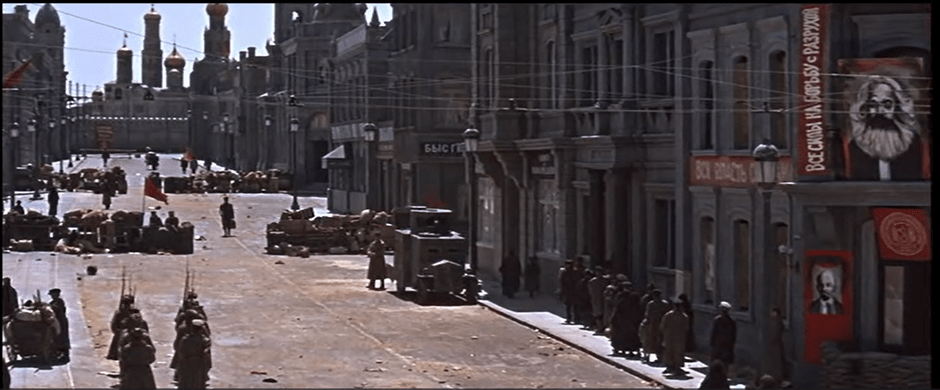
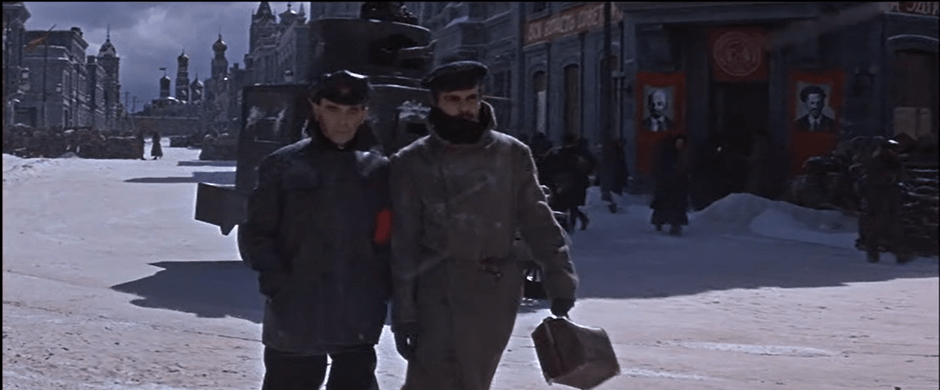
Parts of it are very good – individual monologues, scenes and images convey significant historical events in a dramatic, emotional, visual way. For example, I like how the Moscow street changes over the course of the movie. I mentioned Yevgraf’s monologue. It’s good that we have armoured trains, even though they are in the wrong place and time. This film gives us a strong sense of place, especially in the haunting train journey sequence. It is lavish in supplying the sets, crowds and explosions that give a sense of mass participation in events, of sharp conflict. Its slow pace and the care it takes to root us in its spaces are refreshing in the context of a lot of today’s cinema, with its short scenes and rapid cuts (see Oppenheimer, which I’ll mention later too).

I think that historical movies have their value even when they are inaccurate. They furnish the public with reference points (oh yeah, Roosevelt, the president from Pearl Harbor), and even when these reference points are good only as punch bags for criticism (Gladiator makes a mess of Roman-era battles, but here’s what they really looked like) they are performing some service in that at least. If scholars of history don’t criticize these movies, especially movies we like, we are missing an opportunity to teach. So even as I criticize Doctor Zhivago I cut it plenty of slack. Compared to a lot of other movies that bill themselves as historical, it’s solid enough.

The screenwriter, Robert Bolt, was a former communist who maintained links with the British communist party until 1968. I think this helps explain a lot about the movie: the way it humanises the revolutionaries, the care and feeling in the writing. Maybe this script represents Bolt, through the avatar of Yuri, getting over (or at least coming to new terms with) his love affair with October (Ten years later he wrote a two-act play about Lenin which I am curious to read).

The film appears to advance a thesis about the Russian Revolution: that while it was a natural response to Tsarist tyranny and war, it was itself tyrannical and violent – worse, that the Revolution represented the antithesis to individuality. I don’t agree with this view (you can find a lot of my own views here) but I assume you didn’t ask; the interesting question is whether the movie adds up to a good argument for this view.
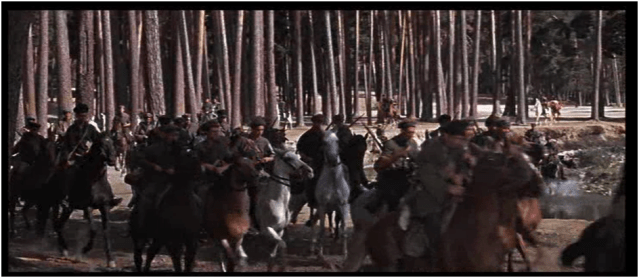
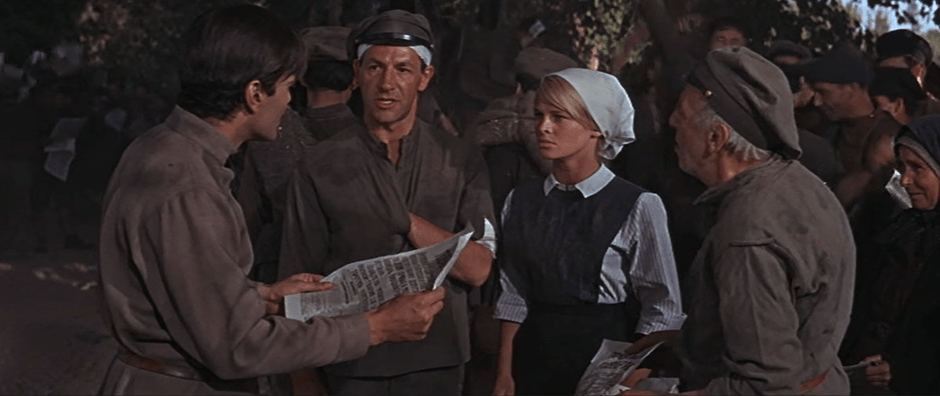
Partisans in the forest, from Dr Zhivago

The Squid Game Baby Civil War

I don’t think it does. The movie’s message impressed me more when I knew less about the real history. I’ve already noted how many times Yuri is confronted by a mean Bolshevik or Bolshevik-adjacent person who is contemptuous of his poetry. In these conversations (first with Kuril, then Yevgraf, then Antipov, Razin and finally Komarovsky) the movie’s case is stated explicitly: that Yuri himself, his private life and his creative output are not compatible with the revolution. The movie is here overplaying its hand because Yuri is actually an understated, inoffensive, decent person, not a wild man or a troublemaker. So what people say about him does not accord with what we see. The theme has to be stated so bluntly in dialogue, again and again, because we don’t see it organically.

The movie presents the Revolution and its supporters generally in a negative light. To do so it too often it relies on exaggerations or inventions, or a collapsing of the timeline that goes beyond reasonable limits. This is a common failing in historical movies: the writer (who is working to industry deadlines and specifications) puts in what they assume was there and what the producers and audience expect to be there. So within weeks of the October Revolution we see a poet exiled for ‘individualism.’ A few weeks later we have villages burned by an army which wasn’t there as a punishment for aiding another army which also wasn’t there.

As regards the Civil War, we get some striking images but little sense of the whole to which they belong. The war enters and exits the stage according to the needs of the narrative, not according to its own logic. This reminds me of something more recent: in the third season of Squid Game we have a miraculous baby who never cries or needs to be fed, or even opens its eyes; its function is to be cute and vulnerable, to add tension to the bloody contest. The Civil War as presented by Dr Zhivago is like the baby in Squid Game. The war adds tension, and we are periodically reminded that it’s there (even before it’s there) but when it isn’t immediately needed, it is docile.
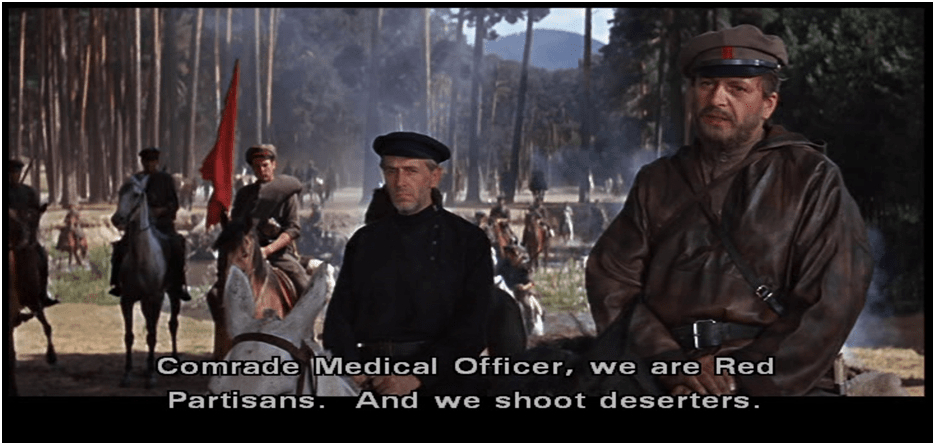
The movie as a historic event

A movie is a big undertaking and, more so than a book, its production and reception constitute historical events in themselves, and you have to be clear on whether you’re talking about the movie as a movie or the movie as an event. Let’s illustrate what I mean by straying over that line in relation to Dr Zhivago. Here I’m far more critical.

What was courage on the part of Boris Pasternak – writing a novel about Russia’s revolutionary years that dissented from the enshrined narrative – is on the part of western filmmakers not courage but complacency, because they are promoting a narrative that’s not at all controversial in their own part of the world. Pasternak doesn’t need to remind his Soviet readers that the Whites were powerful and reactionary, that the Reds brought about popular reforms, or that intervention happened; Soviet readers have heard all that a hundred times before. But Dr Zhivago’s cinema audience in the west is unaware of these parts of the context. And the movie goes further: it treats the revolutionaries with far less sympathy than the novel and makes key changes, such as Yuri being exiled from Moscow and Lara being anti- instead of pro-Bolshevik.

The Russian Civil War, like Dr Zhivago, was an international affair. This film was a US-Italian co-production with an English director and writer, filmed in Spain, Finland and Canada. Why is that important? Because the United States, Italy, Britain and Canada all intervened in the Russian Civil War, all kept it going long after it should have settled down; because the White Finns committed a terrible slaughter against the Red Finns in 1918; and because Franco, a fascist dictator who killed several hundred thousand people with the explicit purpose of preventing an October Revolution in Spain, was still in power when this movie was made there. The apparent complacency of the western filmmakers is really something worse: they are throwing stones in glasshouses.

To me, this underscores the way the western powers intervened, escalated the war, armed a large cast of horrible characters, spread famine and disease, then walked away and forgot all about it. The oblivious moral comfort of it all strikes me as an injustice.

I don’t think you have to be from a group (say, the Russian people) to write about that group. But if you put yourself in this position, you do have a lot more work to do to get it right. This movie wasn’t made with such an understanding. Few movies were in 1965.

You could argue that Bolt as a former communist is in some way a member of the tribe he depicts. He has, I guess, some kind of vulnerability here. It does come across in the writing and to some degree mitigates the complacency, the obliviousness, that I’m complaining about.

Kingdom of Heaven

Scholars of history still only know about a few topics. For example, I thought Oppenheimer (2024) was very good but I wouldn’t be much help to someone who wanted to know if it was accurate.

Kingdom of Heaven (2005, dir Ridley Scott) is a good historical movie, as far as I can tell (I can’t remember what’s in the Director’s Cut and what isn’t). In the broad brush-strokes of the story it tells, it corresponds to the books I’ve read on the Crusades and some scenes follow the primary accounts very closely, such as the scene where Saladin (Ghassan Massoud) offers a refreshing drink before personally executing Reynald de Chatillon (Brendan Gleeson). Balian of Ibelin (Orlando Bloom) is changed from an older, well-established power-broker in the Crusader States to a newly-arrived and penitent young knight who has an affair with the king’s sister. This change is so obvious, and at the same time historically inessential, that there is no concealment going on there, no sense of dishonesty.

There is a good example of where it simplifies history within reasonable limits: when Saladin took Jerusalem in 1187 he enslaved that part of the population which was not ransomed in a complex process; Kingdom of Heaven does not get into the weeds but presents the essential point, that Saladin spared the population from a massacre and most of them walked away with their freedom and all with their lives.

But there are individual lines that are pretty ridiculous. David Thewlis’ character says, ‘I don’t place much stock in religion.’ Dude, you’re a Knight Hospitaller in the 12th Century. You’re half-monk, half-knight and the only reason you live in this part of the world is because the Bible happened there. All your stock is in religion. Also, he’s not a merchant so I feel ‘stock’ is an ill-fitting metaphor.

Let’s consider the theme and this movie as an event. Kingdom of Heaven, considered as a statement on the War on Terror, is interesting. Robert Fisk reported on a screening in Lebanon where the crowd performed a spontaneous standing ovation following a scene where Saladin reverently places upright a crucifix which fell over during the siege of Jerusalem. I don’t know if this Lebanese audience was mostly Muslim or mostly Christian, but either way the reception is moving.

I read the film as liberal imperialist (we can all get along within the status quo), and personally I’m anti-imperialist (we can’t get along so long as the colonisers remain in charge of this land). But the film makes its case well. It presents two political tendencies within the Crusader States that really did exist. The faction around Balian had a more diplomatic and pluralist vision for the future of the Kingdom of Jerusalem, as opposed to Reynald and Guy who were aggressive and chauvinist. The parallel it suggests with the liberal and conservative wings of the pro-war coalition in the US in the 2000s is reasonable. There’s a lot of invention here, but in a medieval setting where we have scant records this is necessary. Screenwriter William Monaghan did a good job.

Now, you’d want someone like acoup.blog to tell you if the armour and tactics in Kingdom of Heaven are right. I’m mostly talking broad strokes.

Platoon

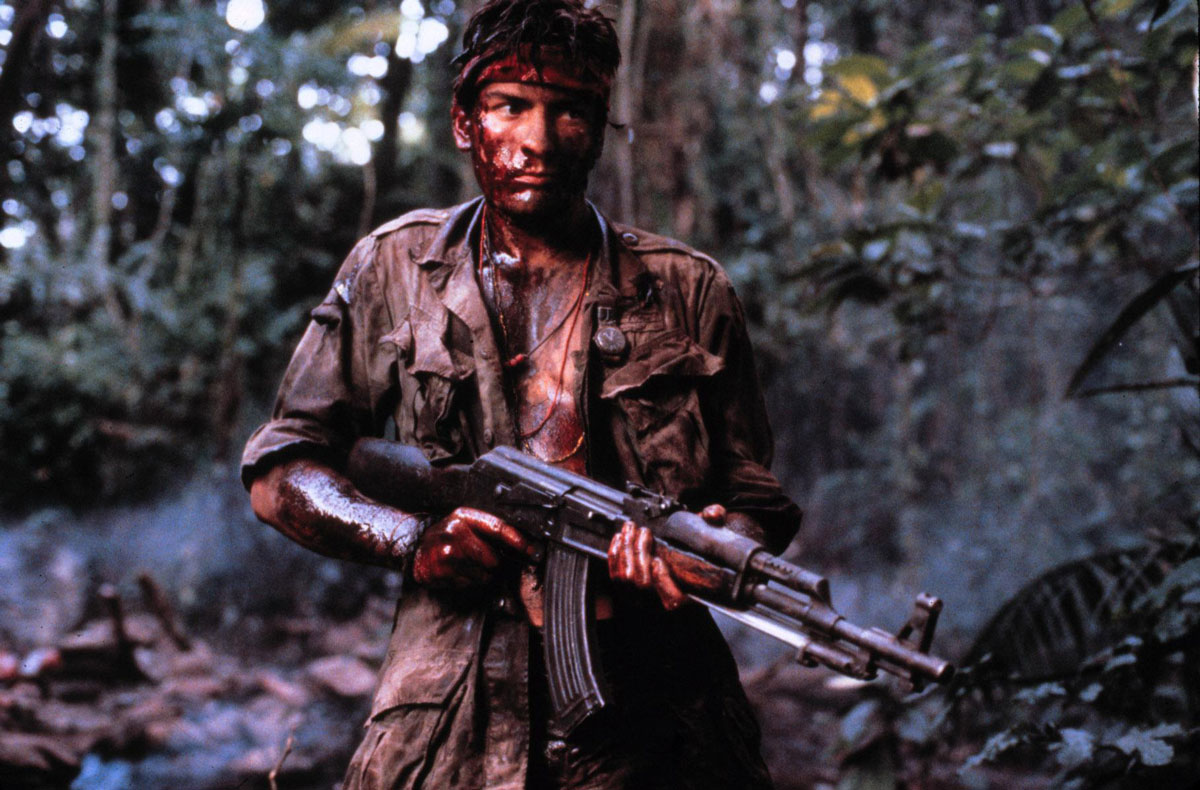
Charlie Sheen as Taylor in Platoon (1986, dir. Oliver Stone)

Platoon (1986) is an interesting one. I’ve read a few memoirs of US soldiers in Vietnam (If I die in a combat zone by Tim O’Brien and Chickenhawk by Robert Mason) and this movie is really true to those firsthand accounts. Director Oliver Stone was, of course, basing the story on his own experiences. It’s a highly authentic reflection of the experiences of US soldiers in the Vietnam War.

That’s the problem, too. How fair a reflection of the real history is it if we get a lot of movies from the US side and almost none showing the Vietnamese side? Millions of Vietnamese died compared to 58,000 US personnel; the Vietnamese still have landmines and the effects of Agent Orange. There’s just no comparison. The Vietnamese are not really humanised in most of these movies either.

Credit here to Oliver Stone, who gave a Vietnamese perspective in other movies he made. Further, he had a valuable story to tell in Platoon, and someone else couldn’t have told it and he couldn’t have told some other story in the same way. He does put Vietnamese people front and centre in the terrifying scene in the village, where we come within a hair’s breadth of something like the My Lai massacre.

But the issue stands. There are a lot of great movies about the Vietnam War but this is a hard limit to how great they can be as historical movies given this major problem.

A Complete Unknown

I have some thoughts on the Bob Dylan biopic A Complete Unknown (2024, dir. James Mangold) that are relevant here.

This is another topic I’ve read about, and in my judgement A Complete Unknown is a very fine example of how to condense the messiness of recorded history (or in this case biography) into a dramatic and entertaining story. Dylan (Timothé Chalamet) gets a ‘composite girlfriend,’ Sylvie (Elle Fanning), who is mostly Suze Rotolo but also not; like with Balian, the movie is changing something without trying to fool us. The theme is well-grounded in real history and it lands powerfully. Dylan, like most of his generation, entered into the struggle for a better world but ultimately walked away. Those who tried to badger him into staying there against his will come across badly, but it’s left open for the viewer to make up their own mind what they think about Dylan.

I was mildly disappointed that we didn’t get to see Phil Ochs (except indirectly, when Joan Baez sings a cover of his song ‘There but for Fortune.’) We see a lot of Pete Seeger and a good bit of Johnny Cash and a couple of glimpses of Dave Van Ronk. If you ask me, Phil Ochs has far more business being in this movie than Johnny Cash does. He would be a powerful foil to Dylan, but I suppose that function in the story is carried out more than adequately by Joan Baez and Pete Seeger.

So Phil Ochs should be there, but the movie is busy enough as it is. The movie has simplified things within reasonable margins. *Huffs* I guess.

The above points suggest a few rules for historical movies, some positive, some negative:

  • If you find a good dramatic scene in the primary sources, absolutely use it (Saladin killing Reynald, Bob Dylan visiting Woody Guthrie).
  • If you want to change things, be obvious about it (Orlando Bloom, Suze Rotolo).
  • Simplify events within reasonable limits (Jerusalem 1187).
  • Ask if the world needs to hear this story (again) or if there’s a more valuable angle you can take.
  • You can tell other people’s stories, but only if you do the homework.
  • You probably shouldn’t make a moral judgement on a nationality which had basically no input in the production – but if you must, then find a way to make yourself and your audience vulnerable.
  • You can do parallels with today, if they actually fit and you do the work to show how they fit.
  • Your movie benefits from using a historical setting, but you have to pay the overheads. For example, if you want to have knights in your movie, don’t let any of them say ‘I don’t place much stock in religion.’
  • If you have to exaggerate and invent to make the theme land, you’d want to ask yourself if the theme is valid.
Home Page/ Archive

Dr Zhivago – is it accurate? 2: World War & October Revolution

This is Part 2 of my notes on a re-watch of David Lean’s 1965 historical epic Dr Zhivago. Part 1 is here. This post will look at how the movie presents the First World War, the Russian Revolution and post-revolution society.

1: The World War

About one hour in, the story of Dr Zhivago, which had rumbled to a halt, is jump-started again by the outbreak of the First World War. Yuri, Antipov and Lara all end up at the frontlines. We witness the army mutinies that accompanied the Revolution. Yuri and Lara fall in love but restrain themselves from actually cheating on their respective spouses.

This section begins with a voiceover from Yefgraf. It’s a very strong monologue layered over a montage which is by turns lavish and bleak, summing up Russia’s experience in World War One, from enthusiastic jingoism to horror, misery and revolt. This monologue is performed by Alec Guinness with dry understated tones betraying just an occasional hint of intense emotion. Yevgraf joins the army along with a bunch of peasant conscripts: ‘Most of them were in their first good pair of boots… By the second winter of the war, the boots had worn out. Even comrade Lenin underestimated the misery of that 1000-mile front – and our cursed capacity for suffering.’

This and all other stills are from Dr Zhivago (1966, dir. David Lean)

This monologue is so good I used it in the podcast version of Episode 1 of Revolution Under Siege. But it has some problems. Yevgraf says that he was ‘ordered to enlist’ by the Bolshevik Party at the outbreak of the war as part of an organised infiltration of the army. I’ve never come across any mention of the Bolsheviks sending agents into the army for a years-long deep undercover project. The Bolsheviks negotiated Tsarist repression by having their legal and illegal sides of the organisation, and if we assume Yevgraf is a trained agent in the illegal component, then it would be very wasteful to send him into the army like a needle in a haystack. The Bolshevik Party was very much on the back foot when war broke out. Between repression, wartime chauvinism and conscription, membership withered and activity waned.

Many working-class militants were conscripted into the army and navy, or ordered to enlist by the courts as punishment for their political activities. Some of these people resurfaced in 1917 as leaders and agitators on the frontlines or on the naval vessels. By mid-1917 the Bolshevik Party had developed a very extensive ‘Military Organisation’ of party members in the army and navy. You can see how a paranoid officer might interpret this as the army being ‘infiltrated by Bolshevik agents.’ The thing is, almost none of the members of the Military Organisation were Bolsheviks in 1914, much less full-time agents on undercover missions.

Yevgraf also describes party policy toward the war in a very strange way. Which country wins is ‘Our task was to organise defeat. That would be our victory.’ That’s a cold and perverse way of explaining an internationalist, anti-war position. Only an opponent would phrase it that way. The Bolsheviks did not ‘organise defeat’ and even in 1917 there were Bolshevik-influenced units, such as the Latvian Rifles, which fought valiantly. Here the screenplay has given us a revolutionary straw man.

What about the visuals which accompany the narration? We see a big recruitment parade, cutting to the horror of the frontlines and the violence of battle. Finally we see the soldiers clambering out of the trench and running back eastward. The imagery tells a story in a simple and very powerful way. As we see here, the Russian army had a tradition of officers dominating and abusing the rank-and-file: we see an officer brandishing his sabre and roaring at the men, ‘Come on, you bastards!’ But apart from the flagrantly abusive officer, the beards and the exotic hats, none of this World War sequence is really drawn from the specifics of the Eastern Front. It mainly draws on the Western Front, tropes familiar to British popular memory of the First World War. It’s not that what we see is wrong, so this is a missed opportunity rather than a big problem. But these images don’t draw out what was distinct about the Eastern Front, which was far more mobile than the Western.

It could be November 1916 on the Somme.

What’s with Antipov? Why is a revolutionary playing a valiant role in the imperialist war? This is authentic. The personal reason is given in Yevgraf’s remark that ‘Happy men don’t volunteer.’ The history-buff reason is that many leftists in all countries supported their own country’s war effort. It just so happened that moderate socialists in Germany saw Germany as the most progressive empire, while moderate socialists in Russia just happened to see their own country in the same way. The Bolsheviks would call Antipov a ‘defencist’ or ‘social chauvinist.’

Antipov’s glasses discarded in the midst of a disastrous infantry charge.

2: Mutiny

Next comes a vivid scene where a crowd of deserters meets a fresh and disciplined unit on the road. It’s a well-shot and dynamic scene, full of tension, as we wonder which side will win out. The deserters hold fast. They convince the new recruits to join the revolt against the war. They all proceed to shoot and bludgeon the officers and continue homeward.[i]

How authentic is this scene? Things wouldn’t have happened this quickly, and the revolting soldiers would not have been this trigger-happy. The scene errs on the side of portraying the soldiers as cruel, removing a lot of mitigating context and hesitations that would have preceded the grisly outcome. The scene is making things simple, brief and visual, but is it conveying a historical untruth? In the last analysis, no. Basically, in many cases soldiers and sailors did kill their officers.

We see a firebrand soldier named Kuril (Bernard Kay, named simply as ‘The Bolshevik’ in the credits) taking the lead and preventing the mass of deserters from disintegrating. He is the cadre in this scene, the frame that holds the revolt together, the leavening agent which causes the bread to rise (Fittingly, the same Kuril goes on to join the Red Guards in a later scene). But when Kuril appeals to the fresh unit to join the deserters, his words should be more along the lines of, ‘Let’s go home and divide up the estates of the landlords,’ and not so much baldly declaring that Russia is not his country. The latter is a curious agitational tactic and it’s surprising that it works.

3: The Revolution

I’ve already mentioned how the movie compresses fourteen months of tumultuous events into one line of dialogue (‘The Tsar has been arrested. Lenin is in Moscow! Civil War has begun!’). Soon after this Yuri receives an ‘order [from] the Provisional Government’ so we are back in real-life chronology, somewhere between February and October 1917, between the overthrow of the Tsar and the seizure of power by the Soviets.

Around this time Lara and Yuri hit it off. In the book, she is fiercely supportive of the Bolsheviks, but the movie’s Lara never breathes a syllable of approval for the revolution. This gives her a bit of a flat personality.

We cut to Moscow and see Yuri’s wife and father-in-law reading a letter from him dated July 20th. ‘Eight weeks ago!’ they say. So it must be late September 1917. There is street fighting outside their window – machineguns and artillery. ‘They’re at it again!’ rages the father-in-law. ‘I wish they’d decide, once and for all, which gang of hooligans constitutes the government of this country.’

This is frustrating! The film nearly got it right! If they had said twelve weeks instead of eight, or August 20th instead of July, that would have made sense – there was street fighting in Moscow for days following the Soviet insurrection of late October.

Back at the frontline, it’s still bright summer, though autumn should be settling in toward winter by now. An old soldier confides in Yuri: ‘There’s fighting at home… Red Guards and White Guards. This old man’s had enough.’ The first of the White armies did not begin to form until December. The term ‘White Guards’ for the counter-revolutionary counterpart of the Red Guards originated in the Moscow street fighting of late October and did not enter into common circulation until later.

The Revolution happens off-screen, and that’s fine. But the glimpses we get of it don’t need to be this muddled. It’s not that it was made simpler for dramatic effect. It’s just made a mess of, in ways that would have been pretty simple to fix.

But the movie redeems itself in little ways that show the filmmakers did their homework. Kuril the militant gets in some good and authentic lines. The befuddled old soldier asks, ‘This Lenin. Will he be the new Tsar, then?’ Kuril explodes: ‘Listen, Daddy! No more Tsars, no more masters! Only workers, in a workers’ state. How about that!’

This movie is clearly anti- the revolution but it delivers that message with certain small reservations and nuances.

4. Life under the Soviets

Kuril, departing to join the Red Guards, says to Yuri: ‘Goodbye, honoured doctor… Want some advice? … Adapt yourself.’ It’s not clear what Yuri has done to invite this veiled threat. He has been totally inoffensive from Kuril’s point of view. This is a foreshadowing of what’s going to happen when Yuri returns home to Moscow to experience life after the Revolution.

The two main features of life when Yuri returns home are (1) famine, disease and general hardship and (2) a stifling political culture in which everyone, like Kuril, seems to be offended by his existence for no apparent reason.

The Moscow neighbourhood which the film crew built specially for the movie. Partial barricades, armoured cars, Red banners and patrolling soldiers indicate that the October Revolution has just concluded.

Famine, disease and hardship

A film critic in The Guardian criticised this movie at the time for reducing the Russian Revolution to ‘a series of consumer problems.’ I suppose starving and freezing can be broadly described as consumer problems. I actually think this is a strength of the movie. Yuri’s silently-suffering wife Tanya has had to sell a clock to buy salami for a meal to welcome him home from the war. Nobody mentions it, but at one stage all the banisters disappear from the stairway of their house – fuel shortages, you see. Consumer problems were the texture of daily life during the Civil War. Dr Zhivago does a good job of showing that.

As we see here, wealthier citizens such as Yuri’s adopted family (we learn in this section of the movie that they are landlords with an estate in the Urals) had to share their homes with working-class people. Mansions and large town houses were divided up into apartments. I agree with Yuri that ‘this is a better arrangement, comrades. More just’ (even though the houses of the wealthy were often unsuitable for renovation into apartment blocks). Because what we don’t see are the absolutely horrifying slum conditions in which workers and the poor lived in Tsarist Moscow: dormitories, shared rooms, beds shared by workers on different shifts. And unfortunately, as the film critic I quoted above correctly noted, the film portrays Yuri’s new housemates as a mob of horrible ‘proles.’ No nuance or humanizing moments for these representatives of urban working-class Russia.

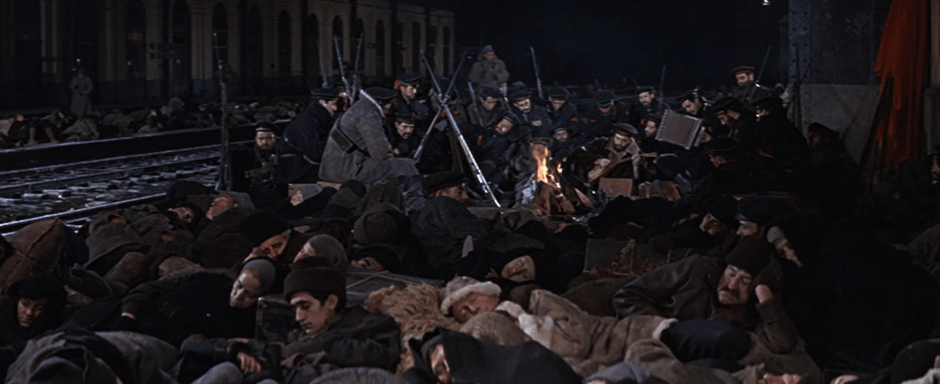
The World War broke the precarious supply system that had kept the cities fed and fuelled. We see the railway station thronged with people leaving Moscow, and this is sadly accurate. The population of the large cities collapsed during the Civil War, as the supply situation grew worse still – Petrograd’s population declined by over half, and Moscow was not much better off. The film is perhaps guilty of accelerating this process but the depiction is well grounded.

What’s not accurate at all is the way Yuri is scolded by the authorities for mentioning famine and disease in Moscow: ‘You’ve been listening to rumourmongers, comrade. There is no typhus in our city.’ This is nonsense. The Soviet authorities did not try to deny hunger or cover up epidemics like, as Boris Johnson would have said, ‘The mayor of Jaws’ [sic].

Tanya introduces Yuri to the new roommates and a visitor, the Soviet delegate (or People’s Commisar of Jaws) who gives Yuri a rude welcome home from the war. The delegate is played by Wolf Frees.

Below are the words of the revolutionary leader Trotsky (whose likeness we see on posters in these scenes) speaking to a public meeting in Moscow in June 1918:

I have with me some telegrams which the People’s Commissar for Food has received from small towns. There the population is, literally and in the exact meaning of the word, on the brink of complete starvation and exhaustion. […] From Sergiyev-Posad: ‘Give us bread, or we perish’ … From Bryansk, May 30: ‘There is a very high death-rate in the factories of Maltsovsk and Bryansk, especially among the children: there is hunger-typhus in the uyezd.’ […]From Pavlov-Posad, on May 21: ‘The population is starving, there is no bread, we cannot get it anywhere. From Dorogobuzh [24] on June 3: ‘Great hunger and mass sickness.’

Note not just the public acknowledgement of famine and typhus but of the most frank and harrowing reality of it. 

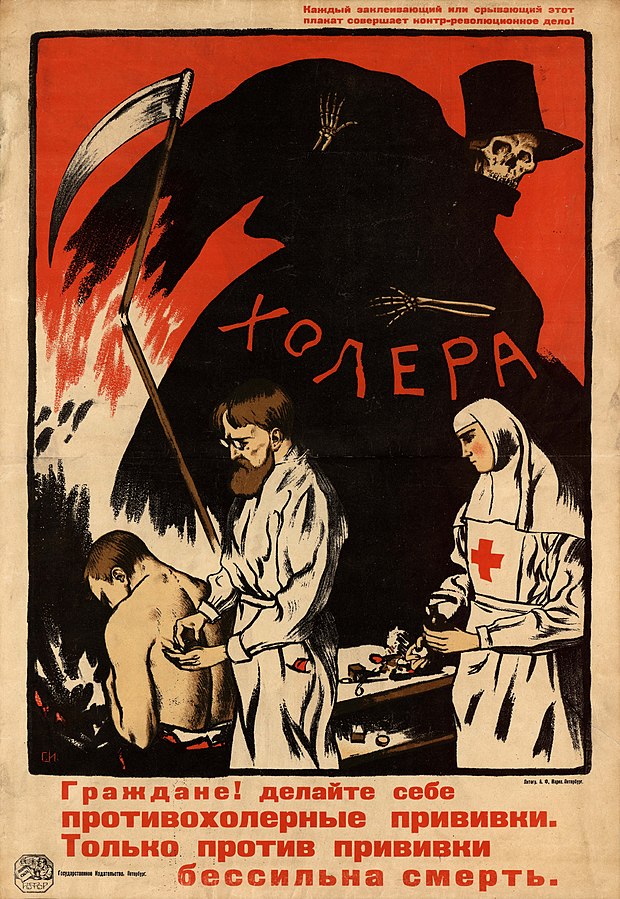
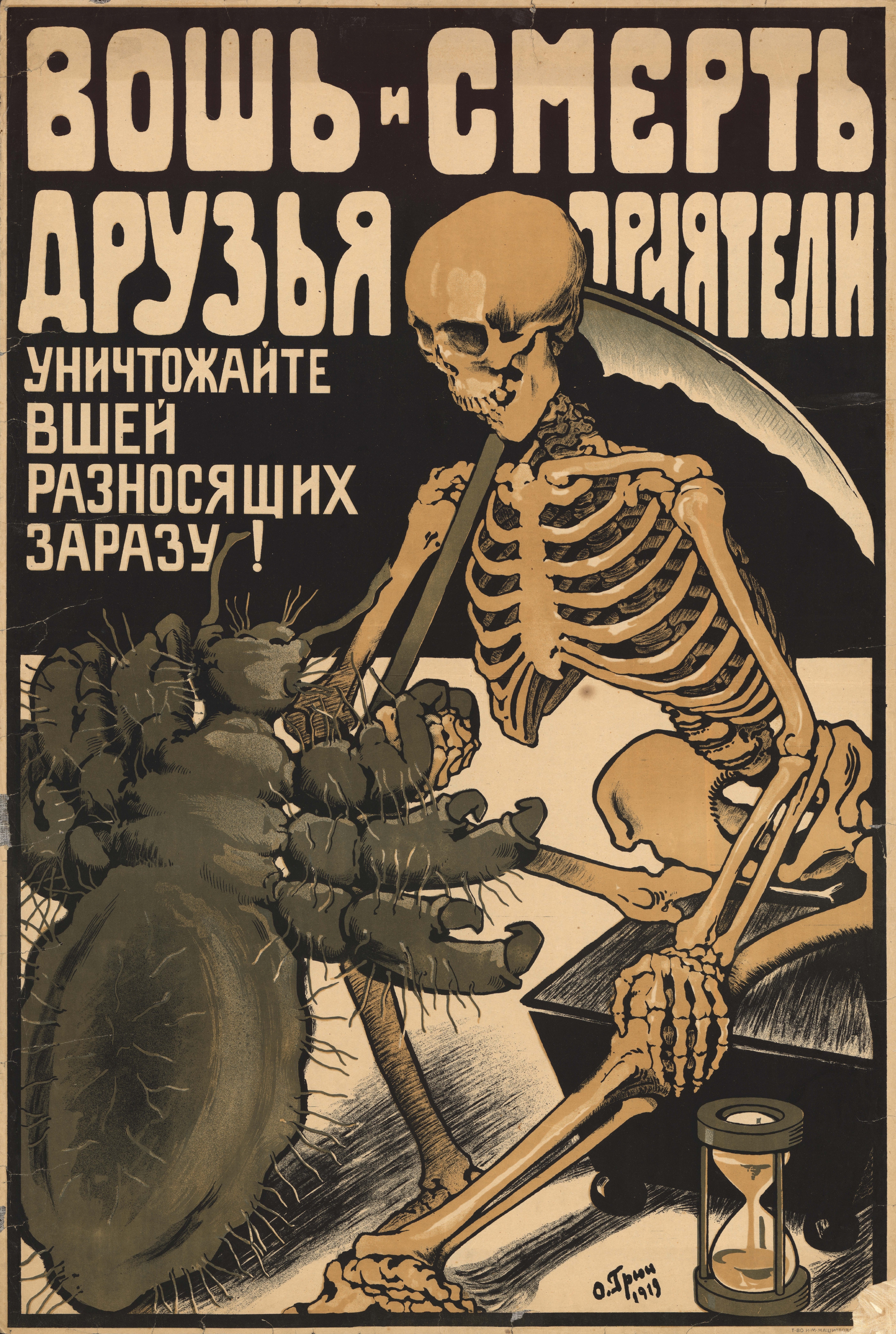
The new Soviet regime took public health very seriously. One White Guard who later wrote a memoir left a bleakly comical description of how he impersonated a doctor and was sent all over Siberia on a public health mission.

The posters below from Wikimedia Commons are Soviet public health warnings from this broad period.

Political Culture

The idea that hunger and disease were covered up is just one of the ways Dr Zhivago is basically wrong in how it shows the early Soviet regime. Yuri is treated in an appalling way by the authorities and the public. The local Soviet delegate yells at him, ‘Your attitude has been noted!’ What attitude? Who’s noted it? The low point is when Yuri arrives home to find his new housemates ransacking his apartment. Then he meets his half-brother Yevgraf for the first time. Instead of the pleasant reunion Yuri expects, he gets his marching orders. Yevgraf warns him that he must leave Moscow because his poetry is ‘not liked.’

‘I think the girl [Yuri’s wife Tonya] was the only one who guessed at their position,’ Yevgraf narrates, implying they could all be shot or arrested or something.

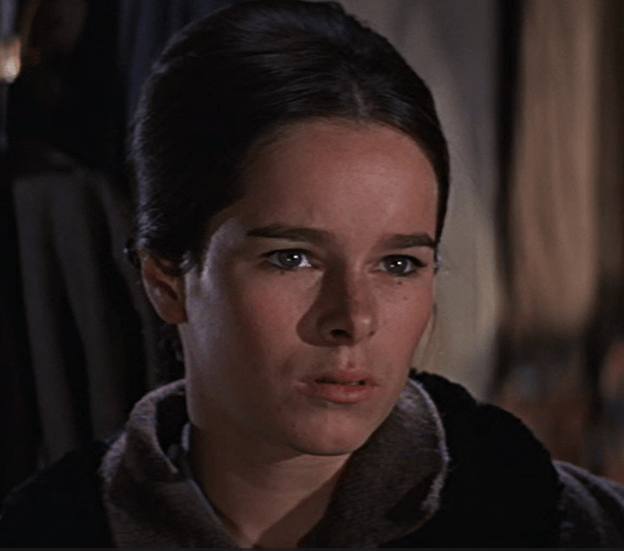
Tonya (Geraldine Chaplin), scared of Yevgraf

What’s the problem with Yuri’s poetry? This is some time in the winter of 1917-18. Yuri is enthusiastic about Bolshevism and calls Yevgraf ‘my political conscience.’ The problem is that his poetry is too ‘individualistic’ and his reasons for liking Bolshevism are too subtle.

If this seems unfair and absurd, it’s because it is. People were not arrested or killed simply for writing ‘individualistic’ poetry in early Soviet Russia. This is early 1918 and the number 1 item on the Soviets’ agenda is whether and how to make peace with Germany, and the related question of how to survive if Germany attacks. The second item is securing food and fuel supplies. The third item would probably be the small forces of White Guards operating in peripheral areas, the foremost being Kornilov’s Volunteer Army in the Don and Kuban regions. Individualistic poets are not on the agenda at all. If Yuri was writing odes of praise to Kaiser Wilhelm or General Kornilov, the Soviet authorities would certainly have had a problem with that. But that isn’t it.

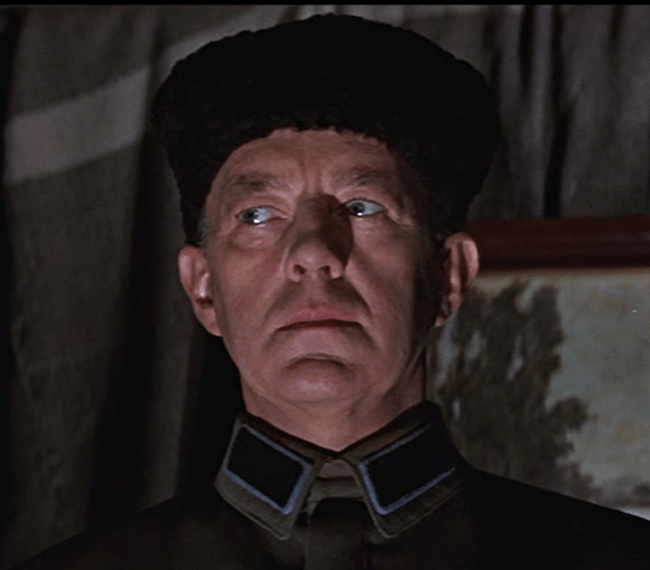
Yevgraf (Alec Guinness), being scary

It’s a neat dramatic moment when Yevgraf enters the room and, by a mere snap of his fingers, puts a stop to the ransacking. He exudes menace. Too much menace. I think this reaction would be plausible after September 1918, when the Soviet authorities shot several thousand hostages in Moscow alone. But this is early 1918 at the latest. The Cheka (it’s implied he is a Chekist) have not yet done anything to inspire mortal dread.

And just consider what we know about Yuri. As marks against him in the eyes of the Soviets, he is the adopted son of a landlord family, with a large house in Moscow and an estate in the Urals. But he accepts the redistribution of both properties without conplaint. He spends most of 1917 in a military unit sympathetic to the Revolution, treating the wounded, saving countless lives and earning the deep esteem of the soldiers. He comes back to Moscow and at once gets to work in the local healthcare system. He expresses support for the revolution at every opportunity.

‘Specialists’ like Yuri who were willing to work conscientiously under the new regime (doctors, engineers etc) were not scorned or abused or rejected. They were valued. Past political actions disagreeable to the new regime (which Yuri, in any case, has none of) would be overlooked. They would be given higher rations. This idea that he would face arrest or imprisonment just for writing poetry is nonsense.

The apparently healthy but idle father-in-law (Ralph Richardson), on the other hand, might find himself conscripted into a labour battalion, say, to dig trenches during the military emergency of 1919. He is not at all invested in politics of either right or left, so it’s quite unlikely that he would end up in deeper trouble than that.

I haven’t referred much to Boris Pasternak’s novel, on which this movie is based, because it was five years ago that I read it. But this point is important: in the novel there is no warning from Yevgraf, no hint that Yuri might be arrested for his poetry or for his ‘attitude.’ Yuri and his family simply leave Moscow of their own accord because of the hunger and fuel shortages, like about a million other people. The filmmakers felt the need to make this very significant and historically inauthentic change.

Chronology

When I write something like, ‘this wouldn’t have happened in February of that year, maybe in June’ readers might think I’m being pedantic. The basic sequence of events in the Russian Civil War is not widely understood so I need to pause and spell out the significance of some of the things I’m saying. If a film simplifies the timeline for the sake of making things more brisk and comprehensible, that’s good. But if the chronological mix-ups in a film erase some of the most interesting features of a historical period and present an alternative version that diverges dramatically from the evidence, that’s a big problem for me.

Winter 1917-18 was a world apart from winter 1918-19, or even summer 1918. The same rules did not apply. The Soviet regime did not spring into being as a repressive one-party state. But in response to conditions of chaos and war which escalated sharply from May 1918, it grew steadily harsher and more repressive. A film about the period should trace these developments in the same clever way that Dr Zhivago tracks fuel shortages through the unexplained disappearance of banisters. Instead the Soviet regime springs into being fully-formed, a strange composite of the revolutionary and Stalinist eras and the screenwriter’s imagination.

This was a severe time. I can think of a few scenarios where an innocent person like Yuri would fall foul of the authorities and end up getting arrested, or even in an extreme case shot. As the Civil War drags on the scenarios become more numerous and plausible. And if he got in trouble, his adopted family background would be held against him. But none of these scenarios involve individualistic poetry, or acknowledging the existence of typhus.

4. The Train

Next comes the most powerful part of the movie, for me: the epic train journey from Moscow to the Ural Mountains.

Are the conditions portrayed accurate? The crowded station, the rush for berths, the dark squalid bunks and the straw? It would be difficult to exaggerate how bad the railways were in this period.  Today this journey by rail would be one or two overnights but fuel shortages, breakdowns, harsh weather and rail traffic all meant that the gruelling 11-day journey depicted here is perfectly authentic.

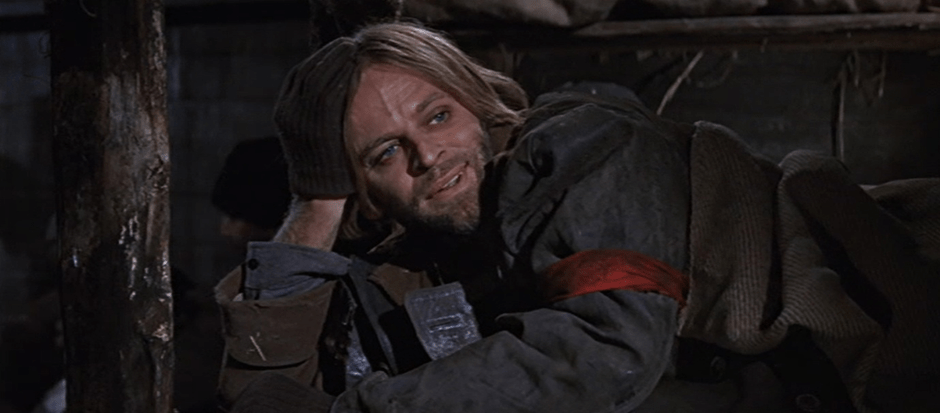
What excellent worldbuilders we have in David Lean and his crew, and screenwriter Robert Bolt. How real this carriage and journey seem – yes, in the way Pauline Kael dismissed as ‘primitive’ (she said that David Lean movies are for the kind of people who are impressed because painted horses on a stage backdrop look ‘real enough to ride.’ Namely, me), but also on a human level. I’m glad they chose not to cut the moment when the anarchist convict (Klaus Kinski) stares at an old couple exchanging a moment of affection while lying on the floor of a crowded carriage. He looks absolutely desolate. I don’t know if it’s accurate or not about shovelling out the straw and sprinkling the disinfectant, about breaking the ice when you roll open the door – but I’m glad it’s in the movie. It’s good also that there are moments when they break out the accordion and do some singing and dancing.

The anarchist (Klaus Kinski)

I’ve already mentioned the anarchist who is imprisoned for forced labour on the train. I haven’t come across mentions of forced labour on the railways at all, let alone this early. I’m not sure if his reason for being here is plausible, but his character certainly is. The Soviet regime raided and cleared out numerous buildings occupied by self-described anarchists in Spring 1918, before the outbreak of Civil War. I say self-described because Soviet authorities regarded them as not proper anarchists, but as assorted bandits, adventurers and dubious characters, armed to the teeth and occupying key buildings. This happened after the train journey we see, but not much later. It’s an engaging performance by Kinski. Here is a mad and unpleasant person, but he’s also admirable and pitiable in equal measure. He might be the kind of person who would have been arrested in the raids of Spring 1918. At first he seems to be anti-authoritarian but his admiration for the Red commander Strelnikov tells us he loves violence and strongmen. It’s also a hint that he fought alongside the Red Guards prior to his imprisonment. You wonder what he did.
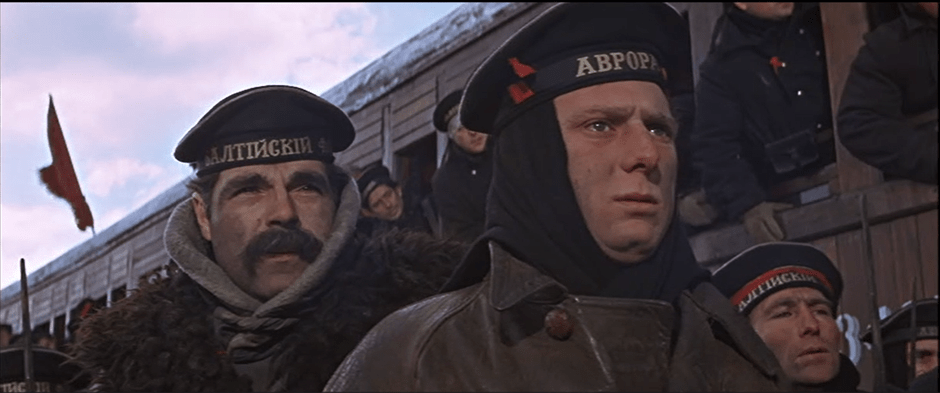
A detachment of Kronstadt sailors. According to his cap, the man in front served on the Aurora, the vessel which fired the signal, a blank artillery shot, to begin the assault on the Winter Palace in Petrograd during the October Revolution

There are also Kronstadt sailors on the train, on their way out to assist at the front lines. A lot of these lads would be anarchists too, not the bandity kind but the serious, political kind many of whom worked alongside and eventually joined the Bolsheviks. Kronstadt sailors played a key role in the revolution of 1917 and in this period detachments of them were indeed sent out to remote corners of Russia to bolster the Reds in this or that skirmish against counter-revolution. Though it seems strange that a load of sailors would be going thousands of kilometres inland, it’s only one of a lot of very strange things that were common occurrences during Russia’s revolutionary period.
The next post will deal with the Civil War, so the burned village and Strelnikov will have to wait.
A final word on the theme of this movie. Clearly it is anti- communist and critical of the revolution. But though this movie often straw-mans Bolsheviks, it never demonises them. It is conscientious about giving each Bolshevik at least one humanising and relatable moment.

Kuril, as I remarked, has some good strong lines. The delegate tries to stop the ransacking of Yuri’s house. Antipov is the most obnoxious but also the most vulnerable. We pretty much view Yevgraf as a teddy bear by the end of the movie. Even Razin, whom we will meet later, has a line where he reveals he once has a wife and four children. What happened to them? The grumpy new janitor of Yuri’s Moscow house gets a good line about how the building had room for thirteen families.

It is only a show of even-handedness, or maybe you could just call it one-sidedness with accompanying nuances. But it matters. After I posted last week, one of my readers sent me a message saying that ‘those scenes of the Tsarists suppressing workers revolts was, to my parents’ generation [people born before World War Two], the dawn of a realization that there mightve been a good reason for Communism in Russia….’

Dr Zhivago is going to get plenty of criticism in the next post, but let’s give it some credit. It was more balanced than a lot of the other texts and narratives that people would have encountered at the time. Maybe, considering certain books by Robert Service and Antony Beevor, and the dreadful Russian TV show about Trotsky, that’s even more so the case today.


[i] The incident in the novel on which this scene is based is longer and more involved. In both versions, a poor officer stands on a barrel to address the mutineers, only to fall victim to a slapstick accident followed by a rifle shot. In the novel this guy was a smug agent of Kerensky’s Provisional Government, and the guys who kill him are a specific hardcore bandit-like group, not the general mass of deserters.

Home Page/ Archive

Revolution Under Siege archive

Dr Zhivago – is it accurate? 1: The Old Regime

From the back of a lorry, men in red armbands throw leaflets to a cheering mob of soldiers. The unit’s doctor, Yuri Andreievich Zhivago (Omar Sharif), is handed a sheet by a bewildered illiterate elder.

‘The Tsar is in prison,’ Yuri reads aloud. ‘Lenin’s in Moscow!’ He looks up and adds, ‘Civil war has started!’

Yuri Zhivago (Omar Sharif), Kuril (Bernard Kay,  Lara (Julie Christie) and the old man (Erik Chitty). This and all other stills from Dr Zhivago, dir. David Lean, 1965

Yuri Zhivago and his unit are a little out of touch. Russia’s Tsar Nicholas II was arrested in March 1917 (Gregorian calendar), Lenin arrived in Russia in April 1917 but did not go to Moscow until early 1918, and the Russian Civil War started in May 1918. Yuri appears to be catching up on fourteen months of news. Word travelled slowly in revolutionary Russia, but not this slowly.

Most of the movie is not this bad and parts of it are pretty strong. I’m inclined to be generous to Dr Zhivago, a 1965 historical epic directed by David Lean, because the movie is generous to the viewer, serving up crowd scenes, spectacular landscapes and big, painful emotions.[i]

But this single line of dialogue is a succession of statements each of which is more jarring to my ears than the one before. It’s like someone scrolling on their phone and declaring, ‘A new coronavirus has broken out in China. American police have murdered George Floyd! Trump supporters have tried to stage an insurrection in New York!’ Note that I’ve got the city wrong and that I assume someone who’s just heard about COVID 19 somehow knows who George Floyd is.

Then again, maybe we will be watching that movie in fifty years.

The verdict of historian Jonathan Smele on Dr Zhivago is not generous: he notes that it is pretty much the only movie in English about the Russian Civil War, which is a shame because it is ‘mostly lamentable’ even though it’s ‘admirably snowy.’[ii]

Smele did not elaborate, but I’m going to,[iii] probably at length, over two or three posts.

This movie was enormously successful and popular at the time of its release. It raked in five Oscars and a ton of money. Very few English-language films have tackled the October Revolution and, aside from this and Warren Beatty’s Reds, none that I’m aware of have portrayed the Russian Civil War.[iv] So this movie, between its massive success and the lack of other films tackling the same subject matter, has had an outsized influence on how people in the English-speaking world see these events.

What follows are my notes on a re-watch of Dr Zhivago, focused on how it presents the history, sometimes comparing it to its source material (the novel of the same name by Boris Pasternak).

1: A flash-forward to… when?

Dr Zhivago starts with Yevgraf (Alec Guinness), an apparatchik in the Soviet security forces, finding his orphaned and long-lost niece and telling her the story of her long-lost parents, Yuri Zhivago and Lara Antipova. This frames the narrative in a neat way as Yuri and Lara are the couple who are canoodling tragically on the movie’s poster.

This framing device works… unless you’re a nerd like me, in which case it will leave you wondering when exactly this flash-forward is supposed to be happening. [v]

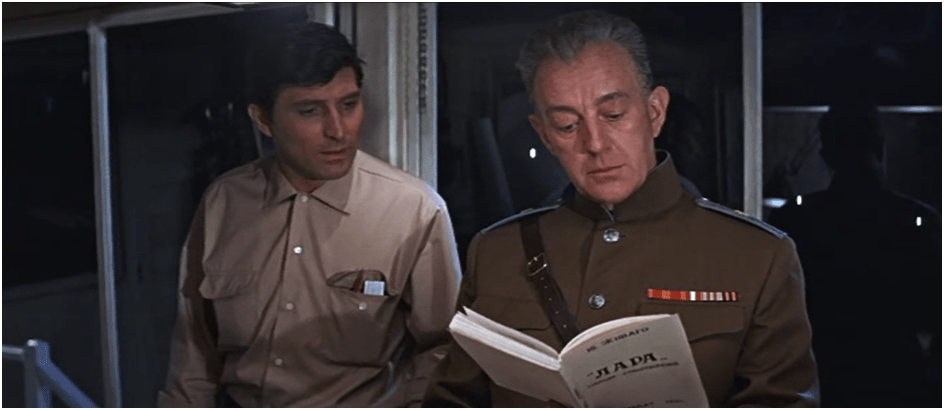
The engineer (I’m unable to identify the actor) and Yevgraf (Alec Guinness) reading a book of poems by Zhivago titled Lara

The niece, Tanya (Rita Tushingham), looks around twenty and we will learn she was born in 1921. Maths would suggest we’re around the years of World War Two. But clues in the scene suggest otherwise.

The overall situation (a hydroelectric dam that seems to be fully operational plus also a horde of women and girls recruited from reformatories excavating rock with their bare hands) suggests we are in the period of shock industrialisation, the Five-Year Plans. And because Tanya is definitely not fourteen or fifteen, 1937 to early 1941 is our range. Right?

Maybe not. Other cues point to the 1950s. Yuri Zhivago’s poetry is going through a period of growing popularity.

‘Everyone seems to [admire him] – now,’ says the engineer. 

Yevgraf replies acidly: ‘Well, we couldn’t admire him when we weren’t allowed to read him.’

Zhivago has been posthumously rehabilitated, meaning we are in a period of relative liberalisation. Relative prosperity, too. Referring to the era of Revolution and Civil War, Yevgraf does a ghoulish version of the Four Yorkshireman routine: ‘There were children in those days who lived off human flesh. Did you know that?’

This comparison between now and the bad old days only makes sense in the era after the death of Stalin in 1953, his denunciation in 1956, and the rehabilitation of vast numbers of people victimised by the Stalinist terror.

Only… Yevgraf’s niece is not in her mid 30s. And the dam appears to be called the Stalinskaya.

Where does that leave us?

If this scene is taking place in 1936-41, then the atmosphere is off. Soviet Union had just gone through a famine and massive campaign of repression in the early 1930s, followed by a terrible slaughter and mass imprisonment campaign that peaked in 1937. The engineer should be soiling his pants at the sight of Yevgraf, not complaining about shortages of machinery (though Tanya looks terrified at first).

Why have they made the film in this way? How serious a departure from history is it?  It’s not outrageous so much as odd. It’s just strange to hear Yevgraf talking about how back in his day, there was cannibalism and certain poets were censored. Not like the era of plenty and pluralism known to historians as [checks notes] THE GREAT TERROR.

2: Central Asia

We flash back to somewhere in Central Asia, some time in late Imperial Russia. In a powerful contrast to the red stars and industrial trappings of the framing device, we see vast mountains and plains. Through the eyes of a little boy, we see the Orthodox priests, black-garbed like a murder of crows, who are presiding over his mother’s funeral. It is a moving scene: a musical crescendo, leaves blown from trees in a sudden gust of wind, nails hammered into the coffin. The little boy is then adopted by a kind family from Moscow who were friends of his mother.

Russia had colonies in Central Asia, and many Russian settlers still have descendants today in countries such as Kazakhstan. So the trappings of the Orthodox Church imposed on a Central Asian scene grounds us in the old Russia of the Tsars, imperial and obscurantist.

The little boy who is burying his mother is of course Yuri Zhivago (in this sequence played by Tarek Sharif, son of Omar). In the novel Yuri’s half-brother Yevgraf was born of a woman native to Central Asia. The movie, without ever saying so out loud, performs an interesting reversal: Yevgraf is the European and Yuri the ‘Eurasian.’ I don’t think fidelity to history was the primary concern here – David Lean just wanted to cast Omar Sharif. But having a lead actor who is from outside Europe is a good move from the point of view of history. Every third or fourth character you run into in the Russian Civil War turns out to be an Armenian from Persia, or a Baltic German who is obsessed with Mongolia, or one way or another has some colourful and complex national identity.

3: Moscow in 1913

(CW: SA)

My nerd rage at the chronological vagueness of the flash-forward is assuaged in the next section of the movie. Dialogue in a later scene (‘I have seen you. Four years ago, Christmas Eve’) places the action in this part of the movie in the winter of 1913-14.

Yuri is now an adult, studying medicine, writing poetry and preparing to marry his adopted sister Tonya (Geraldine Chaplin, incidentally the daughter of Charlie Chaplin). But he keeps running into this girl Lara (Julie Christie), who we know thanks to the framing device will go on to be the mother of Yuri’s child.

Lara, a seventeen-year-old student, is groomed, seduced and raped by a businessman who has leverage over her family, a predatory and perspicacious old monster named Komorovsky (Rod Steiger).

Lara brings this section of the movie to a close by shooting the sexual predator. But Komorovsky survives. Lara and her revolutionary boyfriend Antipov (Tom Courtenay) get married and move away to a distant village.

To film this and later parts of the movie, the crew built a couple of blocks of Moscow in a field in Spain and buried it under fake snow. It was well worth the effort. It looks the part. We will see this neighbourhood, including the huge townhouse of Yuri’s adopted family, going through sweeping changes over the course of the film.

The protest

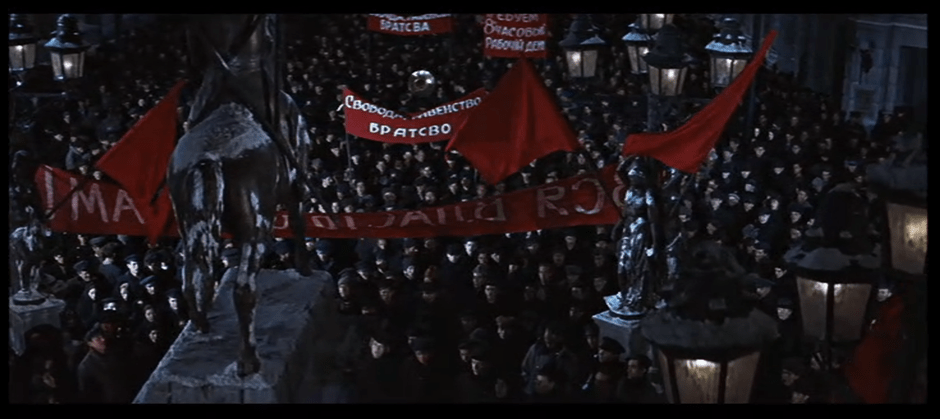
It is on the main street of this Spanish Moscow that we see a workers’ demonstration crushed by the forces of the Tsarist autocracy.

The corresponding scene in the novel takes place during the 1905 Revolution. Viewers might assume wrongly that this is the infamous Bloody Sunday, or even that this scene represents the entire 1905 Revolution – watching this at age 15 or 16 I vaguely thought it was, but now I know that this massacre would not even qualify as a Bloody Wednesday on the scale of Tsarist Russia. 

But the movie is not making a historical misstep here at all. Showing an event like this in 1913 makes sense. Several hundred strikers were massacred at the Lena goldfields in 1912, and in response there was a wave of strikes that only ended with the outbreak of the First World War. This would have involved protests and repression like we see here. The demonstrators perform the ‘Varshavianka’ and the ‘Internationale,’ both period-accurate. At the end of their demonstration, they march back the way they came, presumably sticking together until they reach the safety of a working-class district. But I’m not sure of the tactical rationale behind the dragoons attacking and dispersing them on their way back. I’d assume they would prefer to block the march from entering the affluent district.

It’s worth noting that we don’t see the inside of a factory, a railway yard or a slum. The focus is on how the demonstration turns Yuri’s head, sweeps him up in its romance, and how the state repression appals him. The focus throughout the movie is on how Yuri, who is part of a well-off family, reacts to the twists and turns of the revolution.

After the dragoons’ attack on the protesters

The Bolsheviks

On several occasions characters talk about the Bolsheviks. Antipov denies being a Bolshevik, but doesn’t tell us what party he’s in. ‘The Bolsheviks don’t like me and I don’t like them. They don’t know right from wrong.’

They are mentioned almost as if they were the only revolutionary party in the running. Komorovsky says to Yuri: ‘Oh, I disagree with Bolshevism. … But I can still admire Bolsheviks as men. Shall I tell you why? […] They may win.’

Before 1912, few knew who the Bolsheviks were. They were one faction of one leftist party (the Russian Social-Democratic and Labour Party). In 1912-14 the Bolsheviks grew rapidly. Antipov disliking them is a plausible glimpse of the leftist in-fighting and debates that went on. (The fact that he carries a pistol on a demonstration suggests he is a Socialist Revolutionary, a party with a terrorist legacy. I doubt he’s a Menshevik.)

Komarovsky’s remarks are not so plausible. The Bolsheviks weren’t a household name. Komorovsky would not have anticipated their victory and if he even knew who they were he wouldn’t expect Yuri to. 

I can see why they name-dropped the Bolsheviks here in spite of the above points. The screenplay is introducing little things that are going to be big later. It’s not terrible – but it is wrong.

Tsarism

‘It’s the system, Lara,’ Antipov declares at one point, apropos of nothing. ‘People will be different after the revolution.’ The audience knows instantly that Antipov’s naivety will be cruelly exposed. But to me that’s a bit crude, a bit of a straw man.

All the same, we do get a glimpse of the system. This section paints an ugly picture of late Imperial Russia. A predatory, cynical capitalist, brutal state repression, even an orthodox priest dispensing free doses of sexual hypocrisy to Lara when she goes to the church for guidance.

But we do not see the squalid living conditions of the peasants or, bar the scene where Antipov is dropping leaflets outside a factory, the working or home lives of the urban proletariat. People show a remarkable ability to write many thousands of words and make many hours of cinema about revolutions without ever mentioning little things like the land question. You know, the number one factor motivating almost every modern revolution including this one.

Until next time…

I remember seeing this movie as a teenager and being swept along by it and I can really understand how, four decades earlier, millions were really enchanted by it in cinemas. All the more reason to interrogate how it presents the history. I’m approaching it now with a more analytical eye but I still appreciate and enjoy a lot of what I see here. So far, it’s not a bad job by the standards of a historical epic set in a country that few of the cast or crew would have ever set foot in.

But as I’ve made clear, there’s a bit of ‘The Tsar has been arrested! Lenin is in Moscow!’ to come. And the further we get, the more it goes off the rails.

In the next post we’ll look at how Dr Zhivago treats the First World War and the revolutions of 1917. For good and for bad, there’s a lot to talk about.


Back to Home Page/ Archives

Revolution Under Siege archive

[i] ‘Lenin’s in Moscow’ can be shorthand for ‘Lenin has arrived in the capital city! No, not Moscow, the other capital, the one that doesn’t feature in this movie. Yes, St Petersburg.’ And ‘Civil war has started!’ is just Zhivago’s on-the-spot reaction. Some people in early 1917 characterised events the same way. But all that is a stretch. The average viewer will take it at face value.

[ii] Smele, Jonathan. The ‘Russian’ Civil Wars

[iii] What are my credentials for tackling this, and why does it interest me? Over the last few years I’ve written a lot about the Russian Civil War, and you can find the full book-length project here:

Revolution Under Siege

[iv] Soviet and Russian cinema is a different story. 1934’s Chapaev spawned a whole sub-genre of Civil War movies. I should mention the HBO TV movie Stalin (1992, dir Ivan Passer) which is overambitious and rushed but which does include a handful of fairly well-written scenes dealing with the Civil War.

[v] In the novel, this framing narrative takes place on the Eastern Front of World War Two. Yuri and Lara’s daughter is a boisterous young woman serving on the frontlines.

Barbara Kingsolver and Trotsky

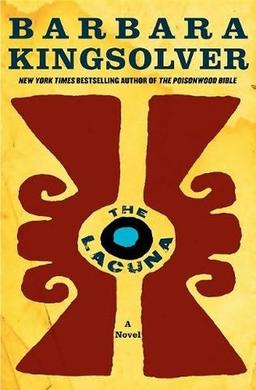
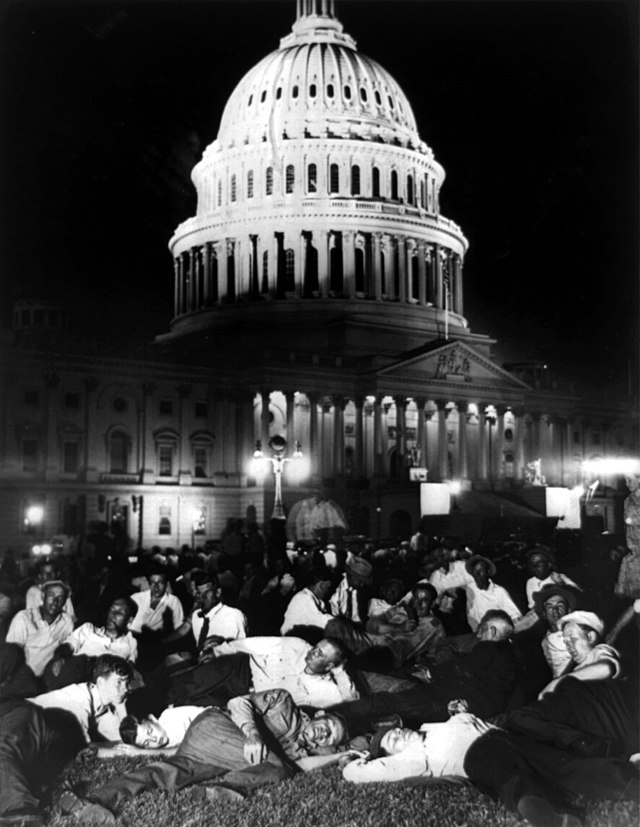
The Lacuna is a 2009 novel by Barbara Kingsolver about a young Mexican-American man, Harrison Shepherd, growing up in the early 20th Century. During his fictional life, spent back and forth between Mexico and the USA, he encounters real events and people, such as when he sees the Bonus Marchers beaten and gassed off the streets of Washington DC in 1932, makes friends with Diego Rivera and Frieda Kahlo in Mexico City, and back in the US finds himself in the firing line of the McCarthy Red Scare. 

It’s a great novel that deserves all the praise and prizes that it got. In this brief post I want to zoom in on one interesting feature: its depiction of the Russian revolutionary Leon Trotsky. Trotsky, who lived in exile in Mexico city from 1937 until his murder in 1940, occupies a prominent place in the story. His depiction is something I’m going to praise but also criticize. 

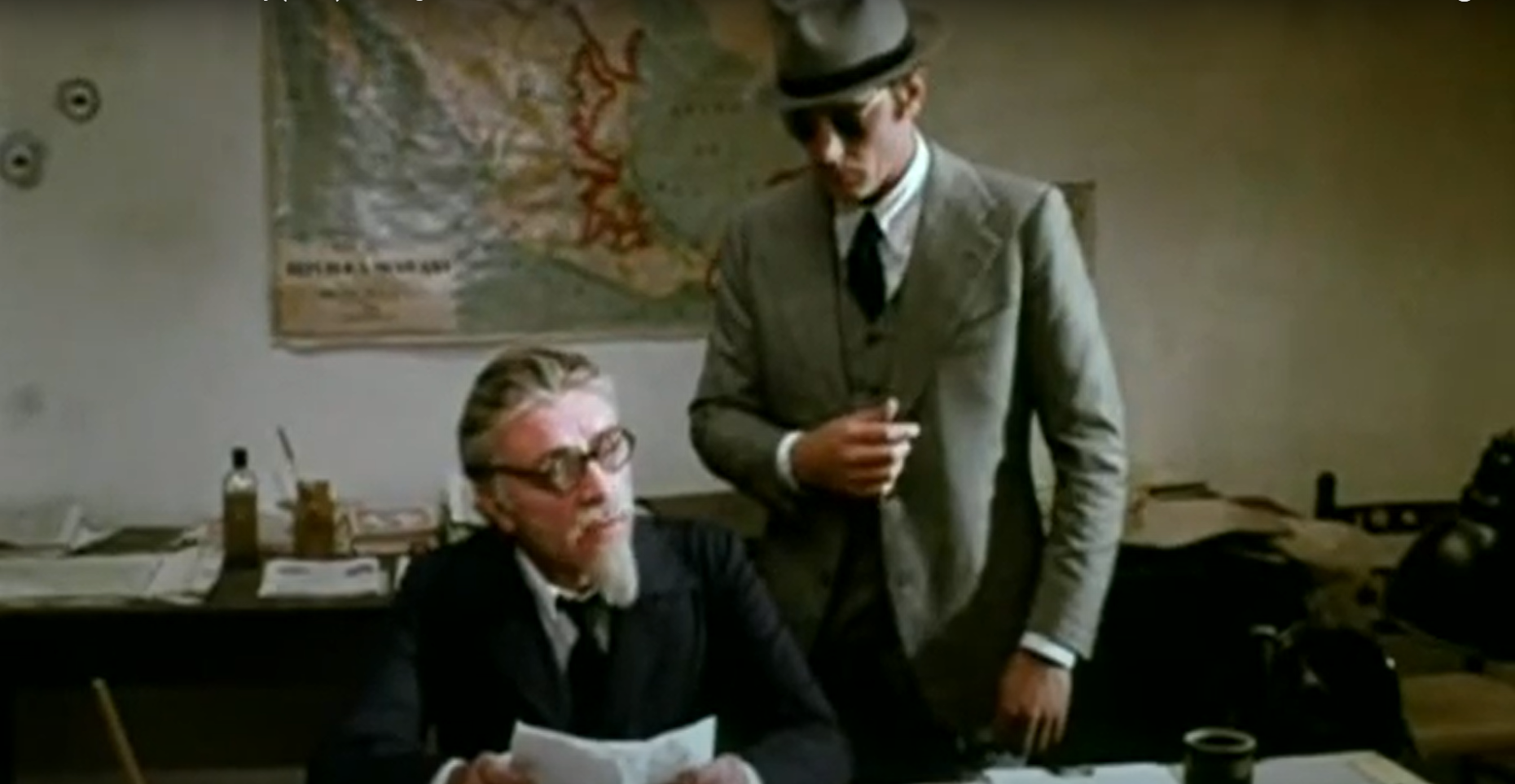
Kingsolver, who cut her teeth writing about miners’ strikes, treats the workers’ leader Trotsky with great sympathy. He appears to Harrison as a short, strong man with the dignified appearance of an older peasant, who is passionate about animals, nature and literature as well as politics. He employs Harrison as a secretary and, when he stumbles upon the young man moonlighting as a writer, gives him precious encouragement. An exile from Stalin’s Soviet Union, Trotsky is more melancholy than angry. Harrison is a witness to Trotsky’s murder and is haunted by the experience. 

As an example of how she depicts Trotsky, in his affair with Frieda Kahlo (they did the dirt on their respective partners, Natalia Sedova and Diego Rivera), Kahlo comes out looking a lot worse than him. Harrison is Kahlo’s friend and confidante, and he judges her more harshly, probably because he knows her better; Trotsky is up on a pedestal and largely escapes judgement.

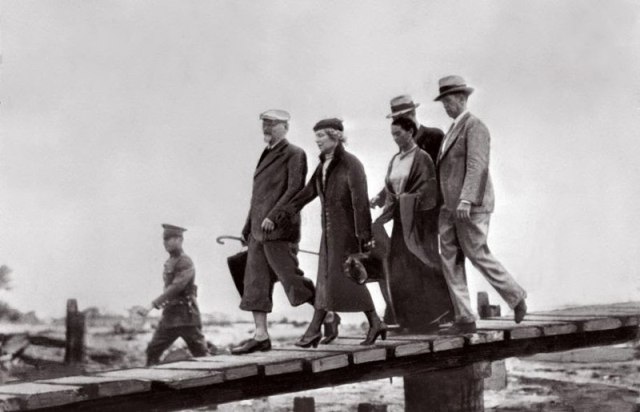
Trotsky, Natalia Sedova arriving in Mexico, escorted by Kahlo

Kingsolver is interested in Trotsky but far more interested in Kahlo. We see Kahlo’s sharp edges, we are invited to judge her at times. But I guess this is because the author decided to make her a central character, to spend more time and energy on her. Trotsky gets comparatively less attention from the author, so we get a simpler picture of him. This is all fair enough. But this leads the novel into some avoidable missteps. 

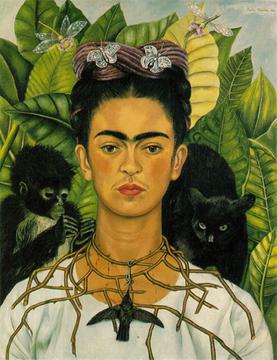
Self-portrait by Frida Kahlo

Funerals

It’s not impossible that Trotsky would have employed Harrison as a secretary. Harrison is a veteran of the Bonus March, a supporter of ‘the dictatorship of the proletariat,’ (understood by him to mean democratic workers’ power) and a member of the leftist artsy milieu in Mexico City. Harrison is also young, and Trotsky was more politically tolerant toward younger comrades. But Harrison is, for all this, not very knowledgeable about or active in politics. I think Trotsky would have sooner entrusted such a key role to members of his own organisation, the Fourth International. 

The 1932 ‘Bonus March.’ Jobless veterans camped out in Washington DC were subjected to a violent military crackdown.

So it’s a very strange moment when Harrison asks how Stalin and not Trotsky ended up in charge of the Soviet Union. This should be something which Harrison already knows about and has developed opinions about, if he’s living and working in a trusted position in Trotsky’s household.

It’s a problematic moment in a bigger way, too. The real Trotsky wrote entire books about Stalin’s rise to power, so we know what he would have said. The explanation he gives in The Lacuna is wide of the mark. Trotsky, earnest and visibly pained by the memory, tells Harrison that he missed Lenin’s funeral because of a devious prank by Stalin. And so Stalin took centre stage at the funeral, and so, in this version of events, he became the sole possible successor to Lenin. I remember being told this by my school history teacher as an aside, as a touch of pop-history anecdote material, but I haven’t come across it anywhere since. Maybe it’s true as far as it goes, but it doesn’t answer the question.

And it’s definitely not the first answer Trotsky would give. In real life, Harrison would want to put the kettle on and pull up a comfortable chair before he asks Trotsky how Stalin ended up in power. Trotsky would not have spoken of personal intrigues; he was far more partial to grand socio-economic analysis and theoretical debates. If you open up his key book on the subject, The Revolution Betrayed, you can see this in the title of the first chapter; it’s not ‘Stalin: Devious Bastard’ but ‘The Principle Indices of Industrial Growth’.

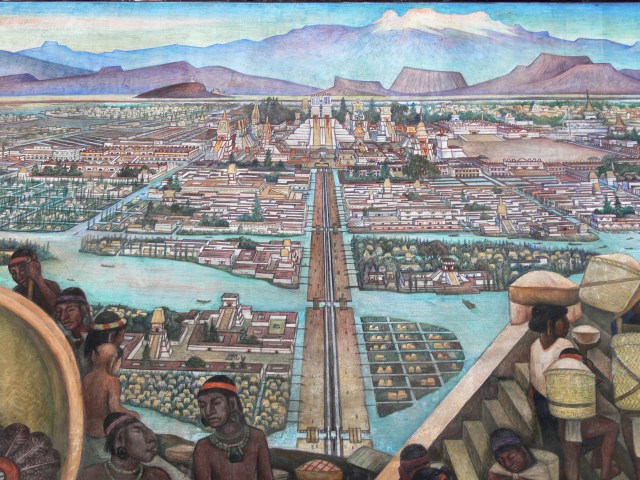
A mural by Diego Rivera depicting Tenochtitlan. Harrison’s stories are set in the same era as this painting

Yeoman farmers

In another strange scene, Trotsky laments the latest news from Russia: now Stalin is going after the ‘Yeoman farmers.’ But Stalin had started in on the ‘Yeoman farmers’ (kulaks) in earnest from 1929, and this conversation is happening around ten years later! In the early 1930s forced collectivisation and the ‘liquidation of the kulaks’ led to famine and terror on a huge scale. It was one of the most traumatic episodes in Soviet history and Trotsky wrote about it at the time. It wouldn’t have been news to him by the time he was in Mexico. In any case by then there were no kulaks left. 

Trotsky in The Lacuna seems to regard these ‘Yeoman farmers’ as a key constituency whom nobody should mess with. This wasn’t the case. While Trotsky condemned Stalin’s onslaught on the peasantry and national minorities, he would still have used the derogatory term ‘kulaks’ rather than ‘Yeoman farmers.’ He saw the kulaks as a problem (though he advocated gradual and peaceful solutions) and earlier (in the mid-1920s) he condemned his opponents, including Stalin, for enacting policies that enriched and empowered this social layer.

‘pedantic and exacting’

In 1938 Trotsky’s son and close comrade Leon Sedov died in Paris, likely poisoned by Soviet agents during a routine surgery. In a powerful obituary, Trotsky expressed regret over his own often difficult personality:

I also displayed toward him the pedantic and exacting attitude which I had acquired in practical questions. Because of these traits, which are perhaps useful and even indispensable for work on a large scale but quite insufferable in personal relationships people closest to me often had a very hard time.

A more rounded novelistic portrayal of Trotsky would show us this ‘pedantic and exacting’ side, which was not a figment of Trotsky’s imagination – and perhaps his own occasional pang of regret over it. As his secretary, transcribing his extensive writings, Harrison would not only experience on occasion this ‘very hard time’ but would read practically every word Trotsky wrote. Someone as raw and open as Harrison would (rightly or wrongly is of no concern here) see some of Trotsky’s writings as ultra-principled or hair-splitting. This would especially be the case in the late 1930s; the extermination of all his allies and supporters back in the Soviet Union left Trotsky isolated, debating with the few survivors over questions which had no easy answers.

Trotsky with Ramón Mercader moments before the assassination. From The Assassination of Trotsky (1972, dir. Joseph Losey)

This depiction of Trotsky is incomparably more accurate and fair than the gothic, depraved supervillain we see in the 2017 Russian TV series. The 1972 movie The Assassination of Trotsky, starring Richard Burton in the title role, is a fair depiction and, I think, a good movie. We do see some steel in Trotsky’s character along with vulnerability. But I should mention that while I am far from its only defender, it was heavily and widely criticized as a film.

It’s believable and accurate that Harrison would encounter Trotsky and see a kind, curious, haunted man. But since he lived with him for a few years, he would see that like many great leaders and writers, Trotsky had his more negative personal traits. A more nuanced Trotsky, like the multi-faceted Kahlo we come to know in The Lacuna, would be all the more sympathetic for our having seen various sides of him. 

Home Page/ Archives

Notes on the Medieval World (1) How Rome Fell

“…throughout all the difficult days of the dissolution of Antiquity, we can trace the hard, selfish interest of a comparatively small group of families, their wealth and interest founded on land.”

-JM Wallace-Hadrill, The Barbarian West: The Early Middle Ages AD 400-1000. Harper Torchbooks, 1962

The book quoted above fell into my possession a little while ago. Knowing full-well that it was short, very broad, and decades out of date, I still read it with interest.

Men supposedly think about  Rome every day. As for me, I’ve read some Robert Graves and played a lot of Total War (never as the Romans), but I’m not especially interested in togas and scutums and senators. But the stuff a little later, the great churn where the senators and castrums are turning into dukes and castles (but aren’t in any particular hurry) are more interesting to me. I like the times when years have three digits and there are a lot of things they haven’t invented yet, like chivalry, or Switzerland, or monks who had to keep it in their pants.

Today people put Rome and the Middle Ages up on a pedestal. But focus your eyes on where one is dissolving into the other, and it all looks more accidental and contingent, and you start learning things, often things you don’t know what to do with, facts you don’t know where in your brain to file.

I read indiscriminately about late antiquity and the early Middle Ages, and every so often I’m going to be posting about what I’ve learned. I might criticise what I wrote here in a future post when I read something else; or someone in the comments may have something to say. No worries. So here are some interesting things I found out from Mr Wallace-Hadrill and his book The Barbarian West.

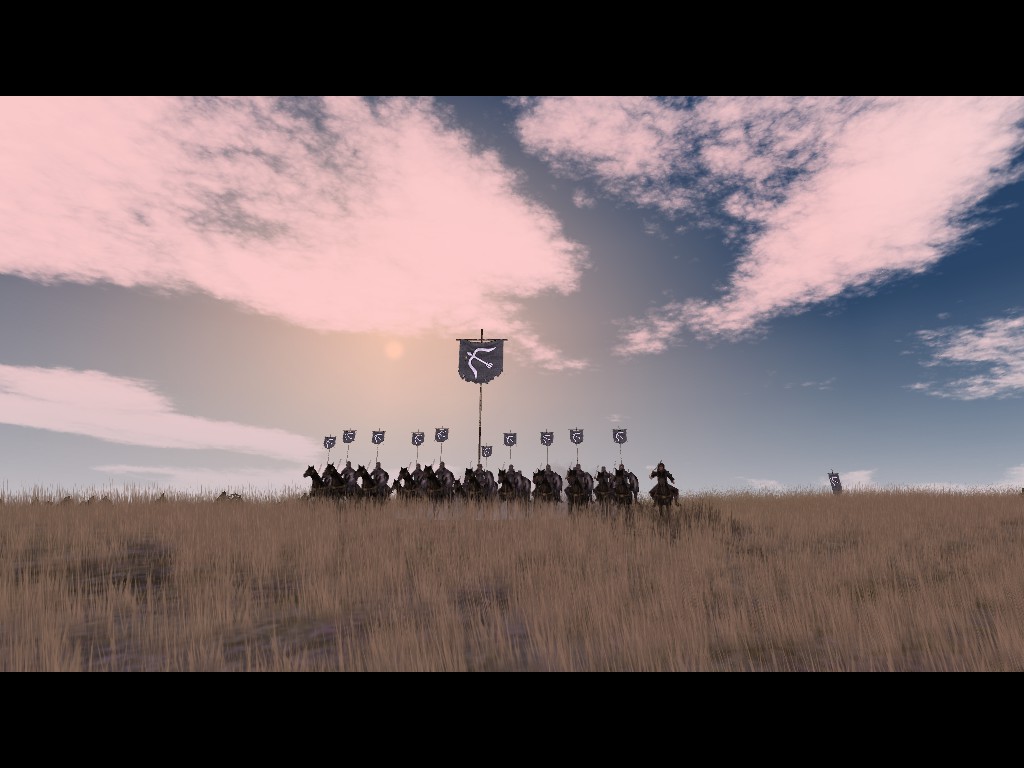
Huns riding over the horizon. The featured image is a screenshot I took on Rome: Total War – Barbarian Invasion (2005), probably the first cultural text about this period that I stumbled upon.

Did ‘barbarians’ actually sack Rome? (p 25-27)

I’ve seen the paintings. I’ve played the videogames. I grew up with a vague sense that there was a day when a horde of savages broke into Rome and burned a lot of nice buildings and murdered a lot of cultivated people, after which there was no more Western Roman Empire and Rome itself was finished as an imperial city.

Wallace-Hadrill says that the Goths took Rome in 410 CE, but did not actually sack it. They wanted food and land, and had no incentive to sack the city. It was back in Roman hands soon after. In 456 there was a serious sack of Rome – not by a nomadic horde, but by the powerful kingdom the Vandal invaders had established in North Africa. It was a sack, but it wasn’t the end of the Western Empire. That didn’t come until 476 and the overthrow of the last Western Emperor by one of his own Hunnic generals, Odoacer.

So the image of ‘barbarians’ sacking Rome doesn’t really convey how it all went down. Both Roman and invader by and large preserved Roman laws and institutions and even language – Latin itself had split into the dialects that would become French, Spanish and Italian before the fall of the Western Empire.

The later Magyar invaders, it is argued, did more damage in Western Europe than the Huns, while the twenty-year attempt by the Eastern Roman Empire to reconquer Italy brought about more destruction than the Huns, the Goths and the Lombards.

The Roman Empire did not fall because of ‘decadence’ (p 10-13)

Why did Rome fall in the first place? On the internet and occasionally in print, I’ve seen people blame it on too much partying, too much sex, too many feasts, orgies, etc. Too much dole. Too much immigration. ‘Weak men create bad times’ etc, etc. If the commentator even notices the gap of centuries between supposed cause (vague ‘decadence’) and effect (fall of Rome), he is not remotely embarrassed by it.

Ugh. Look at it. So decadent. Again from Rome: Total War

Wallace-Hadrill sums up the 4th-century crisis of the Roman Empire in a few paragraphs. In that century, land was falling out of cultivation in all provinces, a sure warning of the collapse to come. Why?

The most striking point is that the people themselves were driven to revolt by intolerable conditions. We have slave revolts and disaffected farmers turning to “mass brigandage.” Later in the 5th century we have a Roman leader, Aetius, actually allying with the Huns to crush a massive popular uprising in Gaul (Aetius at other times allied with Goths against Huns and with Huns against Goths).

Farms had fallen behind because the whole system rested on enslavement, which held back new inventions and kept agriculture primitive. So from its backward agricultural economic base, the Empire couldn’t pay for its legions or for the palaces and luxuries of its ruling class. The vast external border was too expensive to defend properly. The expense was not just in money, because war casualties and conscription drained the labour force.

All in all, we get a picture of a system that has been pushed far past the limits of its own rules. Its drive to conquer others has led to overstretch and its reliance on enslaved people has led to stagnation. It’s not that the Roman ruling class ‘abandoned their virtues’ or that ‘good times created soft men.’ The problem was that the Roman landlords stayed true to their supposed ‘virtues,’ ie, to a system built on enslavement and conquest, even when it had ceased to deliver the goods on its own terms.

Western Christianity started out as African Christianity (p 14-15)

At first, Christianity didn’t take off in the Western Roman Empire. The aristocrats remained pagan; it was artisans and bourgeois in cities like Milan and Carthage who turned to Christianity. In the East, it was closely associated with the Emperor and with the state. What eventually spread in the West was a version of Christianity that took shape in the Roman provinces of North Africa, a more strict interpretation that defended spiritual power against secular power, ie church from state.

The early Catholic church is full of surprises (p 48-52)

Early Christianity is a bit surprising. The first monastic community at Monte Cassino in the 6th Century was disciplined, but not ascetic. They all had wives and children. Rather than a place of quiet contemplation, it was a kind of bunker in a country torn by wars and plagues. As I said, this period is interesting to me because there are little surprises that I’m not sure what to do with.

In the seventh century we have Pope Gregory the Great. This pontifex maximus was last seen in the pages of The 1919 Review cruising the slave markets and cracking feeble puns about how good-looking the enslaved people were.

Here he appears in a different light. Presiding over a period of chaos, war and plagues, Gregory brings in a system of expensive and effective poor relief. “The soil is common to all men,” declared Pope Gregory. “When we give the necessities of life to the poor, we restore to them what was already theirs – we should think of it more as an act of justice than compassion.”

Couldn’t have put it better myself. I’m nearly tempted to let him off the hook for the ‘Not Angles, but Angels’ thing.

Romans, again from Rome: Total War

Illiterate Kings

Charlemagne unified France and you could argue he founded Germany. He was a lawmaker and a patron of arts and religion. He converted the Saxons to Christianity at the point of a sword. A formidable character. But here’s a humanising and poignant detail about him from page 109. Wallace-Hadrill quotes a chronicler named Einhard as he goes on about how great Charlemagne was, how generous he was to the priests and to the arts, the churches he built, the treasures he bestowed. Einhard also says that Charlemagne kept tablets and parchment under his pillows so that when he got a free couple of minutes “he could practise tracing his letters. But he took up writing too late and the results were not very good.” He was a king from a line of kings – but in this age, he never got an opportunity to learn to write. He wanted to – but he was too old when he finally got the chance, and he only got to practise in odd spare moments. Even his flattering chronicler Einhard, looking at the messy lines and errors in Charlemagne’s uncertain script, has to purse his lips and shake his head sadly.

More Huns on the move. From Rome: TW

To finish, I want to note that books like this don’t come out anymore. And that’s for better and for worse. For better, because the author can be a callous prick sometimes. The later Merovingians died young of illnesses, so they were, he says, ‘physical degenerates.’ Sorry, what? But also for worse. This book is pocket-sized, accessible, unpretentious, erudite, focused. No hype, no bloat. An expert is informing the scholar or the layperson, and Harper are taking in $1.25 into the bargain.

So, Notes on the Medieval World isn’t really a series, more a theme I’ll be coming back to between long gaps, whenever I happen to finish a relevant book. Most likely the next one will be Passages from Antiquity to Feudalism by Perry Anderson. Stay tuned to see what videogame screenshots I manage to shoehorn in.

Home Page/ Archives

Before the Fall (5) Notes on The Dawn of Everything

The point that this book has been hammering home is that hunter-gatherers were not ‘innocent’ or just roaming bands. Not only did foragers of the Stone Age have complex social structures and build great monuments, they were politically self-conscious and sophisticated.

Building on this, Chapter 5, ‘Many Seasons Ago,’ describes two very different cultures which lived along the Pacific coast of North America, drawing a series of fascinating comparisons and contrasts between the two. But the arguments and conclusions, this time, I found far less convincing than in previous chapters.

The argument is in essence: look at how radically different these two societies were, even though they had the same mode of production. So, isn’t the idea of a mode of production a bit useless?

The two North American ‘culture regions’ Graeber & Wengrow outline are the Californian Region and the North-West Coast Region. These were not pre-agricultural societies, the authors argue, but anti-agricultural – ie, they knew about farming but chose not to practise it.

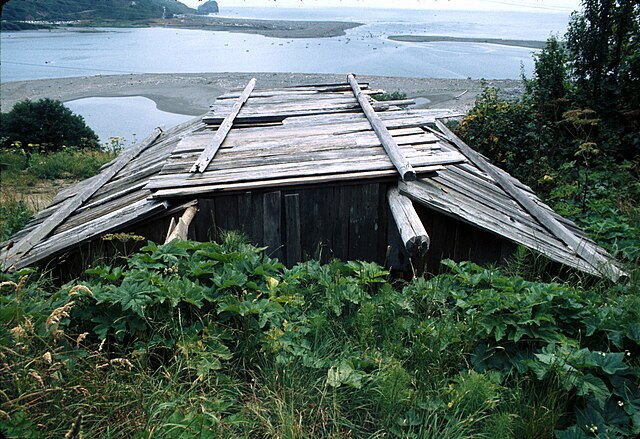
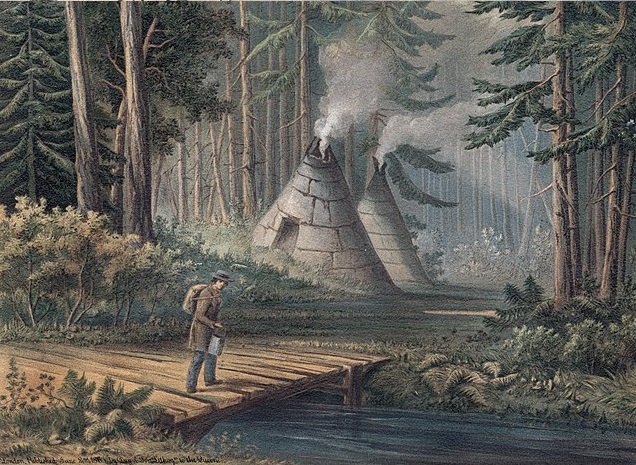
Reconstruction of a Californian Yurok plank house

Within this, as the most striking examples of the two regional cultures, they zoom in particularly on the Yurok (California) and the Kwakiutl (North-West).

Let’s try to sum up what Graeber and Wengrow put forward here.

  • They say that idea of a ‘culture region’ is not perfect but makes more sense than ranking and sorting societies based on ‘mode of production.’ In other words, let’s group different societies based on what games, foods, clothing and values they share, not on whether they are foragers, farmers or industrial workers.
  • They say that societies (or at least these societies) are ‘ultimately’ shaped by political and cultural dynamics, by human agency, and not by ecology or economics. Concretely, the Kwakiutl ate salmon and the Yurok ate nuts and acorns, but that had nothing to do with their respective social structures.
  • Societies define themselves against their neighbours – ‘dynamically interconnected [and] reciprocally constituted’ (Marshall Sahlins.) People traveled a lot in the Stone Age and were aware of neighbours’ customs and tech. What they consciously chose not to borrow is what defines each group: we are the people who don’t go in for slavery, who prefer a spartan aesthetic, etc.
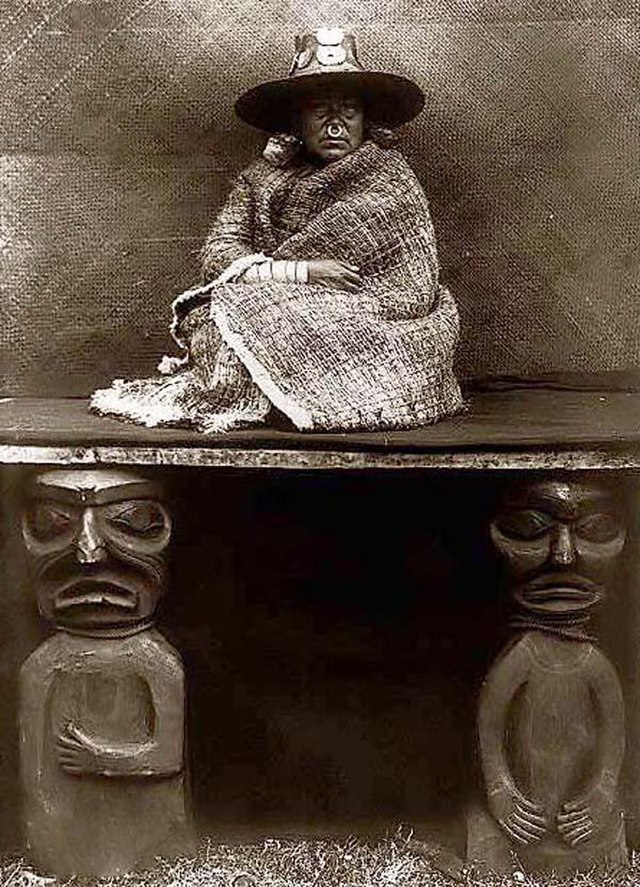
A Kwakiutl woman

So what do I think of all that?

I come to this without much prior knowledge, but it seems to me that the Yurok and Kwakiutl are bad examples for what the authors are trying to argue. Their means of subsistence could be crudely grouped together as ‘forager’ but were radically different. Culture and politics are weird and wonderful, so I’d agree that you can’t say that X climatic-economic input produces Y political-cultural result; if I say that the Kwakiutl eat fish, therefore they make colourful masks and enslave people, clearly there’s a missing link in the argument. But even though we can’t trace the causal relationship, I intuit strongly that there is one. It’s no coincidence that the people who lived on a diet of fatty, oily creatures made a virtue of amassing fat in their possession and in their own bodies. The people who hunted fish also hunted people. The people who ate dry, hard, austere nuts preferred not to hunt people, and themselves valued austere simplicity, hard work and physical thinness.

Between input X (the means of subsistence) and its many, practically untraceable outputs there is plenty of room for randomness and invention, and for the unique historical experiences of a given community, to interfere. It’s delightfully complicated.

Graeber and Wengrow’s thesis is appealing because it assigns the lion’s share of explanatory power to the political initiative of the people themselves. And it’s probably true that western Eurocentric writers are too keen to talk about their own history as a matter of political decisions, leadership, values and principles, while jumping to the most smug, glib, reductive, deterministic explanation they can think of when it comes to someone else’s history.

An idealistic, voluntarist philosophy lends itself well to judging certain communities for conditions forced upon them. But if we make our own choices, we make them from the set of choices available to us. Some people have more and better choices than others. This obvious enough to the authors that at one point they attempt to say, in essence, ‘No, not like that.’ Also, the limits of a given mode of production intrude when the authors acknowledge in passing that the population sizes in these communities were tiny. Neither fish nor nuts could support as large a population as settled agriculture. It’s fair to talk about ‘advance’ or ‘progress’ in relation to productivity of labour.

So they haven’t convinced me that there is a serious ‘problem with modes of production.’ But in the course of their argument they talk about a whole lot of great and interesting stuff. Once again, the journey is such a pleasure that you don’t mind if you never reached the promised destination.

Before the Fall (2): Notes on The Dawn of Everything

Hi, this is Part Two of my run-down on The Dawn of Everything, a book that asks how unequal, hierarchical and class-ridden societies first arose. Here is Part One.

In this chapter Graeber and Wengrow ask:

  • What did indigenous Americans in the 17th Century think about Europeans?
  • To what extent did the Enlightenment draw on sources outside Europe?
  • What does ‘egalitarian’ even mean?

And they emphasize the urgency of these questions: ‘A very small percentage of [the world’s] population do control the fates of almost everyone else, and they are doing it in an increasingly disastrous fashion.’ (p 76) If we want a free society that is not careering toward ecological and social catastrophe, we need to figure out how it came to be that a small minority ended up in control.

Before starting their story of humanity from the beginning, the authors detain us for one chapter to argue that a lot of our ideas about that epic story are wrong to begin with, and to give an account of why. This involves rewriting the history of the Enlightenment. So that’s the fairly ambitious idea of the part we’re looking at today:

Chapter 2: The Indigenous Critique

Along the way, the book delivers a lot of what I expected and wanted. For example, we get a sketch of several indigenous American societies before their destruction by European settlers.

The Wendat (Huron) grew crops around inland fortified towns. They had formal political officers and a caste of war-captives with limited rights, whom the European observers assumed were slaves. Other tribes such as the Mi’qmak and Montagnais-Naskapi, meanwhile, were bands of hunter-gatherers.

The Europeans saw these people as eloquent and very good at reasoned debate, skills honed in near-daily discussions of communal affairs. The Europeans also noticed that they possessed individual liberty, and wholeheartedly disapproved. Laws were not enforced, fathers did not control children, captains had to rely on their own persuasive power to get people to fight.

Jesuit missionaries were shocked to observe the ‘equality of the sexes’ – women had sexual freedom and the right to divorce. But there was a gendered division of labour, with women owning and working the fields while men hunted and fought. This reminds me of Engels’ explanation of how gender inequality came about. His vision of the prior state of equality does not preclude a gendered division of labour.

Looking at the Wendat, I feel like I’m re-playing the greatest hits from Celtic Communism? In an exact parallel with Gaelic Ireland, the Wendat practised communal compensation rather than punishment. There were wealthy people among the Wendat – but, and we saw elements of this in Gaelic Ireland too, the main incentive in hoarding material things was to give them away and thus boost one’s own prestige.

Graeber and Wengrow say lots of clever and interesting things – such as, in relation to the Wendat, ‘insofar as we can speak of communism, it existed not in opposition to but in support of individual freedom’ (p 48) – but they miss one obvious point. The 17th-Century Wendat (I specify 17th Century because, as far as I know, they are still around) had richer and poorer individuals, and individuals who held political office (on the sufferance of those who did not). What they did not appear to have had was distinct classes in conflict with one another. Again, here we see some parallels with Ireland. The Wendat were equal and egalitarian and communist in the sense that they all belonged to a single class. Like with my previous Celtic ruminations, here we are troubled out of complacent identification with the people of the past by the spectre of the un-free, the layer or caste who existed within the community but with curtailed rights. But the authors here don’t seem at all interested in class, and are visibly aggrieved when the Enlightenment salons turn from discussions of political institutions to discussions of economics.

Indigenous people roasting Europeans

What’s equally fascinating is the low opinion these Indigenous people had of Europeans when the latter arrived in the sixteenth, seventeenth and eighteenth centuries. For some reason I tend to forget that European colonisers and indigenous people lived in proximity for centuries, had developed opinions and analyses about each other, and left records of same. What is more, these records were a very popular type of book in early modern Europe.

The Mi’kmaq, around 1608, saw their (overwhelmingly male) French neighbours as envious, slandering, lying, quarrelling, covetous and ungenerous. ‘They are saying these and the like things continually,’ writes the Jesuit missionary who recorded these opinions. To the missionary it was obvious that while the French had more material goods, the Mi’kmaq had more ease, comfort and time.

Twenty years later a missionary among the Wendat recorded that they had no lawsuits and were not covetous. There were no beggars ‘in their towns and villages’ (I admit, embarrassed, that I didn’t know they even had towns and villages before I read this). As for beggars the Wendat heard of existing in France, they ‘blamed us [the French] for it severely.’ While the Wendat had daily community gatherings and discussions, the French interrupted one another, quarrelled, competed to hog the limelight, and often resorted to weak arguments.

This chapter does great service to history by promoting knowledge of a Wendat political leader named Kondiaronk who actually visited France as a diplomat and, in lengthy salon discussions with Frenchmen back on his home turf, voiced a powerful critique of European society.

‘The whole apparatus of trying to force people to behave well would be unnecessary if France did not also maintain a contrary apparatus that encourages people to behave badly,’ declared Kondiaronk – that ‘contrary apparatus’ consisted of money, property rights and profit. If you want to learn more about Kondiaronk, I really recommend you read this book.

Stages

This brings us to the main focus of the chapter. The authors basically give an alternative history of the Enlightenment, arguing that this indigenous critique was of key importance. The idea of societies developing through stages is attributed to the economist Turgot, who developed the idea as a defence mechanism against the indigenous critique: in short, the indigenous people say that Europeans are un-free and miserable, but it doesn’t matter what they say, because they are on a lower level. Their freedom is ‘lower’ than our slavery.

Rousseau’s famous essay on the origin of social inequality appears here as a strange synthesis of the indigenous critique and of the ideas developed to counter it.

I have mixed feelings on this. Texts such as the main one cited here, Curious dialogues with a savage of good sense who has travelled (1703), are fascinating and valuable and it’s a shame they were dismissed so lightly as fabrications. And this narrative of the Enlightenment as a period when Europeans encountered and opened up to ideas from other parts of the world was fresh and interesting. It’s an ambitious argument, though, and the fact that it’s so much at odds with other accounts of the Enlightenment that I’ve read would give me at least pause for thought. Doesn’t the receptiveness of European minds to the indigenous critique say something about how developments within Europe were also driving the Enlightenment?

Whatever Turgot’s agenda was, the idea of societies ascending through stages of economic development is, in itself, a good one. Married to arbitrary criteria, or none at all, (sorry, Age of Empires), this idea leads to bad places. But you can attach it to valuable criteria (such as the productivity of labour) and thereby give some meaning to the concept of progress underlying it. I predict the authors are setting things up for an attack on Marxism in future chapters. They are emphasizing the conservative pedigree of the idea of stages of economic development as part of lining up those dominoes. We’ll see how that goes in the coming chapters.

I enjoyed this chapter in spite of reservations. I hope Kondiaronk and his opinions on early modern European society become a staple of school history courses.

Home Page/Archive

Miseducation Misadventures: The Spanish Lads

This is the first instalment in Miseducation Misadventures, a series looking back the madness, craic and nonsense I encountered as a secondary school teacher in Ireland.

This article deals with the thing nobody tells you about in teacher training, the thing that nobody ever sits you down and explains to you: The Spanish Lads.

Maybe there’s an official name for this phenomenon. If so, I’ve never heard it. Because my experience is weighted toward boys schools, in my head this thing is simply called ‘The Spanish Lads.’

Who are The Spanish Lads?

The basic idea is this: sooner rather than later in your teaching career, you will walk into a new classroom to find among your twenty-five students one or two, maybe as many as three, four or more Spanish Lads. Nobody has told you they will be there, and nobody will ever tell you why they are there, or what you are supposed to do with them. They are a mysterious presence in schools; every staff member assumes that someone else knows what the story is with them. But you will notice that other staff members scold these students for talking to one another in Spanish.

How long does a Spanish Lad stay in Ireland? Not for a few weeks or a term but for an entire academic year, observing the strange rituals of the Irish education system like a latter-day Francisco de Cuellar stranded among the Gaels. Somebody somewhere has decided that this is the best way for them to learn English.

Staffroom chatter will soon reveal the other angle: schools that don’t have enough students have an incentive to take in a crowd of Spanish Lads so as to boost enrolment and get more funding. It’s possible that some of the jobs I had wouldn’t have existed if not for the Spanish Lads – so I owe them.

There is no one type of Spanish Lad. They have wildly varying standards of English and levels of homesickness. Some work hard, others are messers. One might be a class clown with cross-cultural and intergenerational appeal; another might burst into tears if you scold him. In short, they are every bit as varied as Irish Lads. I heard a second-hand story about one who ran some kind of online revenge porn racket. I knew of another who was not in a position to run any kind of online racket, because the woman who generously described herself as his host did not let him use her Wifi.

Maybe someone involved with the Hiberno-Iberian Student Placement Committee, or Armada 2000, or the Kinsale Project, or whatever is the official name for The Spanish Lads, will think this article is unfair. I haven’t reached out to them for comment – I haven’t even tried to google them – partly because I don’t know what they are called, but mainly because the point of this article is to show what this thing looks like on the ground for a teacher. My only obligation here is to be truthful with regards to what I encountered myself.

Two Juans

The Irish Lads often ignore the Spanish Lads due to the language barrier. Sometimes the Irish Lads will liven up a few tedious minutes by teasing the Spanish Lads: a class consisting of seven Dylans, five Jacks, three Haydens and seventeen Oisíns will find it hilarious that two of The Spanish Lads are called Juan.

In large parts of Ireland, Juan and one are pronounced almost the same. There was one Juan I knew who mostly dozed through class. An Irish Lad (the kind of Lad who is delighted with Of Mice and Men because he thinks it gives him a loophole to say racist words) used now and then to ask him, ‘Which Juan are you?’

Juan responded not with words but with a look of drowsy contempt which struck me as dignified and noble.

Where Spanish Lads exist in sufficient concentrations, they form a parallel school community across the wide 12-18 age range. When the Irish Lads push, they push back, and teachers get a headache trying to avoid being enlisted as a referee by the two Lad Factions while also making sure the school’s anti-bullying policy and code of behaviour are observed.

Sink or swim

For a while I worked as a resource teacher, giving extra help to some Russian and Georgian lads with their language barrier. It wasn’t nearly enough but it was a hell of a lot better than nothing. I don’t know if The Spanish Lads get this kind of support as a rule, though in another school I was very briefly assigned to help a small group of Spanish Lads with their English.

Leaving aside extra support, teachers are supposed to cater in their lesson plans for kids who don’t have much English. But that does not apply to the Spanish Lads. Teachers often get saddled with extra responsibilities but no extra resources or time. With the Spanish Lads, it’s different. We are not even given any responsibility. We are just supposed to pretend the language barrier isn’t there. If you think this makes things easier, then you’ve never been a teacher. The problem with a ‘sink or swim’ approach is that a certain number of kids just sink. Of those who sink, a few suffer in silence but most chat, bicker and mess, and that gets in the way of you doing your job.

The stupidest situation I ever encountered was with a 5th year English group. There were around 15 in the class, four of them Spanish Lads, (edit: no, there were actually 5) and around four other kids with English as an Additional Language. Bless my younger and more energetic self: we slogged through a novel, a movie and a heap of poetry. You can run a poem through Google Translate and come into class with printouts in five different languages so that the various nationalities can check the vocab, can have some kind of understanding  of what’s going on. But it’s not ideal, and a novel is a lot tougher. In that context, it’s not strange at all that the Spanish Lads’ attention wandered and that they often disrupted the class, driving me up the wall.

And all the pious scolding, warnings, write-ups and detentions I dealt out were based on a false premise: that there was some normal desirable situation from which this or that kid was deviating. In reality, things were a mess from the outset.

For the record, it was a handful of the Irish kids who gave the most grief in that class – the Spanish came a modest second, but they really didn’t help.

I know I would be sincerely happy if I ever somehow ran into any of my former Spanish Lads. The problem is rarely the kids themselves. And I think that 5th year group did benefit from my teaching. But any small benefit came at a stupidly high cost. It was a waste.

Why do we have schools?

The Spanish Lads are just one example of the things that are wrong with the education system – and here’s where I’ll get more general, and expose some of the themes I’ll probably be dealing with again in this series. What’s teaching all about? Why do we do all this?  

  • So that we can get paid.
  • So that those who are not yet old enough to work or to spend money are confined in institutions all day, out of danger and out of trouble.
  • So that parents can go to work.
  • So that industry and the state (and Canada and Australia and Switzerland) have a labour pool made up of people who can read and write and do sums.
  • So that all those responsible, from school management up to the Minister, can say without technically lying that they are meeting the state’s obligations to provide free secondary education to all.

…And if thousands of kids are just sitting there having their time absolutely wasted, it’s the fault of the kids, or the teachers, or the parents, or vaping, or the internet, or whoever banned teachers from assaulting kids.

If I was cynical I’d leave it at that – all those bad incentives and impulses built in, and the threat of authoritarian ‘solutions’ that would just be a burden of brutality and stupidity on top of all the dysfunction that’s already there.

But the less-bleak truth is that the system we have is the outcome of a compromise between all that crap and the good intentions of educators and our unions, of parents and students.

There’s also a powerful animating idea of universality and public service that’s always there underneath it all, even if it can get hidden under layers of rubbish. No teacher would phrase it like this, but in our modest way we bring liberation to young people – give them tools to reach their own understanding of the world, open the way for them to imagine and to achieve great things, provide them with a social environment that’s broader and more exciting than the home but kinder than the adult world. Some teachers get sick of it and quit (like I did) and some fossilize themselves in bitter cynicism. But for most, a sense of humour mediates between the good thing we’re trying to do and the crap conditions we have to do it in.  

Another less-bleak truth: there are probably thousands of former Spanish Lads and Girls walking around Iberia today thinking that beor, shift, shades and fuist are the Queen’s English. I guess I’m proud that I was part of whatever made that happen.

Do you want to read more like this? Subscribe here:

Or browse my full archive:

Go to Home Page/ Archive

Footnote

More than once, politics has come up with The Spanish Lads. Two little second-year students got really mad when I taught about the Conquistadors’ brutality toward the native Americans.

In that 5th Year class where I had four Spanish Lads, one day all the Irish lads were gone, maybe it was to do some project, or maybe for the ploughing festival. The Spanish Lads turned the chat to politics. I learned that I had a Francoist on my hands – thankfully just one. Two others were staunch Republicans and the fourth was a Catalan Nationalist. The brief but heated debate which followed brought the usually taciturn Georgian student out of his shell. He interjected to school the Francoist, telling him how communism meant free food, free electricity, free everything. Two Spanish factions fighting and a tough Georgian communist intervening – it was almost too much for my history-teacher brain.

The Warmth of Other Suns by Isabel Wilkerson

Have you ever heard of the Great Migration? I had heard of it before reading this book; I had a dim idea that it had something to do with black people moving to the northern cities during World War Two. It turns out, it’s much bigger than that. Isabel Wilkerson’s book The Warmth of Other Suns opened my eyes to the scale of this migration and how central it is to black history. In 1910, 10% of black people lived outside the South. The black population of Chicago was only 44,103. By 1970 that 10% had risen to 43%, and that 44,103 had topped 1 million. They were moving northward in their masses for over fifty years. It was not just a massive demographic shift. It was, says Wilkerson, “the first step the nation’s servant class ever took without asking.”

This is a big book, but I got through it pretty quickly. The author focuses on three individual migrants from different decades, states and backgrounds. She writes about them so well and they are such interesting people, that I remember their names six months after I read the book: Ida Mae Brandon Gladney who went to Chicago, Robert Pershing Foster who went to California, and George Swanson Starling who fled death threats in Florida and became a train porter in New York. In between, the author zooms out to an overall narrative, placing their travails in context. 

I thought I knew about the racist Jim Crow laws in the Southern US. But I never realised just how dystopian, sick, mad and brutal it was. Black and white people could not tread on the same steps or hold the same rail entering a train. Black motorists had to give right of way to white motorists. Black schools got second-hand textbooks begged from white schools. Ocoee 1920 and Rosewood 1923 were two of many pogroms I’d never heard of before. The lynching of Claude Neal (1934) was another episode which was almost beyond belief. Sheriff McCall is another name you’d do well to google if you’re looking to be horrified. Between 1889 and 1929 someone was lynched on average every few days. 

“Scott and Violet Arthur arrive with their family at Chicago’s Polk Street Depot on Aug. 30, 1920, two months after their two sons were lynched in Paris, Texas. The picture has become an iconic symbol of the Great Migration. (Chicago History Museum)”

George Starling attracted my interest because of his role as a labour organiser. In a very informal way, he organised black fruit pickers in Florida to demand better wages. It worked fine until word reached him that the bosses were planning to lynch him. Then he had to high-tail it to the north. Robert Pershing Foster gives an insight into the world of the black bourgeoisie and upper middle class – which always existed, throughout the Jim Crow period and after. But I guess it was Ida Mae’s story that got under my skin the most. We see her as a young wife in Mississippi picking cotton, and we see her as an old woman in the Chicago home she moved into back in the white flight era, observing through her upstairs window the comings and goings of the familiar neighbourhood drug dealers and sex workers.

Generally the black migrants benefited from their migration to the north. Stereotypes about the new black communities in the north – that they had big dysfunctional families, that they didn’t work, that they were uneducated – were all rubbish. 

But often the book’s title reads like bitter irony; the sun wasn’t much brighter in the north. Foster’smigration involved driving for days across the desert being turned away from every motel because of his skin colour – in Arizona, which was not a Jim Crow state. Wilkerson paints a picture of how a ghetto neighbourhood was born. I always assumed ‘white flight’ from the inner city to the suburbs was some slow gradual process. It was not. The first black family would move into the neighbourhood, and at once all the whites would descend into a hysterical frenzy. They would be gone within months or even weeks. 

That is, if they didn’t try to drive out the new black families. There were 58 bombings in 4 years in one Chicago neighbourhood as white concerned residents fought a guerrilla war against peaceful black families. Wilkerson gives an account of the absolutely horrifying events in 1951 in Cicero, a suburb of Chicago, when one black family tried to move in. 

I remember my schoolbooks mentioned that Martin Luther King got a cold reception when he tried to organise black people in the northern cities. I always assumed, in a vague way, that he organised some meetings to which nobody showed up. What actually happened: he organised large marches that were beaten off the streets by violent white mobs. Northern mobs.

What I got out of this book was, first, an acquaintance with Ida Mae, George and Dr Foster, three fascinating individuals. Second, an appreciation of what a massive phenomenon the Great Migration was; think of any famous black person, and chances are they or their parents or grandparents were part of this epic story.

Third, what a crazy dystopia the USA was and is. That country has never really reckoned with this past, not really. For most of my life, the standard way for Americans to deal with the past has been to pretend that Martin Luther King agreed 100% with whatever the hell they happen to believe (Only people in the overlap of the Venn diagram of Protestantism and Socialism can actually claim that honour). This cosy consensus has been fracturing since Trayvon Martin, Mike Brown and George Floyd, and since Trump rose to prominence as a political figure in 2015. I don’t know what the next consensus will be or whether it will be closer to the truth or further away, but it will take a long time to emerge and will be the outcome of an epic political and social struggle. The Warmth of Other Suns deals with a historical episode that ended in the 1970s but it’s impossible to read a book like this without it provoking all kinds of reflections about the present and the future.

The Warmth of Other Suns by Isabel Wilkerson, Random House, 2010

Do you want to read more like this? Subscribe here:

Or browse my full archive:

Go to Home Page/ Archive

Appendix: A note on the death toll

In the short post that follows I will be discussing large numbers of fatalities, and I want to ask readers to keep in mind that these are not ammunition for social media debates but real people who died horrible, untimely deaths.

How many were killed in Red and White Terror? Any estimate you read in any book will be flatly contradicted by the next book you pick up. I have seen claims that the total number killed by both sides was in the millions, but I don’t credit this. It could be argued back and forth whether either side had motive or opportunity for deliberate killing on such a scale. (For the record, I think the Reds had opportunity but not motive, and the Whites had motive but not opportunity.)

But neither side had the murder weapon. The only weapons capable of inflicting death on such a horrific scale are strong and efficient state institutions. Neither side had the institutional capacity for such killing, any more than they had the capacity for major humanitarian operations to tackle hunger and epidemics.

I’ve read a good few primary and secondary sources, and a death toll in the millions just doesn’t seem likely to me. I’ll try to explain why below.

We read that 2,500 Red prisoners were killed after the Whites took Omsk. It is rare that we get such a high death toll from one incident. Did ten massacres with a similar or higher death toll occur during the Civil War? Yes – unfortunately I could think of ten on the spot, split between various factions. Did a hundred incidents with a death toll in the thousands occur? I’m pleased that I can say a flat no. If there were five or six or seven hundred incidents in which thousands were killed, then a death toll in the millions would be plausible. Since there were not, it is not.

This still allows for the possibility that there were hundreds of thousands of individual executions and smaller-scale massacres, but I think that possibility is remote. Life was cheap in this era. But if there were enough small-scale violence going on to add up to the millions, the memoirs and novels that came out of that time would have to have someone being shot or sabred on every page (to be fair, Asian Odyssey by Alioshin comes pretty close to that at times!).

The mass death is terrible enough without exaggeration. My educated guess is that the real number for Red and White combined is greater than 100,000 but less than 500,000. Add in terror campaigns waged by various nationalist forces and interventionists (such as the contribution of Ukrainian Rada forces to the pogroms of 1919, or the massacre of Armenians by Turkish-aligned forces in Baku in 1918) and the total might well be pushed some way north of half a million.

A death toll in the low hundreds of thousands would put the Russian Civil War in the same territory as the Spanish Civil War. Spain had a smaller population, but there terror was pursued in a more determined and systematic way by an efficient military. It seems that in relation to Spain it’s been possible to do some serious homework and settle on a good approximation of the numbers (see Paul Preston’s The Spanish Holocaust). In relation to Russia’s Civil War, I have seen nothing but rough estimates. And, to be brutally honest, this is the case for mortality throughout the revolutionary period: partial data, ambiguity in how it can be interpreted, and politically-motivated spitballing about the total.