Sliocht as Revolution and Counter-Revolution in Spain le Felix Morrow – aistrithe agus curtha in eagar, le ceisteanna. Déanann sé cur síos ar éirí amach na hoibrithe i Barcelona
This is Part Two of a three-part series on 2000AD’s Sláine. You’ll find Part 1 here.
This part is going to be a live commentary as I re-read Demon Killer. I’ll be typing my responses to things as I see them. The point of this is to show how the writer Pat Mills integrated a huge amount of myth and history into these stories without sacrificing fun, pacing or clarity. Sláine is pure fantasy, even – perhaps especially – when it purports to be dealing with real people like Boudicca or William Wallace. But even as we know it’s fantasy, we know it’s not just pulled out of someone’s arse either; it feels authentic and possesses a certain integrity.
Demon Killer was written by Pat Mills and drawn by Dermot Power, Greg Staples, Glenn Fabry and David Lloyd. All images are from that.
So here goes.
Right from the start we see ‘the triple death’ – Celts carried out ‘triple killings’ on their kings.
As king Sláine is forbidden from fighting – in contrast to other cultures, early Irish kingship institutions placed far less emphasis on violence and more on generosity, kinship and wealth
Geasa – taboos – yes, Irish kings had these taboos placed on them. Great mythical examples to be found in ‘The Burning of Derga’s Hostel’
Reading animals’ entrails to see the future – a Roman practise, as far as I know
Dead bodies getting up and speaking – a recurring motif in ancient Irish myths, though usually it’s a severed head
Sláine is to be killed at the end of his reign – plenty of evidence that this was done in Ireland – eg the bog bodies
The flashback to the battle of Clontarf – needless to say there was no warp-spasming warrior and no demon at that battle
Sláine has four wives – yes, polygamy was legally recognised is the old Irish laws, and was widely practised right up to the 17th Century
The magical cauldron comes from the tales of the Tuatha Dé Danann – see Gods and Fighting Men by Lady Gregory
Gold thrown into sacred rivers and lakes – yes, this was done in ancient Ireland, Britain and Gaul – but it seems to have stopped by 800-600 BCE whereas Boudicca’s rebellion was in 60 or 61 CE (Alice Roberts, The Celts, p 92).
This comic way overstates the ‘sacred gold’ angle – they dumped all kinds of artefacts of all substances in the rivers and lakes
When Sláine rises from the pool and Ukko introduces him – Ukko’s eloquence is very typical of Irish mythology: ‘A bone-splitter, a reddener of swords, a pruner of limbs who delights in red-frothed, glorious carnage… Your lives would be prolonged for getting out of his way.’
Sláine is in nothing but a loincloth, slaughtering guys in armour – this image of the wild reckless Celtic warrior is complicated by the fact that real Celtic warriors hid behind massive shields and specialised in hit-and-run attacks
Explanation for how the rebellion began: for the Romans, gold is tax; for the Celts, it’s sacred – no basis in history, of course, but it’s creative and fun
Boudicca says the Romans aren’t real men because they ‘bathe in warm water… anoint themselves in myrhh… and sleep on soft couches with boys… like their emperor who behaves like a woman… as is proved by the beautification of his person’ – OOF – this is the kind of ‘noble savage’/ ‘Fremen mirage’ stuff Sláine usually avoids. Based on what we know, the Celts were very proud of their appearance, adorning themselves with jewellery and dressing in bright colours. We know that the Gauls of Caesar’s time had make-up and fragrant soaps. Irish mythology is full of men describing each other as beautiful. ‘Personal adornments of bronze were abundant’ even among the prehistoric proto-Celts. (Nora Chadwick, The Celts, p 30.)And the casual 1990s homophobia is wide of the mark too – I’ve never come across evidence that the Celts looked down on gay sex or thought the Romans were somehow weird for doing it. Hmmm – and didn’t we see a gay couple in The Horned God?
It is true that Roman soldiers flogged Boudicca and raped her daughters.
Mona (Anglesey) was the druid stronghold but not ‘island of the witches.’ Women as well as men were druids so that detail is fair enough. The idea of them being naked in the cold of north Wales, the idea of them fighting naked, the idea of them playing with human organs, that’s what we call artistic license. But in the very same year as Boudicca’s rebellion, it is true, Suetonius Paulinus led a legion to Anglesey where he fought an arduous battle against the druids, massacred them and then for superstitious reasons set about uprooting their oak groves. Before battle the Romans were ‘paralysed with fear’ by ‘women dressed like Furies in funereal attire, their hair dishevelled, rushing about amongst the warriors…’ So there – they were dressed. In attire, no less. (The Ancient Paths by Graham Robb, p 250-257)
Elfric is clearly supposed to represent the luxury and licentiousness of the Romans – the old ‘noble savage’ theme again. Enjoying yourself in any way makes you weak, you see. But this goes against the theology explained in The Horned God.
Yes, Colchester was where the retired legionaries lived
‘Do not heed warriors who need to protect themselves with helmets and breastplates – such men are full of fear!’ – The Celts were brilliant metalworkers and never had any aversion to armour, though there are accounts of people who went into battle naked.
The druids’ magical herbs that cause hallucinations – a recent Blindboy podcast with Manchán Magan went into this, among other things. Very interesting.
Burning people alive in wicker cages – not the first time we’ve seen this in Sláine – which is apparently based on accounts by Caesar (Gallic Wars) and Strabo (Roberts, the Celts, p 182).
Women as well as men appear among the Celtic troops on the battlefield. I think this is a reasonable interpretation of the evidence of grave goods, history and mythology, which suggests women as prestigious leaders on the Continent, in Britain and in Ireland. I’ve read (I can’t remember where) that in early medieval Ireland women took part in fighting, perhaps a survival of the older custom. But earlier at Colchester Boudicca made a speech that seemed entirely addressed to the men in her army, so that’s odd.
‘You heard the boss!’ – the shield-boss, that is. Brilliant little touch. Classic Sláine.
So this comic, towards the latter half, goes into a bit of a warp-spasm with the killing and the slaughter. This is getting as mad as the ‘Volgan’ occupation of Britain in another Mills classic, Invasion. The craziest part is when Sláine and Boudicca build ‘the bone prison of oeth,’ a prison made of the bones of Roman soldiers. This is based on a story made up by the 18th century Welsh antiquarian Iolo Morganwg. According to Sam Lansman: ‘One of the most evocative of Iolo Morganwg’s forgeries was his description of Caer Oeth ac Anoeth as a dungeon built from the bones of slaughtered Roman legionnaires. This gruesome if impractical prison, the antiquarian claimed, was destroyed and rebuilt several times during the wars between the Romans and the Britons.’ But the 18th-century bluffer didn’t entirely make it up; it’s an interpretation of source material that is all catalogued here on Jones’ Celtic Encyclopedia.
‘The point is the Caesarian Empire provided a role model for future empires to rob and enslave native peoples… No empire ever gets away with it. … Countries built on blood cost the descendants… the injustice leaves a psychic scar… A sickness in their souls…’ You tell em, Nest. Excellent.
A detail I forgot. The gruesome prison of bones is so morbid it opens a portal for Elfric to return – suggesting that all this fury and slaughter is the ultimate cause of the rebellion’s undoing
All this slaughter is not just a trope of comic books. It’s also, to be fair, a trope of old Celtic legends. Read ‘The Battle of the White Strand’ – incredible numbers die left, right and centre.
‘The Omphallos – the Navel of Britain!’ – this is another motif that’s explored in Robb’s The Ancient Paths
‘Your majesty’ – hmmm… I don’t think Britons would have referred to their rather down-to-earth kings and queens by such exalted titles.
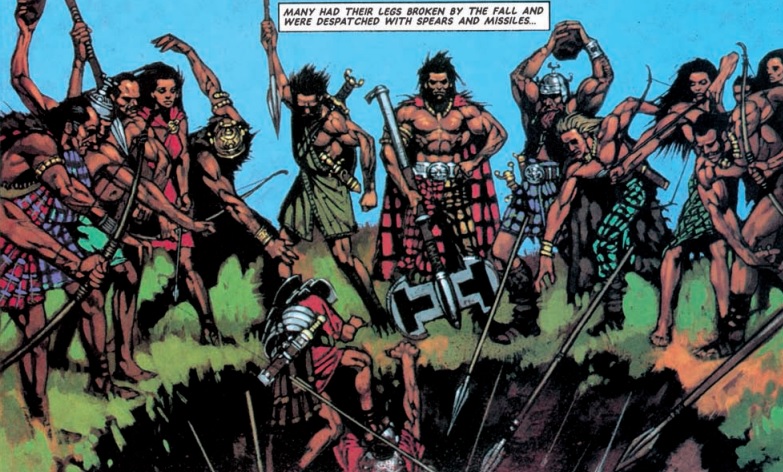
The battle is amazing – a mad mixture of the sort-of plausible with pure unabashed fantasy. Tremendous fun. Nothing really to say except that there were plenty of women as well as men among the Britons, who also had loads of trumpets like we see here, which terrified the Romans. I don’t think there’s any evidence the Britons were goaded into battle in the way we see here, but Graham Robb has a theory about how Boudica chose the battle site for scientific-religious-geographical reasons (Robb, The Ancient Paths, p 263)
Yes, the Britons’ retreat was impeded by their wagons; yes, even according to the Roman Tacitus the civilians were not spared. The cruel reprisals afterwards are accurate. ‘Hostile’ tribes had their lands laid waste.
The lament ‘Ochone’ is real, it’s Irish
The interior of the burial mound resembles real-life continental burials like that of the ‘Hochdorf prince’ – right down to the ‘bronze couch’
I don’t know if this claim about a planned conquest of Ireland is based on anything, but that could be my own ignorance. I will say that Suetonius Paulinus’ maps look way too accurate – the Romans didn’t have such technique in cartography. Their maps were terrible.
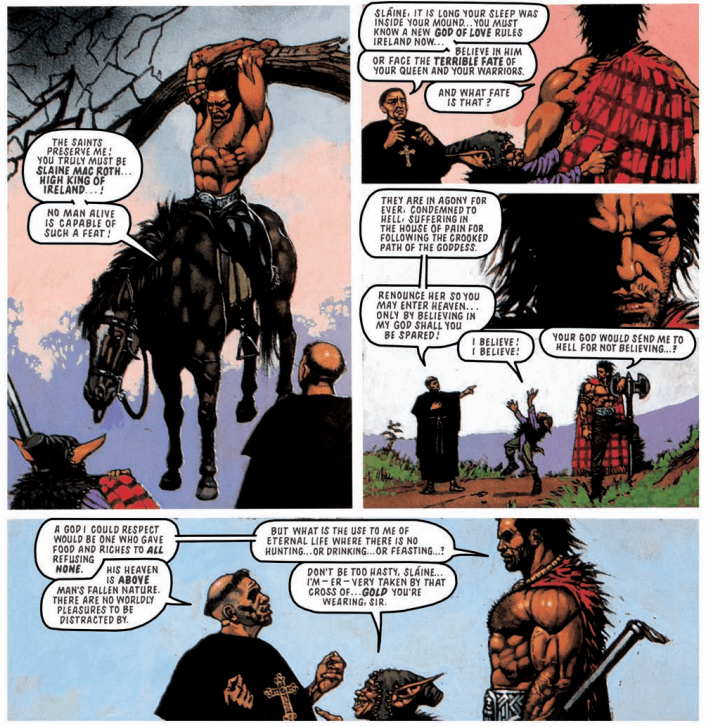
There is a little epilogue where Sláine returns to Ireland to find that his whole world has vanished with the passing of the years. This is brilliant, based on the myth ‘Oisín and St Patrick’ (In Gods and Fighting Men but also online here). In this story a legendary Celtic warrior argues with a Christian saint. It’s absolutely brilliant. The debate between Sláine and the priest is a faithful and creative interpretation of such ancient stories. There’s real authenticity in this little epilogue.
I expected to find like ten bullet points, not thirty-six!
Good thing I chose Demon Killer rather than The Horned God, or I’d have been here all day. The sum of all these little details is a major part of what makes Sláine work. I think the series has lost this over the years – never entirely, but to a considerable extent. Anyway, we’ll get on to that next week with Sláine: Part 3.
Books:
The Celts, Nora Chadwick, Penguin, 1972
The Celts: Search for a Civilisation, Alice Roberts, Heron Books, 2015
Gods and Fighting Men, Lady Gregory, 1904 (1970, Colin Smythe Ltd)



 The 1919 Review