
Or, the housing arrangements of psychopaths
A Demon in my View (1976), The Face of Trespass (1974), Dark Corners (2015)
My first knowledge of Ruth Rendell was probably of seeing her name on library paperbacks around the house when I was a kid. I didn’t read her stuff until many years later after reading some glowing endorsements of her by authors I like. The only title of Rendell’s available that day on my library audiobook app was one called A Demon in My View. So I went ahead and downloaded it. That was back in March; by August I had read three out of her many dozens of novels published across nearly fifty years. I’ll give a run-down of each of the three, in the order in which I read them.
I should add that I listened to these novels as audiobooks, performed by Julian Glover (A Demon in my View) and Rick Jerrom (The Face of Trespass and Dark Corners), who both do a great job.
By the way, the reviews below contain some spoilers.
A Demon in My View
I was hooked on this story, right from the fucked-up start to the ironic and satisfying finish. A Demon in My View is about a man who once terrorised his fictional London suburb as a serial killer, but who has settled into a safer middle age by getting his kicks repeatedly ‘murdering’ a mannequin who lives in the neglected cellar of his shared, rented house.
The killer is a despicable sadist but Rendell manages to get us into his head, convinces us to feel an iota of sympathy for the wretch. He was raised by an aunt who judged him because he was born outside wedlock. There is something pitiable in his uptight, timid, neurotic narrative voice. But this timidity is the flip side of his murderous compulsions; he has a drive to feel power over others by causing fear and pain. The most horrifying example is the flashback scene involving the baby, which nobody who reads this book will ever forget until the day they die.
The whole story revolves around the tension between his hidden world and the intrusive realities of a shared housing arrangement. What we’ve got here is a story that’s fundamentally about housing, a theme that is important in all three books of Rendell’s that I have read.
The story is firmly rooted in its time and place, not in a way that dates it but in a way that enriches it. A new flatmate moves in; he has a very similar name to the secret serial killer, which provides all kinds of opportunities for confusion and subterfuge. In the 1970s, when this story is set, the post was crucial to people’s social lives and communications, and the only phone in a shared house word likewise be a shared one. The new arrival is really our main narrator and protagonist, but the long agony and final comeuppance he inflicts on our serial killer is unintentional and indirect.
Here is a writer, I thought, who can keep me in suspense, craft a believable social and cultural world, invest me in the practical limitations of comms in the 1970s, and horrify me with a rounded portrait of a human monster.
The Face of Trespass
The Face of Trespass is about a young writer living semi-feral in his friend’s cottage on the wooded margin of London while his girlfriend, a married woman, tries to convince him to murder someone. The story is bookended by a brilliant introduction and conclusion which involve a completely different cast of characters but which provide a resolution to the story. The day is not saved, but at least we get a significant consolation at the very end and from an unexpected source.
Murder is of course not relatable. But Rendell surrounds it, links it intimately, with things that are closer to our everyday lives. There’s lust, greed, envy. Again, housing. Scarcity of funds. An elderly mother living in another country and slowly dying; linked to this, a stepfather with emotional baggage and a language barrier. Aunts and old school friends. Pets. Obligations.
Apart from the aforementioned bookends, we stay in the point of view of the main character, the struggling young writer. Everyone reading The Face of Trespass will be able to see clear as day how our main character is being set up. I found this a little frustrating; we hate protagonists who are fools, who walk blithely into trouble. But in the end all was forgiven. Rendell’s playing a deeper game. The girlfriend is out to set him up – that’s obvious. What’s not so obvious (though all the clues are there) is (spoiler alert) how he will get out of it in the end.
Even more so than in A Demon in my View, seventies comms are central to the novel; much of it revolves around people waiting by phones.
One surprising highlight of this novel is the stepfather. I don’t know if I would pick up a book based on some blurb about a stepfather-stepson relationship. But the murder/mystery/thriller genre here serves as a vehicle for an amusing and, in the end, quietly moving sub-plot.
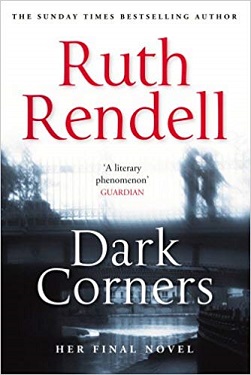
Dark Corners
Dark Corners was Rendell’s last novel, written decades after the other two above. It is still very good and gripping, but rougher around the edges.
At one point in the novel the main character, again a writer, laments that the characters in his work-in-progress all speak like they come from the middle of the century. This must be Rendell’s little dig at herself; the characters speak and often act like they just walked out of the much more affordable London of A Demon in my View. Modern things like the internet are mentioned a lot, but usually bracketed with some comment like, ‘Johnny supposed that this was the way things were these days’ – as opposed to thirty years ago, before Johnny was born.
Like The Face of Trespass, pets and vets come into it. But it’s housing that’s at the heart of the novel, in ways that highlight how the issue has changed radically since the 1970s. The landlord in A Demon in my View is a rather greasy and selfish character; the landlord here is a struggling writer renting out the upstairs of his late Dad’s house so that he can work full-time on his novel. But his tenant proves to be far more trouble than he’s worth. He refuses to pay the rent and refuses to move out.
Meanwhile a rudderless young woman finds her rich friend dead, and proceeds to occupy her apartment and wear her clothes. But impersonating a rich person, like taking in a tenant, proves to be more trouble than it’s worth. In this case, that’s putting it mildly: she is brutally abducted and held for ransom.
These two characters are a few degrees of separation from one another and only meet toward the end, in a very fateful encounter.
Again, the literal setting is London – and there’s a powerful sense of place – but on a deeper level the setting is the human mind struggling with fear and longing. Rendell’s home turf is psychology. As in A Demon in My View, we see the murderer from the inside out, and he is wretched and pitiful. Unfortunately, like The Face of Trespass but more so, we have a struggling writer who spends a chunk of the novel just frustrating us with his passivity and short-sightedness.
There is a third, and subordinate, storyline about a retired man who rides buses for fun (Yes, a third storyline. All three of these books are very slight, but it’s amazing how much is crammed into Dark Corners). This storyline is fun, but its culmination is the retiree very suddenly foiling a terrorist bomb plot. Rendell has this humane side that allows her to write stories where a modest older man becomes a hero thanks to his eccentric hobby, and that is satisfying. The problem is that the bombing has nothing to do with anything else in the novel, and has no impact on subsequent events.
This is one of many strange improbabilities and coincidences that, to my mind, constitute gaps in the fabric of the novel. It’s all the more obvious when compared to how tight-knit the other two books are. It appears the novel is kind of about coincidences – stories criss-crossing in a Pulp Fiction kind of a way. Coincidence played a role in the others, but to a lesser degree, and with more subtlety, and to better effect.
Dark Corners is readable and satisfying, but rough and flawed. In addition to its other virtues, it is rough and flawed in interesting ways.
First and foremost, these were gripping thrillers that passed the time for me while I did chores or drove. But the contrasts between the younger writer and the older, between the younger London and the older, added a great deal to the experience for me.

 The 1919 Review