
Hi, this is Part Two of my run-down on The Dawn of Everything, a book that asks how unequal, hierarchical and class-ridden societies first arose. Here is Part One.
In this chapter Graeber and Wengrow ask:
- What did indigenous Americans in the 17th Century think about Europeans?
- To what extent did the Enlightenment draw on sources outside Europe?
- What does ‘egalitarian’ even mean?
And they emphasize the urgency of these questions: ‘A very small percentage of [the world’s] population do control the fates of almost everyone else, and they are doing it in an increasingly disastrous fashion.’ (p 76) If we want a free society that is not careering toward ecological and social catastrophe, we need to figure out how it came to be that a small minority ended up in control.
Before starting their story of humanity from the beginning, the authors detain us for one chapter to argue that a lot of our ideas about that epic story are wrong to begin with, and to give an account of why. This involves rewriting the history of the Enlightenment. So that’s the fairly ambitious idea of the part we’re looking at today:
Chapter 2: The Indigenous Critique
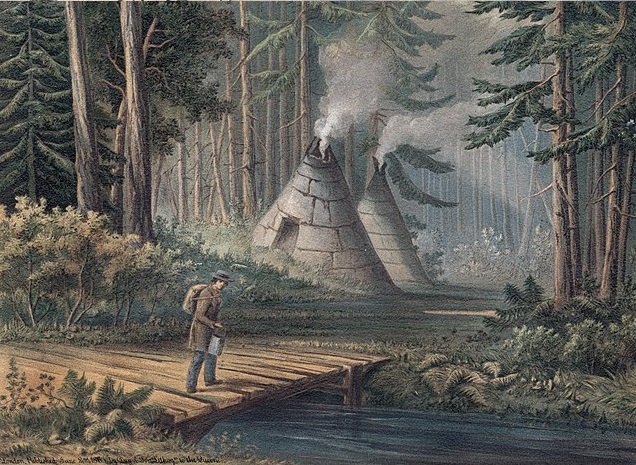
Along the way, the book delivers a lot of what I expected and wanted. For example, we get a sketch of several indigenous American societies before their destruction by European settlers.
The Wendat (Huron) grew crops around inland fortified towns. They had formal political officers and a caste of war-captives with limited rights, whom the European observers assumed were slaves. Other tribes such as the Mi’qmak and Montagnais-Naskapi, meanwhile, were bands of hunter-gatherers.
The Europeans saw these people as eloquent and very good at reasoned debate, skills honed in near-daily discussions of communal affairs. The Europeans also noticed that they possessed individual liberty, and wholeheartedly disapproved. Laws were not enforced, fathers did not control children, captains had to rely on their own persuasive power to get people to fight.
Jesuit missionaries were shocked to observe the ‘equality of the sexes’ – women had sexual freedom and the right to divorce. But there was a gendered division of labour, with women owning and working the fields while men hunted and fought. This reminds me of Engels’ explanation of how gender inequality came about. His vision of the prior state of equality does not preclude a gendered division of labour.
Looking at the Wendat, I feel like I’m re-playing the greatest hits from Celtic Communism? In an exact parallel with Gaelic Ireland, the Wendat practised communal compensation rather than punishment. There were wealthy people among the Wendat – but, and we saw elements of this in Gaelic Ireland too, the main incentive in hoarding material things was to give them away and thus boost one’s own prestige.
Graeber and Wengrow say lots of clever and interesting things – such as, in relation to the Wendat, ‘insofar as we can speak of communism, it existed not in opposition to but in support of individual freedom’ (p 48) – but they miss one obvious point. The 17th-Century Wendat (I specify 17th Century because, as far as I know, they are still around) had richer and poorer individuals, and individuals who held political office (on the sufferance of those who did not). What they did not appear to have had was distinct classes in conflict with one another. Again, here we see some parallels with Ireland. The Wendat were equal and egalitarian and communist in the sense that they all belonged to a single class. Like with my previous Celtic ruminations, here we are troubled out of complacent identification with the people of the past by the spectre of the un-free, the layer or caste who existed within the community but with curtailed rights. But the authors here don’t seem at all interested in class, and are visibly aggrieved when the Enlightenment salons turn from discussions of political institutions to discussions of economics.
Indigenous people roasting Europeans
What’s equally fascinating is the low opinion these Indigenous people had of Europeans when the latter arrived in the sixteenth, seventeenth and eighteenth centuries. For some reason I tend to forget that European colonisers and indigenous people lived in proximity for centuries, had developed opinions and analyses about each other, and left records of same. What is more, these records were a very popular type of book in early modern Europe.
The Mi’kmaq, around 1608, saw their (overwhelmingly male) French neighbours as envious, slandering, lying, quarrelling, covetous and ungenerous. ‘They are saying these and the like things continually,’ writes the Jesuit missionary who recorded these opinions. To the missionary it was obvious that while the French had more material goods, the Mi’kmaq had more ease, comfort and time.
Twenty years later a missionary among the Wendat recorded that they had no lawsuits and were not covetous. There were no beggars ‘in their towns and villages’ (I admit, embarrassed, that I didn’t know they even had towns and villages before I read this). As for beggars the Wendat heard of existing in France, they ‘blamed us [the French] for it severely.’ While the Wendat had daily community gatherings and discussions, the French interrupted one another, quarrelled, competed to hog the limelight, and often resorted to weak arguments.
This chapter does great service to history by promoting knowledge of a Wendat political leader named Kondiaronk who actually visited France as a diplomat and, in lengthy salon discussions with Frenchmen back on his home turf, voiced a powerful critique of European society.
‘The whole apparatus of trying to force people to behave well would be unnecessary if France did not also maintain a contrary apparatus that encourages people to behave badly,’ declared Kondiaronk – that ‘contrary apparatus’ consisted of money, property rights and profit. If you want to learn more about Kondiaronk, I really recommend you read this book.
Stages
This brings us to the main focus of the chapter. The authors basically give an alternative history of the Enlightenment, arguing that this indigenous critique was of key importance. The idea of societies developing through stages is attributed to the economist Turgot, who developed the idea as a defence mechanism against the indigenous critique: in short, the indigenous people say that Europeans are un-free and miserable, but it doesn’t matter what they say, because they are on a lower level. Their freedom is ‘lower’ than our slavery.
Rousseau’s famous essay on the origin of social inequality appears here as a strange synthesis of the indigenous critique and of the ideas developed to counter it.
I have mixed feelings on this. Texts such as the main one cited here, Curious dialogues with a savage of good sense who has travelled (1703), are fascinating and valuable and it’s a shame they were dismissed so lightly as fabrications. And this narrative of the Enlightenment as a period when Europeans encountered and opened up to ideas from other parts of the world was fresh and interesting. It’s an ambitious argument, though, and the fact that it’s so much at odds with other accounts of the Enlightenment that I’ve read would give me at least pause for thought. Doesn’t the receptiveness of European minds to the indigenous critique say something about how developments within Europe were also driving the Enlightenment?
Whatever Turgot’s agenda was, the idea of societies ascending through stages of economic development is, in itself, a good one. Married to arbitrary criteria, or none at all, (sorry, Age of Empires), this idea leads to bad places. But you can attach it to valuable criteria (such as the productivity of labour) and thereby give some meaning to the concept of progress underlying it. I predict the authors are setting things up for an attack on Marxism in future chapters. They are emphasizing the conservative pedigree of the idea of stages of economic development as part of lining up those dominoes. We’ll see how that goes in the coming chapters.
I enjoyed this chapter in spite of reservations. I hope Kondiaronk and his opinions on early modern European society become a staple of school history courses.


 The 1919 Review