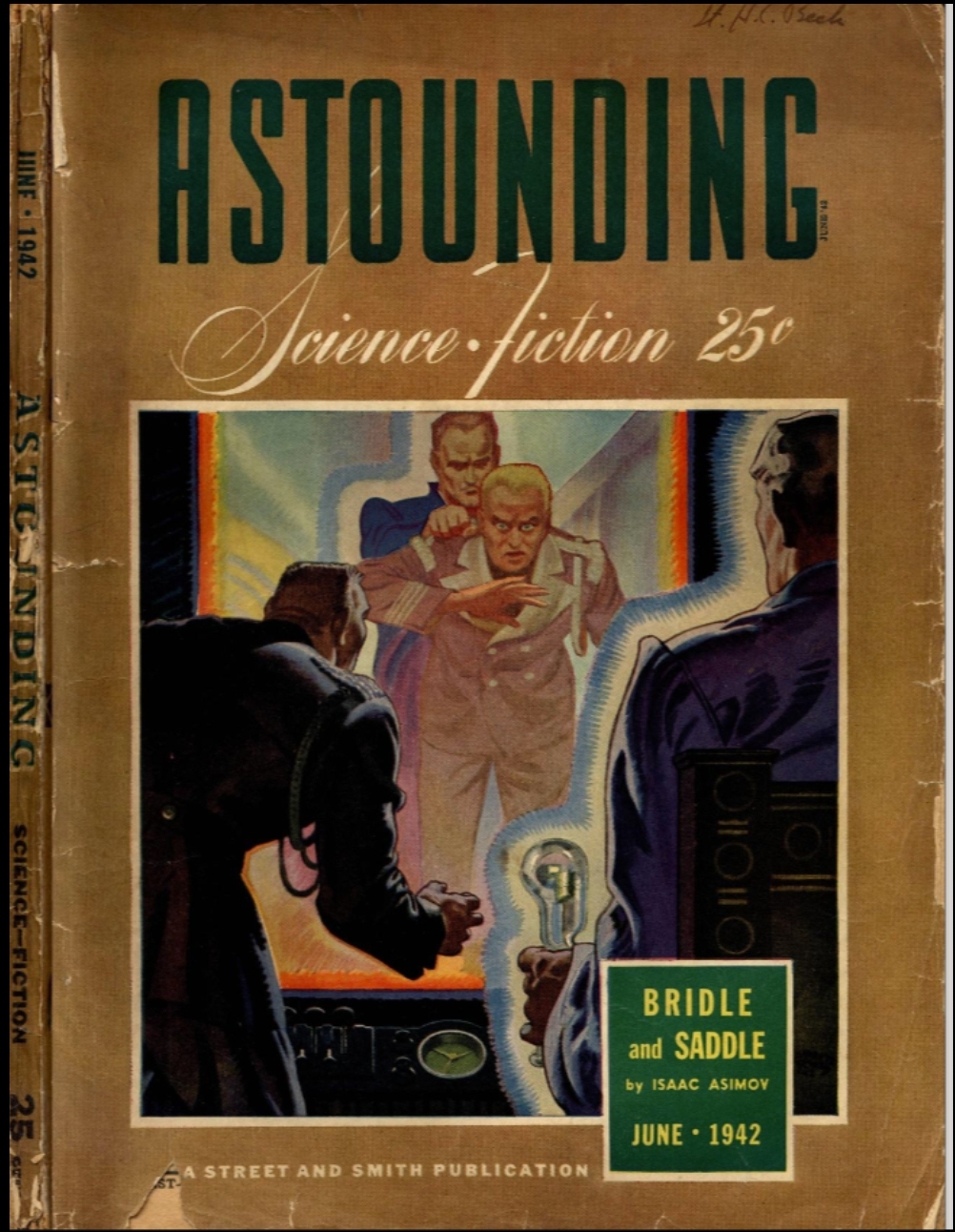

What I’m Reading: Second Foundation by Isaac Asimov

Second Foundation is the third volume of the original Foundation trilogy so before I get into it I’ll sum up what I wrote here on this blog about volumes 1 and 2, Foundation and Foundation and Empire.

I liked the deterministic mid-century materialism of Foundation. On the other hand, it could be smug and cynical and it was extremely of its time (imagine, someone probably died in combat on Iwo Jima knowing what the Seldon Plan was). It was quite dry, to-the-point, talky and minimalist.though it got more flashy and dramatic as it went on. Then at the midpoint of Foundation and Empire Asimov threw the old formula out the window. So long, mid-century determinist fable – don’t let the vast socio-economic forces hit you in the arse on the way out – it’s time for a fun swashbuckling adventure about a villain who can do mind control. This new formula boasted better characterisation and pacing, but overall I missed the tweedy old Foundation.

Second Foundation, like Foundation and Empire, contains two stories separated by a few decades. The first story concludes the story of the Mule, the psychic warlord introduced in the previous volume. He searches for and struggles with the Second Foundation. At last towards the end we get a glimpse of this mysterious institution.

Skirting around spoilers, we don’t see any more of the Mule in the next story. ‘Good,’ I said to myself. ‘We’re back on track. No more Space Yuri. We’re back to the Seldon Plan. Amoral characters as unwitting agents of vast historical forces. Empires hobbled by their own overextension. Kingdoms brought low by atomic hairdryers.’ But I ended up disappointed; this too was a story about psychic powers and mind control. We are focused on the Second Foundation in this story, and they just so happen to be a bunch of psychics like the Mule. Asimov labours to tie it in with the whole idea of psychohistory.
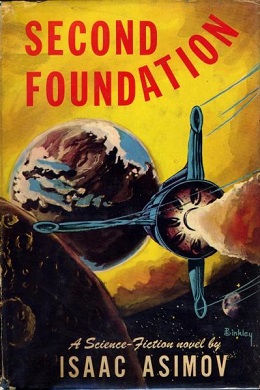
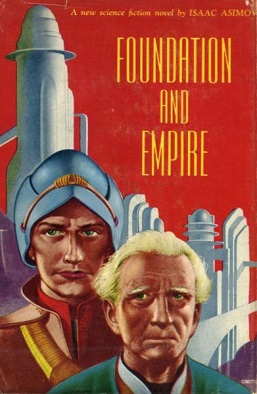
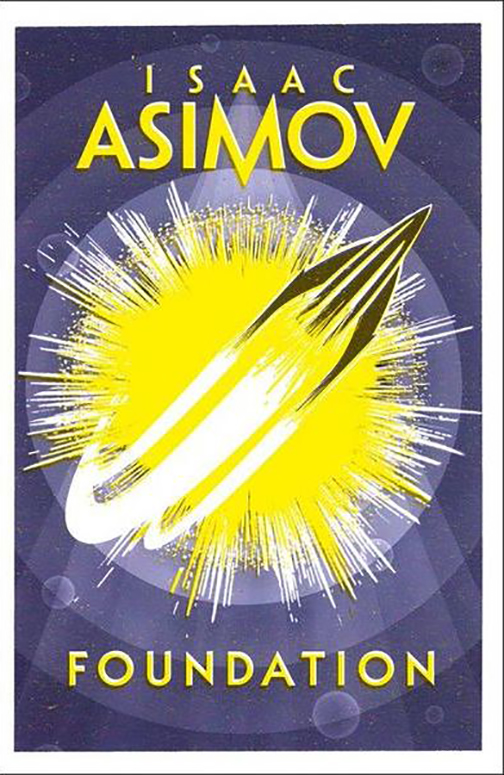
Dust jacket of 1953 edition

The Magneto in the High Castle

To get a sense of how I feel about this, imagine if half-way through The Man in the High Castle Philip K Dick had suddenly introduced Magneto from the X-Men. For the uninitiated, Magneto is, like the Mule, a mutant with special powers; he can control metal with his mind. So imagine if a good chunk of The Man in the High Castle is about Magneto picking up panzers and flinging them around squishing prominent Nazi leaders. Dick’s counterfactual 1960s Nazis are developing plastics, so I suppose they  finally build a plastic tank and squish Magneto in turn. After Magneto is vanquished, there is one final episode in the story, concerning the Japanese Emperor, who it is revealed also has magnetic powers. Dick goes out of his way to explain this, somehow, with reference to the I Ching, in order to tie this absolute nonsense back into the original ideas of the story.

However fun this scenario would be, it would kind of distract from the fascinating questions that Dick uses his alternate history to ponder. To take another example, just for fun, imagine if half-way through The Dark Forest by Cixin Liu, when we are invested in wondering how humanity is going to hold off an alien invasion, the clouds part and Jesus descends, turns a lot of water into wine, and dies on a cross somewhere half-way through Death’s End.

This is kind of what happens with the original Foundation trilogy. Its second half is fun and not by any means devoid of the interesting ideas we find in the first half. The mysteries – where is the Second Foundation? Who are its secret agents? Who is its mysterious leader, the First Speaker? – are solid with good development and payoffs. But they are mechanical. They have more to do with the craft of storytelling than with the science of psychohistory.

And, I mean… no doubt Dick would have written Magneto pretty well too, and would have found some time to ponder the nature of reality itself in between the scene where Bormann gets squashed by a panzer and the scene where Goebbels gets boa constricted by a lamp-post. But it would still have been a wild and irrelevant departure from a promising story.
The spiral galaxy Messier 83. Credit: NASA, ESA, and the Hubble Heritage Team (STScI/AURA)
Acknowledgement: William Blair (Johns Hopkins University)

Motivations

The second half of this volume presented some problems for me, even aside from all that. In this story a group of private citizens from the Foundation are hunting for the Second Foundation, because some people’s brainwaves have started to show up a little strange on the mind-reading machines, and it is suspected that the Second Foundation is interfering.

The motivations of this group of private citizens don’t make much sense. The Second Foundation saved them and it is part of the Seldon Plan, which is their secular religion. And then during the story, agents of the Second Foundation save their arses again and again.  The two Foundations have no basis for conflict at all. In spite of all this, our Foundation characters remain determined to root out the Second Foundation and its agents with extreme prejudice. Not only does it seem perverse, it doesn’t seem urgent at all. There is no existential threat to the Foundation here. The story lacks urgency, unless it is our desire to see how the Second Foundation will stop these gobshites, but the author doesn’t really commit to that either.

It gets worse (and spoilers follow). When the Foundationers identify one Second Foundation agent in their own circle, they immediately torture and restrain him (p. 229, 1994 HarperCollins Voyager edition). When the Foundation crowd believe they have found fifty agents of the Second Foundation, they do not take long to decide on their narrow range of options:

‘What will we do with all of them… these Second Foundation fellas?’

‘I don’t know,’ said Darell, sadly. ‘We could exile them, I suppose. There’s Zoranel, for instance. They can be placed there and the planet saturated with Mind Static. The sexes can be separated or, better still, they can be sterilized – and in fifty years, the Second Foundation will be a thing of the past. Or perhaps a quiet death for al of them would be kinder.’ (p 232)

A subsequent scene confirms that one of these fates has indeed befallen the fifty agents. Though we are not told which one, it hardly makes a difference!

The early-1950s viewpoint of the author offers some sources of interest and amusement, and, occasionally for me, mild disgust. But I was struck in a nice way by this description of an automatic ticket machine as a futuristic wonder:

‘You put a high denomination bill into the clipper which sank out of sight. You pressed a button below your destination and a ticket came out with your ticket and the correct change as determined by an electronic scanning machine that never made a mistake. It is a very ordinary thing[…]’ (p 169-170)

We have that now, and the only abnormal thing there is using cash instead of card. My knee-jerk reaction is to think, ‘how quaint.’ But on reflection, what prescience.

Conclusion

So that’s how I felt about Second Foundation: enjoyed it, recommend it, but expected more and felt it could have been more.

My verdict on the whole Foundation trilogy (I haven’t read the prequels and sequels written forty years later, so for me it is still a trilogy): “The General” in Foundation and Empire and the first few dozen pages of “The Mule” in the same volume represent a kind of peak Foundation for me. It’s lost some of the excessive dryness of the first volume without yet taking on all the extraneous psychic stuff. After this point, it never stops being entertaining or having good ideas; to its credit, it never retcons; and in some ways the writing improves… But it loses touch with its basic theme. The author seems to have lost interest in the question of predicting and planning the future through mathematics and psychology.

No wonder it ends unfinished, only half-way through Seldon’s thousand-year interregnum. Maybe that’s for the best. The rise of the Foundation into a new Galaxy-wide empire would not have been half as interesting as its early struggles for survival. Let’s remember the assumptions the series is built on: that empires are good and interregna are bad. Later stories would have had to go back and deconstruct a lot of that, if they wanted to remain thoughtful and interesting.

Home Page/ Archives

What I’m reading: Foundation and Empire by Isaac Asimov

Last year I wrote about Isaac Asimov’s novel Foundation (1951), in which a small community struggles to preserve culture and technology on the fringe of a collapsing galaxy-wide empire. Hari Seldon, the man whose command of the science of psychohistory allowed him to predict the collapse, has laid out a plan for this community, the Foundation, to unite the Galaxy in ‘only’ a thousand years or so. Foundation is episodic, as every 50-100 years the Foundation is presented with a new existential threat and the question is ‘How will the immortal science of Marxism-Seldonism get them out of this one?’

The sequel Foundation and Empire consists of just two longer episodes, ‘The General’ and ‘The Mule.’ They’re both good and they’re both set in the same world, one after the other. But in tone, theme and style they are two completely different novels. With ‘The Mule,’ we can see Asimov completely throwing out the old formula and introducing a new one. His story about interstellar socio-economics becomes a boisterous space opera about psychics and mind control.

Featured image: ‘Laser Towards Milky Way’s Centre’ by Yuri Beletsky. From Wikimedia Commons. https://apod.nasa.gov/apod/ap100906.html

The General

The first part of the book is peak ‘old-formula’ Foundation. I unambiguously love it. General Bel Riose, the most capable military leader in the decaying rump of the Empire, sets out to conquer the Foundation. His will, his ability and the forces at his disposal are all more than sufficient to the task. How can he possibly fail? 

The main characters are two captives of Bel Riose: the old Imperial aristocrat Ducem Barr and a Foundation trader named Lathan Devers, who are trying to spoil the General’s design. Their mission centres on an apparent contradiction: they must pursue this task with urgency and initiative even as they maintain their faith in the inevitability of a Foundation victory through the Seldon Plan.

A part of my pleasure in this story came from the way our two main characters speak with very distinct voices. Here’s Lathan Devers on page 37 (2016 HarperCollins edition), faking indifference but with some measure of genuine conviction:

Listen […] what’s defeat? I’ve seen wars and I’ve seen defeats. What if the winner takes over? Who’s bothered? Me? Guys like me? […] Get this […] there are five or six fat slobs who usually run an average planet. They get the rabbit punch, but I’m not losing peace of mind over them. See. The people? The ordinary run of guys? Sure, some get killed, and the rest pay extra taxes for a while. But it settles itself out; it runs itself down. And then it’s the old situation again with a different five or six.

I’ve gone into Foundation’s influences on Star Wars before, but it’s so clear in this book, right down to the characters’ voices and attitudes. There are whole pages where we might as well be in the company of Obi-Wan Kenobi and Han Solo; Ducem Barr does a good line in traumatised reminiscences and holding forth about psychohistory the way old Ben does about the Force, and Lathan Devers would have you believe that he’s in it for the money, doesn’t give a damn about your struggle for freedom, and doesn’t have any time for far-fetched ancient belief systems.

Devers, however, is in it for the revolution. He tells the leaders of the Foundation that he wants to ‘spread the wealth a bit, and keep it from concentrating too much out of the hands that work for it.’ (78) And in the next episode we learn that ‘Devers died in the slave-mines […] because he lacked wisdom but didn’t lack heart.’ (89) This is part of a satisfying pattern where each episode by the way refers back to the characters in the previous one.

Compared with the earlier Foundation stories, this one has more detail, more drama, more interstellar travel, and more character. It even has some action. We get a few scenes with the Galactic Emperor himself. It’s still a very talky piece, as if Asimov wrote it with an eye to royalties from a radio play adaptation. But it’s a development.

The contradiction between individual initiative and historical inevitability is resolved very well. Without getting into spoilers, maybe the actions of our main characters were just part of a more general movement which could be predicted mathematically, or maybe they are there only to illustrate the broader trend. They didn’t solve the problem by their own actions – Ducem Barr remarks after the event that ‘through all this wild threshing up of tiny ripples, the Seldon tidal wave continued onward, quietly – but quite irresistibly.’ (76) But that doesn’t mean their actions didn’t matter.

First edition cover. From Wikipedia.org

The Mule

I grumbled about Foundation being very dry, talky and un-visual, and having almost zero women in it. The second half of Foundation and Empire blows all these complaints out of the water. The lead character, Bayta Darrell, is a strong and smart woman; there is more humour, travelogue, spectacle, more set-pieces. The narrator becomes sassy and sardonic.

At the same time it might be a case of “be careful what you wish for.”

There are things that would have been impossible in previous Foundation stories, not all of it good. Asimov moves from the version of sexism where you pretend there are no women in the entire Galaxy to the version of sexism where you describe women’s appearances more than you really need to, or have supposedly sympathetic men say patronizing shit to them. There is hack stuff, whimsical stuff, clichés: a silly clown who talks Shakespearian; a scene which is just making fun of the way women in a typing pool talk to each other; a psychedelic bit where a special musical instrument triggers hallucinations; an episode in which a villainous nobleman captures all the main characters because he wants to have sex with Bayta.

All in all, this story is written more like a traditional novel of its time. So on the one hand it’s better-crafted and easier to get into. On the other hand, it’s less distinctive. It becomes less about the things Foundation is about.

It starts very good, with all the strengths of the new formula on display. Asimov does a neat job of showing us how the Foundation has grown authoritarian and how its outside colonies of traders chafe under its rule and long for independence (as predicted by Hober Mallow and Lathan Devers). ‘Every vice of the Empire has been repeated in the Foundation. Inertia! Our ruling class knows one law; no change. Despotism! They know one rule; force. Maldistribution! They know one desire; to hold what is theirs.’ (89) Instead of giving us a page from the Encyclopedia Galactica explaining it all, the author conveys it through a sequence where a newlywed couple, one from the Foundation and one a trader, go on a family visit and end up being recruited by the Traders’ resistance movement.

So far, so good: we have a Foundation story but told in a more balanced and engaging way. It is setting us up for a story of class warfare and social revolution. Then all of a sudden it ceases to be a story about sociology or economics or politics and becomes a story about mind control. The Seldon plan is thrown into disarray by the appearance of a man who can hypnotize people. Haha! You didn’t consider that possibility, did you Hari Seldon? You dumbass.

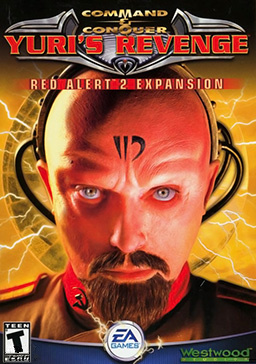
Before I get into criticism of the Yuri’s Revenge turn, let’s just clarify that the story is good and fun and intelligent. The mysteries and twists are one step ahead of the reader. But it’s not a spoiler to say that for the rest of the trilogy the mind control never really takes a back seat. And I just didn’t get as much out of this series from here on out.

Suddenly it all gets a bit ‘Your command is my wish.’ Cover art for Command and Conquer Red Alert 2 Yuri’s Revenge (2001) featuring Udo Kier, a great German actor who passed away this year. Was the Mule a model for Yuri?

What’s my problem with the mind control? Science fiction stories are generally based on “what ifs.” In this case: what if we could predict (and subtly shape) the future development of society through psychology and mathematics? But half-way through the trilogy Asimov suddenly asks, ‘And what if, also, there was a magical guy who could permanently control the emotions of everyone he met?’ It complicates and obscures the original ‘what if’ question.

A defence of Asimov here would be to say that psychohistory deals only with masses of humans, so the mind control stuff is relevant because it’s something happening on the individual level that psychohistory can’t predict. This is stated explicitly a few times. But I just don’t buy it. There’s got to be a more subtle way of interrogating the role of the individual in history and the potential weaknesses of the Seldon Plan. Say, introduce a guy who’s really charismatic, or a small organisation that’s really disciplined. There’s a lot that can happen on a level lower than the actions of billions. Introducing magical mind control, no matter how much Asimov labours to explain it and tie it into psychohistory, doesn’t further explore the concept. It just takes the story somewhere else entirely.

The mysteries are no longer like “how will the Foundation exploit atomic gadgets to control their stronger neighbours?” and more like “Which of these characters is the big baddie in disguise?” and “Which of these planets is the secret base of the Second Foundation?”

I want to re-emphasize that this story is better on a craft level than what came before. My friends who read Foundation at the same time as me didn’t like it, because of the very shortcomings that are addressed in Foundation and Empire. But from my point of view Asimov threw out the baby with the bathwater here. My enjoyment of ‘The Mule’ was tinged with disappointment.

I’ve also read the third novel in the series, Second Foundation, and I will be sharing my thoughts some day soon. Stay tuned.

Nine things that inspired Star Wars

This week I’m taking a break from Miseducation Misadventures to let you in on what runs through my head when I watch Star Wars. Re-watching it as an adult, I notice little things that I can trace back to their source – like the scattered mentions of spice mines and spice freighters in the first movie. Any guesses which SF novel that’s a nod to?

Here are nine sources from which Star Wars drew key ideas. If I’ve missed any interesting ones, chime in down in the comments.

1: Reproductive Biology (2,000 million BCE)

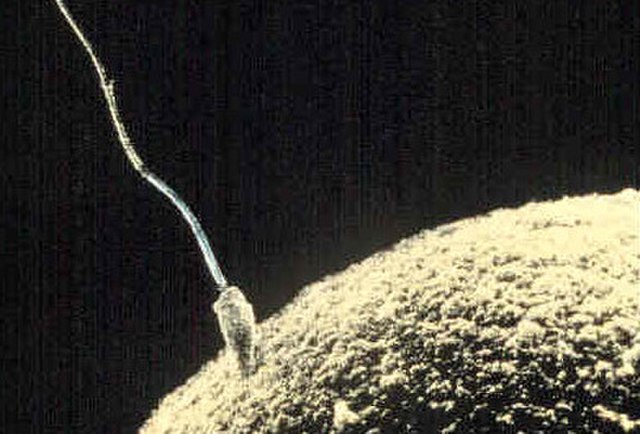
The final battle in 1977’s Star Wars involves a swarm of small starfighters approaching and seeking to penetrate the much larger orb of the Death Star. This looks a hell of a lot like a load of sperm trying to fertilise an egg, with zero-gravity space standing in for the liquid medium through which the little swimmers propel themselves. This was probably not deliberate – the imagery probably bubbled up from the filmmakers’ subconscious. It stands out all the more starkly against this pre-adolescent and mostly sexless galaxy.

2: Metropolis (1927)

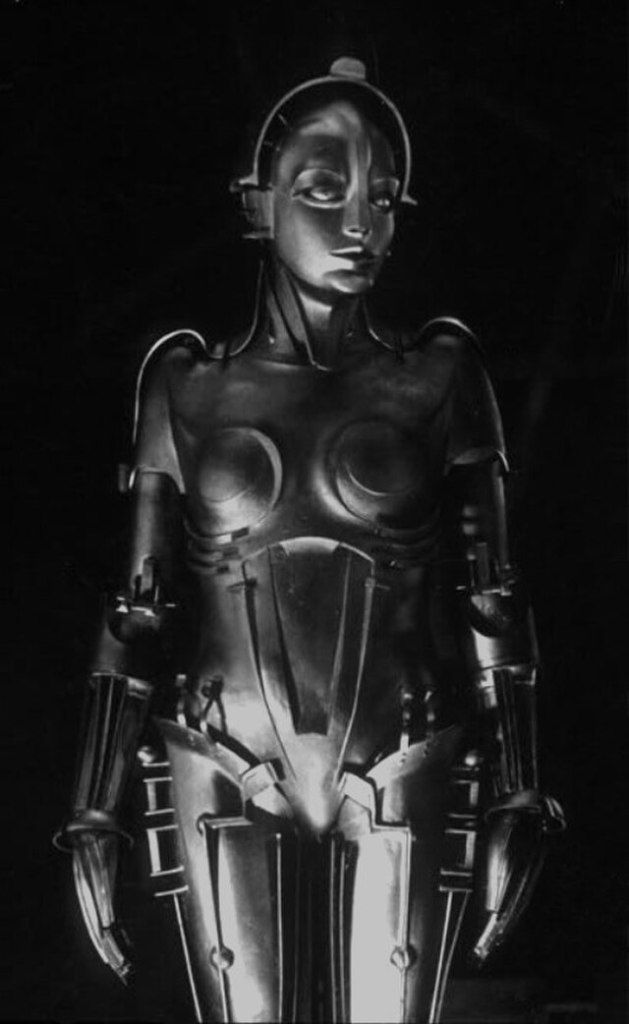
And here we have a female version of C-3PO, in an experimental silent film from Weimar Germany.

3: Flash Gordon (Comic and movies, 1930s)

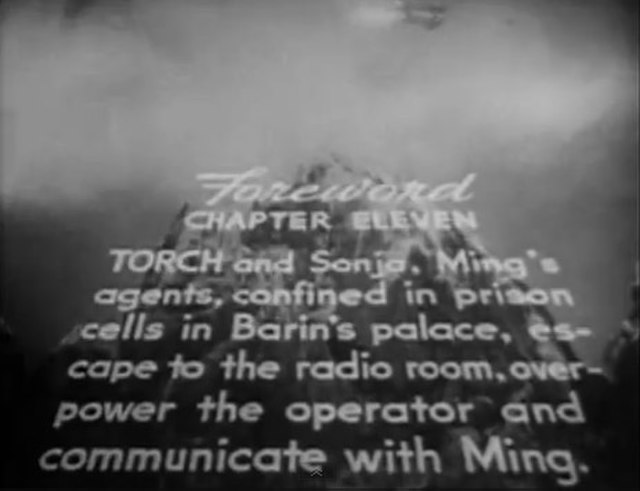
Star Wars took a few cues from Flash Gordon – most obviously the opening text crawl but also the general idea of a series about fun adventures in space.

4: World War Two (1939-1945)

In 1977 when Star Wars came out, World War Two was as recent as the collapse of the Soviet Union, or the first episode of The Simpsons, is to us.

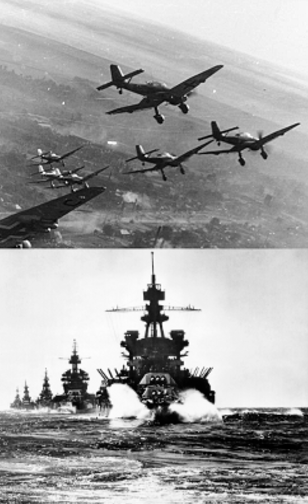
And the movie helps the audience to grasp what is happening in space by using a visual language familiar to them: it has World War Two-era fighter planes in space. The Empire’s star destroyers resemble the warships of the mid-century. The Imperial officers dress like Nazis.

On the other hand, weirdly enough, Star Wars references the Nazi propaganda film Triumph of the Will. The final scene where the rebels have a rally and the human characters all get medals (a weird enough scene in itself) follows part of this notorious film very closely. An odd choice, having the good guys mimic the visuals of a genocidal regime, especially when the bad guys are clearly based on them.

5: Casablanca (1942)

In a colourful jazz bar full of diverse people, in a town full of thieves and refugees, in a desert land where an evil empire is tightening its grip, we meet a cynical smuggler who is secretly an idealist. Will he find it in himself to help the two desperate fugitives who are seeking passage to safety? Of all the cantinas in all the systems in all the galaxy…

6: Foundation by Isaac Asimov (1940s-1950s)

The story and themes of Star Wars and Foundation don’t resemble each other at all. But there are many little things which Asimov seeded in the science fiction genre which pop up in Star Wars:

  • Hyperspace travel
  • Weapons called blasters (much more lethal in Asimov)
  • A galactic empire
  • Space feudalism
  • A city which covers an entire planet (Trantor/Coruscant)
  • The wild outer rim of the galaxy
  • It goes right down to random names: Asimov’s Korellian Republic is echoed in the Corellian shipyards
  • Roguish traders who do the right thing in the end (Foundation has several Han Solos in it, who say things like ‘Never let your sense of morals prevent you from doing what is right.’)

But for Asimov, empires are fundamentally good, the roguish trader is an advertisement for a doctrine of enlightened self-interest, and mysticism is nothing but a charade. All this is at odds with the anti-authoritarianism and sincerity of Star Wars.

7: Akira Kurosawa (1930s-1980s, especially 1950s)

Japan’s most well-known film director had a huge influence on George Lucas and Star Wars. I haven’t seen The Hidden Fortress (1958) but apparently it involves two peasants who escape from a battle (like C-3P0 and R2D2) and meet a princess; there are sword fights, and in the end a bad warlord changes sides. But I’ve seen a few others, like Throne of Blood, Ran and Seven Samurai. Any of these great samurai films show themselves to be ancestors of Star Wars. There are the sword fights and the robes and Darth Vader’s helmet. In a western ear, names like Obi-Wan Kenobi have a Japanese ring to them, and the Jedi resemble an idealised version of the Samurai.

8: Dune (1965)

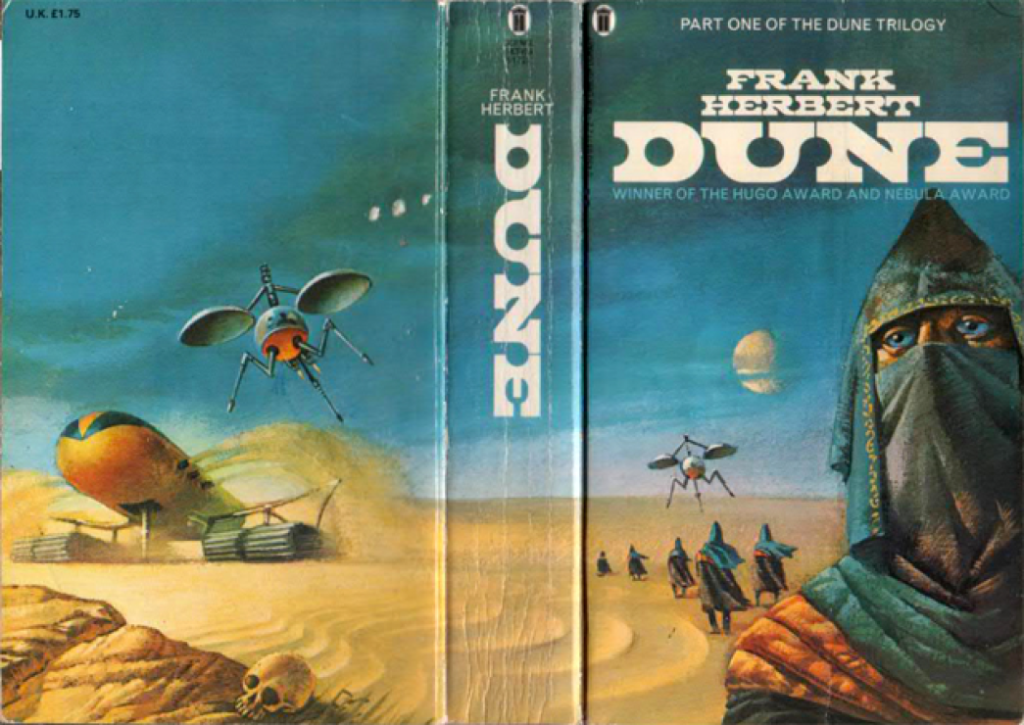
Frank Herbert’s Dune is riding high after Denis Villeneuve’s great film adaptation and I’ve written about it a few times before. Like Foundation, it provided a lot of ideas for Star Wars to pick up.

  • Dune is closer than Foundation to the themes of Star Wars. It is a text that was obviously written at the height of the anti-colonial struggles of the 1960s; it is pretty negative about empire; it is deeply sincere about religion and mysticism (even in charade form!).
  • The Jedi look like samurai, but they owe much to Dune‘s Bene Gesserit, an order of women who cultivate superhuman powers.
  • Both texts feature a harsh desert planet (Arrakis/Tatooine)
  • And giant worms,
  • robed nomad raiders,
  • smugglers,
  • and moisture-harvesting technology.
  • As noted above, scattered references to spice in the first Star Wars movie are another nod to Dune.
  • And once again we have space feudalism.

Foundation and Dune are the best examples I can think of, but they are stand-ins for a whole rich genre of mid-century science fiction without which Star Wars would not have existed.

9: The US War in Vietnam (1965-1973)

A few years ago Star Wars creator George Lucas confirmed in this interview that his story was fundamentally anti-colonial, that his heroic rebels were based in part on the Vietcong and that the evil empire was based on the United States – along with other past empires and freedom fighters throughout history.

Vietnam has featured just as heavily in other radically different readings of Star Wars, which is unsurprising as the war ended just a couple of years before the movie came out. I can’t remember who exactly wrote this, but the idea is that Star Wars was an infantilising nostalgic escape for a US public keen to avoid thinking about their country’s military and moral defeat in Vietnam. White people with American accents got to be the guerrilla heroes – though from the costumes to the names and decor, it is one of the strengths of Star Wars that it has never looked or felt ‘western’ (unless you mean spaghetti western, as there’s more than a hint of ersatz Mexico and Sergio Leone in there).

A last word…

The point of this is not to be like ‘Star Wars is a rip-off’ but to remind everyone that it’s just a movie, a cultural text rooted in its time. Today we have the corporate cynics for whom nostalgia is a currency and the toxic fandom for whom nostalgia and innovation are just different kinds of betrayal. The worst excesses of the fandom, I suspect, are boosted and incentivised by social media, and the back-and-forth whining and apologetics are increasingly astroturfed online by accounts which have harvested awesome volumes of engagement in the past from people bickering about fun movies, and who see the next big controversy as a payday. In all of it, Star Wars is reified, taken out of culture and history, put on a pedestal. One would think it feel from the sky. Actually the movie is a brilliant synthesis, and if Lucas had the precious and pious attitude on display in so much of the online commentary, it never would have been made at all.

Home Page/ Archives

Want to read more like this? Become a subscriber here:

What I’m Reading: Foundation by Isaac Asimov

‘Seldon crises are not solved by individuals but by historic forces. Hari Seldon, when he planned our course of future history, did not count on brilliant heroics but on the broad sweep of economics and sociology. So the solutions to the various crises must be achieved by the forces that become available to us at the time.’ 

– Hober Mallow, ‘The Merchant Princes,’ Foundation by Isaac Asimov

A lot of what’s fresh and brilliant in Isaac Asimov’s Foundation, written as long ago as World War Two, have since become so common in the genre that they almost escape notice when you encounter them in these pages. 

We have travel by hyperspace (‘hyper-space, that unimaginable region that was neither space nor time, matter nor energy, something nor nothing’); weapons called blasters; roguish but ultimately moral traders; cities which cover entire planets; galactic empires with a civilised core and a wild outer rim. We even have a planet called ‘Korellia’ which reappears as the shipbuilding world of Corellia in Star Wars. 

A galaxy without women

The first thing that strikes the reader is that the characters are all male. From a Galactic population numbering – what did he say, a quadrillion? A quintillion? – there are almost no women the author believes are interesting enough for us to meet.  

Here follows a list of female characters in Foundation

  • A telephone operator (!) 
  • A servant who tries on a gizmo
  • The Commdora of Corellia

And, if we really want to be generous:

  • Hober Mallow’s hypothetical mistress (Maybe I’m pushing it now)
  • Housewives are key to Mallow’s scheme to bring down the Korellian Republic (…That’s pushing it.)

The next thing that strikes you is that this book was apparently written as if Isaac Asimov had a very limited special effects budget. The first part contains compelling descriptions of space travel and the city-planet Trantor, but the rest is almost like a stage play: largely a series of conversations in rooms, mostly between seated men. 

Discussing this with friends, I thought of radio dramas, a popular medium in the 1940s when Asimov was writing. He wasn’t writing with an eye to radio adaptation, as far as I know, but maybe he listened to a lot of them and they influenced his style. The 1970s BBC radio play of the Foundation series proves how well it translates to the medium. 

A galaxy without ‘great men’

The lack of a balanced representation of humanity in the cast of characters is pretty awful. But I like the morality and the philosophy of history this story expresses – that it is not ‘great men’ but great impersonal forces that shape history. True greatness lies in predicting and adapting to the currents of history – not holding back the tide, but riding the wave. Real material relations are more important than ideas and words. Don’t be fooled by pomp and regalia; the empire is losing crucial technical skills. Don’t be intimidated by military thugs and their death machines; those machines must be operated by human beings, who can be influenced in clever ways. 

The ‘greatest’ figures in Foundation history are not strutting macho types. Hardin and Mallow alike embrace a kind of humility and acceptance, as well as cunning and unscrupulousness.

Both Hardin and Mallow embark on too-clever-by-half plans that would, in reality, totally demoralise their own people long before they bear fruit. This is a common failing in fiction: the illusion that conflicts have to be solved by clever tricks in order to be narratively satisfying.

In fairness, the climaxes to ‘The Mayors’ and ‘The Merchant Princes’ are very satisfying. Defeat turns to victory in a matter of moments. These eukatastrophes are seamless and well-plotted. 

Cynicism

They use religion to harness the Four Kingdoms to the chariot of the Foundation. But religion is superseded – by the time of Mallow, it is necessary to realise that trade is the new superweapon of Terminus. And trade itself will one day be superseded, become an obstacle: 

‘So, then,’ said Jael. ‘You’re establishing a plutocracy. You’re making us a land of traders and merchant princes. Then what of the future?’

Mallow lifted his gloomy face, and exclaimed fiercely, ‘What business of mine is the future? No doubt Seldon has foreseen it and prepared against it. There will be other crises in the time to come when money power has become as dead a force as religion is now. Let my successors solve those new problems, as I have solved the one of today.’

The flip side of the novel’s cleverness is the smug attitude that comes through. You read this book and feel like you, Isaac Asimov and Salvor Hardin are the three smartest people in the universe, and all these trillions of people are stupid. It celebrates cynicism and manipulation. Hardin controls the press behind the scenes and takes power in a coup. This is to say nothing of the invented religion and how it brainwashes people. This is not moral, of course, but we are supposed to accept that it’s an example of ‘doing what’s right’ in spite of any silly ‘morality.’

A galaxy without violence?

We are told that ‘violence is the last refuge of the incompetent.’ The author’s distaste for violence is rare and refreshing. He’s just not interested in it. The novel is better because of this. But the novel’s philosophy does not renounce violence; it just puts violence in its place, as the enforcer and copper-fastener of things already established by culture, economics and politics. It is not the last refuge of the incompetent; it is a necessary, though subordinate, stage of conquest. 

Consider the following exchange of dialogue: 

Jorane Sutt: You’re a Smyrnian, born in Smyrno, one of the former Four Kingdoms. You’re a Foundation man by education only. By birth, you’re an Outlander and a foreigner. No doubt your grandfather was a baron at the time of the wars with Anacreon and Loris, and no doubt your family estates were taken away when Sef Sermak redistributed the land.

Hober Mallow: No, by Black Space, no! My grandfather was a blood-poor son-of-a-spacer who died heaving coal at starving wages before the Foundation.

This passage tells us a lot: 

  • That the Foundation made war on Anacreon and Loris (two of the Four Kingdoms) some time in between the events of ‘The Mayors’ and ‘The Merchant Princes.’ 
  • That the Foundation has brought about a land revolution in the Four Kingdoms through the dispossession of the nobility. In other words, not just a war but a revolutionary war has taken place between two episodes. To cement in place and enforce the outcome of ‘The Mayors,’ war and revolution were still necessary. 
  • That the resolution of the second Seldon Crisis was not the end of Sermak’s political career (Sermak was the leader of the pro-war party in ‘The Mayors’). In fact, Sermak was heavily involved in the subjugation of the Four Kingdoms, to the extent that the land revolution is attributed to him. The pro-war Actionist Party have their day after all. 
  • People like Hober Mallow come from a background where before the Foundation they were denied any opportunities in life. The coming of the Foundation has been revolutionary, opening new opportunities for them. 

All of this is between the lines. Foundation is short and well-paced, but in places there’s a depth and density to it. These lines remind us that even though the novel leaves violence to one side, the universe in which the novel is set is just as violent as ours. The worst ‘barbarism’ in the novel is that which the Empire carries out on Siwenna – atom-blasting the population in revenge for a rebellion which that population didn’t even support.

This brings us back to the points about how it’s written like a radio play. Of course, it was written for magazines and presumably each instalment had to be kept fairly short. Most of what happens in the novel happens through dialogue, but Asimov puts that dialogue to work. The dialogue is good as drama, but it really shines as worldbuilding. It’s nutritious stuff around which your imagination can sketch in the galaxy outside the four walls of the room where, inevitably, men are talking.