
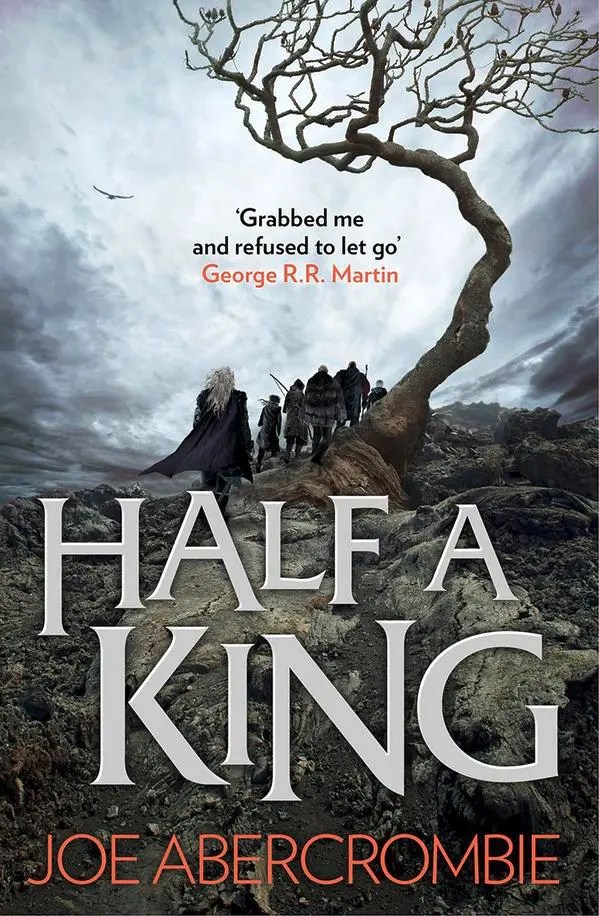
Half a King, by Joe Abercrombie (Harper Voyager, 2014, 2015)
From the first chapter of Half a King by Joe Abercrombie I was struck by how gripping it was. I started taking notes as I read, most of which addressed the question, ‘How does he do it?’ My notes are reproduced below, edited for readability. They point to the features of a certain style of writing that is currently fashionable. This novel is a showcase of the great strengths of this style.
As the title of this post implies, I’m only going to the half-way point of the novel, which is all I’ve read. Spoilers ahoy.
Part 1
- Each chapter is limited to 1500-2500 words (6-9 pages). Each chapter shifts the scenery and cast. There is only one point of view, that of the main character, Yarvi.
- The main conflict is apparent in the first line, and made more explicit by the end of the first chapter: this totally unsuitable person is going to have to try and be king.
- It’s not that fast-paced. What it is is, each chapter has a bearing on the character conflict introduced in chapter 1. In the next chapter Yarvi meets his mother; she is pretty horrible, so this is discouraging for Yarvi’s prospects, but his uncle’s presence is consoling. Next Yarvi meets his betrothed; at first this is intimidating for him but then it turns out she is sound. Next he goes to do a bit of sparring; he gets beaten, but gets his revenge in an unscrupulous way. And so on.
- The author gets away with having very little exposition because the setting is typical and even clichéd. So far, not one surprising element.
- I’m enjoying it, I’m reading on. A number of promises, hints and mysteries have been dropped, and I want to see how things turn out. Eg. There’s a mean high king we will (no doubt) meet; an uncle who seems helpful but who (I predict) will betray Yarvi; a raid coming up; a mystery as to how the father was killed.
- It’s Designated Survivor with Vikings.
- Yarvi is treated badly by his parents but he has more than one ‘good adult’ in his life, who seem to see him and appreciate him: the minister, and his uncle. Those who despise him and those who value him each in their own way make us care about him.
- Neat trick where nervous volubility of a character (the betrothed) gives opportunity for a bit of exposition.
- We have the Maesters (or ‘ministers’) – from George RR Martin; we have a hint of the custom of women being literate instead of men – from Brandon Sanderson.
- We are surprised to find the battle already over when Yarvi shows up. We were expecting battle scene, but what happens instead is more interesting.
- The gruesomeness of the raid aftermath, and Yarvi’s disgust with it, is a hint that he as king is going to make a more just social order.
- A solid twist on page 58. Good stuff. I was not expecting the uncle to betray him so soon.
- Keimdal defends him, unexpected, and Hurik does not. Also unexpected.
- The belt buckle and watery inlet were both very seamlessly but strongly set up.
- ‘He would have liked to weigh his choices, but for that you need more than one.’
- I can’t believe I said this was a Viking Designated Survivor. It’s a different kind of story entirely. Yarvi will have to resolve his conflict (ie to be a king), but in a very different way from what he expected. He will have to fight his way to the kingship, and presumably he will grow into the role as he claws his way up again from rock bottom. There is nothing original about this basic story, but the delivery so far has been very good, so I’m down.
- P 65 great character description of Gorm-Il-Gorm, full half page paragraph, justifies its presence.
Part 2
- I approach Part 2 with trepidation. Yarvi is going to be enslaved, with all the grimdark misery and monotony that such a plot turn entails.
- A cliché of fantasy novels: we only ever see a highly commercialised, Antebellum South model of slavery. It is capitalistic and not, for example, clan based. It is ‘simple’ chattel slavery and not a complex gradation of free and unfree. We fetishise the money economy so much that even our barbarian slave traders use hard currency and treat the enslaved people as commodities. In this novel, the slaves are even sold in a ‘shop’. The word is a bad anachronism. In a medievalesque setting a ‘shop’ is a workshop. At least we were spared a slave auction scene (Though I’m sure if Abercrombie had attempted it he would have made it compelling).
- But the misery and squalor of the ‘shop’ is described economically and in a way that is linked to character. It is not allowed to bog down narrative.
- P 118: Aha. It’s a post apocalyptic Baltic sea. Leningrad, Rostock, Stockholm, Geatland. Copenhagen. All the islands. I’d better go back and change ‘medieval’ to ‘medievalesque.’
- My misgivings were unfounded. The author conveys the misery in skin-callousing terms, but in each chapter the focus is on the character and his goals. It’s setting up how things work on this ship, who’s who, and allowing us to guess ahead about how Yarvi will work these conflicts to his advantage. The author is stacking up Jenga blocks and we know the tower is going to fall. We don’t know how, and for now we are invited to guess.
- In the meantime there are periodic reminders of what Yarvi wants and why – not intrusive or annoying, but natural.
- In spite of the horror, optimism about human nature is evident on the slave ship. This optimism marks the book out from, say, GRR Martin. Yarvi’s companions, for example. Even Trigg is recognisably human – he cries at an emotional song.
- P 125 – a printed circuit board assembly used as jewellery
- Yarvi manages to avert a battle with the ‘savages’, and it’s much more exciting than a battle scene.
- The escape, when it comes, is very satisfying because it has defied us for so long.
- Only 2-3 fatal action scenes so far, but it has kept our attention.
- We are starting to learn more about this world. But only after we have been introduced to Yarvik, to what he wants, his strengths and weaknesses. The rule here is character first, world second. This is what Matt Bird is talking about with his ‘Believe, Care, Invest’ model.
- Looking back, Part 2 has introduced an entirely new cast of characters. Complete reshuffle. Everyone we know from Part 1 is gone. This is risky but Abercrombie pulls it off.
- What about the morality of Yarvi’s escape? First, he squealed on another slave to suck up to the captain. Then he let the sea in through the hull of the boat, drowning seventy or eighty slaves who were chained to their oars.
- On the first point, there are various mitigating factors which are obvious and need not detain us. But the most important point is that he intends to betray the evil captain as soon as possible, and their alliance is very brief.
- On the second point, how he let the water in to a docked ship: (on top of the obvious points like how he tried to save them only to be thwarted by Nothing) the guards had the keys and the opportunity to let the slaves loose. Yarvi did not. And the most important point is this: he’s not the one who put them in those chains. The evil captain bears all the responsibility and Yarvi bears none.
Part 3
- We get a gruelling sequence of events as Yarvi and his band of friends set out across an inhospitable wilderness with no supplies. But now that we are off the slave ship, our cast of characters get a chance to expand, to show what they are made of, to make an impression on the reader.
- Amid all the hardship, we can see a bond being forged between these diverse people. When Jaud carries Sumael. When Yarvi and Ankran make up. When Nothing turns, in the space of just 10 or 15 pages, from a saviour to a would-be murderer of a child, then to pathetic gratefulness when the child’s people help him, and then to swearing a solemn and dramatic oath to Yarvi. All this, without ever appearing to change his mind; his madness has an internal consistency.
- When they reach the house, what a relief – and what a line: ‘I told you steel would be the answer.’
- Repeated physical descriptions reinforce the scarred, outcast status of these characters while also familiarising us with them – Sumael’s notched lip, Ankran’s gap tooth. Also repeated and brief statements reminding us of their backgrounds – the well in the village, the wife, etc.
- How did we come to know these characters? Why did we give the writer our attention long enough for him to show us various facets of these people?
- Frequent changes of mood and pace. From a gruelling chapter, to a chapter of relief and recuperation, and on to a chapter of main characters sitting around, letting their hair down, planning, and sharing a dramatic revelation.
- Change of pace again – the bad guys are catching up. There are always new challenges before the characters can get too comfortable. But at the same time the challenges are not relentless or monotonous. Change and progress are evident. When they endure hardship, they earn something that helps them – for example, they endured the wilderness, and got the supplies that are now proving so useful. We don’t know much about the history, ecology or politics of this setting – but we know that it is a world that is both challenging and rewarding.

Page 228 – That’s all for now. The characters are building a raft on the banks of a river while their enemies close in. I wish them luck, and if I have things to say about the second half of this book (I probably will) I will be sure to post them here.
 The 1919 Review