In this post we trace the collapse of White Siberia in late 1919 and early 1920. This is Series 4, Part 2 of Revolution Under Siege, an account of the Russian Civil War .
Become a paying supporter to get access
Access to this article is limited to paying supporters. If you already subscribe by email, thank you. But if you want to become a paying supporter, please hit ‘Subscribe’ below.
Give me less than the price of a coffee, and you can access everything on this blog for one year.
On the Eastern Front in July 1919, the White regime of Admiral Kolchak was reeling after its armies were driven out of the Ural Mountains. But the Siberian Whites made an audacious throw of the dice, triggering one of the largest battles of the Civil War.
To set the scene for us, here is the diary of General Alexei Pavlovich Budberg, a minister in Kolchak’s government. He recorded his horror and frustration as things fell apart:
July 19th 1919:
Head is spinning from work […] To our disadvantage, the Red Army soldiers at the front were given the strictest order not to touch the population and to pay for everything taken […] The admiral gave the same orders […] but with us all this remains a written paper, and with the Reds it is reinforced by the immediate execution of the guilty.
July 20th 1919:
[…] self-seekers and speculators are white with fear and flee to the east; tickets for express trains are sold with a premium of 15-18 thousand rubles per ticket.
July 22nd 1919:
The Ministry of Railways receives from the front very sad information about the outrages and arbitrariness committed during the evacuation by various commanding atamans and privileged rear units and organizations; all this greatly complicates the hard work of evacuation […]
Kolchak’s soldiers in retreat
Hints of a planned White counter-attack do not give Budberg any relief. On the contrary, he was filled with foreboding:
July 23rd 1919:
Something mysterious is happening at headquarters: operational reports have been temporarily suspended…
In the rear, uprisings are growing; since their areas are marked on a 40-verst map with red dots, their gradual spread begins to look like a rapidly progressing rash.
July 24th 1919:
The mystery […] has been aggravated: to all my questions I receive a mysterious answer that soon everything will be resolved and that very big events will take place that will drastically change the whole situation.
July 25th 1919:
Only today did I learn at headquarters that [General] Lebedev, with the cooperation of [General] Sakharov, wrested from the admiral consent to some complex offensive operation in the Chelyabinsk region, promising to completely eliminate the Reds […]
Undoubtedly, this is Lebedev’s crazy bet to save his faltering career and to prove his military genius; it is obvious that everything is thought out and arranged together with another strategic baby Sakharov, who also yearns for the glory of the great commander.
Both ambitious people obviously do not understand what they are doing; after all, the whole fate of the Siberian white movement is put on their crazy card, because if we fail, there is no longer salvation for us and we will hardly be able to restore our military strength…
Chelyabinsk
The city of Chelyabinsk lies amid a cluster of lakes, a few hours by rail east of where the Ural Mountains fall away to the plains. It can be regarded as ground zero of the Russian Civil War: it was there that a brawl between Czechs and Hungarians led to the revolt of the Czechoslovak Legion.
At the end of July the Red Fifth Army came down from the Mountains into the lake country. This was the same Fifth Army that had held the line at Sviyazhsk and then crossed the Volga to seize Kazan. Trotsky and Vacietis counselled caution and rest for Eastern Army Group after it drove back the White Spring Offensive. But the new commander-in-chief, the military specialist Kamenev, argued for a hot pursuit of the Whites right into the heart of Siberia. So far Kamenev had been vindicated. The same Chinese Reds, led by Fu I-Cheng, who had lost Perm the year before had recaptured it. The Red commander Frunze had taken Ufa after a terrible and bloody fight with Kappel.[i]
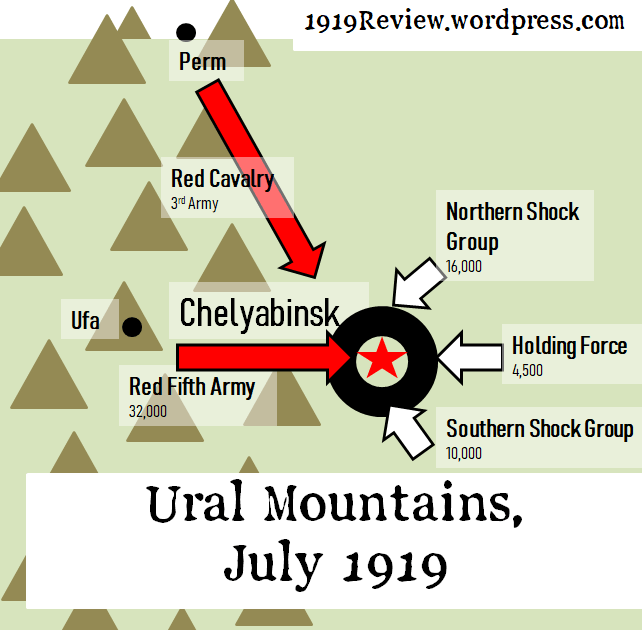
Now the Fifth Army was advancing on Chelyabinsk. But Kolchak, on the advice of his young generals Lebedev and Sakharov, had decided to turn the city into an elaborate trap. The Reds would be allowed to seize the city – then encircled in it, and destroyed.
On July 24th a workers’ uprising began in the city. It was led by an underground Bolshevik organisation that had suffered under the counterintelligence operations of the ‘very cruel’ Colonel Sorochinsky. The Red Fifth Army hurried to the aid of the rebels, and linked up with them. Railway employees sabotaged the White defence: they derailed one armoured train and diverted another into a dead end. The city fell, and the Reds captured many rifles and machine-guns. Morale was good, energy high: Red detachments at once began scouting and advancing out from the city through the suburbs and villages.
But to the north, south and east, White shock groups and formations were closing in on the city to encircle and destroy the Fifth Army.
Let’s pause and get a proper sense of scale. The last time this series zoomed in on a particular battle, that of Kazan, it was easy enough to visualise. In an arena measuring forty kilometres by twenty, there were between ten and twenty thousand soldiers per side.
The Battle of Chelyabinsk compels us to think bigger, on a scale of at least 80 square kilometres.
There were 32,000 rifles and swords in the Red Fifth Army. On the side of the Whites, there were around 30,000 as well: the Northern shock group numbered 16,000, the southern shock group 10,000, and there were 4,500 to the east holding the line between the two.
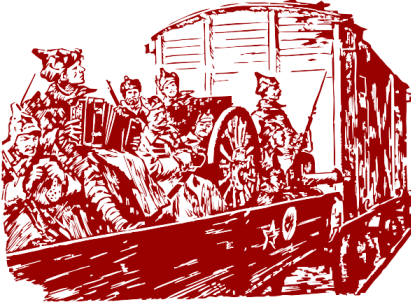
Red soldiers on a train carriage
The Trap
Let’s zoom in on one of those fighters, a White cavalry officer named Egorov.
At four in the morning of June 25th Egorov was waiting with his regiment at a crossroads near one of the several lakes north of Chelyabinsk. Egorov’s Mikhailovsky Regiment consisted of 150 mounted soldiers – ‘rather motley,’ by his own admission, old and young, mostly infantrymen mounted rather than ‘real’ cavalry – along with soldiers on foot.
They were ordered to gather here before seizing the village of Dolgoderevenskaya, north of Chelyabinsk.
Egorov and his men were still stinging from the postscript added to their orders: ‘I advise the regiment commander, Colonel Egorov, to abandon this time the usual delay…’
Adding insult to injury, the Mikhailov Regiment was on time. They were waiting in the early hours of the morning for the Kama Division to show up.
‘To the right and left I hear voices: “Why wait for the Kamtsy?.. Move!.. Enough of the Reds!”’
Egorov decided it was time. The regiment sneaked up close to the village. A local Cossack boy told them there were many Reds in the village, but a lot of them were asleep.
The attack began. White cavalry broke through the outskirts of the village without a shot being fired, and before most of the Reds were awake the White cavalry had dispersed all over the streets while infantry attacked from the west.
‘And only after that,’ writes Egorov, ‘the first rifle shots were heard.’
He was watching from a nearby hillside. The rifle fire intensified, and the sound of the Russian war-cry, ‘Urrah!’ came to him. After an hour of fighting, the Reds fled to the next village.
As Egorov entered the village he heard someone shout: ‘Mister Colonel! Trophies!’
His men were looting what the enemy had left behind: gramophones and field-kitchens. Egorov reckoned the Reds had, in their turn, taken the gramophones from the houses of priests and merchants.
But the Whites got carried away in the celebrations. The Reds counter-attacked and caught them unawares. Fortunately for Egorov, the Kamtsy arrived – the stragglers Egorov had not bothered to wait for – and they had artillery. By three in the afternoon the Reds had been driven back again. Egorov and his cavalry mounted up, and this time pursued them, and drove them out of the next village as well. The Reds began to retreat all along the front.
Egorov’s assistant, a Tatar, had taken a bullet in the arm during the day’s fighting. He was unperturbed. That night at dinner he drank heartily. Then he excused himself, went out into the hall, and removed the bullet with a penknife.
These battles were part of the advance of the northern shock group. It was very successful; it reached the Yekaterinburg-Chelyabinsk railway line, cutting off the Fifth Army and threatening it from the rear.
On 27 July the southern shock group advanced. Its purpose was to link up with the northern group, completing the encirclement. The southern group was commanded by Colonel Kappel, who had led the Whites at Kazan. Kappel was a relic of the late Komuch government and its ‘People’s Army,’ now serving Kolchak and the Whites. There were others present at Chelyabinsk for whom Komuch had served as a Red-to-White pipeline or gateway drug. The workers’ militia of Izhevsk were there, going into battle to the sound of accordions.
Meanwhile the 4,500 White Guards in the middle advanced west into the outskirts of Chelyabinsk.
Another White veteran recalled: ‘On one of the days, apparently on the 27th or 28th […] we found ourselves 3-4 versts from Chelyabinsk and were about to have dinner there.’
He and Egorov and Kappel had good reasons to feel confident. Many would have believed that just as Denikin was advancing in South Russia, they were about to turn the tide in the east.
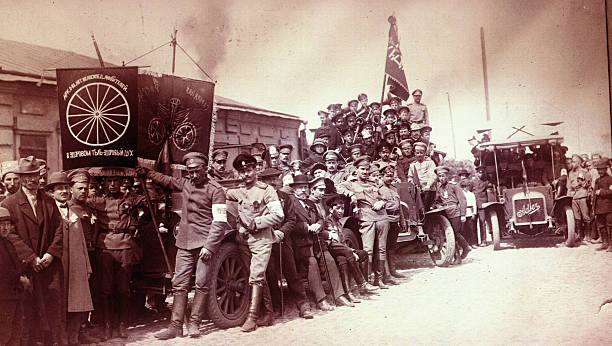
‘Siberian bicycle and autocycle fighting squad,’ June 1919
Resistance
According to the plan, the Reds should have been panicking and falling to pieces by now. Generals Sakharov and Lebedev were young officers who had learned most of what they knew during the period of the Czechoslovak Revolt of 1918. They had led irregular detachments against untrained Red Guards.
But these Reds in Chelyabinsk were made of something else. They held firm. Kappel engaged in heavy battles to the south of the city, but his forces could not break through.
The Chelyabinsk revolutionary committee put out a call, and 8,000 miners and other workers joined the defence, arms in hand. 4,500 others joined work detachments, building defences and supporting the troops. The centre group of Whites could not advance further, and got bogged down in the outskirts.
Why couldn’t the Whites make any headway? We noted in a previous episode that they had raised two divisions of young conscripts. These forces had not even been trained when they were flung into the battle at Chelyabinsk. To encircle an enemy army would have been a challenge at the best of times. The White officers were ordered to spring the trap with personnel who did not know what they were doing.
In Russia, soldiers with rifles are called streltsi, literally ‘shooters.’ One veteran wrote to the Chelyabinsk local newspaper in the 1970s, recalling his days as an officer leading White streltsi:
I was a participant in the battles near Chelyabinsk on July 25-31, 1919, not in the Red Army, but in the White Army, in […] the 22nd Zlatoust regiment of Ural mountain shooters, which they practically were not [sic], since […] they were not even trained at all how to shoot.
During the battle, up to 80% of the 13th Siberian rifle division went over to the Reds. They surrendered in their thousands, bearing US Remington rifles and wearing British uniforms.
It wasn’t just the new conscripts. In the headlong retreat since May, divisions had winnowed to regiments, regiments to, in one case, a ragged group numbering only seventy. Typhus had raged through the White units. Many of the replacements were young Tatars, like Egorov’s friend. Many of these couldn’t speak Russian.
Kappel’s Volga Corps had taken a battering in recent months. Instead of getting time to recover, they, like the new recruits, were thrown into battle.
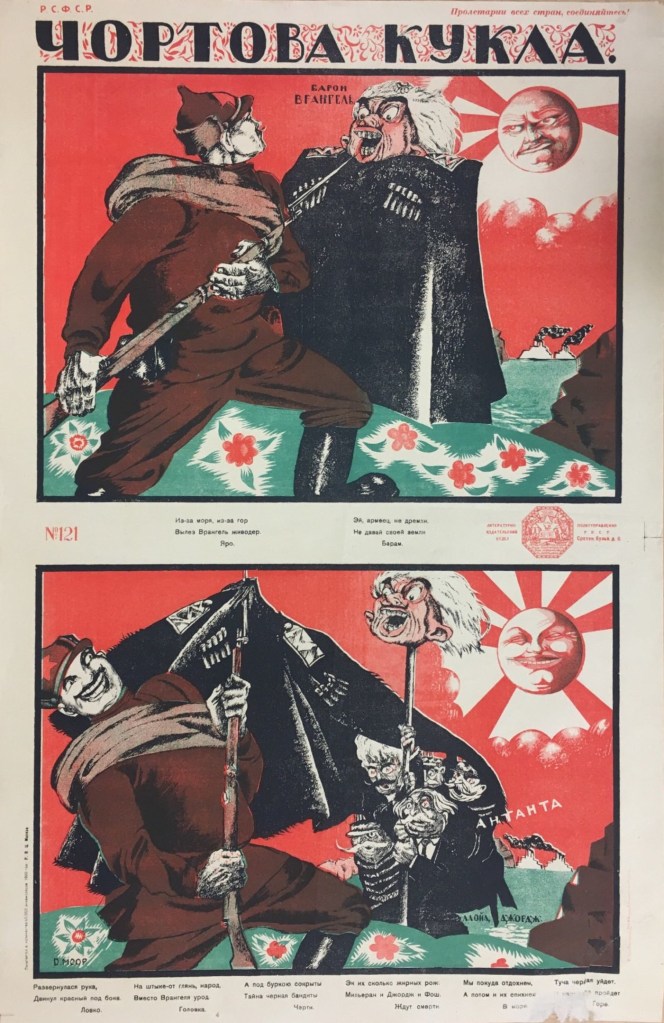
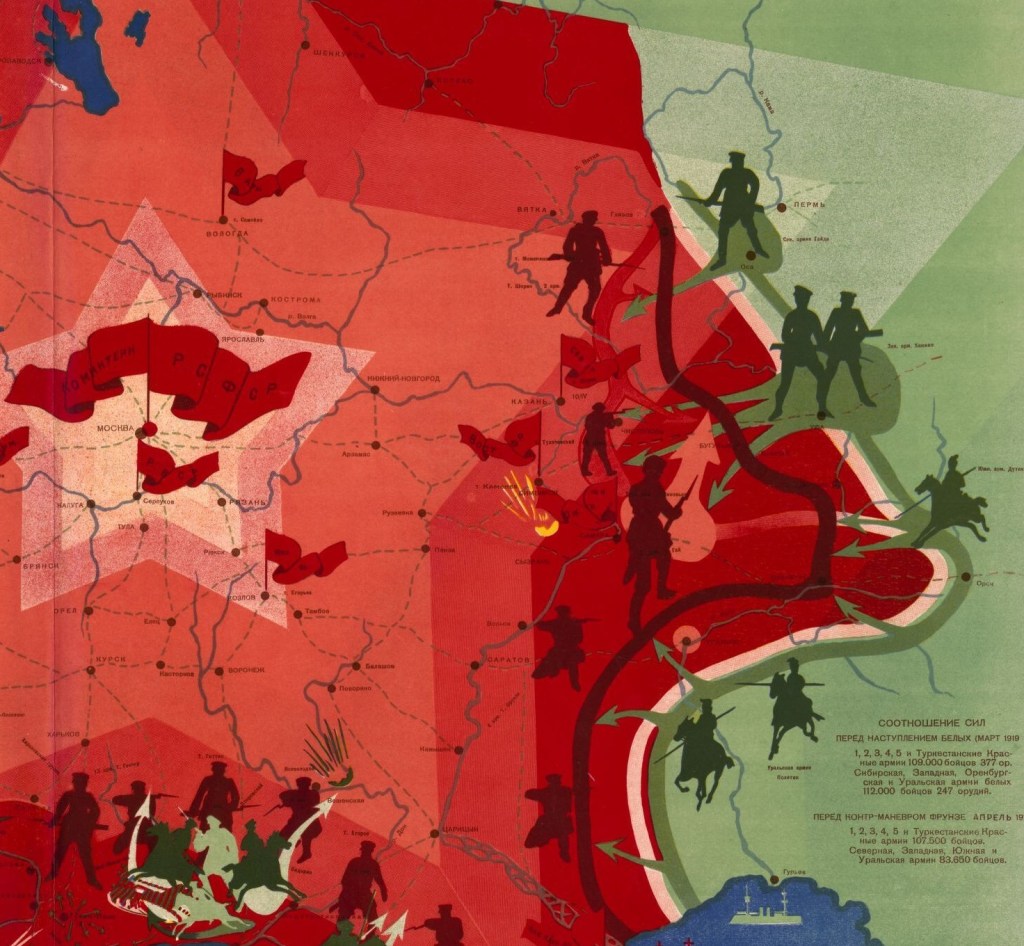
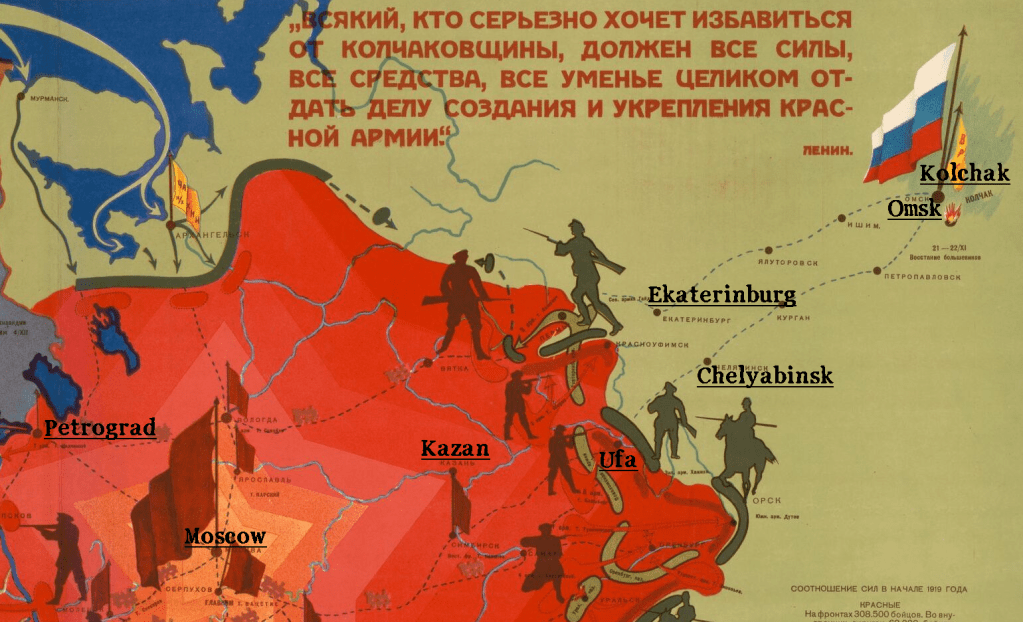
Today’s cover image is a detail from this poster. It’s actually from a later date in the Civil War, from 1920 and the campaign of Baron Wrangel.
On the other side, the Red Fifth Army was experienced and energetic. And they had a political backbone: in the 27th Division alone there were 600 Communist Party members.
But the fighting was fierce. According to one source there were 15,000 Red and 5,000 White casualties.[iii] According to other sources, the Whites lost 4,500 killed and wounded, while 8,000 or even 15,000 were captured, and the Red casualties numbered 2,900.
The Reds held on in the centre and south, then reinforced the vulnerable north. They built up a shock group of their own and between July 29th and August 1st defeated five enemy regiments north of the city. I assume this involved sweeping through the villages Egorov and co had taken nearly a week earlier. Perhaps the gramophones changed hands again.
Cavalry units from the Third Red Army at Perm were hurrying to the aid of Chelyabinsk and threatened the Whites’ northern shock group. The Izhevsk militia was sent to meet them, but the Izhevtsi suffered heavy losses at the village of Muslyumovo. The northern shock group had itself suffered a series of shocks. Its position was untenable.
Back in Omsk, General Budberg was asked by Kolchak what he thought of the Chelyabinsk Operation.
July 31st
I reported to him that I think that now it is necessary to immediately stop it and order to do everything possible to withdraw the troops involved in it with the least damage to them.
The admiral was silent, but asked to speed up the dinner, then went into the office to Zhanen, where he signed a telegram to Lebedev about the retreat; he is very gloomy and anxious.
August 1st
Everything connected with the Chelyabinsk adventure, and most importantly, my powerlessness to stop it and prevent all its consequences, led me to the decision to ask the admiral to dismiss me from my post, and if it is impossible to give [me] a place to the front, then to [accept my resignation].
Budberg’s request was refused, and so he was forced to around Omsk as an agonised and impotent witness to further disaster.
Red advance
From August 1st the Reds were on the offensive. The White retreat eastward grew more chaotic.
Many in the White camp had warned against the Chelyabinsk operation. They favoured instead a defensive strategy: digging in behind the Ishim and Tobol rivers and buying time to train up the new units. After ‘the trap failed to close’[iv] at Chelyabinsk, the White armies were demoralised and sorely depleted. Digging in was less feasible than before, but even more urgent.
The Siberian Whites were not finished all at once. In late July the Siberian Cossack host joined Kolchak’s cause – too late to help at Chelyabinsk, but just in time to give Kolchak and others a false hope in a renewed offensive strategy. Nonetheless the Red advance across Siberia was indeed delayed by serious battles with the Cossacks and on the defence lines of the rivers.
Crisis in White Siberia
But the Battle of Chelyabinsk is not so much a story of Red victory as one of White defeat. That defeat is interesting because in every way it was symptomatic of the crisis that was developing in Kolchak’s Siberia.
Behind White lines there reigned a regime of corruption and terror that exceeds the most lurid caricatures of the Red side. Untrained and demoralised men sent to fight the partisans would torment the farmers, burn villages, loot, torture and kill. Bodies hung from the telegraph-poles along the Trans-Siberian railway.[v] Further east under Semyonov and Ungern, as we have seen, things were even worse.
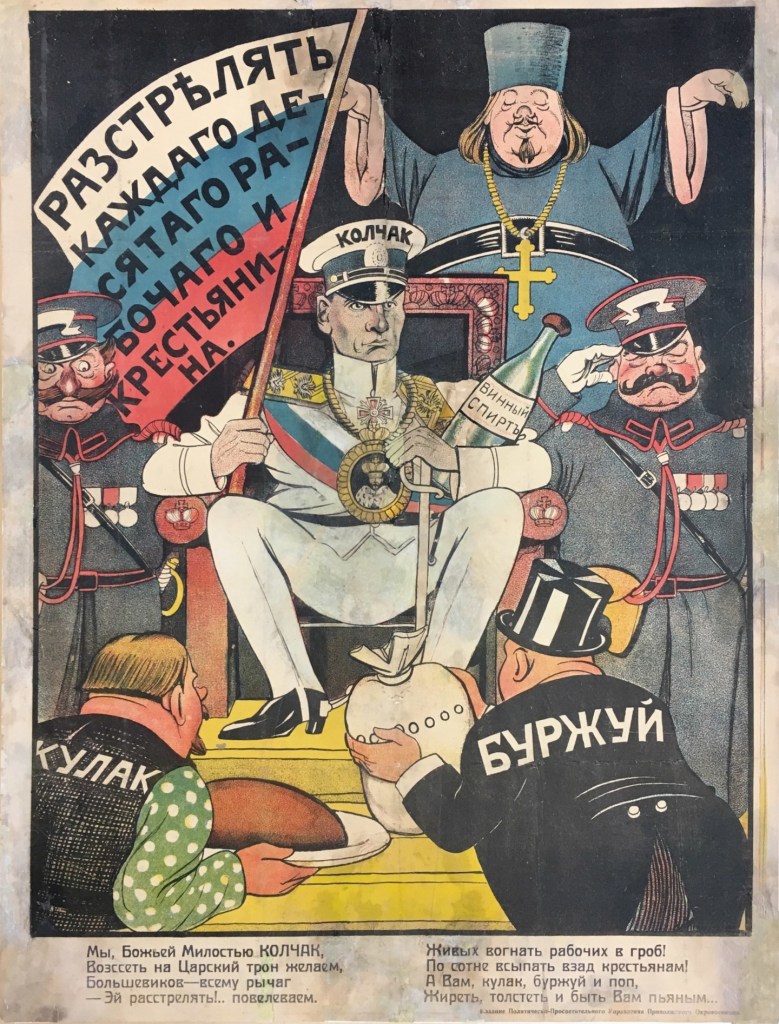
Kolchak in a Red propaganda poster, served by ‘Kulak’ and ‘Burzhui.’ The flag reads ‘Shoot every tenth worker and peasant.’ Most of the symbolism here is accurate enough as war propaganda posters go. But the generals flanking Kolchak should be young phony whizz-kids rather than old duffers. The open monarchist trappings are improbable. The sword is appropriate, as in 1917 Kolchak refused to hand his sword over to a sailors’ committee. Finally, though the Reds would not have realised this at the time, the ‘Burzhui,’ far from handing over bags of money, actually proved self-centred and stingy toward the White Siberian regime. Unless this top-hatted figure represents the international ‘Burzhui,’ who were very generous indeed.
Budberg lamented how among the middle and wealthy classes of the towns everyone felt free to criticise, but never lifted a finger to help in any practical way. It seemed everyone was out for themselves, embezzling without the slightest shame. In the White capital city, Omsk, many wealthy and well-educated people were concentrated. But the poor could not afford to eat and attempts by the state to provide the most basic relief or public services always somehow ended in a dead-end of bungling and embezzling.
The Czechs, whose revolt had given birth to the Eastern Front at Chelyabinsk the year before, were growing disgusted with the White cause, and becoming almost as much of a pain to the Whites in 1919 as they had been to the Reds in 1918. The first stirrings of mutiny were already evident. And in the woods the partisan forces were growing and developing. Meanwhile the Socialist Revolutionary Party were raising their heads again, active both among the partisans and the Czechs. They were the ghost at Kolchak’s feast: he had jailed them after his coup in November 1918, and shot many after the Omsk revolt of December.
Kolchak’s army had come to resemble, in miniature, the Tsarist army of 1917 – in June there had been cases of the men shooting their officers and changing sides. No wonder – the officers had brought back Tsarist practises such as flogging men and striking them in the face. In October, a mass of newly-raised conscripts was sent to the front, and melted away without a trace. Of 800,000 ‘eaters’, only one in ten were fighters; many soldiers travelled with their families in tow. They looted the locals to feed themselves. Some of their supply trains stretched out to 1,000 carts.
‘These were not military units,’ said one disgusted officer, ‘but some kind of Tatar horde.’[vi] Many of those fighting and dying were actually Tatars, so this is a fine example of all the cultural sensitivity we would expect from a White officer.
The battle at Chelyabinsk showed that a spectacular role reversal had taken place. In 1918, the Whites were the professionals, the elite soldiers, and the Reds were the undisciplined rabble. But the rabble had developed into an army. And on the other hand, when the Whites tried to move from elite detachments and all-officer companies to a mass army, they degenerated into a rabble. Their best units were better than the Reds, but their worst units were far worse. The Whites of 1919 were incomparably stronger on paper. But – and this was especially true in Siberia – they had the worst of both worlds. Compared to the early Red Guard formations, they had all the raggedness and all the indiscipline, but none of the political motivation.
Many on the White side noticed the change in the aspect of the Reds. ‘A White leader who visited Tobolsk after it was briefly recaptured was impressed at reports of how well the Reds had behaved.’ And General Budberg wrote that ‘we are not up against the sovdepy and Red Guard rabble of last year but a regular Red Army.’[vii] ‘Sovdep’ was a White nickname for the Reds, based on the words ‘Soviet’ and ‘Deputy.’ Budberg considered the Reds’ battle plans to be plodding and basic. But even basic plans were, in his view, better than none, or than the ‘too clever by half’ manoeuvres of Lebedev and Sakharov.
The Chelyabinsk battle also revealed another key weakness of the White Guards. On November 4th Kolchak complained that his army recruited from among ‘Bolshevik-minded elements’ who at the first opportunity ‘crossed over to the Red side.’ As a result, officers ‘refused to dilute their units’ with new recruits! ‘We had to recruit with great selectiveness, while the enemy freely used local manpower which was favourable to him.’[viii] In other words, the Whites were hindered by the small fact that most people didn’t want to fight for them, and favoured the Reds (even in relatively conservative Siberia).
It is true, as Beevor says (p 344), that ‘A civil war was not an election […] because the vast majority of people wanted to stay out of trouble.’ It is not possible to ascertain the will of the people by ballot in the middle of a civil war. We have to go with cruder measures, such as asking which side could reliably recruit thousands and which side could reliably recruit millions. Judging by this crude but immensely significant measure, the people preferred the Reds to the Whites.
Often the story of the Civil War is one of cruelty and dashed hopes. But the victory at Chelyabinsk was one worthy of a popular revolution. The workers’ rebellion at Chelyabinsk and the participation of thousands of volunteers in the battle underlines this democratic aspect.
The Battle of Chelyabinsk showed how Fifth Army had developed from the semi-irregular force that fought at Kazan into a professional army. But most of Siberia still lay before it, and far behind to the west, Tsaritsyn and Kharkiv had already fallen. Denikin’s advance on Moscow was already well under way.
The diaries of General Budberg came from militera.lib.ru_
In addition, this episode could not have been written without a collection of sources compiled by an internet user named igor_verh on https://forum.axishistory.com/viewtopic.php?t=192991. (The name at first raised alarm bells for me but the site’s description says it is apolitical. Its focus seems to be wargaming).
The sources are as follows, copied and pasted from the post:
As 1919 began, the vast expanse of Siberia was occupied by an array of factions and warlords. This post introduces the reader to some of the White warlords of Siberia, and follows Admiral Kolchak’s Spring Offensive.
Revolution Under Siege is back for a second series, tracing the epic events of 1919 in the Russian Civil War.
Before the October Revolution, when Russia was still fighting in the Great War and desperate for new recruits to replace the millions dead and wounded, the Provisional Government sent two cavalry officers to the furthest eastern reaches of the empire. Their mission was to recruit a regiment of Mongols and Buriats, horse nomads of the steppe.
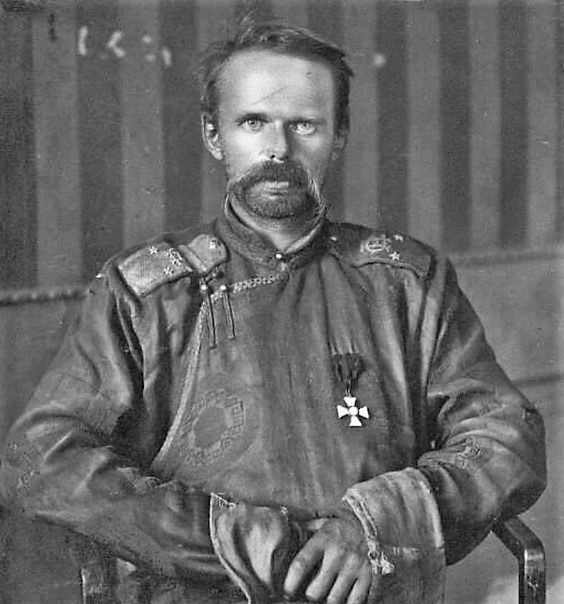
Captain Grigori Semyonov was a Cossack of Buriat origins himself. He was ‘a thick-set character with moustaches shaped like a water buffalo’s horns.’[i] Semyonov’s companion was Baron Roman von Ungern-Sternberg. He was a Baltic German aristocrat from Estonia, but he was already an old Asia hand. He had travelled in Mongolia, he idolised the warriors of the steppe, and on this journey he wore a bright red Chinese jacket and blue trousers. The young baron had the thousand-yard stare. He had served in a regiment which had suffered 200% casualties in the early part of the war. But he was happy during the war years – never happier.
At the start of 1918, the mission consisted of Semyonov, Ungern and six other guys with their horses. Meanwhile back west in the capital, the working class, organised in the soviets and led by the Bolshevik Party, had taken power. The government that had sent Semyonov east no longer existed. The war into which the Mongols and Buriats would have been thrown was, for Russia, over.
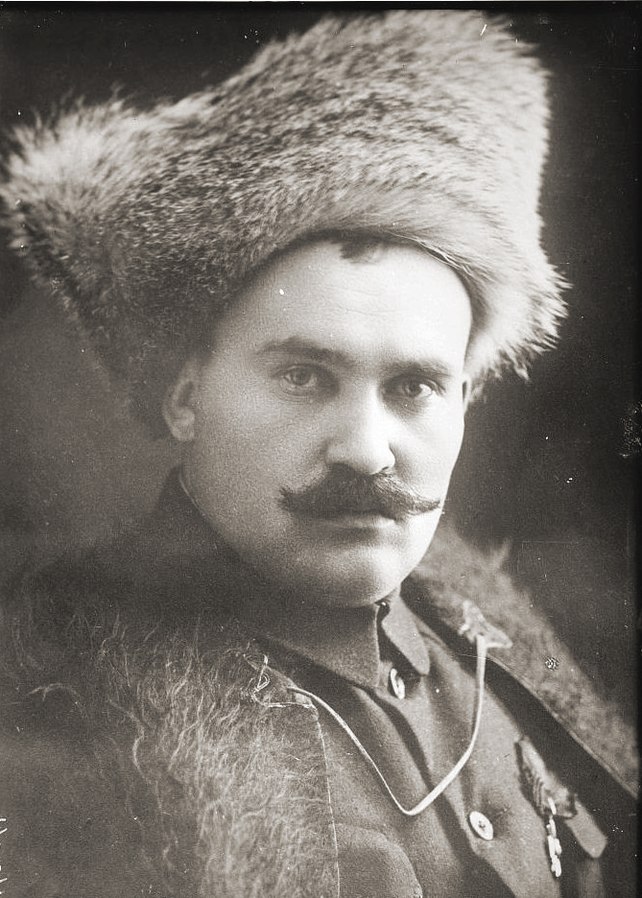
Grigorii Semyonov, ataman of the Trans-Baikal Cossacks
But the sabres of Semyonov and Ungern did not rest. They joined the counter-revolution and became warlords of Siberia. To them, the Provisional Government had been bad enough, but the Revolution was an atrocity. The workers and peasants must be crushed.
Their first uprising was at Verkhneudinsk, just a week or two after the storming of the Winter Palace. They were backed by Transbaikal Cossacks, but they failed, and fled to China.
On New Year’s Day 1918 they crossed back into Russia. Their force of 8 soldiers held a train and lit it up to bluff that they had bigger numbers; in this way they disarmed a Red garrison of 1500.
Meanwhile a Bolshevik sailor and commissar named Kudryashev was on his way to Vladivostok with government money. He and his companions held a New Year’s party on the moving train, and Kudryashev got so drunk he forgot to change trains. The mistake proved fatal.
They were halted near the Chinese border and Ungern led soldiers into the carriage full of celebrating Reds.
Ungern fixed his cold, piercing eyes on Kudryashev and demanded: ‘Deputy Naval Commissar, that’s you?’
‘Baron Ungern looked through his papers, then made a cutting gesture with his hand to his companions. “As for these shits,” he added, pointing to the others from Kudryashev’s party, “whip them and throw them out.”’
Kudryashev was taken out and shot dead in the snow.[ii]
During the six months following the Revolution, Semyonov and Ungern twice rounded up sizeable forces in Manchuria – Mongols, Buriats and anti-communist refugees. They twice invaded Siberia, and were twice driven back across the border into China by the Red Guards.
The fortunes of Semyonov changed thanks to the Allies. First, Semyonov received a load of money from Britain, France and especially Japan, allowing him to hire Chinese mercenaries and to arm and equip his volunteers. Thus he built a force he called the Special Manchurian Division. Second, Semyonov and his Division were on the brink of annihilation when they were saved by the Czechoslovak Revolt of May 1918. Last, when the Special Manchurian Division invaded Russia for the third time in July 1918 it was with massive Czech and Japanese assistance.
A few months earlier, Semyonov had been alone except for a handful of volunteers and an eccentric baron, on a mission from a government he despised. By the end of August, he was dictator of the Transbaikal.
Covering more than 600,000 square kilometres, the Transbaikal region is only a little smaller than Texas. It stretches from Irkutsk in the west, a town on the shores of the vast Lake Baikal, to the Pacific port of Vladivostok in the east.
Semyonov
In late 1918 and through 1919 Semyonov ruled from the town of Chita under the slogan ‘For Law and Order!’ while his officers enjoyed cocaine and the company of sex workers. The night life of the city was made livelier by Red partisan assassins lurking in the alleyways.
Semyonov wished to create an independent state called Daurskii and allegedly awarded himself the title of Grand Duke. But in the words of a Chinese newspaper he was ‘Caliph for an hour and a toy of the Japanese.’[iii] He was more or less subordinate to the Japanese state, which had 70,000 soldiers on his territory along with British, French and US detachments. All the same, he lived like a king. He had thirty mistresses who lived on what was called ‘the summer train’ along with a great store of champagne and an orchestra made up of Austrian prisoners. In June 1918 he was elected ataman (warlord) of the Transbaikal Cossacks.
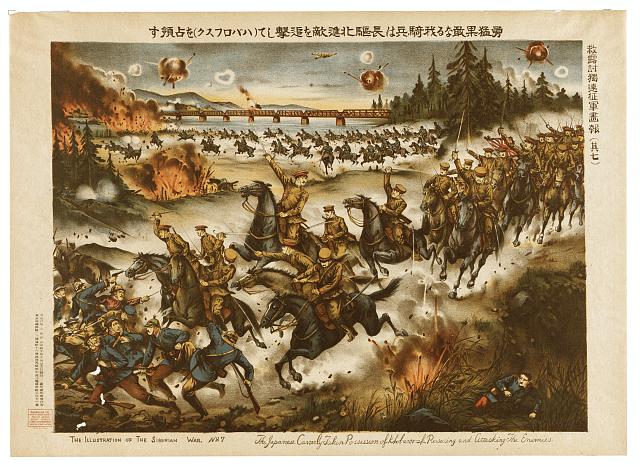
Today’s cover image, from a series of paintings created in Japan titled ‘Illustrations of the Siberian War’
Semyonov used to boast that he could not sleep easily at night unless he had killed someone that day. It was not an idle boast as his victims numbered in the thousands.[iv] By his own account, he personally supervised the torture of 6,500 people.[v] In this last detail Semyonov was not an outlier (though in other respects he certainly was). According to one foreign observer, White Guard officers ‘remarked almost daily that it was necessary for them to whip, punish, or kill someone every day in order that the people know who was protecting them from the Bolsheviks.’[vi]
The Transbaikal was sparsely settled. Trains plied the vast empty lands between the towns and villages. Semyonov and his 14,000 men, by Spring 1919, did not generally stray far outside of Chita, where the warlord lived in a compound guarded by artillery. But armoured trains would supply Semyonov’s armies in the manner of Carribean pirates, pulling up to a station and threatening to open fire with naval guns unless food was handed over.
In Siberia, where the towns were like islands, thousands lived on the rails – Palmer says there were ‘hospital cars, headquarters, brothels, travelling theatres, dining cars appointed like opulent Moscow restaurants, libraries, motor workshops, churches, mobile electric generators, printing shops, offices and torture chambers.’ The old pre-revolutionary cadre of railway workers somehow kept everything moving. Secretly they aided the Red partisans.
Then there were the prison trains, cattle cars filled each with fifty Red prisoners of war, which would travel ‘aimlessly from station to station with neither food nor water.’ Whoever was left alive in the cars after a few weeks would be shot.[vii] For example, a train arrived near Lake Baikal on August 4th, crammed with 2,200 captives from the Red Army (taken during the Spring Offensive – see below). ‘Most of the prisoners appear to be sick with typhus, and starving. Several dead were removed from the cars. It seems that there are dead to be removed at every station.’[viii] The eyewitness quoted just now was a US soldier who was guarding the railway line which the Whites were using in this way.
The railways were the primary target of the Red partisans, though they also infiltrated mines and triggered strikes.[ix] The huge distances and deep forests provided refuge to all those who wanted to fight the Semyonov regime, and they lived in camps as big as small towns.
What was the political character of these guerrilla bands? According to Wollenberg:
Speaking generally, we find that the guerrilla movement assumed two widely contrasted aspects, represented respectively by the Ukrainian guerrillas, among whom the influence of the individualistic wealthier peasants predominated, and the Siberian guerrillas, who manifested the peasant-proletarian disciplined character of the movement. Naturally the line dividing these two opposites was by no means a territorial one; indeed, both these guerrilla manifestations often existed side by side, and were often closely woven with one another in the same band.[x]
On Ukraine, more next episode.
Ungern
Ungern, the baron from Estonia, was now a Major-General under Semyonov. His Asian Cavalry Division, a force which was growing in size to rival Semyonov’s, would be called upon to lash out in reprisal at the villages in the aftermath of partisan raids.
A fort of red stone dominated the border town and railway station of Dauria, and this was Ungern’s castle.[xi] The railway lines were the source of supply for his army and regime; he robbed those who passed through, especially Chinese merchants (for some reason, he hated the Chinese).[xii] The sandy hills near town were scattered with the skulls and bones of Red prisoners who were sent to Dauria, ‘the gallows of Siberia.’
Ungern-Sternberg in Chita in 1920
Ungern ran a strange and very personal regime in Dauria. He was cruel to officers, gentle to horses, popular with soldiers. Evening prayer services were probably the most ecumenical to be found in any military base in the world: Orthodox, Lutheran, Buddhist and other holidays were officially celebrated. When typhus came to Dauria, Ungern went into the hospital and killed those infected who were unlikely to recover. He hated paperwork: when Semyonov sent an inspector, Ungern had him whipped and conscripted.
Within the confines of his own blood-drenched and occult moral code, Ungern was apparently austere and incorruptible. He was virtually the only Semyonovite who did not embezzle; on the contrary, he donated his own pay to the men. He did not believe that the Communist International had been founded only in March 1919, but in ancient times in Babylon. He read mystical signs in playing-cards; he admired Mongolians, and believed they practised magic. Semyonov was surrounded by cocaine and champagne; Ungern smoked opium so that he could have mystical visions. These visions anticipated those of Hitler; in Ungern’s words it was necessary to ‘exterminate Jews, so that neither men nor women, nor even the seed of this people remain.’[xiii]
In most respects Ungern was singular. But in his anti-Semitism he was with the mainstream of ideas in the White camp, where the Protocols of the Elders of Zion and the ‘Zunder Document’ circulated widely, where ‘Jew’ and ‘Communist’ were treated almost as synonyms.
With his extreme reactionary views, the mix of weird and contradictory ideas that informed them, his violent nature, his hatred of women (apparently he is what would now be called a ‘voluntary celibate’), Ungern reminds me of one of those mass shooter from today’s United States.
Semyonov and Ungern were not the only warlords of the Far East. Ataman Kalmykov was also an important figure, subordinate to Semyonov. About Kalmykov my sources don’t tell me much except that he was a glorified bandit, and that he tortured and killed his enemies in blood-curdling ways.
The Civil War in the Transbaikal was a diverse affair. We have noted the presence of Czech, British, French and US forces, and of a full-scale Japanese invasion. Most Japanese stayed by Vladivostok; some went as far inland as Lake Baikal. On one occasion, drunk American soldiers beat up a trainload of White Russians. There was much back-and-forth over the borders with Manchuria and Mongolia. Spies reported to Japanese noblemen rather than to a centralised secret service. Alongside Russian settlers were the indigenous peoples of the area such as the Buriats, who fought on both sides. There was also the Transbaikal Cossack Host, the fourth-largest in Russia with 258,000 fighters, along with the 96,000 Amur, Iakutsk and Issuri Cossacks.[xiv]
A Japanese-sponsored conference discussed founding a pan-Mongolian state. It should be obvious that the White Russians were not keen on the idea (‘dismembering sacred Holy Russia…’). Ungern was also against the idea. He only liked Mongolians when they were romantic nomads; he did not like literate Mongolian intellectuals gathering to discuss modern concepts like nation-states.
There were tensions between Mongolian factions. The Karachen Mongols – from Inner Mongolia, today a province of China – grew angry with delays in pay. Two days of fighting raged in Dauria when 1,500 Karachen killed their Russian officers and seized an armoured train.
Kolchak
Moving westward along the Trans-Siberian railway, we leave the atamans behind and approach Kolchak. We saw last series how in November 1918 Admiral Aleksandr Kolchak cast aside the Right SRs and rose to the position of Supreme Ruler of the White cause in Western Siberia. His capital city was Omsk.
Kolchak was not the only Admiral who, in 1919, found himself ruling supreme over a landlocked territory. Miklós Horthy in Hungary found himself in the same position. Landlocked Admirals are, it appears, not just a symbol but a product of collapsing empires.
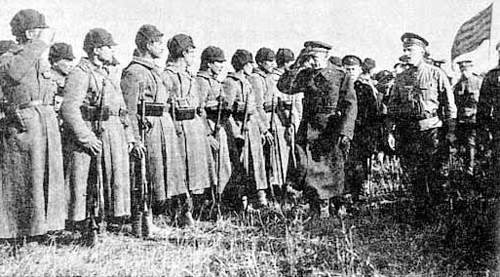
Kolchak inspecting the troops
By the time of Kolchak’s coup, Semyonov had been in power for months. Semyonov felt threatened by this development and enforced a ruthless blockade over Kolchak’s territory. This was like putting his boot on the Admiral’s jugular; the Trans-Siberian Railway was the narrow blood vessel connecting Omsk to the Pacific Ocean, and to the Allies.
An eyewitness recalled Kolchak’s fury: ‘If Ataman Semenov had fallen into his hands now, the Admiral would not have hesitated to have him shot on the spot.’[xv]
After negotiations and a standoff, Semyonov not only lifted his boot but agreed to place himself under Kolchak’s leadership. Later Kolchak would formally and openly acknowledge Semyonov as the next-highest leader of the White cause in Siberia.
They were never happy allies. While Semyonov was a proud and open reactionary, Kolchak was in a position where he had to play a more delicate game. While Ungern was dragging Chinese merchants off trains and Semyonov was swigging champagne with his mistresses, Kolchak was trying to conquer Moscow. Kolchak’s officers were the kind of men who would challenge one another to duels and slap their soldiers in the face, but Kolchak himself had to present his regime as more modern and democratic in spirit. He needed Allied support, and he needed to build up a mass regular army recruited from among ordinary peasants. Everything east of Irkutsk was a bloody embarrassment and in many ways a liability to Kolchak.
But in other ways the Supreme Ruler in Omsk relied on the warlords beyond Lake Baikal. According to Palmer, it was to the realm of Ataman Semyonov that many Red prisoners-of-war were sent, never to return. Those of Kolchak’s faction believed, or at least claimed to believe, that there was a system of prison camps east of Lake Baikal, but there was no such thing. There were death trains, death barges, firing squads, sabres, even ice mallets. All this played ‘a critical, gruesome part in the White infrastructure’[xvi] though we should note that a greater number of Red prisoners were simply recruited as (very unreliable) White soldiers.
In addition, Kolchak and co had no idea how far they could push Semyonov, because they did not know how committed the Japanese were to him. So they didn’t really push him at all.
At least one author has claimed that Ungern was not representative of the White cause.[xvii] This is true enough; Ungern was really only representative of Ungern. But pointing to the prison trains and the mass graves, Palmer argues that the two depended on each other.
This contrast between what it was and what it pretended to be defined Kolchak’s regime. Its government departments were well-staffed and built on an all-Russian scale, but underneath there was very little in the way of actual services being delivered or concrete tasks being carried out. It was, to adapt a phrase, too many atamans, not enough Cossacks. Its military had a lot of top brass with impressive titles, but many were young, junior officers who had no idea how to command tens of thousands.
The Spring offensive
In early 1919 the forces of Admiral Kolchak had plenty of prisoners to dispose of. They went on the offensive and for months enjoyed extraordinary success.
In late 1918 the Komuch regime on the Volga had collapsed under the pressure of the Red Army, the key battle taking place at Kazan. In the winter of 1918-19, Five Red Armies advanced into the Ural Mountains. In January 1919 Lenin envisaged this Eastern Army Group taking Omsk within a month. It was not to be.
Perhaps he should have taken the ‘Perm Catastrophe’ as a warning. I mistakenly wrote in a previous post that after Kolchak’s coup the Czechs played little further role in the war. But it was the Czech officer Gajda who attacked the northern extremity of the Red front at the end of 1918, seizing the town of Perm and throwing the Red Third Army back nearly 300 kilometres.[xviii] Five Red Armies – but were they proper armies in reality, or only on paper? If Gajda could devastate Third Army so easily, Kolchak had reason to believe that the whole Red war effort was ready to crumble under serious pressure.
The Admiral was a sincere and devoted leader who made a point of visiting the frontlines and dispensing gifts to the soldiers. He had that ‘lean and hungry look’ that Shakespeare noticed in certain political figures: ‘he thinks too much… such men as he be never at heart’s ease.’ He was tormented by the dilemmas and pressures of the situation, shouting at his ministers, throwing things around his office, gouging at his desk with a knife. Punishing the furniture was easier than tackling festering problems such as the ‘warlordism’ of Semyonov.
He needed soldiers. Here in Siberia the land question was less pressing, so the peasants were not as hostile to the Whites as elsewhere. But the trained veterans of World War One who had returned to civilian life in Siberia were of no use to him; the war had made them cynical, and in the trenches they had been ‘infected’ with Bolshevik propaganda. From Kolchak’s point of view they were rotten. It was necessary to conscript tens of thousands of younger men, too young to have fought in the ‘German War’ or mutinied during the Revolution. But it would take time to train them up.
Kolchak did not have time. At the start of 1919 it looked like the Allies were ready to sign a peace treaty with the Soviets. To get support and aid, Kolchak needed to show that he stood a chance of crushing the Revolution once and for all. So he needed to launch an offensive, and he needed to do so in the narrow window between bleakest winter and the rasputitsa, the season when every gully would be a roaring torrent and every artillery piece would be axle-deep in mud.
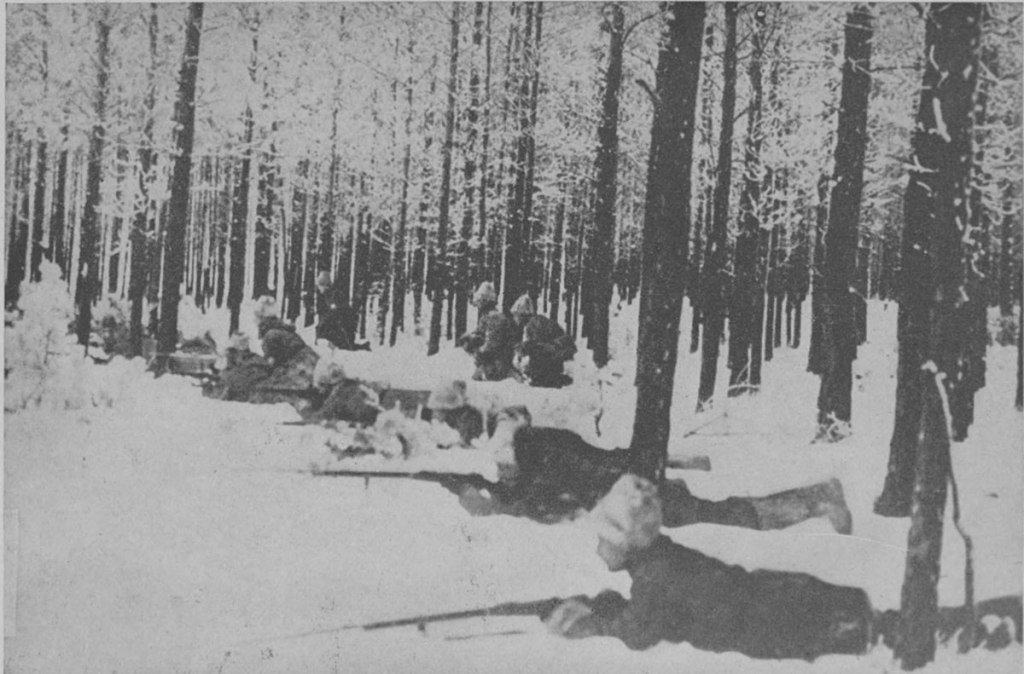
The White forces exploited this narrow window of time with brilliance. On March 4th they advanced through the frozen Ural passes on skis and sledges. On the middle part of their front the Whites set their sights on Ufa. They faced not some rabble of Red Guards, but the Fifth Red Army, tempered at the Battle of Kazan. Nonetheless by March 14th Ufa was in White hands.
Kolchak’s Spring Offensive, surging east to west, detail from number 5 of a series of pictorial wall maps
The young conscripts were still back at Omsk being trained up. This offensive was made by Kolchak’s Siberian Army of officers and Volunteers, bolstered by the incorporated remains of the Komuch People’s Army. So this was a victory of modest numbers against greater numbers.
By the end of April Kolchak’s army had taken a territory the size of Britain, populated by 5 million people. In May, a White officer stood on a height in the re-conquered city of Ufa and looked west over the Belaia river.
Beyond the Belaia spread to the horizon the limitless plain, the rich fruitful steppe: the lilac haze in the far distance enticed and excited – there were the home places so close to us, there was the goal, the Volga. And only the wall of the internatsional, which had impudently invaded our motherland, divided us from all that was closest and dearest.[xix]
There is a profound irony in the White Guard complaining about the internatsional. At that moment, behind his back to the east the railway was held by a counter-revolutionary international: Japan, the Czechs, the US, Britain, France. Allied battalions garrisoned key Siberian cities for Kolchak. The British at Omsk were training up some of the conscripts. If the White officer carried a rifle as he looked westward from Ufa, the bullets in that rifle were of British manufacture; General Knox at Omsk, Kolchak’s best friend among the Allies, claimed that every round fired by the Siberian Whites since December 1918 had been made in Britain, delivered by British ships at Vladivostok, and transported into the interior by British troops.
The flow of supplies had increased. The Spring Offensive had succeeded in terms of land conquered and as a signal to the Allies. Now the peace proposals were a thing of the past, and the Allies had committed themselves with renewed energy to the task of strangling the Russian Revolution. Between October 1918 and October 1919, 79 ships arrived at Vladivostok carrying 97,000 tons of military supplies. This meant around 1.27 million rifles, 9631 machine-guns and 622 artillery pieces.[xx] That is to say nothing of rolling stock, uniforms, greatcoats, boots, etc. Even though a portion of this must have been absorbed by looting and black-marketeering as it passed through the hands of Semyonov, these were vast supplies for a White Army numbering only around 100,000.
But next to what the Whites hoped for and the Reds feared, the role of the Allies fell short. When the Soviet war commissar Trotsky heard of Winston Churchill boasting about the ‘crusade of fourteen nations’ against Bolshevism, he responded with mockery. The Whites, he pointed out, had been hoping for something more like fourteen Allied divisions.
But let us not lose sight of the fact that Allied aid to Kolchak was ‘roughly comparable to total Soviet production in 1919.’[xxi]
Semyonov was a pirate king of the railways; Ungern hated the modern world; Kolchak and his officers denounced the international. But none of the warlords of Siberia would have made it very far without the Allies.
Regardless, the Whites had struck a heavy blow on the Eastern Front. The Ural Mountains had been re-conquered for counter-revolution, and the Allies were staking a million rifles on the victory of Admiral Kolchak. By this time, as we will see in the next few posts, the threats to the Soviet Republic on other fronts had multiplied and grown.
[i] Beevor, Antony. Russia: Revolution and Civil War 1917-1921 (p. 111). Orion. Kindle Edition. I made harsh criticisms of this book. But as you can see, I have found a lot of useful material in it.
[xi] Dauria is also another name for the Transbaikal region
[xii][xii][xii] In spite of his hatred of Chinese and women, Ungern during this period spent 7 months in China and married the daughter of a Chinese general. Palmer guesses that this was a political marriage setup by Semyonov. Palmer, p 111
In Stephen King’s novel The Stand two new societies emerge in a post-apocalyptic USA, based on opposite sides of the Rocky Mountains. A democratic society takes shape in Boulder, Colorado. Meanwhile in Las Vegas power is seized by a supernatural madman who punishes drug users with crucifixion. Only one of these two regimes can survive.
That great, flawed horror epic comes to mind because this post is about two distinct White regimes which emerged on either side of the Ural Mountains in Russia in 1918, and how one consumed the other. As we saw in Part 5, the Czech Revolt led to dozens of White-Guard governments popping up. The Right Socialist Revolutionary (SR) party set up a regime called Komuch (the Committee of Members of the Constituent Assembly) based in the Volga town of Samara. They wanted a republican, democratic counter-revolution, with a mandate from the Constituent Assembly and all the ‘t’s crossed and the ‘i’s dotted. Meanwhile across the mountains a faction of officers and Cossacks set up the Provisional Siberian Government at Omsk, a military dictatorship with a thin Siberian Regionalist veneer.
The most important difference was that Samara was anti-landlord and Omsk was pro-landlord. They were at loggerheads on the land question.
These two regimes did not use direct violence against one another – until the very end, when the outcome was no longer in any doubt. They were supposed to be on the same side against the Reds. But relations were tense; Omsk boycotted Samara’s manufactured goods, and Samara boycotted the grain of Siberia.[i] In August the Omsk regime shut down the Siberian Regional Duma – an elected body dominated by Right SRs, of which the Omsk regime itself was an ungrateful child. Komuch was never secure even within its own territory: ‘Russian officers as well as business and middle-class circles much preferred the state-conscious anti-Communism of Omsk.’[ii] And that territory was shrinking. In a strange twist of fate, the military men of Omsk resided safely a thousand miles in the rear while the Right SRs – civilian politicians – led the regime that was actually fighting the Reds on the Volga. From early September that fight was going very badly. As we saw in Part 8, Kazan and Simbirsk had fallen, and this had thrown Komuch into crisis.
Omsk
While Komuch had grown weaker, the Provisional Siberian Government had grown stronger. The Omsk government did not rest on popular support. Its political wing consisted of junior government officials, conservative refugees from central Russia and the Siberian Regionalists. Its military wing consisted of officers and Cossacks, assisted by a battalion of British soldiers from the Middlesex Regiment. This military wing had built itself up to a force of 38,000 by September, poaching officers from Komuch instead of helping them in any serious way.
The ‘Novoselov Affair’ of September 1918 manifested something that had been obvious for some time. The Siberian Regionalists wanted to increase their presence in cabinet, and a politician named Novoselov was their chosen candidate. But he was abducted by Cossacks and murdered. It was a clear signal, Smele suggests, that anyone who tried to challenge the officers and Cossacks would be found dead some fine morning by the banks of the Irtysh River.
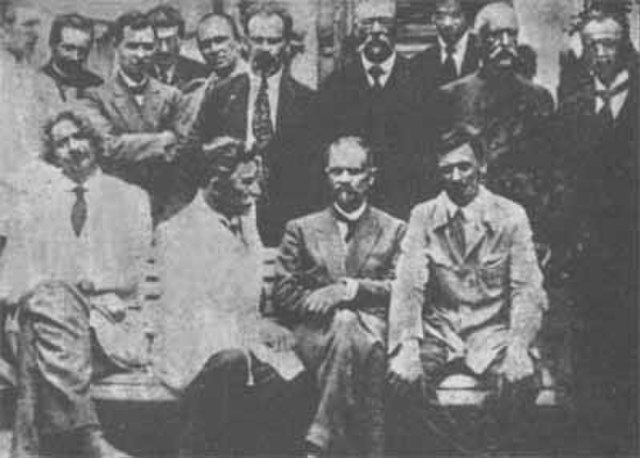
Members of the Provisional Siberian Government
The western Allies looked on with impatience, and demanded Komuch and Omsk get their act together and present a united front. The result was the state conference at Ufa on September 23rd 1918. Ufa is a mountain town half-way between republican Samara and military Omsk. It was as if Stephen King’s two post-apocalyptic tribes held a conference somewhere in Utah. At the Ufa (not Utah) conference a wide array of different counter-revolutionary governments came together. Intellectuals, ‘moderate socialists’ and former terrorists sat down to discuss cooperation with Black-Hundred generals, foreign agents and Cossacks.
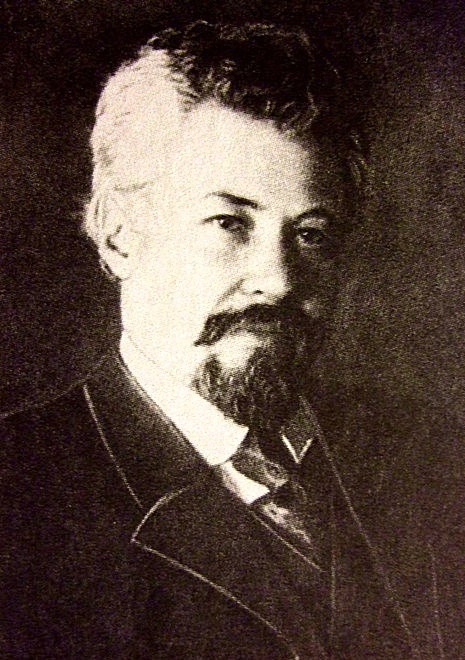
Chernov
The centre of gravity within the SRs had swung from the Right to the Centre. This Centre was embodied in Viktor Chernov, the leading figure in the party, a stout man with a powerful presence who had served as Minister for Agriculture under Kerensky in 1917. During the few hours’ life span of the Constituent Assembly, the deputies had elected him president of Russia. Unlike most Right SRs, he had actually criticised the policy of coalition with the right during the year 1917, though like the others he had dragged his feet on land reform. In the view of his supporters, the October Revolution had vindicated his criticisms; in the view of the officers, he was largely responsible for ‘the weak and indecisive policy that led to the downfall of Mr Kerensky’s government.’[iii]
Now, along with others, he had arrived in Komuch territory arguing for the Right SRs to take a hard line at the Ufa conference. He was up against the resistance not only of officers and Cossacks but of many in his own party. The historian Radkey writes that many Right SRs had become ‘fervent patriots, partisans of the Entente, and devotees of the cult of the state.’ By 1917 ‘a large segment of the Populist intelligentsia had become [Constitutional Democrats] without admitting it.’[iv] We have already seen how the Left SRs split from the party in disgust at these developments. But the divisions ran deeper still. Even Chernov’s centre was divided into a right centre and a left centre. Chernov himself was prevented from going to Ufa by his own comrades, in case his presence upset the Omsk faction.
Viktor Chernov
The Ufa conference opened with a religious service, then talks began. The numbers of delegates heavily favoured the left, but the various factions all had veto power, tipping the balance back to the right. On the other hand, the need to keep the Czechs happy and to impress the Allies put a certain weight on the scale for the left. Countering this in turn was the real balance of forces between Samara and Omsk, which worsened for Samara every day as the Reds advanced.
One sore point was the Constituent Assembly. The Right SRs insisted that it was the only legitimate state power in Russia, sanctioned by the elections of December 1917. Omsk refused to recognise this body, ‘elected in the days of madness and made up chiefly of the anarchist element.’[v] It appears the Omsk officers believed no election could be considered valid until half the Russian working class was dead or behind barbed wire, and until a knout-wielding Cossack could be placed next to every polling station to glower at the voters. An election held in conditions where the workers were organised and confident could not be considered legitimate in their eyes.
It could be argued that Samara won this round. The Omsk government accepted the legitimacy of the Constituent Assembly in principle. But they would not allow it to assume power until January 1919 at the earliest, and even then it must assemble a quorum of 250 elected deputies. To assemble such a quorum, in the chaos of Russia in 1918, was impossible; it had taken Chernov months to make his way to Samara. So it was a hollow victory for Komuch; the generals’ ‘recognition’ was meaningless.
The Ufa Directorate
The outcome of the conference was a merger of Samara, Omsk and other statelets into a government called the Ufa Directorate. Its programme: abolish the Soviets; return lost territories to Russia; resume the war against Germany; and set up a democratic regime.[vi] The Right SRs also changed their land policy to favour the White landlords with whom they were making a deal.[vii]
On paper, the five-member Directorate had a Socialist majority – a concession to the Czechoslovak Legion, who were increasingly war-weary and cynical of the rightward trajectory in the White camp.
But this was only on paper. Just two of the five members of the Directory were SRs, and they were the two most conservative and least authoritative SRs who could be found. The other member of the Directorate with ‘Socialist’ credentials was Tchaikovsky, who was safely in the Arctic Circle at the time, performing socialist fig-leaf duty for another White government.
The Right SR Central Committee had previously voted 6:2 in favour of Chernov’s position that the SRs should fight against ‘the left-wing Red dictatorship [and] an equally despotic Right-wing White dictatorship’ that would probably emerge. ‘In order to fulfil its historic role,’ the party ‘must emerge as a Third Force and fight a determined war for democracy on two fronts.’[viii]
But the same Central Committee flew in the face of this resolution when it voted 4:3 in favour of the Ufa agreement.
Toward the climax of The Stand, that compelling and problematic 1978 horror novel, the democrats from Boulder go to confront the dictator at Las Vegas. They are armed only with their own courage and moral rectitude, along with a mandate from a supernatural higher power.
You can read the book yourself to find out how this plan works out for them. But you only need to read on another few paragraphs to find out how the same method worked out for the SRs when they entered the Ufa Directorate.
If the comparison seems far-fetched, consider these words by the Right SR Avksentiev: ‘We must put our head in the lion’s mouth. Either it will eat us, or it will choke on us.’[ix]
Life in the lion’s mouth was not comfortable. The officers resented what little influence the Right SRs had in the Directorate . In their view, Chernov was whispering in their ears urging them to set up democratic soldiers’ committees inside the White Army. In fact Chernov was not supported by a majority on his Central Committee, let alone by Avksentiev. But he was the bogeyman conjured up by the ‘Siberians’ to add colour to the implausible assertion that the Directorate was dominated by elements who were only two steps away from Bolshevism. ‘The name ‘socialist’ was for them synonymous with ‘traitor.’’[xiii]
‘I drink to dead Samara!’
Meanwhile the Reds were advancing across Komuch’s territory.
The 6,000 workers of Ivashchenko near Samara rose up against the Whites. But this rising was premature; Komuch still had enough strength to put down the rising, killing 1,500.[x] The officers of the People’s Army went from village to village conscripting the peasants. They used the old tried-and-tested Tsarist recruitment methods: public floggings and violent reprisals for deserters and their families.
But they were not so bold in early October, when the Red Armies closed in on Samara. The White volunteers were too few to defend the town. The Czechs retired without a fight. The peasant conscripts deserted to the Reds. The Cossack Dutov withheld any aid. Nobody would defend Samara, but it gets worse; no-one could be found to organise its evacuation. It was a rout, everyone for himself (Chernov included) crowding onto trains to get away.
An SR leader named Volsky was reportedly found drunk and despairing, smashing glasses and ranting: ‘I drink to dead Samara! Can’t you smell the corpse?’
Czech officers taunted Constituent Assembly deputies: ‘Where’s your Army?’ ‘Government? You the government?’
As Samara fell to the Reds, Komuch lashed out at its Red prisoners, killing 306 of them.
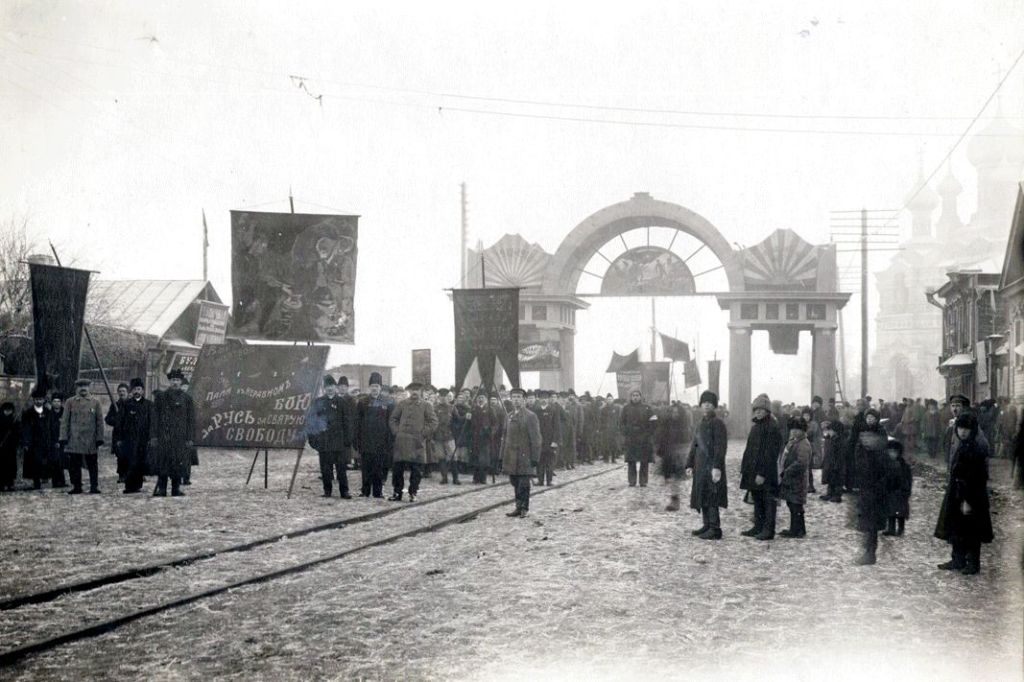
This picture appears to show a Red triumphal procession on Sadovaya Street, Samara, in late 1918 or early 1919.
In spite of its name the Ufa Directorate spent most of its existence governing from railway cars, and officially moved to Omsk in early October. The Novoselov Affair had demonstrated that no civilian politician should push their luck in Omsk, where drunken officers still sang ‘God Save the Tsar.’ The Council of Ministers which served under the Directory was dominated by people more associated with Omsk than Samara. In that city the SR politicians felt the same sense of insecurity and isolation that they had felt in Petrograd in 1917, and in the words of Serge, ‘The very same illusions fortify their spirits. The vocation of parliamentary martyr rises in their breasts.’[xi] Think of Avksentiev with his head in the lion’s mouth. I don’t know what they were thinking; that if they did everything by the book, hosts of constitutional angels would come to their aid… Or that they would get their reward in parliamentary heaven.
Why all the hostility between Samara and Omsk? One way of looking at it is that the generals were too stubborn to recognise that the Right SRs could be a useful political fig-leaf for their cause. They could have kept many Right SR leaders on side by making a few superficial concessions. Their association with the Right SRs was used at the time and is still used today to claim democratic credentials they did nothing to deserve. But the other way of looking at it is that the generals were sophisticated enough to realise that the Right SRs were of little use even as fig-leaves. The Right SRs had only a very narrow base in 1918; their most reliable supporters were the Czechoslovak Legion. Their electoral mandate, such a powerful instrument in constitutional politics, might have been expected to translate into something impressive in the language of civil war. But it simply did not translate.
The Bolsheviks were wise not to recognise the authority of the Constituent Assembly – because practically no-one else did.
Two devastating scenes remained to be played out in the tragedy of the Right SRs. Their protagonist was Admiral Alexander Kolchak.
The Council of the Supreme Ruler
Alexander Kolchak arrived in Omsk in mid-October and was given the Ministry of War and the Marine.
Kolchak was a naval officer from a well-off military family. He explored the Arctic Circle in 1903, travelling by dog-sleigh and spending 42 nights on the open sea. After the disaster of the Russo-Japanese war he approached the Duma (the rigged Tsarist parliament) with plans for naval reform. During World War One he served as an admiral first on the Baltic and then on the Black Sea. During the Revolution, he defied a sailors’ committee by throwing his sword into the sea and declaring the men unworthy of him. ‘Many organisations and newspapers with a nationalist tendency spoke of him as a future dictator.’[xiv]
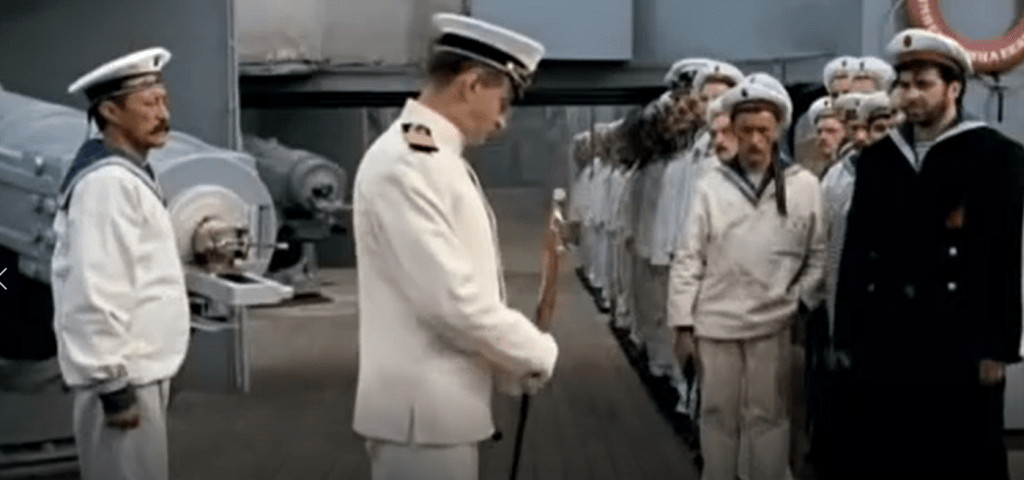
Still from the movie Admiral (2008) dir. Andrei Kravchuk. Kolchak, centre, confronted by the sailors’ committee, draws his ceremonial sword prior to throwing it overboard.
He spent a long time abroad on various wartime plans and projects with the US and other Allies which came to nought. He became an agent of the British state, and was called by London ‘the best Russian for our purposes in the Far East.’[xv] He returned to Russia with the Japanese invasion forces and tried to organise armed detachments in Manchuria and the Far East. Thence he came to Omsk.
A conspiracy coalesced around him, with or just-about-possibly without his knowledge. According to one of his comrades, he ‘had no part in the plot, but was in favour of a military dictatorship.’[xvi]
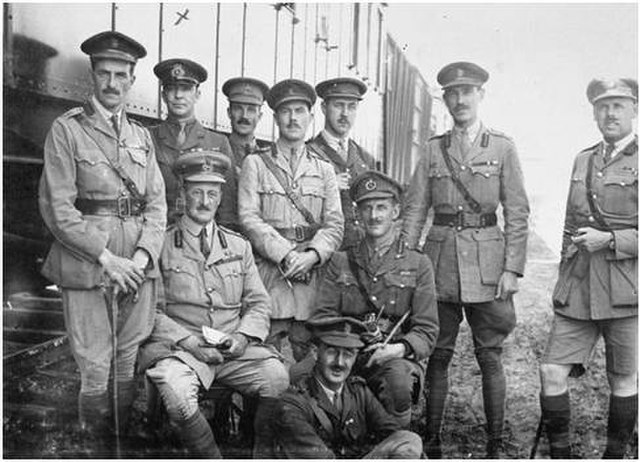
General Knox and other British officers in Siberia. Kolchak was their guy, and they supported his coup.
He had just returned from a tour of the front when it all kicked off. On the night of November 17th, a Cossack detachment arrested many Right SRs, including the two members of the Directorate. The Council of Ministers assumed power. There was a battalion of the British Middlesex Regiment stationed in Omsk at the time, and their leader General Knox knew about the coup before the event and did nothing because he hated the Directorate and was a ‘great champion’ of Kolchak.[xvii] The Omsk garrison commander was on board too. It was a clean sweep.
The Czechs were appalled; but the French and the British dissuaded them from taking any action, the French verbally and the British by physically defending the conspirators. So the coup was bloodless. A new power took over, calling itself the Council of the Supreme Ruler.
The ministers offered the vacant position of Supreme Ruler to Kolchak. He accepted the position, it appears, with a heavy heart, refusing it on the first offer.
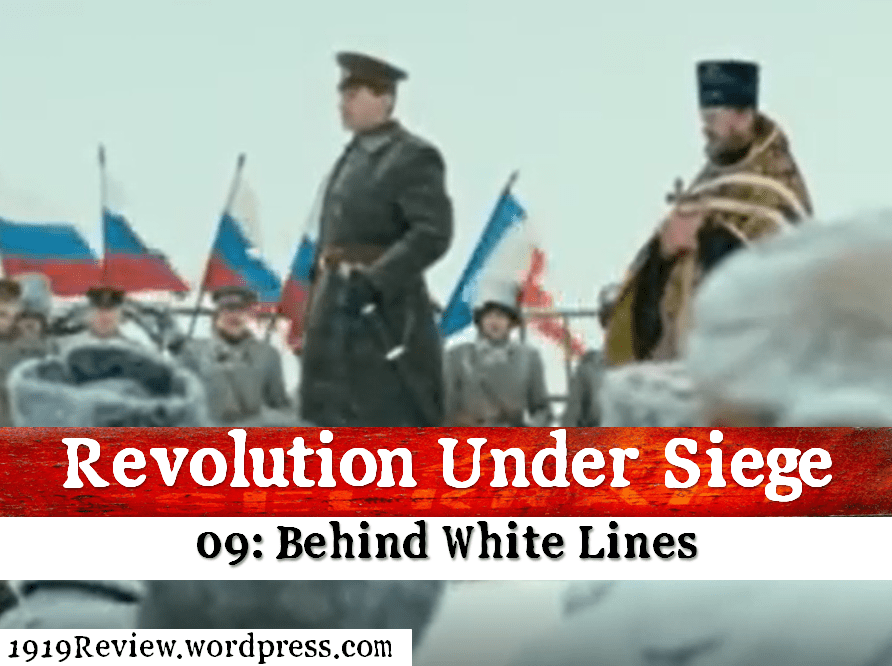
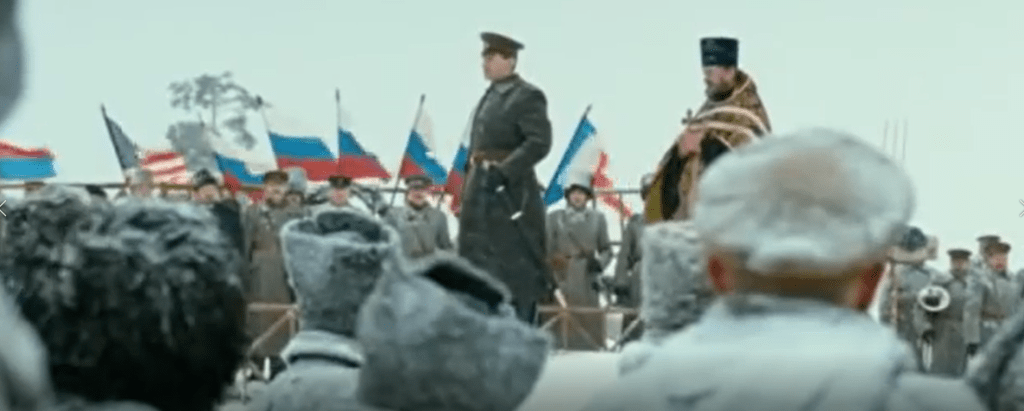
Today’s cover image, another still from Kravchuk’s Admiral. Kolchak in the centre, flanked by the church, plenty of Russian flags, the military, and the flags of Britain and France. This is a very pro-White Guard film. For example it begins with the Admiral sinking a German ship using the power of prayer.
Apologists for the coup preferred not to use the word. It was simply ‘the change;’ one regime ‘gave place’ to another; ‘the directorate ceased to function, and its place was taken by Admiral Kolchak and his ministry,’ who ‘[took] the authority… into their own hands.’ It had been necessary, because the Right SRs had prepared the ground for the Bolsheviks in October 1917, and ‘The same fate now threatened the Directorate.’[xviii]
The Komuch deputies were holding a congress in the mountain town of Yekaterinburg when news arrived of the coup – news, soon followed by armed bands of Siberian Whites who surrounded the venue and arrested them all. The Czechoslovak general Gajda saved them from being murdered by taking them into his custody. There was one last attempt to raise the banner of Komuch with yet another congress, this time in Ufa on December 2nd. It was shut down by Kolchak’s men.
Alone and on the run, Chernov decided to propose a deal to the Reds. They would have the support of the Right SRs if they would only recognise the Constituent Assembly. Still he clung to it. And why wouldn’t he? With it, he was president of Russia. Without it, he was an isolated politician alone on the run.
The Right SRs were legalised – not due to Chernov’s efforts, and needless to say the Constituent Assembly was not recognised. Chernov went to Moscow where he lived in hiding for a year or so before leaving Russia forever.
Back in Siberia, meanwhile, the Regionalist tradition was openly discarded in favour of old-fashioned Russian chauvinism.[xix]
The lion had closed its jaws and, without choking, swallowed the head of the Right SRs. Chernov blamed his own party: ‘our comrades were among those who helped Kolchak’s dictatorship to happen. They pulled down the bulwark of democracy with their own hands.’[xx]
Detail from Russian Civil War pictorial wall map #4, ‘The German Revolution and Entente Intervention’ with some of the captions translated by me. Some details, such as the position of the frontline, are from a later date. The yellow flag in the NW corner represents the Ufa Directorate. The larger tricolour next to it was the flag adopted by the Council of the Supreme Leader. The little explosion is dated and marks the Omsk coup which overthrew the Directorate.
Kolchak had emerged as one of the two paramount leaders of the White cause. In Spring 1919 the Allies would recognise him as superior to Denikin. He was ‘Supreme Ruler’ and not ‘dictator,’ says Smele, ‘so as to maintain the decorum of the civic spirit.’
The note Kolchak struck in his first major address to the Russian people should be familiar to anyone acquainted with Denikin and his ‘I am not a politician, just a simple soldier’ routine:
I am not about to take the road of reaction or of disastrous party politics, but my chief aim will be the creation of a fighting army, victory over the Bolsheviki, and the establishment of justice and order so that the nation may without interference choose for itself the form of government that it desires.[xxi]
The Stand
Joshua Rossett, an aid official from the United States, gives an insight into the perspective on Kolchak held by many in the Pacific port of Vladivostok. He paints a picture of the intelligentsia, workers, peasants and well-meaning Americans all working hard to deal with humanitarian problems, united under the zemstvo, or local government. Then comes the shock of the Omsk coup. He describes Omsk, and the Ufa Directorate which preceded it, as a coup by food hoarders.
At the last local elections in Vladivostok, 35,000 votes were cast. A commissar came down from Omsk and began striking names off the voter rolls, eventually leaving only 4,000 – whom Rossett says were monarchists and speculators.
Rossett had a more visceral shock when local authorities asked a Russian cavalry officer to provide escort for 600 prisoners – men, women and children, mostly Red, some criminals. They were infected with typhus and had to be moved into quarantine. The officer at first refused, then then ‘with genuine enthusiasm’ offered to kill them all.
Very soon there was resistance to the new regime – not from civic-minded people angry at Kolchak’s disregard for the Constituent Assembly, or from appalled American aid workers, but from peasants. They deserted from the White army, refused to supply food, resisted the return of old landlords and old Tsarist officials. The hand of the Supreme Ruler came down heavy on them with hundreds of townships bombarded or burned and peasants ‘shot in dozens.’[xxii] The Red workers had long since fled from White rule in their home towns and set up guerrilla armies in the endless forests of Siberia. Now they were joined by masses of peasants.
The guerrillas composed songs about the untouched forest that sheltered them: ‘Sombre taiga, danger-ridden, Massed, impenetrable trees! Yet we rebels, safely hidden in thy glades, found rest and ease.’[xxiii]
Soon resistance flared up right at the heart of Kolchak’s power. The last scene in the tragedy of Komuch was the December revolt in Omsk. Communists based in the city led a workers’ uprising against the Supreme Ruler. It was crushed, and in response Kolchak lashed out indiscriminately to his left. Serge says that 900 were killed in the repression. Many of the remaining Right SRs and Mensheviks, who had taken no part in the uprising, were included in the massacre. Mawdsley writes: ‘Prominent SRs, including several Constituent Assembly delegates, were summarily executed.’ Of those who were lucky enough to get away, many went over to the Reds. The less lucky survivors sat huddled in cold dungeons, shoulder-to-shoulder with the Communists as 1918, the year of Komuch, withered and died.
From Admiral.
Consolidation
The Russian Civil War is so chaotic and confused that when, from time to time, a pattern emerges in the whirlwind of events, we should pause and examine it. In the White camp over the course of 1918 we can trace the following pattern:
Step 1: Foreign Intervention
On the river Don in May 1918, the Germans intervened.
On the river Volga in May 1918, the Czechs intervened.
Step 2: Local revolt with a ‘democratic’ flavour
Aided by the Germans, the Don Cossacks rose up against the Reds and established a state.
Aided by the Czechs, the Right SRs rose up against the Reds and established a state.
Step 3: In the shelter of the revolt, reactionary forces coalesce
Behind the shelter provided by the Germans and the Don Cossack state, there arose a military dictatorship of officers and Kuban Cossacks.
Behind the shelter provided by the Czechs and the Right SR state, there arose a military dictatorship of officers and Siberian Cossacks.
Step 4: Tensions between democratic and reactionary wings
Nonetheless the Don Cossacks were on unfriendly terms with the Volunteer Army, and the Right SRs were on unfriendly terms with the Omsk regime.
Step 5: Reactionary wing defeats democratic wing
The Don Cossacks spent their strength at Tsaritsyn, then their remains (as we will see in future posts) were cannibalised by the Volunteer Army.
The Right SRs spent their strength at Kazan, then their remains (as we have just seen) were cannibalised by the Omsk regime.
The parallels should be noted well because in them we can see the complex mess of factions tending to resolve itself into united and powerful White armies. Cossack autonomy, Siberian regionalism and Democratic Counter-Revolution – transitional forms, gateway drugs – fall by the wayside and everywhere the White cause takes the form of a far-right military dictatorship.
[ii] Pereira, NGO. ‘The Idea of Siberian Regionalism in late Imperial and Revolutionary Russia.’ Russian History, vol. 20, no. 1/4, Brill, 1993, pp. 163–78, http://www.jstor.org/stable/24657293.
[v] I copied and pasted this quote word-for-word from a reliable source – but I can’t remember which one! When I find it again (probably as I comb through my notes in search of something completely different six months from now), I will post a proper citation here.
[vi] Serge, Victor. Year One of the Russian Revolution, p 346
[xiii] M. I. Smirnov. “Admiral Kolchak.” The Slavonic and East European Review, vol. 11, no. 32, Modern Humanities Research Association, 1933, pp. 373–87, http://www.jstor.org/stable/4202781.




 The 1919 Review