
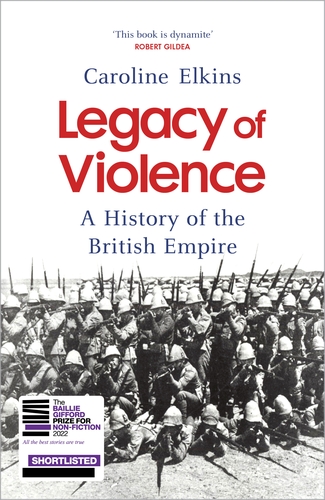
Legacy of Violence: A History of the British Empire by Caroline Elkins, Penguin, 2022
Legacy of Violence covers 200-plus years of the history of the British Empire, from the late 18th to the late 20th century, spending most of its word count in the early-to-mid 20th Century. Elkins refers positively to the anti-imperialist writings of Walter Rodney and Vladimir Lenin, but only to tell us that she will be coming at the subject from a different, though not contradictory, angle. This is primarily a book about repression and counter-insurgency in the British Empire. Economics, politics and sociology are part of the narrative but rarely to the fore.
Elkins focuses on key episodes, states of emergency and of exception, in which laws and human rights were suspended. There are far too many examples to list, but they include the revolt in Jamaica in the 1830s, the Boer War, the ‘Malaya Emergency,’ and the Troubles in Ireland. Questions of philosophy and law are traced through this diverse globe-spanning range of episodes. One thing that really impressed me was how she follows the careers of various British officials – for example, the Black and Tans who went from one brutal counter-insurgency in Ireland to an even worse one in Palestine.
The same themes and phrases keep coming up. For example, you could point to so many examples where the British military terrorised rebellious people into submission with killings, torture and bombing. From one continent and decade to the next, British officials and officers had the same pleasant phrase for this: ‘the salutary moral effect.’
What unfolds as you read through this book is a fascinating and globe-spanning story. Here are some of the things I did not know about, in vaguely chronological order:
- The perpetrator of the infamous Amritsar Massacre in India in 1919, Brigadier-General Dyer, faced a controversy but ultimately got off the hook. But the politician who tried to make Dyer face some consequences was himself punished with the loss of his reputation and career – along with anti-Semitic abuse. Also, that Amritsar Massacre was not just a singular event – it was preceded and followed by a long reign of terror over the whole area where it took place.
- The British prepared the ground for the Naqba, the ‘catastrophe’ in which Palestinians were ethnically cleansed from their country in 1948. Death squads of British commandos, supported by Jewish paramilitaries, suppressed Arab revolts with raids, bombings, assassinations and torture. One of the main British officers, the famous and eccentric Orde-Wingate, was motivated by vicious anti-Arab racism.
- When these paramilitaries began an insurgency against the British Empire in the late 1940s, a wave of anti-Semitism swept Britain. Yeah, right after the Holocaust, Mosely and the British Union of Fascists made a comeback. (Though I had heard about this one in a fascinating book called The 43 Group).
- Long before the Blitz of 1940, the British military pioneered the bombing of defenceless villages, for example in Iraq.
- During and after World War Two, there were prisons in England and in Germany where torture of German detainees was widespread. This was the case tenfold in India, where Britain had to come up with elaborate means to re-establish control after the war.
- After the war there were campaigns to get governments to recognise human rights laws. Britain saw that the Universal Declaration on Human Rights would be incompatible with the brutality required to maintain its empire, so it resisted for decades.
- As Britain cleared out of India, clouds of smoke hung over the major cities; British officials were burning heaps of documents.
- The rebellions in Malaya and Kenya in the 1950s were the most striking and educational parts of the book for me. These were popular rebellions with democratic demands and grievances, and they were put down with a variety of evil means. In Malaya we see the mass transfer of entire ethnic groups and populations. There and in Kenya we see huge torture camps. The reality is that torture was a completely normal practise in the British Empire, though the folks back home didn’t know about it and instead were fed rubbish about ‘hearts and minds.’
There is so much more I could say – if I’d taken notes, I could write in greater length and detail about all the above bullet points and as many again. That goes to show how much I learned from this rich volume. It’s really well-written, it’s obvious that a vast mass of research has gone into it, and there is a deep coherence and structure underlying the whole globe-spanning narrative. I’m grateful to have read this fascinating, disturbing and enlightening work.
 The 1919 Review