We’ve got a guest post for you today, a review of Netflix’s Gundam: Requiem for Vengeance by freelance writer Charlie Jean McKeown.
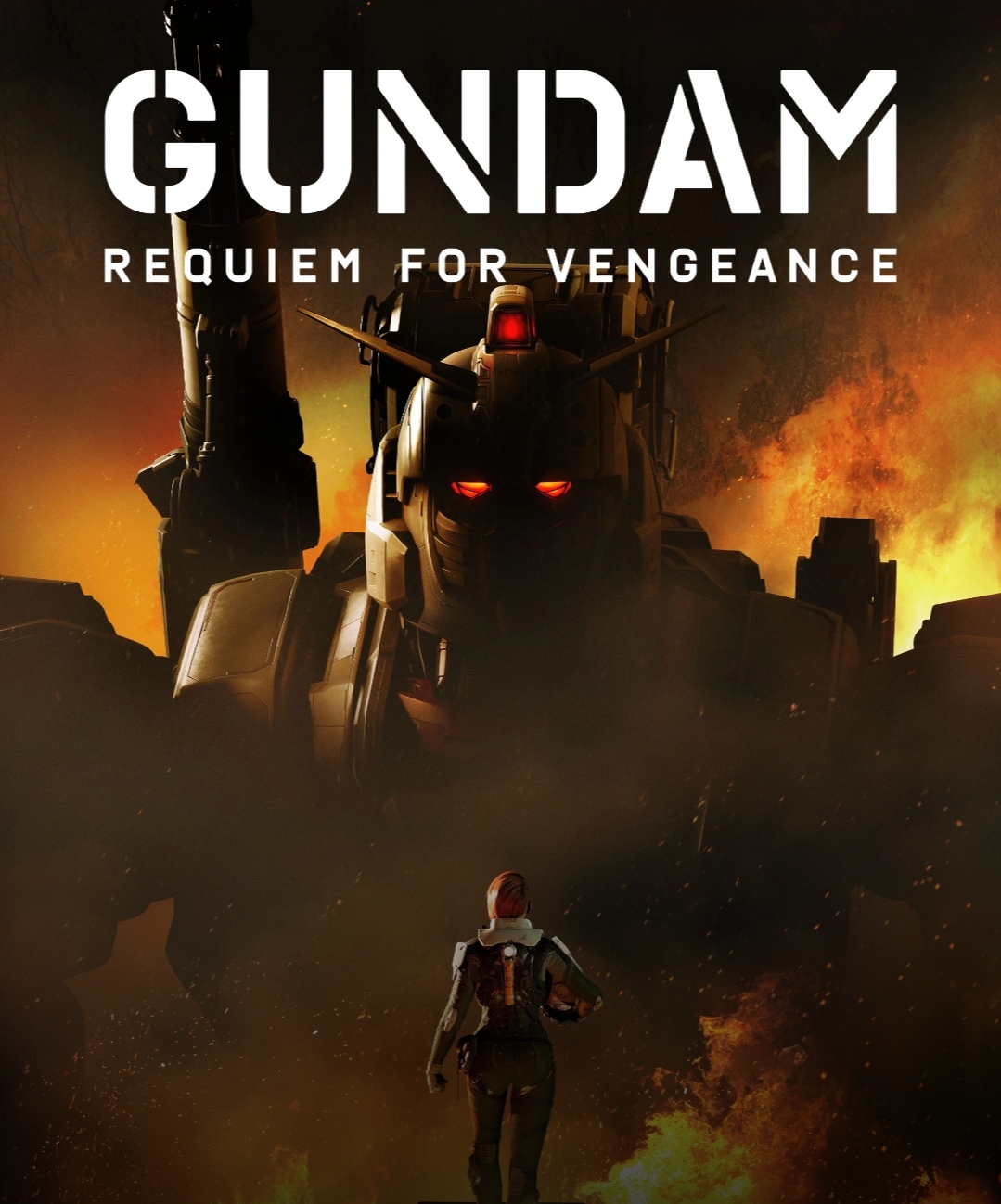
Stories and machines are ultimately driven by people, yet Gundam: Requiem for Vengeance lacks the personality needed for the gritty mecha war drama it tries to be. Since its 40th anniversary, the Gundam franchise has been boasting ambitious projects like SEED Freedom (2024) in theatres, Witch from Mercury (2023) on TV, and in gaming Gundam Evolution (2022). (i )
This new Netflix series follows Zeon soldiers- the usual antagonists- in the closing months of the ‘One Year War.’ It’s an attempted love letter for Gundam fans, with a touching homage to the original 1979 show in its opening titles and what must have been a laborious effort to give the classic mecha designs such glorious detail. However, Requiem has little identity of its own; it has little to offer old fans and nothing accessible for new ones. More disappointingly, it does open up genuinely interesting themes which could have given the show some life if they were navigated by decent characters.
Requiem actually inverts some of Gundam’s most central themes; empathy becomes vengeance, and our protagonist is an enlisted mother rather than the usual child soldier. ‘Time’ is not a new theme for the franchise but had never received the same attention it enjoys here albeit with some overly-obvious motifs. The survival element of other Gundam series is heightened in Requiem too, as we watch the losing side struggle against a war-winning weapon. These themes, though, are only minimally engaged with. While one could blame this on the many action scenes, Gundam has always used battles to deepen its narratives rather than merely embellish them. Furthermore, Requiem still has plenty of peaceful moments in its three-hour runtime. The fault is really found in the show’s repetitive exposition soaking up what should be time spent on challenging characters so that they may develop and investigate these concepts.
All of this culminates into the most disturbingly mishandled theme of Requiem: nationalism. Mirroring the Cold War narrative of Nazi Germany (ii), Zeon had always been presented as an evil fascist regime with ordinary soldiers fighting for their homes. Interestingly, the One Year War – the definitive conflict of the franchise – is renamed here as ‘the Revolutionary War.’ Is this how the fascist Principality of Zeon sees itself? Do they view the One Year War the way Confederates saw the American Civil War? It’s a fascinating angle to investigate. However, it feels like Requiem takes up a ‘both sides matter,’ approach, with no real discussion of Zeon’s war crimes (wiping out half the Earth’s population, for instance). Instead, our apolitical protagonist is “just following orders.” While her final monologue is clearly intended to convey a lesson she learnt, it gives us a rather warped justification for continuing to fight under a swastika-esque banner.
Banner of the Principality of Zeon
While the writing is poor, Requiem’s establishing shots want you to know money and effort went into making them. Requiem is Gundam’s first CG animated production since MS IGLOO (2004), and the improvement in quality is staggering. By tightening their dimensions, the old mecha designs remain credible in today’s science fiction scene while the body language of these giants conveys a surprising degree of emotion. The facial animations are unfortunately less expressive, and to come across they often rely on the wonderful new soundtrack provided by award-winning composer, Wilbert Roget II. Netflix’s first Gundam production does look lovely as a whole, but its writing encourages little confidence in the live action film they announced in 2018. I doubt Requiem will see a second season, which is a terrible shame given its potential; if the writers could make some course-corrections in a new season and rummage through those ideas they raised, then Gundam: Requiem for Vengeance could be forgiven for these first six dismal episodes and actualise its own distinct identity.
(i) While Evolution was closed down in a year, it gave Overwatch 2 a little competition in the hero-shooter market before collapsing under its embarrassing micro-transactions. (ii) A narrative, it should be noted, now being revised by historians who are acknowledging the Wehrmacht’s complicity in war crimes.
Access to this article is limited to paying supporters. If you already subscribe by email, thank you. But if you want to become a paying supporter, please hit ‘Subscribe’ below.
Donate less than the price of a coffee, and you can access everything on this blog for one year.
If you don’t feel like donating, most of my posts are still 100% free, so browse away, and thanks for visiting.
Hi folks. I’m going to dig deep into Cixin Liu’s The Three-Body Problem and its 2024 Netflix screen adaptation. This first post will look at the book’s most fascinating character, Ye Wenjie. The Three-Body Problem is really her story – how and why she betrayed humanity, and the consequences of that betrayal.
I enjoyed the TV show. If you’re looking for a big rant where I complain about every aspect of it, you will be disappointed. But its version of Ye lacks the novel character’s depth, doesn’t hit us as hard emotionally (Due to the script and not due to fine performances by Zine Tseng and Rosalind Chao). Mostly I’m not criticising so much as saying, ‘Look here – this is interesting what they did here and what effect it has.’
The writing in Cixin Liu’s trilogy (I’ve read the first two) is sometimes stilted or technical or slow. But there is great prose here, especially in the Ye Wenjie sections:
Page 294: ‘In the deep silence of midnight, the universe revealed itself to its listeners as a vast desolation.’ (a line repeated to great effect later)
Page 299: ‘Above her, the Red Coast antenna lay open, silently, like a palm toward the universe.’
The screen version lacks this prose but makes up for it with strong visuals. It’s held together by compelling characters who have natural dialogue and interactions. It’s slick enough that it got a lot of eyeballs onto screens; it was a success, and there’s a point past which you can’t argue with that. It brought the main gist of the book to a much wider audience. I’m glad more people got to experience this great thing.
Page and screen are autonomous, and I’m not going to judge one for deviating from the other. Nonetheless about some of these deviations I have plenty to say.
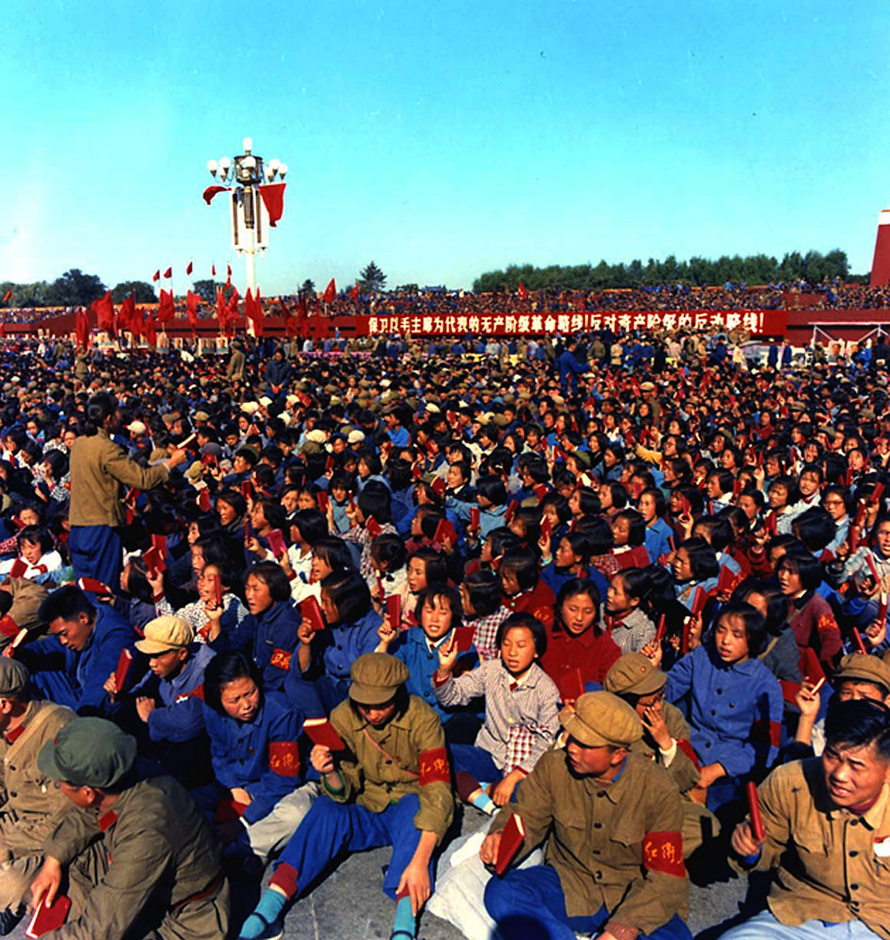
Red Guards during the Cultural Revolution – Tiananmen Square, Beijing, 1966
Cultural Revolution
The Three-Body Problem by Cixin Liu begins with a panorama of Beijing at the height of the Cultural Revolution, with factionists killing one another in street battles. Next we see a stage in a university square. Student paramilitaries denounce and beat a physics professor; they go too far and kill him.
The Netflix TV adaptation begins the same way. But the Netflix audience – and the western reader – mostly has no idea what the Cultural Revolution was. It’s not the business of the screenwriters to give you a history lesson. But western ignorance about China might leave many viewers with questions about this scene. For example, Jordan Peterson – who presents himself as very well-read and knowledgeable – thinks the Cultural Revolution (1966-1976) and the Great Leap Forward (1958-1962) were the same thing. His complete ignorance didn’t give him any pause for thought – he put out that claim in a published book, Maps of Meaning, and while he was at it he declared in passing that 100 million people died in this 18-year-long composite event.
I’m pretty ignorant about a lot of things too – never read Jung. But I’ve visited China and read a few books about the place. The Cultural Revolution took place twenty-odd years after the communist victory of 1949. The 1949 Revolution overthrew the landlord class and delivered a massive expansion of health and education; hence why students who were babies in 1949 are, by 1967, so keen on it and on its foremost leader, Chairman Mao Zedong. But Mao messed up with a campaign called the ‘Great Leap Forward,’ contributing to a terrible famine, and afterwards he was sidelined.
The Cultural Revolution began four years later. It was half a student uprising against government figures who were perceived as conservative or bureaucratic; half Mao’s power play to get back in full control. It was a mess that got way out of hand. The way it’s depicted on text and screen seems fair to me, but the original Chinese reader had more context than the Netflix viewer or western reader.
On the page and on screen we experience the same terrible episode: a teenage girl named Ye Wenjie watches as her father, a theoretical physicist, is publicly humiliated and killed. In the book, we are privy to her own thoughts and memories. Long ago, before the Revolution, her father met Einstein. Einstein pointed to a ditch-digger on the streets of Beijing and asked how much the guy earned. Instead of a deep discussion on the nature of the universe, Professor Ye’s only dialogue with Einstein consisted of telling him that the ditch-digger probably earned 5 cents an hour.
This is one example of an opening that is rich in contrasts; likewise it is bizarre and unsettling how a discussion on theoretical physics is combined with a scene of pseudo-revolutionary ritual persecution and public torture.
This is a moment of cruelty and hysteria, a moment when the human species comes across very badly. This does two things: it sets Ye Wenjie on a course to betray humanity, and in its depiction of a hysterical political rally it prefigures the later development of the Earth-Trisolaris Organisation. The first, at least, comes across clearly enough on the screen as on the page – the second, not so much.
‘Big-character posters’ bearing uncompromising political slogans, a hallmark of the Cultural Revolution, being pasted to a wall in 1967
Red Coast Base
After the worst excesses of the Cultural Revolution, the youth were rusticated en masse, sent out to the countryside to do hard labour and keep out of trouble. That’s where we next catch up with Ye Wenjie: with a logging crew in Inner Mongolia. She watches as ‘vast tracts of grasslands became grain fields, then deserts.’
Ye Wenjie sees the environmental destruction and concludes that humanity is to evil what an iceberg is to the sea – composed of the same material but just in a different form. Her dawning environmental consciousness is warped in this misanthropic direction by her previous experiences. To make matters worse, the first person she trusted since her father’s death, Bai Mulin, betrays her. Long before having any idea that she will one day communicate with aliens, she concludes that ‘To achieve moral awakening required a force outside the human race.’
She gets her chance when she is sent to the mysterious Red Coast Base. Pages 46-48, describing the mysterious dish in use, are very tense, exciting and mysterious. The climax is when the birds fall out of the sky. Here the TV show hews close enough to the book. Again, what we lose in interior monologue, we gain in strong visuals.
Ye Wenjie doesn’t like living at Red Coast base but it suits her. She seeks isolation after her experiences; it seems safer. But here, in her relationship with the commander and commissar, there is room for further betrayals, petty ones this time (pages 174-5).
The TV show hurries through the Red Coast portion of the book in a couple of flashbacks. This is a shame because, alongside the surreal videogame sequences, it’s the best part of the novel.
An example of what we lose: on pages 180-183 we get to see internal government documents where the top-tier Chinese communist leaders discuss how to contact aliens. The first draft is full of heated revolutionary rhetoric but it is dismissed as ‘utter crap’ – don’t send big-character posters into space! A more sober draft follows.
To its credit, the TV show keeps the part where Ye Wenjie figures out that the sun can be used as an amplifier for radio transmissions into space. The explanation in the book is too technical, but on screen it’s just right.
Her idea is dismissed, but she goes ahead in secret. She sends the transmission to the sun. In the book this is an awesome moment, even as Ye herself loses hope:
Ye saw the rest of her life suffused with an endless grayness. With tears in her eyes, she smiled again, and continued to chew the cold mantou.
Ye didn’t know that at that moment, the first cry that could be heard in space from civilization on Earth was already spreading out from the sun to the universe at the speed of light. A star-powered radio wave, like a majestic tide, had already crossed the orbit of Jupiter.
Right then, at the frequency of 12,000 MHz, the sun was the brightest star in the entire milky way.
As a plot point, this comes across clearly on the screen. But the sheer awesomeness of this moment is lost in translation. Likewise the moment, some years later, when she has a choice and betrays the human race. Everything has been leading up to this, but it’s still just enough of a leap that it shocks the reader. This is why Ye Wenjie is a great villain in the book.
The show leaves out some plot points too. In it, Ye has a baby with Mike Evans, her American collaborator. In the book, she has her baby with chief engineer Yang who works at Red Coast base. But in the book we see her commit an incredibly cold-blooded murder of commissar Lei. By an unhappy chance, killing Lei obliges her to kill her husband Yang at the same time. She kills them both – including the father of her child – without hesitating.
Our view of this character changes fundamentally at this point – her betrayal of humanity is made real and manifest. This betrayal is not mediated by a computer screen or a radar dish.
The Earth-Trisolaris Movement
Something crucial happens in the book: Ye Wenjie goes to a local village and lives with the farmers there to have her baby. They donate their blood to save her and house and feed herself and her baby. In return, she teaches their children. This is a lovely section of the book. It’s a rebuke to the anti-human attitude she has adopted. ‘Something finally thawed in Ye Wenjie’s heart.’ (316-321) We see Ye in a different setting and mood from the military-scientific base and the Cultural Revolution era. Her horrific experiences were not the full picture; most of us human beings, while we have our burdens to bear, live lives that are far happier than hers. We do not experience such repeated and concentrated doses of inhumanity. And if she hadn’t, she wouldn’t have betrayed humanity. When we exploit and brutalise one another, we degrade humanity’s faith in itself, humanity’s integrity. When we harm a fellow human we harm ourselves as well.
Her next experiences set her back into her misanthropic groove. Her mother, who helped do the father to death, washes her hands of what she did, and even blames the dad for it. (324-5)
Ye Wenjie then meets the three Red Guards who killed her father – in the TV show, there is thankfully a version of this scene. After their revolutionary ardour was exploited for political ends by a faction in the state, the three teenage girls were doomed to years of hard labour. There’s nothing left in them but bitterness, and they have suffered too much to be remorseful. I found this interesting; the mother is unrepentant because she has moved up in the world, and the girls are unrepentant because they haven’t.
This entirely depressing experience counteracts all Ye’s tendencies toward ‘thawing.’ But we have seen that she has a soft side.
This is relevant when we fast-forward a few decades to the development of the Earth-Trisolaris Organisation (ETO), a political group which is determined to help the aliens to conquer Earth.
In the TV show it is not named as such, and we learn very little about it. This is a weakness of the screen version. Why would some humans wish to collaborate with aliens? What internal debates would such a movement have? These fascinating questions are explored and dramatized in the book but not on the TV show.
They call each other ‘comrade,’ evoking the Cultural Revolution, but this is not a movement of idealistic students. ETO is made up of people drawn from the political, technical and financial ‘elites;’ it is explained that their grasp of science and their knowledge of the darker side of humanity makes them willing recruits. This tracks – Mike Evans is the son of a billionaire and thus alienated from humanity (no pun intended). Efforts to recruit ‘common people,’ meanwhile, have failed due to their ‘instinctive identification’ with humanity. (344-5)
ETO funds all kinds of anti-science groups. This is touched on in just a single line in the show which is really a missed opportunity to say something very relevant to the post-Covid world.
ETO is divided into two factions:
The Adventists wish to eliminate the human race. They realise the Trisolarans might not be much better, but don’t care.
The Redemptionists, on the other hand, have developed elaborate fantasies about Trisolaran civilization, and think the aliens will save humanity from itself.
A new and small third faction, the Survivors, is drawn from the small number of recruits from among the ‘common people’ – they hope to survive the war by collaborating with the Trisolarans.
Much like the Red Guards in 1967 Beijing, the two factions are on the brink of an internal civil war. Ye Wenjie doesn’t much like any of the factions, who have departed from her original vision, but she especially hates the Adventists and plans to wipe them out.
I’ve been praising the book a lot, but it has problems. From a zoomed-out distance, the ETO is compelling. But when Liu tries to show it in real life and real time, it fails to convince. Wang Miao infiltrates the ETO with comical ease; he attends a casual introductory chit-chat in a café, and is immediately invited to a major conference. The events of the conference contain subtle echoes of the Cultural Revolution scene at the start, and culminate in a moment of dramatic action. But the whole thing is stilted. Take it from a seasoned activist: this is not how internal disputes within a revolutionary party work. You don’t just have one meeting where you bring up everything all at once, and then trash it all out on the spot. Political conflict can be dishonest, drawn-out, and dirty – or, to put it kindly, it is richer and more interesting than how it’s presented here.
Having said that, there’s proper drama in the showdown between the two factions, and that’s before the jackboot of the state kicks down the door and Da Shi and his men storm in. The TV show, by contrast, has a flattened ETO.
Until next time…
Next week I’ll look at the other major strand of the novel The Three-Body Problem: Wang Miao’s storyline set in the present day and concerning a flickering universe, a loutish and morally dubious cop, and a mysterious videogame. Of course, I’ll be comparing the original with how it was adapted for the screen.
Did you enjoy reading this? Subscribe to get an email notification whenever I post:
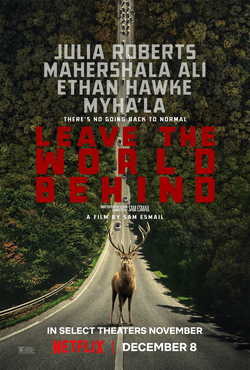
This is a review of the 2023 Netflix movie Leave the World Behind (dir. Sam Esmail). Rather than review it myself, I have delegated the job to a time-traveler from the early Soviet Union. If he does a good job, I will delegate other reviews in the future to other time travelers – 7th-century monks figuring out crime thrillers, eighteenth-century rakes getting teary-eyed over Pixar cartoons, 24th-century asteroid-croppers watching rom coms...
I have spent only a few days in the 21st Century. I have barely ventured outside, as I find this world disorienting and distressing. My host suggested watching a film set in this current century to help orientate me. So I watched the most prominently-advertised film on his home cinema screen: Leave the World Behind.
In this film a family of the intelligentsia leaves the capital for a few days to rent a dacha in the countryside. But their social order begins collapsing around their ears. First, communications and transport are cut. Next, the country is flooded with disorienting enemy propaganda. Last, civil war breaks out. The same thing happened to us in 1918 only, as with everything in Russia, it took longer. They are under attack from an unknown enemy – and speaking from my own bitter experience, it’s probably the Czechoslovak Legion in league with the Cossacks, backed by the Anglo-French imperialist bandits.
The owner of the dacha flees from a calamity in the city along with his daughter, and they arrive at the dacha seeking shelter. He is bourgeois, and he is the owner of the house, but he is also a member of an oppressed nationality. So the mother of the intelligentsia family treats him with chauvinistic suspicion and contempt.
So far, the film presents a situation I can easily comprehend. The characters, too, were familiar types to me.
The father has a fine head of greying hair and a small beard. He is professor, and he looks not unlike some of my own old professors. I recognised him at once as a Narodnik, as he is generous and feckless, democratic in his opinions but not always democratic in his instincts. As the film went on I was again and again confirmed in my impression.
They have a young daughter who is obsessed with fictional works composed several decades before she was born. Naturally, I am unfamiliar with the works in question (Friends and The West Wing), but I felt sympathy with this character as I spent much of my youth engrossed in Turgenev and Tolstoy.
The intellectual family also have a son, a worthless fellow who is cruel to his sister. Late in the film, his teeth fall out of his head. It appears to be a side-effect of some epidemic – again, this to me is very familiar. So the boy and the two men go to a local kulak, who has been hoarding medical supplies. But in this crisis the rural population has turned inward, and the wealthier peasants are solely concerned with individual property and family. The kulak refuses to accept their worthless paper money, and threatens them with a rifle. I could have warned them this would happen.
The bourgeois draws a pistol, intending to expropriate the kulak’s medical supplies by force, but the intellectual becomes histrionic, bares his chest to both firearms, and throws himself on the kulak’s mercy.
The wily peasant relents and accepts the paper money, saying that a ‘barter system’ is acceptable to him.
There was much I did not understand in this film, but I gave a hearty and appreciative laugh when the intellectual salvaged a little of his dignity by correcting the kulak: ‘Well, I gave you money, so it’s not really barter.’
Stripped of their collectivity, these individuals and family groups still respond to their class instincts but lack any actual power. They flounder and tread water. They are saved only by a happy accident; the local landlord has abandoned his mansion, taking his family and all his servants with him, leaving a well-appointed cellar stocked with supplies and cultural riches, which the intelligent young girl finds. The only danger is that the adults will find the nobleman’s wine cellar and drink themselves into oblivion.
They will take refuge from the coming civil war in a nobleman’s cellar. Well and good for them. But what about the fate of their nation and people? To this they appear completely indifferent.
To myself, a man out of time, much was strange, much was familiar. These people of 2023 have screens instead of newspapers; that much is easy enough to grasp. The only printed material in the film is a leaflet in Arabic dropped by some Basmachi aviator. People still smoke, but their pipes are made of metal. With regard to motor cars, it appears the rabid anti-Semite and union-buster Ford has been long since put out of business by Monsieur Tesla’s company.
My host expected me to be awed by the technology. But I expected more from the 21st Century than handheld screens and motor cars which drive themselves (very poorly). At one point wee see that there is a tattered-looking American flag on the moon. That’s it! Only a flag. The relations between men and women appear to be less unequal than in my own time, but aside from that I was, I confess, disappointed by how readily I felt I could comprehend the social relations on screen.
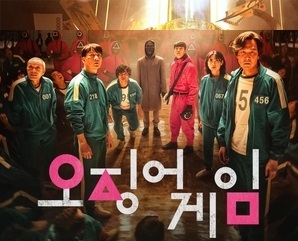
What makes Squid Game different from Hunger Games and Battle Royale? The fight to the death in Squid Game is not just bigger and bloodier. It is voluntary. Stephen King’s Running Man also features a lethal game whose contestants are volunteers. But King’s novel, and its movie version, and Hunger Games and Battle Royale, are set in future dystopias. Squid Game is set in our world, right now.
The conditions in North Korea are so desperate that Sae-byeok risks death to escape. But when she enters the game she risks death again, this time to escape from the desperate conditions for the poor and working class in South Korea, to escape from capitalism. As someone says in Episode 2, it’s worse out there than it is in here.
The final episode of Squid Game hammers home an anti-capitalist argument that has been running through the whole story. Many have commented on this, including the writer and director Hwang Dong-hyuk. This article goes into some detail. But I want to focus on the voluntary nature of the games and how this plays into the anti-capitalist message.
In-ho’s words in the last episode make this point very clear. He says words to the effect that ‘You chose this,’ ‘You signed up for this,’ ‘Nobody forced you.’ Another villain, the psychopathic Sang-woo, insists on Gi-hun’s personal responsibility for all the killing.
Within formal logic, In-ho’s argument is unanswerable. But Gi-hun recoils against his words and against Sang-woo’s. They are wrong. Gi-hun knows it in his gut, and so do we.
It’s true that the game is voluntary. In-ho himself, undercover among the contestants, casts the deciding vote for them all to leave. But for some reason, we don’t accept their arguments.
‘You chose this,’ ‘You signed up for this,’ ‘Nobody forced you.’ That’s what we hear when we complain about our jobs, our mortgages, our car payments. We even hear a version of this in the cliché that ‘people get the government they deserve’ – ie, the people are responsible when their elected leaders betray them. In the most formal sense, it’s all true.
The game’s overseer keeps insisting on ‘equality’ as the fundamental principle of the whole operation. In theory, capitalism is fair and we’re all equal. In theory, the worker and the boss meet one another ‘in the marketplace’ (wherever that is) on a basis of complete equality. They agree to a contract which is satisfactory to both: I work for you, and you pay me. The law says these two people are completely equal. The law says this contract is voluntary.
But the reality is very different from the theory, and from what the law says. That reality is illustrated in every episode of Squid Game.
When we first see Gi-hun, we are invited to see him as a waster and a messer. Then in mid-series we hear about the auto workers’ strike Gi-hun was involved in ten years ago and about the lethal police violence. This sacking was a catastrophe from which his life has never recovered. He got into debt with failed business ventures (Isn’t that what you’re supposed to do? Isn’t that what they tell us to do? Be an entrepreneur?). His family has broken down. No wonder he’s in the situation he’s in. It could happen to you or me.
Another contestant has decades of experience as a glassmaker. We can assume he’s got a similar story to tell. And we see with our own eyes how Ali was scammed by his boss.
The final episode hammers home the point. A TV or radio playing in the background of a scene reminds us about the crisis in household debt. Early on in the series, we might think, ‘OK, these contestants are people in extreme situations – gambling addicts, refugees, gangsters.’ But the final episode insists: this situation is general.
For all its brutality, Squid Game is written with compassion and humanity. These games are not a public spectacle or a reality TV show. They are secret. The public at large do not enjoy the games. They would be sickened if they knew the games were happening. The audience, lapping up other people’s suffering for entertainment, are the handful of billionaires who bankroll the whole operation – and who got rich making everyone’s lives so desperate and precarious in the first place. The indebted and desperate Gi-hun lives on a different planet from these ‘VIPs.’ To claim they are equal is a vicious lie designed to keep Gi-hun in his place – and, perhaps, to soothe the consciences of the wealthy.
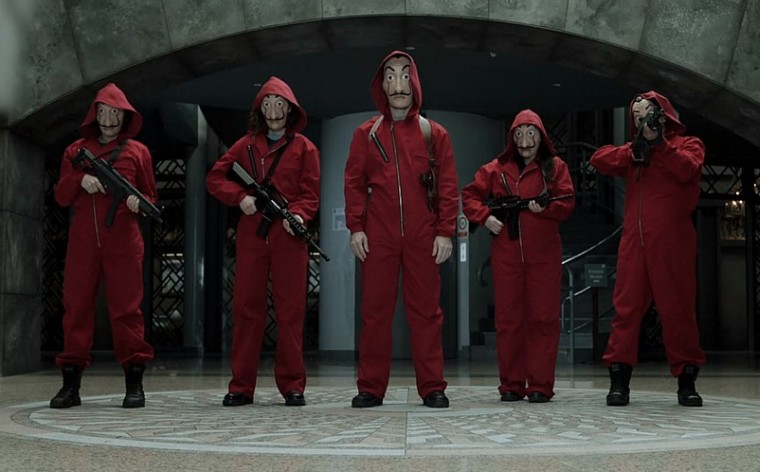
People are drawing parallels with Money Heist, another series on Netflix. Like Squid Game, it has won a colossal audience in spite of the fact that it’s not in English. This Spanish crime series is knee-deep in socialism. A miner from Asturias who calls himself ‘Moscow’ sings ‘Bella Ciao,’ talks about the 15M movement and supports his trans comrade; in a fierce battle in the ruins of the national Bank of Spain, the robbers denounce the forces of the state as fascists and draw inspiration from the Battle of Stalingrad. But what’s more important than any of these Easter eggs is what this guy said: that what makes Money Heist popular is the class rage it channels.
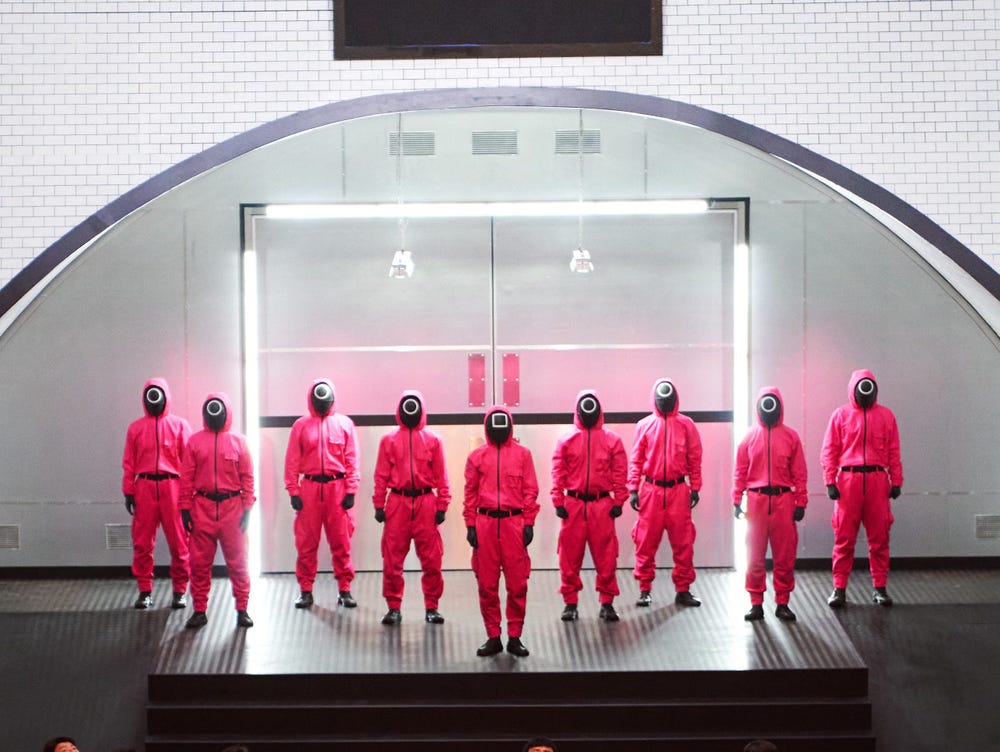
What is it about red jumpsuits and masks? Money Heist (above, image from Dress Like That) and Squid Game (Image from Insider.com).
Money Heist and Squid Game tap into our despair and anger at the brutal and unfair system we live under. Hundreds of people being gunned down in a scene that’s part Red Light, Green Light and part Amritsar Massacre – that’s not a fantasy. That’s what it feels like to live in this society. If a story can tap into such a feeling, language is not a barrier. We live under the same system and even if we speak different languages we can relate to common problems and struggles.
We live in a time of mass protest movements against the wealthy and the state on every continent (Colombia, Sudan, Lebanon, Myanmar, and the list goes on and on). It would be strange if this mood was not reflected in some way in popular culture. But it’s a sign of the times that the entertainment industry – and maybe to an extent audiences – are not ready for a story that is simply about class struggle (with surprising exceptions like Superstore). Politics is a dirty word. It has to be smuggled in, disguised in more wholesome and palatable fare, such as a story about the origin of a mass murderer, about a bank robbery, or about a game show in which four hundred people die horrible deaths. In cynical times, the earnest and compassionate stories we secretly crave can only be packaged in the trappings of cynical and pessimistic genres.




 The 1919 Review