
This is Part 2 of my notes on a re-watch of David Lean’s 1965 historical epic Dr Zhivago. Part 1 is here. This post will look at how the movie presents the First World War, the Russian Revolution and post-revolution society.
1: The World War
About one hour in, the story of Dr Zhivago, which had rumbled to a halt, is jump-started again by the outbreak of the First World War. Yuri, Antipov and Lara all end up at the frontlines. We witness the army mutinies that accompanied the Revolution. Yuri and Lara fall in love but restrain themselves from actually cheating on their respective spouses.
This section begins with a voiceover from Yefgraf. It’s a very strong monologue layered over a montage which is by turns lavish and bleak, summing up Russia’s experience in World War One, from enthusiastic jingoism to horror, misery and revolt. This monologue is performed by Alec Guinness with dry understated tones betraying just an occasional hint of intense emotion. Yevgraf joins the army along with a bunch of peasant conscripts: ‘Most of them were in their first good pair of boots… By the second winter of the war, the boots had worn out. Even comrade Lenin underestimated the misery of that 1000-mile front – and our cursed capacity for suffering.’
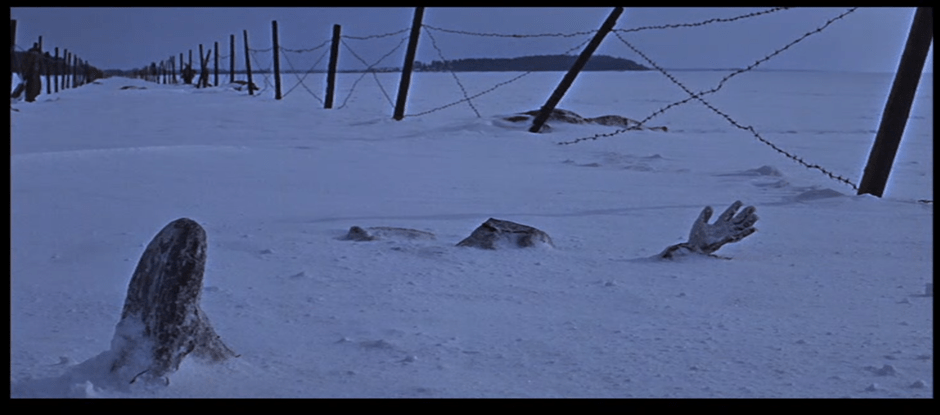
This monologue is so good I used it in the podcast version of Episode 1 of Revolution Under Siege. But it has some problems. Yevgraf says that he was ‘ordered to enlist’ by the Bolshevik Party at the outbreak of the war as part of an organised infiltration of the army. I’ve never come across any mention of the Bolsheviks sending agents into the army for a years-long deep undercover project. The Bolsheviks negotiated Tsarist repression by having their legal and illegal sides of the organisation, and if we assume Yevgraf is a trained agent in the illegal component, then it would be very wasteful to send him into the army like a needle in a haystack. The Bolshevik Party was very much on the back foot when war broke out. Between repression, wartime chauvinism and conscription, membership withered and activity waned.
Many working-class militants were conscripted into the army and navy, or ordered to enlist by the courts as punishment for their political activities. Some of these people resurfaced in 1917 as leaders and agitators on the frontlines or on the naval vessels. By mid-1917 the Bolshevik Party had developed a very extensive ‘Military Organisation’ of party members in the army and navy. You can see how a paranoid officer might interpret this as the army being ‘infiltrated by Bolshevik agents.’ The thing is, almost none of the members of the Military Organisation were Bolsheviks in 1914, much less full-time agents on undercover missions.
Yevgraf also describes party policy toward the war in a very strange way. Which country wins is ‘Our task was to organise defeat. That would be our victory.’ That’s a cold and perverse way of explaining an internationalist, anti-war position. Only an opponent would phrase it that way. The Bolsheviks did not ‘organise defeat’ and even in 1917 there were Bolshevik-influenced units, such as the Latvian Rifles, which fought valiantly. Here the screenplay has given us a revolutionary straw man.
What about the visuals which accompany the narration? We see a big recruitment parade, cutting to the horror of the frontlines and the violence of battle. Finally we see the soldiers clambering out of the trench and running back eastward. The imagery tells a story in a simple and very powerful way. As we see here, the Russian army had a tradition of officers dominating and abusing the rank-and-file: we see an officer brandishing his sabre and roaring at the men, ‘Come on, you bastards!’ But apart from the flagrantly abusive officer, the beards and the exotic hats, none of this World War sequence is really drawn from the specifics of the Eastern Front. It mainly draws on the Western Front, tropes familiar to British popular memory of the First World War. It’s not that what we see is wrong, so this is a missed opportunity rather than a big problem. But these images don’t draw out what was distinct about the Eastern Front, which was far more mobile than the Western.
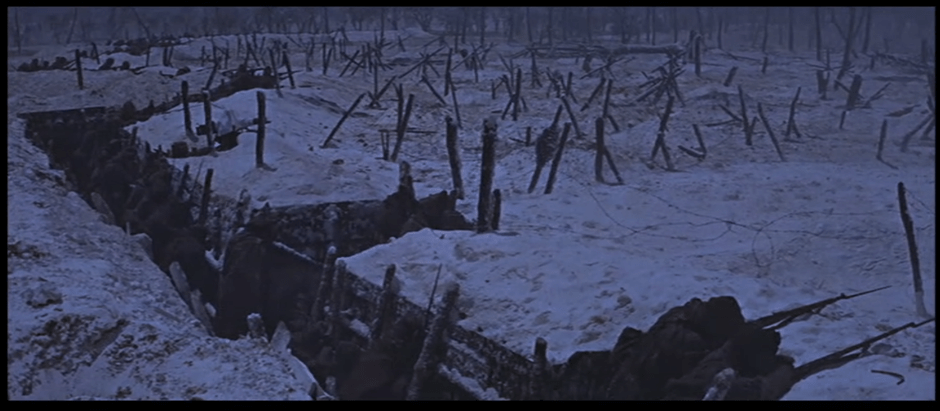
What’s with Antipov? Why is a revolutionary playing a valiant role in the imperialist war? This is authentic. The personal reason is given in Yevgraf’s remark that ‘Happy men don’t volunteer.’ The history-buff reason is that many leftists in all countries supported their own country’s war effort. It just so happened that moderate socialists in Germany saw Germany as the most progressive empire, while moderate socialists in Russia just happened to see their own country in the same way. The Bolsheviks would call Antipov a ‘defencist’ or ‘social chauvinist.’

2: Mutiny
Next comes a vivid scene where a crowd of deserters meets a fresh and disciplined unit on the road. It’s a well-shot and dynamic scene, full of tension, as we wonder which side will win out. The deserters hold fast. They convince the new recruits to join the revolt against the war. They all proceed to shoot and bludgeon the officers and continue homeward.[i]

How authentic is this scene? Things wouldn’t have happened this quickly, and the revolting soldiers would not have been this trigger-happy. The scene errs on the side of portraying the soldiers as cruel, removing a lot of mitigating context and hesitations that would have preceded the grisly outcome. The scene is making things simple, brief and visual, but is it conveying a historical untruth? In the last analysis, no. Basically, in many cases soldiers and sailors did kill their officers.
We see a firebrand soldier named Kuril (Bernard Kay, named simply as ‘The Bolshevik’ in the credits) taking the lead and preventing the mass of deserters from disintegrating. He is the cadre in this scene, the frame that holds the revolt together, the leavening agent which causes the bread to rise (Fittingly, the same Kuril goes on to join the Red Guards in a later scene). But when Kuril appeals to the fresh unit to join the deserters, his words should be more along the lines of, ‘Let’s go home and divide up the estates of the landlords,’ and not so much baldly declaring that Russia is not his country. The latter is a curious agitational tactic and it’s surprising that it works.
3: The Revolution
I’ve already mentioned how the movie compresses fourteen months of tumultuous events into one line of dialogue (‘The Tsar has been arrested. Lenin is in Moscow! Civil War has begun!’). Soon after this Yuri receives an ‘order [from] the Provisional Government’ so we are back in real-life chronology, somewhere between February and October 1917, between the overthrow of the Tsar and the seizure of power by the Soviets.
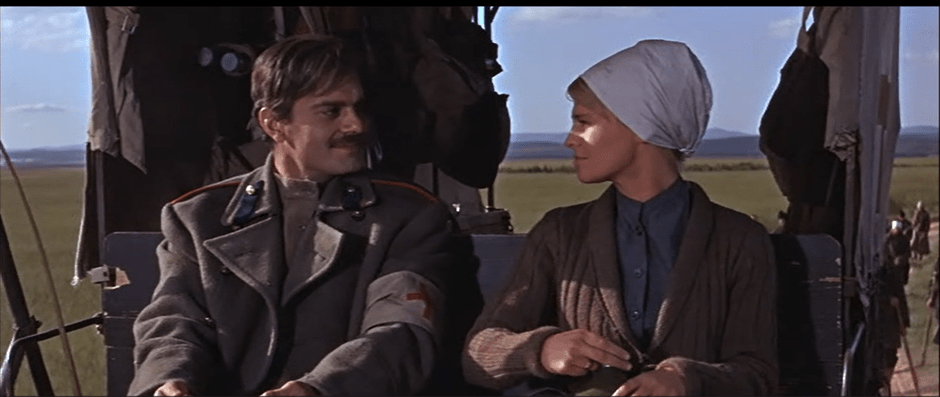
We cut to Moscow and see Yuri’s wife and father-in-law reading a letter from him dated July 20th. ‘Eight weeks ago!’ they say. So it must be late September 1917. There is street fighting outside their window – machineguns and artillery. ‘They’re at it again!’ rages the father-in-law. ‘I wish they’d decide, once and for all, which gang of hooligans constitutes the government of this country.’
This is frustrating! The film nearly got it right! If they had said twelve weeks instead of eight, or August 20th instead of July, that would have made sense – there was street fighting in Moscow for days following the Soviet insurrection of late October.
Back at the frontline, it’s still bright summer, though autumn should be settling in toward winter by now. An old soldier confides in Yuri: ‘There’s fighting at home… Red Guards and White Guards. This old man’s had enough.’ The first of the White armies did not begin to form until December. The term ‘White Guards’ for the counter-revolutionary counterpart of the Red Guards originated in the Moscow street fighting of late October and did not enter into common circulation until later.
The Revolution happens off-screen, and that’s fine. But the glimpses we get of it don’t need to be this muddled. It’s not that it was made simpler for dramatic effect. It’s just made a mess of, in ways that would have been pretty simple to fix.
But the movie redeems itself in little ways that show the filmmakers did their homework. Kuril the militant gets in some good and authentic lines. The befuddled old soldier asks, ‘This Lenin. Will he be the new Tsar, then?’ Kuril explodes: ‘Listen, Daddy! No more Tsars, no more masters! Only workers, in a workers’ state. How about that!’
This movie is clearly anti- the revolution but it delivers that message with certain small reservations and nuances.
4. Life under the Soviets
Kuril, departing to join the Red Guards, says to Yuri: ‘Goodbye, honoured doctor… Want some advice? … Adapt yourself.’ It’s not clear what Yuri has done to invite this veiled threat. He has been totally inoffensive from Kuril’s point of view. This is a foreshadowing of what’s going to happen when Yuri returns home to Moscow to experience life after the Revolution.
The two main features of life when Yuri returns home are (1) famine, disease and general hardship and (2) a stifling political culture in which everyone, like Kuril, seems to be offended by his existence for no apparent reason.
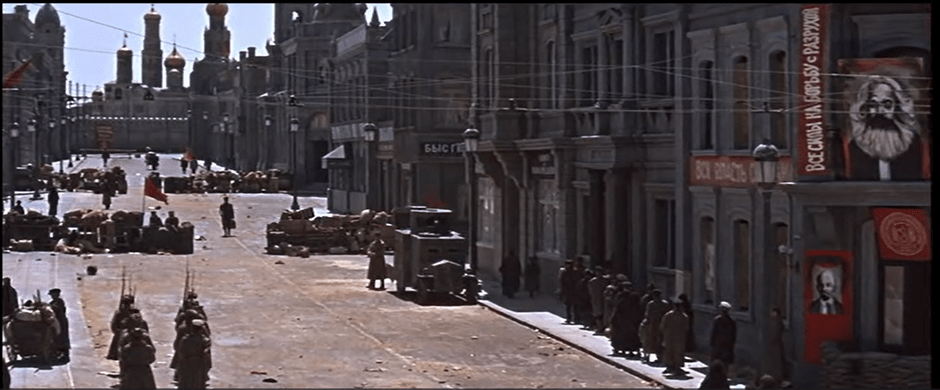
Famine, disease and hardship
A film critic in The Guardian criticised this movie at the time for reducing the Russian Revolution to ‘a series of consumer problems.’ I suppose starving and freezing can be broadly described as consumer problems. I actually think this is a strength of the movie. Yuri’s silently-suffering wife Tanya has had to sell a clock to buy salami for a meal to welcome him home from the war. Nobody mentions it, but at one stage all the banisters disappear from the stairway of their house – fuel shortages, you see. Consumer problems were the texture of daily life during the Civil War. Dr Zhivago does a good job of showing that.
As we see here, wealthier citizens such as Yuri’s adopted family (we learn in this section of the movie that they are landlords with an estate in the Urals) had to share their homes with working-class people. Mansions and large town houses were divided up into apartments. I agree with Yuri that ‘this is a better arrangement, comrades. More just’ (even though the houses of the wealthy were often unsuitable for renovation into apartment blocks). Because what we don’t see are the absolutely horrifying slum conditions in which workers and the poor lived in Tsarist Moscow: dormitories, shared rooms, beds shared by workers on different shifts. And unfortunately, as the film critic I quoted above correctly noted, the film portrays Yuri’s new housemates as a mob of horrible ‘proles.’ No nuance or humanizing moments for these representatives of urban working-class Russia.
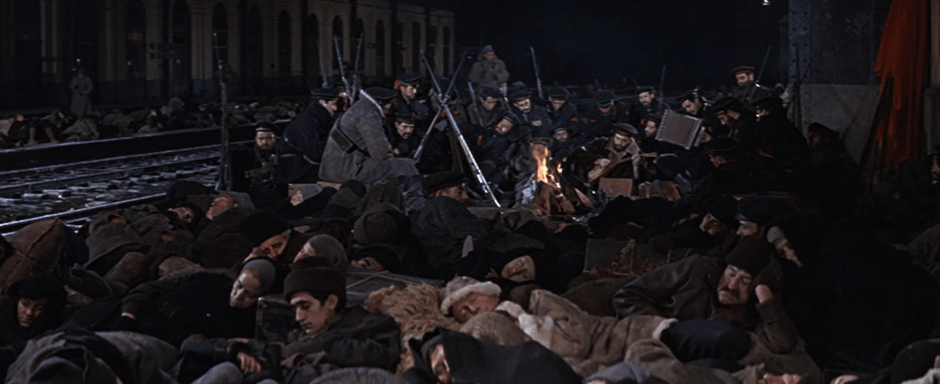
The World War broke the precarious supply system that had kept the cities fed and fuelled. We see the railway station thronged with people leaving Moscow, and this is sadly accurate. The population of the large cities collapsed during the Civil War, as the supply situation grew worse still – Petrograd’s population declined by over half, and Moscow was not much better off. The film is perhaps guilty of accelerating this process but the depiction is well grounded.
What’s not accurate at all is the way Yuri is scolded by the authorities for mentioning famine and disease in Moscow: ‘You’ve been listening to rumourmongers, comrade. There is no typhus in our city.’ This is nonsense. The Soviet authorities did not try to deny hunger or cover up epidemics like, as Boris Johnson would have said, ‘The mayor of Jaws’ [sic].

Below are the words of the revolutionary leader Trotsky (whose likeness we see on posters in these scenes) speaking to a public meeting in Moscow in June 1918:
I have with me some telegrams which the People’s Commissar for Food has received from small towns. There the population is, literally and in the exact meaning of the word, on the brink of complete starvation and exhaustion. […] From Sergiyev-Posad: ‘Give us bread, or we perish’ … From Bryansk, May 30: ‘There is a very high death-rate in the factories of Maltsovsk and Bryansk, especially among the children: there is hunger-typhus in the uyezd.’ […]From Pavlov-Posad, on May 21: ‘The population is starving, there is no bread, we cannot get it anywhere. From Dorogobuzh [24] on June 3: ‘Great hunger and mass sickness.’
Note not just the public acknowledgement of famine and typhus but of the most frank and harrowing reality of it.
The new Soviet regime took public health very seriously. One White Guard who later wrote a memoir left a bleakly comical description of how he impersonated a doctor and was sent all over Siberia on a public health mission.
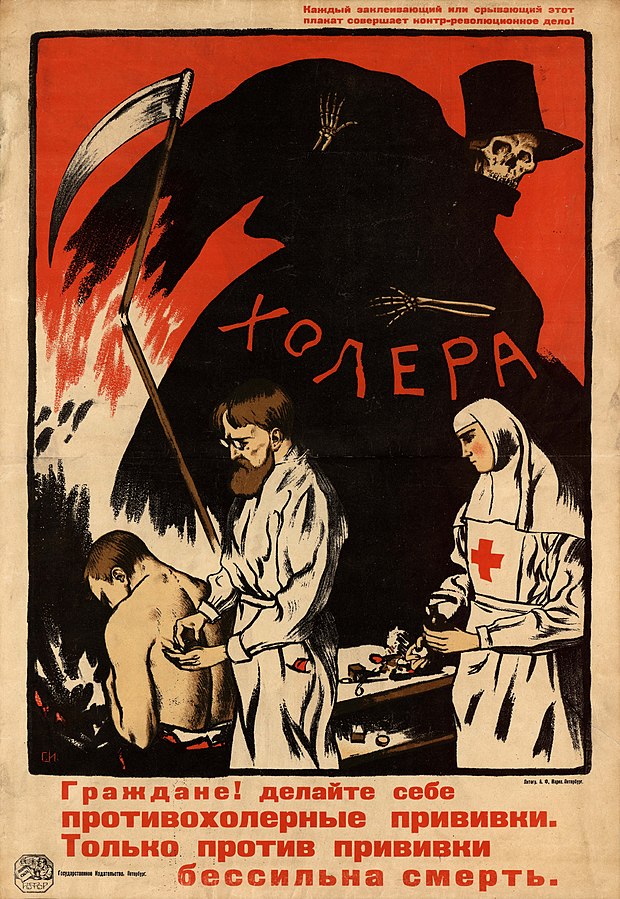
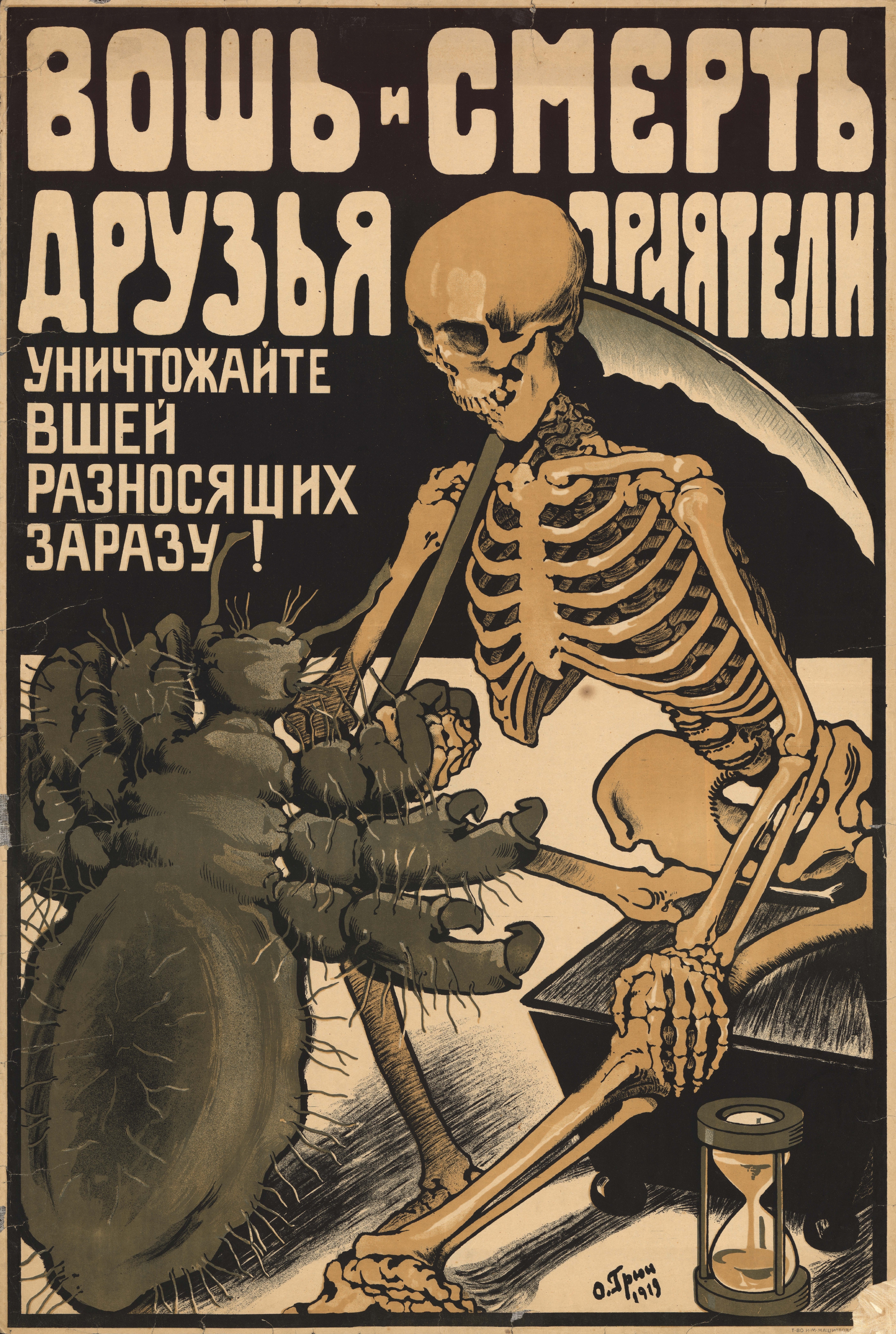
The posters below from Wikimedia Commons are Soviet public health warnings from this broad period.

Political Culture
The idea that hunger and disease were covered up is just one of the ways Dr Zhivago is basically wrong in how it shows the early Soviet regime. Yuri is treated in an appalling way by the authorities and the public. The local Soviet delegate yells at him, ‘Your attitude has been noted!’ What attitude? Who’s noted it? The low point is when Yuri arrives home to find his new housemates ransacking his apartment. Then he meets his half-brother Yevgraf for the first time. Instead of the pleasant reunion Yuri expects, he gets his marching orders. Yevgraf warns him that he must leave Moscow because his poetry is ‘not liked.’
‘I think the girl [Yuri’s wife Tonya] was the only one who guessed at their position,’ Yevgraf narrates, implying they could all be shot or arrested or something.
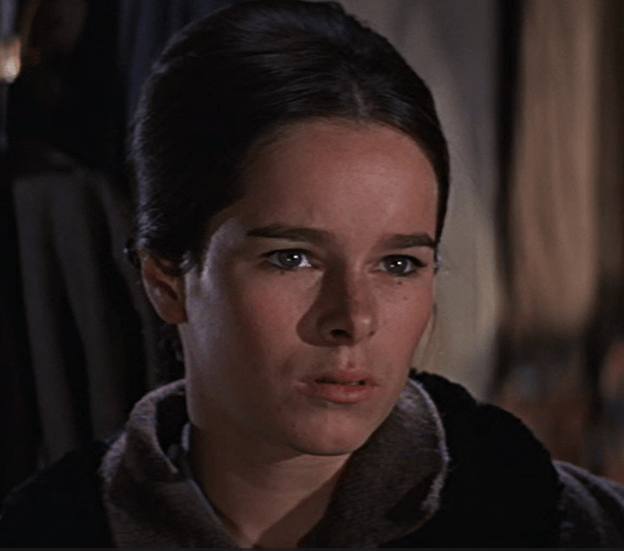
What’s the problem with Yuri’s poetry? This is some time in the winter of 1917-18. Yuri is enthusiastic about Bolshevism and calls Yevgraf ‘my political conscience.’ The problem is that his poetry is too ‘individualistic’ and his reasons for liking Bolshevism are too subtle.
If this seems unfair and absurd, it’s because it is. People were not arrested or killed simply for writing ‘individualistic’ poetry in early Soviet Russia. This is early 1918 and the number 1 item on the Soviets’ agenda is whether and how to make peace with Germany, and the related question of how to survive if Germany attacks. The second item is securing food and fuel supplies. The third item would probably be the small forces of White Guards operating in peripheral areas, the foremost being Kornilov’s Volunteer Army in the Don and Kuban regions. Individualistic poets are not on the agenda at all. If Yuri was writing odes of praise to Kaiser Wilhelm or General Kornilov, the Soviet authorities would certainly have had a problem with that. But that isn’t it.
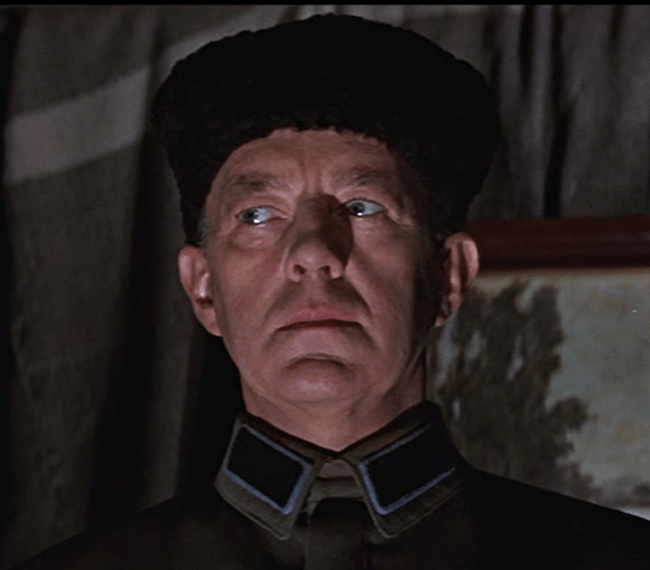
It’s a neat dramatic moment when Yevgraf enters the room and, by a mere snap of his fingers, puts a stop to the ransacking. He exudes menace. Too much menace. I think this reaction would be plausible after September 1918, when the Soviet authorities shot several thousand hostages in Moscow alone. But this is early 1918 at the latest. The Cheka (it’s implied he is a Chekist) have not yet done anything to inspire mortal dread.
And just consider what we know about Yuri. As marks against him in the eyes of the Soviets, he is the adopted son of a landlord family, with a large house in Moscow and an estate in the Urals. But he accepts the redistribution of both properties without conplaint. He spends most of 1917 in a military unit sympathetic to the Revolution, treating the wounded, saving countless lives and earning the deep esteem of the soldiers. He comes back to Moscow and at once gets to work in the local healthcare system. He expresses support for the revolution at every opportunity.
‘Specialists’ like Yuri who were willing to work conscientiously under the new regime (doctors, engineers etc) were not scorned or abused or rejected. They were valued. Past political actions disagreeable to the new regime (which Yuri, in any case, has none of) would be overlooked. They would be given higher rations. This idea that he would face arrest or imprisonment just for writing poetry is nonsense.
The apparently healthy but idle father-in-law (Ralph Richardson), on the other hand, might find himself conscripted into a labour battalion, say, to dig trenches during the military emergency of 1919. He is not at all invested in politics of either right or left, so it’s quite unlikely that he would end up in deeper trouble than that.
I haven’t referred much to Boris Pasternak’s novel, on which this movie is based, because it was five years ago that I read it. But this point is important: in the novel there is no warning from Yevgraf, no hint that Yuri might be arrested for his poetry or for his ‘attitude.’ Yuri and his family simply leave Moscow of their own accord because of the hunger and fuel shortages, like about a million other people. The filmmakers felt the need to make this very significant and historically inauthentic change.
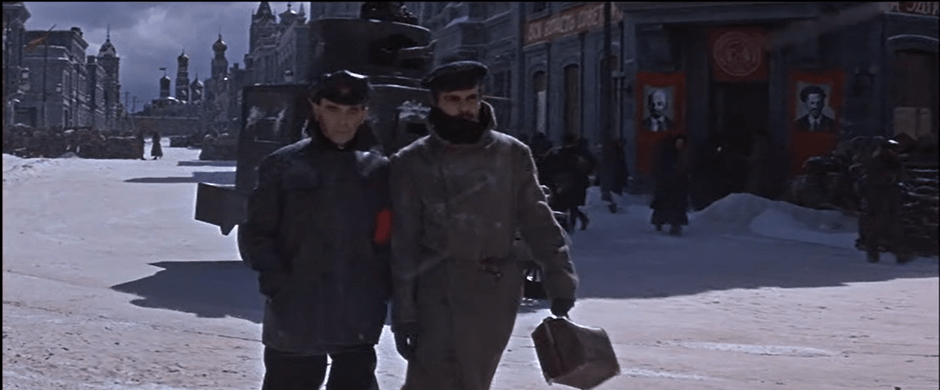
Chronology
When I write something like, ‘this wouldn’t have happened in February of that year, maybe in June’ readers might think I’m being pedantic. The basic sequence of events in the Russian Civil War is not widely understood so I need to pause and spell out the significance of some of the things I’m saying. If a film simplifies the timeline for the sake of making things more brisk and comprehensible, that’s good. But if the chronological mix-ups in a film erase some of the most interesting features of a historical period and present an alternative version that diverges dramatically from the evidence, that’s a big problem for me.
Winter 1917-18 was a world apart from winter 1918-19, or even summer 1918. The same rules did not apply. The Soviet regime did not spring into being as a repressive one-party state. But in response to conditions of chaos and war which escalated sharply from May 1918, it grew steadily harsher and more repressive. A film about the period should trace these developments in the same clever way that Dr Zhivago tracks fuel shortages through the unexplained disappearance of banisters. Instead the Soviet regime springs into being fully-formed, a strange composite of the revolutionary and Stalinist eras and the screenwriter’s imagination.
This was a severe time. I can think of a few scenarios where an innocent person like Yuri would fall foul of the authorities and end up getting arrested, or even in an extreme case shot. As the Civil War drags on the scenarios become more numerous and plausible. And if he got in trouble, his adopted family background would be held against him. But none of these scenarios involve individualistic poetry, or acknowledging the existence of typhus.
4. The Train
Next comes the most powerful part of the movie, for me: the epic train journey from Moscow to the Ural Mountains.
Are the conditions portrayed accurate? The crowded station, the rush for berths, the dark squalid bunks and the straw? It would be difficult to exaggerate how bad the railways were in this period. Today this journey by rail would be one or two overnights but fuel shortages, breakdowns, harsh weather and rail traffic all meant that the gruelling 11-day journey depicted here is perfectly authentic.
What excellent worldbuilders we have in David Lean and his crew, and screenwriter Robert Bolt. How real this carriage and journey seem – yes, in the way Pauline Kael dismissed as ‘primitive’ (she said that David Lean movies are for the kind of people who are impressed because painted horses on a stage backdrop look ‘real enough to ride.’ Namely, me), but also on a human level. I’m glad they chose not to cut the moment when the anarchist convict (Klaus Kinski) stares at an old couple exchanging a moment of affection while lying on the floor of a crowded carriage. He looks absolutely desolate. I don’t know if it’s accurate or not about shovelling out the straw and sprinkling the disinfectant, about breaking the ice when you roll open the door – but I’m glad it’s in the movie. It’s good also that there are moments when they break out the accordion and do some singing and dancing.
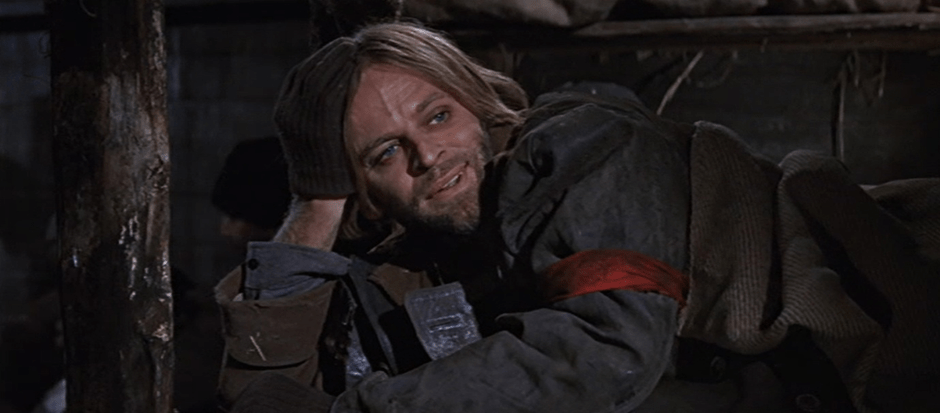
I’ve already mentioned the anarchist who is imprisoned for forced labour on the train. I haven’t come across mentions of forced labour on the railways at all, let alone this early. I’m not sure if his reason for being here is plausible, but his character certainly is. The Soviet regime raided and cleared out numerous buildings occupied by self-described anarchists in Spring 1918, before the outbreak of Civil War. I say self-described because Soviet authorities regarded them as not proper anarchists, but as assorted bandits, adventurers and dubious characters, armed to the teeth and occupying key buildings. This happened after the train journey we see, but not much later. It’s an engaging performance by Kinski. Here is a mad and unpleasant person, but he’s also admirable and pitiable in equal measure. He might be the kind of person who would have been arrested in the raids of Spring 1918. At first he seems to be anti-authoritarian but his admiration for the Red commander Strelnikov tells us he loves violence and strongmen. It’s also a hint that he fought alongside the Red Guards prior to his imprisonment. You wonder what he did.
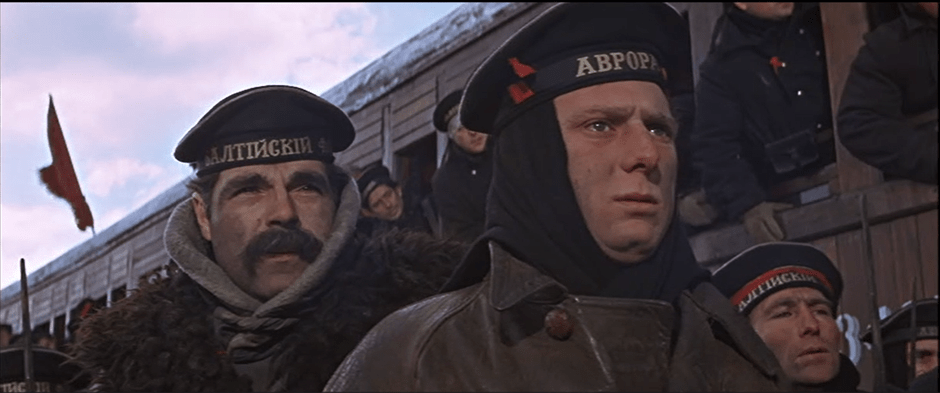
There are also Kronstadt sailors on the train, on their way out to assist at the front lines. A lot of these lads would be anarchists too, not the bandity kind but the serious, political kind many of whom worked alongside and eventually joined the Bolsheviks. Kronstadt sailors played a key role in the revolution of 1917 and in this period detachments of them were indeed sent out to remote corners of Russia to bolster the Reds in this or that skirmish against counter-revolution. Though it seems strange that a load of sailors would be going thousands of kilometres inland, it’s only one of a lot of very strange things that were common occurrences during Russia’s revolutionary period.
The next post will deal with the Civil War, so the burned village and Strelnikov will have to wait.
A final word on the theme of this movie. Clearly it is anti- communist and critical of the revolution. But though this movie often straw-mans Bolsheviks, it never demonises them. It is conscientious about giving each Bolshevik at least one humanising and relatable moment.
Kuril, as I remarked, has some good strong lines. The delegate tries to stop the ransacking of Yuri’s house. Antipov is the most obnoxious but also the most vulnerable. We pretty much view Yevgraf as a teddy bear by the end of the movie. Even Razin, whom we will meet later, has a line where he reveals he once has a wife and four children. What happened to them? The grumpy new janitor of Yuri’s Moscow house gets a good line about how the building had room for thirteen families.
It is only a show of even-handedness, or maybe you could just call it one-sidedness with accompanying nuances. But it matters. After I posted last week, one of my readers sent me a message saying that ‘those scenes of the Tsarists suppressing workers revolts was, to my parents’ generation [people born before World War Two], the dawn of a realization that there mightve been a good reason for Communism in Russia….’
Dr Zhivago is going to get plenty of criticism in the next post, but let’s give it some credit. It was more balanced than a lot of the other texts and narratives that people would have encountered at the time. Maybe, considering certain books by Robert Service and Antony Beevor, and the dreadful Russian TV show about Trotsky, that’s even more so the case today.
[i] The incident in the novel on which this scene is based is longer and more involved. In both versions, a poor officer stands on a barrel to address the mutineers, only to fall victim to a slapstick accident followed by a rifle shot. In the novel this guy was a smug agent of Kerensky’s Provisional Government, and the guys who kill him are a specific hardcore bandit-like group, not the general mass of deserters.
 The 1919 Review