
The questions Paul Lynch addresses in this novel are, first, ‘What if something like the Syrian Civil War happened in Ireland?’ and second, ‘What would that war mean for Eilish Stack, a mother of four living in the suburbs of Dublin?’
He is more interested in the second question than the first. But both are answered in long, consciously-crafted sentences, in uncompromising, unbroken columns of prose. Late in the story Eilish is running out her front door to search for her son when, in mid-sentence, ‘soundlessly she is raised from her feet and borne through the air rearwards with her arms held out in some counter-time of light and darkness holding pieces of cement in her mouth.’ (p 239) In other words, she was caught in the shockwave of an air strike. I like Lynch’s prose. You have to pay attention to get the full meaning from it, and it’s worth the effort.
The book opens with a scene in which two Gardaí who ‘seem to carry the feeling of the night’ knock on her door looking for her husband. He is a trade unionist, and the Gardaí are a from a new Gestapo-type unit who serve an authoritarian government. The trajectory from there to civil war and ruin is gripping, graceful and bleak.
Where are we? In Dublin, in the near future or in an alternate present. Personally, I would have liked page upon page of exposition about who this new governing party are, how they came to power, what their programme is, what their international relations are like, and so forth. I would have liked it, but that doesn’t mean it would have been a good idea. It’s not really the focus of the book. By transposing contemporary wars to a familiar setting, this book made me empathize with the victims of war. A focus on politics might have run a risk of diminishing that. An equivalent of Goldstein’s book-within-a-book from 1984 would have definitely diminished it. It has been compared to 1984, but this is an easier book to like than Orwell’s, and easier to read in spite of the depth of its prose. It’s not so didactic, and it gives a more varied, optimistic and genuine panorama of the human race. But the two are not really the same type of book – Prophet Song is a description, an impression, not an attempt at anatomy or analysis.
Lynch provides enough by way of sketches to give the reader a fair idea of the political background. There is a party or coalition called the National Alliance. Their supporters wear distinctive pins on their collars, hang the tricolour from their windows, and sing the national anthem even at weddings. They make ‘hieratic gestures’ as they speak ‘the cant of the party, about an age of change and reformation, an evolution of the national spirit, of dominion leading to expansion.’ (p 71) They have been in power for two years when, one September and in response to a crisis or supposed crisis whose nature the reader is not told, they introduce an emergency powers bill.
That winter (and here the novel opens), the National Alliance government begins arresting trade unionists. The Teachers’ Union of Ireland (TUI) are in the crosshairs and Eilish’s husband is a senior official. The union leads a protest march which is suppressed violently. In the manner of the Argentine junta, those who are arrested before and during the protest disappear, and the families receive no hint of whether they are alive or dead.
Each atrocity is given its due time and space to be felt and to have knock-on effects through the ins and outs of family life and, usually in the background, national life. We never go numb. Things escalate when Eilish’s son disappears too, though of his own volition. A shocking moment: her elderly father rings up to say that one of her boys was over at his house recently. The tall one. We are one with Eilish in her frustration. Is the confused elder mixing up yesterday’s memories with those of last year? Or was her son alive and at his grandad’s house a couple of days ago?
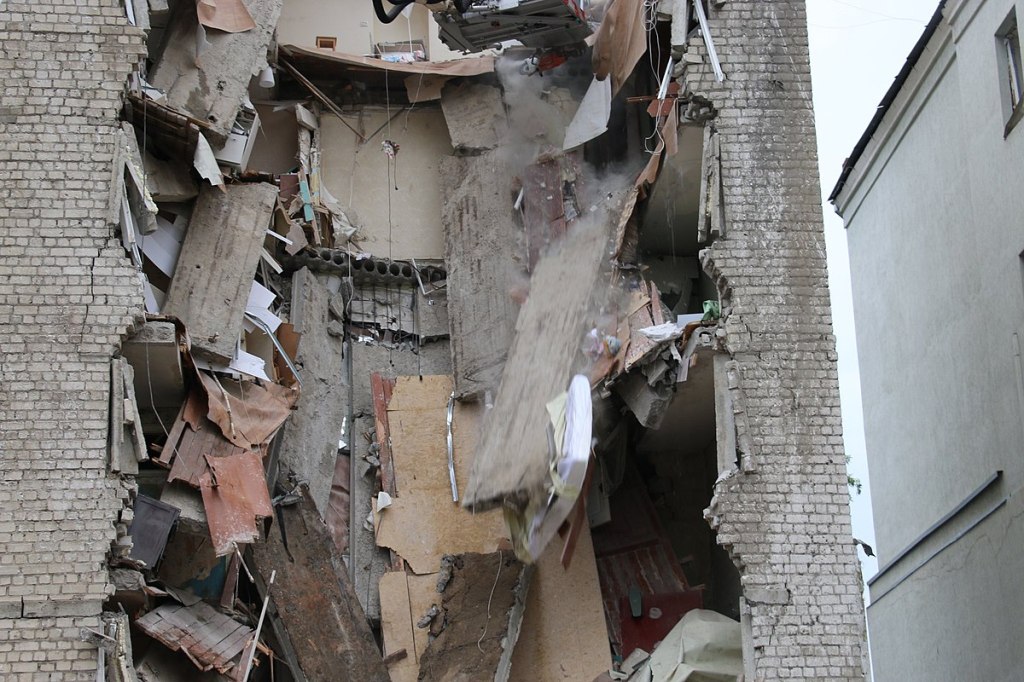
As I was reading Prophet Song, the Israeli state was dropping thousands of bombs on Gaza. ‘There is light now where there used to be none, the buildings folded into rubble, the solitary walls and chimney flues, the staircase that climbs to a sudden drop.’ (p 233) Not Gaza, South Dublin. To call the book prophetic, of course, would be to miss the point. It could be Gaza five years ago, or ten or fifteen ; it could be Damascus, Mosul, Aleppo, Fallujah, Khartoum, Kherson, Kharkiv.
I’m not sure the Irish Defence Forces have enough artillery or air power to cause such destruction; the National Alliance must have received substantial aid from abroad. Foreign military aid is usually a major factor in civil wars, though it is not mentioned here. There is mention of Canada, Australia, Britain and Europe, none of whose governments appear to be friendly with Ireland’s. But there is no mention of the United States. Maybe Ireland has been sucked into fascism in the wake of America, and Washington is sending fighter planes and artillery to Dublin.
By the way, it’s unsettling how easy it is to think of such scenarios. Ten or twenty years ago a lot of people would have been saying that a story like this was implausible but that’s not even a part of the conversation around Prophet Song.
The fact that this could be Gaza underlines how the novel, while rooted in a specific place, manages to be universal. Hence the sketched-in historical and political background. The advantage is that it invites empathy. We might some day hear the song of the prophets of the god of war in our own backyard. The disadvantage is that wars actually do have specific causes, which we need to understand. People are often tempted to attribute it all to ‘human nature’ or eternal elemental forces or whatever – which cuts across empathy.
Eilish is in fight or flight mode from the start of the novel. The run-on sentences and three-page-long paragraphs convey a sense of short breath and a hammering pulse. She is under severe pressures and barely keeping her family together. All the same, her indifference to the political situation is something I find frustrating – frustrating in the way I might find a real person frustrating. But her language adds to the impression of a narrow-minded narrator. Addicts are ‘junkies’ and people ‘from the flats’ have a ‘feral’ appearance.
[Minor spoilers in the paragraph that follows]
At one point she scolds the rebel soldiers for arresting someone who’s out after curfew. ‘My eldest son left home to fight against the regime with you lot and here I stand now on the street being threatened, we wanted the regime out but not to be replaced with more of the same.’ (p 221) Okay – that’s a rare moment of outspoken bravery there from Eilish. But if she will not consent to the rebels enforcing a curfew in a warzone, then she’s just not serious about wanting them to win. As for her son, she fought tooth and nail to try to stop him joining the rebels, so what claim has she got over them?
I think the author was trying to highlight certain uncomfortable truths about war and revolution. In Syria, many of the rebel factions turned out to be worse than the government. In any war, neither side has a monopoly on inhumane behaviour. So I understand his choices here, but I think Eilish comes across more poorly than he intended in this moment.
On the other hand, the believability of her character is not diminished by these flaws. Maybe it says something good about the rebels that Eilish feels free to defy and criticize them in a way she has never done to agents of the state.
[Spoilers over]

The characters all feel real, from the family at the heart of the story to minor incidental characters, like the clown who saves Bailey’s life or the creepy official towards the end of the book. It’s the kind of story that keeps defying expectations, even though overall you know where it’s going. For example, if I tell you that a people smuggler shows up half-way through the story, you will have a certain image in your head. But you will probably not recognize the character as such when she appears, because this novel does not deal in stock figures.
While the family waits for news of the disappeared husband and father, blows keep raining down on them. Usually, they hold up admirably. Sometimes they pay back persecution with defiance. But sometimes you can detect something breaking beyond repair, as when Eilish thinks about the baby in her arms. Like Gabor Maté, who was an infant in the Budapest Ghetto in World War Two, he will grow up to be a damaged person. But ‘out of terror comes pity and out of pity comes love and out of love the world can be redeemed again.’ (p 304)
My criticisms are secondary, and of a kind that are only possible with a bold, compelling and well-crafted novel. While I’m questioning a few of the choices, I’m not lamenting them. Prophet Song invites this kind of interrogation and stands up well under it.
It ends at a familiar place, familiar and dreadful to those who watched the news in 2015 and 2016. In hindsight that is where it was always going to end.
At the beginning and the end, Lynch makes it clear that the force against which Eilish is contending is not a particular party or programme, but a general ‘darkness’ which was there from the start, already containing all the horrors to come. In the final fifty pages or so, that horror reaches a climax. The reader realises how the story has filled us with dread. Because here it is, what we were dreading all along – but it’s not what we expected. It’s worse.
But ‘it is vanity to think the world will end in your lifetime’ – there is some consolation in that ‘the end of the world is always a local event.’
 The 1919 Review