This is Episode 27 of Revolution Under Siege, an account of the Russian Civil War, and the third and final episode dealing with the Polish-Soviet War. Here are the first and second parts.
Become a paying supporter to get access
Access to this article is limited to paying supporters. If you already subscribe by email, thank you. But if you want to become a paying supporter, please hit ‘Subscribe’ below.
Give me less than the price of a coffee, and you can access everything on this blog for one year.
Access to this article is limited to paying supporters. If you already subscribe by email, thank you. But if you want to become a paying supporter, please hit ‘Subscribe’ below.
Give me less than the price of a coffee, and you can access everything on this blog for one year.
The Red Army drives back the Polish invasion. The Soviet leadership faces a choice: whether to make peace or to carry the war into Poland. This is part 26 of Revolution Under Siege, an account of the Russian Civil War.
‘We are a force in the world, and you are destined for the mortuary. I despise you and hold you in contempt.’ Piłsudski, in a fit of anger, was fantasising out loud about what he would like to say to the Soviets. This was during the months before the Polish invasion of Ukraine. ‘No, no, I have not been negotiating. I have just been telling them unpleasant facts… I have ordered them to understand that with us they ought to be humble beggars.’ [1]
It was indeed in a beggarly and humbled condition that the Soviet Union found itself in a full-scale war with Poland a short while after this outburst. Still, somehow, the Soviets found ways to dig deeper. 280,000 communists joined the Red Army – that was 65% of the party’s membership. A measure of the chaos of the times, of the threadbare state of the new institutions, is the fact that 2.5 million people had deserted from the Red Army over the winter of 1919-1920 – to put that into perspective, the Soviets had over three times more deserters than the Poles had soldiers. But an indication that perhaps the Soviets were not bound for the mortuary after all is found in another statistic: 1 million – the number of deserters who returned voluntarily to the Red Army after the Poles invaded. [2] The war commissar Trotsky toured Ukraine speaking to crowds of deserters, urging them to re-enlist.
As you are probably re-enlisting as a reader of this blog after a gap of a week or two, here is a reminder that the Polish-Soviet front was divided by the Pripet Marshes into a Northern and a Southern Sector. In the Southern Sector, Budennyi and First Cavalry broke through enemy lines and the Red Army’s South-West Front forced the Polish forces to withdraw across western Ukraine.
Red Cavalry. A stunning work by Kazimir Malevich, dated to some time betwen 1928 and 1932
Kaleidoscope of Chaos
In the Northern Sector, the Red Army’s Western Front went on the offensive – with disappointing initial results in late May, followed by stunning successes in June and July. Here Third Cavalry Corps, known as Kavkor, played a key role. Kavkor was commanded by a Persian-Armenian socialist named Hayk Bzhishkian.
(This name entered the mangling process of Slavicisation then Latinisation and came out the other end, somehow, as ‘Gay,’ ‘Gaia Gai’, or worst of all ‘Guy D. Guy.’ I will call him Bzhishkian. And if I alienate any readers, I hope it’s because of my long-windedness, my blatant partisanship or my preoccupation with violence, and not because I made you pronounce an Armenian name in your head.)
Kavkor and Bzhishkian advanced on the right flank of the Western Front, where they found weak spots in the overstretched trench lines of the Poles, and broke through before reinforcements could arrive.
Barysaw, where the Polish side had insisted talks must take place, was soon in Soviet hands – what was left of it. The Polish army reduced it to ruins with chemical and incendiary shell-fire. [3]
Bzhishkian’s cavalry seized Vilnius. A 14-year-old scout went ahead and reported back key information. Then Kavkor attacked, aided by local communists, and the city soon fell. The Soviets handed Vilnius over to the Lithuanian government, a magnanimous gesture that ensured the Baltic States didn’t join in on Poland’s side. And at Brest-Litovsk, local Polish communists played a key role in aiding the Red Army.
Piłsudski called the Polish retreat ‘a kaleidoscope of chaos.’ If you look at the Battle of Grodno, you can see what he meant. Here 500 Polish uhlans, an entire regiment, were swept away and drowned while trying to cross the Niemen River.
As at Petrograd and in the South, the Red Army at the Battle of Grodno had to face tanks kindly supplied by the Allies: some were mobile, some were able to fire but were stuck on their transport train.
A frightened soldier shouted to Bzhishkian: ‘Tanks, comrade corps commander! How can one sabre them when they’re made of steel?’
Another cavalryman added: ‘Bayonets are no use; in any case you can never get near them.’
But the cavalry surrounded the French Renault tanks and forced them to retreat, playing for time as the steel monsters were disabled one by one: by artillery, by collisions, by breakdowns and by lack of fuel. Only two escaped across the burning bridge over the Niemen.
‘An armoured tank is nothing to frighten a skilled cavalryman,’ wrote Bzhishkian of the experience in his 1930 memoirs. [4] He would not live to see World War Two and history’s final judgement on that question.
The Polish retreat was chaotic but, Davies points out, tenacious. The most spectacular battles were on horseback; Russian sabres were sometimes defeated by Polish lances. On one occasion a Polish cavalry division commander personally defeated and killed his Soviet counterpart during a battle which delayed the Red advance by two or three days.
Nonetheless the movement was all in one direction, and to the Polish soldier, in Piłsudski’s words, the Soviet advance was ‘like a heavy, monstrous, uncontainable cloud.’ [5]
Today’s cover image. A Red Cavalry fighter, photographed in 1922
The Curzon Line
On July 11th the Allies tried to step in with a peace proposal. [6] Imagine a posh English politician gesturing at a map and saying, ‘Pans, comrades, why not draw the Soviet-Polish boundary just here.’ This here was known as the Curzon Line. It gave the Soviets a lot more territory than they had when the Poles first attacked, and also gave the Poles a lot more than what they stood to lose if Bzhishkian and Tukhachevskii kept advancing.
The Allies proposed this border because they still believed the Soviet Union would collapse and be replaced by a conservative Russian Empire, and they were keen to establish relatively generous borders for their hypothetical future ally.
The Curzon Line, with information allowing you to compare its borders to modern-day Poland. In today’s terms, Wilno is Vilnius and Lwów is Lviv.
Whatever the motivations of the Allies, it suited the Polish government to quit before they got any further behind, and they agreed. [7]The offer was Moscow’s to take or leave – not humble beggars anymore.
The Soviet leaders entered into a debate, dynamic as was the Bolshevik tradition but short and to the point. The question at issue was whether to launch a counter-invasion of Poland or, having repulsed the Polish invasion, to make peace. Unhelpfully, the British tacked on a provision that the Soviet Union should recognise Baron Wrangel and let him hold onto Crimea, which Moscow would never do.
On either July 16th or 17th, Trotsky on behalf of the Red Army command made the case for accepting the peace proposal – though he never accepted the point about Wrangel. Rykov, Radek, Stalin and others also opposed crossing the Curzon Line. Of Radek, Lenin later said, ‘I was very angry with him, and accused him of “defeatism”.’ [8] Lenin was in favour of advancing on Warsaw, and so were most of the Polish communists resident in Russia.
The Debate
The broad arguments of the two sides – let’s call them the peace party and the war party – are laid out below in the form of a dialogue, in my words. Where I am directly quoting, I have indicated it using inverted commas.
War:
We have been subjected to a full-scale invasion. We have driven back our enemy, but if we do not pursue him to his lair and finish him off, he will strike again. Just look at what happened in South Russia – how many times did we have to fight our way across the Don and the Kuban? And now Wrangel is trying to raise the Kuban in revolt yet again. Woe to he who does not carry matters to a finish! We have every right to invade and to destroy this regime of criminal military adventurers, who have brought so much suffering and destruction on the working people of Soviet Ukraine and Soviet Belarus.
The Russian peasant uses his scythe to behead, Itchy-and-Scratchy-style, the Polish Pan (landlord) and Wrangel.
Peace:
From a military perspective, to invade Poland is insane. It is not like Denikin or Kolchak; it is not a question of fighting officers, undisciplined Cossacks and raw conscripts. We face 750,000 Polish troops. It is ‘a regular army, led by good technicians.’ Even if the Red Army takes Warsaw, its supply lines would be stretched too thin to occupy Poland for long. [9] The Soviet Union is crying out for peace. We won’t survive another winter of war. Hunger and disease will be rampant. The regime may even fall apart.
War:
We do not assess these problems purely from a military perspective. It is not a question of conventional war or occupation. The mass of the Polish people, the working class and poor peasantry, will join us in our war against the Polish landlords and bourgeoisie.
And we must also consider the perspective of world revolution. In Britain the ‘Hands off Russia!’ campaign is making headway; on 9th and 10th May, British dockers refused to load munitions onto a ship bound for White Poland. There is a developing revolutionary situation in Italy, with soviets in Turin and factory occupations; and in Germany we’ve seen the defeat of the Kapp Putsh by a workers’ general strike and even the organisation of a workers’ Red Army in the Ruhr. If we defeat Poland, we open the way to Germany, and may trigger revolutionary events there and elsewhere. Imagine if Budennyi or Bzhishkian arrived in Berlin just on time to prevent another massacre of communists like that of January 1919.
We also want peace. But this latest onslaught by the Allies shows that they are hell-bent on our destruction. We cannot hope for peace except by breaking out of our isolation.
Peace:
The Polish workers and poor peasants are unlikely to join us. By pursuing the Polish army into Poland, we will drive them into the arms of Piłsudski and his military-Bonapartist clique. It is still the honeymoon period of Polish independence. Resentment of all things Russian is still understandably strong. ‘This is the historical capital from which ‘Chief of State’ Piłsudski hopes to draw interest.’ [10]
We too see the perspective of world revolution. But if we are defeated, it will be a setback for the revolution everywhere.
War:
The key question, then, is the attitude of the Polish masses. The Polish revolution has always marched in step with the Russian; our anthem ‘Varshavianka’ refers to the Polish revolutionary tradition. In 1905 the Poles held out for longer against the Tsar than the workers of Moscow. In 1919 there were reports of Soviets in Cracow. [11] There were ‘village republics’ where the farmers took collective control of the land. On May Day this year, the demonstrations in Warsaw, Łódź and Czechostochowa were anti-war and anti-government – remarkably, a mere week after the beginning of the Polish invasion. A railway strike in Poznań, beginning the day after the invasion, turned into a week-long pitched battle between strikers and the authorities. [12]
The reports from the Belarussian Front have been most encouraging. Arrogant Polish landlords return on the coat-tails of their army and try to grab the land, and this angers the people and the rank-and-file soldiers. The Poles barely hold the frontline zone, which is traversed freely by refugees, deserters, bandits, petty traders, cocaine dealers and Polish Communist partisans. We have reports of mutinies and of harsh reprisals by Polish officers against the men – including executions. More recently, Polish soldiers returning from leave are condemning Piłsudski as the puppet of the landlords and questioning the aimlessness of the war. On July 26th an infantry unit rose from their trenches singing The Internationale and preparing to cross over to us; they were only prevented by their own side opening fire on them from behind. [13]
And we have many talented Polish communists here in Russia, who are enthusiastic to carry the revolution to their homeland; on May 3rd 90 Polish delegates met in Moscow. In Kharkov and Smolensk we have printed masses of material in the Polish language – 280,000 copies in Smolensk alone. We will guarantee the Polish worker, soldier and farmer an independent Soviet Poland. We even have a Polish brigade, 8,000-strong, on our Western Front, to form the nucleus of a Polish Red Army.
A Polish poster from the 1920 war. The struggle for national independence – ‘the historical capital from which […] Piłsudski hopes to draw interest.’
Peace:
Taken as a whole, the indications are not nearly so favourable. The Polish Socialist Party received only 9% of the vote in January 1919. The Polish Communist Workers’ Party is illegal and has very little support in Poland.The Cracow Soviet was put down. The ‘village republics’ were suppressed with draconian severity. The Piłsudski government is Bonapartist in character; it does not simply represent the landlords or the bourgeoisie, but tries to play a balancing act. It has embarked on land reform of its own accord, which saps the agitational strength of our land programme. The Polish landlords who are trying to claw back parts of Belarus and Ukraine are supported by the Polish officers, but opposed by government agencies [14].
The Polish soldier on the Belarussian Front is demoralised, it is true. But the Polish soldier defending the approaches to Warsaw may prove to be a more formidable opponent.
To invade would not hasten revolution – it would delay it. We cannot tolerate Wrangel in Crimea for a moment longer than is necessary – on that we agree. Let us then focus as much of our strength as possible on Wrangel. But let’s talk to the Allies, and agree on the Curzon Line as our border with Poland.
The Advance to Warsaw
Intra-Bolshevik debates were often conflicts between audacity and caution. Today audacity won out. All agreed that the Soviet Union could not build socialism in isolation from the rest of the world. The key strategic imperative was to break out. Up to this point it was assumed this would happen through an indigenous revolution in another country, but this war represented another kind of opportunity. The war party won the vote, and the Red Army was ordered to sweep on into Poland.
Kalinin and Trotsky review the troops. Trotsky argued against carrying the war into Poland, but according to Davies, once the vote had been taken, few took the war more seriously than Trotsky.
From July 19th to August 7th the Communist International held its Second Congress, a bigger and more impressive affair than the First Congress back in March 1919. Among the 220 delegates was Alfred Rosmer who has given us an often-quoted description of a large map of Eastern Europe that was on display outside Lenin’s office. Visitors watched as little flags were moved across it to mark the positions of the armies; in July, all the red flags were moving west. ‘The advance of the Red Army was stunning; it was developing at a pace which nonplussed professional soldiers ,as only anarmy born of revolutionary enthusiasm is able to do.’ Tukhachevksii’s Western Front took Minsk on July 11th, Vilnius on July 14th, Grodno on July 19th, crossed the Bug River on August 1st and by August 10th was closing in on Warsaw. [15] Some of Hyak Bzhishkian’s Kavkor had in fact run on ahead, west of Warsaw.
Semyon Budennyi, undated. While Tukhachevksii advanced on Warsaw, Budennyi spearheaded the advance on Lviv in the southern sector.
In the Southern Sector, the Red Army captured Rivne and Kamianets-Podilsky on July 4th. Budonnyi is reported to have said that if he had as many riders as the old Tsarist army – that is, 300,000 – ‘I would plough up the whole of Poland, and we would be clattering through the squares of Paris before the summer is out.’ For better or for worse, he had only 16,000, which along with the Red Army’s South-Western Front, aimed to capture the city of Lviv.
What struck Rosmer in a conversation with Lenin, however, was how the Soviet leader was just as interested in what he had to say about developments in the French Socialist Party as he was in Poland. For Lenin, then and always, it was all one struggle. [16]
In August 1920, the crux of that struggle lay not in the Ruhr Valley or the factories of Turin but on the Vistula River. The humble beggars had come to Piłsudski’s doorstep.
References
[1]Davies, p 74
[2] Davies, 142
[3] Trotsky, How the Revolution Armed, Volume 3,‘Postal Telegram No 1886-B’
Full-scale war breaks out between the young Polish Republic and the young Soviet Union. This is Episode 25 of Revolution Under Siege, an account of the Russian Civil War. We are approaching the half-way point in the fourth and final series.
The Bloodless Front
Readers will remember the young Red Cossack Vasily Timofeich Kurdyukov, whose father was a White Guard but who himself joined the Reds along with his brothers. Vasily – I hope Isaac Babel, who recorded this story, changed the names, but let’s call him Vasily – was a witness to the murder of one brother by the father. Is this ringing a bell yet? He was there too when, after the defeat of Denikin, he and his brothers tracked down their father in Maikop and killed him in retaliation despite the protests of the ‘Yids’, by which Kurdyukov meant the Soviet officials.[1]
April 1920 found VasilyKurdyukov on the move. Denikin was, along with Timofei Kurdyukov, vanquished. So Vasily, his older brother Semyon, and 16,000 other members of Budennyi’s First Red Cavalry Army had left South Russia, going from Maikop through Hulyaipole. They were making their way across Ukraine to take part in another campaign, covering 1200 kilometres in 30 days. Compared to the epic struggle against counter-revolution that was behind them, nothing too serious or historic appeared to lie ahead. The war was over, bar the fighting in parts of Siberia, the Caucasus and Central Asia. The political regime seemed to be opening up, loosening up. The Allies lifted the blockade in January. The death penalty had been abolished. The leaders in the Kremlin were discussing post-war reconstruction, not the starting of new wars. Back east in the Urals, Third Army had laid down their rifles and turned to chopping down wood as the first Labour Army. 7th Army, after routing Iudenich near Petrograd, began digging peat. ‘Communiques from the bloodless front’ announced the rebuilding of this bridge or that railway line, the numbers of locomotives repaired, etc. And throughout the Red Army, literacy classes were a day-to-day reality, with thousands of mobile libraries in operation. As Kurdyukov rode, he would have been able to read educational letter-boards on the backs of the riders in front of him. [2]
For most Red Cossacks and for the large minority of worker-volunteers in the Red Cavalry, we can assume that peace couldn’t come soon enough. The fields of the Don and Kuban had been tended largely by the women and the old men since 1914. But we can easily imagine that for some Cossacks who had been at war for six years, life in the saddle with a sabre was the only life they had known as adults.
The First Red Cavalry Army was going west to join up with the Red South-Western Front under Egorov. They would then grab a few Ukrainian towns from the Polish Army, so that when the Soviets and Poland finally got around to signing their peace treaty, the line on the map would be a little further west and the Ukrainian Soviet Republic that bit bigger.
So far, the Poles had been having their own way – defeating the Ukrainian Nationalists in Galicia and seizing from them the city of L’viv (which they called Lwów and the Russians called L’vov, and which is today part of Ukraine); and to the north, beyond the Pripet marshes, the Polish forces had been chipping away at the Soviet border for a year, seizing one Belarussian town after another. But now that Denikin and Kolchak were finished, it was time to hit back. In a few weeks or a month – if peace with Poland hadn’t been signed by then – the Red Army would be ready to launch an offensive, to hammer that border into a more agreeable shape.
But on April 24th 75,000 Polish soldiers invaded Soviet Ukraine. 11,000 fighters lately incorporated into the Red Army mutinied, led by their commanders, and went over to the Poles. The Polish government had signed a treaty with Petliura, the leader of the late Rada, and he and two divisions of Ukrainian soldiers were aiding the invasion. To make matters worse, Makhno chose this moment to strike the Reds: on 25 April his guerrillas massacred a regiment of the Ukrainian Labour Army at Marinka on the Donets. They also blew up bridges around the Kyiv area, crippling transport.
The Polish invasion made swift progress. This was no border skirmish. They were well-armed. Motor trucks infiltrated Red lines on small country roads. 150 planes supported them from the air with devastating attacks on armoured trains and on flotillas on the Dnipro river. There were 82,847 Red Army personnel on the whole South-West Front – but only 28,568 of them had weapons, and they were in disarray. Egorov pulled back his troops rapidly. The Poles gained 240 kilometres in two weeks. On May 7th they took Kyiv, and soon they had bridgeheads east of the Dnipro River. Since April 24th they had suffered only 150 fatalities.
Less than one month later, the White Guards who had found refuge in Crimea began an assault on Ukraine’s mainland. Wrangel’s 35,000-strong ‘Russian Army,’ which contained many of the same officers and Cossacks who had been fighting Soviet power since 1917, had rejoined the fray. Two new fronts had opened up, and the prospect of peace had receded to the very distant horizon.
Petliura (left) and Pilsudski on April 9th, not long before the invasion
At War Again
We can imagine the dismay and fear now felt by people in the Soviet Union, from the Kurdyukov brothers in Budennyi’s ranks to their mother back in South Russia. Just when the country was escaping, at long last, from the realm of war, here was another massive foreign intervention. It would set off the dreadfully familiar cycles of confusion, fear, revolt, hunger, disease, red and white terror. The death penalty was soon restored. The railways were militarised.
In the words of John Reed:
The cities would have been provisioned and provided with wood for the winter, the transport situation would have been better than ever before, the harvest would have filled the granaries of Russia to bursting – if only the Poles and Wrangel, backed by the Allies, had not suddenly hurled their armies once more against Russia, necessitating the cessation of all rebuilding of economic life – […] the concentration once again of all the forces of the exhausted country upon the front.
In the words of Trotsky: ‘Ahead of us lie months of hard struggle… before we can cease to weigh the bread-ration on a pharmacist’s scales.'[3]
This time there was also a strong element of patriotic indignation. A repeat of the Polish invasion of 1612 was widely feared. The famous tsarist General Brusilov came out of hiding and volunteered his services as an advisor to the Red Army.
Communists, from the Politburo in the Kremlin down to the volunteer in the trenches, found themselves trying to rein in patriotism whenever it threatened to spill over into the familiar Tsarist channels of imperialistic contempt for the Polish people. Trotsky and Lenin were scrupulous about never speaking of ‘The Poles’ or ‘Poland’ but only ‘The White Poles’ or the ‘Polish landlords.’ ‘Do not fall into chauvinism,’ urged Lenin. One Red Army paper, Voyennoye Dyelo, got into big trouble. Officers were sacked from the editorial board and the paper was suspended over the use of the phrase ‘the innate jesuitry of the Polacks.’
Trotsky affirmed that ‘defeat of the Polish White Guards, who have attacked us will not change in the slightest our attitude concerning the independence of Poland.’
Ukrainian communists, too, made appeals for the defense of Ukraine as a nation. A common charge was that Petliura was the chosen caretaker of the Polish landlords, to mind the Ukrainian estate which they had their eyes on. [4]
The rest of this post will explore the background to the invasion from the perspective of the Polish Republic, then describe the initial Soviet response.
A Soviet poster from this time. The caption says, ‘This is how the Polish lords’ invasion will end up.’
Intermarium
With the defeat of Germany in November 1918, a strong Polish military force emerged. Four of the combatant empires had large Polish units in their armies – not least a 35,000-strong Polish unit that had been raised in France and was now sent back into Poland. Also important was the Polish unit in the Austrian military, which was led by a man named Józef Piłsudski. The strength of the Polish military is probably what led to the emergence of a bourgeois capitalist Poland instead of a proletarian socialist Poland (though we will look next week at how close Poland came to a socialist revolution).
Let’s dwell for a minute on Józef Piłsudski. A Pole from Eastern Lithuania, he grew up under the heavy hand of Tsarist oppression, became a socialist but in his own words he dismounted from ‘the socialist tramcar at the stop called independence.’ He was not a leader of masses but a back-room conspirator and bank robber. [5] Service as an officer in the Polish unit in the Austrian military during World War One promoted him to the front rank of national leaders. In 1920 he was head of state and commander-in-chief of the armed forces. His huge moustache belonged to the flamboyant 19th Century, but his glowering eyebrows and cropped hair gave an impression of urgency and severity.
Józef Piłsudski
Piłsudski had a vision of what he called Międzymorze, ‘Between the Seas,’ also known as the Intermarium. Without understanding Międzymorze we can’t understand the Polish-Soviet War. The idea was that Poland should lead a federation of countries stretching from the Black Sea to the Baltic – which meant taking over, or at least installing pliable governments in, Ukraine and Lithuania. This idea harked back to the Polish-Lithuanian Commonwealth of centuries past.
But in Poland as in Russia and Ukraine, grand plans had to be put on hold, as famine gripped the countryside and there were years of misery and want. Poland was not torn apart by war as Russia and Ukraine were, but the new Polish state battled with Germans, Czechs and, as we have seen, Ukrainians. Unlike in the Soviet Union, vast amounts of American aid alleviated the situation – in 1919-1920 the American Relief Administration fed and cared for 4 million Poles. By the end of 1919 a strong Polish state was in existence with a population of around 20 million and armed forces numbering 750,000. [6]
The time was ripe for Międzymorze. And the territories of the new Polish empire would be wrestled from the small Lithuanian republic and from the war-weary and ragged Soviet regime.
The communists, as imagined in a Polish wartime poster
Toward War
The revolutionary tradition, and most especially those trends around Lenin, had long supported Polish independence, and the Soviet government never made any territorial claim over Poland. An independent capitalist Poland, like Finland, Estonia, Latvia and Lithuania, would be accepted by Moscow.
Of course, the Soviet Union was in favour of world revolution. But this amounted to supporting communist revolutions and parties in other countries. Military intervention, even in the form of support for indigenous movements, was controversial. As the Brest-Litovsk episode showed, the Bolsheviks’ confidence in world revolution could in the right circumstances make them more amenable to signing a peace treaty, not less, because future revolutionary events would render an unfavourable treaty void.
The issue was where to draw the Soviet-Polish border – where, in the ‘300-mile band of polyglot territory between indisputably ethnic Poland and indisputably ethnic Russia,’ [7] would one state end and the other begin? This question had not been on the agenda since the 18th Century, and there was no recognised border. While Soviet Russia was busy fighting against the White Armies in 1919, Poland was settling this question at the point of a bayonet, making steady gains in a small-scale but one-sided war. Galicia was theirs by July 1919.
So the Polish and Soviet armies had been skirmishing for a year before the Polish invasion in 1920. Since the first clashes between Polish and Red troops took place as early as February 1919, the historian Norman Davies accuses other historians of ‘ignoring’ the ‘first year’ of the Polish-Soviet War. [8] It is Davies who here ignores the qualitative difference between the low-level conflict of that ‘first year,’ and the all-out war which began in April 1920 (This is a flaw in his generally great book).
The borderlands between Poland and the Soviet Union can be divided roughly into a northern area around Belarus and Lithuania, and a southern area, Galicia and Ukraine. The Pripet marshes lay in between the northern and southern areas. Polish, Russian and Jewish people lived in both, Belarussian and Lithuanian farmers in the north, Ukrainian farmers in the south.
The possibility of a peace settlement was there. The Soviets had no shortage of competent Polish supporters, some of whom they sent to Poland to try to negotiate peace from late 1918 right up to the eve of the invasion. One typical offer was of territory and plebiscites in exchange for peace. These got off to a bad start when a joint delegation of Soviet diplomats and Red Cross officials visited the Polish Republic soon after its foundation. They were immediately arrested and deported. During their deportation, Polish police dragged them out into the woods and shot them, killing three and leaving one who survived by playing dead. Nonetheless the Soviets kept up their peace efforts through 1919 and into 1920.
Frustration and alarm gripped Soviet diplomats and politicians in early 1920. They were still at the ‘talks about talks’ stage, and the Polish negotiators were stubborn and demanding. They would only agree to meet for peace talks in Barysaw (Borisov), a town recently captured by the Poles. It was not acceptable to the Reds as it was in a zone of active military operations. The Soviets proposed Warsaw, Estonia, Moscow, or Petrograd, all of which the Polish side rejected. Meanwhile Soviet leaders had accepted six out of seven conditions presented by the Poles as a basis for talks, but balked at the seventh – it demanded that they never attack the Ukrainian Nationalist leader Petliura. [9] When Moscow pushed back, Piłsudski broke off talks.
Beevor characterises all this as Piłsudski ‘playing for time.’ The time, from the first Soviet peace mission, was nearly 18 months. Piłsudski ‘s stubbornness is explained by the fact that he did not seek to make peace, but sought a pretext to invade.
‘When diplomatic moves failed,’ writes Robert Jackson, ‘the Reds launched a series of small attacks along their western front; the Poles beat them off and held their positions.’ [10]
The Soviet leaders were not naive, so they understood that a Polish attack was likely. They developed their own plans for a strategic offensive as far as Brest – hence Kurdyukov and 16,000 other riders hurrying over from South Russia. The limit of the Red Army’s ambition was to seize a few more towns before the signing of a peace treaty, and to foil any plans the Poles might have of doing the same.
Unfortunately, some writers highlight a few facts out of context – a troop build-up here, a local offensive there – and paint a picture of a savage communist horde massing to trample and enslave Poland. Piłsudski’s grandiose imperial ambitions, his deliberate wrecking of peace talks, and his very ambitious and large-scale invasion of Ukraine feature only as minor details, if at all. [11]
The Allies
The Soviet leaders were convinced that the Polish invasion was the work of the Allies. It was characterised as ‘The Third Campaign of the Entente’ in an article written by Stalin in Pravda on May 25, 1920. We can say with hindsight that this impression was wrong.
The Allies did not egg on the Poles to attack the Soviet Union. In fact they were shocked and dismayed by the attack. The Allied leaders had learned that the Soviets were not to be trifled with, and they were getting cold feet on the question of intervention. On the more liberal end, Lloyd George thought the Poles had ‘gone rather mad’ and were behaving as ‘a menace to the peace of Europe.’ [12]
The Allies had rejected schemes proposed by Polish leaders which involved the Allies bankrolling a Polish march on Moscow. In addition to their growing wariness toward the Red Army, the Allies still held out hope that the Soviet regime would collapse, and they didn’t want to big up the Poles too much in case it offended a future conservative regime in Russia. Ideally, they wanted Poland to act as a ‘cordon sanitaire’ protecting Germany from the influence of revolutionary Russia – much as Stalin would use it later as a defensive glacis against the west. To that end the Allies began arming Poland in earnest from January 1920: rifles captured from the Austrians, planes and pilots, 5,000 French officers to train them. It was not much compared to the total resources of the Allies. But for a Polish army severely overstretched by its recent conquests, it was a game-changer [13].
In that very important sense, the Soviets were right. The Allies had backed (and still backed) the Reds’ opponents up to this point, and although they did not push Poland into war, in the months and years leading up to the war they backed Poland, armed its soldiers, gave equipment, lent advisors – in short, made the war possible. People on the Soviet side could not have known the ins and outs of Allied policy, and would have been innocent to believe any verbal reassurances along the lines of, Yes, we are bankrolling the army that’s invading you, and we got some other people to invade you a few months ago, but we didn’t actually want this army to invade you right now.
So the Soviets treated it as a seamless continuation of the Civil War. But the fact remains that their strategic understanding of the situation was wrong on a fundamental point. The initiative had come from Piłsudski, not from the Allies.
Moscow: volunteers for the Red Army during the Polish-Soviet War
The Soviets Rally
This was one of several mistaken ideas with which the Soviets were burdened as this war began. But it would take time for these mistakes to have their fatal effects.
The Poles had made their own strategic mistakes in counting on Petliura and the Rada. After a month in Kyiv, things were not going well. Their ally (or ‘caretaker’) Petliura could not rally the Ukrainian people to his cause. It did not help that the price of the alliance was for the Rada to sign away Lviv and West Ukraine to Poland, which demoralised many Ukrainian Nationalists. This was on top of the basic point that Petliura was acting as an ally to the Polish landlords and business owners who had oppressed and exploited Ukrainians.
On May 25th the Reds began their general counter-offensive. At first, the Red Cavalry tried advancing directly on Polish trenches. They rapidly discovered that wild Cossack charges would not work as well as they had against Denikin, and the first few days of the offensive saw little progress. The Poles were experienced at trench warfare, and it was futile to attack them head-on. The Red Cavalry commanders refined their tactics. They would dismount close to the enemy, use artillery, use small striking forces to take strong points; or find gaps in the enemy line, turn enemy flanks, wreak havoc in the rear.
This Budennyi did personally on June 5th. He spent a sleepless night worrying about the following day’s attack, and rose to bad news about one of his divisions being forced to retreat during the night. He personally joined 1st Brigade of 14th Division and led the unit into marshy ground shrouded in early morning mist. They ran into some Polish cavalry, known as uhlans, and gave chase. One uhlan fired at Budennyi and missed. Budennyi caught up to him, knocked him from his horse. The dismounted uhlan fired again, and the bullet whined past Budennyi. The Red Cavalry commander used the flat of his sabre to disarm the uhlan, and brought him in for questioning. This encounter bore fruit: Budennyi learned of an ideal place to cross the Polish trench lines, and even found good places to fire directly down the trenches. The brigade passed through into the Polish rear.
This cavalry infiltration tactic saw widespread success. The area was too large for Great War-style trenches to cover it fully. Zhitomir, far behind Polish lines, was recaptured by the Reds on June 8th. On June 10th the Poles, threatened with being surrounded, evacuated Kyiv. Two or three days later the Reds marched in – this was, Mawdsley points out (p 348) the sixteenth time that the city had changed hands during the Civil War. Fortunately for the residents of the city it was also the last time.
Egorov’s South-West Front had been evacuated quickly enough that they did not suffer major losses during the Polish advance. It showed lessons learned from 1919: let the enemy advance run out of steam, then hit back hard. A Polish veteran summed it up bluntly: ‘We ran all the way to Kiev, and we ran all the way back.’ [14]
As the South-West Front covered the distance between Kyiv and Lviv, the Reds felt the wind at their backs. The insolent invaders were on the run. They might run all the way back to Warsaw. The Polish army appeared to be weak.
Mikhail Kalinin, president of the Soviets, predicted that the defeat of the Polish Army by the Red would deal the first blow to the Polish bourgeoisie, but that the Polish people themselves would deal the second and fatal blow. Likewise Trotsky ‘assumed that Poland would be liberated by her own people… His only recognisable war aim was to survive.'[15]
The Polish defeat, like the Tsar’s, might lead to revolution at home. A fraternal Soviet Poland might help alleviate the horrible suffering in the Soviet Union, might push Germany into revolution, might ignite Europe. The Reds had entered into the conflict with a notion of a struggle over the borderlands. Now they were being tempted by the idea, to use a modern phrase, of regime change.
[3] On the numbers on South-West Front, Makhno, and mutiny of East Galicians, see Davies, p 108. Quote from Reed, ‘Soviet Russia Now.’ Quote from Trotsky, ‘Speech at a meeting in the Murom railway workshops,’ June 21st 1920. In How the Revolution Armed, Volume 3
[4] Davies, p 115, Smele, p 357, Trotsky quote from ‘The Polish Front and Our Tasks’ in How the Revolution Armed, Volume 3
[5] Davies, p 63
[6] Davies, p 93; Smele, p 153-154
[7] Smele, p 153
[8] Davies, p 22
[9] Davies, p 71-73
[10] Jackson, Robert. At War with the Bolsheviks, Tom Stacey, 1972, p 229.p 230
[11] See Beevor, The Russian Civil War, Chapter 36; and Read, The World on Fire, p 110-111. Trotsky in May 1920 said: ‘[T]the most double-dyed demagogues and charlatans of the international yellow press will be quite unable to present to the working masses the irruption of the Polish White Guards into the Ukraine as an attack by the Bolshevik ‘oppressors’ on peaceful Poland’ How wrong he turned out to be. ‘The Polish Front: Talk with a representative of the Soviet press.’ How the Revolution Armed, Volume 3
This post tells how the White Guards fled South Russia in a state of complete chaos, but survived and established a new base in Crimea. This is Series 4, part 3 of Revolution Under Siege, an account of the Russian Civil War.
A Red soldier named Eduard Dune was captured during Denikin’s advance on Moscow. Among other terrible ordeals in captivity, he succumbed to typhus. Thirst and headaches gave way to two long comas; the second time, he woke up in the war-scarred city of Tsaritsyn, far away from where he’d passed out, and was soon loaded on a train bound for Novorossiysk. There he slowly recovered in an infirmary near the Black Sea port city, and as his faculties returned, he got active in underground work.
There were partisans in the hills near town, and he stole medical supplies from the infirmary and passed them to these ‘Green’ guerrillas. This close to the port of Novorossiysk, the supplies sent by the British government were piled up.
There was so much in storage that food supplies were lying under the open sky, and still the English continued to send more in ship after ship. Now that the White Army had their backs to the sea, the English had begun to supply all that had been promised when the army had stood near Moscow. The prisoners’ infirmary now enjoyed bed linens and other English hospital linen. In our storeroom lay trunks packed with English food products, including cocoa and dried vegetables. There was more than our cook could cope with.
There was a sand spit within sight of the infirmary where the Whites regularly took people for executions. The patients kept watch on this spot, collected intel and helped escapees. Dune and his fellow captive invalids stole papers from comatose typhus-inflicted Whites and supplied them to Red and Green agents in the city. They had a workshop on hospital grounds where they turned out false documents.
Novorossisyk had already been the site of things so strange and terrible they are difficult to visualise; way back in the fourth episode of this series, we followed the Bolshevik sailor Raskolnikov on his mission to scuttle the Black Sea Fleet. Very soon after that, the port fell to the Whites. Now, less than two years later, it was to witness one of the most surreal and pitiful scenes of the war.
Russian Civil War pictorial map number 7, ‘Liquidation of Iudenich and Denikin.’ The White Guards (coloured green) are pursued southward. Trace the Red arrows across the Don River, over the Kuban steppe, and down the Black Sea coast. Note also in the map two things we’re not going to deal with in much detail here: the final victory in North Russia and the rise of Soviet power around Baku, Azerbaijan.
Rostov
Meanwhile the war was raging on, the Whites falling back, the Reds surging southward: in January Tsaritsyn (later Stalingrad, now Volgograd) saw its last battle of the Civil War when it fell to the Reds. But when the Whites reached their old base area of the Don and Kuban Countries, they rallied. The river Don, as if it was in sympathy, froze to let the Whites retreat across it, then thawed before the Reds could. Alongside this military recovery, the White civilian government, such as it was, promised reforms and tried to juice up some popular support. The Red Army hit the moat of the Don in disarray from its long advance, overstretched and agitated with internal disputes.
The Whites recaptured Rostov-on-Don on February 20th. But the Reds were by this time over the worst of their confusion, and it was the Whites’ turn to have some internal disputes. Denikin had made concessions to the Kuban Cossacks – not enough to stop them deserting, but enough to enrage the White officers. ‘What are we?’ they demanded. ‘Cannon fodder for the defence of the hated separatists?’
The First Red Cavalry Army (which by this time boasted 16,000 riders, 238 machine-guns, nineteen artillery pieces and eight armoured trains) crossed the Don and threatened the rear of Rostov; there was nothing for it but to abandon the town and fall back to Ekaterinodar (the city outside which a shell had killed the Whites’ chief inspirer Kornilov two years earlier) and then, after a short hopeless struggle, on to Novorossiysk.[1]
One of many grim chapters in Beevor’s recent book deals with the entry of the Reds into Ekaterinodar. He describes the summary murder of men falsely identified as officers, Kalmyks being massacred for no apparent reason, and dead White Guards being mounted on a locomotive as trophies. Beevor appears to be repeating contemporary rumours which his source’s author heard second-hand, which is consistent with some of my criticisms of the book. [2] But even allowing for exaggeration and rumour-mongering, such excesses probably did form a part of the picture of the Red Army’s advance in some areas.
1st Red Cavalry Army
The cover image is a detail from this 1921 Soviet poster. Of the text, all I can tell you is that the heading means a frontline soldier. Thankfully the images are self-explanatory.
Novorossisk
The resumption of Red advance translated into rumours heard by Dune in the Novorossiysk infirmary: ‘The Whites had won victories with the aid of their cavalry, but ever since Trotsky had said, “Proletarians, to horse!” we too fielded a cavalry, and ours beat the Cossacks all hollow. The Red cavalry had captured all the English tanks.’
This was confirmed by what Dune could see with his own eyes; White Guard Russia was visibly shrinking and contracting around him. First, discipline grew lax, and he could get out into the city on errands. Once there he saw the streets fill up with a strange juxtaposition of affluence and squalor: cartloads of expensive household goods, and huge numbers of typhus-stricken refugees. White officers began taking entire battalions to join the Greens. Back at the infirmary, White Army supplies were stolen wholesale now instead of retail.
Moving away and up the chain of command from the humble soldier Dune, the British General Bridges was disgusted: ‘the whole affair was a degrading spectacle of unnecessary panic and disorder, and I urged the government by cable to dissociate themselves from the White Russians who had no prospects and little fight left in them.’ But Winston Churchill, Secretary of State for War and Air, overruled him. So the British remained and took responsibility for the evacuation of White officers and their wives and children. [3]
Suddenly the British project of pumping in great quantities of supplies and war materiel had to go into reverse: now the British were evacuating White officers and their families, and anyone else who could be crammed on board. At the quays, crowds pressed against the British Army cordon and the ships heaved with people. A tank drove slowly over a row of thirteen British aeroplanes, turning them to matchwood so that the Reds couldn’t use them. Then, of course, the tank itself was abandoned. Other engines of war littered the sea floor where they had been dumped. Tearful Cossacks shot their horses.
The other White naval evacuations were disasters, but Novorossiysk was the worst. [4] It was so bad, Denikin resolved to resign as soon as it was all over. The misery, destruction and desperation were extraordinary:
…the waterfront was black with people, begging to be allowed on board the ships… Conditions were appalling. The refugees were still starving and the sick and the dead lay where they had collapsed. Masses of them even tried to rush the evacuation office and British troops had to disperse them at bayonet point. Women were offering jewels, everything they possessed – even themselves – for the chance of a passage. But they hadn’t the ghost of a chance. The rule was only the White troops, their dependants and the families of men who had worked with the British were allowed on board. [5]
Above: the chaos at Novorossiysk.
The 2nd Royal Scots Fusiliers acted as a rear guard, supported by a naval bombardment (one of the ships firing was the Waldeck-Rousseau, which had mutinied the year before). On March 27th the Red Army arrived, lobbing shells after the fleeing ships. By then, 34,000 had been evacuated (A disproportionate number were Volunteers, which suggests the Don Cossacks got shafted).
The Reds found on the quays an indescribable landscape of dead horses and destroyed equipment – but also heaps of intact supplies, such as one million pairs of socks. General Bridges had not been permitted to abandon the Whites, but he had left food and clothing to try to alleviate the suffering of ordinary people in war-torn South Russia. The Reds captured 22,000 White Guards in the town, and 60,000 later surrendered further down the coast at Sochi.
Other Whites fled into the Kuban steppe, where they waged a guerrilla war. As for the Green armies, at the moment of victory they suffered a split between the pro-Communist elements and the various other forces who were in the mix, and soon dissolved. [6]
London
Meanwhile in London, time of death was called on the White cause. Field Marshal Henry Wilson wrote in his diary: ‘so ends in practical disaster another of Winston’s attempts. Antwerp, Dardannelles, Denikin. His judgement is always at fault.’
Several days later he wrote: ‘cabinet at 6pm. We decided, Curzon leading, finally to tell Denikin to wind up affairs and come to terms with the Soviet government. Great joy. Winston fortunately absent.’ [7]
It was neither the first nor the last time the British had decided to withdraw from the Russian Civil War. They were sick of being on the sidelines of the bloody mess, acting as referee and sponsor, and occasionally stepping onto the pitch to play midfield, only to be frustrated again and again by the unexpected strength of the opposition and the shocking failures of their own side. In spite of all this, British intervention continued while the Whites made another throw of the dice. The fact that some tens of thousands of White Guards had escaped in one piece, plus an accident of geography and miitary fortune, gave the Whites an opportunity.
During the chaotic White retreat across Ukraine, one White officer had fought his way through Makhno’s anarchists to reach Crimea. There he held the Perekop Isthmus, the narrow strip of land connecting Crimea to the mainland. This officer, who had entered Ukraine as one of Shkuro’s notorious ‘White Wolves,’ bore the evocative name Slashchev.
Because of Slashchev’s feat the Whites held onto Crimea, an area 27,000 square kilometres in size, or one-third the size of Ireland. The Reds had no fleet on the Black Sea and the Allies had, so Crimea was a natural fortress as well as a base area of manageable size and with a population of over a million. That’s where the British fleet obligingly left those 35,000 evacuated White Guards. We have the strange picture of masses of hardened veterans disembarking at seaside resort towns.
Crimea
The first item on the agenda was leadership. At a Council of War in April, power passed from Denikin to his rival and critic, the ‘Black Baron’ Wrangel. The military chieftains objected on principle to electing Wrangel. To be clear, they did not object to Wrangel himself, only to the idea of electing a leader. So they insisted Denikin appoint him. After the galling experience of handing power to his rival, Denikin had nothing left to do but depart for Constantinople on a British destroyer, never to return. [8]
Above: photographs and a poster depicting Wrangel
Wrangel was not a graduate of Bykhov prison-monastery or a survivor of the Kuban Ice March, not at all one of the original Kornilov club. But with his height and striking features, he looked the part more than any other major White leader; Soviet cartoons and posters got great mileage out of him.
But there was still a line of continuity going all the way back to those origins as ‘the saga of the Volunteer Army continued in the Crimea.’ The elite ‘colourful units’ that were named after Markov, Alexeev, Kornilov and the others still existed as I Corps. [9] Like his predecessors, Wrangel called himself ‘Ruler’ and his army the ‘Russian Army.’
One of the themes that keeps popping up in this series is the role of the individual in history. Wrangel is a striking case study, because under him a new and distinct White Guard regime emerged in Crimea. Whereas Denikin’s regime was overstretched, ragged and undisciplined, Wrangel’s was every bit as lean and severe as he was.
In contrast to the previous White regimes, there was a functioning government and strict discipline. Reds who deserted were given a fair hearing. Looters were shot. Wrangel’s government would even pass a law redistributing landlords’ holdings to peasants – yes, the Whites were finally ready to cut their losses on that one, and the irony is that Wrangel, unlike Denikin, was actually of the land-owning nobility. His regime also made overtures to Tatars and Ukrainians, and cooperated with the Poles.
(L) Wrangel inspecting White pilots, and (R) his functioning government
Was this all down to Wrangel’s personality?
Perhaps not so much. Actually, the Baron had been a champion of the conservatives within the White movement against the more ‘liberal’ Denikin. Wrangel spoke of the need ‘to make leftist policies with rightist hands’ and pronounced a policy of ‘With the Devil, but for Russia and against the Bolsheviks.’ [10] Every living White Guard, one assumes, had learned extremely harsh lessons in 1919. Popular opinion and practical common sense would have favoured this new approach.
Above, images of Wrangel from the Soviet point of view. ‘Three grenadiers’ labelled Iudenich, Denikin and Wrangel; Wrangel as Khan of the Crimea; and ‘The Tsarist gendarme, Baron Wrangel’
What made this approach possible was the fact that an overwhelming mass of White Guards were now concentrated in a stable, small, self-contained base area. Just as one example of how Crimea insulated the Whites from the chaos that had messed things up before, the Cossacks could no longer do the old loot-and-desert routine. They didn’t have horses anymore, let alone horses that could swim across the Black Sea. The character of the new regime had more to do with the new base than with any other factor. But it is one of those interesting moments when so many things, right down to the physical appearance of the leader, produce the same impression: this was a White army, but leaner and smarter, confronting Moscow with a new type of challenge.
[1] Mawdsley, pp 302-309. Special thanks are due to Mawdsley, on whose book I relied heavily for this post. Dune, 180-198
[2] Beevor, pp 431-2
[3] Kinvig, p 311
[4] Smele,p 140
[5] Kinvig, p 309
[6] Smele, p 140. Dune, p 211. On the Greens, see the notes from Diane Koenker and SE Smith in Dune’s memoirs, p 187
[7] Kinvig, p 312
[8] Mawdsley, p 309
[9] Mawdsley, p 364
[10] Ibid, p 363
The new texture behind the ‘Revolution Under Siege’ text is from the Wikimedia Commons image ‘Rust and dirt’ by Roger McLassus. Not that anyone is eagle-eyed enough to notice, but it is important to credit people
In this post we trace the collapse of White Siberia in late 1919 and early 1920. This is Series 4, Part 2 of Revolution Under Siege, an account of the Russian Civil War .
Become a paying supporter to get access
Access to this article is limited to paying supporters. If you already subscribe by email, thank you. But if you want to become a paying supporter, please hit ‘Subscribe’ below.
Give me less than the price of a coffee, and you can access everything on this blog for one year.
This post is about the anti-Semitic massacres carried out by the White Armies and the Ukrainian Rada forces during the Russian Civil War. It is the first part of the fourth series of Revolution Under Siege, my account of the Russian Civil War.
The Russian Civil War sent fragments spinning in random directions, to lodge in unexpected places. Years later, a piece of shrapnel from the war hit the ground with lethal effect in Paris. On May 26th 1926 Shalom Schwartzbard, a refugee from Ukraine, approached a man on Rue Racine, drew a revolver and shot him multiple times.
‘When I saw him fall,’ said Schwartzbard later, ‘I knew that he had received five bullets. Then I emptied my revolver [into the body].’
He handed his revolver to a police officer and, in case there was any doubt, confessed on the spot: ‘I have killed a great assassin.’
More details filtered out to a shocked public. Schwartzbard had fought for the French Army in World War One. After the Russian Civil War, he had returned to his home country of Ukraine to discover that fifteen members of his immediate family had been murdered in a wave of anti-Semitic violence. The man murdered on that Paris street was Symon Petliura, the Ukrainian nationalist leader whose forces were responsible.
Shalom Schwartzbard
It is perhaps fitting that this blood was spilled on a French street. The French government was one of those which had by turns supported and spurned Petliura and his movement. France also supported other factions whose forces carried out pogroms, such as the White Armies and the Polish government.
Schwartzbard’s murder trial turned into a kind of tribunal about the pogroms of 1919. France itself was no stranger to anti-Semitism – this was only twenty years after Captain Alfred Dreyfus, an innocent Jewish officer in the French army, was branded as a spy. But such a horrific picture emerged of the 1919 pogroms that the French jury acquitted Schwartzbard in spite of his obvious guilt.
The carnage of 1919 has its echoes in the warzones of today. There is a street in Kyiv, Ukraine named after Petliura. And in Beersheba in southern Israel we can find Avenger Street, subtitled Shalom Schwartzbard Street. [i]
This chapter will attempt to trace that fragment back to its source, examining the storm of pogrom violence which raged across the former Russian Empire.
The Schwartzbard Trial
The White Pogroms
In 1919 the White armies of General Denikin marched on Moscow. Killings of Jews often followed the conquest of a town or the capture of a Red unit. This was the first time that districts where Jews lived in large numbers fell under the control of the White Armies, leading to a wave of pogroms in August and September. They ‘combined “normal” undisciplined looting with ideological anti-Semitism.’[ii]
One Red unit retreating from the Don Country fell into the hands of a partisan ‘Green’ band of Cossacks. At first the Cossacks only killed those who tried to escape, and mainly concerned themselves with robbing from or bartering with their captives. When an officer of the advancing Whites appeared, however, these ‘Greens’ joined the Whites instantly, and lined the prisoners up for inspection.
Eduard Dune remembered the massacre which followed:
Many of the Cossacks had drunk more wine than they should have, but even the [White] commandant, who was sober, took us in with a vacant, sarcastic glance. He began his tour of the ranks without a single word; he would stop silently, look us over, and move on. […]
“Yid?” he asked Aronshtam, the brother of the brigade commissar.
“I am a Jew!” he replied.
“Two steps forward. Right face-run!”
Aronshtam turned to the right, but he didn’t run. He moved forward a step and looked back. The officer wasn’t looking at him, he was going on to the next man.
The Cossacks maliciously cried, “Run, you mangy sheep!”
But he didn’t know where to run, there was a half circle of Cossacks in front of him, Cossacks with rifles pointed. He approached almost to their muzzles, and then fell backward from a shot at point-blank range.
Stunned by the image of Aronshtam’s death, I tried not to look at the next shootings of “Yids,” which included Russians as well as Jews. [iii]
The White officer wanted to single out and murder Jewish people – or sometimes merely those he suspected of being Jewish. And the Cossacks were willing participants. Why?
The officer and the Cossacks grew up in Tsarist Russia, where Jews were openly persecuted. The Tsar’s secret police wrote and published the notorious Protocols of the Learned Elders of Zion, a book which purported to disclose the details of an alleged Jewish plot for world domination. Laws discriminated against them, and state-sponsored mobs from time to time waged brutal campaigns of arson, robbery, rape, assault and murder against them. These campaigns were known as pogroms. Naturally, this ethos of persecution permeated the upper classes and the army and seeped out through the whole society.
Beevor gives the impression that the Revolution, by empowering workers and poor people, thereby opened the floodgates for anti-Semitic violence. This stands reality on its head. Those who hated the Revolution shamelessly used anti-Semitism as a weapon against it. The Protocols circulated widely in the ranks of the White Armies; ‘Jew’ and ‘communist’ were practically synonyms in their propaganda; and they also published another forgery, the ‘Zunder Document,’ which was supposedly found on the body of a Red commissar – ‘evidence’ that the whole Revolution was a Jewish conspiracy.[iv] Famous White propaganda posters such as ‘Victims of the International’ and ‘Witness the Freedom in Sovdepiya’ were weighed down with anti-Semitic caricatures and tropes.
There was a spectrum of anti-Semitic delirium. On the extreme end was Baron Ungern-Sternberg, who believed he had a sixth sense which could identify Jews and who had an elaborate occult mythology to justify his desire to murder them all. On the more pragmatic end, White generals such as Budberg were not so unhinged. Still anti-Semitic assumptions were so much a part of their make-up that they took for granted the idea that ‘the Jews’ were behind the Revolution.[v]
In the early 20th Century, Jews were widely blamed for all the evils of life under capitalism and, conveniently, also for the revolutionary movements which developed in response to these evils. They were all-purpose scapegoats for modernity. For the reactionary officer who didn’t want to remove his head from the sand, it was far easier and more comforting to blame the Jews than to accept that the revolution was a mass movement with deep roots in Russian society.
The Soviet military commissar Trotsky was himself from a Jewish background, from a farm in South-West Ukraine. He answered the question of why Jews made up a ‘fairly high’ proportion of the Red leadership, although ‘far from constituting such a big percentage of the total as is maintained in White-Guard reports, leaflets and newspapers.’ He also noted that White officers not only hated the Jews, but imagined them to have superior talents.
Anti-semitism means not only hatred of the Jews but also cowardice in relation to them. Cowardice has big eyes, and it endows its enemy with extraordinary qualities which are not at all inherent in him. The socio-legal conditions of life of the Jews are quite sufficient to account for their role in the revolutionary movement. But it has certainly not been proved, nor can it be proved, that Jews are more talented than Great Russians or Ukrainians.[vi]
Jules Grandjean, an image of the Kishinev Pogrom of 1903
Denikin apparently issued several edicts against anti-Semitism. But they were ignored, and he didn’t try to enforce them.
The British chief rabbi counted ‘no less than 150 pogroms carried out by Denikin’s army,’ and the Red Cross reported that the ‘Retirement of Soviet troops signified for the territory left behind the beginning of a period of pogroms with all their horrors.’
Winston Churchill, the foremost advocate of intervention in Britain, was under pressure from his liberal coalition partners. Lloyd George urged him: ‘I wish you would make some enquiries about this treatment of the Jews by your friends.’
So Churchill made a half-hearted attempt to get Denikin to stop his men slaughtering Jewish people; ‘the Jews were powerful in England, he declared.’ Historian Clifford Kinvig remarks: ‘not the most altruistic expression of concern, it must be said.’
But General Denikin would not oblige. In fact, he formally refused to declare Jews equal before the law.[vii]
By mid-November 1919 Denikin’s advance had reached its limit. The retreat was orderly at first. But after the fall of Kharkiv to the Reds, panic set in. Baron Wrangel launched a tirade against Denikin. Denikin responded by accusing Wrangel of plotting a coup. Wrangel was fired and packed off to Constantinople. The Whites gave up most of Ukraine without offering resistance (a key exception was Crimea, which will be very important later). In Odessa another evacuation of White sympathisers took place, this one even more chaotic than the last. ‘Ships slowly listed under the weight of people clinging to the deckrails and scrambling aboard.’ The revolts in Denikin’s rear gathered pace.[viii]
The British general Holman spent the months of retreat jumping in aeroplanes to personally fly bombing missions against the advancing Reds. It must have been dispiriting that the flights kept getting shorter. Even after retreating to Ekaterinodar, his refrain did not change: ‘let’s take an aeroplane and a tank and bomb the blighters.’
General ‘bomb the blighters’ Holman, according to another officer, ‘is obsessed by the idea of wiping out the Jews everywhere and can talk of little else.’ He even asked a military chaplain why the Anglican church ‘did not start a crusade against them.’ Another Englishman, Commander Goldsmith, is quoted as saying that ‘a Russian Jew is quite the most loathsome type of humanity.’ [ix]
When so many powerful people in the Allied camp were themselves Anti-Semitic, it’s no wonder the Allies continued to support the Whites even though they murdered Jews.
The retreat saw a terrible wave of pogroms. The White Guards would sing: ‘Black Hussars! Save our Russia, beat the Jews. For they are the commissars!’ And they were as good as their word, once again inflicting terror on the Ukrainian towns and villages.
Kolchak’s forces in Siberia did not enter Jewish-majority areas, but still made their violent prejudices known, especially during retreats. They had killed 2,200 Jewish people in a pogrom just before they pulled out of Yekaterinburg on July 15th. Dragomirov, the White general presiding in Kyiv, allowed his forces to torment the Jews of that city for six days. [x]
‘Victims of the International’ – containing anti-Semitic elements such as racist caricatures, blood libel, and accusations of treachery (‘thirty pieces of silver’)‘Witness the freedom in Sovdepiya’ – another anti-Semitic fever dream. In this and in the previous poster, Chinese people and sailors feature prominently
Pogroms in Ukraine
From February 1917 through 1918, attacks on Jews throughout the former Tsarist empire were in general sporadic and small in scale. Nor did Petliura’s forces begin the massacres when they first took over large parts of Ukraine in late 1918. It was when the Petliura forces were defeated by the Red Army at the very end of 1918 and the start of 1919 and fled westward in demoralised fragments that they began attacking Jewish communities. These attacks carried on through 1919. The horrific atrocities of Ataman Grigoriev (See Chapter 17) constituted a major escalation.
The first large-scale pogroms were carried out by retreating Ukrainian Rada soldiers on December 31st 1918. The Proskurov Pogrom of February 1919 provides a vivid example of what a pogrom looked like. Rada forces under Ivan Samosenko entered the town of Proskurov (now Khmelnytskyi) and, under the slogan ‘Kill the Jews, and Save the Ukraine’, murdered 1,500 Jewish men, women and children in three or four hours, using sabres and bayonets. The pogrom was supposedly a reprisal for a failed Soviet uprising in the town.
Another hard-hit area was Chernobyl, where gangs under a warlord named Struck raided towns and boarded steam ships on the river Dnipro in order to carry out murders.
In the Brusilov/ Khodorkov area in mid-June 1919, 13-year-old Jack Adelman was woken in the middle of the night by gunfire. People he refers to as ‘bandits’ had seized the town.
My mother, sister and I quickly dressed and ran. My grandparents refused to leave. We joined hundreds of other Jews who quickly left town and walked or ran into the countryside. It soon got light and we saw several armed men on horseback come closer and closer. When they reached us, they ordered us back and lined us up near a sugar factory on the outskirts of the town. They separated the men from the women and children. I was thirteen years old, but very small and was left with the women and children. The men were driven back into town and locked up in a synagogue. This and adjacent buildings were set on fire. The men perished in the fire. One person survived. He was thirteen years old, but tall for his age. I never found out how he managed to survive.
The whole town burned down. Many people were killed, and more were wounded. One aunt of mine was badly wounded and died a few days later. Two of her daughters were wounded by swords but survived. I saw a teacher of mine sitting in the ditch off the road. I realized he was shot and killed while trying to hide in that ditch. I never really learned how many people died in this pogrom.
Around noon the bandits left after the entire town was destroyed. We headed toward the nearest railroad station, about twenty miles from our town. We finally came to Kiev a day or two later and there learned that my aunt was dead.
The dates suggest that the bandits were part of the Grigoriev revolt.
‘The Ukraine Terror and the Jewish Peril,’ a contemporary pamphlet, contains numerous other graphic and disturbing accounts. Often the ordeal was drawn out over several days and involved a steady one-sided escalation – from robbery, the levying of collective ‘contributions,’ public humiliation and sexual assault to massacre. The survivors might again be extorted for ‘contributions.’[xi]
Pogroms were able to happen because the pogromists had the monopoly or near-monopoly on armed force. The pogromists had all the rifles, grenades, bayonets and sabres, and the victims were a helpless captive population.
Issachar Ber Rybak, The Small Town After the Pogrom, 1917
Why Ukraine?
Jews made up 9% of Ukraine’s population. Because of historic persecution, they were concentrated in the cities and many were merchants and professionals. The natural antagonism between the farmer and the merchant was supplemented by national tensions and religious bigotry. Where the White officer assumed that Jews were traitors to Russia, Ukrainian nationalists tended to see them as agents of Russian imperialism. The Jews were general purpose, one-size-fits-all scapegoats.
Carr writes: ‘According to a Jewish writer, a member of the Rada called anti-Semitism at this time [1918] “our principal trump.”’ This suggests that at least some Ukrainian Nationalist leaders were happy to make political capital by fuelling anti-Jewish hatred.
Some historians defend Petliura today. His regime made some ‘efforts towards combating anti-Semitism within its lands’ and it is argued that he was ‘not culpable for events that were beyond the control of a weak and besieged government in a chaotic land.’ This is not a bad argument, but it must be extended to nearly all factions in the conflict. [xii]
Injured survivors of pogroms, 1919
A 2013 article from the Times of Israel follows a descendant of Shalom Schwartzbard who is not sure who to believe – her relatives for whom Petliura was a villain or modern Ukrainian scholars who are trying to rehabilitate him.
“Petliura was not anti-Jewish — but as a leader, he was responsible,” said [Anatoly] Podolsky, [Director of the Ukrainian Institute for Holocaust Studies] who cited recent research into a pogrom in Proskurov in February 1919 in which 1,500 Jews were killed. One of Petliura’s military chiefs was the pogrom’s leader; Petliura ordered him executed, Podolsky said. [xiii]
Israel and Ukraine today are members of the same broad US-led coalition. Attempts to reappraise the history and rehabilitate Petliura align with modern political agendas. But they obviously clash with other modern political agendas, namely the United States’ arming of Israel. We can resolve this clash by pointing out that, whatever they may say today, very few politicians in Western Europe or North America in 1919 cared about either Ukrainians or Jews.
There is more ambiguity about the role of the Ukrainian anarchist Nestor Makhno. There are claims that he engaged in pogroms, though Makhno himself made a strong rebuttal.[xiv] Polish forces also carried out pogroms and, during the 1920 war with the Soviet Union, interned Jews en masse and discharged them from the army. There were also instances of Red units carrying out pogroms, especially in 1920 with Budennyi’s Red Cavalry in Poland but also earlier: in the pamphlet ‘The Ukraine Terror,’ we learn of bloody incidents in Rossava, February 11th to 15th 1919, and a couple of months later in Vasilkov. This was in a context where Red forces were newly mobilising in Ukraine and were still plagued by ‘partisanism’ and indiscipline.
The difference is that the Black and Red armies both ruthlessly punished those of their own soldiers who carried out pogroms, and this resulted in a much lower incidence. White officers responsible for pogroms were almost never punished.
Illustration of a pogrom in Lviv in 1914
Once again, destruction in Lviv, after a pogrom in November 1918.
Who were the worst offenders when it came to pogroms, the Ukrainain Rada or the White Armies?
Kinvig says it was Denikin and the Whites (p 232): ‘many, no doubt, [were killed] by partisan forces and bandit groups, but the majority, it seems, by Denikin’s armies’); Smele says it was probably Petliura and the Rada. ‘Most of these pogroms – and certainly the most brutal and extensive – occurred during the rule in those regions of the Directory of the UNR [the Rada] in 1918-19.’ (p 161)
Most pogroms were carried out by soldiers – soldiers who had received their training in the openly anti-Semitic institution that was the army of the Tsar. 15 million men passed through this army during World War One, and went on to fight for all sides in the Civil War. So whether it manifested in the White or in the Ukrainian Rada armies, or even amid the Reds or Anarchists, hatred of Jews was a legacy of Tsarist Russia. That said, the Red Army suppressed that legacy while the White Armies basked in it.
Conclusion
There were 1,500 pogroms in 1,300 localities across Ukraine and Galicia in 1918-1919. In all, somewhere between 50,000 and 200,000 lost their lives with another 200,000 ‘casualties and mutilations’ and millions forced into exile. Thousands were sexually assaulted and that some who served ‘in the local Soviets were even boiled alive (‘communist soup’).’ [xv]
If we compare these pogroms with the Holocaust twenty years later, we see some disturbing parallels. The two atrocities happened in the same regions and were visited on the same communities. There is a certain overlap between the White Guard, Baltic German and nationalist movements in Eastern Europe in 1918-19 and the Nazis and collaborators in the same region in World War Two. The White movement functioned as a greenhouse in which anti-Semitic ideas flourished which would later be employed by the Nazis.
On the other hand, the Holocaust killed millions whereas the victims in 1919 numbered in the low hundreds of thousands. The Holocaust was carried out not by locals (notwithstanding the participation of some) but by an occupying imperial power, Nazi Germany. Finally, the genocide of 1919 was carried out with primitive methods (often, literally, with fire and the sword) while the genocide of the 1940s was carried out with a developed industrial apparatus of death factories.
The pogroms of 1919 were certainly the worst massacre of Jews in modern times excluding the Holocaust, and they had both immediate and long-lasting impacts. The historian Budnitskii, quoted in Smele’s book (162), writes that ‘The experience of Civil War showed the majority of the Jewish population of the country that it could only feel secure under Soviet power,’ and in the 1920s Soviet Jews showed a very accelerated rate of assimilation. On the other side, the pogroms rebounded upon their perpetrators, causing moral rot and civil chaos within the White camp and hastening its defeat.
I listen to Chapo Trap House and Hell on Earth, and those lads often coin a phrase – Maga Chud, Hot Couch Guy, Lanyard, etc. One of the little phrases they have pioneered on there, especially with reference to the podcast Blowback, is the idea that guys or weird little guys are a big part of what makes history interesting. They mean, basically, a character. A guy is some outrageous, fascinating, usually horrible individual, almost always a literal guy: Macarthur; Charlie Wilson in Afghanistan; Von Manstein and Gustavus Adolphus in the Thirty Years’ War. I think the ‘Great Man’ Theory of History is bullshit but I believe in the explanatory power of biography, particularly of the not-so-great man. An individual character can be a strong nail on which to hang a narrative.
My writing has progressed from an obsession with the Celts and the Gaels to an even deeper obsession with the Russian Civil War. That has involved wading through a sea of colourful characters. That’s no surprise: an empire collapsed, and with all institutions turned to dust, the force of personality briefly became a real material force. Any half-way charismatic character could ‘shark up a band of lawless resolutes’ and just have a go at conquering Russia.
I’m going to try and narrow it down to the five most interesting guys I’ve come across. But we can’t go with the obvious big names – Lenin, Trotsky, Kolchak or Denikin. For all their differences and their interesting features, these characters are straightforward. ‘Guys’ are hard to define but they have to defy expectations, or even to defy the laws of political gravity. It’s also difficult to rank them. Below, number 1 is definitely number 1 but the other four are joint second. Here goes.
Top: Grigoriev and his movement, as depicted in a Red poster; bottom, Red army routing Grigoriev
Grigoriev was the pure distillation of the contemporary warlord. He fought for, or at least flirted with, literally every side that was active on his front of the war. Let’s go through the list. From the Tsarist Army he went to the Ukrainian Nationalist Rada (check); he helped overthrow them on behalf of the German-backed Hetman Skoropadsky (check); then he rejoined the Rada and helped overthrow Skoropadsky. Then he linked up with the Ukrainian Left SRs (check); next he brought his partisan horde into the Red Army and captured Odessa for them (check). In May 1919 he set up shop on his own when he launched a massive revolt against the Soviet power which covered about a third of Ukraine and which was accompanied by vicious anti-Jewish pogroms. After his revolt was put down he tried to make an alliance with Makhno and the Anarchists (check). They discovered that he had made a secret alliance with the Whites (check), so they killed him and brought his followers into their army.
Grigoriev is an easy pick for this list. He was notably rude and charmless, and he was pissed as a newt when he took Odessa. Frequently to be found RHUI – Riding a Horse Under the Influence – but he led from the front and for this he was admired by his men. In his drunken, fearless, martial, bigoted figure he embodied the chaos of his land in 1919. If the Reds had followed through on their plan to send him and his army to help the Hungarian Soviet, he probably would have ended up joining the Slovakians or something.
4: Larissa Reissner
Larissa Reissner was one of thousands of women who volunteered to fight in the Red Army, not to mention those who fought in, and even led, Red partisan forces.
After fighting in and writing about that battle, she went on to spy behind the Japanese lines in Siberia, disguised as a peasant woman. She was captured, because her disguise was utterly unconvincing, but she escaped. Along with her husband Raskolnikov (aka Ilyin, another contender for ‘guy’ status), she went to Kabul and negotiated a diplomatic agreement with the King of Afghanistan.
She knew many famous writers and artists, from Mandelstam to Akhmatova. Most Bolsheviks’ personal lives appear to have consisted of drinking tea and country hikes, but Reissner’s was far more interesting and colourful. Of how many people can we say that they conversed about poetry with Anna Akhmatova, and also spent a month in the squalor and danger of the frontlines at Kazan?
Larissa Reissner died young of typhus in 1926.
3: Prince Pavel Rafalovich Bermondt-Avalov
This was a complex war, with foreign powers (Germany, Britain, Japan…) layered on top of national and ethnic movements (Estonians, Bashkirs, Armenians…), themselves layered on top of class factions (workers, peasants, intelligentsia, capitalists, landlords…). On top of that, people switched sides a lot (General X was a pro-German monarchist who was in favour of independence for Y nationality, now he’s a pro-Allied SR; tomorrow he will be a Red military specialist, but preparing a mutiny on behalf of the Green partisans…) For every political orientation, for every trajectory through this mess, there was an individual character, a guy.
Bermondt-Avalov is the best example. ‘Bermondtian’ came to mean a pro-German, anti-Baltic Nationalities anti-communist. He built up a White Army by recruiting Russian soldiers from German prison camps. As you might have guessed, he was a protégé of the German government, and became one of their instruments in trying to build up a Baltic German Empire in 1919 (Yes, after the war the Allies gave the Germans a chance to conquer the Baltic, just to have a go at the Soviets). For a time Bermondt-Avalov and co had to play nice with the British and the British-backed Latvian and Estonian Nationalists. But his German-backed Whites were very distinct from the Allied-backed Whites. While the latter marched on Petrograd, he decided it would be a great time to march on Riga – ie, to declare war on the British-backed Latvian government. The Latvian and Estonian Nationalists defeated him, but his war undermined the White attack on Petrograd.
I chose Bermondt-Avalov not because I know a whole lot about his personality, temperament, etc, but because he raised an army to fight the Reds and ended up fighting other anti-communists. He may have been more interested in establishing Baltic German power than in fighting communism, but the two were not necessarily mutually exclusive. The way things turned out, German-oriented Whites were a historical curiosity. But if the Allies had not intervened, or if the Germans had come out of World War One stronger, then the Bermondt-Avalovs would have represented something different.
He fled to Germany, served the Nazis, for some reason was deported to Yugoslavia in 1941, and went to the United States where he died in the 1970s.
2: Jukums Vacietis
Vacietis, AKA Vatsetis, is another guy who stood in the thick of the raging national and class cross-currents.
He was a son of farm labourers who rose through the ranks of the Latvian Rifles, an all-Latvian unit of the Tsar’s army. Unlike most of the soldiers of the Tsar they had strong and bitter reasons to resist Germany right to the end: if Germany conquered Latvia, then the arrogant Baltic German barons would oppress them and push them around even more than before. So even while revolutionary consciousness spread among the Latvians, their discipline and spirit did not diminish.
He got in hot water in 1919 – partly for losing a debate over strategy, and partly because he fantasized out loud in front of his comrades about maybe someday being the next Napoleon. He was replaced with the less temperamental Sergei Kamenev (another non-party military officer who gets too little credit). He became a professor at the Red Army military academy after capital charges against him were proved false. But like most of his contemporaries in the Red Army, he did not survive the Stalinist terror of the late 1930s.
1: Baron Roman Von Ungern-Sternberg
What can one say about the ‘Mad Baron’? Where do you start?
Ungern was one of those Baltic Germans that the Latvians were so worried about. If he’s anything to go by, they were right.
He was a Buddhist of some kind, also influenced by Theosophy, but Lutheran in origin, Orthodox insofar as he served Tsarism. He believed in magic and occult secrets. Other White Guards looked to Europe to save them from Revolution, but Ungern saw Europe as the epicentre of the revolutionary earthquake. I am obliged to give him grudging points for consistency and rigour in that he rejected the whole Enlightenment and modernity along with the October Revolution.
His remedy for the revolutionary storm in the West? In the words of one of his disciples: ‘Here in these historic plains [Mongolia and adjacent parts of China and Russia] we will organize an army as powerful as that of Genghis Khan. Then we will move, as that great man did, and smash the whole of Europe. The world must die so that a new and better world may come forth, reincarnated on a higher plane’ (Alioshin, Dmitri. Asian Odyssey, H Holt and Company, New York, 1940, p 15).
Unlike most other White warlords, he did not get drunk, have orgies, or amass a fortune. He gave his own money to support his soldiers. He liked animals, or at least hated humans; if someone served bad food to the horses, he would lock them up and force them to eat it for days. He hated the Chinese, but idolized the Mongolians with an extreme romanticism.
It is sometimes said that he believed himself to be the reincarnation of Ghengis Khan. That’s probably not true. But the Mongolian theocracy declared that he was the reincarnation of another important figure from Mongolian history. They were grateful to him because he drove out the Chinese occupying forces from Mongolia – in the process carrying out an unbelievable sack and slaughter in the Mongolian capital city. So far, things were going well for his dreams of world conquest. But Mongolian communists, backed by the Soviets, soon defeated him, and he was tried and executed on Soviet soil.
There are too many other big characters to name or describe, and I will probably want to revise this list on further reading and reflection.
Honourable mentions to Shkuro, Mai-Maevskii, Frunze, Tukhachevsky… and at least twenty others.
It is August 4th 1922, and the scene is a remote hillside in Tajikistan, near the Afghan border. Ismail Enver Pasha, the former war minister of Turkey, draws his sabre and leads a group of riders on a wild charge downhill into machine-gun fire. Somehow, the riders take out one machine-gun, but they are twenty-five against 300 Red Army soldiers.
The Basmachi were guerrilla forces active in Central Asia from 1918 on and off until the early 1930s, a divided and diverse constellation of irregular bands which attacked Red Army outposts and convoys. At times there were multiple armies numbering in the low tens of thousands active in different places.
The name apparently comes from the Uzbek verb basmak, ‘to attack,’ a word with connotations of banditry. But they called themselves kurbashi, fighters.
As far as I can see, this guerrilla movement drew on several sources of support all at once. Here they are, not in order of priority:
First, as noted, it reflected the failures and the atrocities of the Toshkent Soviet in its early phase, when Kokand was sacked and Russian settlers ran riot across the Fergana Valley. This caused the movement to emerge in early 1918.
Second, it was a response by desperate people to the harsh Civil War conditions and the attendant famine; the movement really became a force over the winter of 1919-20, when a 62% drop in the cultivated area of Turkestan had taken place and half the population was at risk of starvation. In this context the Red Army got first call on food, infuriating many local people.
Third, it was a spill-over from the White movement and the enraged old ruling classes, such as the army of Junaid Khan which cooperated with Kolchak, and the Emir of Bokhara, who was kicked out by his own people in 1920. From the start the movement was sponsored by these bastions of feudal reaction, and Khvostov in his book The White Armies treats the armed forces of Khiva and Bokhara unambiguously as a component of the Basmachi.
Fires in the city of Bokhara, September 1920, during the struggle between the Red Army and Young Bokharans on the one side and the Emir of Bokhara on the other. The Emir was a key sponsor of the Basmachi.
As I say, these sources of support are not presented here in order of importance, because to be honest I have no idea what that order was. A definitive history of the Basmachi has not yet been written. A full account of this fascinating movement is beyond my abilities, and their most active and significant phase falls outside the 1918-1920 period which is my focus in Revolution Under Siege and Class War and Holy War.
But they overlap with my narrative and serve as a sequel to it. Also, they throw a different light on the story I have told in Class War and Holy War, sometimes complicating and other times confirming the case I have made. You can read on and make up our own mind.
Phase One
The 1916 rebellion against conscription represents the prologue to the Basmachi. The first phase of the movement is its emergence after the Kokand massacre, mostly under the sponsorship of the Emir of Bokhara. It remains small until the summer of 1919-1920; in Summer 1920 it is strong enough to seize the Ferghana Valley. Meanwhile other bands are operating in other parts, such as one up by the Aral Sea helping Kolchak.
The Basmachi leader Madamin-Bek after his defection to the Reds, 1920
In Hiro’s account (42), the Soviets did not defeat the Basmachi with violence alone. Moscow sent in two renowned and capable generals, Frunze and Kamenev. Their approach was to return mosques and religious properties to Islamic authorities, to allow religious schools and courts to re-open, and to build a militia of poor Muslim farmers called the Red Sticks. Crucially, they confronted the Basmachi not with Russians but with Muslim units, which the Red Army by now had plenty of. (42-3)
Smele’s account (243) supports this: once the Whites were defeated, the Reds were able to wage heavy offensives against the Basmachi, combined with economic, religious and social concessions: NEP; the return of property to the clergy and the toleration of Islamic courts and schools.
Phase Two
Here the scene shifts to Turkey and the spotlight to Enver Pasha. As a young army officer from humble origins, he led the Young Turks revolt of 1908. But as War Minister during Turkey’s disastrous First World War he lost a lot of prestige. In 1920 he fled to the Soviet Union, and made an improbable deal with Lenin. The peoples of Central Asia (at least some of them, anyway) had, during the war, looked to the Turkish Empire as a potential liberator from Russia. Enver Pasha now promised to use his prestige as a Turkish military leader, anti-clerical moderniser and revolutionary to win over the Central Asian nationalities more firmly to the Soviet banner.
So this seems to have been an example of the Soviet Union making a kind of concession to pan-Turkic identity in order to forge a closer bond. If so it was a complete disaster.
Enver Pasha
On November 8th 1921 Enver Pasha arrived at Bokhara. The next day he rode out ‘on a hunting trip’ with 24 followers. Now he showed his true colours – he not only joined the Basmachi, he recruited thousands to their cause. Had he been fooling the Soviets all along, or did he change his mind after Moscow signed treaties with Turkey in 1921?
Into 1922, Enver Pasha and the Basmachi went from strength to strength. His allies included the Emirs of Bokhara and of Afghanistan. He had 2,000 soldiers under his command, and 14,000 more in his broader alliance. He was ‘commander-in-chief of all the Armies of Islam,’ though privately he called his religious followers ’bigots.’ Soon he controlled Dushanbe (which he seized with just 200 guerrillas) and large parts of the old territory of Bokhara.
The Soviet Union sued for peace. Enver Pasha told them: ’Peace is only acceptable after the withdrawal of Russian troops from Turkestan soil. The freedom fighters, whose leader I am, have sworn to fight for independence and liberty until their last breath.’
But his movement faced serious problems. There were tensions between the various nationalities and between religious and secular tendencies. Many civilians supported the Reds or were neutral. Splits developed and Enver Pasha’s followers went to join other bands or even to join the Reds. In the summer, the Red Army defeated Enver Pasha in a regular battle, after which he was on the run in the direction of Afghanistan with a dwindling band. In early August he celebrated the Islamic festival of Bayram, enclosed mountain flowers in a letter to his wife, and died in that desperate charge into Red machine-guns. His body was only identified some days later.
(In passing, one well-read blogger has recently described Enver Pasha as follows: ‘the worst human being who happened to be a general [during World War One…] Ottoman Minister of War from 1914 to 1918, a vain, arrogant strutting sort of man who not only utterly botched the only battle in which he commanded directly (Sarikamish, Dec. 1914 – Jan 1915) but who also then blamed his defeat (falsely) on the Armenians and subsequently instigated and played a key role in the Armenian genocide. He then sold his services to the Soviets, before betraying them to side with the Basmachi movement, which didn’t go particularly well either.’ No-one else I’ve read mentions the connection to the Armenian genocide, probably because this was in the past a neglected subject. A friend, a Kurdish-Turkish communist, has described Enver Pasha to me as a quasi-fascist counterpart to the more left-leaning Kemal Ataturk – the two men embodying different facets of Turkish nationalism.)
The banner of Ergash Kurbashi, taken by the Red Army
Phase 3
The Basmachi experienced a final revival in 1925-6. Their supporters stood for election in the Soviets, took over several in the region, and re-launched the insurgency. Only with their defeat in 1926 did the Soviet Union formally close the last front of the Russian Civil War, three years after the destruction of the last White Army.
A little while ago I wrote: ‘The peoples of Central Asia articulated demands for autonomy many times, but as far as I can see, demands for independence were few, inchoate and scattered. When they were put forward, they were complicated by being linked to broader identities: pan-Islamic or pan-Turkic ideas.’ It should be clear from the context that I’m talking about 100 years ago, not today.
But according to one author quoted by Smele, the Basmachi movement was nothing less than a civil war with the goal of national independence. Smele says this is going too far: this was a disunited and inchoate movement. I’d add that the khans and emirs were unambiguous counter-revolutionaries, not freedom fighters; and that European Russia, too, produced revolts of the rural population in anger at the severity of Civil War conditions.
Moscow confronted the Basmachi with concessions alongside military offensives. How effective was this strategy? On the one hand, the Basmachi were not finally defeated until the early 1930s, but they never threatened the ‘centres of Russian power’ and ‘frequently fought among themselves.’ (Mawdsley, 239) The Soviets played a long game, pushing the Basmachi campaign to a lower level, though they remained endemic. The fact that a long game of concessions was effective, and the fact that Moscow chose to pursue it, represent points against the view of the Basmachi as a movement representing a general desire for independence.
Negotiations between Soviet authorities and Basmachi in the Fergana Valley, 1921
Let’s not forget, though, that the Reds were fighting these guys for more than a decade. I don’t think the numbers quoted by Smele are plausible – apparently some say that over half a million Red soldiers died in combat with the Basmachi after the end of the Civil War – but it was a serious struggle. The Basmachi represented something more significant than the rural uprisings which Russia witnessed in 1921. It was not mere feudal reaction, but was in part a ‘scourge of god’ punishing the Toshkent Soviet for its undemocratic policy and the violence which served it. We can see feudal particularism, Pan-Turkism and Pan-Islam all in the mix. While it was something less than, or even other than, a movement for national liberation, it’s not difficult to see tendencies in that direction.
This post tells the story of how, having defeated the White Armies, the Soviet Union fought against racism and inequality in Central Asia.
Developments in Central Asia in the early years of the revolution were viewed with mounting alarm by Moscow. The Central Committee of the All-Russian Communist Party warned of the danger of the Soviet regime in Turkestan becoming ‘A Russian Ulster – the colonists’ fronde [revolt] of a national minority counting on support from the centre.’
Readers of the Russian socialist press before the revolution would have been reasonably well-informed on Irish politics (See Lenin’s 1913 article ‘Class War in Dublin’). The ‘Russian Ulster’ remark was made during the Northern Ireland pogroms of 1920-22. In what are known as the ‘First Troubles,’ gangs of loyalists burned a thousand homes and businesses, killed hundreds of people, and expelled Catholics from the Belfast shipyards along with many Protestant trade union activists.
Of course the comparison only goes so far (see the note at the end of this post). But it must have stung the Russian communists in Toshkent because it was true in many ways.
The Turkestan Communist Party was, in 1921, political home to ‘the communist priest, the Russian police officer and the kulak from Semirechie [East Kazakhstan, near China] who still employs dozens of hired labourers, has hundreds of heads of cattle and hunts down Kazakhs like wild beasts.’ In 1920 a veteran Bolshevik, Safarov, wrote: ‘National inequality, in Turkestan, inequality between Europeans and natives, is found at every step.’
And in response to racism in the region’s Communist Party, the minority of Muslim communists became nationalistic. ‘Militant Great Russian chauvinism and the defensive nationalism of the enslaved colonial masses shot through with a mistrust of the Russian – that is the fundamental and characteristic feature of Turkestan reality.’ Thus wrote Broido, another of the few ‘Old Bolsheviks’ of Turkestan, in 1920.
The Congress of the Peoples of the East in Baku, Azerbaijan in September 1920 was a remarkable event in which supporters of the Soviet regime from across Asia gathered, many in their national costume, many having made dangerous journeys. It was remarkable, too, for the spirit of free debate and criticism which prevailed. A Turkestan delegate condemned the ‘inadequacy’ of communism in Central Asia, demanding the removal of ‘your colonists now working under the guise of communism.’
He was met with applause and cries of ‘Bravo’.
‘There are among you, comrades,’ he continued, ‘people who under the mask of communism ruin the whole Soviet power and spoil the whole Soviet policy in the East.’
Safarov repeated the indictment at the 10th Party Congress in March 1921. (Carr, 338, 341)
A mosque in the Soviet Union, from a 1923 painting by Amshey Nurenberg
Moscow intervenes
EH Carr notes that though nationalities policy was discussed at the 8th Communist Party congress in March 1919, Turkestan was somehow not mentioned. Toshkent was after all as far away and as difficult to access as Soviet Hungary. But from July 1919 official statements began to recognise and to stress the importance of Turkestan. It was described as ‘the outpost of communism in Asia.’ With the realisation of its importance came recognition of the crimes and mistakes of the Toshkent Soviet. A 12 July telegram from the Party Central Committee, written by Lenin, insisted on ‘drawing the native Turkestan population into governmental work on a broad proportional basis’ and on no more requisitioning of Muslims’ property without the consent of local Muslim organisations.
The Tashkent leaders were resistant, but as soon as the rail link with Moscow was restored in October 1919, Moscow ‘despatched a team of ideological troubleshooters’ to Toshkent to respond to ‘reports of blood-letting and anarchy.’ (Hopkirk, 79) This official commission insisted that the ‘mistrust of the native toiling masses of Turkestan’ can only be overcome by offering them self-determination, a principle which was ‘the foundation of all the policy.’ Lenin’s further communications stressed ‘comradely relations’ between Russian and Muslim and urged communists to ‘eradicate all traces of Great Russian imperialism.’ (Carr, 339, 340)
Turkestan remained, however, just one relatively small front in a war fought on a continental scale, and Lenin and co were practical. This is unmistakeable in a coded telegram from Lenin to three Toshkent communist leaders dated December 11th 1919:
Your demands for personnel are excessive. It is absurd, or worse than absurd, when you imagine that Turkestan is more important than the centre and the Ukraine. You will not get any more. You must manage with what you have, and not set yourselves unlimited plans, but be modest.
You can look up this stuff on Marxists Internet Archive. A May 25 1920 telegram from Lenin to Frunze consists of a staccato and bluntly practical series of questions about the state of the oil wells. In two August 1921 letters settling a dispute between a pair of communist leaders in Turkestan, Lenin agrees that Moscow must buy ‘nine million sheep’ from Central Asian merchants. ‘They must be obtained at all costs!’ – hence ‘a number of concessions and bonuses to the merchants.’ But the consistent through-line is that ‘the Moslem poor should be treated with care and prudence, with a number of concessions’ – ‘systematic and maximum concern for the Moslem poor, for their organisation and education’ which must be ‘a model for the whole East.’
Some Bolsheviks (notably Stalin) held the idea that only the working class of a given nation should decide the fate of that nation (Jones). The problem with this position is illustrated starkly in Central Asia, where a few thousand foreign railway workers tried to exercise ‘self-determination’ over the heads of ten million Muslim farmers. But Lenin recognised that vast areas of the territory that fell within Moscow’s gravity well were underdeveloped (that is, even more so than the semi-feudal Russian metropole), and that a more sensitive and democratic policy was necessary.
Through 1919, according to Mawdsley (328), Muslims were given ‘more of a role in the state and party, thanks to Moscow’s influence. The centre kept overall control, but more than a semblance of power was given to progressive natives.’ For example, Turar Ryskulov was a Kazakh who joined the Bolsheviks in September 1917 and went on to hold numerous prominent and powerful government posts. (Smele, 333n42)
You might say, ‘Well, Moscow remained in real control,’ but that misses an important point. The peoples of Central Asia articulated demands for autonomy many times, but as far as I can see, demands for independence were few, inchoate and scattered. When they were put forward, they were complicated by being linked to broader identities: pan-Islamic or pan-Turkic ideas.
In January 1920 there arrived the first ‘Red Train’ of party activists fluent in native languages and there was a ‘rapid improvement during 1920’ in the Soviet authorities’ treatment of Muslims.
‘In the winter of 1920-21,’ writes Carr (340), ‘Friday was substituted for Sunday as the weekly rest day, and the postal authorities for the first time accepted telegrams in local languages.’ It’s really shocking that such basic measures were not in place before that time. But at least the ‘Russian Ulster’ was now steadily being dismantled.
Military conquests
Meanwhile the Red Army was consolidating its hold on Central Asia.
The Khanate of Khiva, south of the Aral Sea, had held out against the Reds. In January 1920 the Young Khivans, an indigenous progressive movement, began a revolt and invited the Red Army into the city. The result was the establishment of the Khorezm People’s Socialist Republic.
The new Russian Socialist Federation recognized the Khorezm People’s Soviet Republic as an independent state –publicly renouncing all claims to territory and offering a voluntary economic and military union with the new state. All property and land that once belonged to the Russian state, as well as administrative structures were handed over to the new government with no demands for compensation. Financial assistance was provided to build schools, to campaign to end illiteracy and to build canals, roads and a telegraph system.
The other major feudal power was Bukhara, which in 1920 suffered under famine conditions and under its regressive and violent Emir. In August 1920 the Young Bukhara movement called in the Red Army just like their counterparts in Khiva. There were four days of fighting in Bukhara. By October the Emir was running for the hills to join the Basmachi, while the First Congress of Bukhara workers met in his palace. (Hiro, 41; Carr, 340) There is even a story (Hopkirk, quoting M.N. Roy) that the women of the Emir’s numerous harem each chose to marry a Red Guard after a bizarre kind of speed-dating session.
Detail from Pictorial Wall Map 08: ‘Liquidation of Kolchak and his followers.’ From the accompanying notes: ‘Former Tsarist Turkestan, essentially most of Central Asia, is represented as a giant fireball erupting out of Tashkent. Red spearheads advance throughout as though they were spreading flames. Various centers of authority had arisen in Central Asia following the revolution, but the Red Army managed to turn the region into a series of soviet republics by the end of 1920. Spread across the region is the name Mikhail Frunze, commander of the Turkestani Red Army, who defeated fierce guerilla opposition to set up a Turkestan Autonomous Soviet Socialist Republic in September 1920.’
In 1920 revolution in Europe was receding as an immediate possibility. Communist leaders turned their attention to the east: there were major independence struggles in India, and in Turkey a guerrilla movement was resisting Allied occupation. In Toshkent there was even a brief attempt to build a revolutionary army of Muslims from the Indian subcontinent.
Social Conquests
The October Revolution did not, as things turned out, attempt to overthrow the British Raj in India, but in the longer term it overthrew illiteracy in Central Asia. For example, in 1926 literacy was only 2.2% in Tajikstan; by 1939 it was 71.7%. 1,600 public libraries were opened across Turkestan. Along with this there was a dramatic rise in the availability of media; newspapers, periodicals, books and radio. Other socio-economic achievements included major road and rail projects and works such as the Fergana Canal.
Red victory in Central Asia brought massive changes to family life, with bans on child marriage and encouragement to women to learn to write. The proportion of women in the workforce in Uzbekistan was 9% in 1925, and 39% by 1939 as women entered into the civil service, schools, colleges, universities, hospitals and labs.
In a 1990 interview with the BBC’s Central Asian Service, a secondary-school teacher reflected on what the October Revolution and its extension to Central Asia meant for her:
I felt I was the luckiest girl in the whole world. My great-grandmother was like a slave, shut up her house. My mother was illiterate. She had thirteen children and looked old all her life. For me the past was dark and horrible, and whatever anyone says about the Soviet Union, that is how it was for me.
She could access free infant healthcare. She could also avail of measures which, in my country in 2023, are not even on the table for discussion: two years’ maternity leave with full salary, and a guaranteed childcare place for her children. (Dilip Hiro, 56)
The revolution in Central Asia was in large part a gender and family revolution, but it was above all a land revolution. From 1920, the major Muslim political parties saw an exodus of members to the Communist Party. Even in rural areas, communism gained popularity. ‘Contrary to the Muslim clerics’ dire warnings […] they [the communists] had concentrated on confiscating the lands of the feudal lords and distributing them to landless and poor peasants.’ (Hiro, 41)
A March 1920 decree returned Central Asian land that had been seized by Russian settlers – 280,000 hectares were given back to local people in a single year. The most notorious racists among the Russian population were deported back to Russia.
From March 1921, the New Economic Policy (NEP) was brought in across the Soviet Union. In Central Asia there was a danger it might cut across land redistribution (hence Lenin’s letters of August 1921 quoted above), but through skilful implementation it was a success. From 1925-1929 there was further redistribution of land at the expense of landlords and clerics. The beks, emirs and khans were simply finished as a ruling class.
The former ruling classes rage at the economic development being achieved by the proletariat. An Uzbek-language poster, published in Tashkent, 1920s. (Source)
Cultural Conquests
Under Soviet rule, the various languages of Central Asia were standardised with Arabic script on a Turkic base of vocabulary and grammar, with the exception of the Persian-influenced Tajik language. Lenin explicitly rejected forcing these languages into Cyrillic script, though as we will see this was later done under Stalin.
For Central Asian languages, this was a historic moment. For example the Kyrgyz language was set down in script for the first time in 1922. (Hiro, 46)
By 1923 there were 67 schools teaching in Mari, 57 in Kabardi, 159 in Komi, 51 in Kalmyk, 100 in Kirghiz, 303 in Buriat and over 2500 for the Tatar language. In Central Asia, the number of national schools, which numbered just 300 before the revolution, reached 2100 by the end of 1920.
This article by David Trilling from Eurasianet.org points out that the surge in artistic achievement which followed 1917 continued for longer in Central Asia:
The 1920s saw an unfettered flowering of creativity in these regions, especially among Russian-trained artists based in Tashkent and Baku. While central publishing houses in Moscow and Leningrad were shifting to Socialist Realism, artists in the periphery continued the avant-garde movement, combining it with local traditions, according to the exhibit’s curator, Maria Filatova. She sees the colorful posters from the 1920s and early 1930s, with their longer texts and multiple figurines, as direct decendents of local calligraphy and miniature traditions.
Filatova feels the relative freedom of the 1920s makes the work from that decade artistically more interesting compared to what followed. The work is also revealing about that period in early Soviet history, when “socialist ideas coexisted with Islamic ideology.”
For example – the cover image for this post, part of the exhibition in question, an Azeri-language Red Army recruitment poster
Political Conquests
These socio-economic gains were the basis for the emergence of new states in Central Asia.
Early in the Civil War Ataman Dutov, a key White leader in the Urals, recognized the autonomy of the Kazakhs. But when Kolchak took over in late 1918, true to form, he suppressed it. So there was a split between the White Guards and the Kazakh people. In Autumn 1919 the Red General Frunze issued an amnesty for all the fighters of the Alash-Orda who had sided with the Whites; this proved a master-stroke politically and militarily. The Kazakhs came over to the Reds in great numbers and within 4 or 5 months the Reds had advanced all the way across the vast expanse of Kazakhstan.
Moscow quickly recognised a Kazakh Autonomous Soviet Socialist Republic (ASSR). Confusingly, it was at first known as the Kyrgyz ASSR, because Russians ignorantly called the Kazakhs Kyrgyz.
This Kazakh ASSR, population 6.5 million, was the first of the Soviet Republics of Central Asia. The others emerged in the next few years:
The Turkmens got the autonomous state for which they had been fighting, in the form of the Turkmenia SSR, population one million;
There emerged the Kyrgyz ASSR, population one million;
And in December 1926 the Tajik ASSR, population one million, separated from…
The Uzbek SSR, population 5 million.
The drawing of the boundaries between these new states was not dictated by Moscow, which confined itself to laying down general principles and settling intractable disputes. The actual borders were worked out by local parties and specially designated commissions. Look at a map of the world and at the vortex of convoluted borders between Kyrgyzstan, Uzbekistan and Tajikistan: this was a result of bargaining between indigenous communists. What a contrast to the suspiciously straight lines we see in parts of the Middle East and Africa, drawn up by imperial officials rather than by people with on-the-ground interests and knowledge. (Hiro, 44)
Yes, I know it’s in Hungarian. But in any language you can see the convoluted tangle of borders
Muslim communists began to come to the fore. But the particular history of Soviet Central Asia also led to particular problems. As outlined above, chauvinism among Russian communists led to a ‘defensive nationalism’ among Muslim communists. This bred further conflict; many of the Muslim leaders who came to prominence in Soviet Central Asia entertained Pan-Turkic ideas as part of that ‘defensive nationalism,’ leading to disagreement between them and Moscow, a struggle which the former lost. (Mawdsley, 332) The Volga Tatar communist Soltangaliev was arrested in 1923, accused of complicity in a Pan-Turkist conspiracy with the Basmachi – an accusation that strikes me as improbable. He was expelled from the party and even jailed, but later released. (Smele, 333n43)
The history of the Soviet Union is sometimes presented as a monolithic story of dictatorship. Certainly the draconian security measures of the Civil War era and the 1921 ban on opposition should not be downplayed, and under Stalin from the late 1920s totalitarian rule was imposed. But as we have seen, even during the Civil War Soviet congresses made important decisions. The Civil War years in fact saw centrifugal tendencies – from Tsaritsyn to Toshkent, local officials turned their noses up at signed credentials from Lenin, and declared that they would do as they pleased. In the 1920s we see some of the potential of Soviet democracy shine through despite extraordinary difficulties such as post-war reconstruction. This is obvious in the case of Central Asia. Hiro writes: ‘the landless, poor and middle-income peasants forming the bulk of the population benefitted economically and politically’ from the extension of the October Revolution to their lands. ‘For instance, in the 1927 to 1928 elections to the Soviets in Tajikistan, the landless, poor and middle-income peasants accounted for 87% of the deputies.’
Conclusion
This post concludes my four-part miniseries Class War and Holy War, a spin-off from Revolution Under Siege. But I’m going to add two short posts to this series, one dealing with the fascinating guerrilla movement known as the Basmachi and another on the impact of Stalinist forced collectivisation and terror in Central Asia.
This series started out bleak and violent. Urban Russia, linked by rail and wire, transplanted the revolution from the Baltic Sea to the Silk Road with remarkable speed. But in Toshkent the Russian population was surrounded by a majority that was of a different religion and of many different nationalities. The workers’ leaders, almost none of whom were developed Bolshevik cadres, filtered the October Revolution through an approach that was at best crude, at worst brutally racist. Instead of combining the anti-colonial revolution with the workers’ revolution, they set the one against the other and risked creating what the Party’s Central Committee termed ‘a Russian Ulster.’
But the Toshkent Soviet did manage to survive a bitter military struggle against many diverse enemies, and from late 1919 the racist element was in retreat. What has been covered in this concluding post really is remarkable: the peoples of Central Asia tore down their ancient lords and shared their land out among the poor; they booted out the worst of the Russian settlers and shared out their land, too; women seized the day; minority languages were revived; the number of healthcare facilities, schools and libraries increased massively; for some years, the people enjoyed free creative expression, democratic rights and real representation; people of different nationalities settled their borders by debate and compromise. Such things really are possible, and in a revolutionary time they can happen quickly.
I’m not describing heaven on earth, and I’m sure the legacy of the Soviet period is disputed and complicated in the diverse countries of Central Asia today, and I understand why the events I have written about might be coloured more negatively in the eyes of people from the region because of later developments. This is a topic I have only begun to look at over the last six months or so, and I feel exactly how I imagine an Uzbek blogger writing about Irish history would feel. While I don’t want to get stuck into comment-section trench warfare, I welcome constructive criticism from people mpre familiar with the region. But it’s difficult for me not to be impressed and even moved, comparing the Central Asian revolution with today’s bitter and violent world with all its bigotry and its apparently intractable national and religious conflicts. Violence and horror are part of history – you didn’t need me to tell you that. But such things as we have described in this post are possible too, even against a background of hate and bloodshed, and they really did happen.
Note on ‘A Russian Ulster’
Speaking of which, here’s a final note about the phrase ‘a Russian Ulster.’ The phrase is inappropriate in important ways.
The first problem is that Central Asia is way bigger, more diverse and more globally significant than Ulster, but because of Anglo cultural hegemony nobody has ever uttered the phrase ‘Ulster is in danger of becoming a British Turkestan.’
Second, the Protestant population in Ireland are not ‘settlers’ but the descendants of settlers from centuries ago, and they have as much of an established place here as anyone. By contrast, the main mass of Russians in Central Asia dated only from the 1890s.
A scene from the Belfast shipyards in 1911
Third, while the sectarian division in Ireland has been and remains bitter and violent, the situation in Central Asia in the early 20th Century appears to have been much worse. I’m sure Northern Irish Catholics and Central Asian Muslims have no interest in competing in the oppression Olympics, but it’s necessary to clarify the limits of the comparison.
Fourth, before the 1920-22 ‘Troubles’ came the 1919 Belfast engineering strike – in which Catholics and Protestants stood together in a strike committee that virtually ran the city. One of several prominent socialist leaders, incidentally, was Simon Greenspon, a man of Russian Jewish background. Here was a glimpse of ‘a Russian Ulster’ in a very different sense.

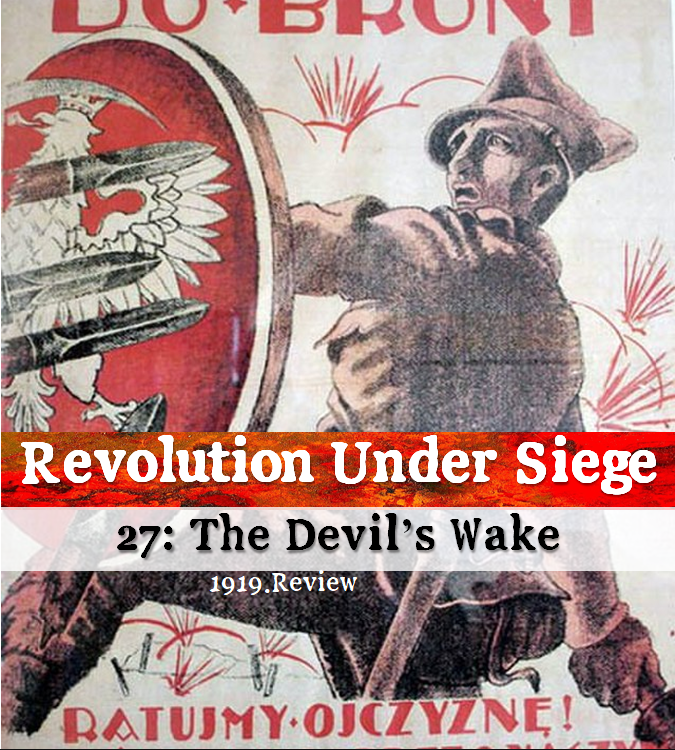

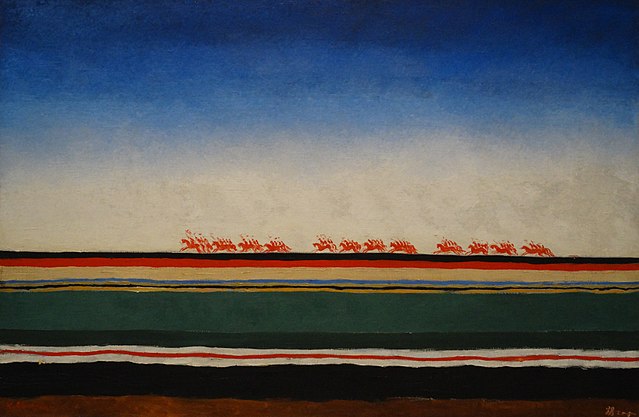
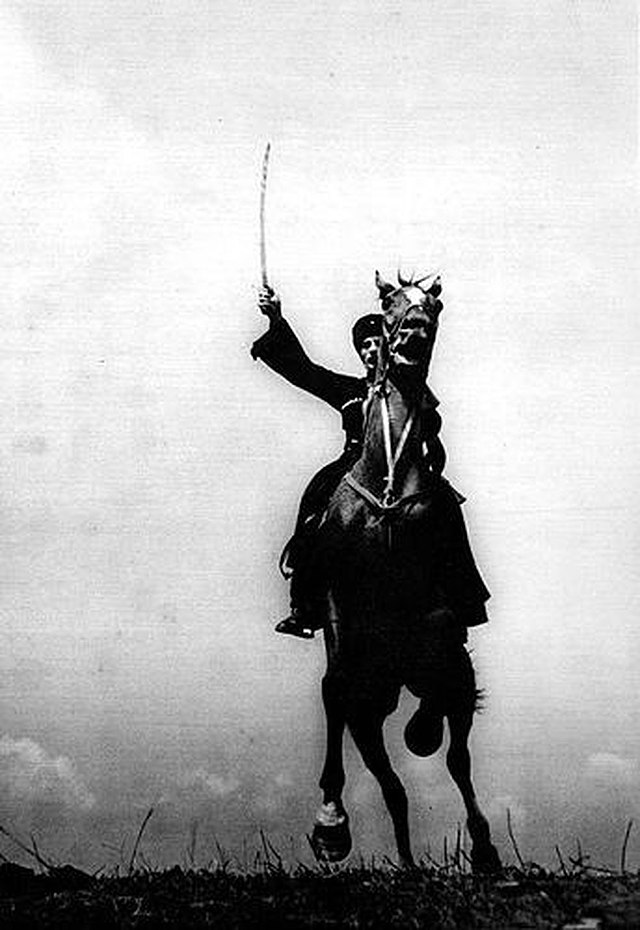
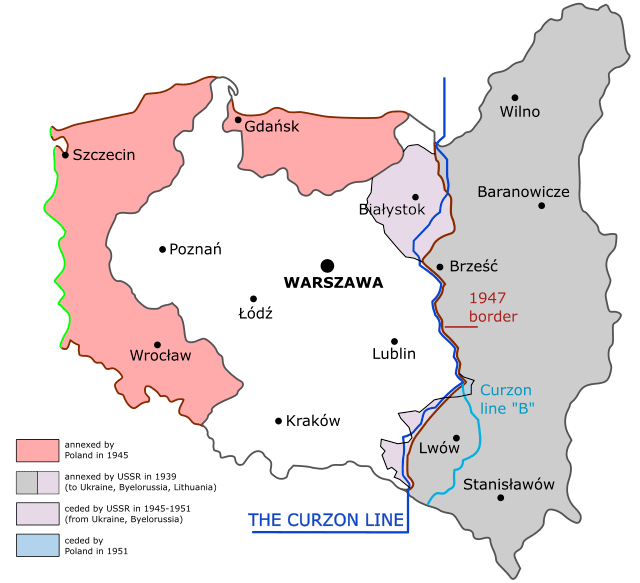
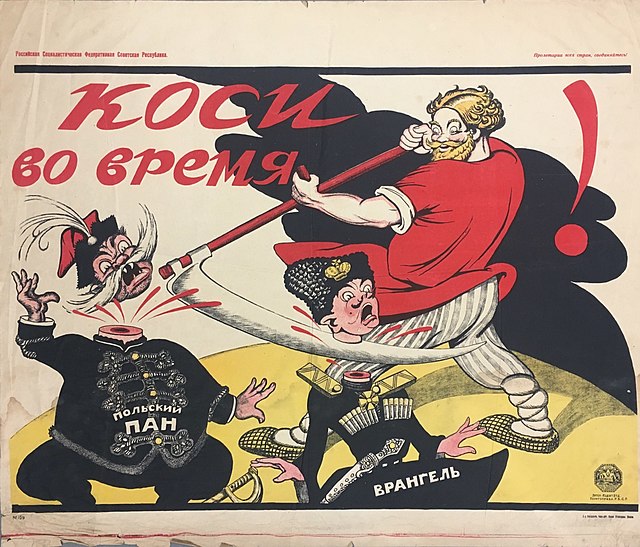
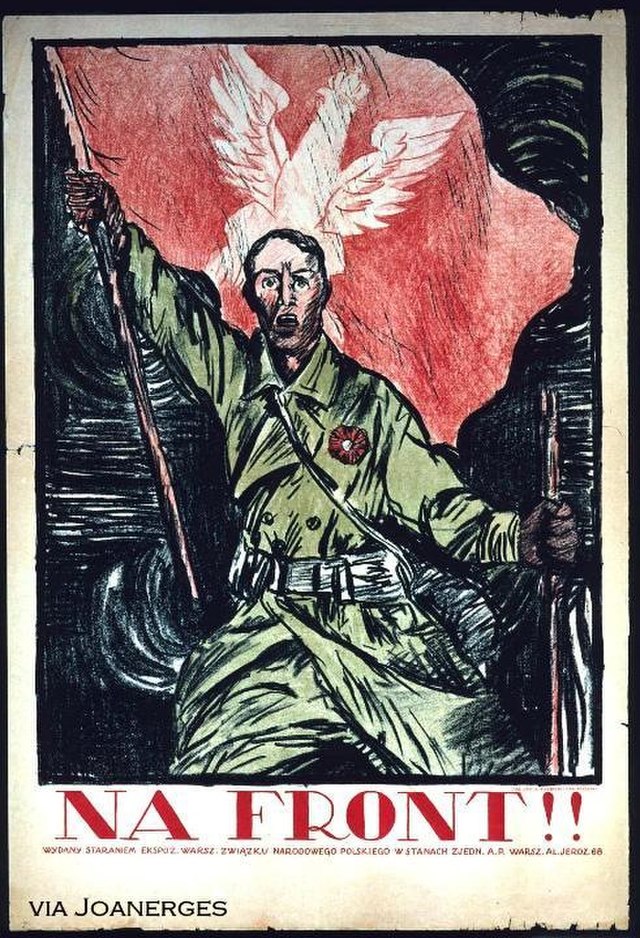
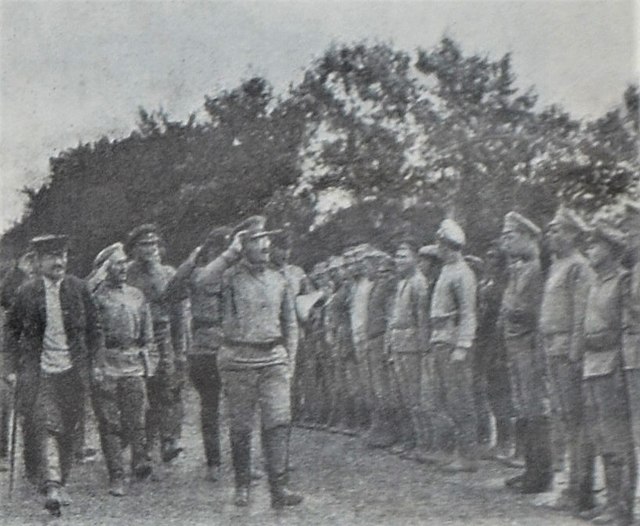
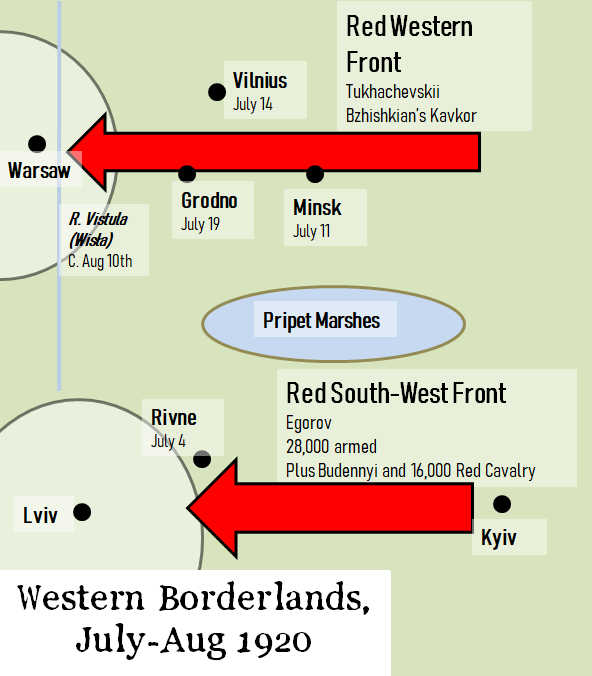
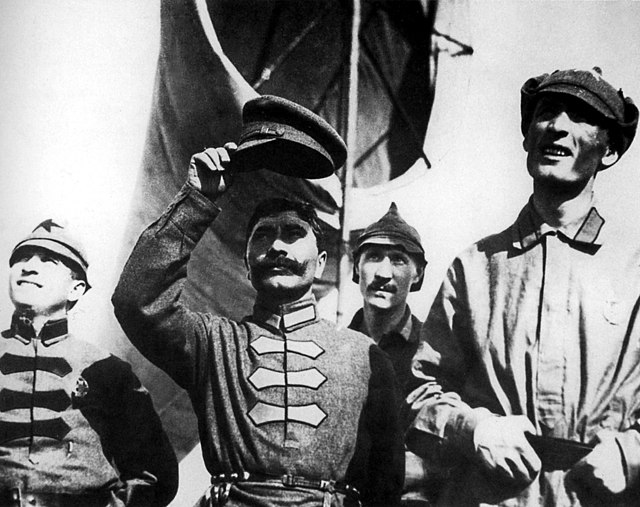

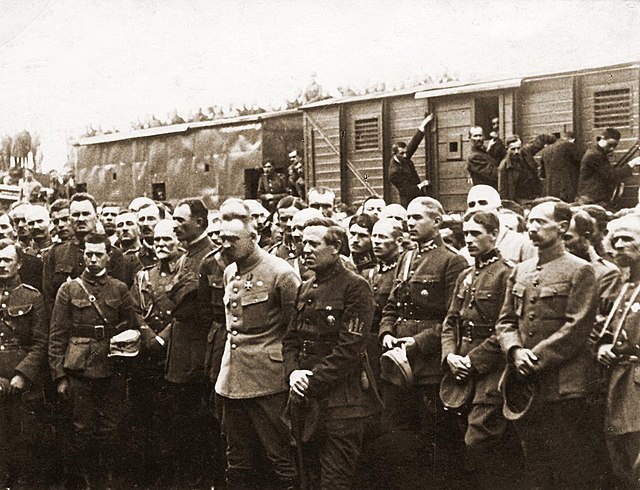
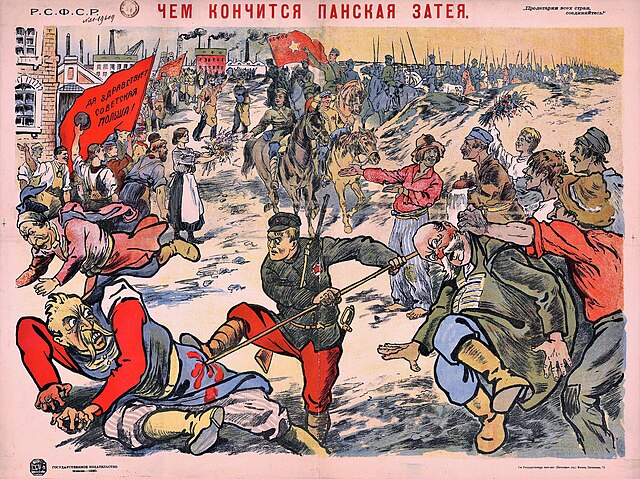
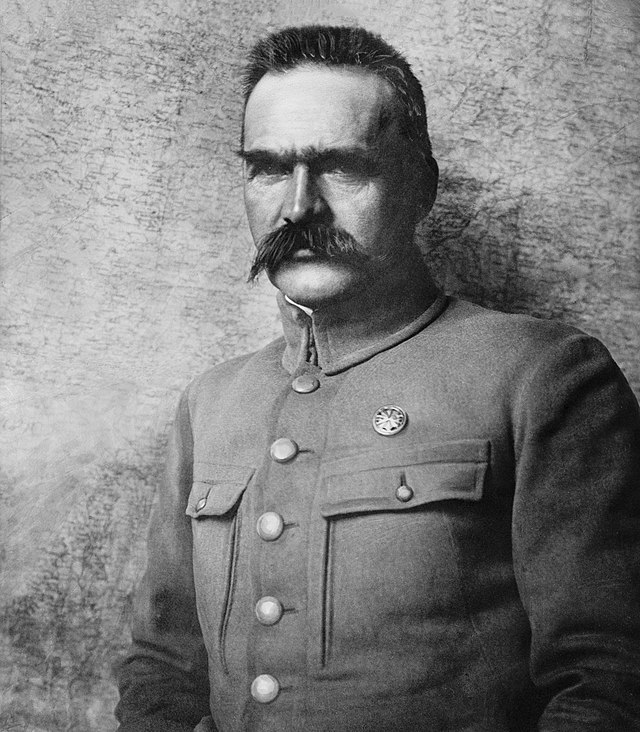

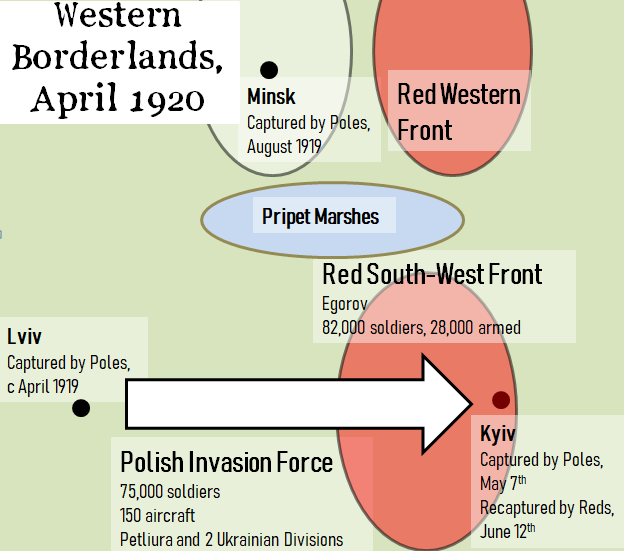
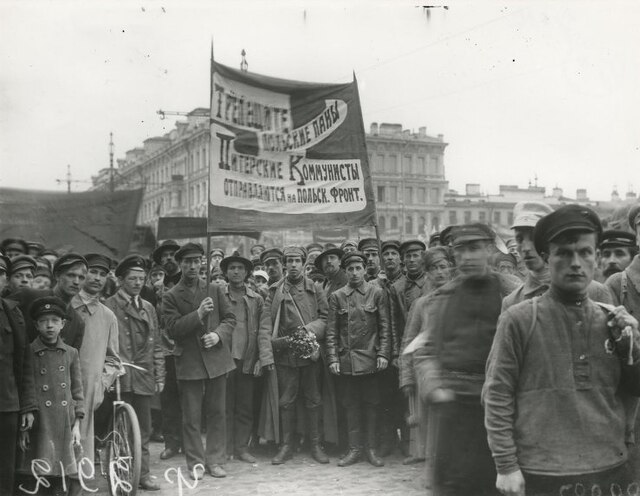
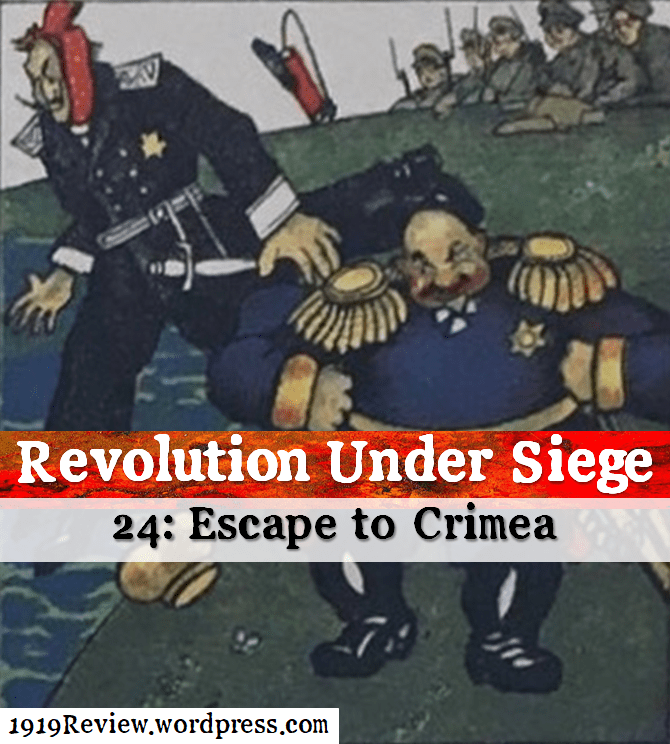
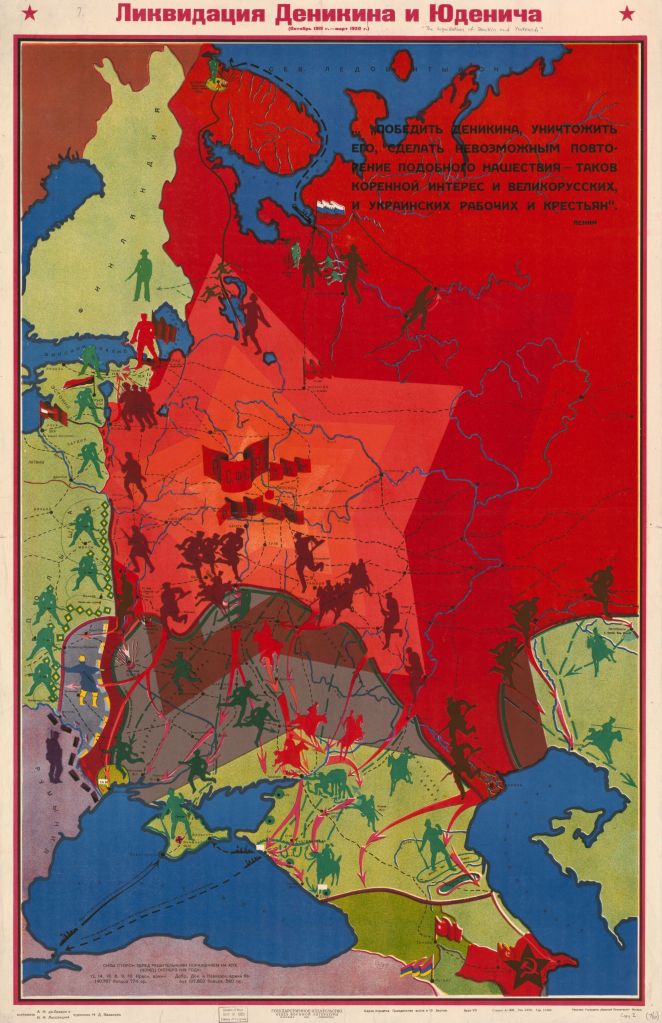

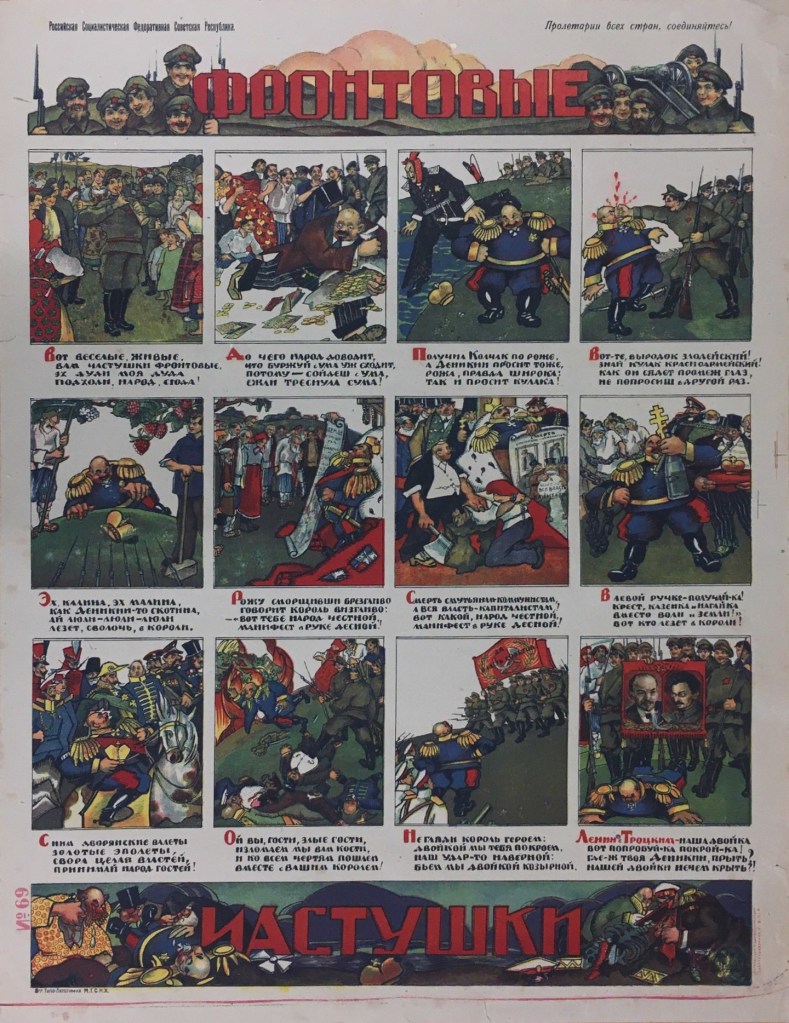
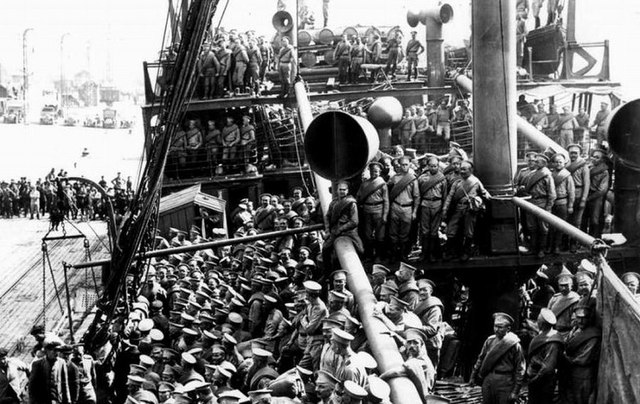
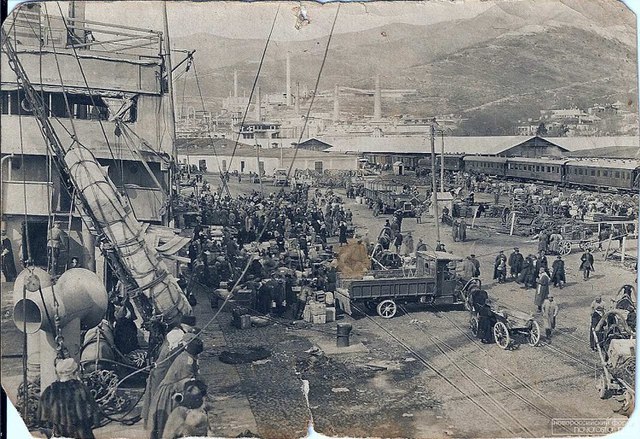
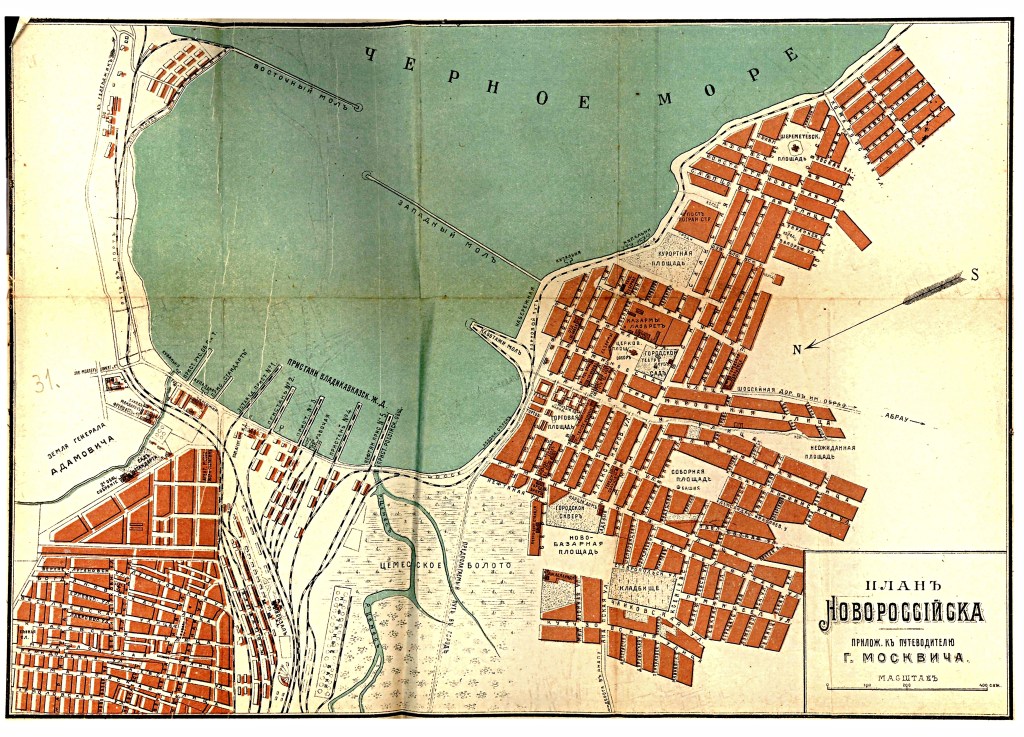

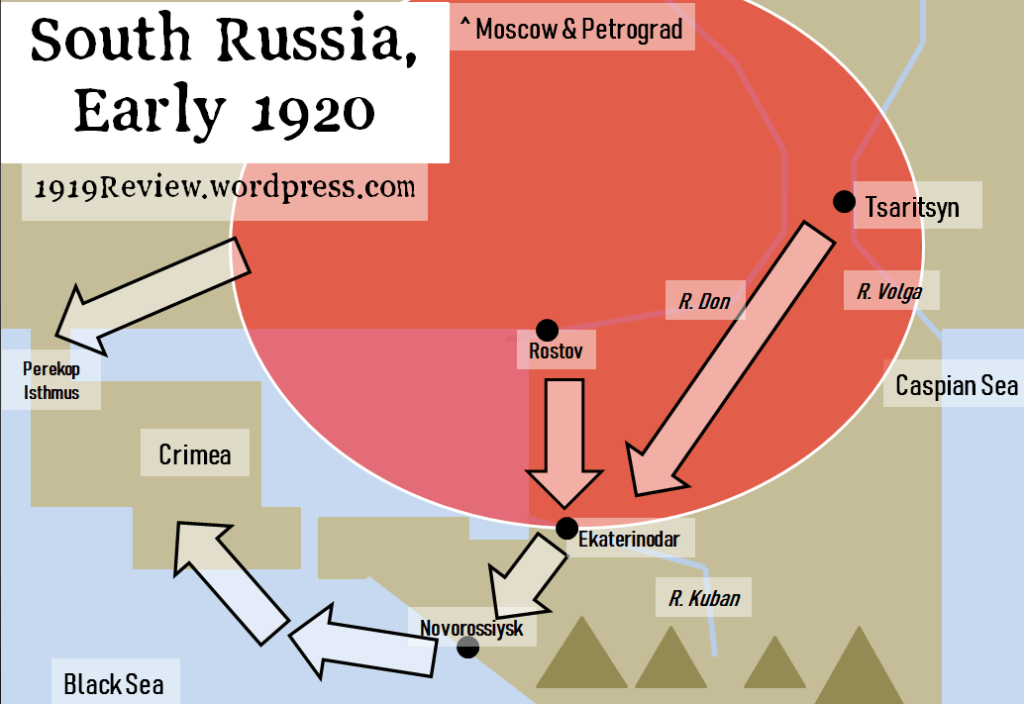
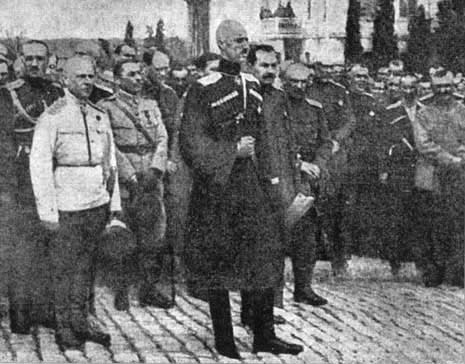


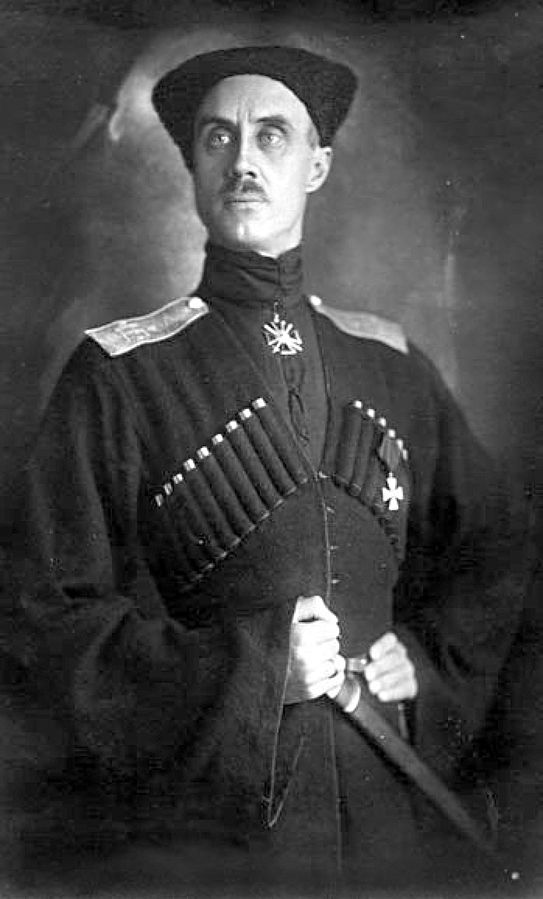


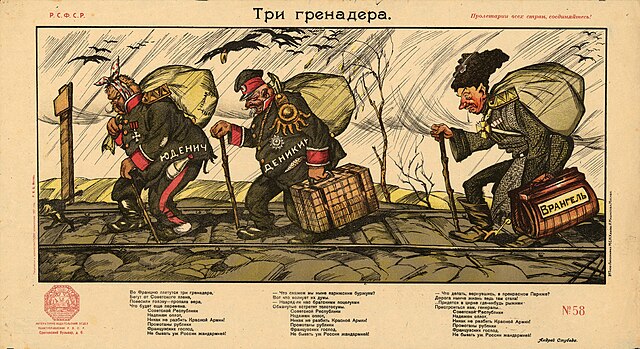
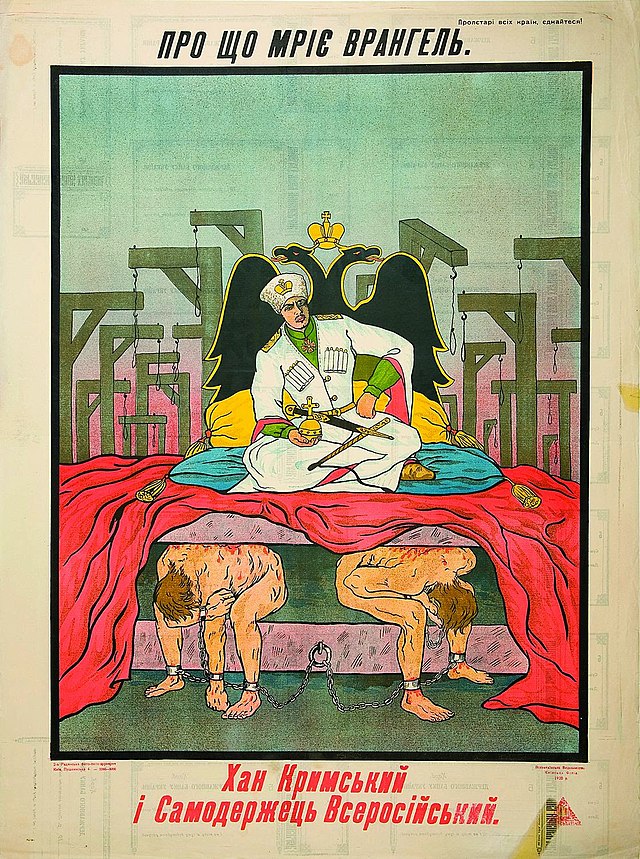
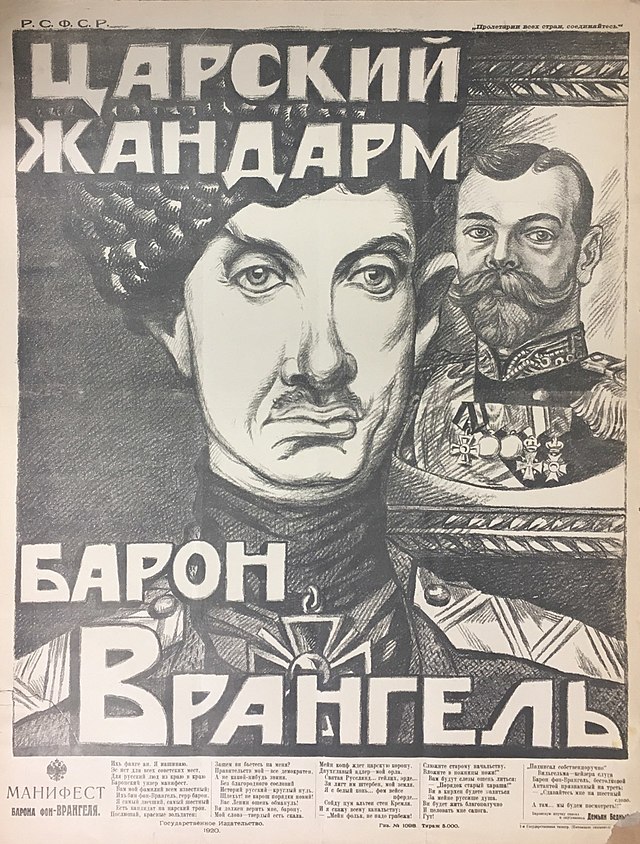

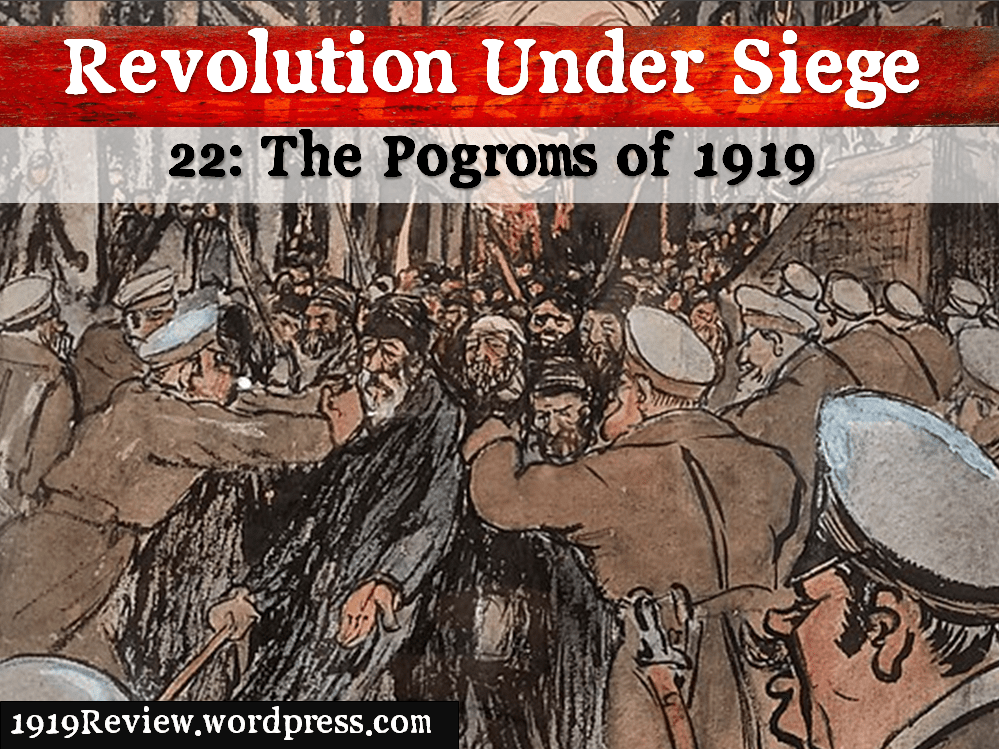
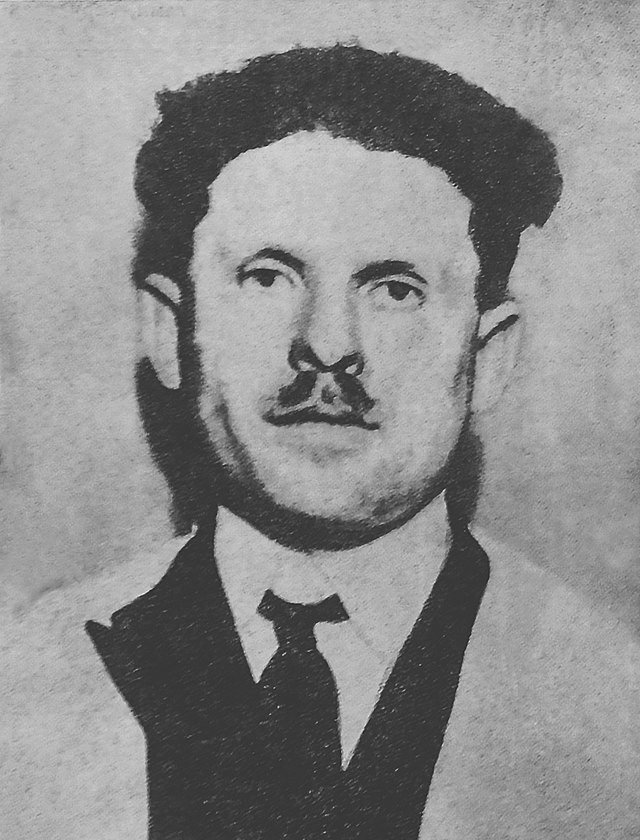
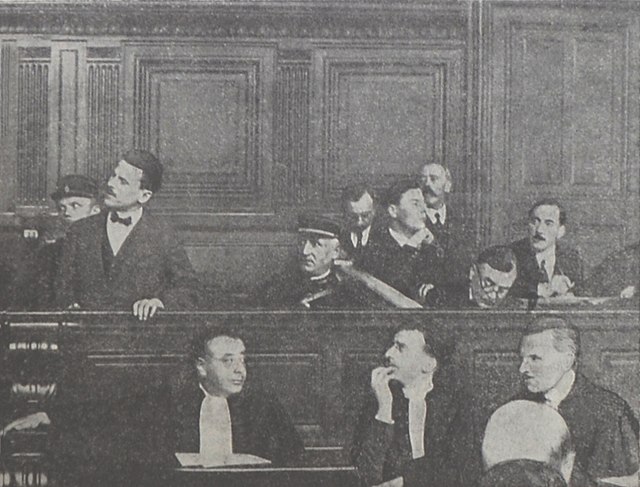

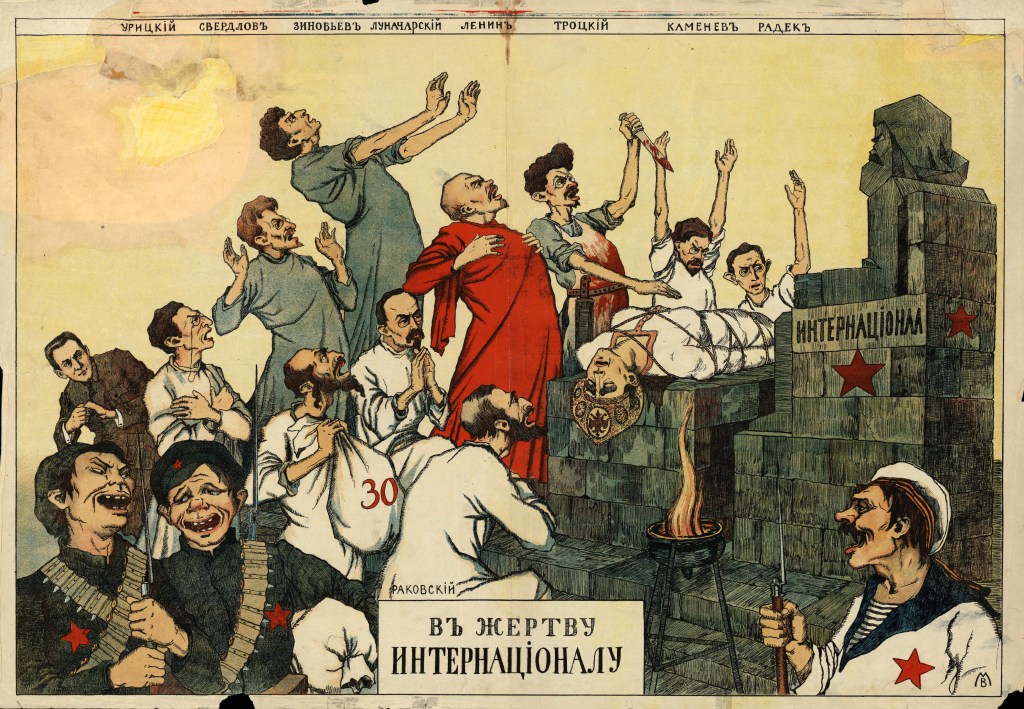

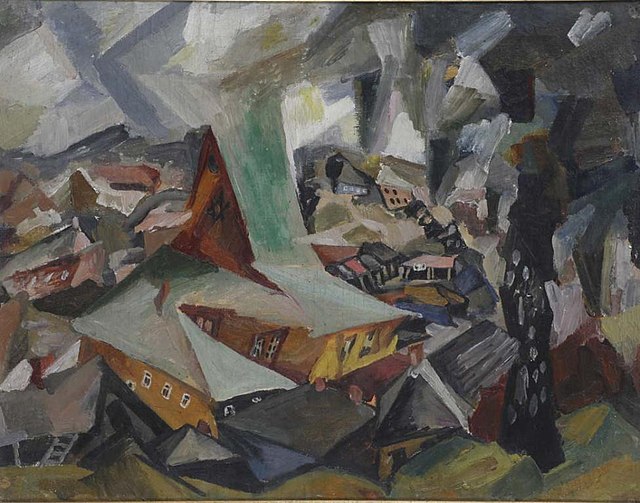
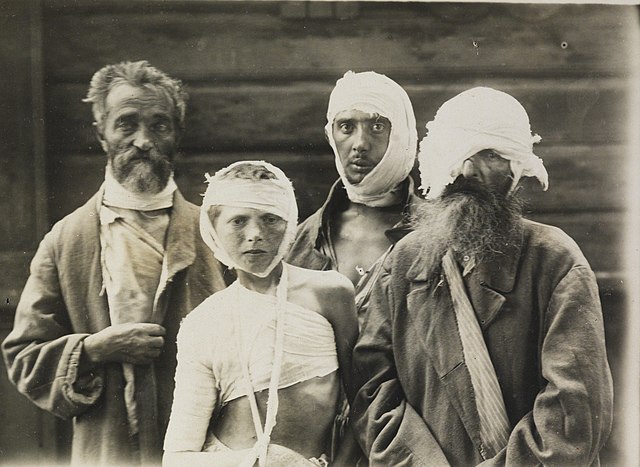


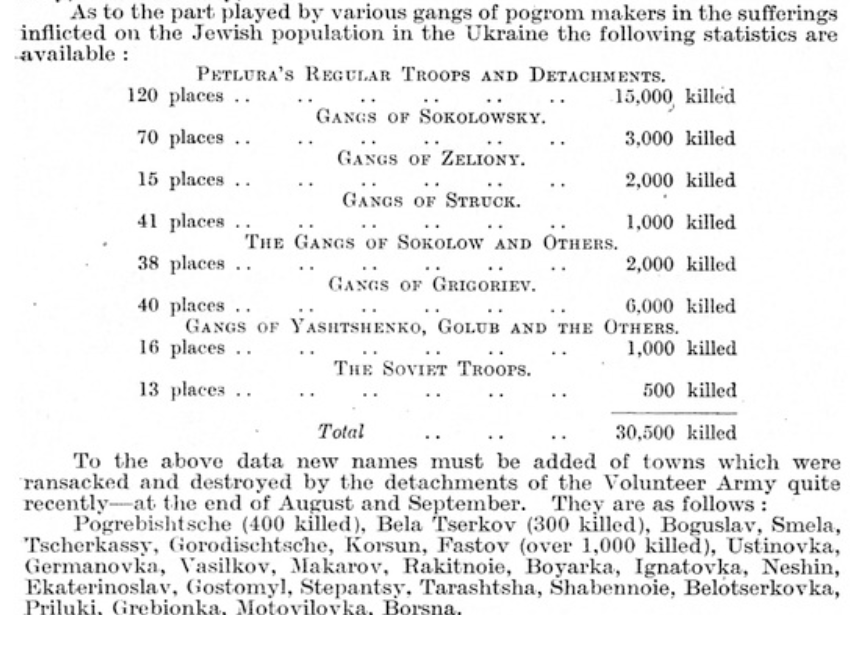
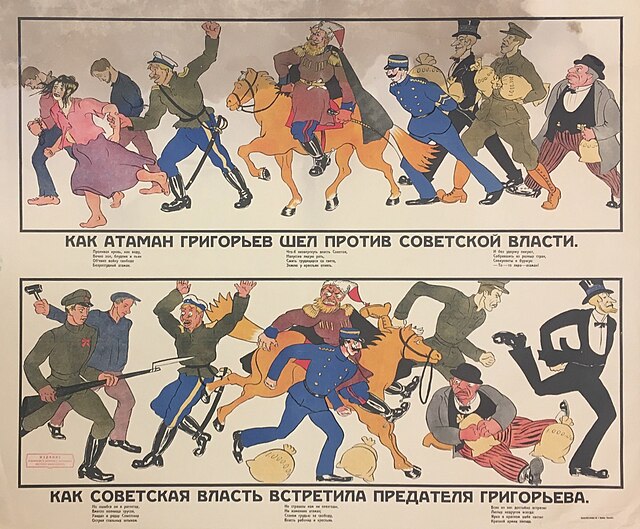

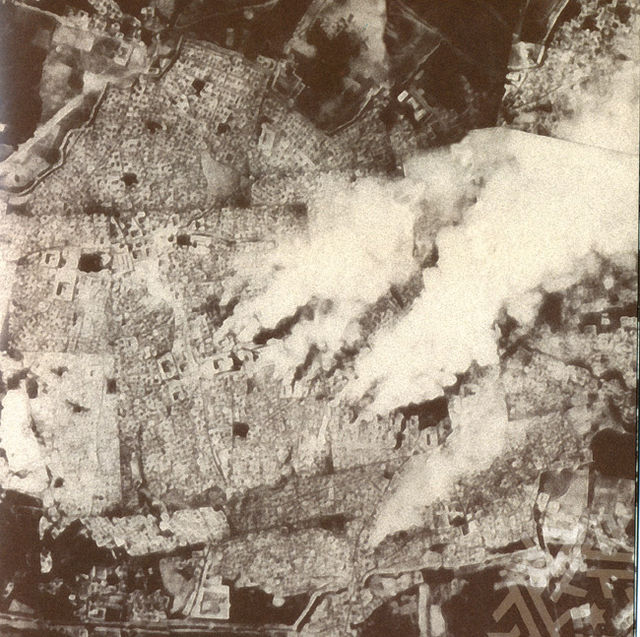

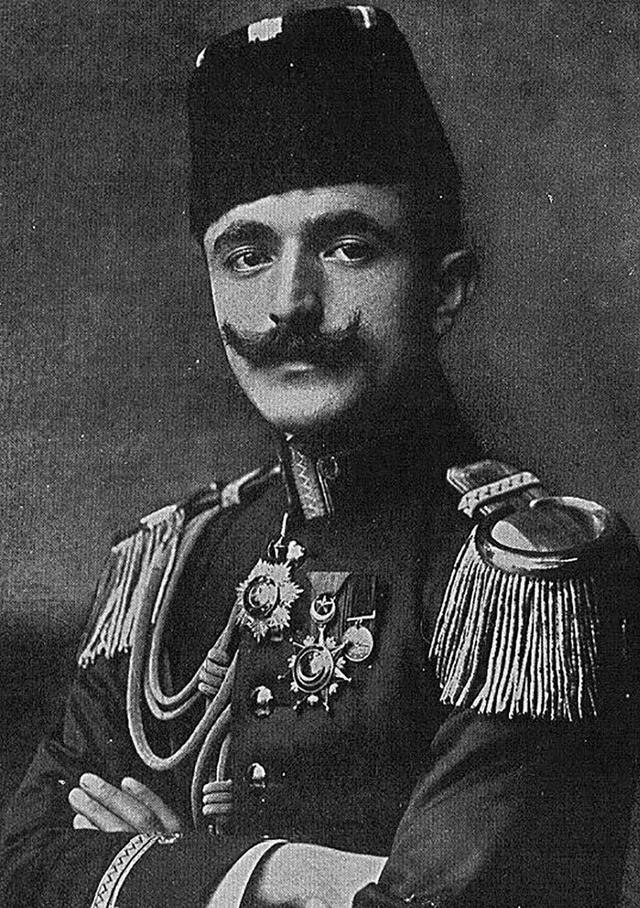
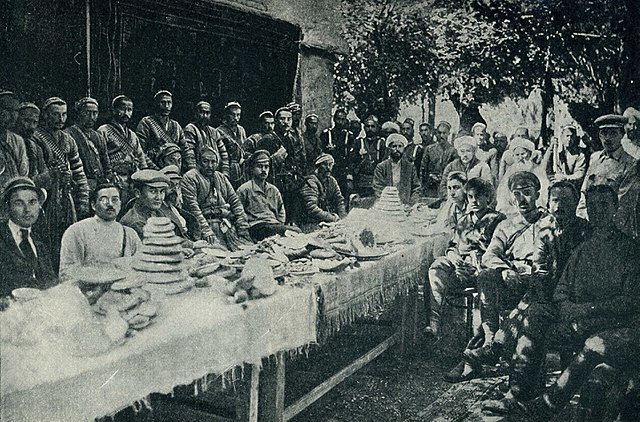


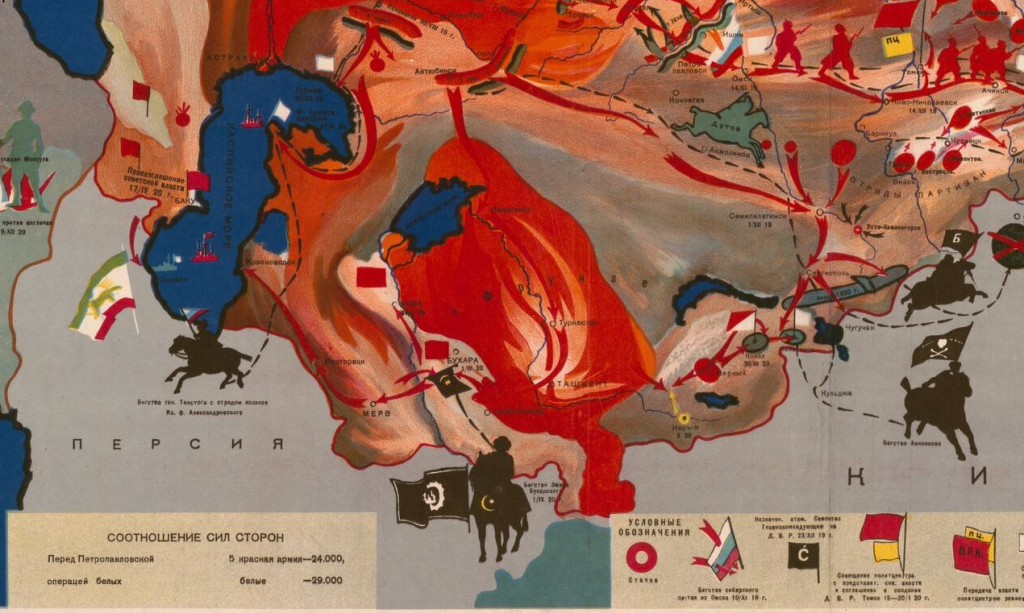
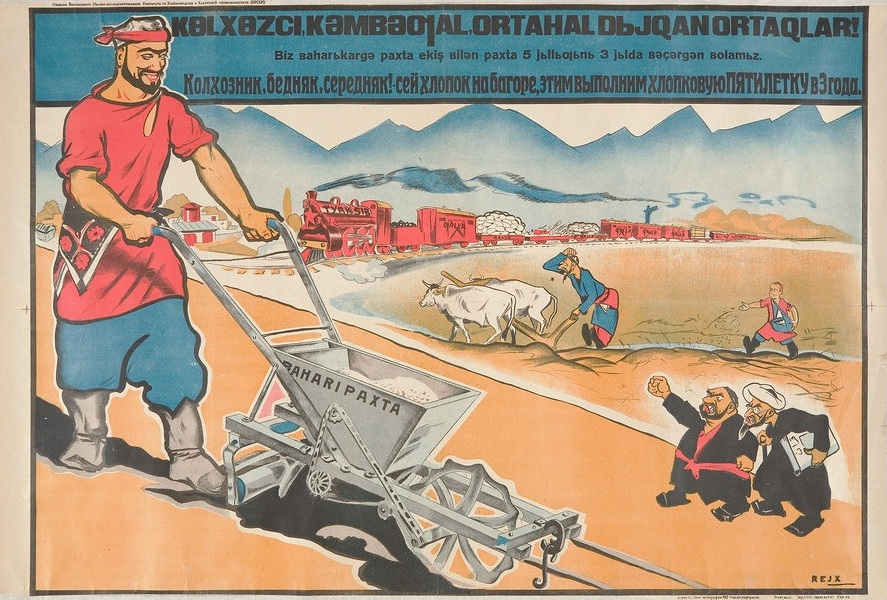

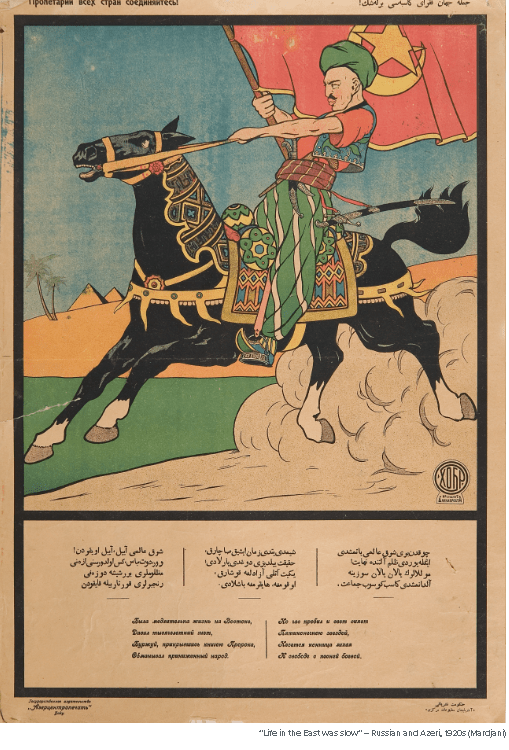
 The 1919 Review