11: Warlords of Siberia

As 1919 began, the vast expanse of Siberia was occupied by an array of factions and warlords. This post introduces the reader to some of the White warlords of Siberia, and follows Admiral Kolchak’s Spring Offensive.  

Revolution Under Siege is back for a second series, tracing the epic events of 1919 in the Russian Civil War.

Before the October Revolution, when Russia was still fighting in the Great War and desperate for new recruits to replace the millions dead and wounded, the Provisional Government sent two cavalry officers to the furthest eastern reaches of the empire. Their mission was to recruit a regiment of Mongols and Buriats, horse nomads of the steppe.

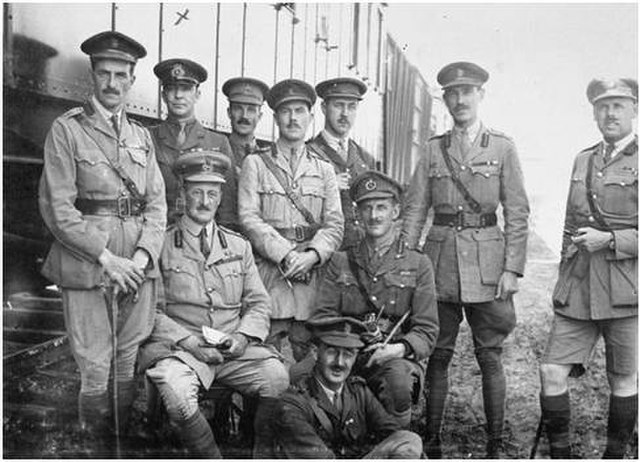
Captain Grigori Semyonov was a Cossack of Buriat origins himself. He was ‘a thick-set character with moustaches shaped like a water buffalo’s horns.’[i] Semyonov’s companion was Baron Roman von Ungern-Sternberg. He was a Baltic German aristocrat from Estonia, but he was already an old Asia hand. He had travelled in Mongolia, he idolised the warriors of the steppe, and on this journey he wore a bright red Chinese jacket and blue trousers. The young baron had the thousand-yard stare. He had served in a regiment which had suffered 200% casualties in the early part of the war. But he was happy during the war years – never happier.

At the start of 1918, the mission consisted of Semyonov, Ungern and six other guys with their horses. Meanwhile back west in the capital, the working class, organised in the soviets and led by the Bolshevik Party, had taken power. The government that had sent Semyonov east no longer existed. The war into which the Mongols and Buriats would have been thrown was, for Russia, over.
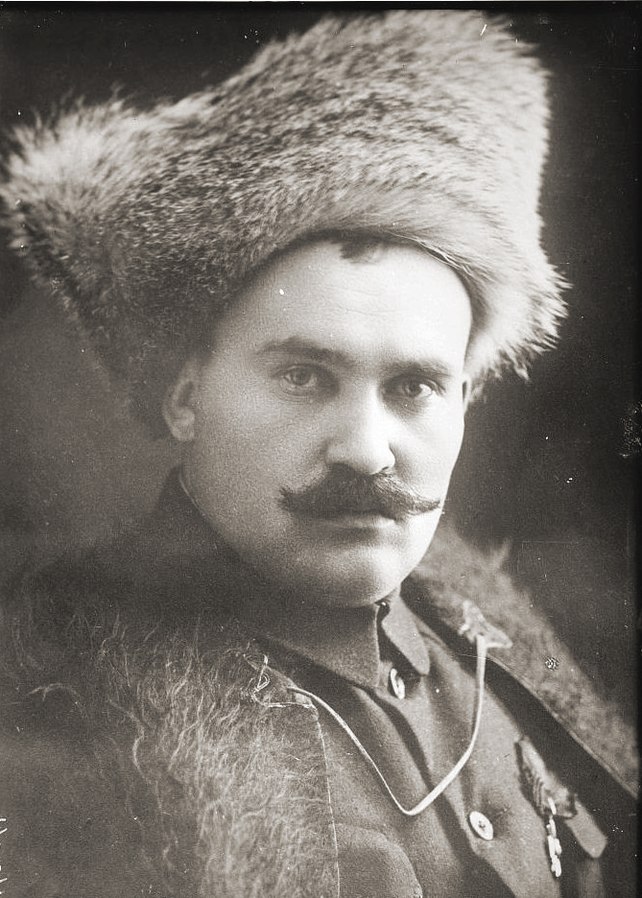
Grigorii Semyonov, ataman of the Trans-Baikal Cossacks

But the sabres of Semyonov and Ungern did not rest. They joined the counter-revolution and became warlords of Siberia. To them, the Provisional Government had been bad enough, but the Revolution was an atrocity. The workers and peasants must be crushed.

Their first uprising was at Verkhneudinsk, just a week or two after the storming of the Winter Palace. They were backed by Transbaikal Cossacks, but they failed, and fled to China.

On New Year’s Day 1918 they crossed back into Russia. Their force of 8 soldiers held a train and lit it up to bluff that they had bigger numbers; in this way they disarmed a Red garrison of 1500.

Meanwhile a Bolshevik sailor and commissar named Kudryashev was on his way to Vladivostok with government money. He and his companions held a New Year’s party on the moving train, and Kudryashev got so drunk he forgot to change trains. The mistake proved fatal.

They were halted near the Chinese border and Ungern led soldiers into the carriage full of celebrating Reds.

Ungern fixed his cold, piercing eyes on Kudryashev and demanded: ‘Deputy Naval Commissar, that’s you?’

‘Baron Ungern looked through his papers, then made a cutting gesture with his hand to his companions. “As for these shits,” he added, pointing to the others from Kudryashev’s party, “whip them and throw them out.”’

Kudryashev was taken out and shot dead in the snow.[ii]

During the six months following the Revolution, Semyonov and Ungern twice rounded up sizeable forces in Manchuria – Mongols, Buriats and anti-communist refugees. They twice invaded Siberia, and were twice driven back across the border into China by the Red Guards.

The fortunes of Semyonov changed thanks to the Allies. First, Semyonov received a load of money from Britain, France and especially Japan, allowing him to hire Chinese mercenaries and to arm and equip his volunteers. Thus he built a force he called the Special Manchurian Division. Second, Semyonov and his Division were on the brink of annihilation when they were saved by the Czechoslovak Revolt of May 1918. Last, when the Special Manchurian Division invaded Russia for the third time in July 1918 it was with massive Czech and Japanese assistance.

A few months earlier, Semyonov had been alone except for a handful of volunteers and an eccentric baron, on a mission from a government he despised. By the end of August, he was dictator of the Transbaikal.

Covering more than 600,000 square kilometres, the Transbaikal region is only a little smaller than Texas. It stretches from Irkutsk in the west, a town on the shores of the vast Lake Baikal, to the Pacific port of Vladivostok in the east.

Semyonov

In late 1918 and through 1919 Semyonov ruled from the town of Chita under the slogan ‘For Law and Order!’ while his officers enjoyed cocaine and the company of sex workers. The night life of the city was made livelier by Red partisan assassins lurking in the alleyways.

Semyonov wished to create an independent state called Daurskii and allegedly awarded himself the title of Grand Duke. But in the words of a Chinese newspaper he was ‘Caliph for an hour and a toy of the Japanese.’[iii] He was more or less subordinate to the Japanese state, which had 70,000 soldiers on his territory along with British, French and US detachments. All the same, he lived like a king. He had thirty mistresses who lived on what was called ‘the summer train’ along with a great store of champagne and an orchestra made up of Austrian prisoners. In June 1918 he was elected ataman (warlord) of the Transbaikal Cossacks.
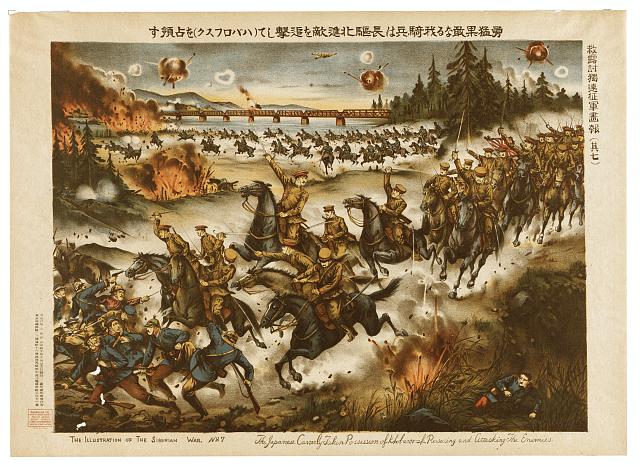
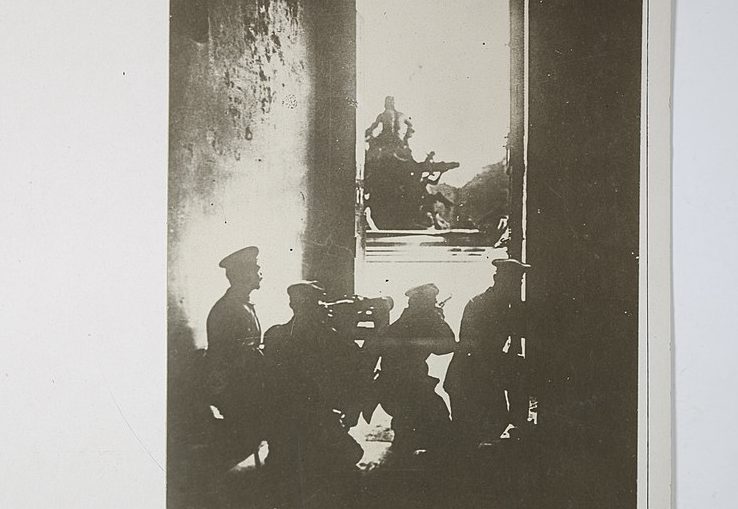
Today’s cover image, from a series of paintings created in Japan titled ‘Illustrations of the Siberian War’

Semyonov used to boast that he could not sleep easily at night unless he had killed someone that day. It was not an idle boast as his victims numbered in the thousands.[iv] By his own account, he personally supervised the torture of 6,500 people.[v] In this last detail Semyonov was not an outlier (though in other respects he certainly was). According to one foreign observer, White Guard officers ‘remarked almost daily that it was necessary for them to whip, punish, or kill someone every day in order that the people know who was protecting them from the Bolsheviks.’[vi]

The Transbaikal was sparsely settled. Trains plied the vast empty lands between the towns and villages. Semyonov and his 14,000 men, by Spring 1919, did not generally stray far outside of Chita, where the warlord lived in a compound guarded by artillery. But armoured trains would supply Semyonov’s armies in the manner of Carribean pirates, pulling up to a station and threatening to open fire with naval guns unless food was handed over.

In Siberia, where the towns were like islands, thousands lived on the rails – Palmer says there were ‘hospital cars, headquarters, brothels, travelling theatres, dining cars appointed like opulent Moscow restaurants, libraries, motor workshops, churches, mobile electric generators, printing shops, offices and torture chambers.’ The old pre-revolutionary cadre of railway workers somehow kept everything moving. Secretly they aided the Red partisans.

Then there were the prison trains, cattle cars filled each with fifty Red prisoners of war, which would travel ‘aimlessly from station to station with neither food nor water.’ Whoever was left alive in the cars after a few weeks would be shot.[vii] For example, a train arrived near Lake Baikal on August 4th, crammed with 2,200 captives from the Red Army (taken during the Spring Offensive – see below). ‘Most of the prisoners appear to be sick with typhus, and starving. Several dead were removed from the cars. It seems that there are dead to be removed at every station.’[viii] The eyewitness quoted just now was a US soldier who was guarding the railway line which the Whites were using in this way.

The railways were the primary target of the Red partisans, though they also infiltrated mines and triggered strikes.[ix] The huge distances and deep forests provided refuge to all those who wanted to fight the Semyonov regime, and they lived in camps as big as small towns.

What was the political character of these guerrilla bands? According to Wollenberg:

Speaking generally, we find that the guerrilla movement assumed two widely contrasted aspects, represented respectively by the Ukrainian guerrillas, among whom the influence of the individualistic wealthier peasants predominated, and the Siberian guerrillas, who manifested the peasant-proletarian disciplined character of the movement. Naturally the line dividing these two opposites was by no means a territorial one; indeed, both these guerrilla manifestations often existed side by side, and were often closely woven with one another in the same band.[x]

On Ukraine, more next episode.

Ungern

Ungern, the baron from Estonia, was now a Major-General under Semyonov. His Asian Cavalry Division, a force which was growing in size to rival Semyonov’s, would be called upon to lash out in reprisal at the villages in the aftermath of partisan raids.

A fort of red stone dominated the border town and railway station of Dauria, and this was Ungern’s castle.[xi] The railway lines were the source of supply for his army and regime; he robbed those who passed through, especially Chinese merchants (for some reason, he hated the Chinese).[xii] The sandy hills near town were scattered with the skulls and bones of Red prisoners who were sent to Dauria, ‘the gallows of Siberia.’
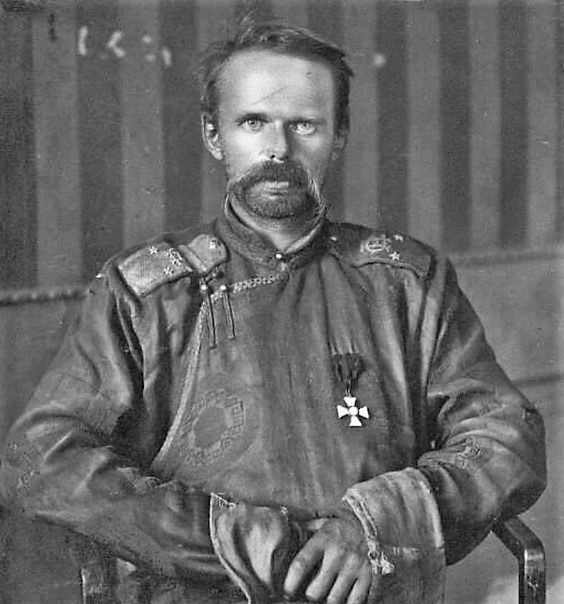
Ungern-Sternberg in Chita in 1920

Ungern ran a strange and very personal regime in Dauria. He was cruel to officers, gentle to horses, popular with soldiers. Evening prayer services were probably the most ecumenical to be found in any military base in the world: Orthodox, Lutheran, Buddhist and other holidays were officially celebrated. When typhus came to Dauria, Ungern went into the hospital and killed those infected who were unlikely to recover. He hated paperwork: when Semyonov sent an inspector, Ungern had him whipped and conscripted.

Within the confines of his own blood-drenched and occult moral code, Ungern was apparently austere and incorruptible. He was virtually the only Semyonovite who did not embezzle; on the contrary, he donated his own pay to the men. He did not believe that the Communist International had been founded only in March 1919, but in ancient times in Babylon. He read mystical signs in playing-cards; he admired Mongolians, and believed they practised magic. Semyonov was surrounded by cocaine and champagne; Ungern smoked opium so that he could have mystical visions. These visions anticipated those of Hitler; in Ungern’s words it was necessary to ‘exterminate Jews, so that neither men nor women, nor even the seed of this people remain.’[xiii]

In most respects Ungern was singular. But in his anti-Semitism he was with the mainstream of ideas in the White camp, where the Protocols of the Elders of Zion and the ‘Zunder Document’ circulated widely, where ‘Jew’ and ‘Communist’ were treated almost as synonyms.

With his extreme reactionary views, the mix of weird and contradictory ideas that informed them, his violent nature, his hatred of women (apparently he is what would now be called a ‘voluntary celibate’), Ungern reminds me of one of those mass shooter from today’s United States.

Semyonov and Ungern were not the only warlords of the Far East. Ataman Kalmykov was also an important figure, subordinate to Semyonov. About Kalmykov my sources don’t tell me much except that he was a glorified bandit, and that he tortured and killed his enemies in blood-curdling ways.

The Civil War in the Transbaikal was a diverse affair. We have noted the presence of Czech, British, French and US forces, and of a full-scale Japanese invasion. Most Japanese stayed by Vladivostok; some went as far inland as Lake Baikal. On one occasion, drunk American soldiers beat up a trainload of White Russians. There was much back-and-forth over the borders with Manchuria and Mongolia. Spies reported to Japanese noblemen rather than to a centralised secret service. Alongside Russian settlers were the indigenous peoples of the area such as the Buriats, who fought on both sides. There was also the Transbaikal Cossack Host, the fourth-largest in Russia with 258,000 fighters, along with the 96,000 Amur, Iakutsk and Issuri Cossacks.[xiv]

A Japanese-sponsored conference discussed founding a pan-Mongolian state. It should be obvious that the White Russians were not keen on the idea (‘dismembering sacred Holy Russia…’). Ungern was also against the idea. He only liked Mongolians when they were romantic nomads; he did not like literate Mongolian intellectuals gathering to discuss modern concepts like nation-states.

There were tensions between Mongolian factions. The Karachen Mongols – from Inner Mongolia, today a province of China – grew angry with delays in pay. Two days of fighting raged in Dauria when 1,500 Karachen killed their Russian officers and seized an armoured train.

Kolchak

Moving westward along the Trans-Siberian railway, we leave the atamans behind and approach Kolchak. We saw last series how in November 1918 Admiral Aleksandr Kolchak cast aside the Right SRs and rose to the position of Supreme Ruler of the White cause in Western Siberia. His capital city was Omsk.

Kolchak was not the only Admiral who, in 1919, found himself ruling supreme over a landlocked territory. Miklós Horthy in Hungary found himself in the same position. Landlocked Admirals are, it appears, not just a symbol but a product of collapsing empires.
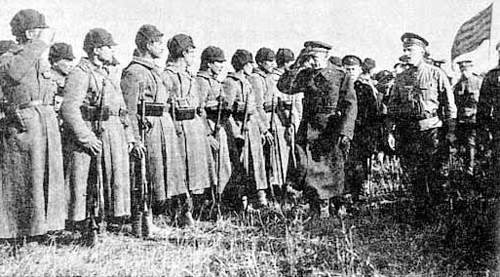
Kolchak inspecting the troops

By the time of Kolchak’s coup, Semyonov had been in power for months. Semyonov felt threatened by this development and enforced a ruthless blockade over Kolchak’s territory. This was like putting his boot on the Admiral’s jugular; the Trans-Siberian Railway was the narrow blood vessel connecting Omsk to the Pacific Ocean, and to the Allies.

An eyewitness recalled Kolchak’s fury: ‘If Ataman Semenov had fallen into his hands now, the Admiral would not have hesitated to have him shot on the spot.’[xv]

After negotiations and a standoff, Semyonov not only lifted his boot but agreed to place himself under Kolchak’s leadership. Later Kolchak would formally and openly acknowledge Semyonov as the next-highest leader of the White cause in Siberia.

They were never happy allies. While Semyonov was a proud and open reactionary, Kolchak was in a position where he had to play a more delicate game. While Ungern was dragging Chinese merchants off trains and Semyonov was swigging champagne with his mistresses, Kolchak was trying to conquer Moscow. Kolchak’s officers were the kind of men who would challenge one another to duels and slap their soldiers in the face, but Kolchak himself had to present his regime as more modern and democratic in spirit. He needed Allied support, and he needed to build up a mass regular army recruited from among ordinary peasants. Everything east of Irkutsk was a bloody embarrassment and in many ways a liability to Kolchak.

But in other ways the Supreme Ruler in Omsk relied on the warlords beyond Lake Baikal. According to Palmer, it was to the realm of Ataman Semyonov that many Red prisoners-of-war were sent, never to return. Those of Kolchak’s faction believed, or at least claimed to believe, that there was a system of prison camps east of Lake Baikal, but there was no such thing. There were death trains, death barges, firing squads, sabres, even ice mallets. All this played ‘a critical, gruesome part in the White infrastructure’[xvi] though we should note that a greater number of Red prisoners were simply recruited as (very unreliable) White soldiers.

In addition, Kolchak and co had no idea how far they could push Semyonov, because they did not know how committed the Japanese were to him. So they didn’t really push him at all.

At least one author has claimed that Ungern was not representative of the White cause.[xvii] This is true enough; Ungern was really only representative of Ungern. But pointing to the prison trains and the mass graves, Palmer argues that the two depended on each other.

This contrast between what it was and what it pretended to be defined Kolchak’s regime. Its government departments were well-staffed and built on an all-Russian scale, but underneath there was very little in the way of actual services being delivered or concrete tasks being carried out. It was, to adapt a phrase, too many atamans, not enough Cossacks. Its military had a lot of top brass with impressive titles, but many were young, junior officers who had no idea how to command tens of thousands.
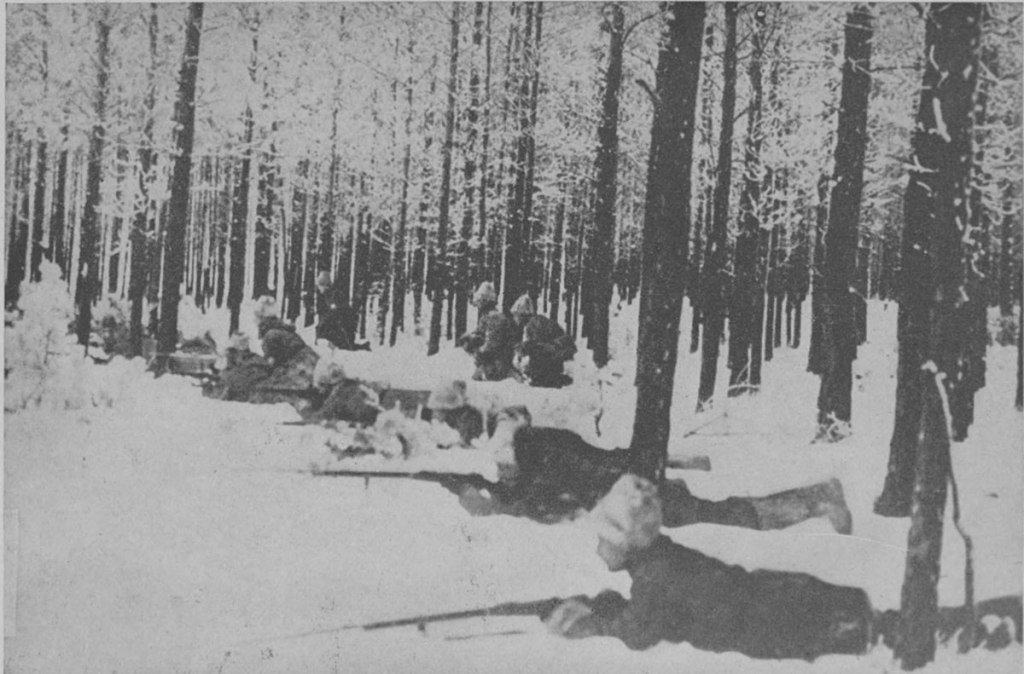
The Spring offensive

In early 1919 the forces of Admiral Kolchak had plenty of prisoners to dispose of. They went on the offensive and for months enjoyed extraordinary success.

In late 1918 the Komuch regime on the Volga had collapsed under the pressure of the Red Army, the key battle taking place at Kazan. In the winter of 1918-19, Five Red Armies advanced into the Ural Mountains. In January 1919 Lenin envisaged this Eastern Army Group taking Omsk within a month. It was not to be.

Perhaps he should have taken the ‘Perm Catastrophe’ as a warning. I mistakenly wrote in a previous post that after Kolchak’s coup the Czechs played little further role in the war. But it was the Czech officer Gajda who attacked the northern extremity of the Red front at the end of 1918, seizing the town of Perm and throwing the Red Third Army back nearly 300 kilometres.[xviii] Five Red Armies – but were they proper armies in reality, or only on paper? If Gajda could devastate Third Army so easily, Kolchak had reason to believe that the whole Red war effort was ready to crumble under serious pressure.

The Admiral was a sincere and devoted leader who made a point of visiting the frontlines and dispensing gifts to the soldiers. He had that ‘lean and hungry look’ that Shakespeare noticed in certain political figures: ‘he thinks too much… such men as he be never at heart’s ease.’ He was tormented by the dilemmas and pressures of the situation, shouting at his ministers, throwing things around his office, gouging at his desk with a knife. Punishing the furniture was easier than tackling festering problems such as the ‘warlordism’ of Semyonov.

He needed soldiers. Here in Siberia the land question was less pressing, so the peasants were not as hostile to the Whites as elsewhere. But the trained veterans of World War One who had returned to civilian life in Siberia were of no use to him; the war had made them cynical, and in the trenches they had been ‘infected’ with Bolshevik propaganda. From Kolchak’s point of view they were rotten.  It was necessary to conscript tens of thousands of younger men, too young to have fought in the ‘German War’ or mutinied during the Revolution. But it would take time to train them up.

Kolchak did not have time. At the start of 1919 it looked like the Allies were ready to sign a peace treaty with the Soviets. To get support and aid, Kolchak needed to show that he stood a chance of crushing the Revolution once and for all. So he needed to launch an offensive, and he needed to do so in the narrow window between bleakest winter and the rasputitsa, the season when every gully would be a roaring torrent and every artillery piece would be axle-deep in mud. 

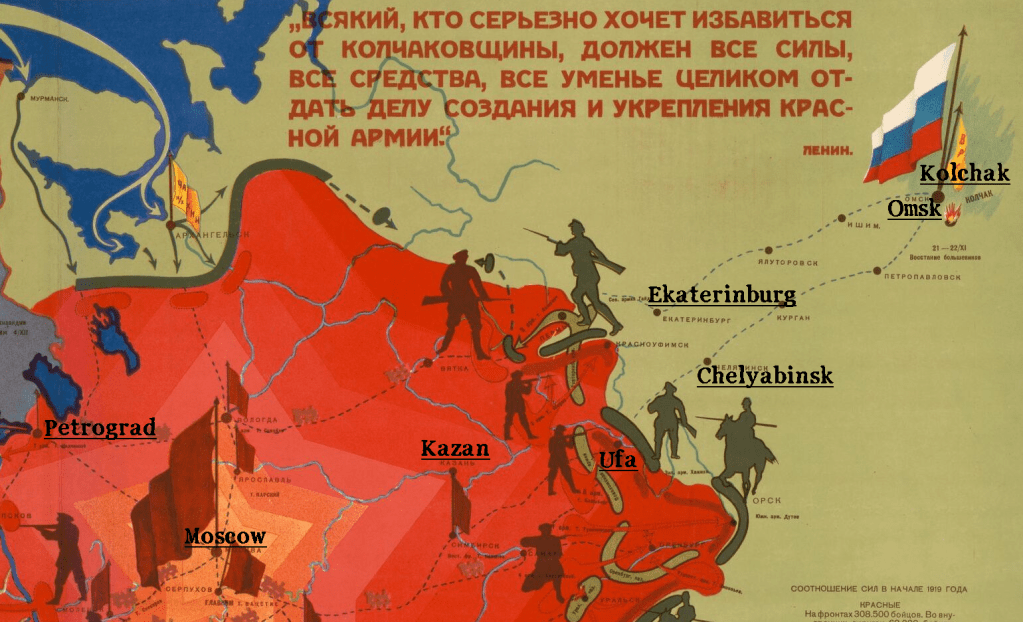
The White forces exploited this narrow window of time with brilliance. On March 4th they advanced through the frozen Ural passes on skis and sledges. On the middle part of their front the Whites set their sights on Ufa. They faced not some rabble of Red Guards, but the Fifth Red Army, tempered at the Battle of Kazan. Nonetheless by March 14th Ufa was in White hands.
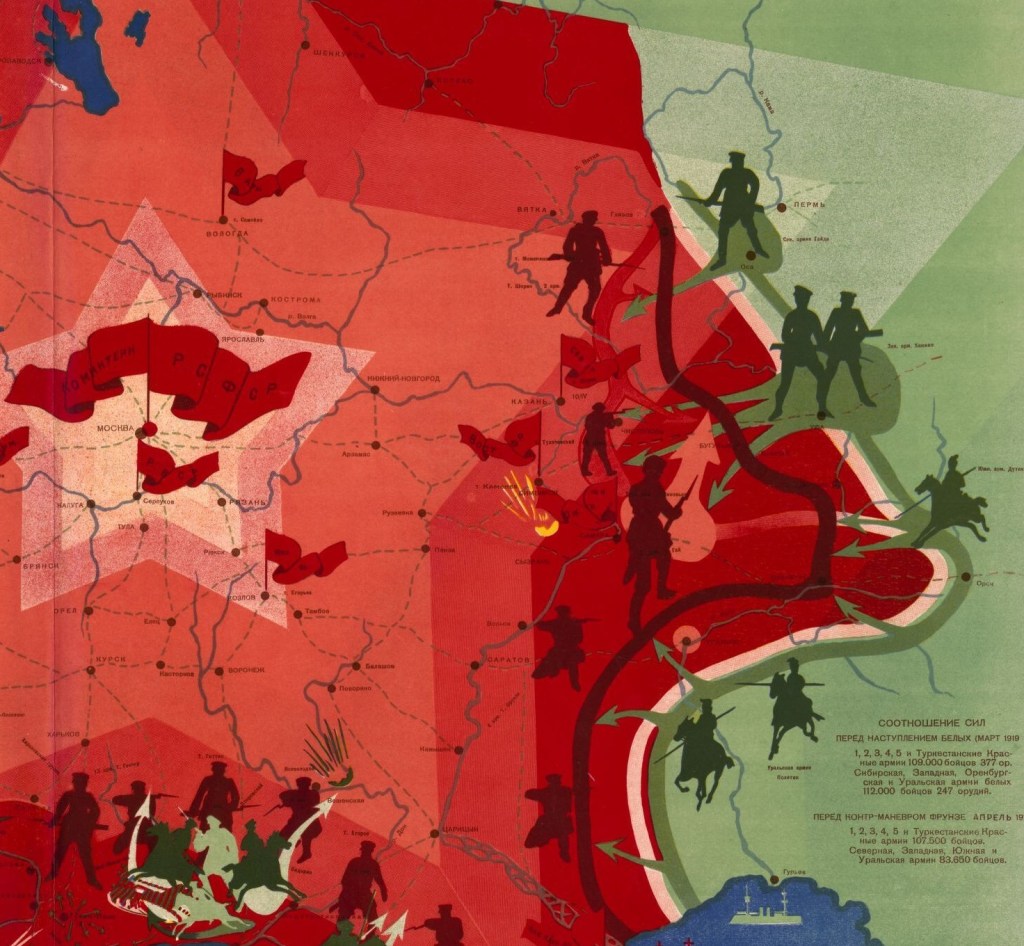
Kolchak’s Spring Offensive, surging east to west, detail from number 5 of a series of pictorial wall maps

The young conscripts were still back at Omsk being trained up. This offensive was made by Kolchak’s Siberian Army of officers and Volunteers, bolstered by the incorporated remains of the Komuch People’s Army. So this was a victory of modest numbers against greater numbers.

By the end of April Kolchak’s army had taken a territory the size of Britain, populated by 5 million people. In May, a White officer stood on a height in the re-conquered city of Ufa and looked west over the Belaia river.

Beyond the Belaia spread to the horizon the limitless plain, the rich fruitful steppe: the lilac haze in the far distance enticed and excited – there were the home places so close to us, there was the goal, the Volga. And only the wall of the internatsional, which had impudently invaded our motherland, divided us from all that was closest and dearest.[xix]

There is a profound irony in the White Guard complaining about the internatsional. At that moment, behind his back to the east the railway was held by a counter-revolutionary international: Japan, the Czechs, the US, Britain, France. Allied battalions garrisoned key Siberian cities for Kolchak. The British at Omsk were training up some of the conscripts. If the White officer carried a rifle as he looked westward from Ufa, the bullets in that rifle were of British manufacture; General Knox at Omsk, Kolchak’s best friend among the Allies, claimed that every round fired by the Siberian Whites since December 1918 had been made in Britain, delivered by British ships at Vladivostok, and transported into the interior by British troops.

The flow of supplies had increased. The Spring Offensive had succeeded in terms of land conquered and as a signal to the Allies. Now the peace proposals were a thing of the past, and the Allies had committed themselves with renewed energy to the task of strangling the Russian Revolution. Between October 1918 and October 1919, 79 ships arrived at Vladivostok carrying 97,000 tons of military supplies. This meant around 1.27 million rifles, 9631 machine-guns and 622 artillery pieces.[xx] That is to say nothing of rolling stock, uniforms, greatcoats, boots, etc. Even though a portion of this must have been absorbed by looting and black-marketeering as it passed through the hands of Semyonov, these were vast supplies for a White Army numbering only around 100,000.  

But next to what the Whites hoped for and the Reds feared, the role of the Allies fell short. When the Soviet war commissar Trotsky heard of Winston Churchill boasting about the ‘crusade of fourteen nations’ against Bolshevism, he responded with mockery. The Whites, he pointed out, had been hoping for something more like fourteen Allied divisions.

But let us not lose sight of the fact that Allied aid to Kolchak was ‘roughly comparable to total Soviet production in 1919.’[xxi]

Semyonov was a pirate king of the railways; Ungern hated the modern world; Kolchak and his officers denounced the international. But none of the warlords of Siberia would have made it very far without the Allies.

Regardless, the Whites had struck a heavy blow on the Eastern Front. The Ural Mountains had been re-conquered for counter-revolution, and the Allies were staking a million rifles on the victory of Admiral Kolchak. By this time, as we will see in the next few posts, the threats to the Soviet Republic on other fronts had multiplied and grown.

***

Go to Revolution Under Siege Archive

Go to Home Page/ Archive

Sources


[i] Beevor, Antony. Russia: Revolution and Civil War 1917-1921 (p. 111). Orion. Kindle Edition. I made harsh criticisms of this book. But as you can see, I have found a lot of useful material in it.

[ii] Beevor, p. 112

[iii] Beevor, 296

[iv] Smele, The ‘Russian’ Civil Wars, 269 n65, 348 n13

[v] Smith, Russia in Revolution, p 200

[vi] Palmer, The Bloody White Baron,92

[vii] Palmer, p 104-106

[viii] Beevor, p. 331

[ix] Beevor, p 295

[x] Wollenberg, The Red Army, https://www.marxists.org/history/ussr/government/red-army/1937/wollenberg-red-army/ch02.htm

[xi] Dauria is also another name for the Transbaikal region

[xii][xii][xii] In spite of his hatred of Chinese and women, Ungern during this period spent 7 months in China and married the daughter of a Chinese general. Palmer guesses that this was a political marriage setup by Semyonov. Palmer, p 111

[xiii] Palmer, 93

[xiv] Mawdsley, The Russian Civil War, p 200-201

[xv] Beevor, p. 250

[xvi] Palmer, 113

[xvii] Rayfield, in Stalin’s Hangmen

[xviii] Mawdsley, 183

[xix] Mawdsley, p 202

[xx] These numbers are tallied from information provided by Mawdsley, p 198

[xxi] Mawdsley, 198
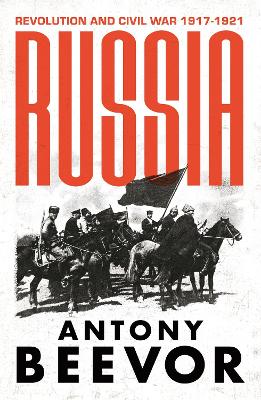
So far, Beevor’s new book is terrible

I learned a lot from Stalingrad and The Battle for Spain, so I was interested to learn that Antony Beevor was tackling the Russian Civil War in his latest book.

But judging from what I’ve read so far, Russia: Revolution and Civil War 1917-1921 is a crude offering. I’ll show what I mean by reference to a single chapter (which is more or less all I’ve read).

When I looked at the contents page, my eye was drawn to a chapter titled ‘The Infanticide of Democracy, November-December 1917.’

If you’re going to put an image of infanticide into my head, you’d better have a good reason. In this case, there is no good reason: during those two months, November and December, the Bolsheviks secured a majority in the Soviets, then received the blessing of a peasant soviet congress. They passed decrees on peace and land. They went into coalition with the Left SRs. They held the Constituent Assembly elections. The street fighting lasted only a few days, and the Whites involved were in general treated with magnanimity. Throughout, the Bolsheviks resisted the pressure to enter coalition with parties whose programme was diametrically opposed to theirs, and relied instead on the active support of millions of people.

All in all, I see this period as one during which, against challenging odds, the new soviet government lived up to its promise. But Beevor doesn’t see it that way.

Peace

He starts out talking about the war. Even though he dubs World War One ‘The Suicide of Europe’, he condemns the Soviets for trying to end the war. For him, the peace efforts were a bad thing because they encouraged rowdy and violent deserters (as if the rotten Tsarist army was not already collapsing due to mass desertion). If the Bolsheviks had broken their peace promise and forced everyone to fight on at gunpoint, no doubt Beevor would condemn that too. And he would be right!

Next in line for condemnation are the deserters themselves – because they ripped the upholstery out of first-class train carriages to wrap around their bare feet. Unmoved by the bare feet of the soldiers, Beevor is moved by the plight of the upholstery.

It must be fun for Beevor to come up with these taboo-busting chapter titles. ‘The Suicide of Europe,’ ‘The Infanticide of Democracy’… What’s next? ‘The Incest of Asia’? ‘The Opioid Addiction of Oligarchy’?

Plotting Civil War

Lenin, Beevor tells us, ‘welcomed destruction for its own sake.’ From there, he argues that Lenin wanted to start a civil war – ‘to achieve tabula rasa through violence,’ that he wanted all the horrendous destruction and inhumanity of 1918-1921 to happen so that he could ‘retain power’ and build communism on a clean slate.

So according to Beevor, Lenin’s plan was to hold power and to build communism in a context where the industries were devastated, where the areas which produced food and raw materials were occupied by enemy armies, where the urban working class – his support base! – were dying in huge numbers, where military spending made it impossible to pursue ambitious social programmes. Needless to say, this was not his plan.

By April, Lenin was happy (an unfortunately very wrong) to declare that the war was over. The idea that he wanted the Civil War at all is just as absurd as his alleged motivation.

But Beevor ‘proves’ his contention by cooking up the most negative and hostile interpretations of carefully-selected utterances by Lenin, then presenting these interpretations as fact.

You can feel Beevor’s fury and disgust every time he mentions Lenin. Whenever we see that name, it is accompanied by a bitterly hostile remark. He must have damaged his keyboard, angrily banging out L – E – N – I – N again and again. And yet to Lenin he keeps returning, as though the revolution revolved around one man.

Food

He ridicules Lenin’s claim that wealthy people were sabotaging food supplies. But this sabotage was taking place. First, there was speculation, or in other words the hoarding of food to drive up prices. Second, there was the strike of government employees, which was creating a humanitarian crisis, the sharpest edge of which was a food shortage. This strike was financed by rich people and big companies, and collapsed when they withdrew their support.

In a context of looming famine, when Lenin calls wealthy people ‘parasites’ and calls for a ‘war to the death’ against them, Beevor says this is ‘tantamount to a call to class genocide.’

The blind spots Beevor reveals are interesting. In this passage he talks about two things: 1) rich people starving poor people to death, and 2) Lenin making an inflammatory speech. If you asked me which of those two things could best be described as ‘class genocide,’ I know which one I’d pick. But for Beevor, it’s the first-class upholstery all over again. He gets upset about dangerous words and not about empty stomachs.

The food supply crisis, naturally, he blames on the Bolsheviks – even though the food crisis had been getting worse since 1915 and the Bolsheviks had been in power for all of five minutes.

Kornilov

The author turns his attention to the right-wing General Kornilov, who broke out of prison and rode across Russia to the Don Country where he met up with thousands of other officers and set up a rebel army to fight the Soviet government. His descriptions of Kornilov in this chapter make him sound like a fearless adventurer whose only fault is that maybe he’s too brave. There were ‘innumerable skirmishes.’ No doubt if it had been Lenin fighting his way across the country Beevor would pause to describe the blood and guts of his ruthlessly slaughtered victims. Instead of this, he compares the whole thing to Xenophon’s Anabasis (That’s The Warriors to you and me).

Lenin is portrayed as plotting to start a civil war. But Beevor never ventures to speculate that maybe Kornilov is plotting to start a civil war. Apparently Kornilov is fighting his way across the country and raising a rebel army for some other purpose.

Beevor’s version of Lenin can only retain power by achieving ‘tabula rasa through violence’ – as opposed to retaining power by democratic means. Meanwhile what was Kornilov doing, and why does it not come in for any scrutiny?

Lenin’s power rested on the active support of many millions of people through the Soviets, which were at this stage still a robust participatory-democratic system. Meanwhile Kornilov’s power rested on the support of several thousand men who gathered by the Don river at the end of 1917. They were united in the conviction that no elections were possible in Russia until the country was ‘purged’ and ‘cleansed’ of the soviets, along with nationalist movements and minorities.

In other words, they wanted to achieve tabula rasa through violence. But, at least in this chapter, it does not occur to Beevor to present them in this way.

Anti-Semitism

The most dishonest part of the chapter comes with Beevor’s remarks on anti-Semitism. He relates two local episodes in which soldiers and sailors attacked Jewish people. These incidents are supposed to prove that the Soviets tolerated or even encouraged anti-Semitism. We read: ‘Soviet authorities tacitly condoned violence against Jews’!

But just a few pages earlier, Beevor writes at length about the foundation of the Cheka. Somehow he fails to mention that one of the main purposes for which the Cheka was founded was to combat anti-Semitic pogroms. The very incidents he describes may have been those which the soviets responded to by setting up the Cheka.

Nor does he mention the outlawing of all racist discrimination, including anti-Semitism, by the new government.

The Cheka

The Cheka during November-December 1917 was a security organisation with only a few dozen full-time staff. But Beevor writes of it as if it were already the feared and controversial instrument of terror that it became over the year 1918. No, scratch that, he writes about it as if it were already the NKVD under Lavrentiy Beria.

For example, he quotes a poem which he says was ‘later’ published in a Cheka anthology. This is a disgusting, psychopathic little poem which celebrates killing. What Beevor doesn’t mention is that this poem was published a lot later, 1921 at the earliest. The entire Civil War took place between the point we’re at in the narrative and the date when the Cheka published this unhinged poem. Four years is an age in times of revolution and civil war. This poem was not written or published in December 1917 and could not possibly have been. The brutality it reflects was a product of the Civil War. Beevor presents it as if it were a cause of that war, part of the ‘infanticide’ of democracy, as if that mindset was there from the start, was in the DNA of the Cheka.

After the Civil War, by the way, the Cheka was radically downsized. Its role, under different names and big organisational changes, as Stalin’s executioner was yet another even later development.

By jumping around in time like this Beevor doesn’t just present a misleading account. He tells a dull story, a smooth and frictionless history of the Russian Revolution. Stalin’s totalitarian state is already there, fully-formed, in November 1917.

The Bolsheviks were initially humane and even magnanimous. Utterances from revolutionary leaders in which they speak in military metaphors can be easily found. But it is just as easy to find them expressing the hope that the Russian Revolution would be a lot less bloody than the French (so far, it had been). Krasnov was paroled after attacking Petrograd. Many Whites who fought in Moscow were let go and allowed to keep their weapons. Lunacharsky was so horrified by the fighting in Moscow he resigned as a minister. Lenin was the victim of an assassination attempt in January 1918, but it was hushed up at the time so as not to provoke reprisals. But 1918 saw Kornilov and his successors, along with foreign powers and the Right SRs, create a terrible military, political and humanitarian crisis in a bid to crush the soviets. This was the context for the development of the Cheka into what it became.

But in the monotonous world in which this chapter takes place, there is no change, no development of characters or institutions. A is always equal to A. The Cheka is always the Cheka. This way of looking at the world may pass muster in a book where, for example, Guderian’s Panzer Corps remains for a long period a dependable, solid and unchanging entity. But it is ill-suited to talking about revolutions and civil wars, in which institutions can pass through a lifetime of changes in a few months.

It’s not just that he gives a misleading, flattened account. It’s that he misses an opportunity to tell a far more interesting story.

The Left SRs

To minimise the significance of the coalition, Beevor treats the Left SRs as a bunch of ineffectual idiots and claims that the Bolsheviks always got their way. In fact, many of the key early leaders of the Red Army and Cheka were Left SRs; all Soviet institutions were shared between the two parties, for long after the coalition broke up in March 1918, and even after the Left SR Uprising of July 1918. But here Beevor treats the Left SRs just as he treats the Cheka: by jumping around in time as if context does not matter.

It’s real Doctor Manhattan territory. It is December 1917, and the Bolsheviks and Left SRs are making a coalition; it is March 1918, and they are breaking up over the Brest Treaty; it is July 1918, and they are shooting at each other in the streets of Moscow.

It gets worse. We are informed that ‘Leading Left SRs also fought for the distribution of land to the peasants, against what they now suspected was the Bolshevik plan of outright nationalisation.’

They ‘fought’, did they? Against whom?

Collectivisation, let alone ‘outright nationalisation,’ of land was not attempted, and it certainly was not an issue in the Bolshevik-Left SR split. Local experiments in state farms, and certain ultra-left policies in Ukraine and the Baltic States, are the only thing that comes close to what Beevor is suggesting. Stalin’s policy of forced complete collectivisation, meanwhile, was ten years away, and was never even contemplated by Lenin.

When Beevor writes that Lenin ‘had shamelessly copied’ Left SR policy on land, he is committing a double absurdity. First, because Lenin’s own position on the land question, consistent over twenty years or so, was broadly the same. Second, because the rules of plagiarism and copyright do not apply to policies. Adopting the policy of another party is a concession to that party.

But that wouldn’t do for Beevor. He cannot show Lenin being agreeable in any way. He insists that Lenin was like an icebreaking ship, that he was a worse autocrat than Nicholas II. Whenever Lenin’s actions contradict the extreme characterisations, Beevor cooks up a sinister motivation, rather than just reassessing his views, or admitting that politics and history are complex. The coalition with the Left SRs? A nasty trick. The Constituent Assembly elections? ‘Lip service.’ Soviet democracy? He claims it was ‘sidelined’ even though Soviet Congresses continued to meet and to decide key questions of policy well into the crisis of summer 1918.

Every narrative trick in the book is on display in this chapter. For example, Beevor describes the Left SRs getting in on the ground floor of the Cheka in a way that would leave an unattentive reader with the impression that they had been excluded. He describes up as down and black as white.

Persia

I’m disappointed. I was actually interested in reading Beevor’s account of the Civil War. I did not expect to agree with all or even most of what he said. But I thought he’d have something to say, and that it would enrich my own ongoing series on the Russian Civil War. Instead we get this monotonous, unbalanced condemnation that we’ve heard so many times before from so many sources: school, TV, and books with gushing quotes in their blurbs. The same old story is invariably described in these gushing blurbs as fresh and challenging.

Two-thirds of the way through, the chapter changes tack. It follows the critic Viktor Shklovsky as he runs off to Persia at around this time. This was horrifying reading, but at least I learned something I hadn’t already known. The Tsarist army was in occupation of a part of Persia, which was a major contributor to the fact that a third of Persia’s population died of famine and disease during the First World War. The Russian soldiers shot civilians for fun, abducted women and sold them in Crimea. Beevor notes that there was a different going rate for women who had already been raped and for those who had not.

Horrified, I read an article going deeper into this. Here – it seems by accident – the title ‘The Infanticide of Democracy’ earns its place. The Persians had a democratic revolution in 1909. Russia and Britain could not tolerate the possibility of an independent Persian Republic. They invaded, supported the reactionaries, and slaughtered thousands.

The horrors of the Tsarist occupation of Persia should give Beevor pause for thought. Was Lenin really ‘a worse autocrat than Nicholas,’ if this is what Nicholas did to Persia? These killers and slave-traffickers were many of the same officers and Cossacks who staffed the White Armies. If the Reds were fighting against such a heavy legacy of oppression, shouldn’t even a consistent liberal historian cut them some slack?

Beevor does not mention (at least in this chapter) that the Soviets renounced any Russian claim on Persian territory, and withdrew what was left of the Russian army. I had to learn that from the article linked above. But if he did mention it, no doubt he would find a way to twist it into something sinister and evil.

Conclusion

A lot of this chapter is taken up with abstract little sermons like the following: ‘This summed up the Bolsheviks’ idealised ruthlessness, elevating their cause above any humane concern such as natural justice or respect for life’ – or upholstery.

I don’t want the reader to think I have it in for Beevor just because I disagree with him. My shelf and my devices are full of titles whose authors I disagree with. Take the following remark by Laura Engelstein from her introduction to Russia in Flames: ‘there were no halcyon days of the Bolshevik Revolution. There was no primal moment of democratic purity that was later betrayed.’ I disagree with this statement, but at least there’s something there with which to disagree. It’s not a strident condemnation, let alone the third or fourth strident condemnation on a single page.

Evan Mawdsley’s book answers all kinds of fascinating questions about the Russian Civil War. It does so in a way that’s biased toward the Allies, but which leaves space for the reader to disagree, which often gives the other side the best lines, etc.

I have no problem, obviously, with polemical or agitational or partisan writing. But Beevor batters us over the head with his opinion and leaves us no space to interpret what he tells us. He writes in a ‘take it or leave it’ manner that does not invite debate. If he’s writing about 1917 and can’t find the evidence he needs to shock you into submitting to his point of view, he’ll go as far as 1921 to get it, then neglect to tell you where it came from.

I don’t know whether it’s complacency – he believes that he has a water-tight case, so he makes it with maximum force – or anxiety – he has serious doubts about what he’s writing, so he leaves no room for the reader to make up their own mind.

To sum up, the first part of the chapter was about a government that was trying to end World War One, share land with the peasants, and give power to workers’ councils. The author could hardly contain his rage and disgust. The end of the chapter was about a Tsarist army mass-murdering Persian people for eight long years. Here the author suddenly dropped the sermonising, the angry tone, the condemnations. Without his stranglehold on the narrative it was easier to read, in spite of the horrors he was describing. But the sudden shift in tone – oh man, it spoke volumes.

I have a sinking feeling that the whole book is going to be like this.

Go to Revolution Under Siege Archive

Go to Home Page/ Archive

Review: The Don Flows Home to the Sea by Mikhail Sholokhov (Premium)

‘Cossack versus Red Army . . a war of unparalleled savagery […] A story of incredible brutality, well-larded with sexual adventures […] This book makes compulsive if horrifying reading; it is on a plane of human conduct as bestial as if it had occurred in the Dark Ages.’

From the blurb to The Don Flows Home to the Sea: Part One, 1960 Four Square Books edition

Become a paying supporter to get access

Access to this article is limited to paying supporters. If you already subscribe by email, thank you. But if you want to become a paying supporter, please hit ‘Subscribe’ below.

Donate less than the price of a coffee, and you can access everything on this blog for one year.

If you don’t feel like donating, most of my posts are still 100% free, so browse away, and thanks for visiting.

Go to Revolution Under Siege Archive

Go to Home Page/ Archive

Russia 1918: What if the Constituent Assembly had taken power?

In January 1918, a few months after the October Revolution in Russia, a parliament called the Constituent Assembly met for one day before it was suppressed by the Soviets. This blog has dealt with the episode before. The incident suggests a ‘What if?’

In OTL (Original Timeline, ie, real life), the Soviets were willing to allow the Constituent Assembly (CA) to exist as a subordinate body. Likewise the CA was willing to let the Soviets exist as a subordinate body. But neither would tolerate the other attempting to assume state power.

But what if the Soviets were willing to bend the knee? What if the Constituent Assembly was allowed to assume control? How might the Russian Revolution and Civil War have developed from there? How might the Russian Twentieth Century have been different?

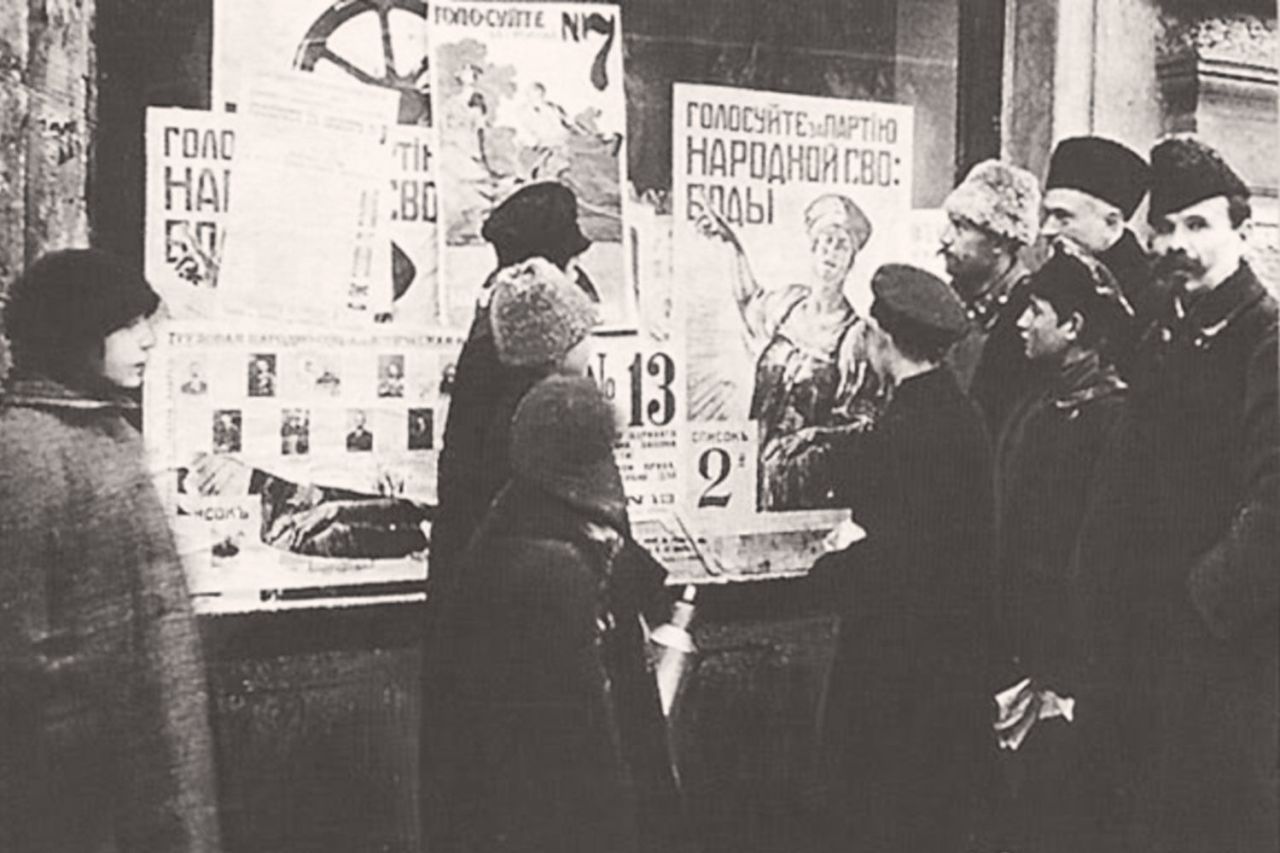
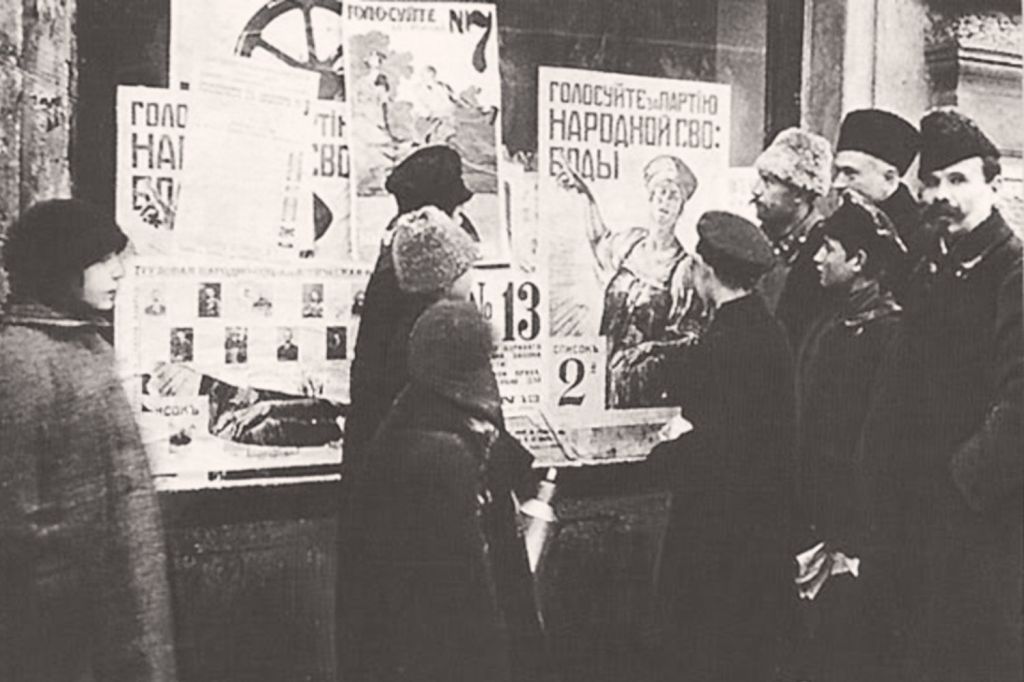
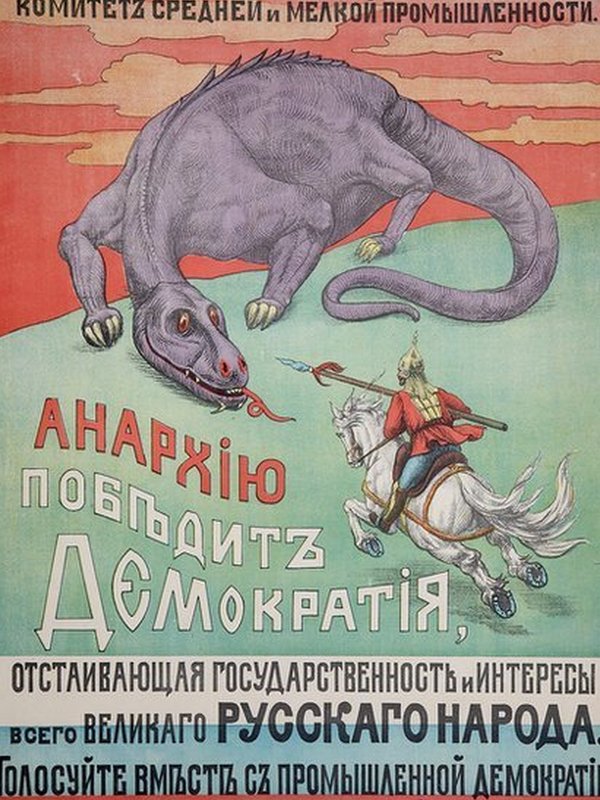
Posters for the Constituent Assembly elections

Element of Divergence

First we should explore plausible scenarios where this could take place. We should answer the question of why and how it might come about that the Soviets, having seized state power, would be willing to hand it over to the CA.

The Soviets were workers’ councils, a system of direct participatory democracy. The Bolsheviks Party had won a decisive majority in these councils in September 1917. They believed that the Soviet was a higher form of democracy than the CA. They hated the Right Social Revolutionary party (RSR), which over 1917 had made compromises to the right and enacted repression against the left. They believed that the split between the RSRs and the Left SRs rendered the election results meaningless.

In other words, the Bolsheviks (along with their allies the Left SRs) had strong reasons to suppress the CA.

In spite of these strong reasons, it is not that difficult to imagine the Soviets giving up power to the CA. In Germany and in Austria in this period, and in Spain in the 1930s, we see many examples of communists, socialists and anarchists giving up power to a bourgeois-democratic government in exactly this way. In fact, they were far more flagrant. The German Social Democrats assembled militias of far-right veterans to suppress the German Revolution. The Communists in Spain became the enthusiastic apologists of a liberal-republican government and preached that Spain was not ready for revolution. In short, the Bolsheviks are the outlier among social-democratic and even nominally communist parties in the Twentieth Century in that they were really willing to seize and hold power.

In our ATL (Alternative Timeline), the leadership of the Soviet is more in line with the mainstream of international social democracy – ie, more timid and cautious.

I do not propose a single ‘Point of Divergence’ – for example, Lenin is murdered by agents of the Provisional Government; Trotsky stays in a British concentration camp in Canada. Rather I propose an Element of Divergence, a factor which develops differently over a whole period of years and even decades. In this ATL, the Bolshevik Party as we know it simply do not develop. The more radical and militant trends within the Russian Social-Democratic and Labour Party (RSDLP) do not cohere into the Bolshevik party from 1903 to 1912; rather they remain loose and scattered and undefined. We will, for convenience, refer to them as the militant socialists.

Fighting during the German Revolution, during which the equivalent of the Soviets did hand over power to the equivalent of the Constituent Assembly.

The Alternate Timeline

Pushed by a mass upsurge of workers, soldiers, sailors and peasants, the militant socialists end up in control of the Soviet by October 1917. They proceed to seize power in some incident corresponding to the October Revolution. But by January they are afraid of their own power and uncertain what to do with it. Their own base – workers and poor peasants – feel the hesitancy from above and demoralisation begins to set in. Meanwhile the militant socialist leaders feel pressure from the Russian ‘intelligentsia’ (professional middle classes) which supports the RSRs and the CA.

Instead of shutting down the CA after a single day, they remain in it, trying to negotiate a strong position for the Soviets within a new CA-dominated political regime. In other words, they turn back the clock and accept Provisional Government Mark 2. The discredited Provisional Government, attacked from right and left then finally overthrown in the October Revolution, has returned in a new guise with many of the same personnel.

Thus begins the Chernovschina – the regime of Viktor Chernov, a firebrand within the RSRs who in OTL served for that one day as President of the Constituent Assembly.

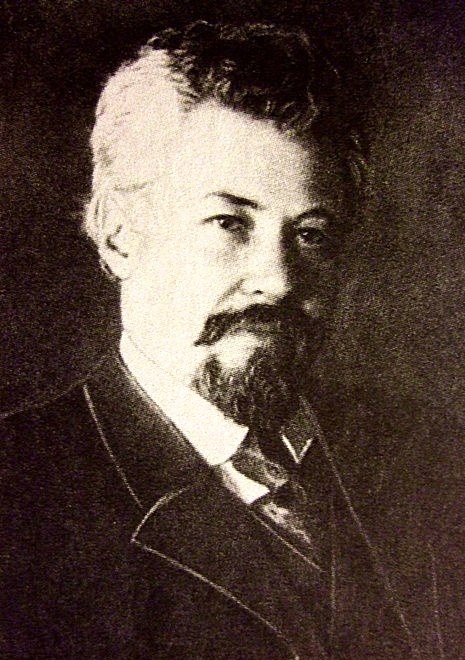
Viktor Mikhailovich Chernov, president of Russia for one day in 1918. During 1917, though a Right SR, he had been critical of the doomed policy of coalition with the right-wing parties

Chernovschina

In OTL, the RSRs set up a government at Samara during the Civil War in the name of the Constituent Assembly. This government was called Komuch. It gives us valuable insights into the main features of the all-Russian Chernovschina which develops in this ATL.

The Chernovschina, like Komuch, would have a narrow base of support: a layer of the intelligentsia, and not much beyond that. Its decisive majority vote in the CA elections may seem to indicate that it had a mandate. But for Komuch, this mandate translated into precisely nothing. It was unable to raise an army. It suppressed the Soviets on its own territory and gave back the industries to their capitalist owners; still the wealthy refused to support it.

Komuch governed a population of 12 million people on the Volga. Chernov would govern all of Russia, including the central industrial region where the factory workers in their millions are enthusiastic supporters of the Soviet. In these central provinces and great cities, the Bolsheviks actually won a majority in the CA elections. Unlike Komuch, the Chernovschina would be able to present itself as having the support of the Soviet; this and this alone, the support (really the submission) of the Soviet, explains why it is in power.

It has a tense relationship with the Soviet, with the working class, with the poor peasants. But the militant socialists are forced to act as the enforcers of the Chernovschina. They try to whip their supporters into line, because to do otherwise would be to admit their own bankruptcy.

As in OTL, famine begins, striking the cities hardest. Chernov refuses to consider the kind of expropriations which the Bolsheviks practised in OTL; thus he retains the passive support of the peasant majority, but loses the active support of the cities.

Thus the working class, its hopes raised high by the October Revolution, feels a horrendous demoralisation set in as 1918 advances. Many still hold out hope that the Chernovschina will deliver for them, or that the Soviet might yet overthrow the CA. On that basis, Chernov is still able to mobilise some support.

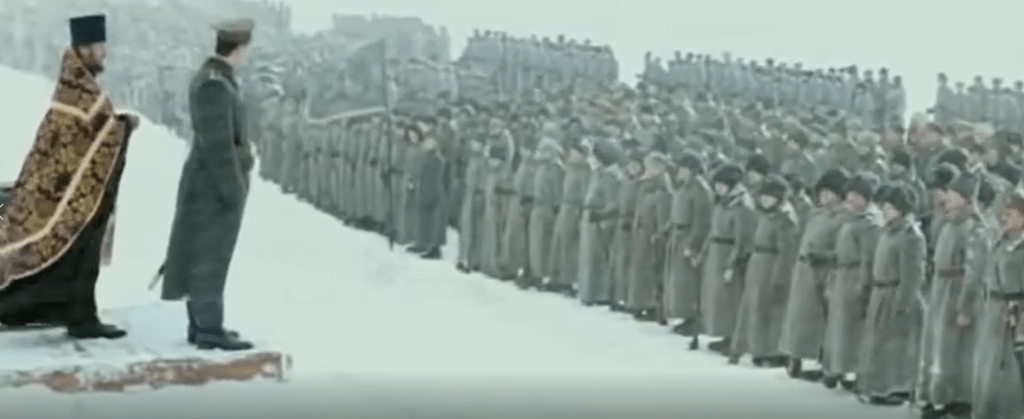
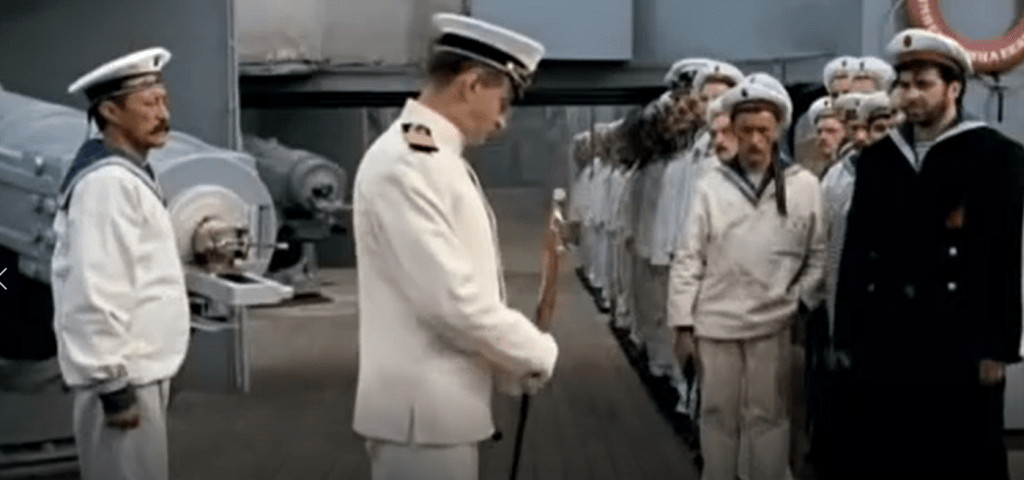
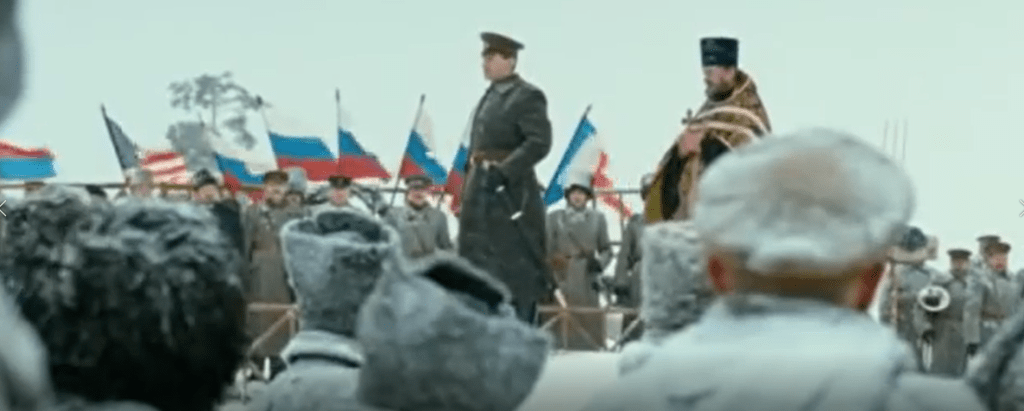
Still from the movie Admiral, dir Andrey Kravchuk, 2008. In ATL as in OTL, the White Guards, with the blessing of the church, rallies the troops for counter-revolution.

Civil War

And support he needs. The Russian armed forces, though in an advanced state of collapse, are fighting a desperate war against Germany. Meanwhile in ATL as in OTL, military officers, nobles, the bourgeoisie and the church organise counter-revolutionary armies. They see the RSRs as little better than the militant socialists; in any case, the militant-socialist bogeyman is an integral part of the Chernov coalition. Alongside the new Russian army which Chernov is trying to build, the Red Guards are the main armed force on which the CA can rely.

And Chernov himself, as in OTL, supports the seizure of noble land by peasants. The emergent White Guards have no reason to be less hostile to the RSRs than they were to the Bolsheviks in OTL.

It is frankly impossible to see how the Chernovschina can win the war against Germany, or even to hold out until Germany’s defeat in the West. But as in OTL, they are determined to continue the war. We must envisage an inexorable German advance to the gates of Moscow itself, even the fall of Petrograd, before the RSRs are forced to sign a peace treaty even more humiliating than the Treaty of Brest-Litovsk.

The Allies, meanwhile, look askance at the Chernovschina for the same reasons the Whites do: the communist bogeyman. Initially they support Chernov against Germany, but then turn against it when the peace treaty is signed.

So we end up as in OTL: White armies, backed by the Allies, fighting against the ‘Red’ (perhaps the ‘Pink’) regime of Chernov. The Allies might be less enthusiastic about intervention because the Chernov regime is more amenable to them – paying the debts and not seizing the factories. It is possible the Allies, or at least some of the Allied countries, would remain neutral. But on the other hand the Allies would not be held back by their own people. In OTL, there was deep support for the October Revolution among working-class people in the western countries, resulting in the ‘Hands off Russia’ movement and the Black Sea mutiny. These factors tied the hands of Allied intervention. It is doubtful the western working class would be as sympathetic to the Chernov government, so the Allies’ hands would not be tied in the same way. 

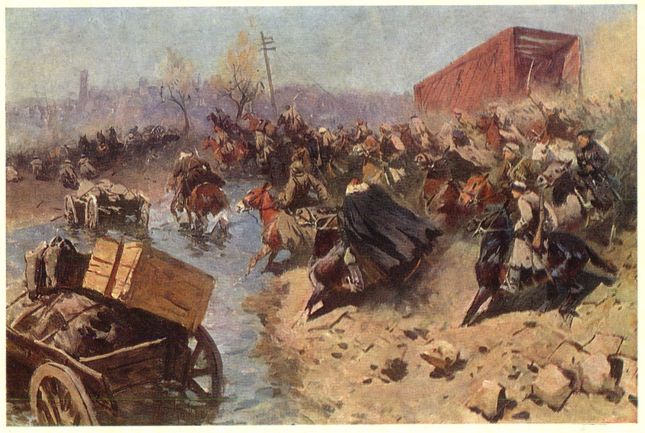
Painting on the Civil War by Mitrophan Grekov

The Fall of the Constituent Assembly

Increasing discontent in the ranks of militant socialists at some point breaks out into a mass uprising against Chernov in Moscow. Meanwhile Chernov and co have grown impatient with the Soviet; they see it as the main obstacle to Allied support. So the Chernovschina engage in the bloody suppression of the uprising of the Moscow proletariat. This results in the final liquidation of the Red Guards and the Soviets, and the final demoralisation of the working class. The Revolution is over.

The Chernovschina tries to fight on, but its people are utterly demoralised and it is beleaguered on all to sides. It succumbs to the onslaught of the White Armies. The death-blows are probably dealt in the campaigning seasons of Spring and Summer 1919.

So this ATL leads us to a White victory in the Russian Civil War. That is a ‘What If’ for another day and another post. But suffice it to say that a White military victory would only be the beginning of the violence. The White movement, in order to fulfil its aims, would terrorise the urban population into submission and seize the land back from the peasants. The scene would be set for decades of conflict as the White generals invade the newly-independent republics one after another, trying to restore their vision of ‘Russia one and indivisible.’

Conclusion

This alternate history is based on two main real-life analogues: Komuch (which I have written about here, here and here) and the Republican side during the Spanish Civil War.

For some, it is tempting to imagine that the CA might have led Russia to stable parliamentary democracy, averted civil war, etc. But an electoral majority does not invest a political party with magical powers. In terms of sheer numbers, the RSRs won an overwhelming vote. But the vote was confused and passive in character. They had a very narrow base of confident, active supporters. The CA could only have survived if the Soviets had made the terrible mistake of propping it up at their own expense – at their own very great expense.

Appendix: “…who was later killed by Stalin…”

This is an Appendix post to Revolution Under Siege, my series on the Russian Civil War.

This post started life as a (terrible) idea for a drinking game. Read or listen to my blog and drink any time you come across

a)      A White leader whose name starts with K

b)     A Red leader who was later killed by Stalin

When you’re reading any account of the Civil War, the phrase “…who was later killed by Stalin…” is a repeating motif. On rare occasions, like the case of Semyonov, this refers to a White leader. But nearly all the time it refers to a Red.

Hence the title.

But instead of inventing the least funny drinking game ever, I went back through all the posts from Series 1 (covering 1918) and made a list of every named individual who supported the Red side. Some are people I spent a whole chapter talking about, others accidental mentions in the captions of photos, others still the authors of sources.

For each one I asked, ‘What happened to them? How did they die?’

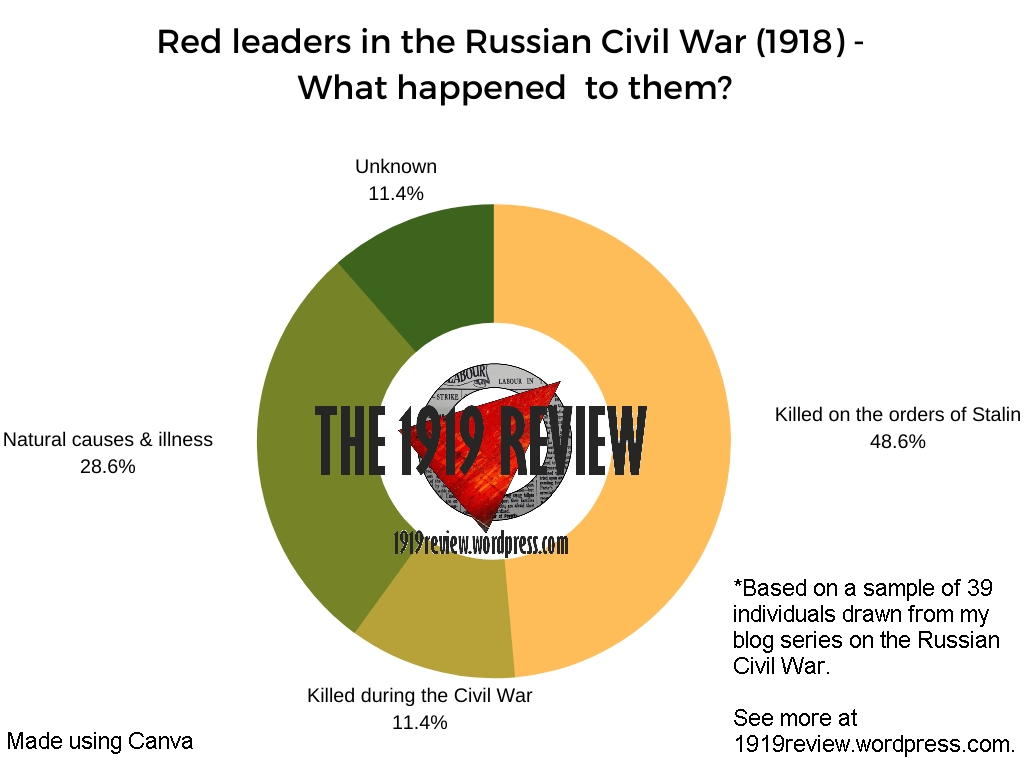
This graph was the result.

The graph is based on 39 people. It counts all Red supporters mentioned during Season 1 – so, Reds who were prominent during the year 1918, plus a scattering of accidental figures. There will be omissions, but it is broadly representative. I have in no sense deliberately weighted this sample so as to make Stalinism look bad. I could have weighted it far further in that direction without stretching credibility. For example, I have included Adolf Joffe under ‘Natural Causes or Illness’ even though his suicide was triggered by the persecution of the Left Opposition by the Stalin group.

So that you can see for yourself, here is the full list.

Natural Causes or Illness

1.      Alexander Serafimovich (Author, The Iron Flood) – Natural causes, 1949

2.      Kliment Voroshilov (Red commander in Southern Army Group in 1918) – Natural Causes, 1969

3.      Klavdia Nikoaevna (Editor of Kommunistka) – Killed in a German bombing raid, 1944

4.      Vasily Chuikov (Red Guard, later commander at Stalingrad in 1942-43) – Natural causes, 1982

5.      Vladimir Lenin (Leading figure in Bolshevik Party) – Illness, 1924

6.      Nikolai Andreyev (Assassin of Count Mirbach) – Illness (Typhus), 1919

7.      Felix Dzerzhinsky (Founder and leader of the Cheka) – Illness (Heart attack), 1926

8.      Yakov Sverdlov (Leading figure in Bolshevik Party) – Illness (Spanish Flu?), 1919

9.      Larissa Reissner (Red Army soldier and writer) – Illness (Typhus), 1926

10.   Josef Stalin (Leading figure in Bolshevik Party) – Illness, 1953

11.   Adolf Joffe, (Leading figure in Bolshevik Party) – Suicide, 1927

Killed in Civil War

12.   Mikhail Muraviev (Former Tsarist officer and Left SR) – killed by Reds, 1918

13.   Dmitry Popov (Chekist, Left SR, Anarchist) – killed by Reds, 1921

14.   Commissar Panteleev (Involved in mutiny at Sviyazhsk) – killed by Reds, 1918

15.   Fyodor Podtelkov (Leader of Red Cossacks, SR) – killed by White Cossacks, 1918

16.   V. Volodarsky (Bolshevik) – killed by SR assassin, 1918

17.   Moisei Uritsky (Bolshevik) – killed by SR assassin, 1918

18.   Nikolai  Markin (Bolshevik sailor) – killed in battle, 1918

Unknown

(‘Unknown’ means ‘I was unable to find out.’ I’d appreciate further info anyone has).

19.   Vakhrameyev

20.   Makhrovskii (Communist imprisoned at Tsaritsin)

21.   Slavin (Unable to identify with certainty the identity of this individual)

22.   Mitorfan Grekov (Civil War painter) – died in 1934

Killed on the orders of Stalin

23.   Maria Spiridonova (SR leader) – executed, 1941

24.   Alexander Shlyapnikov (Bolshevik leader) – executed, 1937

25.   Lev Trotsky (Bolshevik leader) – assassinated, 1940

26.   Feodor Raskolnikov (Bolshevik sailor) – probably assassinated, 1938

27.   Lev Kamenev (Bolshevik leader) – executed, 1937

28.   Vasily Blyukher (Red officer) – executed, 1938

29.   Yakov Blumkin (assassin of Count Mirbach, Chekist) – executed, 1929

30.   Jukums Vacietis (commander of Latvian Rifles) – executed, 1938

31.   Bela Kun (leader of Hungarian Communists) – executed, 1938

32.   Yuri Sablin (left SR and Red officer) – executed, 1937

33.   IM Vareikis (Bolshevik, assassin of Muraviev) – executed, 1938

34.   Andrei Snesarev (Former Tsarist officer) – died in prison, 1934

35.   Pavel Sytin (Former Tsarist Officer) – executed, 1938

36.   Nikolai Bukharin (Bolshevik leader) – executed, 1938

37.   Martin Latsis (Either a Left SR or a Bolshevik; accounts vary) – executed, 1938

38.   Mikhail Tukhachevsky (Red Army commander) – executed, 1937

39.   Konstantin Akashev (Red aviator, anarchist) – executed, 1931

And Quiet Flows the Don by Mikhail Sholokhov (Premium)

English translation (1934) by Stephen Garry. Penguin Classics, 2016

The other day, after several textual misadventures which I will mention in a footnote below, I finished Mikhail Sholokhov’s masterpiece And Quiet Flows the Don. This review will tie in with my series on the Russian Civil War, Revolution Under Siege, as the novel throws some sidelights on the things I wrote about there.

You can read this post – and many others on this website – for just €5.

Get access to this post – and the entire archive of The 1919 Review – for €5 per year.

My Sources

All my sources in one place.

An asterisk (*) signifies a source which I have used but not read cover-to-cover.

Books

  1. Ali, Tariq. The Dilemmas of Lenin, Verso, 2017
  2. Bryant, Louise, Six Red Months in Revolutionary Russiahttps://www.marxists.org/archive/bryant/works/russia/ch09.htm
  3. Carleton, Gregory. Russia: The Story of War, Belknap, 2017
  4. *Carr, EH. The Bolshevik Revolution Volume 1. Pelican, 1950 (1969)
  5. Davies, Norman. White Eagle, Red Star: The Polish-Soviet War 1919-1920, Orbis, 1983
  6. *Denikin, Anton. The Russian Turmoil; Memoirs: Military, Social and Political, 1920
  7. Deutscher, Isaac, The Prophet Outcast, Oxford University Press, 1963
  8. Faulkner, Neil. A People’s History of the Russian Revolution, Pluto, 2017
  9. Khvostov, Mikhail. The Russian Civil War (1) The Red Army. Osprey Publishing, 1997 (2008) Illustrations by Karachtchouk, Andrei
  10. Khvostov, Mikhail. The Russian Civil War (2) White Armies. Osprey Publishing, 1997 (2008) Illustrations by Karachtchouk, Andrei
  11. *Konev, AM. The Red Guard in the Defence of October, extracts available on the website Leninism.ru
  12. LeBlanc, Paul. Lenin and the Revolutionary Party, Haymarket Books, 1993
  13. Mawdsley, Evan. The Russian Civil War, 1982 (Birlinn, 2017)
  14. Raskolnikov, FF. Tales of Sub-Lieutenant Ilyin, 1934 (New Park, 1982), https://www.marxists.org/history/ussr/government/red-army/1918/raskolnikov/ilyin/index.htm
  15. *Ransome, Arthur. The Truth About Russia. 1918. https://www.marxists.org/history/archive/ransome/1918/truth-russia.htm
  16. *Rayfield, Donald, Stalin and his Hangmen, Viking, 2004
  17. Read, Anthony. The World on Fire: 1919 and the Battle with Bolshevism. Pimlico, 2009
  18. Serafimovich, Aleksander. The Iron Flood, 3rd Edition. Hyperion Press, Westport, Connecticut. 1973 (1924). Illustrations by A. Kokorin.
  19. Serge, Victor. Year One of the Russian Revolution, 1930 (Haymarket, 2015)
  20. *Serge, Victor. Memoirs of a Revolutionary. https://www.marxists.org/archive/serge/1945/memoirs/ch01a.htm
  21. Service, Robert, Trotsky: A Biography, Belknap Press, 2009
  22. Smele, Jonathan. The ‘Russian’ Civil Wars 1916-1926, Hurst & Company, London, 2015
  23. Smith, S.A. Russia in Revolution: An Empire in Crisis 1890 to 1928, Oxford University Press, 2017
  24. Smith, S.A. The Russian Revolution and the Factories of Petrograd, February 1917 to June 1918. Unpublished dissertation, 1980. University of Birmingham Research Archive, e-theses depository.
  25. *Taylor, A.J.P. The First World War: An Illustrated History. Penguin, 1963. (1982)
  26. *Trapeznik, Alexander. The Revolutionary Career of Viktor Mikhailovich Chernov (1873-1952). Masters’ thesis, University of Tasmania, 1988
  27. *Trotsky, L.D. How the Revolution Armed. 1923. https://www.marxists.org/archive/trotsky/military-pdf/Military-Writings-Trotsky-v1.pdf
  28. Trotsky, L.D. My Life: An Attempt at an Autobiography, 1930 https://www.marxists.org/archive/trotsky/1930/mylife/index.htm
  29. Ulam, Adam B, Lenin and the Bolsheviks, 1965
  30. Valtin, Jan. Out of the Night, 1941 (1988), Fortress Books.
  31. Westerlund,Per-Åke. The Real Lenin, A Socialist Party Publication (Australia), 2018
  32. Wollenberg, Erich. The Red Army. 1937. https://www.marxists.org/history/ussr/government/red-army/1937/wollenberg-red-army/index.htm
  33. *The USSR: A Short History, Novosti Press Agency Publishing House, 1975

Articles

  1. Argenbright, Robert, ‘Red Tsaritsyn: Precursor of Stalinist Terror,’ Revolutionary Russia, Vol. 4, No. 2, December 1″991,, pp.757-783
  2. Bechhofer, CE. ‘What happened in Omsk? Admiral Kolchak’s Credentials.’ Current History, Vol 10, no. 3, pt 1, June 1919, 484-485. Accessed on Jstor.org https://www.jstor.org/stable/45324453?seq=1#metadata_info_tab_contents
  3. Hafner, Lutz, ‘The Assassination of Count Mirbach and the “July Uprising” of the Left Socialist Revolutionaries in Moscow, 1918,’ The Russian Review , Jul., 1991, Vol. 50, No. 3 (Jul., 1991), pp. 324-344
  4. Hellebust, Rolf. “Aleksei Gastev and the Metallization of the Revolutionary Body.” Slavic Review, vol. 56, no. 3, 1997, pp. 500–518. JSTORhttp://www.jstor.org/stable/2500927. Accessed 18 June 2021.
  5. Kollontai, Alexandra. ‘Women fighters in the days of the Great October Revolution,’ 1927. https://www.marxists.org/archive/kollonta/1927/fighters.htm
  6. Pereira, NGO. ‘The Idea of Siberian Regionalism in late Imperial and Revolutionary Russia.’ Russian History, vol. 20, no. 1/4, Brill, 1993, pp. 163–78, http://www.jstor.org/stable/24657293.
  7. Reissner, Larissa. ‘Svyazhsk.’ Republished in Fourth International, June 193. https://www.marxists.org/history/etol/newspape/fi/vol04/no06/reissner.htm
  8. Serge, Victor: ‘Once More: Kronstadt’, April 1938. https://www.marxists.org/archive/serge/1938/04/kronstadt.htm.
  9. Trudell, Megan. ‘The Russian Civil War: A Marxist Analysis.’ International Socialism, Spring 2000. https://www.marxists.org/history/etol/newspape/isj2/2000/isj2-086/trudell.htm#f39
  10. Smirnov, M. I. “Admiral Kolchak.” The Slavonic and East European Review, vol. 11, no. 32, Modern Humanities Research Association, 1933, pp. 373–87, http://www.jstor.org/stable/4202781.
  11. Topwar.ru, no individual writer credited, ‘The personal file of General Snesarev,’ Dec 12 2012. https://en.topwar.ru/21778-lichnoe-delo-generala-snesareva.html

Film

  1. Axelbank, Herman (dir.), Tsar To Lenin, 1937

< Back to Contents

10: Red Flag over Europe (Premium)

Become a paying supporter to get access

Access to this article is limited to paying supporters. If you already subscribe by email, thank you. But if you want to become a paying supporter, please hit ‘Subscribe’ below.

Donate less than the price of a coffee, and you can access everything on this blog for one year.

If you don’t feel like donating, most of my posts are still 100% free, so browse away, and thanks for visiting.

Home Page/ Archives

09: Behind White Lines

Listen to this post on Youtube or as a podcast

In Stephen King’s novel The Stand two new societies emerge in a post-apocalyptic USA, based on opposite sides of the Rocky Mountains. A democratic society takes shape in Boulder, Colorado. Meanwhile in Las Vegas power is seized by a supernatural madman who punishes drug users with crucifixion. Only one of these two regimes can survive.

That great, flawed horror epic comes to mind because this post is about two distinct White regimes which emerged on either side of the Ural Mountains in Russia in 1918, and how one consumed the other. As we saw in Part 5, the Czech Revolt led to dozens of White-Guard governments popping up. The Right Socialist Revolutionary (SR) party set up a regime called Komuch (the Committee of Members of the Constituent Assembly) based in the Volga town of Samara. They wanted a republican, democratic counter-revolution, with a mandate from the Constituent Assembly and all the ‘t’s crossed and the ‘i’s dotted. Meanwhile across the mountains a faction of officers and Cossacks set up the Provisional Siberian Government at Omsk, a military dictatorship with a thin Siberian Regionalist veneer.

The most important difference was that Samara was anti-landlord and Omsk was pro-landlord. They were at loggerheads on the land question.

These two regimes did not use direct violence against one another – until the very end, when the outcome was no longer in any doubt. They were supposed to be on the same side against the Reds. But relations were tense; Omsk boycotted Samara’s manufactured goods, and Samara boycotted the grain of Siberia.[i] In August the Omsk regime shut down the Siberian Regional Duma – an elected body dominated by Right SRs, of which the Omsk regime itself was an ungrateful child. Komuch was never secure even within its own territory: ‘Russian officers as well as business and middle-class circles much preferred the state-conscious anti-Communism of Omsk.’[ii] And that territory was shrinking. In a strange twist of fate, the military men of Omsk resided safely a thousand miles in the rear while the Right SRs – civilian politicians – led the regime that was actually fighting the Reds on the Volga. From early September that fight was going very badly. As we saw in Part 8, Kazan and Simbirsk had fallen, and this had thrown Komuch into crisis.

Omsk

While Komuch had grown weaker, the Provisional Siberian Government had grown stronger. The Omsk government did not rest on popular support. Its political wing consisted of junior government officials, conservative refugees from central Russia and the Siberian Regionalists. Its military wing consisted of officers and Cossacks, assisted by a battalion of British soldiers from the Middlesex Regiment. This military wing had built itself up to a force of 38,000 by September, poaching officers from Komuch instead of helping them in any serious way.

The ‘Novoselov Affair’ of September 1918 manifested something that had been obvious for some time. The Siberian Regionalists wanted to increase their presence in cabinet, and a politician named Novoselov was their chosen candidate. But he was abducted by Cossacks and murdered. It was a clear signal, Smele suggests, that anyone who tried to challenge the officers and Cossacks would be found dead some fine morning by the banks of the Irtysh River.

Members of the Provisional Siberian Government

The western Allies looked on with impatience, and demanded Komuch and Omsk get their act together and present a united front. The result was the state conference at Ufa on September 23rd 1918. Ufa is a mountain town half-way between republican Samara and military Omsk. It was as if Stephen King’s two post-apocalyptic tribes held a conference somewhere in Utah. At the Ufa (not Utah) conference a wide array of different counter-revolutionary governments came together. Intellectuals, ‘moderate socialists’ and former terrorists sat down to discuss cooperation with Black-Hundred generals, foreign agents and Cossacks.

Chernov

The centre of gravity within the SRs had swung from the Right to the Centre. This Centre was embodied in Viktor Chernov, the leading figure in the party, a stout man with a powerful presence who had served as Minister for Agriculture under Kerensky in 1917. During the few hours’ life span of the Constituent Assembly, the deputies had elected him president of Russia. Unlike most Right SRs, he had actually criticised the policy of coalition with the right during the year 1917, though like the others he had dragged his feet on land reform. In the view of his supporters, the October Revolution had vindicated his criticisms; in the view of the officers, he was largely responsible for ‘the weak and indecisive policy that led to the downfall of Mr Kerensky’s government.’[iii]

Now, along with others, he had arrived in Komuch territory arguing for the Right SRs to take a hard line at the Ufa conference. He was up against the resistance not only of officers and Cossacks but of many in his own party. The historian Radkey writes that many Right SRs had become ‘fervent patriots, partisans of the Entente, and devotees of the cult of the state.’ By 1917 ‘a large segment of the Populist intelligentsia had become [Constitutional Democrats] without admitting it.’[iv] We have already seen how the Left SRs split from the party in disgust at these developments. But the divisions ran deeper still. Even Chernov’s centre was divided into a right centre and a left centre. Chernov himself was prevented from going to Ufa by his own comrades, in case his presence upset the Omsk faction.

Viktor Chernov

The Ufa conference opened with a religious service, then talks began. The numbers of delegates heavily favoured the left, but the various factions all had veto power, tipping the balance back to the right. On the other hand, the need to keep the Czechs happy and to impress the Allies put a certain weight on the scale for the left. Countering this in turn was the real balance of forces between Samara and Omsk, which worsened for Samara every day as the Reds advanced.

One sore point was the Constituent Assembly. The Right SRs insisted that it was the only legitimate state power in Russia, sanctioned by the elections of December 1917. Omsk refused to recognise this body, ‘elected in the days of madness and made up chiefly of the anarchist element.’[v] It appears the Omsk officers believed no election could be considered valid until half the Russian working class was dead or behind barbed wire, and until a knout-wielding Cossack could be placed next to every polling station to glower at the voters. An election held in conditions where the workers were organised and confident could not be considered legitimate in their eyes.

It could be argued that Samara won this round. The Omsk government accepted the legitimacy of the Constituent Assembly in principle. But they would not allow it to assume power until January 1919 at the earliest, and even then it must assemble a quorum of 250 elected deputies. To assemble such a quorum, in the chaos of Russia in 1918, was impossible; it had taken Chernov months to make his way to Samara. So it was a hollow victory for Komuch; the generals’ ‘recognition’ was meaningless.

The Ufa Directorate

The outcome of the conference was a merger of Samara, Omsk and other statelets into a government called the Ufa Directorate. Its programme: abolish the Soviets; return lost territories to Russia; resume the war against Germany; and set up a democratic regime.[vi] The Right SRs also changed their land policy to favour the White landlords with whom they were making a deal.[vii]

On paper, the five-member Directorate had a Socialist majority – a concession to the Czechoslovak Legion, who were increasingly war-weary and cynical of the rightward trajectory in the White camp. 

But this was only on paper. Just two of the five members of the Directory were SRs, and they were the two most conservative and least authoritative SRs who could be found. The other member of the Directorate with ‘Socialist’ credentials was Tchaikovsky, who was safely in the Arctic Circle at the time, performing socialist fig-leaf duty for another White government.

The Right SR Central Committee had previously voted 6:2 in favour of Chernov’s position that the SRs should fight against ‘the left-wing Red dictatorship [and] an equally despotic Right-wing White dictatorship’ that would probably emerge. ‘In order to fulfil its historic role,’ the party ‘must emerge as a Third Force and fight a determined war for democracy on two fronts.’[viii]

But the same Central Committee flew in the face of this resolution when it voted 4:3 in favour of the Ufa agreement.

Toward the climax of The Stand, that compelling and problematic 1978 horror novel, the democrats from Boulder go to confront the dictator at Las Vegas. They are armed only with their own courage and moral rectitude, along with a mandate from a supernatural higher power.

You can read the book yourself to find out how this plan works out for them. But you only need to read on another few paragraphs to find out how the same method worked out for the SRs when they entered the Ufa Directorate.

If the comparison seems far-fetched, consider these words by the Right SR Avksentiev: ‘We must put our head in the lion’s mouth. Either it will eat us, or it will choke on us.’[ix]

Life in the lion’s mouth was not comfortable. The officers resented what little influence the Right SRs had in the Directorate . In their view, Chernov was whispering in their ears urging them to set up democratic soldiers’ committees inside the White Army. In fact Chernov was not supported by a majority on his Central Committee, let alone by Avksentiev. But he was the bogeyman conjured up by the ‘Siberians’ to add colour to the implausible assertion that the Directorate was dominated by elements who were only two steps away from Bolshevism. ‘The name ‘socialist’ was for them synonymous with ‘traitor.’’[xiii]

‘I drink to dead Samara!’

Meanwhile the Reds were advancing across Komuch’s territory.

The 6,000 workers of Ivashchenko near Samara rose up against the Whites. But this rising was premature; Komuch still had enough strength to put down the rising, killing 1,500.[x] The officers of the People’s Army went from village to village conscripting the peasants. They used the old tried-and-tested Tsarist recruitment methods: public floggings and violent reprisals for deserters and their families.

But they were not so bold in early October, when the Red Armies closed in on Samara. The White volunteers were too few to defend the town. The Czechs retired without a fight. The peasant conscripts deserted to the Reds. The Cossack Dutov withheld any aid. Nobody would defend Samara, but it gets worse; no-one could be found to organise its evacuation. It was a rout, everyone for himself (Chernov included) crowding onto trains to get away.

An SR leader named Volsky was reportedly found drunk and despairing, smashing glasses and ranting: ‘I drink to dead Samara! Can’t you smell the corpse?’

Czech officers taunted Constituent Assembly deputies: ‘Where’s your Army?’ ‘Government? You the government?’

As Samara fell to the Reds, Komuch lashed out at its Red prisoners, killing 306 of them.

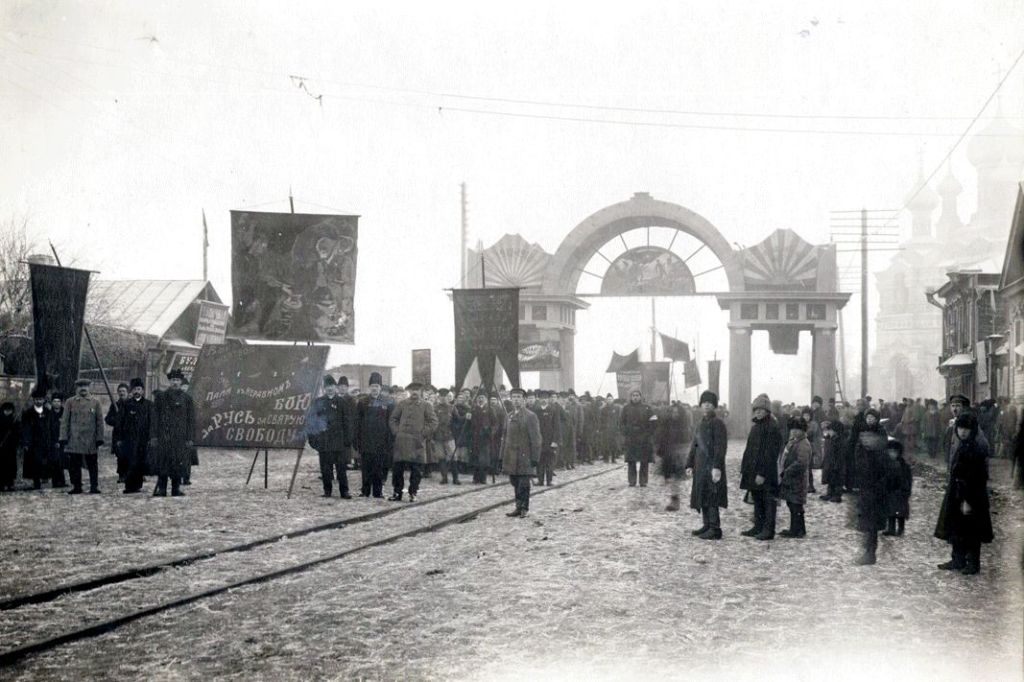
This picture appears to show a Red triumphal procession on Sadovaya Street, Samara, in late 1918 or early 1919.

In spite of its name the Ufa Directorate spent most of its existence governing from railway cars, and officially moved to Omsk in early October. The Novoselov Affair had demonstrated that no civilian politician should push their luck in Omsk, where drunken officers still sang ‘God Save the Tsar.’ The Council of Ministers which served under the Directory was dominated by people more associated with Omsk than Samara. In that city the SR politicians felt the same sense of insecurity and isolation that they had felt in Petrograd in 1917, and in the words of Serge, ‘The very same illusions fortify their spirits. The vocation of parliamentary martyr rises in their breasts.’[xi] Think of Avksentiev with his head in the lion’s mouth. I don’t know what they were thinking; that if they did everything by the book, hosts of constitutional angels would come to their aid… Or that they would get their reward in parliamentary heaven.

Why all the hostility between Samara and Omsk? One way of looking at it is that the generals were too stubborn to recognise that the Right SRs could be a useful political fig-leaf for their cause. They could have kept many Right SR leaders on side by making a few superficial concessions. Their association with the Right SRs was used at the time and is still used today to claim democratic credentials they did nothing to deserve. But the other way of looking at it is that the generals were sophisticated enough to realise that the Right SRs were of little use even as fig-leaves. The Right SRs had only a very narrow base in 1918; their most reliable supporters were the Czechoslovak Legion. Their electoral mandate, such a powerful instrument in constitutional politics, might have been expected to translate into something impressive in the language of civil war. But it simply did not translate.

The Bolsheviks were wise not to recognise the authority of the Constituent Assembly – because practically no-one else did.

Two devastating scenes remained to be played out in the tragedy of the Right SRs. Their protagonist was Admiral Alexander Kolchak.  

The Council of the Supreme Ruler

Alexander Kolchak arrived in Omsk in mid-October and was given the Ministry of War and the Marine.

Kolchak was a naval officer from a well-off military family. He explored the Arctic Circle in 1903, travelling by dog-sleigh and spending 42 nights on the open sea. After the disaster of the Russo-Japanese war he approached the Duma (the rigged Tsarist parliament) with plans for naval reform. During World War One he served as an admiral first on the Baltic and then on the Black Sea. During the Revolution, he defied a sailors’ committee by throwing his sword into the sea and declaring the men unworthy of him. ‘Many organisations and newspapers with a nationalist tendency spoke of him as a future dictator.’[xiv]

Still from the movie Admiral (2008) dir. Andrei Kravchuk. Kolchak, centre, confronted by the sailors’ committee, draws his ceremonial sword prior to throwing it overboard.

 He spent a long time abroad on various wartime plans and projects with the US and other Allies which came to nought. He became an agent of the British state, and was called by London ‘the best Russian for our purposes in the Far East.’[xv] He returned to Russia with the Japanese invasion forces and tried to organise armed detachments in Manchuria and the Far East. Thence he came to Omsk.

A conspiracy coalesced around him, with or just-about-possibly without his knowledge. According to one of his comrades, he ‘had no part in the plot, but was in favour of a military dictatorship.’[xvi]

General Knox and other British officers in Siberia. Kolchak was their guy, and they supported his coup.

He had just returned from a tour of the front when it all kicked off. On the night of November 17th, a Cossack detachment arrested many Right SRs, including the two members of the Directorate. The Council of Ministers assumed power. There was a battalion of the British Middlesex Regiment stationed in Omsk at the time, and their leader General Knox knew about the coup before the event and did nothing because he hated the Directorate and was a ‘great champion’ of Kolchak.[xvii] The Omsk garrison commander was on board too. It was a clean sweep.

The Czechs were appalled; but the French and the British dissuaded them from taking any action, the French verbally and the British by physically defending the conspirators. So the coup was bloodless. A new power took over, calling itself the Council of the Supreme Ruler.

The ministers offered the vacant position of Supreme Ruler to Kolchak. He accepted the position, it appears, with a heavy heart, refusing it on the first offer.

Today’s cover image, another still from Kravchuk’s Admiral. Kolchak in the centre, flanked by the church, plenty of Russian flags, the military, and the flags of Britain and France. This is a very pro-White Guard film. For example it begins with the Admiral sinking a German ship using the power of prayer.

Apologists for the coup preferred not to use the word. It was simply ‘the change;’ one regime ‘gave place’ to another; ‘the directorate ceased to function, and its place was taken by Admiral Kolchak and his ministry,’ who ‘[took] the authority… into their own hands.’ It had been necessary, because the Right SRs had prepared the ground for the Bolsheviks in October 1917, and ‘The same fate now threatened the Directorate.’[xviii]

The Komuch deputies were holding a congress in the mountain town of Yekaterinburg when news arrived of the coup – news, soon followed by armed bands of Siberian Whites who surrounded the venue and arrested them all. The Czechoslovak general Gajda saved them from being murdered by taking them into his custody. There was one last attempt to raise the banner of Komuch with yet another congress, this time in Ufa on December 2nd. It was shut down by Kolchak’s men.

Alone and on the run, Chernov decided to propose a deal to the Reds. They would have the support of the Right SRs if they would only recognise the Constituent Assembly. Still he clung to it. And why wouldn’t he? With it, he was president of Russia. Without it, he was an isolated politician alone on the run.

The Right SRs were legalised – not due to Chernov’s efforts, and needless to say the Constituent Assembly was not recognised. Chernov went to Moscow where he lived in hiding for a year or so before leaving Russia forever.

Back in Siberia, meanwhile, the Regionalist tradition was openly discarded in favour of old-fashioned Russian chauvinism.[xix]

The lion had closed its jaws and, without choking, swallowed the head of the Right SRs. Chernov blamed his own party: ‘our comrades were among those who helped Kolchak’s dictatorship to happen. They pulled down the bulwark of democracy with their own hands.’[xx]

Detail from Russian Civil War pictorial wall map #4, ‘The German Revolution and Entente Intervention’ with some of the captions translated by me. Some details, such as the position of the frontline, are from a later date. The yellow flag in the NW corner represents the Ufa Directorate. The larger tricolour next to it was the flag adopted by the Council of the Supreme Leader. The little explosion is dated and marks the Omsk coup which overthrew the Directorate.

Kolchak had emerged as one of the two paramount leaders of the White cause. In Spring 1919 the Allies would recognise him as superior to Denikin. He was ‘Supreme Ruler’ and not ‘dictator,’ says Smele, ‘so as to maintain the decorum of the civic spirit.’

The note Kolchak struck in his first major address to the Russian people should be familiar to anyone acquainted with Denikin and his ‘I am not a politician, just a simple soldier’ routine:

I am not about to take the road of reaction or of disastrous party politics, but my chief aim will be the creation of a fighting army, victory over the Bolsheviki, and the establishment of justice and order so that the nation may without interference choose for itself the form of government that it desires.[xxi]

The Stand

Joshua Rossett, an aid official from the United States, gives an insight into the perspective on Kolchak held by many in the Pacific port of Vladivostok. He paints a picture of the intelligentsia, workers, peasants and well-meaning Americans all working hard to deal with humanitarian problems, united under the zemstvo, or local government. Then comes the shock of the Omsk coup. He describes Omsk, and the Ufa Directorate which preceded it, as a coup by food hoarders.

At the last local elections in Vladivostok, 35,000 votes were cast. A commissar came down from Omsk and began striking names off the voter rolls, eventually leaving only 4,000 – whom Rossett says were monarchists and speculators.

Rossett had a more visceral shock when local authorities asked a Russian cavalry officer to provide escort for 600 prisoners – men, women and children, mostly Red, some criminals. They were infected with typhus and had to be moved into quarantine. The officer at first refused, then then ‘with genuine enthusiasm’ offered to kill them all.

(From The Rise of a New Russian Autocracy by Joshua Rossett, printed by the Independent Labour Party, 1919)

Very soon there was resistance to the new regime – not from civic-minded people angry at Kolchak’s disregard for the Constituent Assembly, or from appalled American aid workers, but from peasants. They deserted from the White army, refused to supply food, resisted the return of old landlords and old Tsarist officials. The hand of the Supreme Ruler came down heavy on them with hundreds of townships bombarded or burned and peasants ‘shot in dozens.’[xxii] The Red workers had long since fled from White rule in their home towns and set up guerrilla armies in the endless forests of Siberia. Now they were joined by masses of peasants.

The guerrillas composed songs about the untouched forest that sheltered them: ‘Sombre taiga, danger-ridden, Massed, impenetrable trees! Yet we rebels, safely hidden in thy glades, found rest and ease.’[xxiii]

Soon resistance flared up right at the heart of Kolchak’s power. The last scene in the tragedy of Komuch was the December revolt in Omsk. Communists based in the city led a workers’ uprising against the Supreme Ruler. It was crushed, and in response Kolchak lashed out indiscriminately to his left. Serge says that 900 were killed in the repression. Many of the remaining Right SRs and Mensheviks, who had taken no part in the uprising, were included in the massacre. Mawdsley writes: ‘Prominent SRs, including several Constituent Assembly delegates, were summarily executed.’ Of those who were lucky enough to get away, many went over to the Reds. The less lucky survivors sat huddled in cold dungeons, shoulder-to-shoulder with the Communists as 1918, the year of Komuch, withered and died.

From Admiral.

Consolidation

The Russian Civil War is so chaotic and confused that when, from time to time, a pattern emerges in the whirlwind of events, we should pause and examine it. In the White camp over the course of 1918 we can trace the following pattern:

  • Step 1: Foreign Intervention
  • On the river Don in May 1918, the Germans intervened.
  • On the river Volga in May 1918, the Czechs intervened.
  • Step 2: Local revolt with a ‘democratic’ flavour
  • Aided by the Germans, the Don Cossacks rose up against the Reds and established a state.
  • Aided by the Czechs, the Right SRs rose up against the Reds and established a state.
  • Step 3: In the shelter of the revolt, reactionary forces coalesce
  • Behind the shelter provided by the Germans and the Don Cossack state, there arose a military dictatorship of officers and Kuban Cossacks.
  • Behind the shelter provided by the Czechs and the Right SR state, there arose a military dictatorship of officers and Siberian Cossacks.
  • Step 4: Tensions between democratic and reactionary wings
  • Nonetheless the Don Cossacks were on unfriendly terms with the Volunteer Army, and the Right SRs were on unfriendly terms with the Omsk regime.
  • Step 5: Reactionary wing defeats democratic wing
  • The Don Cossacks spent their strength at Tsaritsyn, then their remains (as we will see in future posts) were cannibalised by the Volunteer Army.
  • The Right SRs spent their strength at Kazan, then their remains (as we have just seen) were cannibalised by the Omsk regime.

The parallels should be noted well because in them we can see the complex mess of factions tending to resolve itself into united and powerful White armies. Cossack autonomy, Siberian regionalism and Democratic Counter-Revolution – transitional forms, gateway drugs – fall by the wayside and everywhere the White cause takes the form of a far-right military dictatorship.

< Back to Contents


[i] Mawdsley, Evan. The Russian Civil War, p 145

[ii] Pereira, NGO. ‘The Idea of Siberian Regionalism in late Imperial and Revolutionary Russia.’ Russian History, vol. 20, no. 1/4, Brill, 1993, pp. 163–78, http://www.jstor.org/stable/24657293.

[iii] Bechhofer, CE. ‘What happened in Omsk? Admiral Kolchak’s Credentials.’ Current History, Vol 10, no. 3, pt 1, June 1919, 484-485. Accessed on Jstor.org https://www.jstor.org/stable/45324453?seq=1#metadata_info_tab_contents

[iv] Pereira

[v] I copied and pasted this quote word-for-word from a reliable source – but I can’t remember which one! When I find it again (probably as I comb through my notes in search of something completely different six months from now), I will post a proper citation here.

[vi] Serge, Victor. Year One of the Russian Revolution, p 346

[vii] Smith, SA. Russia in Revolution, p 169

[viii] Trapeznik, Alexander. The Revolutionary Career of Viktor Mikhailovich Chernov (1873-1952). Masters’ thesis, University of Tasmania, 1988, p 283

[ix] Smele, Jonathan. The ‘Russian’ Civil Wars, p 74

[x] Serge, Year One 344

[xi] Serge, Year One, p 377

[xii] Mawdsley, 153

[xiii] M. I. Smirnov. “Admiral Kolchak.” The Slavonic and East European Review, vol. 11, no. 32, Modern Humanities Research Association, 1933, pp. 373–87, http://www.jstor.org/stable/4202781.

[xiv] Smirnov

[xv] Smele, 291

[xvi] Smirnov

[xvii] Smith, p 170

[xviii] Bechhofer

[xix] Pereira

[xx] Trapeznik, p 285

[xxi] Bechhofer

[xxii] Serge, Year One, p 378

[xxiii] Wollenberg, The Red Army, Ch 2 https://www.marxists.org/history/ussr/government/red-army/1937/wollenberg-red-army/ch02.htm

Controversies: White Terror

A few weeks ago we looked at the Red Terror. This post picks up directly where that post left off.

One of the greatest myths about the Civil War is that White Terror was not as significant as Red Terror.

A book by Donald Rayfield titled Stalin and his Hangmen is one example.[i] I stumbled on this book while looking for other information, and as it happened I read and took notes on only about 10 or 15 pages, on which the following points are based. But those 10 or 15 pages were bad enough.

Rayfield, after an account of some of the most gruesome episodes of Red Terror, goes on to call the Russian Revolution a ‘holocaust’ and to claim that it was as bad as Hitler’s genocide. One outrageous statement follows another.

As for the White Terror, Rayfield has this to say: ‘Such lapses [killings] were infrequent in the White Army, which was staffed with many principled officers and backed up by an administration which had not completely discarded its ethics.’ Supposedly, only the anarchists under Makhno and ‘some Cossacks’ ‘systematically employed terror on a scale comparable to the Red Terror.’[ii]

How does one even begin to respond to this?

‘Some cossacks!’ A neat trick. #NotAllCossacks! Just ‘some.’ Like Krasnov, Semyonov… you know, the main ones who were in charge. You can’t silo off the cossacks like they’re some separate thing There would have been no White movement without the cosacks; only one in five fought with the Reds.

Even if we leave aside the cossacks, where were the principles and ethics of the officers during the years of slaughter in 1914-1917? The Tsarist military during the war was absolutely infamous for brutality and corruption.

Illustration of events in Nizhny-Novgorod during the 1905 Revolution

The Tsarist military was no stranger to terror. In 1918, the failed 1905 Revolution was a recent memory. Between October 1905 and April 1906, the Tsarist military ‘are believed to have executed some 15,000 people, shot or wounded at least 20,000 and deported or exiled another 45,000.’[vii] Denikin, a moderate leader by White standards, casually admits in his memoirs that he took part in this repression.

But words fail me; none of this is sufficient.

So let’s say it loud and clear: White Terror preceded Red Terror. Unlike with the Spanish Civil War, we have nothing close to reliable numbers. But all the indications are that it was as bad, if not worse.

  • Krasnov (who by September 1918 had forces at the gates of Tsaritsyn) had threatened the workers of Petrograd with a massacre in November 1917, echoing Kornilov’s threats of several months before. Thankfully, both were defeated.
  • But White Guard threats turned to reality in Moscow during the October Revolution, with the massacre in the Kremlin arsenal of several hundred workers.
  • The executions carried out by the Left SR Muraviev in Kiev in January 1918, a strikingly early outlier of Red Terror, were directly preceded by executions carried out by the Ukrainian Rada before the fall of Kiev.
  • Kornilov, as we have seen, declared ‘the greater the terror, the greater will be our victory’ during the First Kuban campaign. He was not alive to witness the Second Kuban campaign, in which this slogan was put into action and proved correct. The Second Kuban Campaign was absolutely characterized by terror. Yes, these were ‘principled officers.’ But their principles were hierarchy, tradition, property and order. And these principles told them to crush the revolution by any means necessary.
  • The German forces and their puppet Skoropadsky in Ukraine carried out mass executions.
  • The rising of the Kuban Cossacks in summer 1918 was accompanied by mass killings of the ‘outsiders’ and all perceived ‘Bolsheviks.’
  • We have seen how the Czech Legion and Komuch were responsible for ‘an epidemic of lynchings.’ The Reds amnestied any Czech who surrendered; the Czechs shot any of their countrymen captured alongside the Reds.
  • In Part 8 we looked at the fall of Kazan in August 1918, and the White Terror that followed.
  • And then there is Finland: ‘According to figures produced by the Finnish National Archives, during the course of [the Finnish Civil War, January to May 1918] 5,199 Reds and 3,414 Whites were killed in action, 7,370 Reds and 1,424 Whites were executed, and 11,652 Reds and four Whites died in prison camps.’[iii] This, in a country of two million people in the space of four months, is absolutely horrifying.
  • The Don Cossack Host which besieged Tsaritsyn had a record for brutality that made Stalin look like an amateur. Between May 1918 and February 1919, its leader Krasnov is estimated to have killed between 25,000 and 45,000 of his own people. The scale of White Terror under one White general in just ten months was in the tens of thousands. In spite of all this, the Reds made an appeal to Krasnovite officers which promised not only pardons but new appointments if they surrendered to the Reds.[iv]
  • Out in the far east, Cossack warlords and the sadistic Ungern-Sternberg were in control. Rayfield tries to argue that Ungern-Sternberg was not representative of the White cause. We have an article on Ungern right here on this blog which argues that the depravity and insanity of Urgern were in fact rooted in the aristocracy, the coubter-revolution and the military.
A Kadet poster expresses the White attitude – the Revolution is not a popular movement, but a monster named ‘anarchy’ that must be slain

In other words, Rayfield is making another outrageous claim, which we have above disproved simply in relation to the period before September 1st 1918. It would be time-consuming, but not at all difficult, to hammer home the point with a survey of White Terror over the course of the entire war. But that would be getting ahead of the main narrative of the series, and besides the facts above should suffice.

When a Petrograd Communist newspaper called for ‘more blood, as much as possible’ in September 1918, that was an extreme and unjustifiable statement. But we need also to understand that all the things listed above had unfolded in the months leading up to that statement.

The Left SR Latsis complained: ‘They are killing our people in their hundreds and thousands. We are executing their people one by one, after long negotiations in front of commissars and courts.’[v] That is an exaggeration. But it was the perception of many on the Red side in mid-1918.

SA Smith in particular is an antidote to Rayfield. He emphasises how different forces, not just the Reds and the Whites, used terror. ‘All protagonists in the civil war practised extreme violence… Peasants disembowelled members of the food detachments and local communities wreaked havoc on neighbours they believed to have appropriated their land or resources. Violence could thus be predatory or a desperate reaction by a community facing threat.’[vi] Nationalist movements, for example in the Caucusus, used terror and carried out ethnic cleansing.

Taking a step back, what we’re talking about here is a vast and rotten empire falling apart, and different factions contending for the vacated power, all using violence. This was in the broader context of the bloodiest and most large-scale war in human history to date, the First World War.

White Terror preceded Red Terror in another sense that we have already considered – the bloodshed of the 1905 Revolution. 15,000 dead – this was the toll of White Terror in a revolution that never escalated to the same level as that of 1917. People on the Red side had vivid memories of this, and they extrapolated from it to imagine what a counter-revolution would have led to in the more intense and escalated situation of 1918-1920.

One of the many unbelievably racist White Guard propaganda posters. The altar is inscribed with the word ‘International’

A key fact of the Civil War is that the Reds had mass support and the Whites didn’t. The Whites had money, skilled personnel, connections, important remnants of the military apparatus, and foerign support. But neither the peasants nor the workers supported them, and their relationship with the intelligentsia was only a little better.

This means that to achieve victory in the Civil War, the Whites would have had to inflict an unimaginable level of violence. To drive the peasants off the land they had seized, to disarm and ‘pacify’ every working-class district in every city, would have required a very bloody dictatorship. The virulent racism and chauvinism of White propaganda (where ‘Jew’ and ‘communist’ were one and the same) raises the question of what brutal excesses the minorities and nationalities would have suffered under the iron heel of White dictatorship. It is a good thing that human eyes never had to witness the ethics and principles of the reactionary White soldiers on full display after a bloody conquest of Moscow or Petrograd.

< Back to Contents


[i] Rayfield, Donald, Stalin and his Hangmen, Viking, 2004. P 85-87.

[ii] Rayfield, Donald, Stalin and his Hangmen, Viking, 2004. P 85-87.

[iii] Smele, 60

[iv] Serge, Year One, 269

[v] Westerlund, 65

[vi] Smith, S. A., Russia in Revolution, p 164

[vii] Read, Anthony, The World on Fire: 1919 and the Battle with Bolshevism, Pimlico, 2008, p 5