
What I’m Reading: Second Foundation by Isaac Asimov

Second Foundation is the third volume of the original Foundation trilogy so before I get into it I’ll sum up what I wrote here on this blog about volumes 1 and 2, Foundation and Foundation and Empire.

I liked the deterministic mid-century materialism of Foundation. On the other hand, it could be smug and cynical and it was extremely of its time (imagine, someone probably died in combat on Iwo Jima knowing what the Seldon Plan was). It was quite dry, to-the-point, talky and minimalist.though it got more flashy and dramatic as it went on. Then at the midpoint of Foundation and Empire Asimov threw the old formula out the window. So long, mid-century determinist fable – don’t let the vast socio-economic forces hit you in the arse on the way out – it’s time for a fun swashbuckling adventure about a villain who can do mind control. This new formula boasted better characterisation and pacing, but overall I missed the tweedy old Foundation.

Second Foundation, like Foundation and Empire, contains two stories separated by a few decades. The first story concludes the story of the Mule, the psychic warlord introduced in the previous volume. He searches for and struggles with the Second Foundation. At last towards the end we get a glimpse of this mysterious institution.

Skirting around spoilers, we don’t see any more of the Mule in the next story. ‘Good,’ I said to myself. ‘We’re back on track. No more Space Yuri. We’re back to the Seldon Plan. Amoral characters as unwitting agents of vast historical forces. Empires hobbled by their own overextension. Kingdoms brought low by atomic hairdryers.’ But I ended up disappointed; this too was a story about psychic powers and mind control. We are focused on the Second Foundation in this story, and they just so happen to be a bunch of psychics like the Mule. Asimov labours to tie it in with the whole idea of psychohistory.
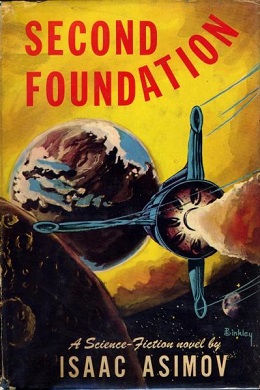
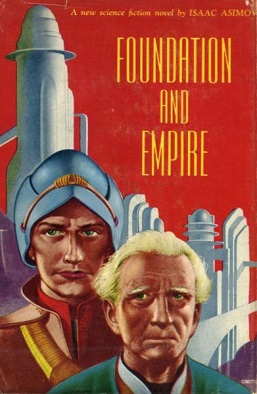
Dust jacket of 1953 edition

The Magneto in the High Castle

To get a sense of how I feel about this, imagine if half-way through The Man in the High Castle Philip K Dick had suddenly introduced Magneto from the X-Men. For the uninitiated, Magneto is, like the Mule, a mutant with special powers; he can control metal with his mind. So imagine if a good chunk of The Man in the High Castle is about Magneto picking up panzers and flinging them around squishing prominent Nazi leaders. Dick’s counterfactual 1960s Nazis are developing plastics, so I suppose they  finally build a plastic tank and squish Magneto in turn. After Magneto is vanquished, there is one final episode in the story, concerning the Japanese Emperor, who it is revealed also has magnetic powers. Dick goes out of his way to explain this, somehow, with reference to the I Ching, in order to tie this absolute nonsense back into the original ideas of the story.

However fun this scenario would be, it would kind of distract from the fascinating questions that Dick uses his alternate history to ponder. To take another example, just for fun, imagine if half-way through The Dark Forest by Cixin Liu, when we are invested in wondering how humanity is going to hold off an alien invasion, the clouds part and Jesus descends, turns a lot of water into wine, and dies on a cross somewhere half-way through Death’s End.

This is kind of what happens with the original Foundation trilogy. Its second half is fun and not by any means devoid of the interesting ideas we find in the first half. The mysteries – where is the Second Foundation? Who are its secret agents? Who is its mysterious leader, the First Speaker? – are solid with good development and payoffs. But they are mechanical. They have more to do with the craft of storytelling than with the science of psychohistory.

And, I mean… no doubt Dick would have written Magneto pretty well too, and would have found some time to ponder the nature of reality itself in between the scene where Bormann gets squashed by a panzer and the scene where Goebbels gets boa constricted by a lamp-post. But it would still have been a wild and irrelevant departure from a promising story.
The spiral galaxy Messier 83. Credit: NASA, ESA, and the Hubble Heritage Team (STScI/AURA)
Acknowledgement: William Blair (Johns Hopkins University)

Motivations

The second half of this volume presented some problems for me, even aside from all that. In this story a group of private citizens from the Foundation are hunting for the Second Foundation, because some people’s brainwaves have started to show up a little strange on the mind-reading machines, and it is suspected that the Second Foundation is interfering.

The motivations of this group of private citizens don’t make much sense. The Second Foundation saved them and it is part of the Seldon Plan, which is their secular religion. And then during the story, agents of the Second Foundation save their arses again and again.  The two Foundations have no basis for conflict at all. In spite of all this, our Foundation characters remain determined to root out the Second Foundation and its agents with extreme prejudice. Not only does it seem perverse, it doesn’t seem urgent at all. There is no existential threat to the Foundation here. The story lacks urgency, unless it is our desire to see how the Second Foundation will stop these gobshites, but the author doesn’t really commit to that either.

It gets worse (and spoilers follow). When the Foundationers identify one Second Foundation agent in their own circle, they immediately torture and restrain him (p. 229, 1994 HarperCollins Voyager edition). When the Foundation crowd believe they have found fifty agents of the Second Foundation, they do not take long to decide on their narrow range of options:

‘What will we do with all of them… these Second Foundation fellas?’

‘I don’t know,’ said Darell, sadly. ‘We could exile them, I suppose. There’s Zoranel, for instance. They can be placed there and the planet saturated with Mind Static. The sexes can be separated or, better still, they can be sterilized – and in fifty years, the Second Foundation will be a thing of the past. Or perhaps a quiet death for al of them would be kinder.’ (p 232)

A subsequent scene confirms that one of these fates has indeed befallen the fifty agents. Though we are not told which one, it hardly makes a difference!

The early-1950s viewpoint of the author offers some sources of interest and amusement, and, occasionally for me, mild disgust. But I was struck in a nice way by this description of an automatic ticket machine as a futuristic wonder:

‘You put a high denomination bill into the clipper which sank out of sight. You pressed a button below your destination and a ticket came out with your ticket and the correct change as determined by an electronic scanning machine that never made a mistake. It is a very ordinary thing[…]’ (p 169-170)

We have that now, and the only abnormal thing there is using cash instead of card. My knee-jerk reaction is to think, ‘how quaint.’ But on reflection, what prescience.

Conclusion

So that’s how I felt about Second Foundation: enjoyed it, recommend it, but expected more and felt it could have been more.

My verdict on the whole Foundation trilogy (I haven’t read the prequels and sequels written forty years later, so for me it is still a trilogy): “The General” in Foundation and Empire and the first few dozen pages of “The Mule” in the same volume represent a kind of peak Foundation for me. It’s lost some of the excessive dryness of the first volume without yet taking on all the extraneous psychic stuff. After this point, it never stops being entertaining or having good ideas; to its credit, it never retcons; and in some ways the writing improves… But it loses touch with its basic theme. The author seems to have lost interest in the question of predicting and planning the future through mathematics and psychology.

No wonder it ends unfinished, only half-way through Seldon’s thousand-year interregnum. Maybe that’s for the best. The rise of the Foundation into a new Galaxy-wide empire would not have been half as interesting as its early struggles for survival. Let’s remember the assumptions the series is built on: that empires are good and interregna are bad. Later stories would have had to go back and deconstruct a lot of that, if they wanted to remain thoughtful and interesting.
Home Page/ Archives

What I’m reading: Foundation and Empire by Isaac Asimov

Last year I wrote about Isaac Asimov’s novel Foundation (1951), in which a small community struggles to preserve culture and technology on the fringe of a collapsing galaxy-wide empire. Hari Seldon, the man whose command of the science of psychohistory allowed him to predict the collapse, has laid out a plan for this community, the Foundation, to unite the Galaxy in ‘only’ a thousand years or so. Foundation is episodic, as every 50-100 years the Foundation is presented with a new existential threat and the question is ‘How will the immortal science of Marxism-Seldonism get them out of this one?’

The sequel Foundation and Empire consists of just two longer episodes, ‘The General’ and ‘The Mule.’ They’re both good and they’re both set in the same world, one after the other. But in tone, theme and style they are two completely different novels. With ‘The Mule,’ we can see Asimov completely throwing out the old formula and introducing a new one. His story about interstellar socio-economics becomes a boisterous space opera about psychics and mind control.

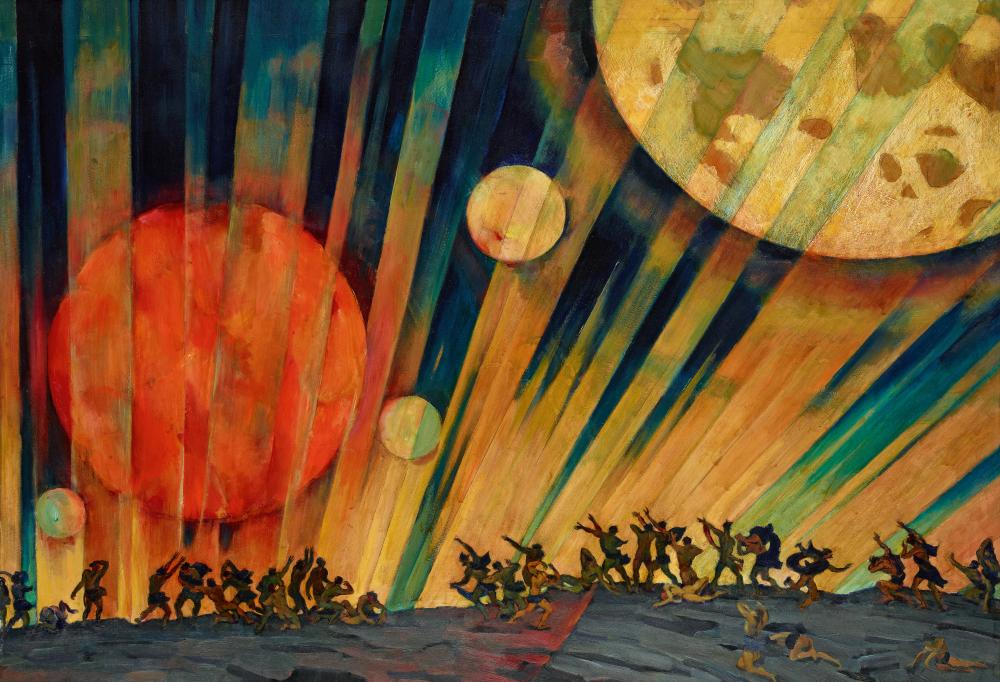
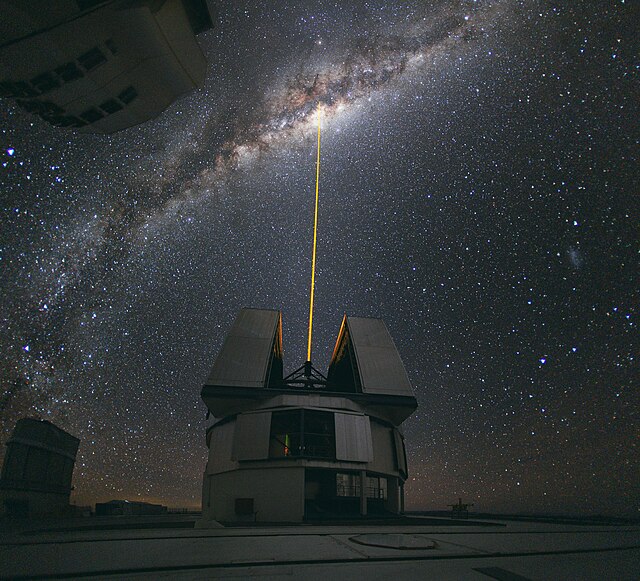
Featured image: ‘Laser Towards Milky Way’s Centre’ by Yuri Beletsky. From Wikimedia Commons. https://apod.nasa.gov/apod/ap100906.html

The General

The first part of the book is peak ‘old-formula’ Foundation. I unambiguously love it. General Bel Riose, the most capable military leader in the decaying rump of the Empire, sets out to conquer the Foundation. His will, his ability and the forces at his disposal are all more than sufficient to the task. How can he possibly fail? 

The main characters are two captives of Bel Riose: the old Imperial aristocrat Ducem Barr and a Foundation trader named Lathan Devers, who are trying to spoil the General’s design. Their mission centres on an apparent contradiction: they must pursue this task with urgency and initiative even as they maintain their faith in the inevitability of a Foundation victory through the Seldon Plan.

A part of my pleasure in this story came from the way our two main characters speak with very distinct voices. Here’s Lathan Devers on page 37 (2016 HarperCollins edition), faking indifference but with some measure of genuine conviction:

Listen […] what’s defeat? I’ve seen wars and I’ve seen defeats. What if the winner takes over? Who’s bothered? Me? Guys like me? […] Get this […] there are five or six fat slobs who usually run an average planet. They get the rabbit punch, but I’m not losing peace of mind over them. See. The people? The ordinary run of guys? Sure, some get killed, and the rest pay extra taxes for a while. But it settles itself out; it runs itself down. And then it’s the old situation again with a different five or six.

I’ve gone into Foundation’s influences on Star Wars before, but it’s so clear in this book, right down to the characters’ voices and attitudes. There are whole pages where we might as well be in the company of Obi-Wan Kenobi and Han Solo; Ducem Barr does a good line in traumatised reminiscences and holding forth about psychohistory the way old Ben does about the Force, and Lathan Devers would have you believe that he’s in it for the money, doesn’t give a damn about your struggle for freedom, and doesn’t have any time for far-fetched ancient belief systems.

Devers, however, is in it for the revolution. He tells the leaders of the Foundation that he wants to ‘spread the wealth a bit, and keep it from concentrating too much out of the hands that work for it.’ (78) And in the next episode we learn that ‘Devers died in the slave-mines […] because he lacked wisdom but didn’t lack heart.’ (89) This is part of a satisfying pattern where each episode by the way refers back to the characters in the previous one.

Compared with the earlier Foundation stories, this one has more detail, more drama, more interstellar travel, and more character. It even has some action. We get a few scenes with the Galactic Emperor himself. It’s still a very talky piece, as if Asimov wrote it with an eye to royalties from a radio play adaptation. But it’s a development.

The contradiction between individual initiative and historical inevitability is resolved very well. Without getting into spoilers, maybe the actions of our main characters were just part of a more general movement which could be predicted mathematically, or maybe they are there only to illustrate the broader trend. They didn’t solve the problem by their own actions – Ducem Barr remarks after the event that ‘through all this wild threshing up of tiny ripples, the Seldon tidal wave continued onward, quietly – but quite irresistibly.’ (76) But that doesn’t mean their actions didn’t matter.

First edition cover. From Wikipedia.org

The Mule

I grumbled about Foundation being very dry, talky and un-visual, and having almost zero women in it. The second half of Foundation and Empire blows all these complaints out of the water. The lead character, Bayta Darrell, is a strong and smart woman; there is more humour, travelogue, spectacle, more set-pieces. The narrator becomes sassy and sardonic.

At the same time it might be a case of “be careful what you wish for.”

There are things that would have been impossible in previous Foundation stories, not all of it good. Asimov moves from the version of sexism where you pretend there are no women in the entire Galaxy to the version of sexism where you describe women’s appearances more than you really need to, or have supposedly sympathetic men say patronizing shit to them. There is hack stuff, whimsical stuff, clichés: a silly clown who talks Shakespearian; a scene which is just making fun of the way women in a typing pool talk to each other; a psychedelic bit where a special musical instrument triggers hallucinations; an episode in which a villainous nobleman captures all the main characters because he wants to have sex with Bayta.

All in all, this story is written more like a traditional novel of its time. So on the one hand it’s better-crafted and easier to get into. On the other hand, it’s less distinctive. It becomes less about the things Foundation is about.

It starts very good, with all the strengths of the new formula on display. Asimov does a neat job of showing us how the Foundation has grown authoritarian and how its outside colonies of traders chafe under its rule and long for independence (as predicted by Hober Mallow and Lathan Devers). ‘Every vice of the Empire has been repeated in the Foundation. Inertia! Our ruling class knows one law; no change. Despotism! They know one rule; force. Maldistribution! They know one desire; to hold what is theirs.’ (89) Instead of giving us a page from the Encyclopedia Galactica explaining it all, the author conveys it through a sequence where a newlywed couple, one from the Foundation and one a trader, go on a family visit and end up being recruited by the Traders’ resistance movement.

So far, so good: we have a Foundation story but told in a more balanced and engaging way. It is setting us up for a story of class warfare and social revolution. Then all of a sudden it ceases to be a story about sociology or economics or politics and becomes a story about mind control. The Seldon plan is thrown into disarray by the appearance of a man who can hypnotize people. Haha! You didn’t consider that possibility, did you Hari Seldon? You dumbass.

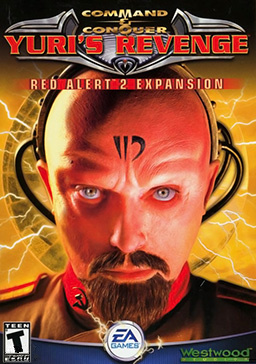
Before I get into criticism of the Yuri’s Revenge turn, let’s just clarify that the story is good and fun and intelligent. The mysteries and twists are one step ahead of the reader. But it’s not a spoiler to say that for the rest of the trilogy the mind control never really takes a back seat. And I just didn’t get as much out of this series from here on out.

Suddenly it all gets a bit ‘Your command is my wish.’ Cover art for Command and Conquer Red Alert 2 Yuri’s Revenge (2001) featuring Udo Kier, a great German actor who passed away this year. Was the Mule a model for Yuri?

What’s my problem with the mind control? Science fiction stories are generally based on “what ifs.” In this case: what if we could predict (and subtly shape) the future development of society through psychology and mathematics? But half-way through the trilogy Asimov suddenly asks, ‘And what if, also, there was a magical guy who could permanently control the emotions of everyone he met?’ It complicates and obscures the original ‘what if’ question.

A defence of Asimov here would be to say that psychohistory deals only with masses of humans, so the mind control stuff is relevant because it’s something happening on the individual level that psychohistory can’t predict. This is stated explicitly a few times. But I just don’t buy it. There’s got to be a more subtle way of interrogating the role of the individual in history and the potential weaknesses of the Seldon Plan. Say, introduce a guy who’s really charismatic, or a small organisation that’s really disciplined. There’s a lot that can happen on a level lower than the actions of billions. Introducing magical mind control, no matter how much Asimov labours to explain it and tie it into psychohistory, doesn’t further explore the concept. It just takes the story somewhere else entirely.

The mysteries are no longer like “how will the Foundation exploit atomic gadgets to control their stronger neighbours?” and more like “Which of these characters is the big baddie in disguise?” and “Which of these planets is the secret base of the Second Foundation?”

I want to re-emphasize that this story is better on a craft level than what came before. My friends who read Foundation at the same time as me didn’t like it, because of the very shortcomings that are addressed in Foundation and Empire. But from my point of view Asimov threw out the baby with the bathwater here. My enjoyment of ‘The Mule’ was tinged with disappointment.

I’ve also read the third novel in the series, Second Foundation, and I will be sharing my thoughts some day soon. Stay tuned.

The Three-Body Problem on page and screen (2) The Flickering Universe (Premium)

Become a paying supporter to get access

Access to this article is limited to paying supporters. If you already subscribe by email, thank you. But if you want to become a paying supporter, please hit ‘Subscribe’ below.

Donate less than the price of a coffee, and you can access everything on this blog for one year.

If you don’t feel like donating, most of my posts are still 100% free, so browse away, and thanks for visiting.

Here you can browse the blog’s full archive.

The Three-Body Problem on page and screen (1) Betraying Humanity

Hi folks. I’m going to dig deep into Cixin Liu’s The Three-Body Problem and its 2024 Netflix screen adaptation. This first post will look at the book’s most fascinating character, Ye Wenjie. The Three-Body Problem is really her story – how and why she betrayed humanity, and the consequences of that betrayal. 

I enjoyed the TV show. If you’re looking for a big rant where I complain about every aspect of it, you will be disappointed. But its version of Ye lacks the novel character’s depth, doesn’t hit us as hard emotionally (Due to the script and not due to fine performances by Zine Tseng and Rosalind Chao). Mostly I’m not criticising so much as saying, ‘Look here – this is interesting what they did here and what effect it has.’

The writing in Cixin Liu’s trilogy (I’ve read the first two) is sometimes stilted or technical or slow. But there is great prose here, especially in the Ye Wenjie sections:

  • Page 294: ‘In the deep silence of midnight, the universe revealed itself to its listeners as a vast desolation.’ (a line repeated to great effect later)
  • Page 299: ‘Above her, the Red Coast antenna lay open, silently, like a palm toward the universe.’

The screen version lacks this prose but makes up for it with strong visuals. It’s held together by compelling characters who have natural dialogue and interactions. It’s slick enough that it got a lot of eyeballs onto screens; it was a success, and there’s a point past which you can’t argue with that. It brought the main gist of the book to a much wider audience. I’m glad more people got to experience this great thing. 

Page and screen are autonomous, and I’m not going to judge one for deviating from the other. Nonetheless about some of these deviations I have plenty to say. 

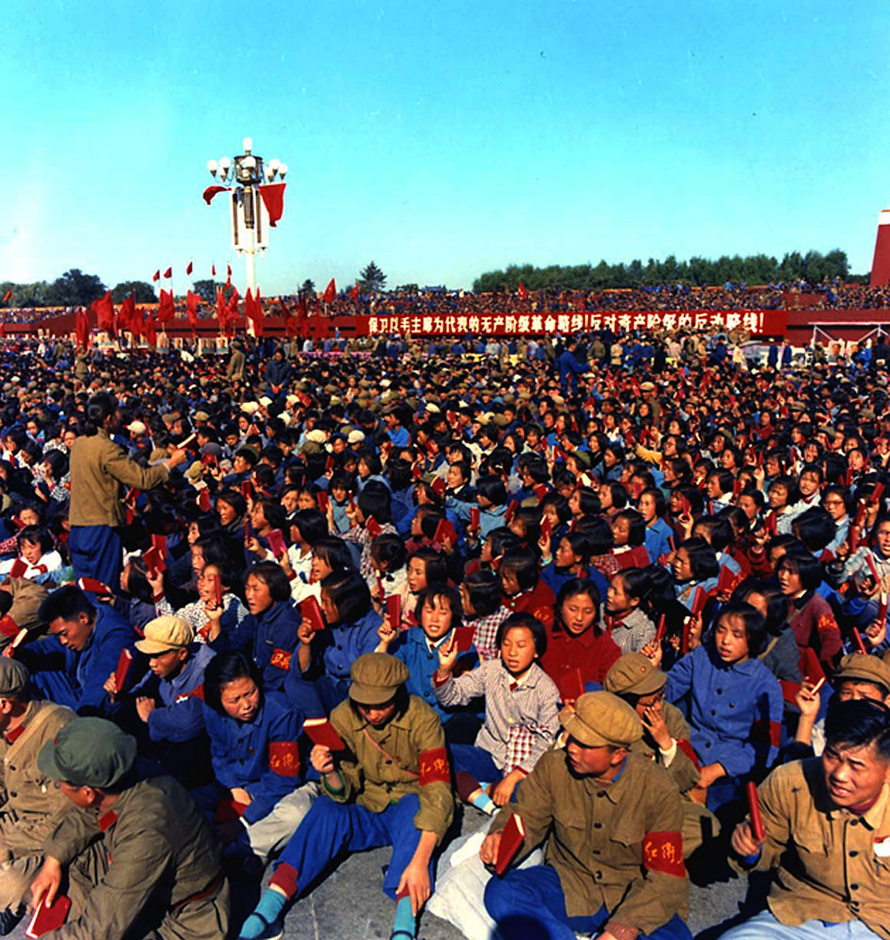
Red Guards during the Cultural Revolution – Tiananmen Square, Beijing, 1966

Cultural Revolution

The Three-Body Problem by Cixin Liu begins with a panorama of Beijing at the height of the Cultural Revolution, with factionists killing one another in street battles. Next we see a stage in a university square. Student paramilitaries denounce and beat a physics professor; they go too far and kill him.

The Netflix TV adaptation begins the same way. But the Netflix audience – and the western reader – mostly has no idea what the Cultural Revolution was. It’s not the business of the screenwriters to give you a history lesson. But western ignorance about China might leave many viewers with questions about this scene. For example, Jordan Peterson – who presents himself as very well-read and knowledgeable – thinks the Cultural Revolution (1966-1976) and the Great Leap Forward (1958-1962) were the same thing. His complete ignorance didn’t give him any pause for thought – he put out that claim in a published book, Maps of Meaning, and while he was at it he declared in passing that 100 million people died in this 18-year-long composite event. 

I’m pretty ignorant about a lot of things too – never read Jung. But I’ve visited China and read a few books about the place. The Cultural Revolution took place twenty-odd years after the communist victory of 1949. The 1949 Revolution overthrew the landlord class and delivered a massive expansion of health and education; hence why students who were babies in 1949 are, by 1967, so keen on it and on its foremost leader, Chairman Mao Zedong. But Mao messed up with a campaign called the ‘Great Leap Forward,’ contributing to a terrible famine, and afterwards he was sidelined.

The Cultural Revolution began four years later. It was half a student uprising against government figures who were perceived as conservative or bureaucratic; half Mao’s power play to get back in full control. It was a mess that got way out of hand. The way it’s depicted on text and screen seems fair to me, but the original Chinese reader had more context than the Netflix viewer or western reader. 

On the page and on screen we experience the same terrible episode: a teenage girl named Ye Wenjie watches as her father, a theoretical physicist, is publicly humiliated and killed. In the book, we are privy to her own thoughts and memories. Long ago, before the Revolution, her father met Einstein. Einstein pointed to a ditch-digger on the streets of Beijing and asked how much the guy earned. Instead of a deep discussion on the nature of the universe, Professor Ye’s only dialogue with Einstein consisted of telling him that the ditch-digger probably earned 5 cents an hour. 

This is one example of an opening that is rich in contrasts; likewise it is bizarre and unsettling how a discussion on theoretical physics is combined with a scene of pseudo-revolutionary ritual persecution and public torture. 

This is a moment of cruelty and hysteria, a moment when the human species comes across very badly. This does two things: it sets Ye Wenjie on a course to betray humanity, and in its depiction of a hysterical political rally it prefigures the later development of the Earth-Trisolaris Organisation. The first, at least, comes across clearly enough on the screen as on the page – the second, not so much.

‘Big-character posters’ bearing uncompromising political slogans, a hallmark of the Cultural Revolution, being pasted to a wall in 1967

Red Coast Base

After the worst excesses of the Cultural Revolution, the youth were rusticated en masse, sent out to the countryside to do hard labour and keep out of trouble. That’s where we next catch up with Ye Wenjie: with a logging crew in Inner Mongolia. She watches as ‘vast tracts of grasslands became grain fields, then deserts.’ 

Ye Wenjie sees the environmental destruction and concludes that humanity is to evil what an iceberg is to the sea – composed of the same material but just in a different form. Her dawning environmental consciousness is warped in this misanthropic direction by her previous experiences. To make matters worse, the first person she trusted since her father’s death, Bai Mulin, betrays her. Long before having any idea that she will one day communicate with aliens, she concludes that ‘To achieve moral awakening required a force outside the human race.’

She gets her chance when she is sent to the mysterious Red Coast Base. Pages 46-48, describing the mysterious dish in use, are very tense, exciting and mysterious. The climax is when the birds fall out of the sky. Here the TV show hews close enough to the book. Again, what we lose in interior monologue, we gain in strong visuals. 

Ye Wenjie doesn’t like living at Red Coast base but it suits her. She seeks isolation after her experiences; it seems safer. But here, in her relationship with the commander and commissar, there is room for further betrayals, petty ones this time (pages 174-5).

The TV show hurries through the Red Coast portion of the book in a couple of flashbacks. This is a shame because, alongside the surreal videogame sequences, it’s the best part of the novel. 

An example of what we lose: on pages 180-183 we get to see internal government documents where the top-tier Chinese communist leaders discuss how to contact aliens. The first draft is full of heated revolutionary rhetoric but it is dismissed as ‘utter crap’ – don’t send big-character posters into space! A more sober draft follows. 

To its credit, the TV show keeps the part where Ye Wenjie figures out that the sun can be used as an amplifier for radio transmissions into space. The explanation in the book is too technical, but on screen it’s just right.

Her idea is dismissed, but she goes ahead in secret. She sends the transmission to the sun. In the book this is an awesome moment, even as Ye herself loses hope: 

Ye saw the rest of her life suffused with an endless grayness. With tears in her eyes, she smiled again, and continued to chew the cold mantou.

Ye didn’t know that at that moment, the first cry that could be heard in space from civilization on Earth was already spreading out from the sun to the universe at the speed of light. A star-powered radio wave, like a majestic tide, had already crossed the orbit of Jupiter. 

Right then, at the frequency of 12,000 MHz, the sun was the brightest star in the entire milky way.

As a plot point, this comes across clearly on the screen. But the sheer awesomeness of this moment is lost in translation. Likewise the moment, some years later, when she has a choice and betrays the human race. Everything has been leading up to this, but it’s still just enough of a leap that it shocks the reader. This is why Ye Wenjie is a great villain in the book.

The show leaves out some plot points too. In it, Ye has a baby with Mike Evans, her American collaborator. In the book, she has her baby with chief engineer Yang who works at Red Coast base. But in the book we see her commit an incredibly cold-blooded murder of commissar Lei. By an unhappy chance, killing Lei obliges her to kill her husband Yang at the same time. She kills them both – including the father of her child – without hesitating. 

Our view of this character changes fundamentally at this point – her betrayal of humanity is made real and manifest. This betrayal is not mediated by a computer screen or a radar dish.

The Earth-Trisolaris Movement

Something crucial happens in the book: Ye Wenjie goes to a local village and lives with the farmers there to have her baby. They donate their blood to save her and house and feed herself and her baby. In return, she teaches their children. This is a lovely section of the book. It’s a rebuke to the anti-human attitude she has adopted. ‘Something finally thawed in Ye Wenjie’s heart.’ (316-321) We see Ye in a different setting and mood from the military-scientific base and the Cultural Revolution era. Her horrific experiences were not the full picture; most of us human beings, while we have our burdens to bear, live lives that are far happier than hers. We do not experience such repeated and concentrated doses of inhumanity. And if she hadn’t, she wouldn’t have betrayed humanity. When we exploit and brutalise one another, we degrade humanity’s faith in itself, humanity’s integrity. When we harm a fellow human we harm ourselves as well.

Her next experiences set her back into her misanthropic groove. Her mother, who helped do the father to death, washes her hands of what she did, and even blames the dad for it. (324-5) 

Ye Wenjie then meets the three Red Guards who killed her father – in the TV show, there is thankfully a version of this scene. After their revolutionary ardour was exploited for political ends by a faction in the state, the three teenage girls were doomed to years of hard labour. There’s nothing left in them but bitterness, and they have suffered too much to be remorseful. I found this interesting; the mother is unrepentant because she has moved up in the world, and the girls are unrepentant because they haven’t. 

This entirely depressing experience counteracts all Ye’s tendencies toward ‘thawing.’ But we have seen that she has a soft side. 

This is relevant when we fast-forward a few decades to the development of the Earth-Trisolaris Organisation (ETO), a political group which is determined to help the aliens to conquer Earth. 

In the TV show it is not named as such, and we learn very little about it. This is a weakness of the screen version. Why would some humans wish to collaborate with aliens? What internal debates would such a movement have? These fascinating questions are explored and dramatized in the book but not on the TV show. 

They call each other ‘comrade,’ evoking the Cultural Revolution, but this is not a movement of idealistic students. ETO is made up of people drawn from the political, technical and financial ‘elites;’ it is explained that their grasp of science and their knowledge of the darker side of humanity makes them willing recruits. This tracks – Mike Evans is the son of a billionaire and thus alienated from humanity (no pun intended). Efforts to recruit ‘common people,’ meanwhile, have failed due to their ‘instinctive identification’ with humanity. (344-5) 

ETO funds all kinds of anti-science groups. This is touched on in just a single line in the show which is really a missed opportunity to say something very relevant to the post-Covid world.

ETO is divided into two factions: 

  • The Adventists wish to eliminate the human race. They realise the Trisolarans might not be much better, but don’t care. 
  • The Redemptionists, on the other hand, have developed elaborate fantasies about Trisolaran civilization, and think the aliens will save humanity from itself. 

A new and small third faction, the Survivors, is drawn from the small number of recruits from among the ‘common people’ – they hope to survive the war by collaborating with the Trisolarans. 

Much like the Red Guards in 1967 Beijing, the two factions are on the brink of an internal civil war. Ye Wenjie doesn’t much like any of the factions, who have departed from her original vision, but she especially hates the Adventists and plans to wipe them out. 

I’ve been praising the book a lot, but it has problems. From a zoomed-out distance, the ETO is compelling. But when Liu tries to show it in real life and real time, it fails to convince. Wang Miao infiltrates the ETO with comical ease; he attends a casual introductory chit-chat in a café, and is immediately invited to a major conference. The events of the conference contain subtle echoes of the Cultural Revolution scene at the start, and culminate in a moment of dramatic action. But the whole thing is stilted. Take it from a seasoned activist: this is not how internal disputes within a revolutionary party work. You don’t just have one meeting where you bring up everything all at once, and then trash it all out on the spot. Political conflict can be dishonest, drawn-out, and dirty – or, to put it kindly, it is richer and more interesting than how it’s presented here. 

Having said that, there’s proper drama in the showdown between the two factions, and that’s before the jackboot of the state kicks down the door and Da Shi and his men storm in. The TV show, by contrast, has a flattened ETO.

Until next time…

Next week I’ll look at the other major strand of the novel The Three-Body Problem: Wang Miao’s storyline set in the present day and concerning a flickering universe, a loutish and morally dubious cop, and a mysterious videogame. Of course, I’ll be comparing the original with how it was adapted for the screen. 

Did you enjoy reading this? Subscribe to get an email notification whenever I post:

Or browse the blog’s full archive.