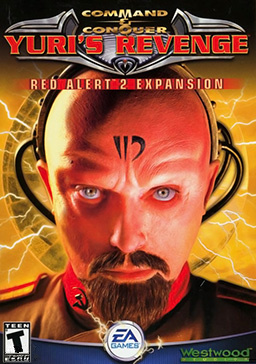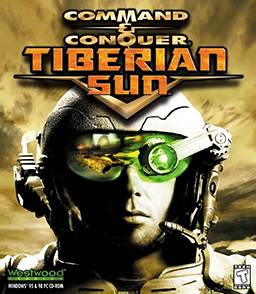

Games that warped my young mind: Tiberian Sun (1: Setting and Story)

When I was 11 or 12 – or maybe it was some older and more embarrassing age – there was a field near my house that me and my friend called the Tiberium Field. You had to dash across it in twenty seconds flat, otherwise Tiberium poisoning would kill you and turn your body into a visceroid, an aggressive and indestructible blob of human tissues. In our heads, we were in Command and Conquer: Tiberian Sun.

So far, so nostalgic. This is a post where I talk about a 1999 strategy game, maybe to recapture the remembered leisure and innocence of the childhood that surrounded it.

But I never got past a few missions of Tiberian Sun, never owned my own copy, and I like it a lot more now than I did back then. If we’re talking nostalgia, I was always more of a Red Alert guy (who could have guessed?). At the time I thought Tiberian Sun was, in comparison to Red Alert 2, drab and self-serious, with a clumsy interface and confusing missions. Earlier this year when I bought the whole Command and Conquer back catalogue for a tenner, I didn’t expect that this would be the game I spent the most time on, the one where I actually finished both campaigns, the one that would haunt my imagination.

So this is not all nostalgia. Something else is going on here, and I’m going to try and find out what. And even within the nostaglia, there’s the question of how this game worked its way into my imagination in such a way as to turn the grass of that neighbourhood field into an expanse of deadly and valuable green crystals.

So how did this game warp my young (and not-so-young) mind?

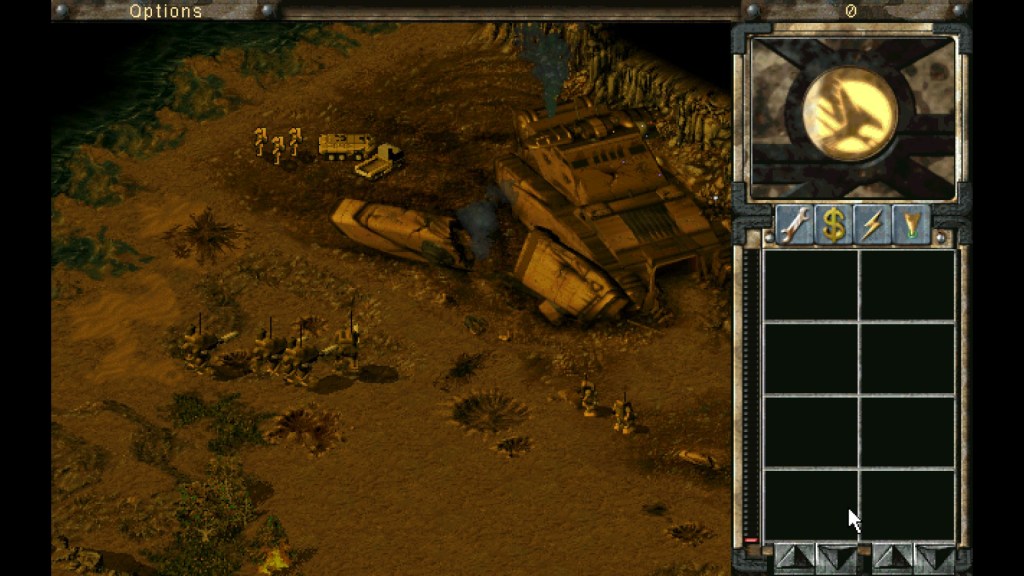
This screenshot is from the expansion pack, Firestorm

The Tiberium-haunted world

The first point in favour of Tiberian Sun (henceforth TS) is its setting. The world of the original Command and Conquer was sort of improvised. The developers said, let’s have something like the spice from Dune 2 – it works so well as a resource-gathering feature – but transplanted to another setting. The result is Tiberium, a strange green crystal native to some alien world which has begun to spread over Earth’s surface. There are two factions: the Global Defence Initiative (GDI), a one-world military defending the status quo, and the Brotherhood of Nod, which is part-Tesla, part-ISIS, part Comintern, and obsessed with using the Tiberium for obscure ends. My impression, having played only a little of the original C&C, is that whatever worldbuilding there is starts to peter out around there. The setting is just an excuse to have a war game on the Dune 2 formula. (I’ve talked about the Red Alert spin-off elsewhere.)
Tiberian Sun takes the worldbuilding more seriously. A couple of decades after the first game, the Tiberium infestation has advanced, and Planet Earth is now terminally sick. GDI and Nod are still fighting over ruined cities and land choked with alien crystals and alien weeds, skies torn by ion storms, poisoned air, mutated genetics. For more on the setting and its applicability as a prophecy for our times, I recommend this article from Eurogamer by Robert Whitaker.

Tiberian Sun captured that late-1990s sense of some vague impending doom. But in 2024 it offers a strange kind of relief. You can retreat into the barren comfort of a world that is already destroyed, where there is little to save. There are unexpected inheritances from Dune: like in Herbert’s book, the ground beneath your feet is more than a setting, it’s an actor with powers of life and death over the fragile humans and machines crawling on its surface.

The applicability to climate change and global warming (which we all absolutely knew about in the 1990s even though those in power did nothing) are obvious. It’s a metaphor for our times in another way too. GDI are coded as “good” but we never see them actually doing, or even promising, anything good. They never help anybody or change anything, until the Forgotten twist their arms. We side with GDI only because Nod are obviously and extravagantly worse. Yes, GDI is Harris and Nod is Trump. Neither side offers a way out of war and ecological destruction. But Nod at least offers its supporters the shallow pantomime of its rituals and chanting and bloody spectacles.

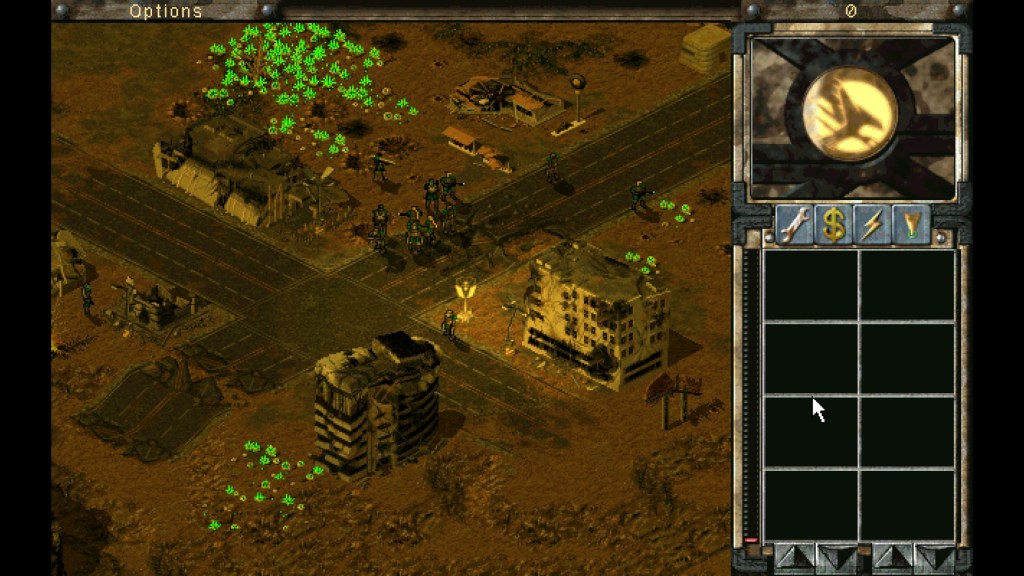
Mutants, ruins and the glow of Tiberium. It’s a vibe

The setting itself tells a story: when we move our little men across the map, we see ruined high-rise buildings, contrasted with space-age-looking new settlements with solar panels and bunkers and greenhouses: the civilian world has retrenched into smaller and more resilient communities. Meanwhile war has advanced as a science. It’s all laser guns and visored helmets, giant walking battle mechs, cyborgs, explosive throwing discs, orbiting battle stations. Humanity is spending and innovating to fight more effectively, even as we have less and less to fight for. While the Red Alert setting just pits an evil faction against a good faction, Tiberian Sun (TS) takes place in a world that is messier and more ambiguous. In Red Alert, we don’t know why the Soviets are attacking the status quo. In TS, we don’t know why GDI are defending it.

Videogames then were violent, militaristic, imperialist – not in a the conscious and blatant way that Call of Duty is now, but as it were by default, by reflex. C&C is no exception. The GDI versus Nod struggle is at base the same old Imperialism versus Third World struggle, with the legitimate struggles of the global majority (“disenfranchised nations” seduced by Nod) packaged as evil fanaticism. In TS it is less explicit, filtered through layers of deniability in the worldbuilding, but we get signals, such as that the villains in Tiberian Sun have names that are Arabic, Latin and Slavic (he’s literally called ‘Slavik’). The Latino baddie is a drug smuggler who menaces the southwestern United States, playing into racist tropes. We see one South Asian guy in the ‘Global’ Defence Initiative, but the rest of the goodies are Americans.

The Forgotten

The music is not as conspicuously brilliant as that of Red Alert 2 but it has a greater range. There are moments of foreboding (‘Valves’) and loss (‘Approach’). If Red Alert 2 is a violent cartoon, Tib is a 1980s-90s action sci-fi movie – the vibe, to me, is sort of like Terminator 2, Aliens and Paul Verhoeven.

The melancholy themes probably belong to the third faction in Tib – unplayable and lightly sketched, but essential to the story (I suppose if GDI is Harris and Nod is Trump, they are Jill Stein or Cornel West). This is a loose confederation of clans who call themselves The Forgotten. They are people mutated by Tiberium exposure – insulted and belittled as ‘shiners’ by GDI and Nod alike, distrustful of GDI due to past atrocities, persecuted and imprisoned by Nod. They are few but they are pretty lethal in a fight.

The Forgotten are the conscience of this story. In the GDI campaign, it is only by overcoming prejudices and working with the mutants that GDI can defeat Nod. In the Nod campaign, you prevent any possibility of an alliance between GDI and mutants through a nasty trick. There’s more going on here than is usually the case in this series.

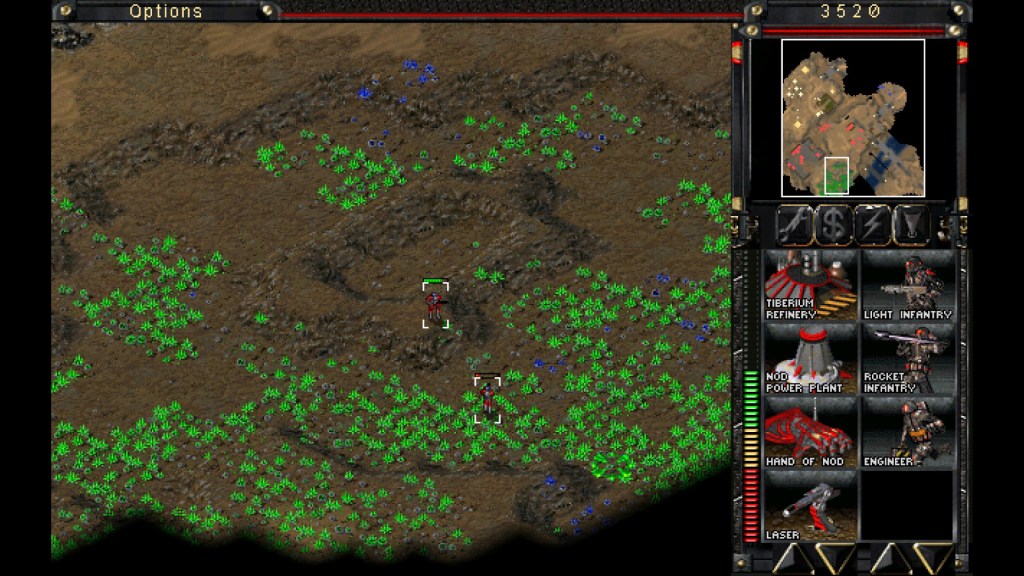
An actual Tiberium field

Tiberium Wars

In Part Two of this review I’m going to be looking at two other strengths of Tiberian Sun – the cutscenes (you heard me) and the gameplay. But before I move on I want to comment on the 2007 sequel, Tiberium Wars and its expansion Kane’s Wrath (I haven’t played Tiberium Twilight). What I have to say about Tiberium Wars (TW) underlines what I’ve just said about TS.

I’ve played a lot of TW and enjoyed it, but it doesn’t have the same grip on me as its 1999 predecessor. And I don’t think it’s just nostalgia.

The graphics and the smoother interface are a huge upgrade on TS, marking a rapid development in just 8 years. The story is solid, far less silly, and it’s all in all a lot of fun to play. But the setting doesn’t feel as real to me, and I think I know why.

Tiberium Wars leans with dispiriting heaviness into a ‘Global War on Terror’ framing. Magazine ads for the game talked about fighting terrorism. Technologically, GDI has been downgraded – no more stomping robots. This is explained in-game as being due to budget cutbacks, but the effect of it (and probably the intention) is to make everything look a few-score degrees more like Iraq or Afghanistan, or some near-future 9/11. The expansion Kane’s Wrath thankfully leans back the other way, and was clearly crafted by people who loved TS.
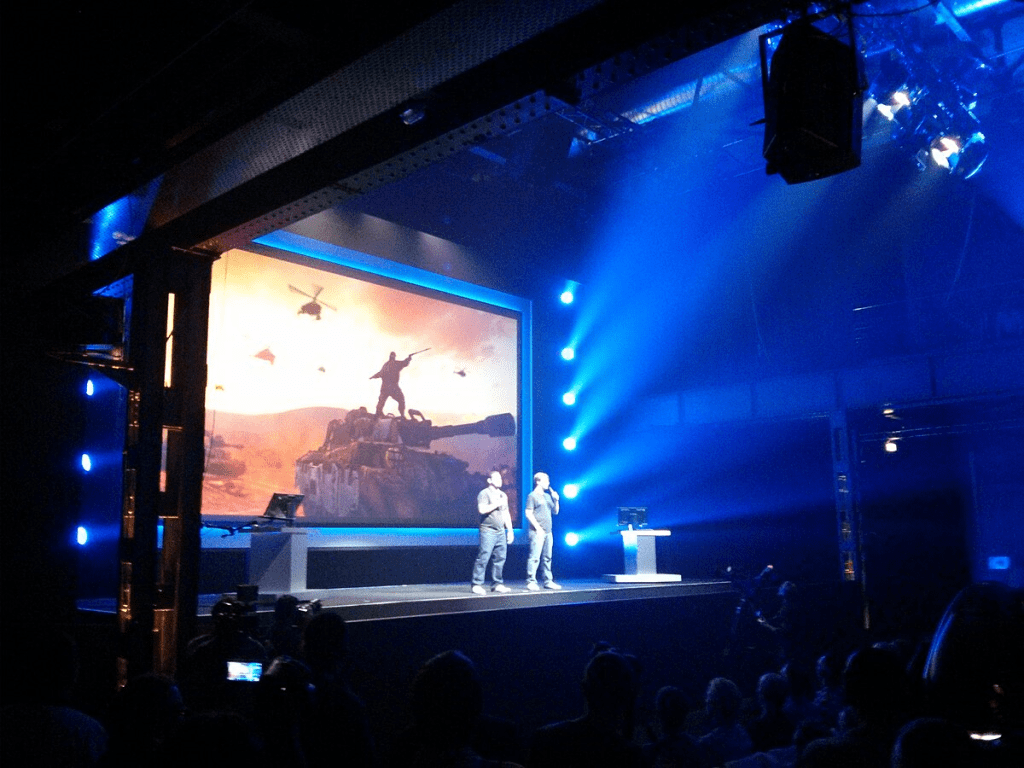
From a 2013 EA press conference about a new C&C title. If you have eyes, you can see the vibe they’re going for. And it’s not ‘morally dubious 1990s action sci-fi movie’

TW’s setting is retconned so that the Tiberium-infested world is divided up into uninhabitable Red Zones, Yellow Zones which are in a state of social collapse, and Blue Zones which are stable and prosperous. This is a marked contrast to Tiberian Sun, in which everywhere – Egypt, the USA, Norway, Germany, Britain, Mexico – was one of two things: a Yellow Zone or a snowy Yellow Zone. In TW, the Blue Zones we see are all either in the USA or in Germany. We always see them menaced and under assault. The first few missions are a bizarrely close remake of Red Alert 2, with the baddies invading hallowed American landmarks like the White House and the Pentagon (No! Please don’t destroy the White House or the Pentagon! Anything but them!). The Imperialism vs Third World framing is much more obvious and open. It’s no accident that the Forgotten are left out of the story of TW – they appear only as an Easter egg and they talk like super mutants from Fallout.

At base the reasons I don’t like it as much are political; I think it’s a shitty way to portray the majority of the human race, as if they have nothing better to be doing than besieging and menacing whatever dull place you live. But you don’t have to agree with that to see that these are two very different types of story and setting. Tiberium Wars is the same old C&C story about protecting the status quo. Tiberian Sun has more depth and ambition.
Home Page/ Archives

To receive an email when Part 2 of this article goes live, type in your email below:

Nine things that inspired Star Wars

This week I’m taking a break from Miseducation Misadventures to let you in on what runs through my head when I watch Star Wars. Re-watching it as an adult, I notice little things that I can trace back to their source – like the scattered mentions of spice mines and spice freighters in the first movie. Any guesses which SF novel that’s a nod to?

Here are nine sources from which Star Wars drew key ideas. If I’ve missed any interesting ones, chime in down in the comments.

1: Reproductive Biology (2,000 million BCE)

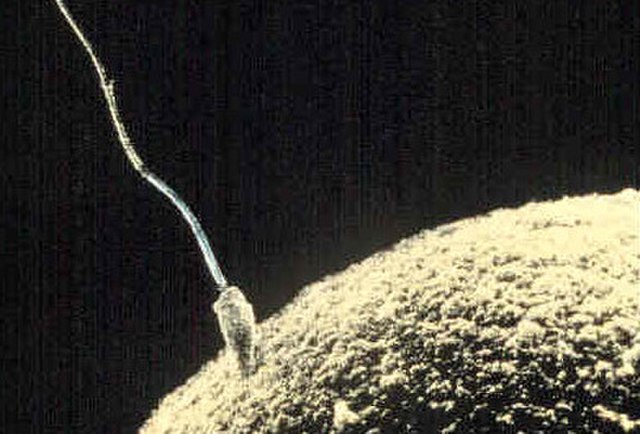
The final battle in 1977’s Star Wars involves a swarm of small starfighters approaching and seeking to penetrate the much larger orb of the Death Star. This looks a hell of a lot like a load of sperm trying to fertilise an egg, with zero-gravity space standing in for the liquid medium through which the little swimmers propel themselves. This was probably not deliberate – the imagery probably bubbled up from the filmmakers’ subconscious. It stands out all the more starkly against this pre-adolescent and mostly sexless galaxy.

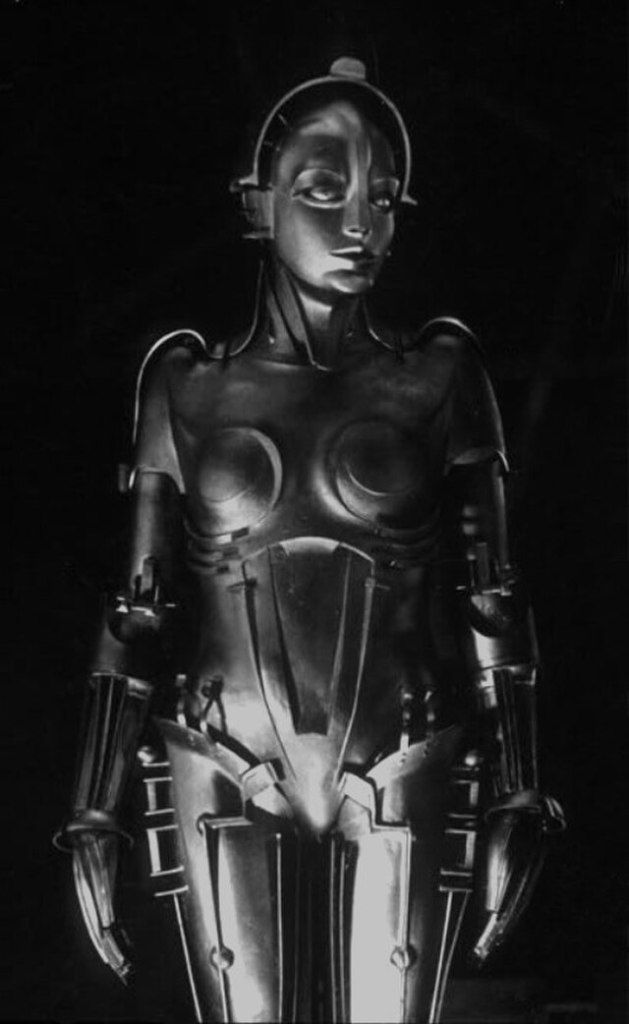
2: Metropolis (1927)

And here we have a female version of C-3PO, in an experimental silent film from Weimar Germany.

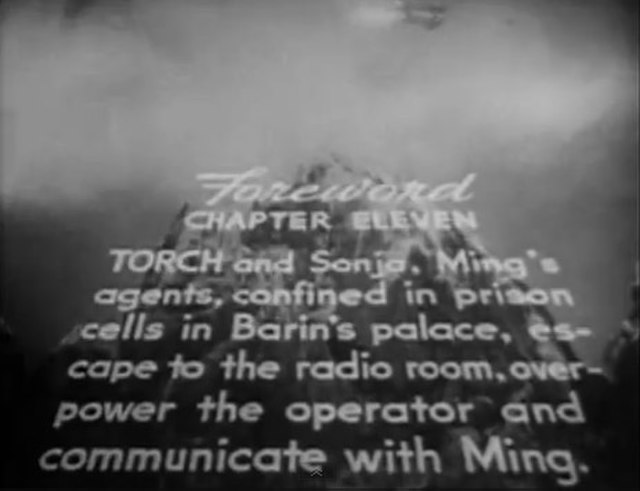
3: Flash Gordon (Comic and movies, 1930s)

Star Wars took a few cues from Flash Gordon – most obviously the opening text crawl but also the general idea of a series about fun adventures in space.

4: World War Two (1939-1945)

In 1977 when Star Wars came out, World War Two was as recent as the collapse of the Soviet Union, or the first episode of The Simpsons, is to us.

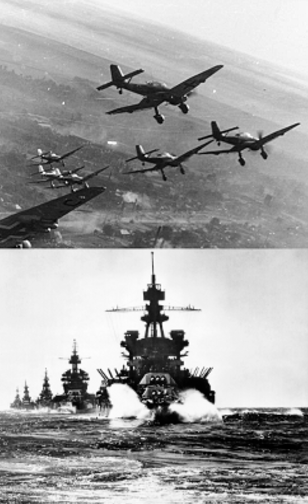
And the movie helps the audience to grasp what is happening in space by using a visual language familiar to them: it has World War Two-era fighter planes in space. The Empire’s star destroyers resemble the warships of the mid-century. The Imperial officers dress like Nazis.

On the other hand, weirdly enough, Star Wars references the Nazi propaganda film Triumph of the Will. The final scene where the rebels have a rally and the human characters all get medals (a weird enough scene in itself) follows part of this notorious film very closely. An odd choice, having the good guys mimic the visuals of a genocidal regime, especially when the bad guys are clearly based on them.

5: Casablanca (1942)

In a colourful jazz bar full of diverse people, in a town full of thieves and refugees, in a desert land where an evil empire is tightening its grip, we meet a cynical smuggler who is secretly an idealist. Will he find it in himself to help the two desperate fugitives who are seeking passage to safety? Of all the cantinas in all the systems in all the galaxy…

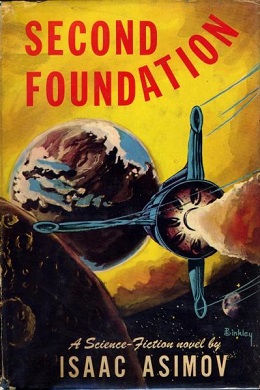
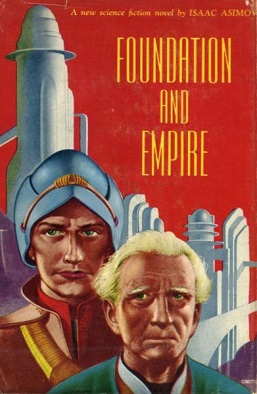
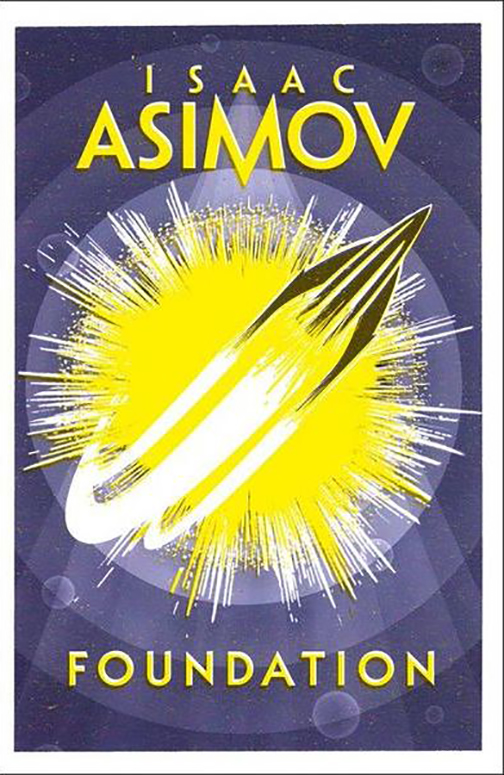
6: Foundation by Isaac Asimov (1940s-1950s)

The story and themes of Star Wars and Foundation don’t resemble each other at all. But there are many little things which Asimov seeded in the science fiction genre which pop up in Star Wars:

  • Hyperspace travel
  • Weapons called blasters (much more lethal in Asimov)
  • A galactic empire
  • Space feudalism
  • A city which covers an entire planet (Trantor/Coruscant)
  • The wild outer rim of the galaxy
  • It goes right down to random names: Asimov’s Korellian Republic is echoed in the Corellian shipyards
  • Roguish traders who do the right thing in the end (Foundation has several Han Solos in it, who say things like ‘Never let your sense of morals prevent you from doing what is right.’)

But for Asimov, empires are fundamentally good, the roguish trader is an advertisement for a doctrine of enlightened self-interest, and mysticism is nothing but a charade. All this is at odds with the anti-authoritarianism and sincerity of Star Wars.

7: Akira Kurosawa (1930s-1980s, especially 1950s)

Japan’s most well-known film director had a huge influence on George Lucas and Star Wars. I haven’t seen The Hidden Fortress (1958) but apparently it involves two peasants who escape from a battle (like C-3P0 and R2D2) and meet a princess; there are sword fights, and in the end a bad warlord changes sides. But I’ve seen a few others, like Throne of Blood, Ran and Seven Samurai. Any of these great samurai films show themselves to be ancestors of Star Wars. There are the sword fights and the robes and Darth Vader’s helmet. In a western ear, names like Obi-Wan Kenobi have a Japanese ring to them, and the Jedi resemble an idealised version of the Samurai.

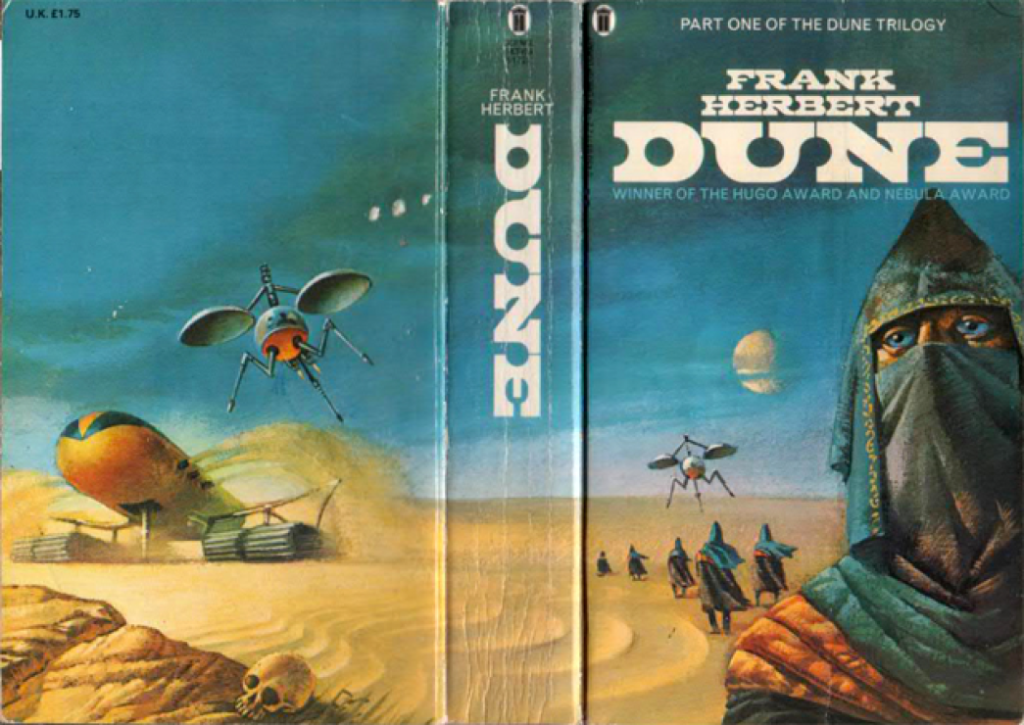
8: Dune (1965)

Frank Herbert’s Dune is riding high after Denis Villeneuve’s great film adaptation and I’ve written about it a few times before. Like Foundation, it provided a lot of ideas for Star Wars to pick up.

  • Dune is closer than Foundation to the themes of Star Wars. It is a text that was obviously written at the height of the anti-colonial struggles of the 1960s; it is pretty negative about empire; it is deeply sincere about religion and mysticism (even in charade form!).
  • The Jedi look like samurai, but they owe much to Dune‘s Bene Gesserit, an order of women who cultivate superhuman powers.
  • Both texts feature a harsh desert planet (Arrakis/Tatooine)
  • And giant worms,
  • robed nomad raiders,
  • smugglers,
  • and moisture-harvesting technology.
  • As noted above, scattered references to spice in the first Star Wars movie are another nod to Dune.
  • And once again we have space feudalism.

Foundation and Dune are the best examples I can think of, but they are stand-ins for a whole rich genre of mid-century science fiction without which Star Wars would not have existed.

9: The US War in Vietnam (1965-1973)

A few years ago Star Wars creator George Lucas confirmed in this interview that his story was fundamentally anti-colonial, that his heroic rebels were based in part on the Vietcong and that the evil empire was based on the United States – along with other past empires and freedom fighters throughout history.

Vietnam has featured just as heavily in other radically different readings of Star Wars, which is unsurprising as the war ended just a couple of years before the movie came out. I can’t remember who exactly wrote this, but the idea is that Star Wars was an infantilising nostalgic escape for a US public keen to avoid thinking about their country’s military and moral defeat in Vietnam. White people with American accents got to be the guerrilla heroes – though from the costumes to the names and decor, it is one of the strengths of Star Wars that it has never looked or felt ‘western’ (unless you mean spaghetti western, as there’s more than a hint of ersatz Mexico and Sergio Leone in there).

A last word…

The point of this is not to be like ‘Star Wars is a rip-off’ but to remind everyone that it’s just a movie, a cultural text rooted in its time. Today we have the corporate cynics for whom nostalgia is a currency and the toxic fandom for whom nostalgia and innovation are just different kinds of betrayal. The worst excesses of the fandom, I suspect, are boosted and incentivised by social media, and the back-and-forth whining and apologetics are increasingly astroturfed online by accounts which have harvested awesome volumes of engagement in the past from people bickering about fun movies, and who see the next big controversy as a payday. In all of it, Star Wars is reified, taken out of culture and history, put on a pedestal. One would think it feel from the sky. Actually the movie is a brilliant synthesis, and if Lucas had the precious and pious attitude on display in so much of the online commentary, it never would have been made at all.

Home Page/ Archives

Want to read more like this? Become a subscriber here:

What I’m Reading: Foundation by Isaac Asimov

‘Seldon crises are not solved by individuals but by historic forces. Hari Seldon, when he planned our course of future history, did not count on brilliant heroics but on the broad sweep of economics and sociology. So the solutions to the various crises must be achieved by the forces that become available to us at the time.’ 

– Hober Mallow, ‘The Merchant Princes,’ Foundation by Isaac Asimov

A lot of what’s fresh and brilliant in Isaac Asimov’s Foundation, written as long ago as World War Two, have since become so common in the genre that they almost escape notice when you encounter them in these pages. 

We have travel by hyperspace (‘hyper-space, that unimaginable region that was neither space nor time, matter nor energy, something nor nothing’); weapons called blasters; roguish but ultimately moral traders; cities which cover entire planets; galactic empires with a civilised core and a wild outer rim. We even have a planet called ‘Korellia’ which reappears as the shipbuilding world of Corellia in Star Wars. 

A galaxy without women

The first thing that strikes the reader is that the characters are all male. From a Galactic population numbering – what did he say, a quadrillion? A quintillion? – there are almost no women the author believes are interesting enough for us to meet.  

Here follows a list of female characters in Foundation

  • A telephone operator (!) 
  • A servant who tries on a gizmo
  • The Commdora of Corellia

And, if we really want to be generous:

  • Hober Mallow’s hypothetical mistress (Maybe I’m pushing it now)
  • Housewives are key to Mallow’s scheme to bring down the Korellian Republic (…That’s pushing it.)

The next thing that strikes you is that this book was apparently written as if Isaac Asimov had a very limited special effects budget. The first part contains compelling descriptions of space travel and the city-planet Trantor, but the rest is almost like a stage play: largely a series of conversations in rooms, mostly between seated men. 

Discussing this with friends, I thought of radio dramas, a popular medium in the 1940s when Asimov was writing. He wasn’t writing with an eye to radio adaptation, as far as I know, but maybe he listened to a lot of them and they influenced his style. The 1970s BBC radio play of the Foundation series proves how well it translates to the medium. 

A galaxy without ‘great men’

The lack of a balanced representation of humanity in the cast of characters is pretty awful. But I like the morality and the philosophy of history this story expresses – that it is not ‘great men’ but great impersonal forces that shape history. True greatness lies in predicting and adapting to the currents of history – not holding back the tide, but riding the wave. Real material relations are more important than ideas and words. Don’t be fooled by pomp and regalia; the empire is losing crucial technical skills. Don’t be intimidated by military thugs and their death machines; those machines must be operated by human beings, who can be influenced in clever ways. 

The ‘greatest’ figures in Foundation history are not strutting macho types. Hardin and Mallow alike embrace a kind of humility and acceptance, as well as cunning and unscrupulousness.

Both Hardin and Mallow embark on too-clever-by-half plans that would, in reality, totally demoralise their own people long before they bear fruit. This is a common failing in fiction: the illusion that conflicts have to be solved by clever tricks in order to be narratively satisfying.

In fairness, the climaxes to ‘The Mayors’ and ‘The Merchant Princes’ are very satisfying. Defeat turns to victory in a matter of moments. These eukatastrophes are seamless and well-plotted. 

Cynicism

They use religion to harness the Four Kingdoms to the chariot of the Foundation. But religion is superseded – by the time of Mallow, it is necessary to realise that trade is the new superweapon of Terminus. And trade itself will one day be superseded, become an obstacle: 

‘So, then,’ said Jael. ‘You’re establishing a plutocracy. You’re making us a land of traders and merchant princes. Then what of the future?’

Mallow lifted his gloomy face, and exclaimed fiercely, ‘What business of mine is the future? No doubt Seldon has foreseen it and prepared against it. There will be other crises in the time to come when money power has become as dead a force as religion is now. Let my successors solve those new problems, as I have solved the one of today.’

The flip side of the novel’s cleverness is the smug attitude that comes through. You read this book and feel like you, Isaac Asimov and Salvor Hardin are the three smartest people in the universe, and all these trillions of people are stupid. It celebrates cynicism and manipulation. Hardin controls the press behind the scenes and takes power in a coup. This is to say nothing of the invented religion and how it brainwashes people. This is not moral, of course, but we are supposed to accept that it’s an example of ‘doing what’s right’ in spite of any silly ‘morality.’

A galaxy without violence?

We are told that ‘violence is the last refuge of the incompetent.’ The author’s distaste for violence is rare and refreshing. He’s just not interested in it. The novel is better because of this. But the novel’s philosophy does not renounce violence; it just puts violence in its place, as the enforcer and copper-fastener of things already established by culture, economics and politics. It is not the last refuge of the incompetent; it is a necessary, though subordinate, stage of conquest. 

Consider the following exchange of dialogue: 

Jorane Sutt: You’re a Smyrnian, born in Smyrno, one of the former Four Kingdoms. You’re a Foundation man by education only. By birth, you’re an Outlander and a foreigner. No doubt your grandfather was a baron at the time of the wars with Anacreon and Loris, and no doubt your family estates were taken away when Sef Sermak redistributed the land.

Hober Mallow: No, by Black Space, no! My grandfather was a blood-poor son-of-a-spacer who died heaving coal at starving wages before the Foundation.

This passage tells us a lot: 

  • That the Foundation made war on Anacreon and Loris (two of the Four Kingdoms) some time in between the events of ‘The Mayors’ and ‘The Merchant Princes.’ 
  • That the Foundation has brought about a land revolution in the Four Kingdoms through the dispossession of the nobility. In other words, not just a war but a revolutionary war has taken place between two episodes. To cement in place and enforce the outcome of ‘The Mayors,’ war and revolution were still necessary. 
  • That the resolution of the second Seldon Crisis was not the end of Sermak’s political career (Sermak was the leader of the pro-war party in ‘The Mayors’). In fact, Sermak was heavily involved in the subjugation of the Four Kingdoms, to the extent that the land revolution is attributed to him. The pro-war Actionist Party have their day after all. 
  • People like Hober Mallow come from a background where before the Foundation they were denied any opportunities in life. The coming of the Foundation has been revolutionary, opening new opportunities for them. 

All of this is between the lines. Foundation is short and well-paced, but in places there’s a depth and density to it. These lines remind us that even though the novel leaves violence to one side, the universe in which the novel is set is just as violent as ours. The worst ‘barbarism’ in the novel is that which the Empire carries out on Siwenna – atom-blasting the population in revenge for a rebellion which that population didn’t even support.

This brings us back to the points about how it’s written like a radio play. Of course, it was written for magazines and presumably each instalment had to be kept fairly short. Most of what happens in the novel happens through dialogue, but Asimov puts that dialogue to work. The dialogue is good as drama, but it really shines as worldbuilding. It’s nutritious stuff around which your imagination can sketch in the galaxy outside the four walls of the room where, inevitably, men are talking.

The Three-Body Problem on page and screen (2) The Flickering Universe (Premium)

Become a paying supporter to get access

Access to this article is limited to paying supporters. If you already subscribe by email, thank you. But if you want to become a paying supporter, please hit ‘Subscribe’ below.

Donate less than the price of a coffee, and you can access everything on this blog for one year.

If you don’t feel like donating, most of my posts are still 100% free, so browse away, and thanks for visiting.

Here you can browse the blog’s full archive.

The Three-Body Problem on page and screen (1) Betraying Humanity

Hi folks. I’m going to dig deep into Cixin Liu’s The Three-Body Problem and its 2024 Netflix screen adaptation. This first post will look at the book’s most fascinating character, Ye Wenjie. The Three-Body Problem is really her story – how and why she betrayed humanity, and the consequences of that betrayal. 

I enjoyed the TV show. If you’re looking for a big rant where I complain about every aspect of it, you will be disappointed. But its version of Ye lacks the novel character’s depth, doesn’t hit us as hard emotionally (Due to the script and not due to fine performances by Zine Tseng and Rosalind Chao). Mostly I’m not criticising so much as saying, ‘Look here – this is interesting what they did here and what effect it has.’

The writing in Cixin Liu’s trilogy (I’ve read the first two) is sometimes stilted or technical or slow. But there is great prose here, especially in the Ye Wenjie sections:

  • Page 294: ‘In the deep silence of midnight, the universe revealed itself to its listeners as a vast desolation.’ (a line repeated to great effect later)
  • Page 299: ‘Above her, the Red Coast antenna lay open, silently, like a palm toward the universe.’

The screen version lacks this prose but makes up for it with strong visuals. It’s held together by compelling characters who have natural dialogue and interactions. It’s slick enough that it got a lot of eyeballs onto screens; it was a success, and there’s a point past which you can’t argue with that. It brought the main gist of the book to a much wider audience. I’m glad more people got to experience this great thing. 

Page and screen are autonomous, and I’m not going to judge one for deviating from the other. Nonetheless about some of these deviations I have plenty to say. 

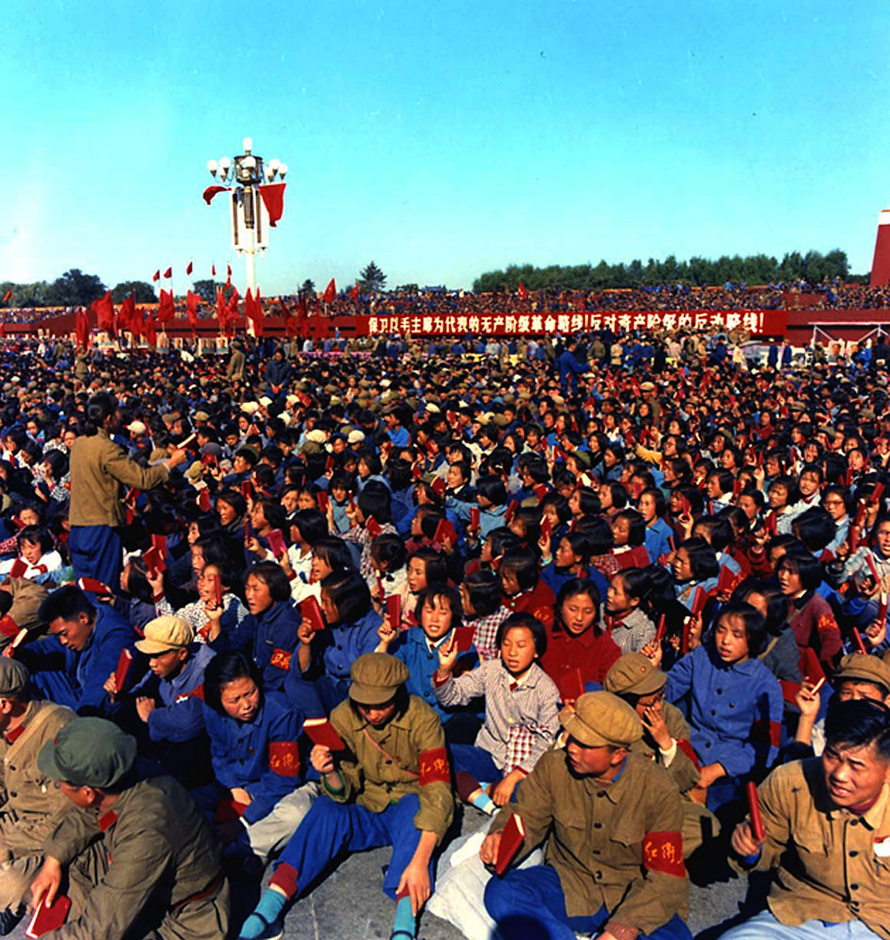
Red Guards during the Cultural Revolution – Tiananmen Square, Beijing, 1966

Cultural Revolution

The Three-Body Problem by Cixin Liu begins with a panorama of Beijing at the height of the Cultural Revolution, with factionists killing one another in street battles. Next we see a stage in a university square. Student paramilitaries denounce and beat a physics professor; they go too far and kill him.

The Netflix TV adaptation begins the same way. But the Netflix audience – and the western reader – mostly has no idea what the Cultural Revolution was. It’s not the business of the screenwriters to give you a history lesson. But western ignorance about China might leave many viewers with questions about this scene. For example, Jordan Peterson – who presents himself as very well-read and knowledgeable – thinks the Cultural Revolution (1966-1976) and the Great Leap Forward (1958-1962) were the same thing. His complete ignorance didn’t give him any pause for thought – he put out that claim in a published book, Maps of Meaning, and while he was at it he declared in passing that 100 million people died in this 18-year-long composite event. 

I’m pretty ignorant about a lot of things too – never read Jung. But I’ve visited China and read a few books about the place. The Cultural Revolution took place twenty-odd years after the communist victory of 1949. The 1949 Revolution overthrew the landlord class and delivered a massive expansion of health and education; hence why students who were babies in 1949 are, by 1967, so keen on it and on its foremost leader, Chairman Mao Zedong. But Mao messed up with a campaign called the ‘Great Leap Forward,’ contributing to a terrible famine, and afterwards he was sidelined.

The Cultural Revolution began four years later. It was half a student uprising against government figures who were perceived as conservative or bureaucratic; half Mao’s power play to get back in full control. It was a mess that got way out of hand. The way it’s depicted on text and screen seems fair to me, but the original Chinese reader had more context than the Netflix viewer or western reader. 

On the page and on screen we experience the same terrible episode: a teenage girl named Ye Wenjie watches as her father, a theoretical physicist, is publicly humiliated and killed. In the book, we are privy to her own thoughts and memories. Long ago, before the Revolution, her father met Einstein. Einstein pointed to a ditch-digger on the streets of Beijing and asked how much the guy earned. Instead of a deep discussion on the nature of the universe, Professor Ye’s only dialogue with Einstein consisted of telling him that the ditch-digger probably earned 5 cents an hour. 

This is one example of an opening that is rich in contrasts; likewise it is bizarre and unsettling how a discussion on theoretical physics is combined with a scene of pseudo-revolutionary ritual persecution and public torture. 

This is a moment of cruelty and hysteria, a moment when the human species comes across very badly. This does two things: it sets Ye Wenjie on a course to betray humanity, and in its depiction of a hysterical political rally it prefigures the later development of the Earth-Trisolaris Organisation. The first, at least, comes across clearly enough on the screen as on the page – the second, not so much.

‘Big-character posters’ bearing uncompromising political slogans, a hallmark of the Cultural Revolution, being pasted to a wall in 1967

Red Coast Base

After the worst excesses of the Cultural Revolution, the youth were rusticated en masse, sent out to the countryside to do hard labour and keep out of trouble. That’s where we next catch up with Ye Wenjie: with a logging crew in Inner Mongolia. She watches as ‘vast tracts of grasslands became grain fields, then deserts.’ 

Ye Wenjie sees the environmental destruction and concludes that humanity is to evil what an iceberg is to the sea – composed of the same material but just in a different form. Her dawning environmental consciousness is warped in this misanthropic direction by her previous experiences. To make matters worse, the first person she trusted since her father’s death, Bai Mulin, betrays her. Long before having any idea that she will one day communicate with aliens, she concludes that ‘To achieve moral awakening required a force outside the human race.’

She gets her chance when she is sent to the mysterious Red Coast Base. Pages 46-48, describing the mysterious dish in use, are very tense, exciting and mysterious. The climax is when the birds fall out of the sky. Here the TV show hews close enough to the book. Again, what we lose in interior monologue, we gain in strong visuals. 

Ye Wenjie doesn’t like living at Red Coast base but it suits her. She seeks isolation after her experiences; it seems safer. But here, in her relationship with the commander and commissar, there is room for further betrayals, petty ones this time (pages 174-5).

The TV show hurries through the Red Coast portion of the book in a couple of flashbacks. This is a shame because, alongside the surreal videogame sequences, it’s the best part of the novel. 

An example of what we lose: on pages 180-183 we get to see internal government documents where the top-tier Chinese communist leaders discuss how to contact aliens. The first draft is full of heated revolutionary rhetoric but it is dismissed as ‘utter crap’ – don’t send big-character posters into space! A more sober draft follows. 

To its credit, the TV show keeps the part where Ye Wenjie figures out that the sun can be used as an amplifier for radio transmissions into space. The explanation in the book is too technical, but on screen it’s just right.

Her idea is dismissed, but she goes ahead in secret. She sends the transmission to the sun. In the book this is an awesome moment, even as Ye herself loses hope: 

Ye saw the rest of her life suffused with an endless grayness. With tears in her eyes, she smiled again, and continued to chew the cold mantou.

Ye didn’t know that at that moment, the first cry that could be heard in space from civilization on Earth was already spreading out from the sun to the universe at the speed of light. A star-powered radio wave, like a majestic tide, had already crossed the orbit of Jupiter. 

Right then, at the frequency of 12,000 MHz, the sun was the brightest star in the entire milky way.

As a plot point, this comes across clearly on the screen. But the sheer awesomeness of this moment is lost in translation. Likewise the moment, some years later, when she has a choice and betrays the human race. Everything has been leading up to this, but it’s still just enough of a leap that it shocks the reader. This is why Ye Wenjie is a great villain in the book.

The show leaves out some plot points too. In it, Ye has a baby with Mike Evans, her American collaborator. In the book, she has her baby with chief engineer Yang who works at Red Coast base. But in the book we see her commit an incredibly cold-blooded murder of commissar Lei. By an unhappy chance, killing Lei obliges her to kill her husband Yang at the same time. She kills them both – including the father of her child – without hesitating. 

Our view of this character changes fundamentally at this point – her betrayal of humanity is made real and manifest. This betrayal is not mediated by a computer screen or a radar dish.

The Earth-Trisolaris Movement

Something crucial happens in the book: Ye Wenjie goes to a local village and lives with the farmers there to have her baby. They donate their blood to save her and house and feed herself and her baby. In return, she teaches their children. This is a lovely section of the book. It’s a rebuke to the anti-human attitude she has adopted. ‘Something finally thawed in Ye Wenjie’s heart.’ (316-321) We see Ye in a different setting and mood from the military-scientific base and the Cultural Revolution era. Her horrific experiences were not the full picture; most of us human beings, while we have our burdens to bear, live lives that are far happier than hers. We do not experience such repeated and concentrated doses of inhumanity. And if she hadn’t, she wouldn’t have betrayed humanity. When we exploit and brutalise one another, we degrade humanity’s faith in itself, humanity’s integrity. When we harm a fellow human we harm ourselves as well.

Her next experiences set her back into her misanthropic groove. Her mother, who helped do the father to death, washes her hands of what she did, and even blames the dad for it. (324-5) 

Ye Wenjie then meets the three Red Guards who killed her father – in the TV show, there is thankfully a version of this scene. After their revolutionary ardour was exploited for political ends by a faction in the state, the three teenage girls were doomed to years of hard labour. There’s nothing left in them but bitterness, and they have suffered too much to be remorseful. I found this interesting; the mother is unrepentant because she has moved up in the world, and the girls are unrepentant because they haven’t. 

This entirely depressing experience counteracts all Ye’s tendencies toward ‘thawing.’ But we have seen that she has a soft side. 

This is relevant when we fast-forward a few decades to the development of the Earth-Trisolaris Organisation (ETO), a political group which is determined to help the aliens to conquer Earth. 

In the TV show it is not named as such, and we learn very little about it. This is a weakness of the screen version. Why would some humans wish to collaborate with aliens? What internal debates would such a movement have? These fascinating questions are explored and dramatized in the book but not on the TV show. 

They call each other ‘comrade,’ evoking the Cultural Revolution, but this is not a movement of idealistic students. ETO is made up of people drawn from the political, technical and financial ‘elites;’ it is explained that their grasp of science and their knowledge of the darker side of humanity makes them willing recruits. This tracks – Mike Evans is the son of a billionaire and thus alienated from humanity (no pun intended). Efforts to recruit ‘common people,’ meanwhile, have failed due to their ‘instinctive identification’ with humanity. (344-5) 

ETO funds all kinds of anti-science groups. This is touched on in just a single line in the show which is really a missed opportunity to say something very relevant to the post-Covid world.

ETO is divided into two factions: 

  • The Adventists wish to eliminate the human race. They realise the Trisolarans might not be much better, but don’t care. 
  • The Redemptionists, on the other hand, have developed elaborate fantasies about Trisolaran civilization, and think the aliens will save humanity from itself. 

A new and small third faction, the Survivors, is drawn from the small number of recruits from among the ‘common people’ – they hope to survive the war by collaborating with the Trisolarans. 

Much like the Red Guards in 1967 Beijing, the two factions are on the brink of an internal civil war. Ye Wenjie doesn’t much like any of the factions, who have departed from her original vision, but she especially hates the Adventists and plans to wipe them out. 

I’ve been praising the book a lot, but it has problems. From a zoomed-out distance, the ETO is compelling. But when Liu tries to show it in real life and real time, it fails to convince. Wang Miao infiltrates the ETO with comical ease; he attends a casual introductory chit-chat in a café, and is immediately invited to a major conference. The events of the conference contain subtle echoes of the Cultural Revolution scene at the start, and culminate in a moment of dramatic action. But the whole thing is stilted. Take it from a seasoned activist: this is not how internal disputes within a revolutionary party work. You don’t just have one meeting where you bring up everything all at once, and then trash it all out on the spot. Political conflict can be dishonest, drawn-out, and dirty – or, to put it kindly, it is richer and more interesting than how it’s presented here. 

Having said that, there’s proper drama in the showdown between the two factions, and that’s before the jackboot of the state kicks down the door and Da Shi and his men storm in. The TV show, by contrast, has a flattened ETO.

Until next time…

Next week I’ll look at the other major strand of the novel The Three-Body Problem: Wang Miao’s storyline set in the present day and concerning a flickering universe, a loutish and morally dubious cop, and a mysterious videogame. Of course, I’ll be comparing the original with how it was adapted for the screen. 

Did you enjoy reading this? Subscribe to get an email notification whenever I post:

Or browse the blog’s full archive.

Screen Adaptations of Dune

The new Dune is phenomenal. Two-plus years ago Dune: Part One got me out to the cinema for the first time since Covid and it was exhilerating. Part Two is reported to be even better. But Frank Herbert’s 1965 novel Dune has been adapted for the screen before, more than once. I have seen all these adaptations, because I have a strange fascination with Dune which is part nostalgia because I first read it aged 14, part a mature realisation that the things we enjoy don’t have to coincide with the things we believe in, and part, no doubt, reasons that could be best explained by Freud (sandworms), Marx (family retainers) and Edward Said (white saviour complex).

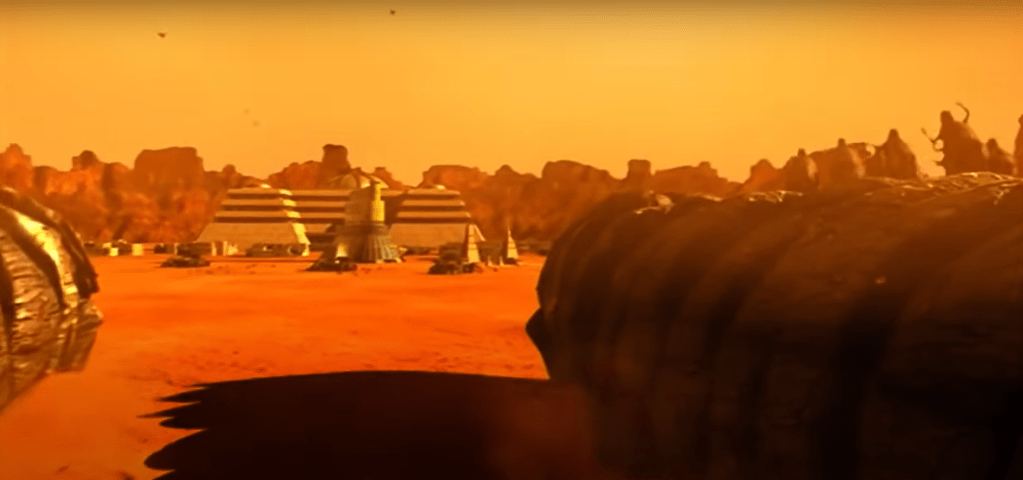
Freudian beasts, their hour come round at last, slouching toward Arrakeen. From the 2000 TV version, dir. John Harrison.

Enough deprecation. I also like this story because it’s exciting, intelligent and haunting. The author takes politics, economics and ecology seriously while telling a great story. How well has that translated to the screen?

This review will take a look at David Lynch’s 1984 movie, the Sci Fi Channel’s 2000 miniseries, and Denis Villeneuve’s 2021 adaptation of the first half of the novel.

Villeneuve is talking about adapting the Dune sequels. In a bit of a sequel to this post, we will look at the 2003 adaptation of Dune Messiah and Children of Dune.

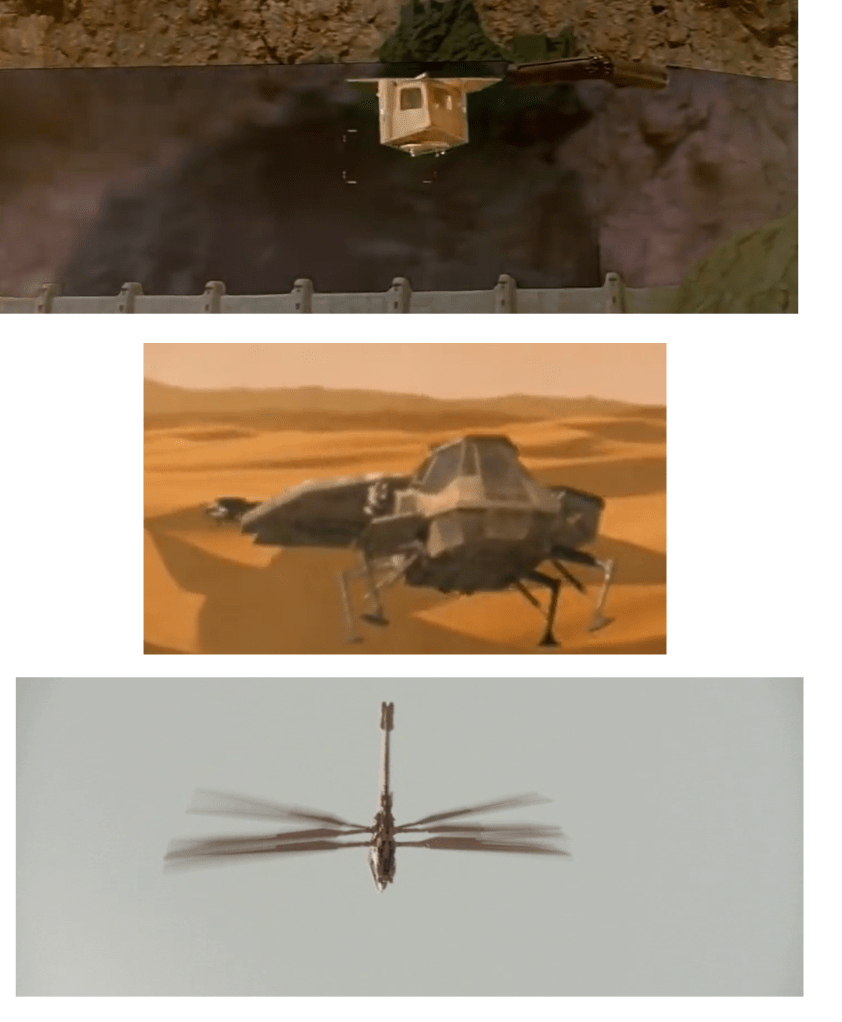
Three different versions of the ornithopter from, top to bottom, 1984, 2000 and 2021.

Harkonnen Horror Picture Show

God created 1984’s Dune to train the faithful. For every good thing I can say about it, there’s a bad thing too, and vice versa.

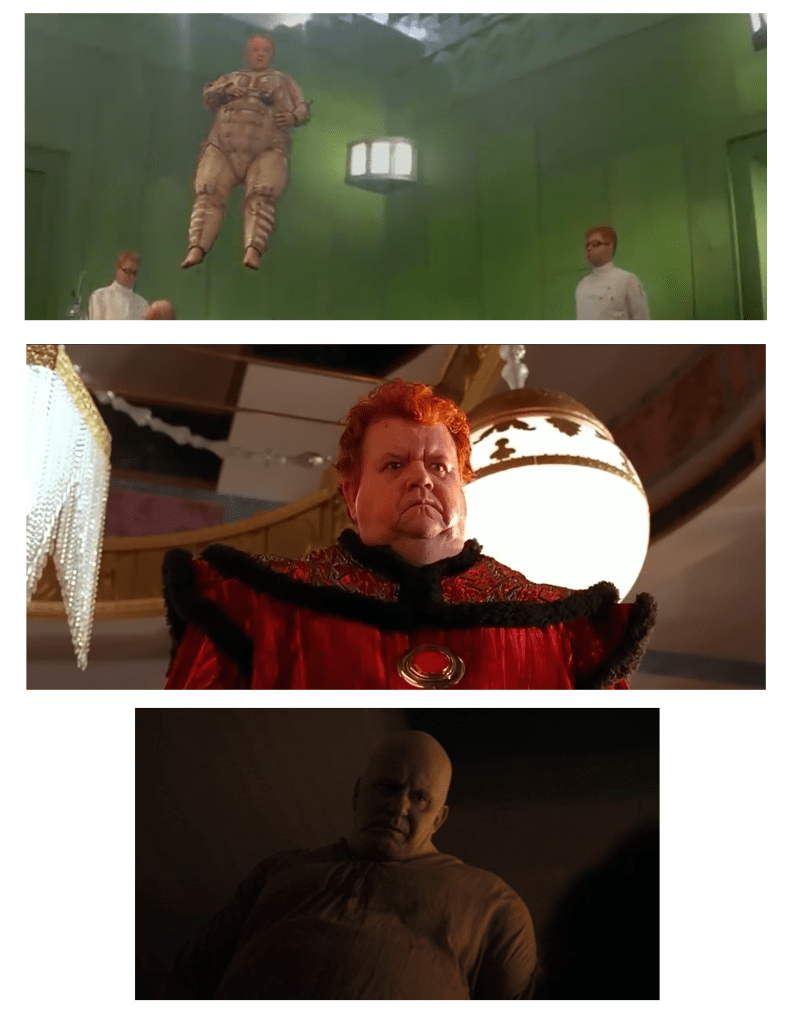
To begin with, something bothers me about the interiors. The Atreides live in surroundings of Victorian frumpiness, gaudy but flat, like the decor in Boris Johnson’s house; the Harkonnens in a green-lit space slaughterhouse. For all the implicit homophobia in the way the Baron is portrayed, something about the campiness of the whole set-up makes me think the whole evil cabal might jump out of their chairs and start singing ‘Time Warp’ at any moment. But other elements of the visual design are brilliant – the guild spice navigator and his cohorts, who prefigure the fascinating visual excess of Warhammer 40,000; the tonsured Bene Gesserit; the faceless rubber menace of the Harkonnen troops.

The spaceships look cool; but the visual sequence in which the guild navigator bends time is slow, unclear and not necessary.

I like the weirding modules. These are invented out of whole cloth for the movie: in short the Atreides have a special weapon that can kill with the utterance of a sharp syllable. This idea fits pretty well in the world of Dune and helps the story along. For example, it explains what’s so special about Paul from the point of view of the Fremen: he brings a powerful new weapon to the table. But the shields, personal force-fields used by combatants in the universe of Dune, look silly.

Top to bottom: Kenneth McMillan, Ian McNiece, and Stellan Skarsgard as Baron Vladimir Harkonnen. Top to bottom, the colour pallettes of a 1980s movie, a TV show from 2000 and a 2020s movie

The movie is rushed and incoherent. It might have gotten away with telling such a huge story in just over two hours, but it goes out of its way to be confusing and to trip us up on irrelevant things. It’s difficult to imagine anyone who hasn’t read the books being able to follow what’s going on. But the final half-hour strides along with a formidable momentum and plenty of cool imagery.  

At the very end of the movie it suddenly rains on Arrakis – a development that makes no sense in the logic of the world, but which is absolute magic on a simple storytelling and thematic level. I can see why they couldn’t resist.

It’s a movie I could talk about, back and forth, is it good or is it bad, for a long time.

The guild spice navigator, from the 1984 Dune, dir David Lynch

A very delicate time

The opening of 1984 Dune is problematic in ways that are thrown into sharp relief by the quality of the 2021 Dune’s opening. In 1984 Dune, we begin with Princess Irulan, a very formal narrator who stares straight into the camera and explains things, followed by a scene in the imperial throne room. In 2021 Dune we begin with Chani narrating over a striking visual sequence. 

The 2021 approach is more democratic and materialist, centring the indigenous Fremen and the key resource they control rather than the galactic aristocracy. But it is also much better from a storytelling point of view: it is rooted in real and tangible things, while narrators and the high politics of throne rooms are distant and abstract. Chani is narrating but also participating in a sequence that conveys visually the importance of the spice, the oppression of the Fremen by the Harkonnen, and the transfer of power from the Harkonnens to another noble house.

The guild spice navigator in the 1984 Dune is a top-tier movie monster. In the books we don’t see him until Dune Messiah, but here he makes his grand entrance in the opening sequence. Unfortunately that is a big problem. Although he is cool, he is one of several big things that we don’t need to know about this universe right away, or at all. But the movie goes out of its way to foreground him.

From the 2021 Dune, dir Denis Villeneuve. Murky.

Comedians of Dune

The Harkonnen scenes in the 1984 Dune leave me with a vague impression of grotesque-looking people bellowing and jabbering monstrous things at one another, punctuated with maniacal cackling. The 2021 Dune is a bit humourless by comparison. There is an early moment in which Paul and Duncan Idaho share a chuckle. But that is an oasis in a desert of dourness.

There is, to be fair, one other joke in the movie:

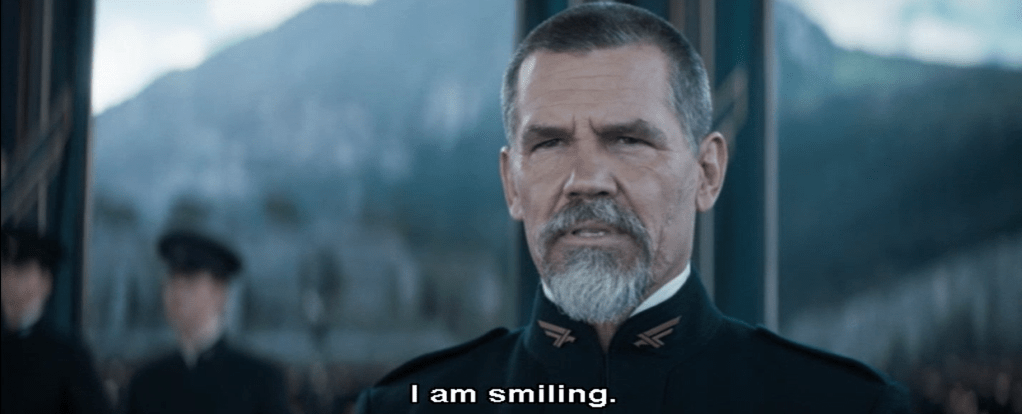
‘Smile, Gurney,’ says Duke Leto.

Scowling, Gurney replies: ‘I am smiling.’

Someone has decided to make Gurney ‘the grumpy one.’ It’s a good joke, delivered well by the actors. Is the movie taking a dig at its own serious tone? Or is it opening itself up to the retort: ‘Which grumpy one?’

Still, the 2021 Dune is better in almost every way. The storytelling and worldbuilding are far more skilful, conscious, economical; the screenwriters treat words as the Fremen treat water. The visuals play with light and shade, convey weight, grit, thirst, scale. It does not lack that essential quality: weirdness, accident, quirkiness (Who thought of giving the Atreides bagpipes? Give them a medal) but it doesn’t allow that element, either, to get in the way of the story.

In any adaptation, fidelity to the original is not crucial for me. Things have to change in the move from one medium to another. A change for the better, or a change necessary for the medium, justifies itself. But for what it’s worth, the 2021 Dune is much more faithful to the original. Both other adaptations resort to arming their extras with projectile firearms. But in the book and the 2021 version, shields have rendered firearms obsolete, and combat is primarily a hand-to-hand affair.

Budgets of Dune

An even smaller point against the 2021 Dune is its portrayal of the city of Arrakeen. In a movie that cost $165 million to make, this key location appears to be nothing more than a scale model, entirely devoid of human life. The 2000 TV adaptation, working with a budget of $20 million, manages to convey a lively and bustling place. (In case you’re wondering, the 1984 Dune cost about $40 million.)

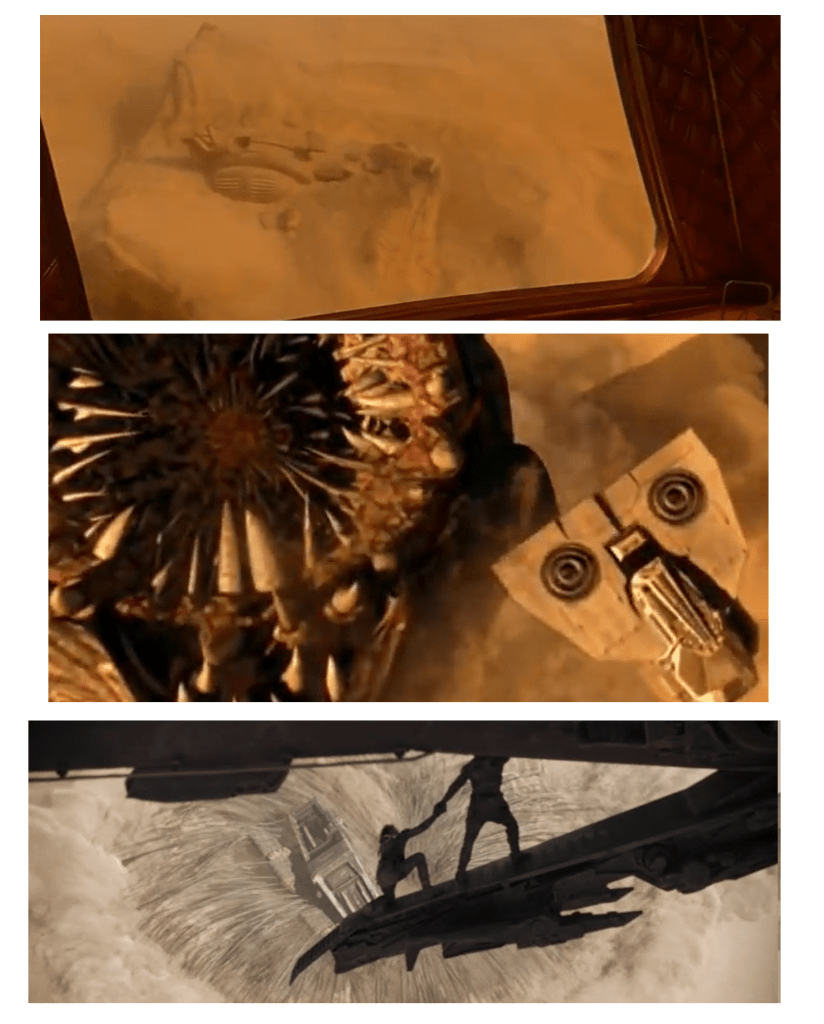
The same moment in three different versions: fleeing by ornithopter as a sandworm eats a spice factory. Top to bottom, 1984, 2000 and 2021.

Now we come to the most obscure adaptation, Frank Herbert’s Dune, a three-part miniseries for the Sci Fi Channel written and directed by John Harrison.

(It was one of three very fine miniseries released by the Sci Fi Channel around that time, along with Steven Spielberg’s UFO epic Taken and Battlestar Galactica. The latter ended up running to the proverbial six seasons. It was an underappreciated moment in the history of ‘prestige TV’.)

I’ll level with you up front: Frank Herbert’s Dune is not visually spectacular – the CGI is dated and some of the costumes look tacky.

But the actors are impressive. It is long not because it is bloated, but because it has made a conscious decision to tell the story more fully and faithfully, without unseemly haste. Everything about this adaptation is confident and assured, as if having a smaller budget gave it much more freedom.

And about that CGI: on a technical level, it would not pass muster today. (Though nostalgia or irony might induce people to deliberately copy this style in the future – stranger things have happened). The images are well-composed and are shot and edited in such a way that, interspersed with live-action footage, they tell a compelling and comprehensible story. A lot of today’s filmmakers could learn a lot from how the CGI is used here, how John Harrison does so much with relatively little. The result is that a CGI-heavy action scene, such as when the spice factory is eaten by a worm, is a genuinely tense experience.

In a fantastic scene, the ‘Beast Rabban’ gets a personal comeuppance he never gets in the novel when he is killed by a mob in the streets of Arrakeen. I guess budget dictates that some additional scenes must happen in this set, to justify the expense of building it; but budgetary needs can coincide with storytelling needs. It is satisfying to see this showdown happen in this familiar place. In the novel, by contrast, we are told in the most perfunctory Shakespearian way that ‘Rabban, too, is dead’ – offscreen somewhere.

I don’t want to over-praise something that, after all, will have dated poorly, especially measured against the new big-budget spectacle. But here’s one last piece of praise: Frank Herbert’s Dune is the only adaptation to leave in the crucial banquet scene (into which it inserts the Princess Irulan and a bodyguard of Sardaukar. It’s important later that we know who these people are, so it makes sense to feature them here).

It was shot in Czechia, and you can decide for yourself whether that (a) results in lamentable whitewashing of the Middle Eastern elements or (b) to your great relief, distances the adaptation from the wild orientalism of the novel.

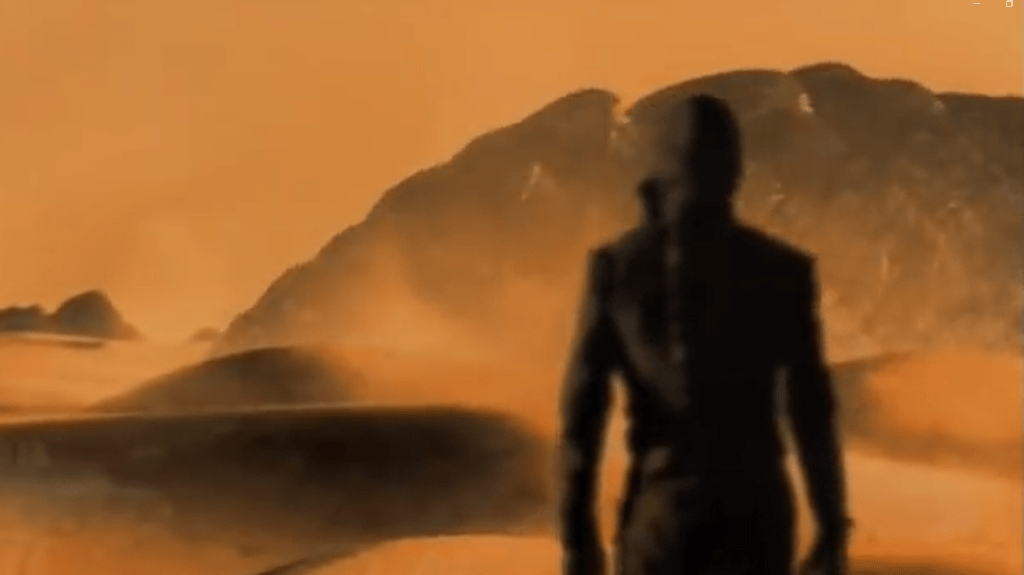
Paul in stillsuit watches a sandworm’s back cresting the sand. From the 2000 version.

Recommendations of Dune

If you want a spectacular modern science fiction epic, well-conceived and well-executed, with current stars and big budget, you should watch the Denis Villeneuve Dune.

If, like me, you are really into Dune and also interested in the process of storytelling and adaptation, these versions are all deeply intriguing.

If, like me, you are interested in things that are good but also kind of bad, you should watch David Lynch’s Dune. The highs and lows are equally bold and striking.

If you liked the 2021 Dune and want to know more, but aren’t much of a reader or can’t get into the books, the 2000 miniseries is a good place to go to delve deeper into the story. It would be a good option for someone who prefers the pacing and serial form of TV shows. It also has the great advantage that it has a direct sequel to introduce you to the later books in the series.

Next week I’ll talk about that sequel: the novels Dune Messiah and Children of Dune, along with the TV miniseries Frank Herbert’s Children of Dune (2003). Stay tuned for that if you want to hear about how a low-budget TV adaptation can be better than the source material. Until then, enjoy Dune: Part Two.

Home Page/ Archives

How Dune gets away with it

Review: Nova by Samuel R Delany (1968)

In the 32nd Century, a crew of misfits blasts off from an obscure corner of our solar system on a quest to the heart of an exploding star.

Delany’s prose does justice to the awesome premise. Here is the moment of take-off: ‘And the moon fell into Neptune; Neptune fell into the sun. And the sun began to fall. Night exploded before them.’ (p 41)

Much later in the quest, the crew arrive at a sun known as the Dim, Dead Sister. It is described as follows: ‘the explorer who decided to name the outermost of the Dim, Dead Sister’s planets Elysium had indulged a poor joke. With all the planoforming devices available, it was still a frozen cinder ellipsing at trans-Plutonian distances from Her ghost-light, barren and uninhabited.’ (p 181)

It is no spoiler to throw in these two lines from the climax of the novel. A ship ‘received the shuttle boat like a cannon shot in reverse.’ (p 225) A while later, I won’t say what page, ‘the star went nova. The inevitable is that unexpected.’

Humanity has spread out across many stars and worlds, forming three distinct polities. A key contradiction of capitalism has been overcome by means of a technological innovation that makes labour fulfilling rather than alienating. But at the heart of the plot is a battle between corporations for an extremely rare fuel, Illyrion – so yeah, there are plenty of contradictions left in capitalism.

From the cover of the 1st edition

By attempting to harvest a massive quantity of Illyrion from the heart of a star as it goes nova (that is, explodes catastrophically!), ship’s captain Lorq Van Ray is not only risking his life and his senses, and not only attempting to settle a feud with some powerful enemies – he is also blasting wide open the economics and politics of interstellar humanity.

For the most part the novel follows through on its promise. Along the way, there’s a lot of food for thought, particularly in the discussions between two crew members, Katin and Mouse.

This is a novel set in a new interplanetary society, where people feel rootless – like the 20th Century with its urbanization. Someone complains (p 46) that ‘We live in an age when economic, political and technological change have shattered all cultural tradition.’ This is a platitude, but it’s deliberate; Delany is well aware that people in every age have said similar things. In this age as in others, people who say such things are mostly wrong, and the novel is quietly demonstrating this to us throughout.

This is a story about a sudden, revolutionary change, and that is offset by Delany’s focus on a deep human culture thousands of years old. The story blasts off, but the setting has a certain weight and grounding. Mouse, the artist, represents a cultural continuity. Before his mission across the stars, we get page after page about his adventures on Earth – an Earth that is not so different from our own.

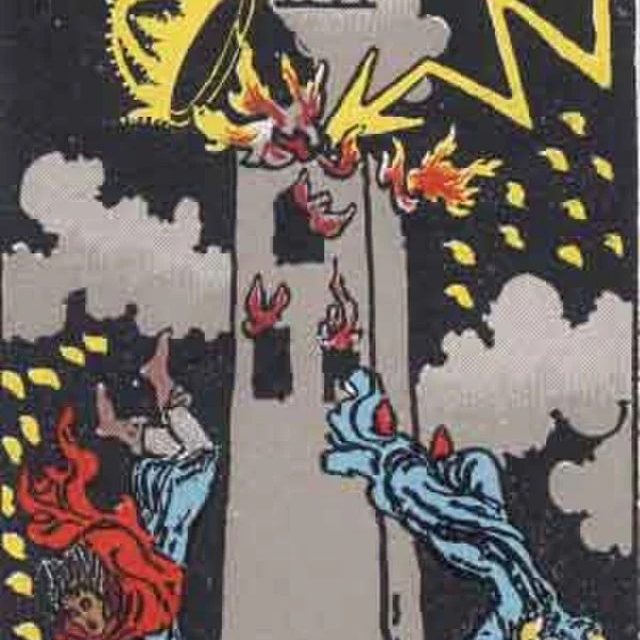
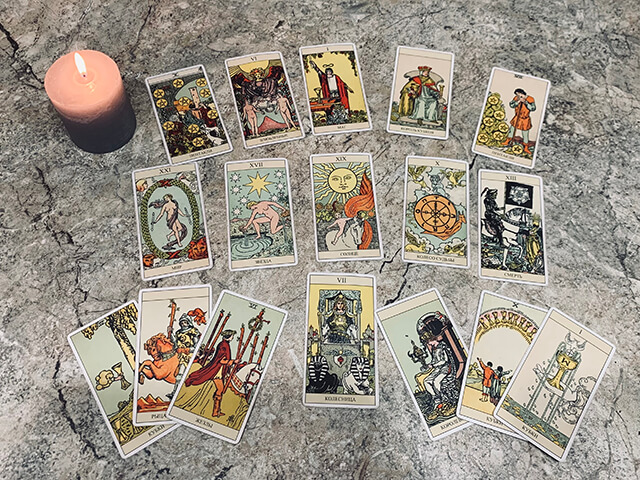
This is also where the tarot cards come in. Katin, the educated man, thinks that to be ‘skeptical about the Tarot’ is ‘a very romantic notion’, linked to ‘petrified ideas a thousand years out of date.’ (p 123) The people of this world believe in the scientific efficacy of tarot.

The flashback which explains Lorq Van Ray’s motivations is very strong. The climax of the story is exciting and really pays off. I love the syrinx, a musical instrument belonging to Mouse, an object which earns its keep in different and unexpected ways for the entire novel.

But Nova suffers from a slow middle – one of the most obvious cases I’ve seen in a while. Out of 240 pages, it meanders from about page 120 to page 200. There seems to be little purpose to the characters’ itinerary and activities. Katin’s lectures are interesting but not always relevant. My attention sagged when Delany began to dwell on the Tarot cards and picked up again when the bad guys suddenly showed up to crash the good guys’ hiding place.

I have a few other complaints. Sometimes the descriptions aren’t clear enough to do justice to an action scene – there was a fight involving nets and gas on a flight of steps which I just couldn’t visualize. On page 202 we are told, ‘a hand slapped Lorq’s sternum, slapped it again, again. The hand was inside.’ What does this phrase mean? Whose hand? It was inside his sternum? How?

Lorq, Katin and Mouse are good characters, and their rapport facilitates a lot of exposition, most of it neat. Katin seems confident and Mouse seems taciturn, shy. But Katin over-thinks and, beneath it all, he’s anxious. At one point Mouse has to reassure him, ‘Hey […] It’s all right. I like you. I was just busy, is all.’ (p 177) It’s rare for Mouse to speak, so it’s telling that when he chooses to speak his words are kind. But while the other members of the crew have their interesting quirks, they never really live up to their potential.

The slow middle didn’t put me off, and had enough interesting ideas, conversations and images to keep me reading. But it lacked that rocket fuel which powered the beginning and end. The premise, the beginning and the end are more than strong enough to compensate. In hindsight, too, there are motifs and undergirding ideas running through the structure of the story – the idea of sensory overload, and linked to it the image of a person walking into fire like a bug drawn to a light – that lend the story power and coherence.

Go to Home Page/ Archives

10 underrated SF novels with great concepts

A few weeks ago I wrote about Dune. As I mentioned, its underlying concept isn’t actually that great. I wrote, ‘It’s about a teenager who […] becomes emperor of the galaxy by convincing native people that he’s their god,’ and then I added something about phallic monsters.

Stated so baldly, the concept would actually put a lot of people off. The real brilliance of Dune, I argued, is in the delivery.

Here are ten Science Fiction novels which are not as well-known as Dune but which have it all: great concept and great execution.

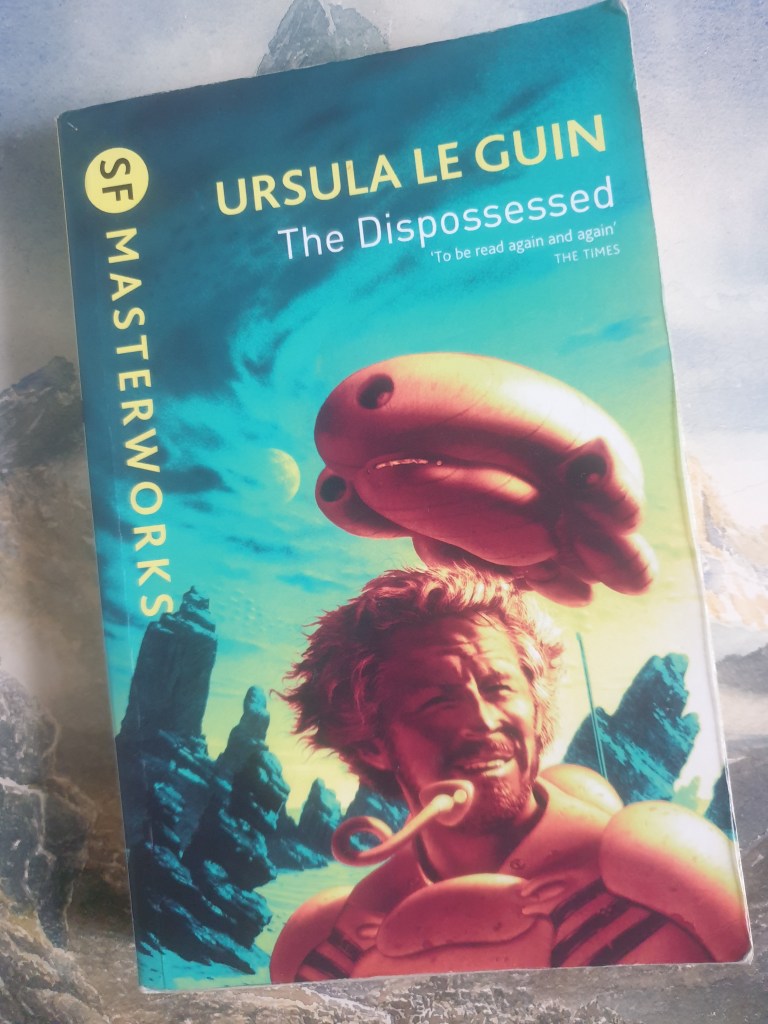
1. The Dispossessed by Ursula K Le Guin (1974)
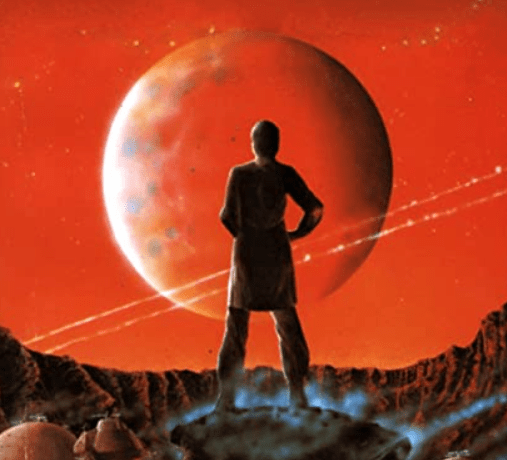
In The Dispossessed, the great Ursula K Le Guin sets herself the task of describing an anarcho-communist society. An inventor named Shevek has lived all his life on the arid moon of Anarres. On Anarres, all property is public and the state has ‘withered away’ – there are no police, courts or prisons, there is no money and no large-scale private property. On the basis of voluntary cooperation, this society is highly-organised and industrialised. It provides housing, food, healthcare and education to all.

But this is not one of those novels where the story is just window-dressing for a political lecture (a valid genre – The Iron Heel is very good on its own terms – but unpopular today). Anarres is not a utopia. This moon is poor in resources, so the common standard of living is not luxury. The dissolution of the family means that child-rearing can be left to institutions. Now, these institutions do a perfectly good job, but it’s obvious that Shevek has unresolved pain caused by his mother’s abdication of responsibility for him. Academic rivalry can get vicious. Political controversies still lead to violence, as we see in the first pages.

The story is about Shevek growing fed up with Anarres – though as he explores other worlds and societies, capitalist and sort-of Stalinist, he sees that they are far worse.

2. Rosewater by Tade Thompson (2016)

An alien lands in rural Nigeria. But this is not a slightly funny-looking humanoid in a flying saucer or tripod. It’s a vast biological presence, a kind of dome. Once a year it heals those afflicted by mutilation and disease, attracting a pilgrimage. But the real agenda of this alien presence is unclear.

Thompson shows how, decades later, a whole society has been reshaped by the alien presence, and we witness a shadow struggle of psychics and intelligence agencies.

3. Iron Council by China Miéville (2004)

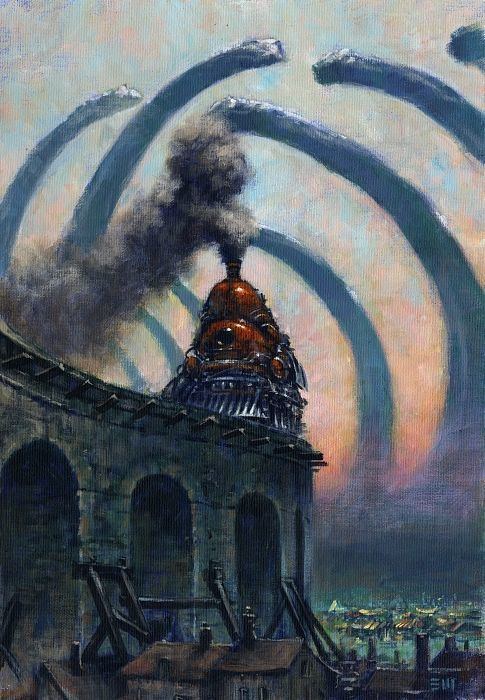
In a time when steampunk and fantasy Victoriana were cutting-edge, Miéville posed a very relevant question: in all these gears and goggles, where’s the steampunk Karl Marx? Where’s the steampunk Paris Commune?

That suggests the premise of Iron Council, the last part of the Bas-Lag trilogy (each can be read as a standalone). Civil war engulfs the city of New Crobuzon as the old regime clings to power in the face of a workers’ uprising. All this in a dark and floridly bizarre steampunk fantasy world where convicts are punished by being turned into semi-machines, and spirals can be magical weapons of mass destruction.

In Iron Council, Miéville also asked a question that nobody else would have thought of: what if a frontier railway-builders’ strike led to the creation of a nomadic railway-borne communist republic? What if this train had to rush half-way across the world to aid the New Crobuzon Revolution?

Today’s cover image, a painting of Miéville’s New Crobuzon from Alchetron.com. Original artist unknown

4. American War by Omar El-Akkad (2017)

In the near future, the southern states of the US start a civil war over a fossil fuel ban. In this novel’s bleak vision, war is a matter of misguided desperate people being crushed physically by high-tech weaponry, and crushed mentally and spiritually by prisons.

As the war settles down to a guerrilla struggle, a federation of Arab states sends agents into the sprawling refugee camps. They groom a generation of suicide terrorists to carry on what everyone knows is a doomed struggle. And that’s not even the worst part.

This bleak story draws you in with a well-drawn world and characters. It all feels painfully real. The foreign agents are prolonging this war for their own selfish geopolitical purposes – but that’s exactly what US agencies have been doing for decades, all over the world and especially in Arab countries. This parallel seems to emerge naturally from the story and world. It is not one-to-one and it is not immediately obvious. The world and story work on its own terms – though for me the ending was bit too extravagant to be credible.

5. The Three-Body Problem by Cixin Liu (2008, trans 2014)

How would aliens communicate with humanity? Imagine intelligent life that has evolved on a world whose rules and dangers we can barely comprehend. In Liu’s novel, these aliens explain their history to us through an incredibly trippy cult videogame that they infiltrate into our cyberspace. Our characters discover and play this game. At first it seems totally bizarre, but meaning gradually emerges from it. This is how the aliens communicate with the humans, and how the novel communicates with us. We come to grasp the mind-bending cosmic reality of an alien world.

What’s with the searing flashbacks to Mao’s Cultural Revolution? This ties in thematically with the alien story. There emerges a political movement of humans, fanatics who support the aliens and hate their own species. The moral of the story, implicitly, is as follows: all hail bloody state repression, the only force that can save us from dangerous fanatics, be they Maoists or alien proxies. It’s a horrible message but implicit, not explicit, and one that is unfortunately pretty common in cutural texts from all parts of the world, the US or Britain every bit as much as China.

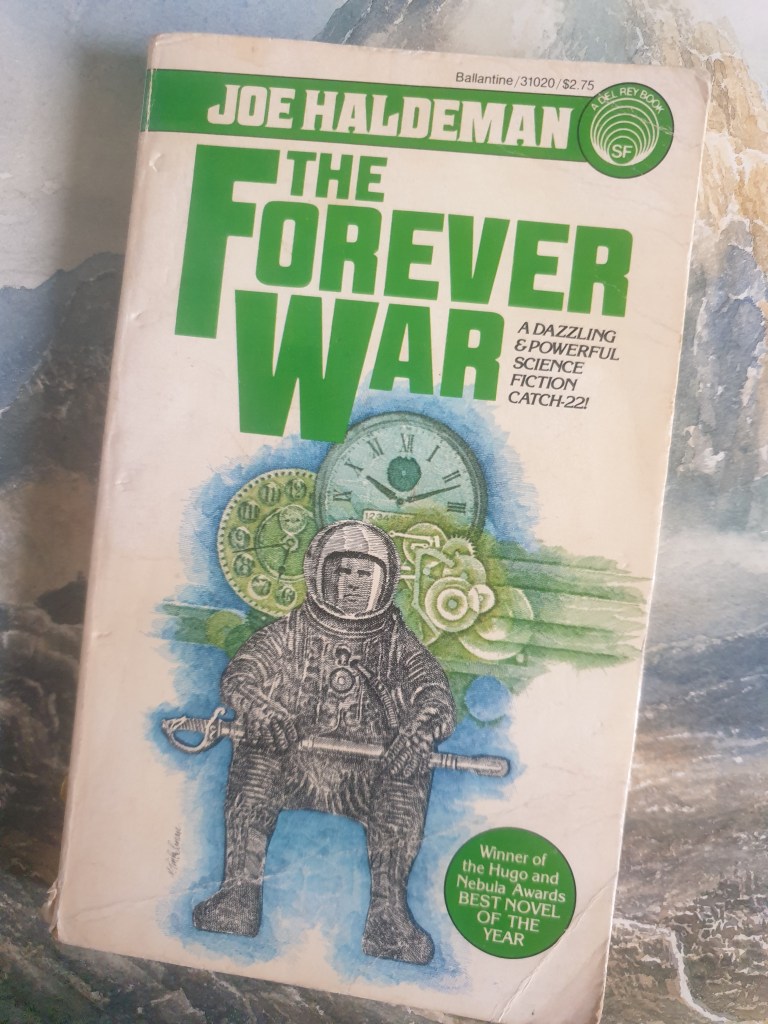
6. The Forever War by Joe Haldeman (1974)

A young soldier is sent to war on a distant planet. Our main character jets back and forth across the galaxy at light speed, from earth to the battlefields and back again; he ages a few months, but meanwhile on earth centuries pass.

The military sci-fi aspects are really well-realised, but the heart and soul of the book is the very literal ‘future shock’ experienced by Private William Mandella as he fights for a society he no longer understands.

7. Parable of the Sower by Octavia E Butler (1993)

In Parable of the Sower we watch a near-apocalyptic California descend into a post-apocalyptic California. But this is not Mad Max or Fallout. Violence is all around, but it is not the answer. The answer is to band together and help one another selflessly, and that is what we see happening, in spite of suspicion and scarcity.

The main character is a visionary young woman who is making up her own religion. Certain other Science Fiction prophets have used religion to wage intergalactic jihad. But in Parable of the Sower, it is a creed of compassion and mutual aid, with obvious relevance for the tasks which face our band of survivors.

Meanwhile, the causes of the collapse of society are not singular or simple. There is no alien invasion, zombie virus or nuclear strike. It’s simply that corporate power has grown to a terrible scale and has destroyed society, the economy and the environment. The start of the novel is not too distant from the reality today.

8. The Stone Sky by NK Jemisin (2017)

On the Broken Earth, devastating earthquakes are a regular occurrence. Enter the orogones, humans who can control geology with their minds. This makes them saviours but also potential destroyers; an orogene in a fit of rage can cause a whole town to collapse into an abyss.

The Stone Sky (2017) is the third part of the Broken Earth trilogy. (Yes, you have to read them in order). The Fifth Season (2015)and The Obelisk Gate (2016) are great in their own ways, but in The Stone Sky the brilliant concepts are fully-developed and the mysteries are revealed. Most importantly our characters, who have often seemed like shadowy sketches, emerge fully into the light. The relationship between the main character and her daughter define the novel, and at the climax of the story everything comes together in a single moment, a single decision. Yes, after all the horror we get a happy ending.

9. Judge Dredd: Complete Case Files 2 (1977-1979)

credits from 2000AD.com:

WRITERS CHRIS LOWDERJOHN WAGNER & PAT MILLS

ARTISTS BRENDAN MCCARTHYBRETT EWINSBRIAN BOLLANDDAVE GIBBONSGARRY LEACHMIKE MCMAHON & RON SMITH

LETTERERS TOM FRAMETOM KNIGHT & JACK POTTER

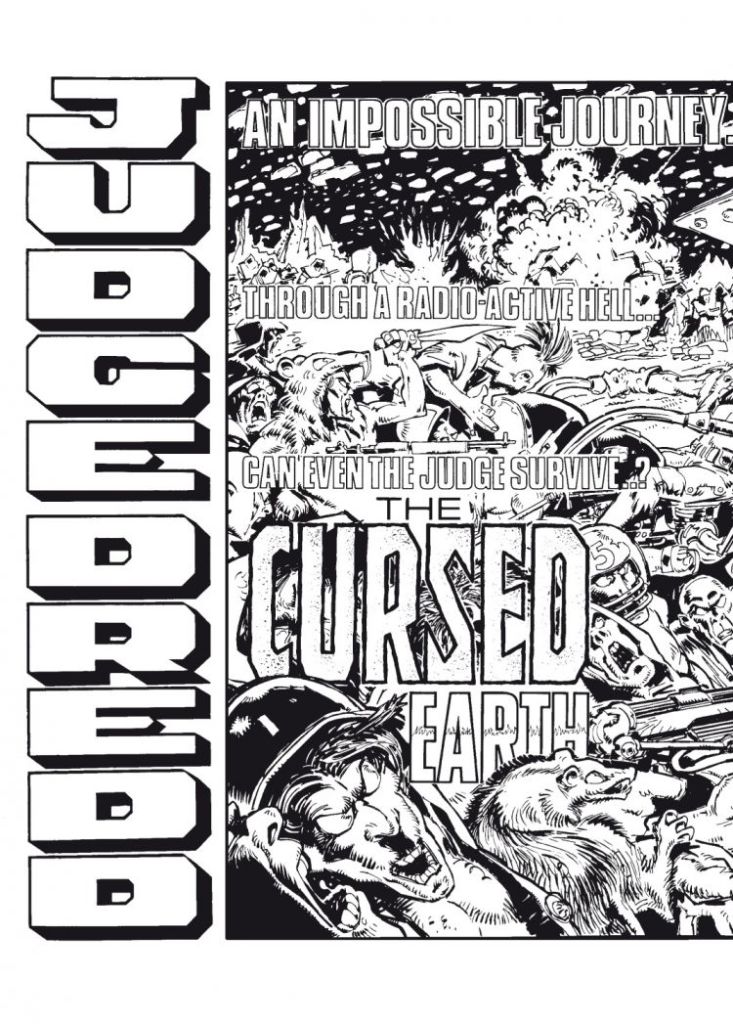
Judge Dredd and a punk biker have to cross a nuclear-wasteland USA on motorbikes. Crazy adventures ensue. This is the Cursed Earth Saga. Dredd and co are attacked by a tiny but fierce robot general, free a captive alien king, and come face to face with the cryogenically frozen president who caused the nuclear war. It’s wacky, fast-paced, gruesome and sometimes disarmingly tender.

From 2000ad.com

Dredd returns to his futuristic mega-city. He’s not there five minutes before the insane Judge Cal seizes control of the city. Inspired by the reign of Caligula, the story traces a very satisfying back-and-forth struggle between Dredd and Cal. Cal descends into ever-more ridiculous and evil excesses until finally he sentences the entire population to death and lines them up to be eaten by alien mercenaries; Dredd raises a revolution, arms the people, and links up with unlikely allies such as the sewer-dwelling mutant Fergie.

In the decades since these stories came out, Dredd has had many satirical and epic and memorable adventures. But to my mind they has never quite equalled the Cursed Earth and Judge Cal.

10. The Water Knife by Paolo Bacigalupi (2015)

Rounding off the list, an all-too-topical premise. In The Water Knife, the whole south-eastern United States have dried up. The cities are dying. Bloody struggles and intrigues unfold as leaders try everything short of all-out war to seize control of the water supplies. The ‘Water Knife’ of the title is Angel, a tough guy who secures water supplies for Las Vegas.

Something like this is going to happen. I happened to see online just the other day that the water levels in Lake Mead, Nevada, are frighteningly low. Bacigalupi brings to life what it could to mean for politics, culture and the dark underworld of organised crime and the secret state. 

Go to Home Page/ Archive

Detail from the cover of a vintage edition of The Disposessed