
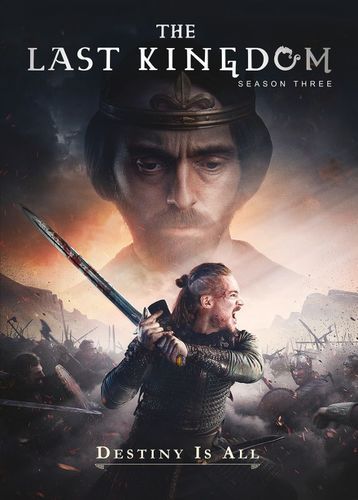
The Last Kingdom has come to an end. I watched nearly all of it and enjoyed nearly all of what I watched. But by the third season I was already aware that it was a kind of modular story, constructed from parts that would show up again and again, reused in new configurations:
- Danes invade Saxon lands
- The Danish leader, like a James Bond villain’s henchman, has some eccentricity of costume or behaviour
- Uhtred is tempted to join his Danish friends
- A Saxon nobleman is scheming for his own benefit and to the detriment of the kingdom
- The King of Wessex is being unreasonable and listening to bad advice
- Uhtred expresses anti-clerical views, but there is a specific priest (or even several) whom he admires
- Uhtred does something of which the Saxons disapprove
- The King of Wessex banishes Uhtred
- Uhtred, though an outlaw, resolves to save the Saxons
- Uhtred convinces the King of Wessex to redeem himself
- Uhtred, through clever tricks, wins a battle and saves the Saxons
Drop a comment if I missed any.
(Spoilers Below)
But The Last Kingdom was a good show. In between these reusable blocks there was much material that did not fit this repetitive pattern, such as Breda acting as a foil to Uhtred, diverging ever-further from him and from his Saxon friends. With each turn of the wheel her actions grew more extreme until suddenly she was up in Iceland doing throat-singing and human sacrifices.
We could make similar points about several other characters, such as Aethelfaed and Aelswith, real multi-dimensional personalities. The women characters in particular got to operate autonomously from the repeating story blocks and the elements of ‘stock character’ which this imposed on Uhtred, the King, the Scheming Nobleman, the Big Bad Dane, the Good Priest and the Bad Priest. And often the Stock Characters and modular blocks were executed so well it was difficult to be bothered by the repetition.
The Last Kingdom has come to an end with a movie, Seven Kings Must Die, in which most of these blocks of story got one last airing. I can’t deny I felt something stir in me when Uhtred finally saw Valhalla with his dying eyes. For five seasons and a movie he has been torn between Saxon and Danish worlds. He always came down on the Saxon side, but in death he finally gets to drink and boast with long-dead comrades and enemies. But of the faces laughing around the eternal mead-table, I could only definitively put a name to one (Breda, naturally).
I was struck, in Seven Kings, by the drabness of the world of this story. Maybe this is because I was watching The Last Kingdom at movie length, or maybe it’s because I recently saw the samurai epic Ran, which is awash in colour. Uhtred’s Anglo-Saxon England is all greys and browns in a murky filter. Some people on the internet who want to ‘RETVRN’ to back-breaking agricultural toil (of the feudal and not the gulag variety) think there’s a screen conspiracy to make the Middle Ages look bad by suppressing the colours. I don’t buy the conspiracy angle. Creators and audiences feel that bright colours are tacky and cheesy. Indeed, Ran is brilliant but some of the costumes do look synthetic. Organic colours and non-plasticky textures feel more authentic. Whether they are or not, I don’t know, but they are certainly a cheap and easy way to make things feel authentic. Maybe this shortcut to ‘authenticity’ has run its course culturally.
Seven Kings ended with a great battle scene, but some damage was done by the scenes immediately preceding the clash. It was not clear who was where, how many soldiers they had, or where those soldiers came from. A little more care here would have gone a long way.
The worst thing you could say about The Last Kingdom is that it was a bit boring at times, especially in the last two seasons. That’s where I skipped a few episodes. My loss of interest, I think, was due to the repetition. They filmed it all in a replica medieval village in Hungary, and it was obvious that one ‘town square’ location filled in for multiple towns. By about Season Four the viewer is too familiar with these interiors and exteriors – not the comfortable and evocative familiarity of a definite location which we know well, but the tiresome familiarity of the same kinds of places filling in for the same kinds of places. The interchangeableness of locations mirrored the interchangeableness of story elements, and both undercut the best efforts of writers, crew and cast to make each season fresh and exciting.
The first season was definitely the best – the set-up for the whole show is great, and early on the elements of repetition have not yet set in. The other seasons had great high points – the attack on Dunholm, or Uhtred’s first failed attempt to reclaim Bebbanburgh, or the time he and Breda tried to talk to their friend’s ghost. I am interested in this period because it’s not yet the Middle Ages, though you can see the outlines beginning to emerge; everything is DIY, rough and ready, down-to-earth, organic. I felt this story conveyed that sense of the period well.
The script for The Last Kingdom, like the visuals, never shone with brilliance. But it never made me groan or cringe either, and sometimes it moved me. The writing was never less than competent, and sometimes more than. I studied this historical period in college and, watching The Last Kingdom, I noticed very few of the anachronistic howlers one usually finds in these kinds of things.
There was a characteristic moment in Seven Kings: Uhtred makes a speech about how they must forge an English identity from diverse communities, and Finan pipes up ‘I don’t have to say I’m English, do I?’ It was a neat moment: the 21st-century Irish actor might be ad libbing, or the 10th-century character might be speaking from a point of view rooted in his own time. Uhtred has competently (not brilliantly) given the story a sense of theme and purpose; without undermining this, Finan has managed to cut across any danger of grandiosity or chauvinism. Somebody was paying close attention to what was being said, and I appreciated that.
 The 1919 Review