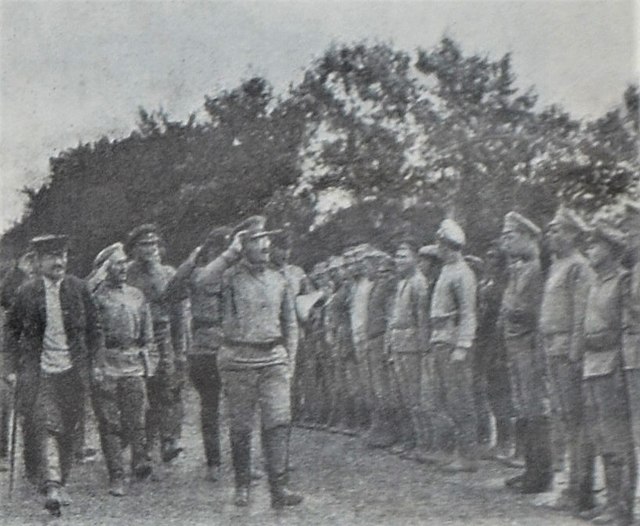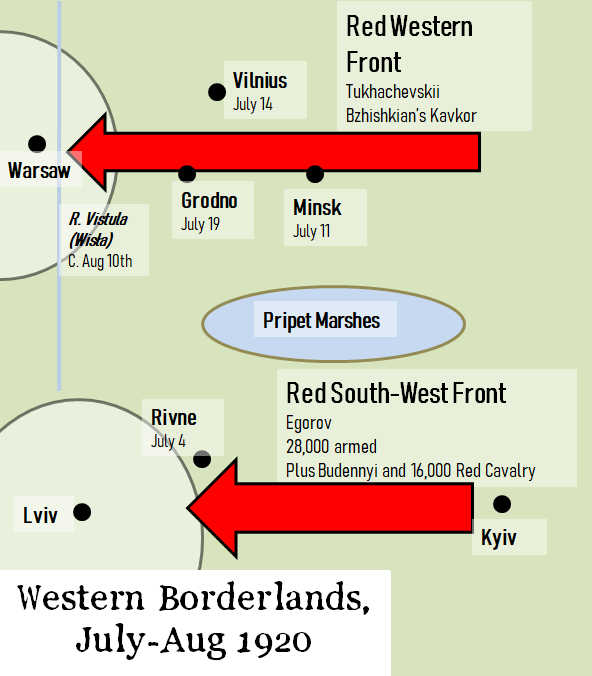
Dr Zhivago – Is it accurate? (3) Civil War

This is the third part of my  notes on a re-watch of David Lean’s Dr Zhivago, a 1965 historical epic about the Russian Revolution. I’m going through it with an eye to historical accuracy.

Here is part one…
And here is part two.

The first two parts have been mixed – sometimes the crew really seem to have done their homework but we’ve also seen some things changed for the sake of simplicity (fair enough), some big things changed in order to reinforce the movie’s theme (Not so fair enough), and some things changed for no apparent reason at all.

Now it’s time to get to the part that most interests me, the film’s presentation of the Civil War. Unfortunately, it’s messier than anything we’ve seen so far.

The burned village

Yuri and his family are on a train passing through the Ural Mountains when they see a burned-out village and, on rescuing a woman from the ruins, learn that the Red commander Strelnikov ordered the burning to punish the villagers, who were falsely accused of selling horses to the White Armies. There are several ways that this is implausible.

First, this is winter 1917-18 in the northern Urals. Until the Czechoslovak Revolt of May 1918 this was a peaceful region. There are no Whites here to buy horses. Maybe this could be happening at this time in the Don Country or Turkestan, ie thousands of kilometres away. But not here.
Even in the Don Country, or one of the other places where strings of battles flared up and died down at this time, we would be unlikely to see the burning of a village.

The Reds did worse things than this during the Civil War. But at this point in the movie we are only a few months out from October. The war has not begun yet, the cycles of violence have not had a few goes-around yet. And when we do see Red reprisals against a village, these would be targeted against the wealthier inhabitants.

What kind of atrocity would be plausible? A little later, food detachments descended on villages to confiscate surplus grain, and this naturally led to conflict. A scene serving the same purpose but involving some excess by a food detachment would make sense here, and the chronological fudge would be forgivable.

Strelnikov, armoured trains, Red Army
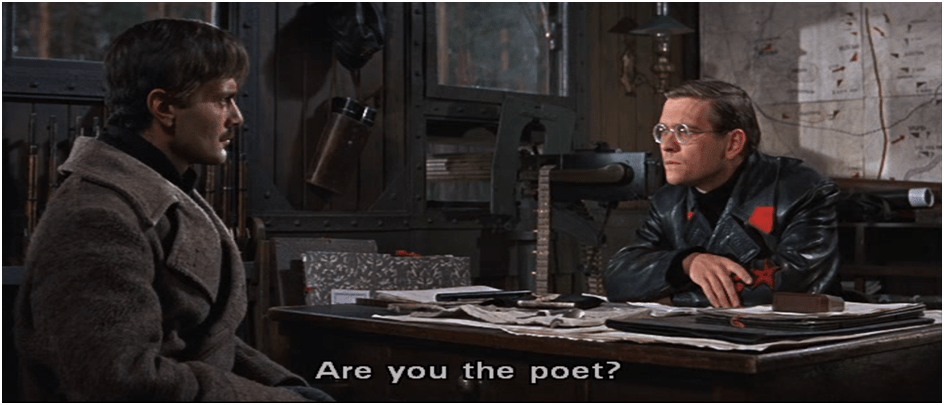
Armoured train interior. Note the machine-gun pointing out a loophole right beside Strelnikov’s desk. Neat detail.

Yuri goes for a walk while the train is stopped, and stumbles on an armoured train commanded by Strelnikov (a nom de guerre that means something like ‘shooter’). His real name is Antipov and he is Lara’s estranged husband. This is another of those scenes that gives the impression that revolutionaries were grievously offended whenever a man wrote poetry.

One of my readers, a socialist like myself, sent me this message regarding Antipov/ Strelnikov:


‘Hey interesting take on Dr Zhivago. I always assumed that Antipov was based on a crude portrayal of Trotsky ie not in bolsheviks or mensheviks, total fanatic and bordering on a latter day incel (‘the personal life in Russia is dead’ because of revolution, actually Trotsky wrote on how the revolution awakened the Russian personality [after] years of oppression) and then there’s his role in civil war later in the film.’


I replied:


‘Yes, the armoured train etc. maybe the filmmakers were going for Trotsky […] I see him more as one of these very romantic left SR types [members of the Left Socialist Revolutionary party, the Bolsheviks’ early coalition partners] who zigzags between sentimentality and ultra leftism […] He seems to me a lot like an early Red Army commander named Muraviev although important differences too.’


The first three de facto commanders of the Red Army (the above-mentioned Muraviev, then Vacietis and Kamenev) were non-Bolsheviks. Cooperation with the other parties and non-party individuals was the rule in these early days, especially with Left SRs and anarchists. That Antipov is resurfacing as a Red commander at this point makes a lot of sense.

Meanwhile his behaviour make sense for his character: his insistence on his ‘manhood’ and his apparent revolutionary ardour are a defence against the deep pain and vulnerability in him. If his private life really is dead, it haunts him. His fanaticism and cruelty would be a better fit for later in the war, but atrocities occurred this early (though not anywhere near here), often at the hands of non-party Red leaders like Antipov.
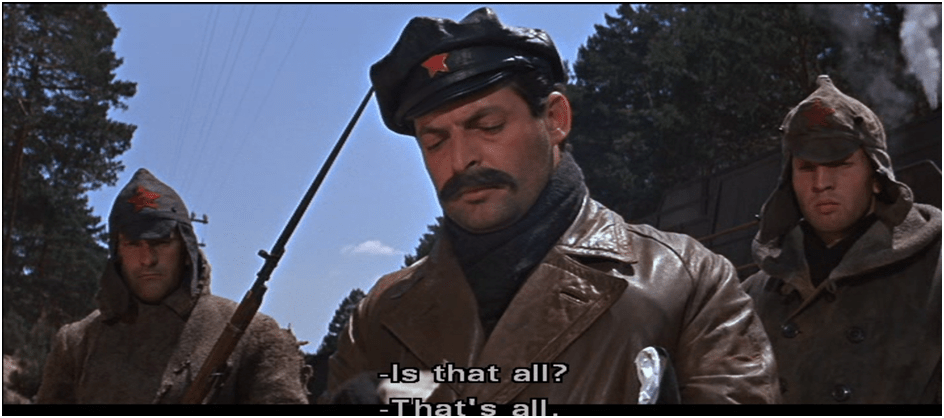
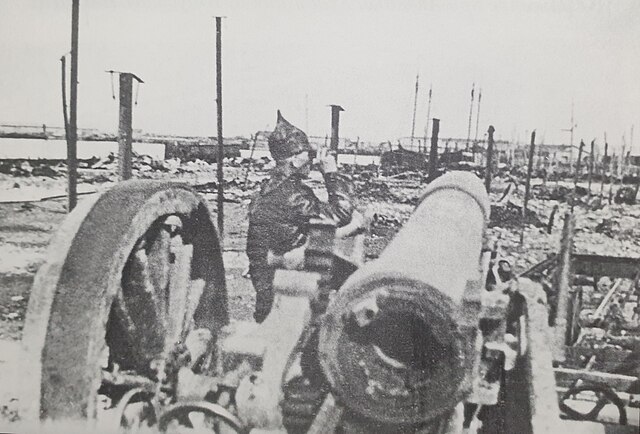
Two Red Army soldiers with pointed bogatyrka hats. All stills are from Doctor Zhivago (1965) dir. David Lean

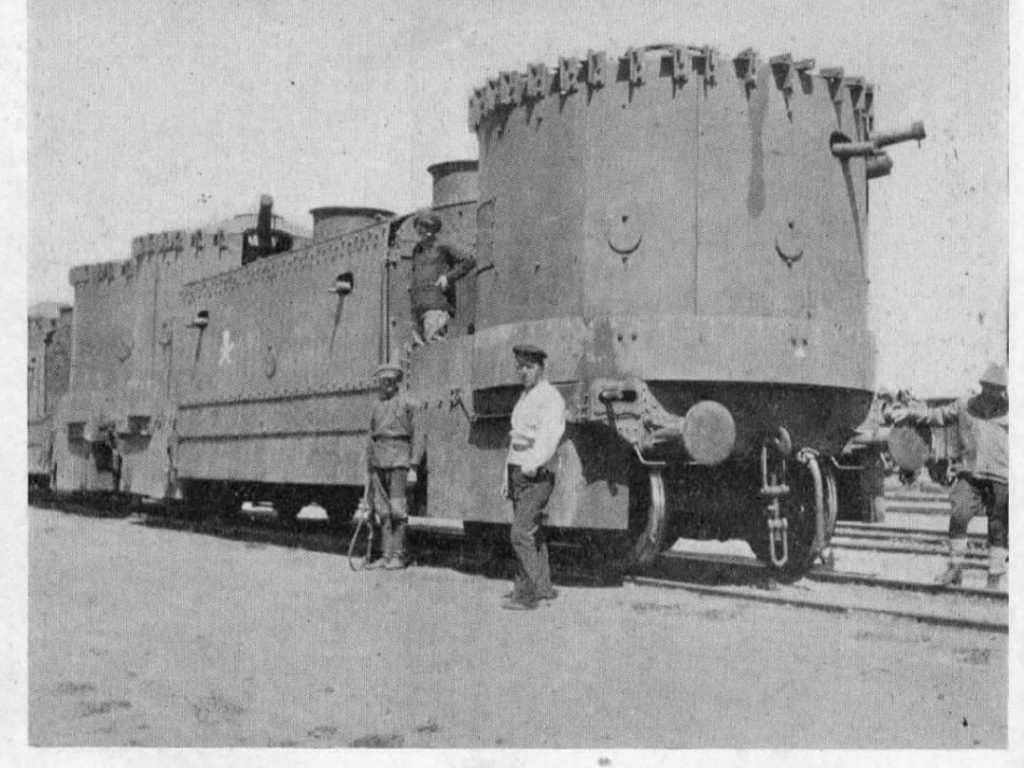
The rest of it does not make sense. On the one hand I’m definitely glad that in the one movie about the Russian Civil War there is an impressive armoured train, staffed by Red Army soldiers in the pointy bogatyrka hats. It would be a shame if that never made it into the vivid colours of mid-century film (likewise with all the cavalry we see later, these are features of the Civil War).

But when we see the armoured train, it’s way too early! It’s the first fine spring day of 1918. It was snowing a few days ago. There are no armoured trains yet. Trotsky’s train first rode out in August 1918 and it was still just a train, no armour yet. Early armoured trains were makeshift; for example one in Turkestan was armoured with compressed bales of cotton.

What about the uniform worn by the Red Army soldiers? It had not yet even been designed. It was formally adopted around January 1919 and it was nearly a year later before most Red soldiers were wearing it.
What’s more, the Red Army itself basically didn’t exist yet. It was a couple of months old, still very small, and entirely concentrated in the west, facing the threat of a renewed war with Germany. The Red Army wasn’t in the Urals at all, anticipating no military threat there (they turned out to be very wrong!).

This isn’t just a pedantic point of chronology. The movie is missing out on the most interesting and important fact: the Red Army just didn’t have its shit together at this stage.

What you would have in this region at this time would be Red Guards. They would be enthusiastic local civilians, say, part of the workforce of a local factory or mine, or a few hundred poor peasants. If the Whites reared their head, local people would flood into the Red Guards to meet the threat. They would do silly things, like abandon the frontline to go home for a hot meal and a change of clothes. But they would not burn a local village because their own houses would be in the village.

Yuriatin

We learn that the town of Yuriatin has changed hands: ‘first the Reds, then the Whites. Now the Reds again.’ Like the pointy hats and armoured trains, this would be plausible a year later but not now. No town in the Urals fell to the Whites before the Czechoslovak Revolt of May 1918.

We also learn that there are ‘the Reds in the forest. The partisans’. That’s another example of the movie’s bad habit of mentioning things way too early just because they are going to feature later (White Guards, Bolsheviks and now Partisans). A partisan movement developed across Siberia and the Urals later, after the Whites seized control. This movement really got going after Admiral Kolchak took over all the other White factions in his coup of November 1918 and began to persecute even the moderate socialists who had supported the Whites up to this point.

So that is how the Red partisan movement got started. They have no business mooching around in the woods in early Spring 1918. Who are they partisaning against? It’s like if a movie showed us the French Resistance taking refuge in the woods months before the German invasion of France.

The boarded-up mansion

Yuri’s adopted family have a mansion out here, which the local revolutionary committee has boarded up and declared property of the people. Landlords’ houses were indeed boarded up, to stop criminals from looting the books and fine furnishings and artworks inside (A few examples are given in Eduard Dune’s memoir, Notes of a Red Guard, in the chapter titled ‘Rob the Robbers’). Later the big house might be turned into an artist’s retreat or an orphanage.
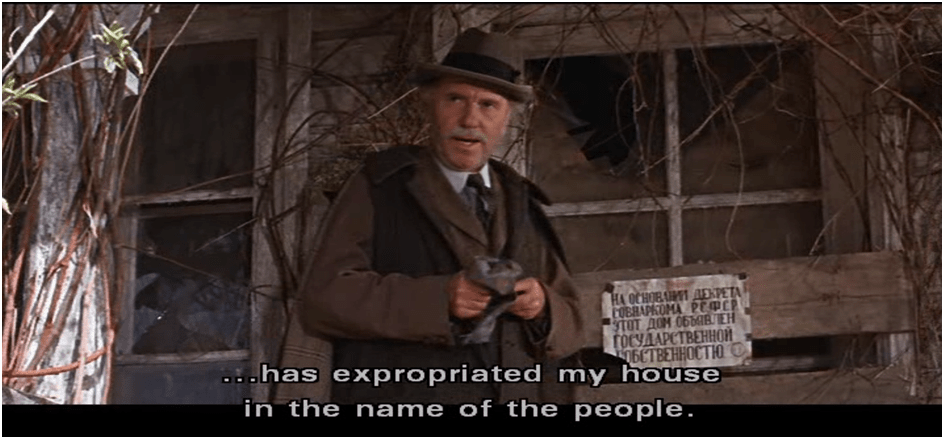
Here we get the movie’s only hints at the land revolution. The Varykino estate – the land, tools, livestock and buildings – would have been divided up between local farmers back in autumn. We get a glimpse of this when a local man addresses Yuri’s adopted father as ‘your honour.’ His very likeable response is: ‘Now, now, now. That’s all done with, you know.’

But he is not so easygoing when he sees the house boarded up. Yuri has to warn his adopted father not to tear down the boards. That would be counter-revolution, and ‘they shoot counter-revolutionaries.’ Again, a year later this would be a reasonable. At this point it’s not true and nor would he think it’s true.

Likewise, later we have several claims that deserters from the Red Army are shot. If that were true, the Reds would have run out of bullets and lost the war. They had literally millions of deserters, and the penalty was to lose pension rights on a second offense. Armed mutiny or suspected treason were treated with great harshness but desertion was treated leniently.

The Last Tsar

We can be absolutely sure that it’s still 1918 because that summer, when Yuri and his family are settled nicely in the cottage, bad news comes.

‘Not another purge?’ demands Yuri’s adopted father. This is a very strange thing to say. The first ‘purge’ of the Communist Party took place several years later and consisted of expulsions, not arrests or executions. The script is giving the impression that the Bolsheviks, by summer 1918, have already been through multiple rounds of bloody 1937-style inquisitions.

But no, the bad news is not ‘another’ purge. It’s that Soviet authorities in Yekaterinburg have killed the Tsar and his family. This places us in July 1918.

What doesn’t come across in the scenes of idyllic rural life that frame this news is that over the last three months, in the cut between this sequence and the last, the Russian Civil War has begun and escalated wildly, and the Urals are ground zero. Those Red Guards drawn from the local mine or factory would have been swept aside by professional soldiers – detachments of the Czechoslovak Legion, bands of officers and Cossacks. Those who could not escape westward to friendly territory would become partisans or be killed. The revolutionary committee down in Yuriatin who boarded up the estate are likely most of them dead. You would expect the Whites, on taking Yuriatin in June or July, to have come up to the estate of Varykino and restored to its previous owners full possession of the mansion and its lands. At the very least Yuri’s family should have some soldiers billeted on them; they are at the front line, on a piece of ground that will change hands four or five times between now and mid-1919 when Yuri is abducted by the partisans.
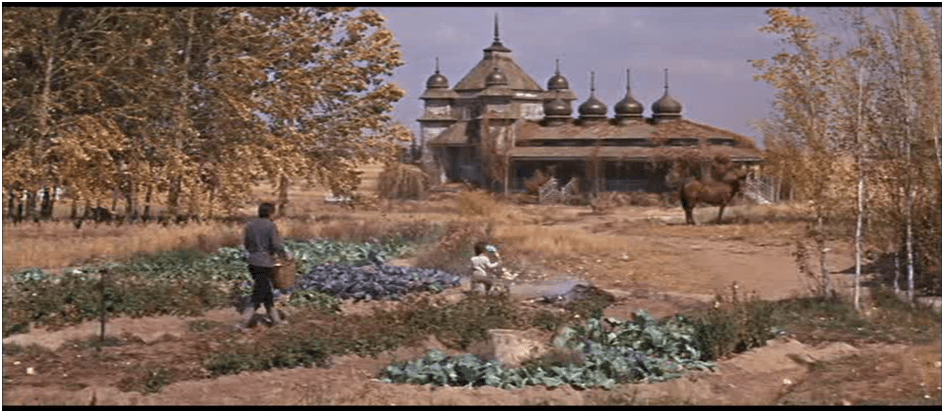
Idyllic scenes at Varykino

So we don’t see war when we should, and we do see it when we shouldn’t.

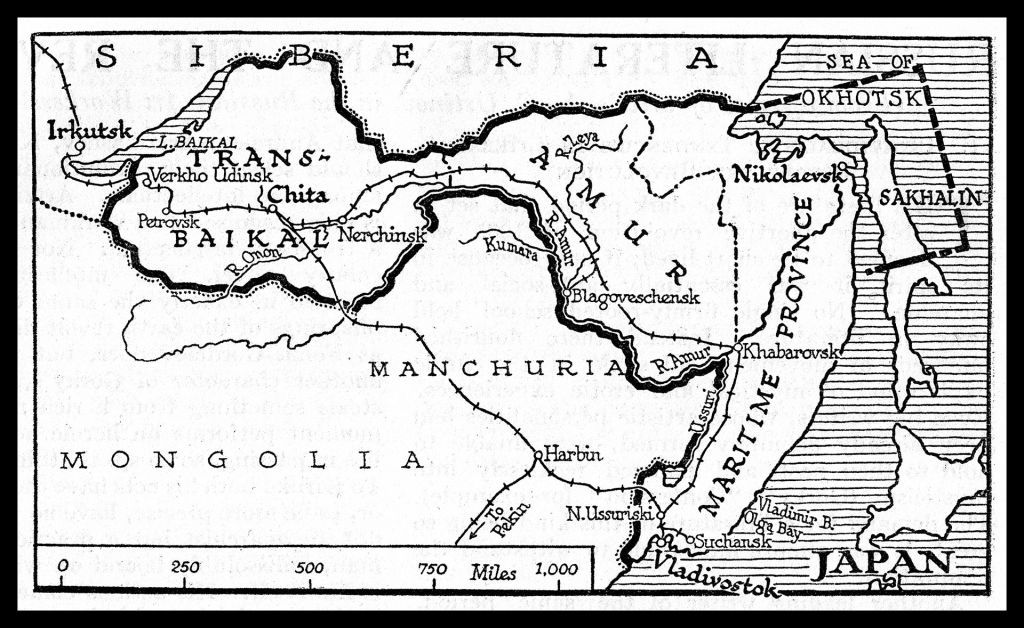
Incidentally, we also hear that Strelnikov has gone to Manchuria. I don’t know why would have gone there, but if he has, he’s a dead man. It’s wall-to-wall White émigrés and Allied agents in Manchuria, and the most violent and depraved White warlords control the territory between here and there.

Where are all the counter-revolutionaries?

Yuri is forced to serve as a doctor in a partisan unit for, by my reckoning, a year and a half, from summer 1919 to the winter of 1920-21. The timeline starts to make some sense. We see a charge across ice in late 1919; I’m not sure of the tactics on display here but really anything goes, because nobody really knew what they were doing in the Russian Civil War. Anyway, this might be the crossing of the Irtysh river in November. After forcing the river the Reds took Omsk, capital of  the ‘Supreme Ruler’ Admiral Kolchak. After that comes the Ice March, a long period of pursuit and mopping up. Then comes a long war against Ataman Semyonov and other warlords of the Far East, which drags on into 1922 (when the Reds take Vladivostok) and even 1923 (when the last White army is defeated). The various things we see in this sequence with the partisans could well be taking place during these lengthy, confused and far-flung campaigns.

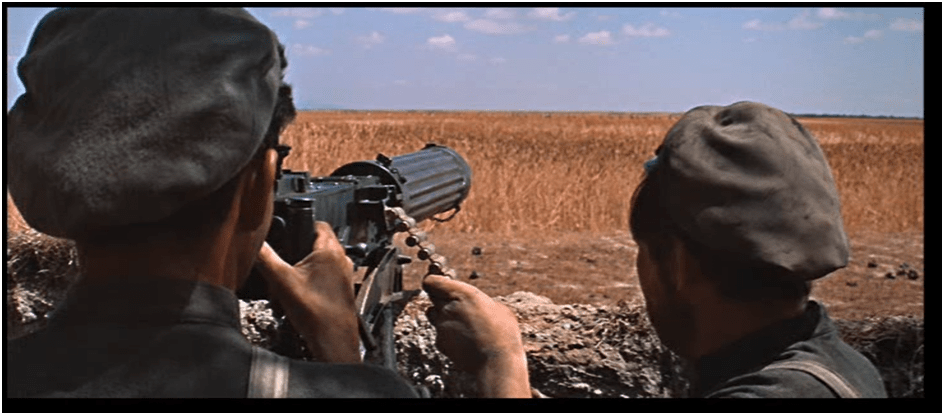
Rapid changes of season in these scenes indicate the passage of time from mid 1919 to the winter of 1920-21 in 20 minutes of screen time (although later lines of dialogue indicate that we are still in mid-1920)

A major problem with this movie is that we don’t properly see a single White Guard in all its three hours. People opposed to the Revolution are phantoms off-screen. In this sequence, White Guards are rifle flashes in the treeline, distant fleeing figures, corpses. There is no indication of who the Whites are, what kind of threat they pose or to whom, or what they are fighting for.

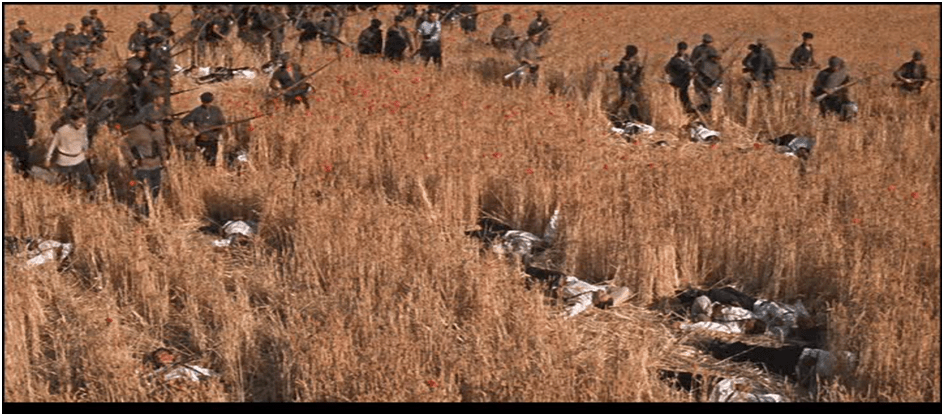
The only time we see White Guards, it is a pathetic showing. They are a few dozen of what appear to be military cadets, young smooth-cheeked men in white uniforms. They are quickly mown down with machinegun fire, after which the Yuri and the Reds inspect the bodies with looks of mingled pity and disgust.

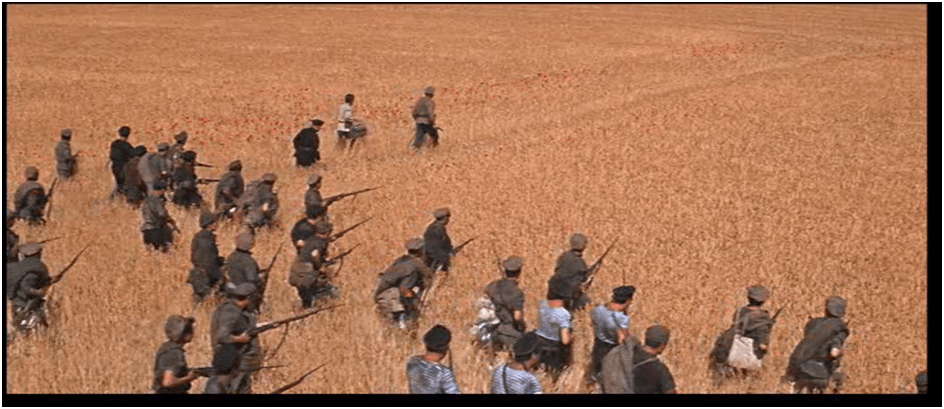
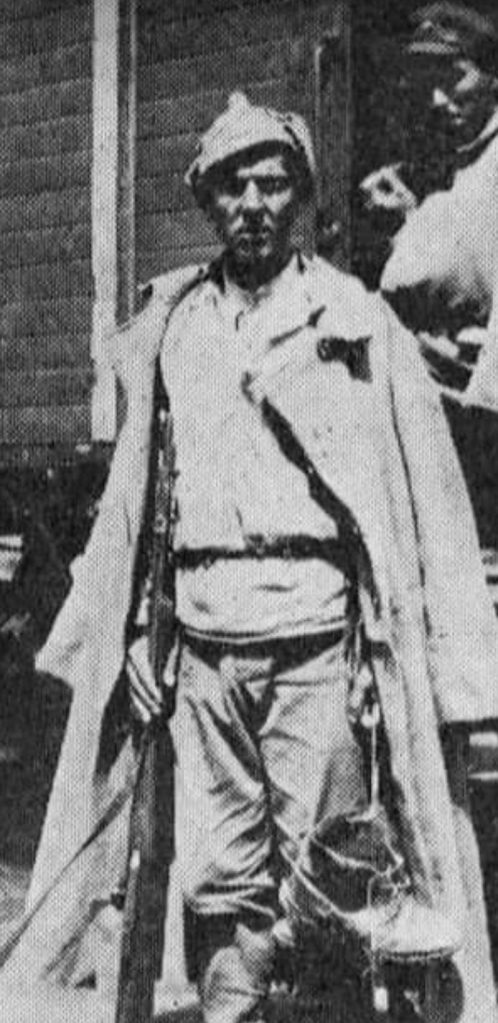
Note the irregular uniforms. There are even some sailors. This is what Antipov’s men should look like earlier in the movie, and their armoured train should be a line of bullock carts

The Red commander glares at the dead body of the White leader, a stuffy-looking officer, and growls, ‘The old bastard.’ This old-school Tsarist martinet has brought these kids on a hopeless crusade and gotten them all killed for nothing.

Presumably these are graduates of some military school set up under Kolchak. Kolchak’s officers did have a bad habit of sending raw recruits into hopeless offensives. In itself this scene is a fair comment on the White cause.

The problem is that it’s all we see. The Whites come across as small bands of foolish adventurers who don’t pose any real threat. In reality the Whites controlled three-quarters of the territory of Russia from mid-1918 to the end of 1919, and held onto sizeable chunks of it for years after. On the second anniversary of the October Revolution, their forces were simultaneously in the suburbs of Petrograd and at Orel on the road to Moscow. On two major fronts they massed over 100,000 fighters each, plus tens of thousands on most of the smaller fronts. They far outclassed the Reds in military expertise, and, thanks to the Allies, had parity or superiority in munitions and supplies. They also had the Allies themselves: several hundred thousand soldiers, sailors and pilots of the intervention. These White governments were repressive, violent and anti-Semitic. And they really had the potential to win the war.

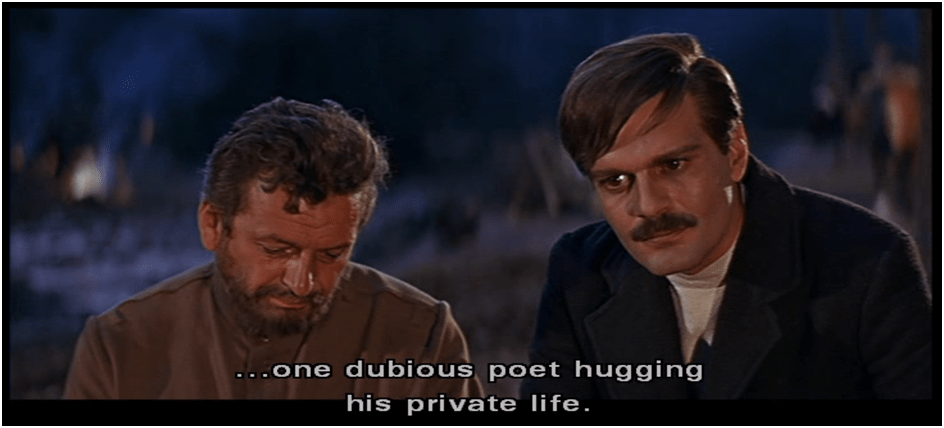
When you know this context, it’s easier to understand why the Reds we see in the movie are a bit uptight. But it becomes less easy to understand why Razin, the partisans’ commissar, seems to think his job is to scour all of Russia punishing ‘dubious poets’ and ‘unreliable schoolmasters.’ No. That’s not the partisans’ job. Their job is to fight behind the lines of a brutal military dictatorship supported by the most powerful countries in the world.

By the way, Razin is another one to add to our collection of Reds who are offended by poetry.
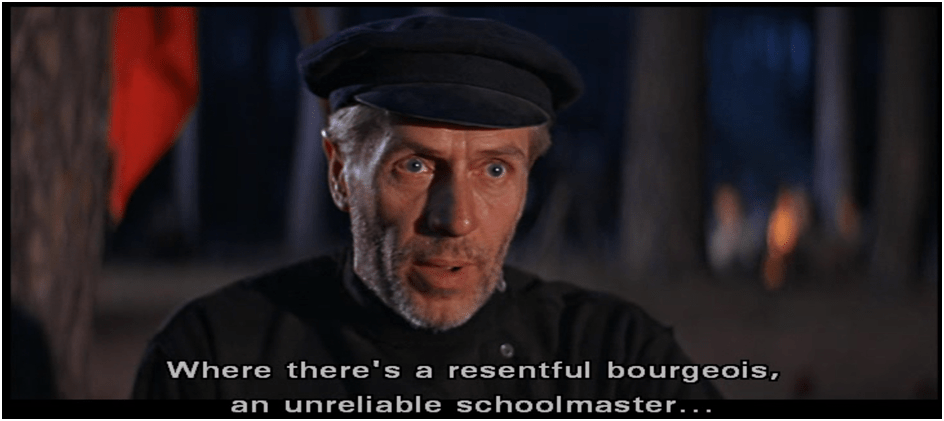
Noel Willman as Razin, the partisan unit’s rather intense political commissar.
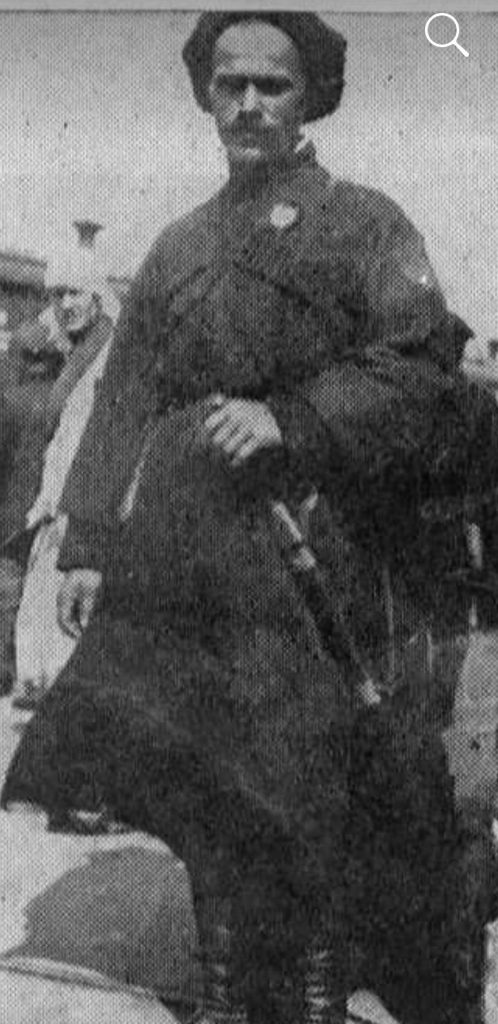
Gérard Tichy as Liberius, the commander of the partisan unit. The movie gives a general, though unsympathetic, sense of how dual command worked in the Red Army.

What is missing from this movie? There really should be a scene in which Yuri meets a plastered Cossack pogromist with earrings and a wild forelock, and a necklace made of gold teeth; or maybe a twenty-year-old who commands five thousand men, attends séances, wears the skin of a wolf, and snorts cocaine from the scalp of a murdered commissar. That would give a slightly exaggerated but reasonable impression of what the Whites were all about.

The war’s end

Yuri deserts from the partisans. He limps through a snowy landscape, pursuing huddled indistinct shapes which he imagines to be his wife and child. This captures the misery, confusion, exhaustion and dislocation of this moment in history, the winter of 1920-21. It was ‘Russia in the shadows,’ as HG Wells put it, the young Soviet Union bled white and traumatised from seven years of total war.

Yuri finds his family gone, but Lara is still around, and they shack up together. Komarovsky puts in an appearance, warning them that they are about to be arrested and shot and offering to protect them. Their ‘days are numbered.’

But why? Lara because she is the wife of Antipov/ Strelnikov, who has fallen foul of the Soviet regime for unspecified reasons; Yuri because of his ‘way of life’ – here we go again – ‘everything you say, your published writings, are flagrantly subversive.’ I thought his writings were individualistic, not subversive. And anyway, what has Yuri published in the last two years while riding around Siberia treating gunshot wounds and typhus?

By the end of the war the cycles of violence had taken many spins around and the Soviet security organs had developed harsh instincts. Since mid-1918 the Cheka and the revolutionary tribunals have shot tens of thousands of people, at a low estimate. So in one sense Yuri and Lara are right to be afraid and the film’s tone of doom and dread is not out of place.

But either Komarovsky is bullshitting them or the movie is bullshitting us. Lara has been estranged from Antipov since the outbreak of the First World War; I don’t think she would be on the radar of the authorities. And although many things have changed since early 1918 (a de facto one-party state, an all-consuming total war, years of hunger and epidemics) I feel the Soviet authorities would still really, really not care about Yuri’s poetry. He has never lifted a finger against the Soviet regime. His ‘way of life’ has consisted for the last two years of serving as ‘a good comrade [and] a good medical officer’ in a partisan unit behind enemy lines.

But Yuri and Lara believe that their heads are on the block. Lara and her two daughters, one a child and one unborn, go with Komarovsky. Yuri takes his chances with the Cheka, though they never do come for him, except in the form of Yevgraf who saves him from sleeping rough in Moscow.
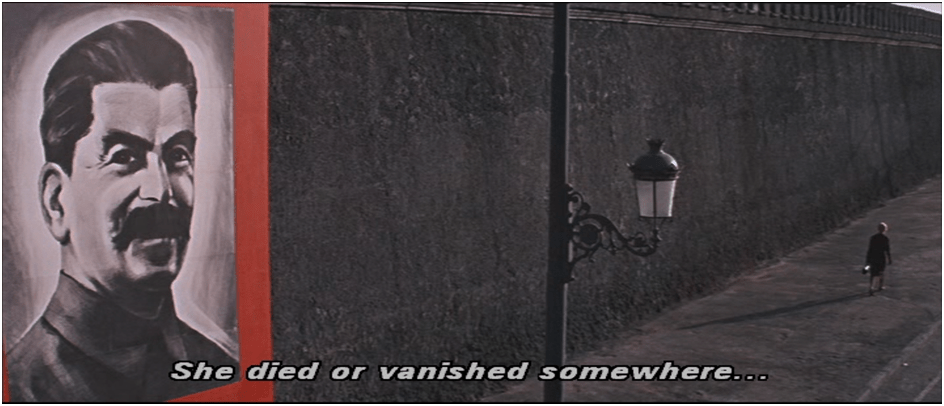
Back to the framing device

Meanwhile back in the future, Yevgraf and his niece Tanya have been talking all night, piecing together the story we have just witnessed. Now they finish the last few pieces of the puzzle. They do so very well as far as story is concerned. Not so much the history. Tanya (Yuri and Lara’s daughter) was ‘Lost at the age of eight when Civil War broke out in the Far East.’ She was born in 1921, so this would be 1929 or 1930. There was a brief Sino-Soviet War in 1929, but no Far East Civil War.

Yuri’s death rings true. Many who lived intense lives during the Revolution and Civil War succumbed to illnesses in the decade after.BOf course, there were epidemics and a shortage of medical supplies. But there was also a physical and spiritual exhaustion, which is what does for Yuri in the end.

Lara, meanwhile, ‘died or vanished somewhere. In a labour camp […] A nameless number on a list that was afterwards mislaid.’ The arrest of Lara appears to happen in the early 1930s, so before the 1936-9 terror. But it is still all too authentic. The population of prison camps run by the successors of the Cheka grew from 8,500 to two million in a few short years as the Stalin regime tightened its grip.

For all that, the film ends on an optimistic tone. Tanya plays the balalaika as her grandmother did, and her boyfriend seems kind, and rainbows grace the rushing waters by the dam.

And I’ll leave it there, at the end of the movie. I had a conclusion here but it ran on too long. I’ll finish and post that next week.

Meanwhile, if you want to read more about the Russian Civil War according to yours truly, check out my series Revolution Under Siege:

Revolution Under Siege

Dr Zhivago – is it accurate? 1: The Old Regime

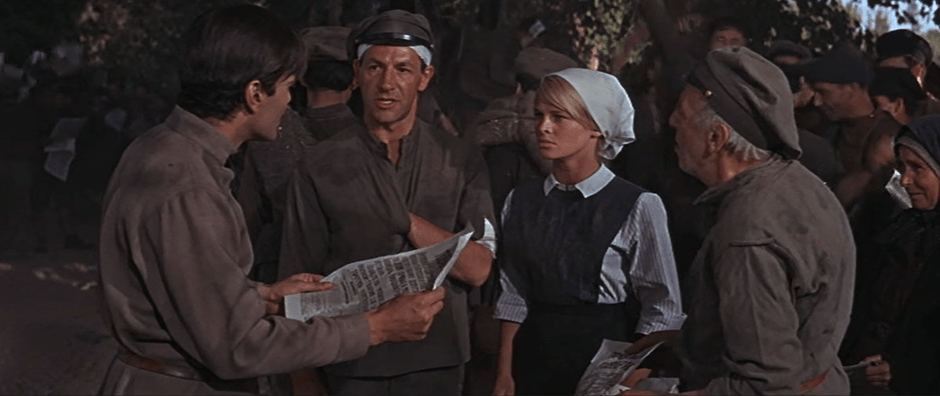
From the back of a lorry, men in red armbands throw leaflets to a cheering mob of soldiers. The unit’s doctor, Yuri Andreievich Zhivago (Omar Sharif), is handed a sheet by a bewildered illiterate elder.

‘The Tsar is in prison,’ Yuri reads aloud. ‘Lenin’s in Moscow!’ He looks up and adds, ‘Civil war has started!’

Yuri Zhivago (Omar Sharif), Kuril (Bernard Kay,  Lara (Julie Christie) and the old man (Erik Chitty). This and all other stills from Dr Zhivago, dir. David Lean, 1965

Yuri Zhivago and his unit are a little out of touch. Russia’s Tsar Nicholas II was arrested in March 1917 (Gregorian calendar), Lenin arrived in Russia in April 1917 but did not go to Moscow until early 1918, and the Russian Civil War started in May 1918. Yuri appears to be catching up on fourteen months of news. Word travelled slowly in revolutionary Russia, but not this slowly.

Most of the movie is not this bad and parts of it are pretty strong. I’m inclined to be generous to Dr Zhivago, a 1965 historical epic directed by David Lean, because the movie is generous to the viewer, serving up crowd scenes, spectacular landscapes and big, painful emotions.[i]

But this single line of dialogue is a succession of statements each of which is more jarring to my ears than the one before. It’s like someone scrolling on their phone and declaring, ‘A new coronavirus has broken out in China. American police have murdered George Floyd! Trump supporters have tried to stage an insurrection in New York!’ Note that I’ve got the city wrong and that I assume someone who’s just heard about COVID 19 somehow knows who George Floyd is.

Then again, maybe we will be watching that movie in fifty years.

The verdict of historian Jonathan Smele on Dr Zhivago is not generous: he notes that it is pretty much the only movie in English about the Russian Civil War, which is a shame because it is ‘mostly lamentable’ even though it’s ‘admirably snowy.’[ii]

Smele did not elaborate, but I’m going to,[iii] probably at length, over two or three posts.

This movie was enormously successful and popular at the time of its release. It raked in five Oscars and a ton of money. Very few English-language films have tackled the October Revolution and, aside from this and Warren Beatty’s Reds, none that I’m aware of have portrayed the Russian Civil War.[iv] So this movie, between its massive success and the lack of other films tackling the same subject matter, has had an outsized influence on how people in the English-speaking world see these events.

What follows are my notes on a re-watch of Dr Zhivago, focused on how it presents the history, sometimes comparing it to its source material (the novel of the same name by Boris Pasternak).

1: A flash-forward to… when?

Dr Zhivago starts with Yevgraf (Alec Guinness), an apparatchik in the Soviet security forces, finding his orphaned and long-lost niece and telling her the story of her long-lost parents, Yuri Zhivago and Lara Antipova. This frames the narrative in a neat way as Yuri and Lara are the couple who are canoodling tragically on the movie’s poster.

This framing device works… unless you’re a nerd like me, in which case it will leave you wondering when exactly this flash-forward is supposed to be happening. [v]

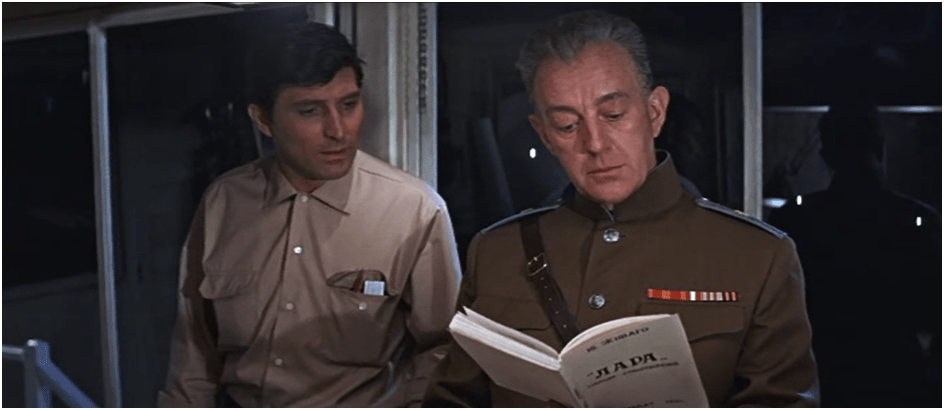
The engineer (I’m unable to identify the actor) and Yevgraf (Alec Guinness) reading a book of poems by Zhivago titled Lara

The niece, Tanya (Rita Tushingham), looks around twenty and we will learn she was born in 1921. Maths would suggest we’re around the years of World War Two. But clues in the scene suggest otherwise.

The overall situation (a hydroelectric dam that seems to be fully operational plus also a horde of women and girls recruited from reformatories excavating rock with their bare hands) suggests we are in the period of shock industrialisation, the Five-Year Plans. And because Tanya is definitely not fourteen or fifteen, 1937 to early 1941 is our range. Right?

Maybe not. Other cues point to the 1950s. Yuri Zhivago’s poetry is going through a period of growing popularity.

‘Everyone seems to [admire him] – now,’ says the engineer. 

Yevgraf replies acidly: ‘Well, we couldn’t admire him when we weren’t allowed to read him.’

Zhivago has been posthumously rehabilitated, meaning we are in a period of relative liberalisation. Relative prosperity, too. Referring to the era of Revolution and Civil War, Yevgraf does a ghoulish version of the Four Yorkshireman routine: ‘There were children in those days who lived off human flesh. Did you know that?’

This comparison between now and the bad old days only makes sense in the era after the death of Stalin in 1953, his denunciation in 1956, and the rehabilitation of vast numbers of people victimised by the Stalinist terror.

Only… Yevgraf’s niece is not in her mid 30s. And the dam appears to be called the Stalinskaya.

Where does that leave us?

If this scene is taking place in 1936-41, then the atmosphere is off. Soviet Union had just gone through a famine and massive campaign of repression in the early 1930s, followed by a terrible slaughter and mass imprisonment campaign that peaked in 1937. The engineer should be soiling his pants at the sight of Yevgraf, not complaining about shortages of machinery (though Tanya looks terrified at first).

Why have they made the film in this way? How serious a departure from history is it?  It’s not outrageous so much as odd. It’s just strange to hear Yevgraf talking about how back in his day, there was cannibalism and certain poets were censored. Not like the era of plenty and pluralism known to historians as [checks notes] THE GREAT TERROR.

2: Central Asia

We flash back to somewhere in Central Asia, some time in late Imperial Russia. In a powerful contrast to the red stars and industrial trappings of the framing device, we see vast mountains and plains. Through the eyes of a little boy, we see the Orthodox priests, black-garbed like a murder of crows, who are presiding over his mother’s funeral. It is a moving scene: a musical crescendo, leaves blown from trees in a sudden gust of wind, nails hammered into the coffin. The little boy is then adopted by a kind family from Moscow who were friends of his mother.

Russia had colonies in Central Asia, and many Russian settlers still have descendants today in countries such as Kazakhstan. So the trappings of the Orthodox Church imposed on a Central Asian scene grounds us in the old Russia of the Tsars, imperial and obscurantist.

The little boy who is burying his mother is of course Yuri Zhivago (in this sequence played by Tarek Sharif, son of Omar). In the novel Yuri’s half-brother Yevgraf was born of a woman native to Central Asia. The movie, without ever saying so out loud, performs an interesting reversal: Yevgraf is the European and Yuri the ‘Eurasian.’ I don’t think fidelity to history was the primary concern here – David Lean just wanted to cast Omar Sharif. But having a lead actor who is from outside Europe is a good move from the point of view of history. Every third or fourth character you run into in the Russian Civil War turns out to be an Armenian from Persia, or a Baltic German who is obsessed with Mongolia, or one way or another has some colourful and complex national identity.

3: Moscow in 1913

(CW: SA)

My nerd rage at the chronological vagueness of the flash-forward is assuaged in the next section of the movie. Dialogue in a later scene (‘I have seen you. Four years ago, Christmas Eve’) places the action in this part of the movie in the winter of 1913-14.

Yuri is now an adult, studying medicine, writing poetry and preparing to marry his adopted sister Tonya (Geraldine Chaplin, incidentally the daughter of Charlie Chaplin). But he keeps running into this girl Lara (Julie Christie), who we know thanks to the framing device will go on to be the mother of Yuri’s child.

Lara, a seventeen-year-old student, is groomed, seduced and raped by a businessman who has leverage over her family, a predatory and perspicacious old monster named Komorovsky (Rod Steiger).

Lara brings this section of the movie to a close by shooting the sexual predator. But Komorovsky survives. Lara and her revolutionary boyfriend Antipov (Tom Courtenay) get married and move away to a distant village.

To film this and later parts of the movie, the crew built a couple of blocks of Moscow in a field in Spain and buried it under fake snow. It was well worth the effort. It looks the part. We will see this neighbourhood, including the huge townhouse of Yuri’s adopted family, going through sweeping changes over the course of the film.

The protest

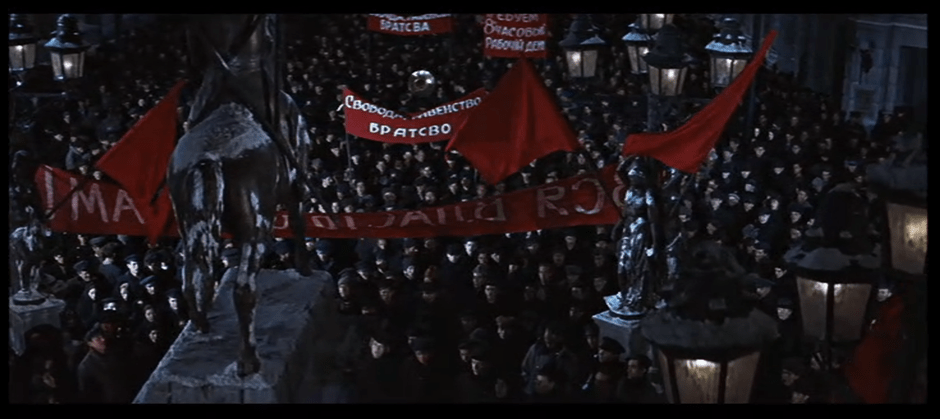
It is on the main street of this Spanish Moscow that we see a workers’ demonstration crushed by the forces of the Tsarist autocracy.

The corresponding scene in the novel takes place during the 1905 Revolution. Viewers might assume wrongly that this is the infamous Bloody Sunday, or even that this scene represents the entire 1905 Revolution – watching this at age 15 or 16 I vaguely thought it was, but now I know that this massacre would not even qualify as a Bloody Wednesday on the scale of Tsarist Russia. 

But the movie is not making a historical misstep here at all. Showing an event like this in 1913 makes sense. Several hundred strikers were massacred at the Lena goldfields in 1912, and in response there was a wave of strikes that only ended with the outbreak of the First World War. This would have involved protests and repression like we see here. The demonstrators perform the ‘Varshavianka’ and the ‘Internationale,’ both period-accurate. At the end of their demonstration, they march back the way they came, presumably sticking together until they reach the safety of a working-class district. But I’m not sure of the tactical rationale behind the dragoons attacking and dispersing them on their way back. I’d assume they would prefer to block the march from entering the affluent district.

It’s worth noting that we don’t see the inside of a factory, a railway yard or a slum. The focus is on how the demonstration turns Yuri’s head, sweeps him up in its romance, and how the state repression appals him. The focus throughout the movie is on how Yuri, who is part of a well-off family, reacts to the twists and turns of the revolution.

After the dragoons’ attack on the protesters

The Bolsheviks

On several occasions characters talk about the Bolsheviks. Antipov denies being a Bolshevik, but doesn’t tell us what party he’s in. ‘The Bolsheviks don’t like me and I don’t like them. They don’t know right from wrong.’

They are mentioned almost as if they were the only revolutionary party in the running. Komorovsky says to Yuri: ‘Oh, I disagree with Bolshevism. … But I can still admire Bolsheviks as men. Shall I tell you why? […] They may win.’

Before 1912, few knew who the Bolsheviks were. They were one faction of one leftist party (the Russian Social-Democratic and Labour Party). In 1912-14 the Bolsheviks grew rapidly. Antipov disliking them is a plausible glimpse of the leftist in-fighting and debates that went on. (The fact that he carries a pistol on a demonstration suggests he is a Socialist Revolutionary, a party with a terrorist legacy. I doubt he’s a Menshevik.)

Komarovsky’s remarks are not so plausible. The Bolsheviks weren’t a household name. Komorovsky would not have anticipated their victory and if he even knew who they were he wouldn’t expect Yuri to. 

I can see why they name-dropped the Bolsheviks here in spite of the above points. The screenplay is introducing little things that are going to be big later. It’s not terrible – but it is wrong.

Tsarism

‘It’s the system, Lara,’ Antipov declares at one point, apropos of nothing. ‘People will be different after the revolution.’ The audience knows instantly that Antipov’s naivety will be cruelly exposed. But to me that’s a bit crude, a bit of a straw man.

All the same, we do get a glimpse of the system. This section paints an ugly picture of late Imperial Russia. A predatory, cynical capitalist, brutal state repression, even an orthodox priest dispensing free doses of sexual hypocrisy to Lara when she goes to the church for guidance.

But we do not see the squalid living conditions of the peasants or, bar the scene where Antipov is dropping leaflets outside a factory, the working or home lives of the urban proletariat. People show a remarkable ability to write many thousands of words and make many hours of cinema about revolutions without ever mentioning little things like the land question. You know, the number one factor motivating almost every modern revolution including this one.

Until next time…

I remember seeing this movie as a teenager and being swept along by it and I can really understand how, four decades earlier, millions were really enchanted by it in cinemas. All the more reason to interrogate how it presents the history. I’m approaching it now with a more analytical eye but I still appreciate and enjoy a lot of what I see here. So far, it’s not a bad job by the standards of a historical epic set in a country that few of the cast or crew would have ever set foot in.

But as I’ve made clear, there’s a bit of ‘The Tsar has been arrested! Lenin is in Moscow!’ to come. And the further we get, the more it goes off the rails.

In the next post we’ll look at how Dr Zhivago treats the First World War and the revolutions of 1917. For good and for bad, there’s a lot to talk about.


Back to Home Page/ Archives

Revolution Under Siege archive

[i] ‘Lenin’s in Moscow’ can be shorthand for ‘Lenin has arrived in the capital city! No, not Moscow, the other capital, the one that doesn’t feature in this movie. Yes, St Petersburg.’ And ‘Civil war has started!’ is just Zhivago’s on-the-spot reaction. Some people in early 1917 characterised events the same way. But all that is a stretch. The average viewer will take it at face value.

[ii] Smele, Jonathan. The ‘Russian’ Civil Wars

[iii] What are my credentials for tackling this, and why does it interest me? Over the last few years I’ve written a lot about the Russian Civil War, and you can find the full book-length project here:

Revolution Under Siege
[iv] Soviet and Russian cinema is a different story. 1934’s Chapaev spawned a whole sub-genre of Civil War movies. I should mention the HBO TV movie Stalin (1992, dir Ivan Passer) which is overambitious and rushed but which does include a handful of fairly well-written scenes dealing with the Civil War.

[v] In the novel, this framing narrative takes place on the Eastern Front of World War Two. Yuri and Lara’s daughter is a boisterous young woman serving on the frontlines.

Appendix: A note on the death toll

In the short post that follows I will be discussing large numbers of fatalities, and I want to ask readers to keep in mind that these are not ammunition for social media debates but real people who died horrible, untimely deaths.

How many were killed in Red and White Terror? Any estimate you read in any book will be flatly contradicted by the next book you pick up. I have seen claims that the total number killed by both sides was in the millions, but I don’t credit this. It could be argued back and forth whether either side had motive or opportunity for deliberate killing on such a scale. (For the record, I think the Reds had opportunity but not motive, and the Whites had motive but not opportunity.)

But neither side had the murder weapon. The only weapons capable of inflicting death on such a horrific scale are strong and efficient state institutions. Neither side had the institutional capacity for such killing, any more than they had the capacity for major humanitarian operations to tackle hunger and epidemics.

I’ve read a good few primary and secondary sources, and a death toll in the millions just doesn’t seem likely to me. I’ll try to explain why below.

We read that 2,500 Red prisoners were killed after the Whites took Omsk. It is rare that we get such a high death toll from one incident. Did ten massacres with a similar or higher death toll occur during the Civil War? Yes – unfortunately I could think of ten on the spot, split between various factions. Did a hundred incidents with a death toll in the thousands occur? I’m pleased that I can say a flat no. If there were five or six or seven hundred incidents in which thousands were killed, then a death toll in the millions would be plausible. Since there were not, it is not.

This still allows for the possibility that there were hundreds of thousands of individual executions and smaller-scale massacres, but I think that possibility is remote. Life was cheap in this era. But if there were enough small-scale violence going on to add up to the millions, the memoirs and novels that came out of that time would have to have someone being shot or sabred on every page (to be fair, Asian Odyssey by Alioshin comes pretty close to that at times!).

The mass death is terrible enough without exaggeration. My educated guess is that the real number for Red and White combined is greater than 100,000 but less than 500,000. Add in terror campaigns waged by various nationalist forces and interventionists (such as the contribution of Ukrainian Rada forces to the pogroms of 1919, or the massacre of Armenians by Turkish-aligned forces in Baku in 1918) and the total might well be pushed some way north of half a million.

A death toll in the low hundreds of thousands would put the Russian Civil War in the same territory as the Spanish Civil War. Spain had a smaller population, but there terror was pursued in a more determined and systematic way by an efficient military. It seems that in relation to Spain it’s been possible to do some serious homework and settle on a good approximation of the numbers (see Paul Preston’s The Spanish Holocaust). In relation to Russia’s Civil War, I have seen nothing but rough estimates. And, to be brutally honest, this is the case for mortality throughout the revolutionary period: partial data, ambiguity in how it can be interpreted, and politically-motivated spitballing about the total.

Revolution Under Siege: Conclusion (Part 2 of 2)

In Part 1 of this conclusion we looked at the popularity of the Reds, the anti-democratic spirit of the Whites and the terrible impact of foreign intervention. The Soviets were popular and progressive. They were attacked in a brutal civil war, and they have been lied about and misunderstood ever since.

But that doesn’t mean they did nothing wrong. For the first half of this post we’re going to look at the question of terror. Finally, we’re going to ask whether the Civil War led to Stalinism.

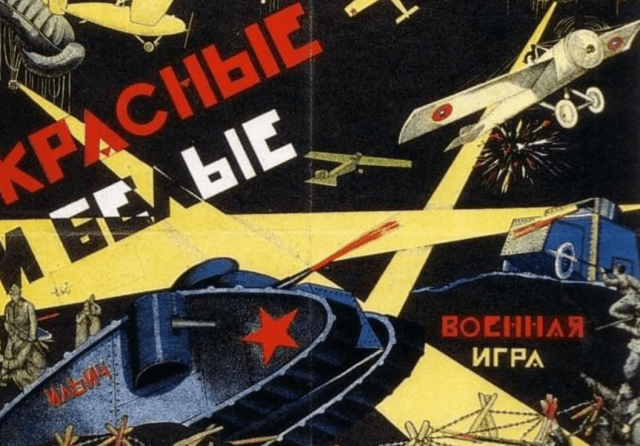
Cover art for a 1920s Soviet board game called ‘Red vs White: War Game’

Terror

The most disturbing part of the Civil War is the use of terror by the winning side. ‘After the outbreak of Civil War,’ writes Fitzpatrick, ‘the Cheka became an organ of terror, dispensing summary justice including executions, making mass arrests, and taking hostages.’ According to Fitzpatrick, terror encompassed ‘not only summary justice but also random punishment, unrelated to specific guilt […].’ [1]

Deutscher sums up the violence in a vivid phrase: ‘terror and counter-terror inexorably grew in a vicious and ever-widening spiral.’ But he does not elaborate much beyond saying that the Reds ‘did not shrink from the shooting of hostages’. [2]

Smith writes that ‘the extent to which the new [Soviet] regime relied on violence is now much clearer than it once was’ – for example, in Deutscher’s time. But he adds that it is also better understood to what extent all sides relied on violence. [3]

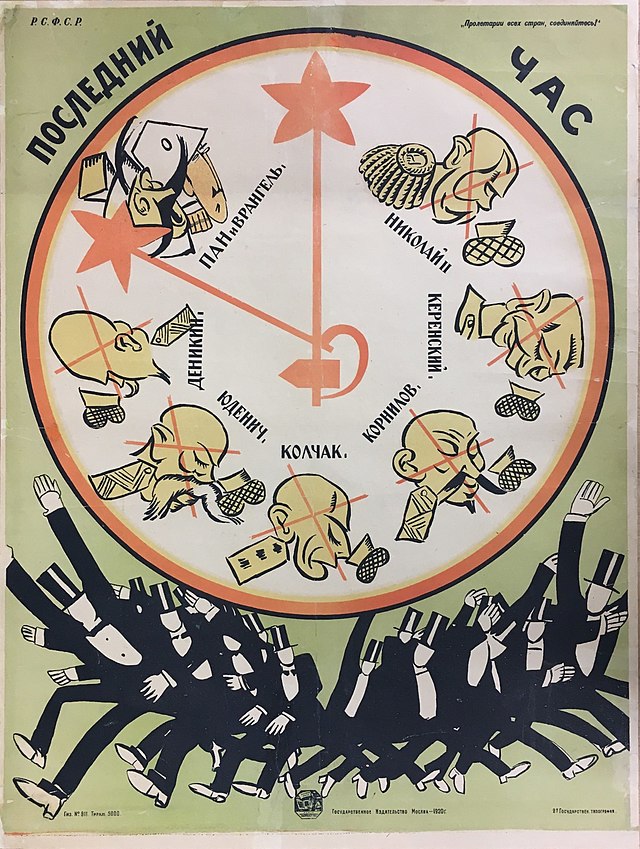
My own reading bears this out. There’s no indication that Red Terror was in any sense worse than White Terror. All sides, from Makhno to Piłsudski and from the Soviet regime to peasant insurgents, used terror as a weapon. These were the grisly rules of this war.

The question is: Who wrote the rulebook? Who were the instigators of the unconstrained use of violence?

Who instigated terror?

In 1917 itself the conduct of the Bolsheviks was markedly restrained and humane; massacres committed by enraged sailors were condemned. The early White Guards were not just spared but paroled.

Late in 1917 White Guards massacred Red Guards within the walls of the Kremlin. Even before the start of Civil War proper the two foremost leaders of the White armies, Alexeev and Kornilov, defended the practise of shooting all Red prisoners. Kornilov was public and outspoken, calling for as much terror as possible and declaring that he was ready to kill most of the population if necessary.

From May, we have the Civil War proper. Unrestrained terror against ‘Bolsheviks’ was the rule during the White risings of Spring-Summer 1918. At Omsk, according to a Right SR witness, 2,500 captive Red soldiers and workers were massacred. At the hands of Ataman Dutov, hundreds were buried alive. These are just a few examples of many to show that the Whites got a big head-start on terror. White terror was decentralized and unsystematic throughout the war, but practically every faction engaged in it.

The White head-start on terror is an obvious and clear fact to me when I look at the timeline. But none of my sources talk about it.

Repression under the Soviets

Red Terror ramped up gradually over the summer and began in earnest with an explosion of violence in September 1918. It kept raging in local peaks and troughs until the end of the war.

The Soviet regime’s violence was not premeditated. It was a response to a crisis not of its making. Most of the country’s territory had been seized – not by a popular revolt against ultra-left excesses, but by a well-armed minority and by foreign armies. The insurgents were killing Soviet-aligned soldiers and civilians by the thousand long before the Soviets responded in kind.

The case for Red Terror was made openly. The Communists justified it by pointing to the crimes of their enemies, and promised it would be set aside as soon as possible:

The proletariat who strive for equality of all human beings, have no longing for dictatorship with terrorism, and do not themselves choose that tactical course. As soon as the situation permits of it they will forego it. In the process of the Socialist revolution they will always seek to discover whether this or that section of the bourgeoisie can be induced to join with them in the exercise of power, whether the circle of those possessing equal rights is not capable of extension, and they will greet the day with ringing of bells and shouts of joy in which all chains will disappear […]

Karl Radek, ‘Dictatorship and Terrorism’ Chapter 6 https://www.marxists.org/archive/radek/1920/dictterr/ch06.htm

Radek also emphasized that the curtailing of soviet democracy and the security measures in his own country were not a model for other countries to follow.

The Soviet Union needed a severe security regime in order to survive this war. The Communists in Baku, Azerbaijan stuck to peaceful methods and ended up being executed. The problem is this: what the Soviets actually did went beyond the kinds of measures covered by Trotsky’s and Radek’s arguments. We have covered some of the gruesome details before in this series.

Two dreadful massacres early in 1918, at Kokand and Kyiv, were outliers: carried out by non-Bolsheviks in peripheral places far from central oversight. But it is a problem that they are neglected in any Soviet sources I’ve come across.

Some of the worst excesses, including the above, occurred in regions that were not predominantly Russian – such as Astrakhan and Crimea. The Bolsheviks took an inspiring stand on the question of national liberation – but the age-old racism and chauvinism of the Russian state found expression in the severity with which some of the agents of the Revolution acted when surrounded by non-Russians.

Revolutionary movements in the future must not take the same road. Terror had a brutalizing effect on the Soviet state and on its supporters. The Red side never endorsed torture – but there is evidence that it happened in some places. Can that be a surprise, when the Communist paper in Petrograd in September 1918 literally called for blood? On the pretext of deterring counter-revolutionaries, violence could be used maliciously. It was often counter-productive, triggering revolt. All this is on top of the cruelty and waste, which go without saying.

‘Ideas learned under fire’ included many negative and paranoid ideas – in other words, trauma. The idea learned from Baku or Omsk in 1918 – that one must take ruthless measures against any stirring of counter-revolution – was a very harmful idea when applied generally.

On the other hand, the English-speaking reader is never challenged, in accounts of the Russian Revolution and Civil War, to imagine how his own government might react if foreign armies and insurgents seized most of its territory. 9/11 was enough to bring out the US political establishment in open defence of torture.

The Soviet regime was under unimaginable threats and pressures. This popular and progressive government had a right to fight for its survival. Ultimately these pressures and threats caused it to stoop to inhumane and counterproductive measures when it should have held firm to a line which might have better balanced security concerns with humanitarian principles.

Red Armoured Train No. 17, named ‘Victory or Death.’ From the US labour paper The Toiler, shared online by a great page called Revolution’s Newsstand

Did the Civil War lead to Stalinism?

Repression dismantled

Some accounts narrate the executions in Crimea and after Kronstadt in a way that leaves the reader believing that the repressive apparatus built up during the Civil War was kept in place afterwards. In fact, the Cheka was radically cut down, most of its staff let go and its powers curtailed. The use of executions ‘diminished into insignificance.’ The system of prison camps used during the Civil War was shut down; there is no direct continuity between it and the notorious Gulag system. The Cheka, renamed OGPU, was left in charge of only a small number of prisons.

The criminal justice system in the Soviet Union in the 1920s was progressive and lenient. Exile was abolished, prison sentences cut down, crimes caused by poverty judged lightly, non-custodial sentences preferred. Prisoners were paid for work, educated, and often allowed to live outside the prison. The imprisoned population in the whole Soviet Union was under 200,000 in 1927 – likely an overcount as many sentences were shorter than a year.

In other words, repression actually was a Civil War emergency measure.

There were also around 8,500 people in harsher OGPU-run facilities. In 1929, the year Stalin’s regime began its notorious campaign of forced collectivization, 60,000 were transferred from the prisons to new OGPU unpaid labour camps. ‘[T]he network of camps grew to embrace 662,000 by the middle of 1930, and it was to grow within another couple of years to nearly two million.’ [4]

From 8,500 to two million in a few years – that’s a historic rupture.

This leads us on to the second main point of this post. The society which emerged from the war fell a long way short of, say, what Lenin envisaged in The State and Revolution. But it fell even further short of totalitarian Stalinism. The devastation of the war was only one condition, and not by itself a sufficient one, for the descent into the totalitarian nightmare.

A Red Cossack. Again, from The Toiler

Red Army demobilised

As early as the start of 1920 the Red Army started demobilizing. ‘Lenin and the majority of the party’s leadership were obsessed with the recovery of the economy,’ (not fanatical world conquest) so 90% of the Red Army was sent home. There were 5.3 million personnel in 1921 – and just 562,000 by 1924, structured as a territorial militia.

This was very much army of a new type – commanders and rank-and-file soldiers were drawn from the same social classes; their uniforms were nearly identical; ranks were abolished; revolutionary discipline forbade corporal punishment and appealed to conscience. [5]

This army was wrenched away from its egalitarian and liberatory origins – but again the rupture came in the 1930s, not in the Civil War era.

The Red Army changed radically in the Stalinist period. Ranks were reinstated. Commissars were abolished, only to return later in a more inquisitorial form. Forced collectivization stunned the rank-and-file soldiers; the Great Terror decimated and terrorized the officers. The Soviet Union entered World War Two with a severely demoralized and fundamentally changed Red Army.

From The Toiler – A Red Army soldier

Living conditions

In 1921, after fighting on several fronts throughout the Civil War, Eduard Dune returned to the factory where he had been working when he first became a Bolshevik in 1917. The place was silent and shuttered. A handful of the old workers were minding the place, living off potatoes they grew on the grounds. But on the inside, the factory was perfectly preserved in the hope of economic recovery. [6] This is an image of promised renewal and reconstruction.

The promise was fulfilled. Contrary to the clichéd fatalistic aphorisms about how socialism only ‘shares out misery more equally,’ ‘runs out of other people’s money’, etc, in the 1920s working-class people saw huge benefits. City dwellers could now avail of free healthcare and far cheaper housing. Workers had a generous social insurance scheme. The countryside was far less penetrated by new social services, but appreciated the absence of landlords. A generation of worker and peasant youth benefited from much wider access to education. Smith (Russia in Revolution, p 320 and following) emphasizes the achievements in healthcare, in spite of scarce resources.

It is significant that, as soon as the Civil War was over, economic recovery began. This backs up the idea that war conditions, not Bolshevik policies, caused economic crisis.

Soviet democracy

The regime in the immediate aftermath of the Civil War was far more pluralist than one might expect in a country utterly devastated by war. It was a rich period culturally – Soviet youth experimented with free love; nudists jumped onto trams in Moscow; Esperanto speakers organized themselves; Soviet artists were at the cutting edge globally.

Contrary to another cliché, the Communists never actually abolished workers’ control in the factories. What emerged by the end of the Civil War was a compromise (there’s that word again). Some factories were run by elected committees, others by a centrally-appointed manager (a communist, a former manager, a chief engineer, or even in some cases the former owner), others still by a worker or group of workers from the plant appointed to run it. The latter was ‘often the most successful’ arrangement. [7] In other words, where workers’ control functioned well, it was kept. Where it turned out badly (and there are many reasons it might, in a context of economic collapse and war), the state stepped in and either modified it or ended it.

In practically every ‘democratic’ country at the time, poor people, minorities and women were excluded from voting. By contrast, the Soviets were elected by all men and women over 18. Those deemed to be exploiting others were denied the vote; this amounted to a tiny percentage of people.

The Soviet regime is sometimes accused of lacking ‘checks and balances’ necessary to prevent tyranny. In 1917-18 it was nothing but checks and balances. However, it’s true that the state which emerged from the Civil War was authoritarian and dysfunctional.

The Mensheviks had by this stage positioned themselves as a loyal opposition. Lenin and his old comrade, the Menshevik leader Martov (according to Tariq Ali in The Dilemmas of Lenin) were warmly reconciled before their deaths. Nonetheless the Soviet state subjected the Mensheviks to a severe crackdown in 1921, with thousands of them arrested. There was a parallel crackdown against oppositionists inside the Communist Party – Shlyapnikov and Kollontai were not arrested, but their faction was shut down. These measures were supposed to be temporary, to be reviewed after the Soviet Union had put a few years of urgent reconstruction behind it. But as the 1920s went on the Left Opposition, which included many of the most prominent Old Bolsheviks, found itself having to campaign for a restoration of democracy, amid increasing crackdowns from the party apparatus.

Though Lenin supported the crackdown on Mensheviks and the ban on internal party factions, he sounded the alarm early about the Soviet state and, in his final writings, took a democratic turn – for example on Georgia and on cooperatives. In 1920 he cautioned: ‘ours is a workers’ state with bureaucratic distortions.’ ‘Later,’ writes Faulkner, ‘alarmed at the influence of former Tsarist officials and newly appointed careerists in the government apparatus, he posed the question: ‘This mass of bureaucrats – who is leading whom?’ [8]

The bureaucrats included the former Mensheviks Beria and Vyshinskii. Beria would later serve as the notorious head of Stalin’s secret police. Vyshinskii, as prosecutor in the Moscow show trials later in life, would call for the ‘mad dogs’ (the defendants) to be shot.

Be conscious of how much heavy lifting is being done by this word ‘later.’ Here as with other topics, the decisive break came not in the Civil War but after 1928.

We have to note, however, that with the political regime, the curve is less dramatic, the rupture less obvious. Terrible damage was done in the Civil War, and the cost of economic recovery in the 1920s was a growth of bureaucracy and ‘NEPmen’, develoments which helped Stalin’s rise to power. Faulkner writes: ‘The revolution had been hollowed out. And, in one of history’s most bitter twists, another species of counter-revolution […] was growing, a malignant embryo, inside the revolutionary regime itself.’

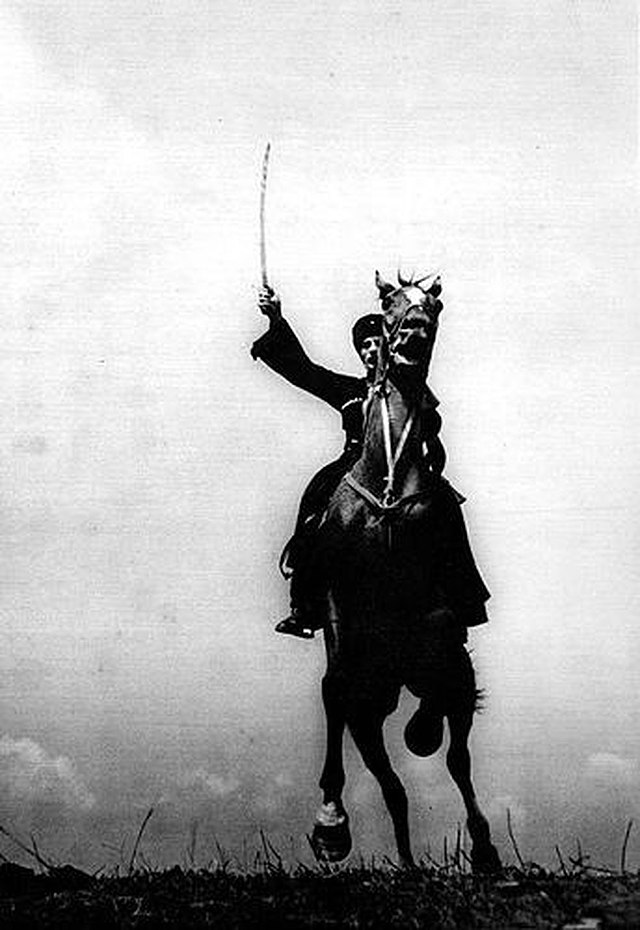
Today’s cover image. Caption copied directly from WIkimedia Commons: ‘Russian_Revolutionary_Poster,_Red_Cavalry kiev Russian Revolutionary Poster Mount your horses, workers and peasants! The Red Cavalry is the guarantee of victory. Designer unknown, 1919.’

To be or not to be

We can’t hope to understand the Soviet Union without understanding that it was engulfed in its formative years by a cataclysm not of its making. This, alongside the country’s underdevelopment and isolation, created the authoritarian and bureaucratic tendencies, personified in Stalin, which would later seize power. So if people want to know where the Soviet Union’s siege mentality came from, they should probably read up on the siege.

We can’t hope to understand how the Soviet Union survived this cataclysm without appreciating that the October Revolution was genuinely popular.

It might be objected that if the Red soldiers could have seen the future, the cynicism and brutality of Stalinism, they would have lost the will to fight.

Maybe, maybe not. People at the time did consider the possibility of something like Stalinism; they had historical precedents in Cromwell and Bonaparte. In Victor Serge’s novel Conquered City, written in the 1930s but set during the Russian Civil War, two characters discuss the possibility that the Revolution might one day be hijacked by a dictator.

‘It wouldn’t be worth it, no…’ says Kirk. ‘It would be better, for the Revolution, to perish and leave a clear memory.’

Osipov responds: ‘No, no no, no! Get rid of those ideas, comrade. They’ve been beaten into us with billy clubs, I mean with defeats. No beautiful suicides, above all!’ [9]

I reckon western opinion of the Russian Revolution would be kinder if the revolutionaries had had the decency and good sense to be defeated and to die horrible deaths. The memory of the Soviet regime would be ‘clear.’ What’s not clear is what great service would be rendered to humanity by another epic of popular revolt and cruel defeat – another Paris Commune, Finnish Soviet, Spanish Republic, Indonesia 1965-66, or Chile 1973.

Osipov’s phrase ‘No beautiful suicides!’ brings to my mind the speech in Shakespeare’s Hamlet – ‘to be or not to be…’ In Malcolm X’s reading, the Danish prince was deciding, in that speech, whether to suffer in silence or to risk death and damnation by resistance. [10] The Russian Revolution was a moment of liberation and creativity when humble working people exercised real power. They were brave to take arms against a sea of troubles, to defend their new socialist republic by every means consistent with that end.

The Revolution lit a beacon of liberation and creativity. Revolution Under Siege set out to trace what happened to this flame. It is not surprising that the Revolution fell short of its promise. What is surprising is that even after the years of hunger, typhus, shellfire and blood, there survived still a spark emitting the light of social justice and the warmth of human solidarity.
Osipov, in the trenches before Petrograd in 1919, continues his debate with Kirk:

‘We’re here to stay, by God! to hold on, to work, to organise […] To live, that’s what the flesh-and-blood working class wants, that great collection of hungry people behind us whom we seem to be leading but who in reality are pushing us forward. Whenever there is a choice – give up or continue – they continue. Let’s continue, let’s get into the habit of living.’

References

[1] Fitzpatrick, 77-78

[2] Deutscher, Stalin, 192

[3] Smith, 383

[4] Solomon, Peter H. ‘Soviet Penal Policy, 1917-1934: A Reinterpretation.’ Slavic Review, Vol 39, No 2. Jul 1980. P 199, 202, 210.

On the Cheka being cut down, see Smith, Russia in Revolution, p 296: ‘At the end of 1921 there were 90,000 employees on the official payroll of the Cheka, but by end of 1923 only 32,152 worked in OGPU. In the same period the number of those working clandestinely for the political police fell from 60,000 to 12,900, and by late 1923 the total number in the internal troops, border guards, and escort troops had fallen from 117,000 to 78,400.’A

A note on the structure of the post-war Red Army:

In 1921 Trotsky argued for the replacement of the standing army by a territorial militia – a more traditional socialist position which had been favoured until the military emergencies of 1918. What emerged was a compromise: a small Red Army backed up by a large territorial militia. In 1934, at the height of this hybrid system, 74% of personnel were in the territorial militia. Men were drafted to serve for five years, during which time they would be soldiers for a few days a month, or a month or two in the summer. After their five years, they would be subject to recall in wartime.

 [5] Reese, 40, 53-55

[6] Dune, 86-87

[7] Fitzpatrick p 80

[8] Faulkner, p 236

[9] Serge, Conquered City, p 141

[10] Malcolm X on Hamlet: https://www.openculture.com/2009/08/malcolm_x_at_oxford_1964.html

Revolution Under Siege: Conclusion (Part 1 of 2)

‘Ideas which enter the mind under fire remain there securely and forever.’

This is the Conclusion to Revolution Under Siege, a series about the Russian Civil War. In this first part of the Conclusion, we will ask: How did the Red Army win the war? What was the nature of Allied intervention? Were the White Guards fascist?

How the Red Army triumphed

The Soviet victory in the Russian Civil War has been summed up in all kinds of dramatic ways: ‘A People’s Tragedy’ or ‘the Death of Hope’ (no less!). Whatever picture you have of the Civil War in your own mind, the vanishing point, ‘the place where all the rays meet’ (as Tolstoy is supposed to have said) is October. If the October Revolution was legitimate and justified, then the struggle to defend it was inspiring. If the Revolution was a coup by conspirators bent on mass murder and insane social experiments, then each battle to defend it was just one more atrocity.

But since I am switching from narrative mode to conclusion mode, let’s not agree to disagree. The Allied intervention forces at first believed that the Bolsheviks were an isolated group who were out of their depth. If this had been true, the Whites would have had little difficulty in winning the war. If October really was an undemocratic coup, if the political programme of Lenin and Trotsky was a wild social experiment, then the outcome of the Civil War would make no sense.

The fact that the Reds controlled the part of Russia with the largest population, best transport links, most industry and largest military stockpiles was an important reason for their victory. But this fact was not an accident. The Whites and Reds did not draw cards at random for territory. In this logistically ‘central’  and majority working-class area of Russia, the Bolsheviks received large majority votes not only in the Soviet but in the Constituent Assembly elections.  

Their support among the working class was very strong, and remained very strong through incredible hardships. Working from this powerful base, the Soviet regime drew into its orbit large swathes of the farming population along with the national minorities. Hence it was able to build an army which vastly outnumbered that of the Whites.

In 1918-9 the Whites secured base areas and foreign aid, and built large armies. If the Soviet leaders were only adventurers, and if the Red Army was only a mass of conscripts subjected to terror and crude propaganda, Kolchak and Denikin would have steamrolled them. But the Soviets’ internal collapse, on which every White general counted, never took place.

Western historians have approached this war in the footsteps of the interventionists of their own country. Like their grandads, they refer to the Red Army as ‘the Bolsheviks’ as if to fool themselves into thinking that they are only speaking about a crew of cranks. But they often come away with a wary respect for the Soviets:

‘Yet these despised creatures [the ‘Bolsheviks’], these subhumans, who according to the casualty figures were all but annihilated time and again in various sectors – for some unaccountable reason continued to appear in strength. Not only that; they fought back hard, and as time went by they developed an unmistakable military prowess…’ [1]

The interventionists and the Whites had to learn this wary respect too, but the hard way.

There is a perception that the Reds won through violence and propaganda. [2] But the Whites were not shy when it came to violence and, because many of them were military officers, they were much better at it. When the Civil War broke out, the Soviets had only very feeble military and security institutions. Besides, violence often backfired, as in the Don country in early 1919.

They did manage to turn a movement of factory militias into an army – under-supplied, wearing a motley collection of uniforms and with barely a single steel helmet between the five million of them; and leaking deserters like a sieve, especially at harvest time – but nonetheless an army capable of winning this war. 50,000-70,000 women served in it. It had no officers, no ranks – ‘company commander’, for example, was a job title held by a qualified soldier who wore the same uniform as the rank-and-file soldier. Corporal punishment was banned. The army was truly multinational in character: primarily Russian, Ukrainian and Belarussian, but also Finnish, Latvian, Chinese, Hungarian, Uzbek… Among them was the Senegalese Kador Ben-Salim, who came to Russia with a travelling circus, joined the Red Army, and later became a Soviet movie star. Education and political discussion were central in this new type of army – and they were sorely needed, since even many commanders had only three years of schooling and didn’t know arithmetic. But ‘by the end of 1920 there were 3,000 Red Army schools, 60 amateur theatres, and libraries with reading rooms in every soldiers’ club.’ [3]

Yes, the Reds were good at inflicting violence – in the sense that they were able to build a cohesive and large military force using democratic and socialist methods.

As for propaganda, the Whites had no qualms about churning out lurid anti-Semitic propaganda posters and forgeries like the ‘Zunder Document’ and the ‘Protocols of the Learned Elders of Zion.’ But the Reds probably had more industrial printing facilities and paper stocks at their disposal. More importantly, they had an appealing political programme which enthused both the artists who created the propaganda and the people who consumed it. This propaganda had the great benefit of usually being positive and sincere.

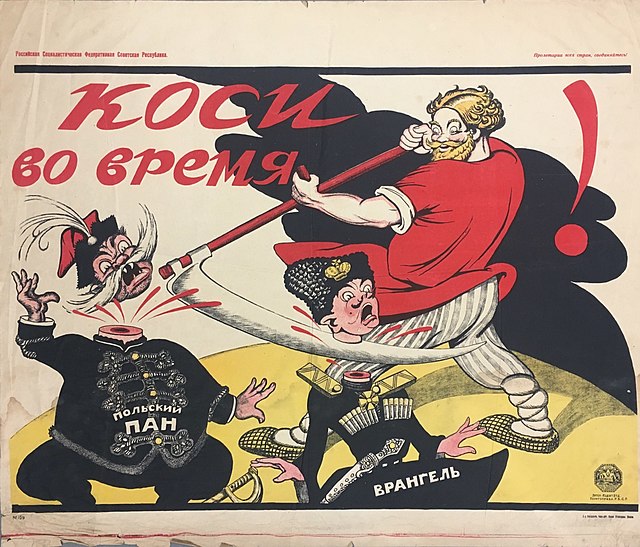
The Allies put Wrangel in a cannon to shoot him at the Soviets. Like I said, usually positive and sincere

So in these limited senses, it was true that violence and propaganda were important.

But crucial to the Red victory were the innate qualities of the working class of the former Russian Empire: their capacity for self-sacrifice; their creative and technical skills; their courage and resourcefulness, for example in organizing a partisan movement in Siberia. Their social skills and political sophistication made a huge difference – they found ways to work with specialists from the former privileged classes, without handing power back to them; ways to neutralize or win over enemies like the Cossacks; ways to fraternize with interventionist troops such as the French and the Germans; ways to make friends of national groups who had been foes, such as the Bashkirs. On top of these innate qualities, they learned quickly and we can see the Red Army growing from a partisan and militia movement to an army with systematic workings. Ideas learned under fire, as Trotsky remarked, are learned for good.

These qualities would not have found expression without the channel provided by the programme and method of the Bolshevik Party. Without the latter leading the Soviets to power in October 1917, this revolutionary energy would have dissipated. But the Bolshevik Party itself would not have existed without a working-class support base and cadre. It was a product of its class.

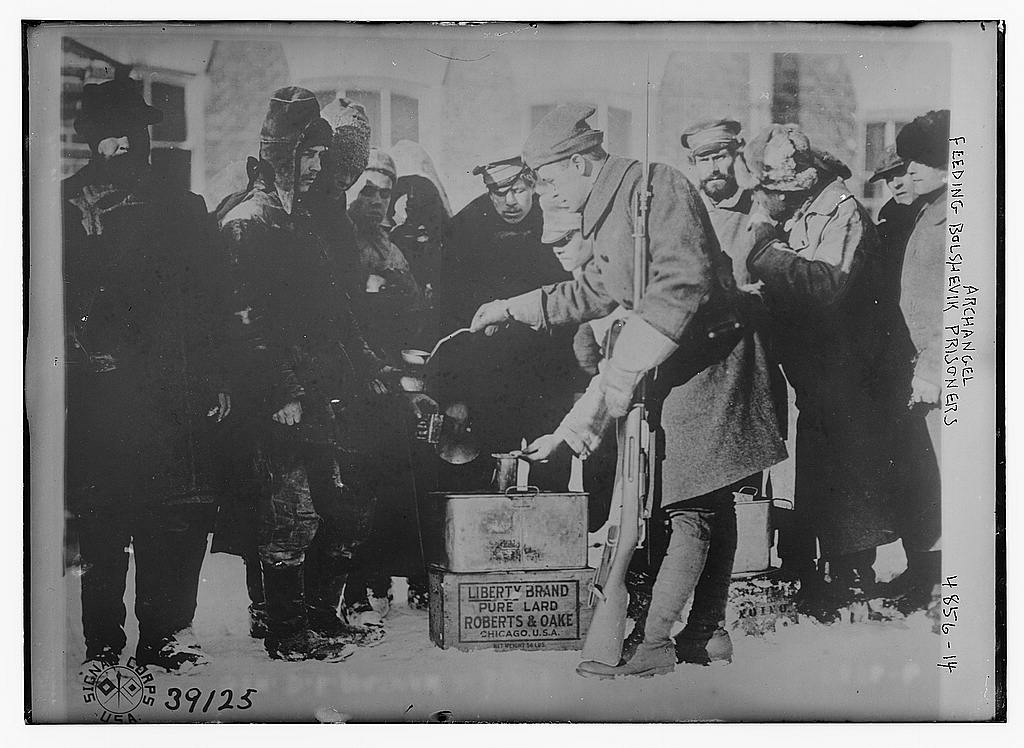
‘Bolshevik’ prisoners being fed by Allied troops in North Russia

Were the Whites fascist?

The leading cadre of the Whites also showed courage, resourcefulness, endurance, military skill and valour. But by contrast with the Reds, the White movement was anti-democratic and unpopular. The White leaders openly despised the popular masses. Their contempt for ‘politics’ was in fact contempt for the burning demands of the people – silly political questions like land can be settled after the important business of flogging and hanging the revolutionaries.

Their harshness, fury and inclination to violence werr no surprise. They were gestated in the Tsarist military, an institution which was far harsher and more hierarchical than its peers in other European countries.

General Sakharov, a right-hand man of Kolchak, refused to serve in a particular military unit because it was associated with the ‘democratic spirit’ of the Komuch government. [4] Other White leaders challenged one another to duels or even assassinated one another over accusations of pandering to ‘the democracy.’ The White leaders never accepted the Constituent Assembly results, which they dismissed as popular madness and anarchy.

‘[They] aspired to re-establish ‘Russia One and Indivisible’, which meant suppressing ‘anarchy’ and restoring a strong state and the values of the Orthodox Church. What united them emotionally was a passionate detestation of Bolshevism, which they saw as a ‘German-Jewish’ conspiracy […] In White propaganda, the words ‘Jew’ (zhid) and ‘Communist’ were interchangeable. Naturally, they detested class conflict, and they feared and hated the revolutionary masses (that ‘wild beast’ […].’ [5]

The partner of the White officer was the Cossack. The Cossack, in contrast to the officer, was often mobilised by a popular demand for the autonomy of his particular host. Other motivating factors were a fear of the ‘aliens,’ their tenants; the desire of wealthier Cossacks to hold onto power; and the Cossack tradition of military service. The Cossacks were indispensable to the White war effort, and tens of thousands of them stuck out the Civil War to the end. But by mid-1920, Wrangel found that the Don and Kuban Cossacks did not have another rebellion in them. They too had learned certain ideas under fire.

Only episodically, and with disappointing results, did the Whites attempt to mobilize the population at large. In the words of Mawdsley, ‘their social and political programme was not one that bred spontaneous popular support.’

Many White leaders later embraced fascism. Around the time Mussolini marched on Rome, Sakharov claimed with pride that ‘the White movement was in essence the first manifestation of fascism.’ But Mawdsley scorns this claim – because ‘the Whites lacked the mobilization skills and relatively wide social base of the Italian or German radical Right’ [6].

Just to underline that point: the best argument for regarding them as not fascist is simply that they couldn’t mobilise mass support – not that they weren’t reactionary, or that they weren’t violent. To quote The Simpsons (and to paraphrase Mawdsley), they were never popular.

The Whites were a movement of the middle and upper classes which was pulled together over the course of the year 1917. Its origins lay soon after the February Revolution, when Denikin, Kornilov and their milieu reached a firm decision: in the words of Denikin’s memoirs, ‘Military power must be seized.’ The Kornilov Affair was the first attempt. After the October Revolution the same people created the White Armies, to fight the Soviet regime openly. They embarked on a civil war without popular support, in fact consciously ranging themselves against the will of the population. At first (October 1917 to April 1918) they failed miserably, though in the process they caused much destruction and suffering. Their failure (and the initial failures of Dutov, Semyonov etc) was due to the fact that massive numbers of workers and poor peasants mobilised against them whenever they raised their heads. But from Spring 1918, Allied and German help arrived in earnest, the Don Cossacks revolted, and the Civil War proper began.

Comparisons with Spain

Beevor compares the Whites to the Republicans in the Spanish Civil War because, like the Republicans, they suffered from internal divisions. [7] But to my mind the White Russians far more closely resemble the camp of Franco. Hitler and Mussolini drew popular support from the middle layers of society. Franco was called a fascist and called himself one, but unlike Hitler or Mussolini he was part of the establishment. The actual fascists (Falange and JONS) were only one component of his coalition. With their alliance of clerical, aristocratic, bourgeois and military elements, the Francoists and the White Russians were remarkably similar.

There are differemces. The Whites presented a ‘democratic’ face to preserve the Allies from embarrassment while Franco, having plentiful aid from fascist countries, had no need to hide. Another contrast is that Francoist terror was systematic, top-down and clearly aimed at extermination [8]. Maybe the Whites killed roughly as many people as Franco did (nobody knows), but in terror as in most things, they were not systematic.

In short, the Whites can be called proto-fascist, but only in the broad sense that the term ‘fascist’ would apply to Franco.

The key difference between the Spanish and the Russian civil wars lies in the position occupied by the professional middle classes (sometimes called the petty bourgeoisie or, in Russian terms, the ‘Intelligentsia’). In Spain, the workers and poor farmers generously permitted the professional middle classes to lead them (to defeat) in an alliance known as the Popular Front. In Russia, assertive workers’ representatives, in the form of the Bolsheviks, did not permit the intelligentsia to assume leadership of the Revolution. So the intelligentsia fled to the White camp where they strutted and fretted their hour upon the stage before they were overthrown by forces to their right.

If the Bolsheviks had gone into coalition with the Mensheviks and Right SRs on the terms demanded of them in coalition talks in November 1917, I think it’s likely the Russian ‘Pan-Socialist Coalition’ would have met the same fate as the Spanish Popular Front.

Intervention

The ugly things the early Soviet regime did (of which, more in Part 2) could only have happened in the context created by the military onslaught of the old ruling classes backed by the whole ‘civilised’ world. Nye Bevan, architect of Britain’s National Health Service, believed that the later development of Stalinism could be traced back in large part to the brutality inflicted on the early Soviet Union by the Allies:

I remember so well what happened when the Russian revolution occurred. I remember the miners, when they heard that the Czarist tyranny had been overthrown, rushing to meet each other in the streets with tears streaming down their cheeks, shaking hands and saying: ‘At last it has happened.’ Let us remember in 1951 that the revolution of 1917 came to the working class of Great Britain, not as social disaster, but as one of the most emancipating events in the history of mankind. Let us also remember that the Soviet revolution would not have been so distorted, would not have ended in a tyranny, would not have resulted in a dictatorship, would not now be threatening the peace of mankind, had it not been for the behaviour of Churchill, and the Tories at that time. [9]

To this day, writers in the English-speaking world write of their countries’ invasion of Soviet Russia as a silly farce. They dismiss the idea that intervention was a serious matter at all. The whole thing, we are assured, was blown out of proportion by Soviet historians.

But all I hear is, ‘Why are the Russians so angry about it? We only invaded them a little bit.’

Allied intervention was desperately sought and deeply appreciated by the Whites. When a White leader recieved the blessing of world empires and regional powers, it was a great boost to his prestige. But that was only a part of the package. It also included supplies – food, bedding, clothes, fuel – and vast quantities of weapons, enough to arm and equip every White soldier several times over (see the graphic below). The White leader had stable, well-trained Allied forces garrisoning his rear and guarding his railways. He had advisers at his side. He had financial credits. He had, at his back, the most powerful navies in the world waiting to evacuate him, his soldiers and their wives and children, just in case he still somehow managed to lose. The Whites had all that and the Reds had none of it.

And they tell us foreign intervention was a myth…

The interventionists also outright invaded. The Japanese government had 70,000 troops in Siberia at one point, engaged in full-scale war with Soviet partisans. Germany occupied a vast territory with a vast army in 1918. The French and Greeks sent in a force of 65,000 in 1919. The Czechoslovak Legion numbered around 50,000. All that is to say nothing of Poland in 1920. Other interventionists sent in troops by the thousand and not by multiple tens of thousands. However, the prospect of a full-scale Allied invasion no doubt helped encourage many young lads to enlist in the Whites who might otherwise have stayed home. The French invasion of Ukraine in 1919 was inhibited not by the qualms of the French government but by the mutiny of the French soldiers and sailors.

In North Russia, the interventionists had around 15,000 soldiers by summer 1918 – British, US, French, Italian, Serbs, Czechs and Poles. The local Whites could only muster 5 infantry companies, one cavalry squadron and one battery. [10] On this front it was not a question of intervention in war – the Allies were the war. Here more than elsewhere they fought directly with Soviet forces.

More galling still is the accusation that the Soviet regime was responsible for all deaths by famine and disease in these terrible years. [11] The country was hungry for years before the Revolution, ever since the economic demands of the First World War upset the delicate food supply system. The Tsarist army engaged in forced requisitioning. The German government looted Ukraine of foodstuffs. The Allies blockaded Russia, a repeat of a policy of artificial famine that was employed against the German people in the First World War. All the interventionists knew that in supporting the Whites they were disrupting exchange and production in an already half-starving country. When famine struck in 1921-2, no foreign government contributed to famine relief. The non-government American Relief Administration saved countless lives before future president Hoover withdrew it for political reasons. [12]

A Soviet poster giving public health advice to the population about the cholera epidemic

Trudell writes that ‘Foreign intervention also played a devastating role in the containment of the Revolution within Russia’s borders.’ Quoting Chamberlin, she adds that if Allied aid had ceased in November 1918, ‘the Russian civil war would almost certainly have ended much more quickly in a decisive victory of the Soviets. There a triumphant revolutionary Russia would have faced a Europe that was fairly quivering with social unrest and upheaval.’

The British leaders knew that the Soviet regime was popular and were well aware of the bigotry and corruption of the White forces. According to a July 1919 British government memo, ‘No terrorism, not even long suffering acquiescence, but something approaching enthusiasm’ could explain how the Soviet regime had held onto power. ‘We must admit then that the present Russian government is accepted by the bulk of the Russian people.’ [13] But the British government did not cease supporting the Whites until almost a year later.

Readers may find the vacillations of the Allies confusing. The explanation is this: there was a logic to supporting the Whites even if their defeat was certain; the war would weaken and contain the Soviet Union. In order to contain revolution, the Allied leaders prolonged this war by at least two years, condemning countless innocent people to death by starvation and epidemics.

‘We workers blamed our hunger on the counterrevolution, not on our regime,’ wrote Eduard Dune. [14] They were right.

My impression of the role of the interventionists is very far from the picture of well-intentioned bumbling that is often presented to us. I’m reminded of the words F Scott Fitzgerald would write a few years later in The Great Gatsby about a bourgeois couple in the United States: ‘They were careless people […] —they smashed up things and creatures and then retreated back into their money or their vast carelessness or whatever it was that kept them together, and let other people clean up the mess they had made….’

Ironies

The vast numbers of poor and working-class people who supported the Soviet regime were denounced at the time as ignorant, savage, criminal and even animal. The people who were responsible for the First World War called them violent and irrational. But these supposed ‘illiterates’ were fighting for progressive and modern causes: against domination by kings, priests and landlords, against racism and empire, for women’s liberation, for workers’ rights, for the extension of democracy into the workplace. They legalised abortion and same-sex relationships many decades ahead of other countries.

Another irony: they entered upon this struggle with the perspective that they only had to hold out until other revolutions in more developed countries would come to their aid. But as things turned out, they had to fight not only their own ruling class, but the whole world. The early years of the new regime were spent in battle: fighting to stave off the bloody fate that had met the Paris Commune and the Finnish Soviet; fighting against hunger and disease; ultimately fighting, due to these great pressures, against the threat of social collapse and political and moral degeneration.

Soviet victory in the Civil War was remarkable. ‘It was amazing, given the massive forces – both internal, and those of Allied intervention ranged against them – that the Soviets managed to ride out such compressed storms of horror and emerge victorious.’ [15]

The regime that emerged, limping and traumatized, from the horror of the war fell far short of what the masses had set out to fight for in 1917. But this, at least, was neither ironic nor remarkable. The Soviet leaders had predicted that far worse would come to pass if the revolution did not spread westward. It was also the entirely predictable result of the devastation caused by the war. Speak with caution about the results of this ‘socialist experiment’ – the lab was set on fire by arsonists.

Next week we will look further into these issues. Stay tuned for Part Two of this conclusion.

Home Page/ Archives

Revolution Under Siege Archive

[1] Jackson, At War With the Bolsheviks, p 235

[2] See the introduction to Engelstein, Russia in Flames

[3] Trudell, Megan, The Russian Civil War: A Marxist Analysis

[4] Smele 117

[5] Smith, S. A.. Russia in Revolution, p. 171

[6] Mawdsley, 389

[7] Beevor, Russia, ‘Conclusion: The Devil’s Apprentice’

[8] See Paul Preston, The Spanish Holocaust

[9] Quoted in Nye Davies, ‘At Last it has happened’: Bevan the Russian Revolution and the Soviet Union.’ Published on 31 Oct 2017 by Cardiff University: https://blogs.cardiff.ac.uk/thinking-wales

[10] Khvostov, White Armies, p 8

[11] Again, see Beevor, Russia, ‘Conclusion: The Devil’s Apprentice’ – but really this accusation, implicit and explicit, is everywhere.

[12] Trudell

[13] Ibid

[14] Dune, p 123

[15] Bainton, Roy. A brief history of 917, Russia’s year of Revolution. Robinson 2005, p 206

Appendix: The Russian Civil War in popular memory (Premium)

Become a paying supporter to get access

Access to this article is limited to paying supporters. If you already subscribe by email, thank you. But if you want to become a paying supporter, please hit ‘Subscribe’ below.

Give me less than the price of a coffee, and you can access everything on this blog for one year.

Appendix: When did the Civil War end?

It is May 1920, and the Bolshevik sailor Raskolnikov is on the deck of the destroyer Karl Liebkencht, watching as 1,500 Red sailors land on the coast of Iran. Black plumes of shellfire erupt on the shore as the guns of the Red fleet bombard the British Empire’s elite Ghurka soldiers.

It is 1921, and the ‘mad Baron’ Ungern-Sternberg, having seized Mongolia’s capital and received the blessing of its priest-king, is setting out for war against the Soviet regime.

It is 1922, and the last White Guard regime still clings to power in Vladivostok in the Far East. General Horvath has given up all pretenses and pretensions at democracy, and rules over an openly monarchist regime, backed by the Japanese military.

It is 1923, and the last White Army, now abandoned by the Japanese, still clings to existence in remote and barely-habitable reaches of the Pacific coast.

It is 1926, and the Red Army is once again fighting the Basmachi in Central Asia.

The conclusions of the Russian Civil War were even messier and more manifold than its beginnings. As with the question of when it started, it’s helpful to think of two civil wars – a broad period of violence in the Tsarist Empire and its successor states lasting from 1916 to 1926 or from 1917 to 1923, and a narrow and more defined struggle between the Red Army and the White movement initiated by Generals Kornilov and Alexeev.

Revolution Under Siege never set out to be a comprehensive history of the ‘broad’ Russian Civil War, but I’m glad I paused the main story to write four or five posts about Central Asia and the Basmachi. This was a way of paying indirect homage to all the theatres of war which my main narrative has been obliged to neglect, such as North Russia, the partisan war in Siberia, the Caucasus and the Baltic States. To this we must now add the Russian Far East and Mongolia, which were very significant after 1920.
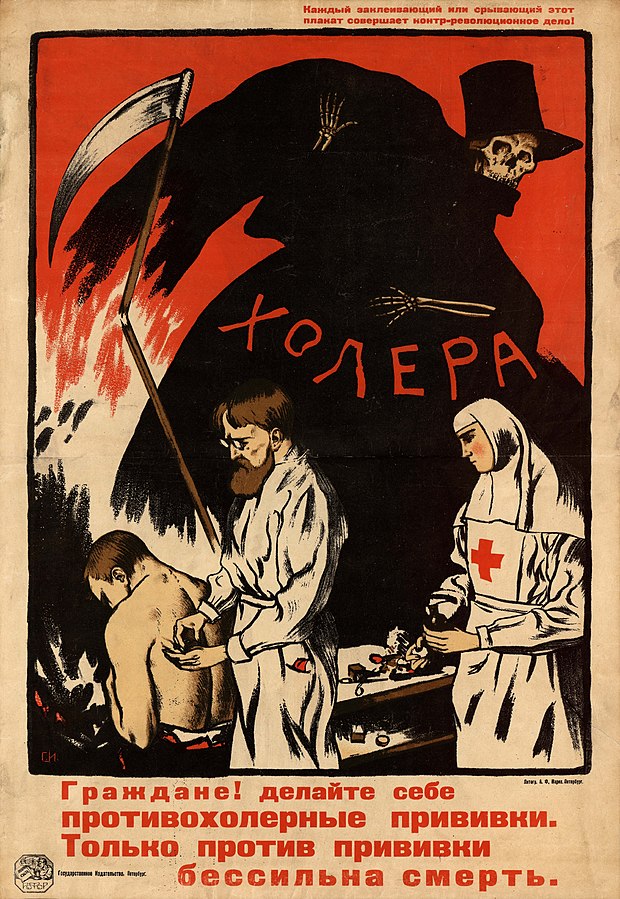
Rather than write another three or four seasons of Revolution Under Siege dealing with a period when the Revolution was, in fact, no longer under siege, I’m going to sum up as much of it as I can in one post. These are all things I’d write whole episodes about, if I had infinite time and if the scope of this project were just a few degrees wider.
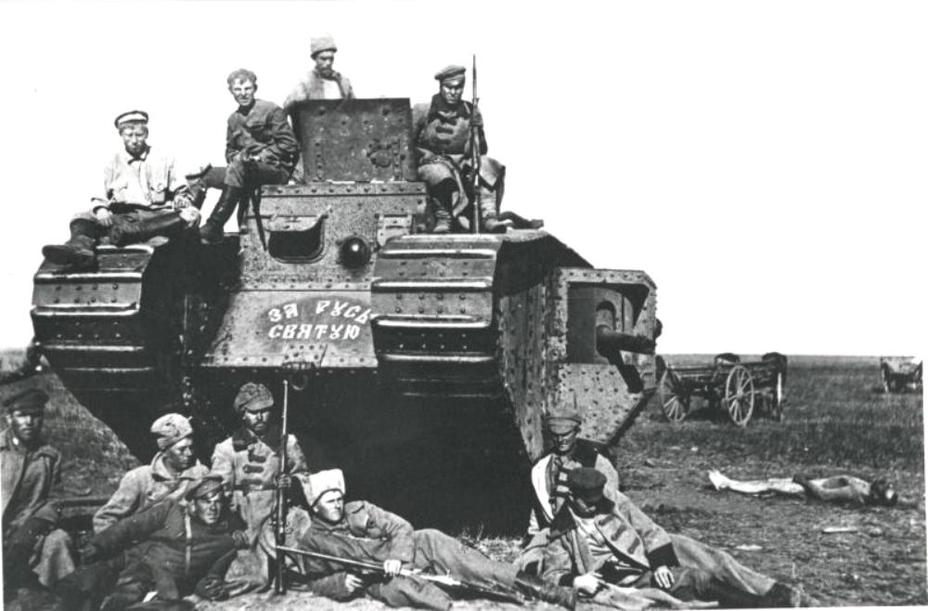
North Russia

In the Arctic Circle Red forces battled with British and American troops directly from 1918 through to 1920. This was a small and slow war fought in extremely harsh conditions. Each side proved capable of landing heavy blows on the other, but by 1920 the Reds had the upper hand on the frozen battlefields and the tide of political opinion in the Allied nations was turning decisively against the Russian adventure. The Allies pulled out at last, and the Reds retook Murmansk and Archangel’sk in early 1920.

Coat of arms of the Far Eastern Republic. Not the corn, anchor and tool representing peasants, fishers and workers.

Siberia & the Far East

The Reds led an uprising in Vladivostok in January 1920 – a time when the ground was splitting under the feet of Kolchak’s regime. But this uprising was put down by the Cossacks of Semyonov, assisted by the Japanese military. Its leaders, including the noble-born Bolshevik Sergey Lazo, disappeared to an unknown fate.

A few months later the Reds took Irkutsk and set up the Far Eastern Republic in coalition with Mensheviks and SRs. The Far Eastern Republic had its own Red Army and its own emblem. For the next few years it made slow and steady advances against Semyonov’s Trans-Baikal fiefdom and finally, after the Japanese withdrawal, took Vladivostok from General Horvath in 1922. The last major city in the hands of the Whites was now in Red hands.

Mongolia

The Russian Civil War spilled over organically into Mongolia: White Russians fled there, some to settle peacefully, others to raid over the border.

When Baron Ungern moved his forces from the Trans-Baikal into Mongolia, terror seized the Chinese forces occupying the country. According to the White soldier Dmitri Alioshin, the Chinese set about slaughtering every White Russian they could find. The White Russians, who despised the Chinese with intense racism, responded in kind. The White Russians were mostly skeptical of the unhinged Baron and would have avoided him in the normal course of events, but they were driven into his arms by the actions of the Chinese military.

Ungern and his forces endured the steppe winter of 1920-21, and in February they marched on the Mongolian capital city (known variously as Urga, Ikh Khuree, Ulan Baatar). They seized it from superior numbers of Chinese soldiers and began several days of intense slaughter and looting.

Meanwhile the Reds had made an alliance with Sukhbaatar and Chaibalsan, two more left-wing Mongolian leaders who opposed Ungern. A joint Soviet and Red Mongolian army crossed the border. Ungern hastened to meet it. His luck ran out. After defeats, he fled with small numbers, who turned against him and abandoned him in the wild. A Soviet Mongolia was established, and Ungern was captured, tried and executed in Russia.

The Caucasus and Persia

Victory in South Russia spilled over into a string of major gains in the Caucasus. In Azerbaijan the local communists overthrew the Musavatists, the nationalist forces supported first by Turkey and then by Britain. Neighbouring Armenia also contained many pro-Soviet elements and like Azerbaijan it was soon its own Soviet Republic. So secure were the Caucasus that Baku, which had been in enemy hands mere months before, was chosen as the venue for the September 1920 Congress of the Peoples of the East.

Meanwhile the Whites had withdrawn their Caspian Fleet, consisting of 17 ships along with 50 guns, to the British-occupied port of Enzeli in Persia (Iran). Raskolnikov led a Red striking force on a surprise raid, took and held the town for days, and returned the ships, munitions and materiel to Soviet Azerbaijan and Soviet Russia. In Persia itself, the Russian Revolution produced its shockwaves in the form of popular guerrilla leaders. The Enzeli raid, meanwhile, embarrassed the British so badly the Persian parliament rejected a proposed treaty that would have utterly subordinated the country to London.

The Daghestanis had troubled Denikin’s rear at a key moment. In 1920 some Daghestanis revolted against the Soviet power, though as many remained neutral and as many again were pro-Soviet. The Red Army suffered around 5,000 fatalities in tough battles over mountains, defiles and villages perched over sheer cliffs.

Georgia did not come into the Soviet orbit until 1923. The manner in which this was achieved was extremely controversial. It was the subject of Lenin’s final political struggle before his death. Though in extremely poor health, he waged a campaign against Stalin and his ally Ordzhonikidze. The latter pair were guilty of the premature entry of the Red Army into a Georgia that was not quite ready to accept it, and for the heavy-handed manner in which they dealt with the Georgian communists.

Makhno

Makhno and his Anarchist Black Army had been making open warfare against the Soviet power. But during the campaign against Wrangel the Anarchists agreed to a truce, sent some forces to help deal with Wrangel and, more importantly, stopped raiding in the rear of the Red Army.

Even taking into account how deep the hostility was between the Red Army and the Black, and how shallow their cooperation was, there’s something shocking about the Michael Corleone-like speed and ruthlessness with which the Anarchists were dealt as soon as Wrangel was out of the way. The commander of the Anarchist detachment which had fought in Crimea was summoned to Red Army HQ, but it appears it was a trap. He didn’t make it out alive.

After this, Makhno’s fortunes spiraled. He ended up with a couple of dozen companions fleeing across the Romanian border with the Red Cavalry hot on his heels. A humble life as an exile in Paris awaited him.

Internal Revolts

We have traced the fronts of the Civil War clockwise from Murmansk to the Black Sea. Now we return to the heart of European Russia. In late 1920 and into 1921, Tambov Province saw a rural revolt against Soviet power which far exceeded any peasant unrest during the Civil War. Soviet officials and their families were slaughtered out by furious insurgents, who organized into an army along regular lines.

Early 1921 saw a general strike of workers in Petrograd demanding better rations and fewer restrictions on political rights and economic activity. After the end of the strike, in March, the Kronstadt sailors revolted with a mix of similar demands and more far-reaching demands. Suppressing the Tambov and Kronstadt Revolts required serious military operations.

Smele says ‘it has been estimated that’ 2000 sailors were executed after the suppression of the revolt. If so, the scale of the reprisal was truly shocking. On the other hand Marcus Hesse, drawing on Paul Avrich, paints a different picture:

Of those who didn’t flee, several hundred were sentenced to death, although most were then amnestied. Others were imprisoned in camps intended for prisoners of war — some later ended up in the Solovetsky prison, which opened in June 1923 and later became part of the notorious ‘GULAG’. Several years later they were released under a general amnesty.

Leftists have been arguing about Kronstadt for a hundred years, and rather than wade in here I will just make one observation. Each year of the Civil War began, for the Soviets, with a promise of peace that was soon dashed. Spring would invariably bring with it new White and interventionist offensives. The familiar cycles of revolt and foreign intervention would repeat themselves with what must have become a dreadful and crushing sense of inevitability. The Kronstadt Revolt took place only a few months after the defeat of Wrangel, and precisely on the cusp of the Spring campaigning season. Sure, the Kronstadt sailors were raising democratic demands; the Don Cossacks and Right SRs, too, had raised democratic demands but had ended up spilling their blood for the White militarists. With the benefit of hindsight we know that the war, in European Russia at least, was over. The Communists did not have that benefit. We can hardly understand Kronstadt without an appreciation of the fear they had, a fear based on lessons learned in blood, of another year of war.

These revolts would not have taken place during the struggle against the White Armies, because neither the Tambov peasants nor the Kronstadters wanted to see a return of the landlords. But once Wrangel was defeated, the floodgates were opened for many serious grievances to find expression in armed revolt. The horrific conditions endured by both civilians and military during the Civil War meant there was widespread anger. Much of this was directed at the Soviet power and the Communist Party, as they were the regulators and arbiters in this austere armed camp. From both the factories and the naval base of Kronstadt, the leading elements from 1917 were absent: dead like Markin at Kazan, commanding fleets like Raskolnikov, or serving in the state apparatus.

The Kronstadt Revolt in particular, which took place during the Party Congress, served as a warning to the Soviet government that the Spartan wartime regime had been maintained for far too long, and must be dismantled as a matter of urgency.

So, when did the Civil War end? One answer would be 1922, with the conquest of Vladivostok from the Whites. Another would be 1926, with the defeat of the Basmachi. Antony Beevor ends with sailors being shot after the Kronstadt Revolt – a suitably depressing scene for his narrative purposes. But in these three cases we are losing sight of the big picture.

So I’m going to say November 1920.

The former Russian Empire was at war between Spring 1918 (the revolt of the Czechoslovak Legion and the Cossacks) and Autumn 1920 (the treaty with Poland and the defeat of Wrangel). This was an all-out war with profound geopolitical importance, fought between irreconcilable and defined adversaries, with clear criteria for the victory or defeat of each side.

This war was the most important of a complex of armed struggles which engulfed the collapsing Russian Empire in what we could call a ‘Time of Troubles’ lasting from 1916 to 1926 in Central Asia and from 1917 to 1923 in Russia itself. It is the narrow Civil War rather than the broad ‘Time of Troubles’ which has been the focus of Revolution Under Siege. But the two are of course not neatly separable.

Further Reading

On Enzeli and Persia: https://www.marxists.org/history/ussr/government/red-army/1918/raskolnikov/ilyin/ch05.htm

On Daghestan, see Eduard Dune

On Georgia, see Lenin’s Final Fight, Pathfinder Press, 1995, 2010

On Kronstadt: See Smele, p 200-210, also https://internationalsocialist.net/en/2021/04/revolutionary-history

28: The Black Baron

This is Episode 28 of Revolution Under Siege, my series on the Russian Civil War. In this post, we look at the invasion of Ukraine by the ‘Black Baron’ Wrangel.

By the time the Soviets signed a ceasefire with Poland, another serious war had been raging for months in the south of Ukraine: the struggle with the forces of Baron Wrangel.

White Crimea

Wrangel’s Crimea, to which the survivors of Denikin’s army had fled, was a strange place. The only parallel would be Taiwan soon after the Chinese Revolution. Imagine if the top politicians, billionaires and military officers got chased out of the mainland United States and washed up in the hotels and resorts of Hawaii or in Puerto Rico. People today talk about a ‘refugee crisis’ when a few hundred thousand people seek refuge on a continent home to hundreds of millions. Imagine being Crimean – one of fewer than a million – and seeing tens of thousands of Russian counter-revolutionaries and their dependents descending on your little peninsula. To people from that part of the world, Crimea was and is associated with holidays, beaches, cypress trees and nightingales, the mosques and masjids of the Tatar villages.

In 1920 this idyllic holiday destination was a refuge for Don Cossacks still mourning the horses they shot at Novorossisyk; women who had married conservative and strong-willed army officers, only to see them humbled by soldiers’ committees; children cast out of the homes they grew up in; business owners and aristocrats who have nightmares about the sailors and the Cheka; famous ministers under the Tsar; the agents of half-a-dozen foreign powers, selling information; speculators turned refugees turned speculators again; former bloodhounds of the Tsarist secret police who have found a new employer in Wrangel; people who cheered on February but saw October as a kind of apocalypse; people who saw February as an apocalypse; infants of the Civil War who have known crowded billets, refuges and train carriages during headlong typhus-haunted flights; elderly dependents; girlfriends. Between the price of bread and the low pay of a soldier (even of a junior officer) most of these people must have lived in a state of desperation.

The father, husband, or son, the ally, pawn or constituent who stands at the centre of all these figures, whom they all have in common, is the White officer. This character has changed little since we first introduced him back in Episode 2, in spite of ordeals, triumphs, humiliations, allies gained and lost along the way.

Many of the White officers remember the Russo-Japanese War, and most the Great War. Some go back to the very start of the White movement: the Kornilov Affair, imprisonment in Bykhov Monastery, Rostov and the Kuban Ice March; some rode across the seething Ukraine of 1919, drunk and high under wolf talismans.

Some of these individuals crack under the pressure of the war. General Slashchev was fired after the stern Wrangel found him passed out from drugs and alcohol, dressed in a gold-trimmed Turkish robe, surrounded by his collection of birds. [1] But let’s speak of them as a collective. The White officer will fight on to the end, because to accept the egalitarian order promised by communism would be, to his mind, to accept the downfall of civilisation and the obliteration of his personal dignity.

Today’s cover image is a detail from the above, a poster from 1920 whose theme is how the forces of the Revolution in 1917 compare with three years later. Note the slender figure of Wrangel, near bottom right.

Circumstances dictate an offensive

Speaking with journalists, Wrangel outlined a cautious strategy. ‘I don’t make big plans. I think I need to gain time.’ Here in Crimea, he explained, one can live, free of hunger and terror; more will join us, and we will expand gradually at the expense of the Soviet territory [2]. But circumstances dictated a bolder strategy.

First, there was the Polish-Soviet War. The Whites had hardly settled in Crimea when Piłsudski marched into Kyiv. A better opportunity for a breakout would not come along. Immediately they began to make plans for an attack on the mainland.

Second, there was the crowded Crimea and the looming winter. Wrangel’s people would not have enough food to stay alive, let alone provide an instructive contrast to the hungry Soviet territory. The price of food in Crimea rose at least 16-fold between April and October 1920. [3] The Allies might be so kind as to keep them all alive for a while, but now less than ever before could the White officer take foreign aid for granted. Nutrition, never mind strategy, dictated that they must seize the harvests from other parts of Ukraine and Russia.

It was necessary to make a move.

The British government heard of plans for the coming offensive and tried to dissuade Wrangel. They had been through all this before with Denikin and Kolchak. But they could not dissuade Wrangel: in June the ‘Russian Army’ broke out in all directions.

History is being helpful for once: the main frontline of that war is very similar to one of the main frontlines in today’s war in Ukraine, following the course of the Dnipro River. Like Putin’s in 2022, Wrangel’s forces burst out of Crimea in April 1920 and seized the neighbouring chunk of the mainland, an area known as the Northern Tauride. It was the ‘colourful’ units, named after dead White generals like Markov and Kornilov and composed of the most professional, determined and experienced soldiers, which broke out from Crimea to the river Dnipro in just one week. His forces numbered somewhere between 40,000 and 70,000, an imposing number concentrated in such a small area. They advanced westward as far as the Dnipro and east as far as Mariupol (site of a terrible battle in 2022). They also landed forces by sea in the Don and Kuban regions in Russia.

Red soldiers drill in Kharkiv, 1920

The Allies draw back

Now something unprecedented happened: the British really did cut them off. It turned out there was after all a limit to the number of rifles they were willing to pour into the Soviet Union (That limit was somewhere in the millions, but it did exist). British trade unionists had protested and gone on strike under the slogan ‘Hands off Russia,’ and this was a key part of the context in which the sceptical Prime Minister Lloyd George at last won out over the pro-war Churchill.

The French government, on the other hand, gave massive aid to Wrangel. This mostly arrived from Romania in August and September [4]. Other foreign aid included from Poland and from the Menshevik government in Georgia; Whites who had been interned in those countries were sent to further boost Wrangel’s numbers. But the French took the opportunity to wring heavy economic concessions out of Wrangel, and in the French agenda, Wrangel was only a distraction to help the Polish war effort.

But…

Here are two qualifiers: first, this White Army would not have come into existence, and would not have escaped destruction in the Kuban, without Allied aid. So Wrangel’s regime was a legacy of intervention. Second, if Wrangel were to defeat a few Red Armies, were to take over large parts of Ukraine, were to ignite the Kuban and the Don in revolt again, the British and the French would surely get over their scepticism and part with another few million rifles. It would be 1919 all over again: ‘To Moscow!’

But as it stood, the Whites were on their own – or as close to ‘on their own’ as they had ever been. The British had cut them off, and the French were obviously using them toward limited ends.

The Cossacks draw back

The Allied spigot had waned to a trickle. So had the Cossack spigot.

There was still a large Don Cossack contingent in Wrangel’s ‘Russian Army.’ And there was a White guerrilla army, independent of Wrangel, surviving in the remote parts of the Kuban. Wrangel made strenuous efforts to raise the Don and Kuban in revolt again, through landing his forces in those regions by ship. But the population failed to rise. In the Kuban, the beachhead was surrounded by an amphibious counter-strike by the Red Army.

The Cossacks had seen war, revolution and counter-revolution pass over them so many times they were sick of it. This, along with a ‘more conciliatory Bolshevik policy’ and a ‘more effective occupation force’ meant they would not be enlisted in another adventure this time. [5]

The peasants draw back

With his old friends abandoning him, the White officer had to find new ones. He tried to win over the peasants. Wrangel’s government, as it advanced in June, announced a new land law. The estates of the nobility would be given to the peasants, and the nobility compensated. A more direct hearts-and-minds campaign was waged by General Dragomirov. He would roll into a Crimean village and (instead of embarking on a pogrom as he had done in Kyiv) would set up some tables, roast a few lambs, share out barrels of booze, and raise a toast: ‘the day will soon come when we will hear the bells of Moscow.’ [6]

But the land law was more than a day late and more than a rouble short. The Soviets had already shared out the land – without compensation. So there was no popular upsurge for Wrangel on account of this land law.

A Red poster from 1920. ‘Wrangel is coming to us […] What we earned with blood, we will defend with blood.’

Reds on the back foot

Their list of friends was not getting any longer. But the White officers held the Northern Tauride all through the summer and into autumn despite determined counter-attacks. One time a whole Red Cavalry unit was surrounded and ‘practically wiped out.’ Communists and commissars would have been executed on the spot; [7] others would have been propositioned for recruitment. Thousands of horses would have been captured – to the delight of every Don Cossack who found himself back in the saddle.

Things went badly for the Reds here for a long time. The war with Poland was the biggest and most intense campaign of the Civil War, and large parts of Ukraine were still unfriendly. The Anarchists wished to retake Dnipo, which had served for some weeks in 1919 as the centre of their utopian experiment. Beevor describes how they entered the town in the guise of farmers with carts piled high with hay. Once in the city, they revealed machine-guns under the hay and started blasting. They were driven out of the city, but they left ten captive Red soldiers behind, their guts torn out and grain stuffed into the cavities.

Bridgehead

Despite these setbacks and troubles, the Reds managed to make headway even before the end of the Polish-Soviet War.

Like today, the river Dnipro formed the most important front line. Here the Reds forced a few bridgeheads in the face of stiff White resistance; the high right bank commands the low left bank. Most of the bridgeheads were lost again, but at the town of Khakovka they held out. (Today Kakhovka is in Russian hands. Nova Kakhovka, ten kilometres down the river, was where that dam got blown up in June 2023.) Around Khakovka there was an intense, dug-in battle lasting months. Contrary to Beevor’s claim that Wrangel ‘never presented a serious threat to the Red Army’s rear,’ (p 479) this seems to have been one of the most intense battles Red and White ever fought. 

The White general Slashchev (soon to be dismissed after the Turkish robe incident) sent repeated cavalry charges against Red trenches and barbed wire. The Whites also sent in twelve British Mark V tanks. They had a dozen aircraft, 60 artillery pieces and 14 armoured cars. These would seem like pathetic numbers today but this represented a concentration of machine force not hitherto seen in the Civil War [8]. Each tank was named, like a ship, after some general of the White cause or of the old empire.

But soon the Whites could feel keenly the effects of the withdrawal of Allied support. At the height of the battle they were down to twenty artillery shells a day. [9] When Poland and the Soviet Union signed a peace treaty in October, the tide turned instantly against the Whites. Their isolation was now as complete as it had ever been. With the war in the west over, there began a vast concentration of forces against Wrangel.

Meanwhile on October 14th the Whites made a great assault on the Khakovka bridgehead. The Reds defended the small town with three lines of trenches and barbed wire. There wasn’t enough time to dig the tank traps, and White scouts spotted where the Reds put their mines, so it looked like the Reds would have no effective counter to the tanks. 6,000 Whites went into the attack against 10,000 dug-in Reds. The Whites were confident in spite of their smaller numbers; they had beaten far worse odds in 1918 and 1919.

But the great White attack ran into a level of Red resistance the Whites had never seen before. The tank ‘Generalissimo Suvorov’ was destroyed by a Red armoured car bearing the name ‘Antichrist.’ Another tank (‘Ataman Ermak’) ended up crashing into a regimental bathhouse, where it kept up fire until a Red cannon blasted six shells into it from a distance of ninety metres. A White horse battery ran into the shock troops of the veterans from Siberia, who showed them an unexpected and terrible weapon: two volleys from flamethrowers, which sent them fleeing in panic, dropping their weapons. [10]

A Red soldier with an artillery piece

The Red Worker

The White officer has changed little, but he has just discovered that his opponent, the Red worker, is almost unrecognisable. When the Red Guards first came down to the Don Country in pursuit of Kornilov at the start of 1918, they patrolled trains and verbally asked the passengers to give up any concealed weapoms – basically operating on the honour system. In that, there was as much nervousness as humanity. In summer 1918 some Red units would abandon the front line en masse to have a nap. The unit from one town would refuse to share its horses with that from the next.

See them now massing for the attack on the Northern Tauride. They are in long overcoats with red trimming and spiked bogatyrka hats which give them a distinctive appearance redolent of the steppe. They have rifles and are well-accustomed to using them. The lads at Khakovka have 200 rounds each. Amphibious landings, bridgeheads, cavalry assaults, digging and holding trenches, knocking out tanks and aircraft, fighting on when outflanked – none are beyond them.

But first, try to make out the familiar figure of the Red Guard of 1917-18 amid 133,000 armed and uniformed fighters, amid the tachanki, armoured cars and armoured trains, their old allies the Latvian Rifles, and the mass of conscripts from the farming population. Budennyi’s Red Cavalry are here. There is even a detachment of long-haired Anarchists with their black banners; in August, the Soviets and Makhno signed up to a temporary alliance against Wrangel.

This description of the aspect of the Red soldiers in the neighbouring Kuban region probably applies to the Reds in Ukraine:

In every battalion now there were as many Communists as used to be found in a whole regiment. The political section of the division grew into a huge institution with dozens of organizers, agitators, and instructors. We published our own newspaper, we had our own printing press. For illiterates or those who could barely read we organized schools in the regiments with a corps of teachers. [11]

Communists make up 8% of this massed force, probably a higher proportion than you would have seen at Kazan, Perm or Petrograd [12]. Many of the Red Guards of the 1917-18 vintage have been promoted or died in battle or from epidemics. Still there is a politicised core of working-class recruits which holds the army together: many would have joined from the great wave of communist, worker and trade unionist volunteers that signed up around the time of Kazan in the summer of 1918; or those called up to resist Kolchak; or the wave recruited to resist the Polish invasion.

This picture of the Red Army in 1920 is significant for our assessment of the whole war and the whole revolution. Smith and others argue that the Soviet power basically lost its support base in the first half of 1918. I don’t subscribe to this view. Laura Engelstein, who is far more critical of the Reds than I am, would also be sceptical. [13] Historians recognise an implicit popular endorsement of the Polish government in the massive upsurge of volunteers during the Red advance on Warsaw. It’s long past time to see the significance of these successive waves that entered the Red Army. Even this late, after the dissolution of a large part of the working class, the defeat of revolutions abroad, and the emergence of a Soviet state which, under pressure of war, showed increasingly its severe aspects, another wave of genuine enthusiasm was conjured in response to Wrangel. Where did they keep coming from?

And that army was increasingly professional and formidable. The White General Dostovalov would later write that the Reds had developed even since Novorossiysk earlier that year. There were now ‘excellent Russian divisions’ alongside the stereotypical image of Latvians and Chinese. ‘The Kakhovka bridgehead was fortified in an exemplary manner’ with well-built trenches, marked firing distances and consideration given to crossfire. ‘The Red Army grew before our eyes and surpassed us in its growth.’ [14]

Breakthrough

The challenge facing this army was an unusual one. Their aim was not to make Wrangel retreat, but to trap and destroy his army. If Wrangel managed to withdraw to Crimea, it would be extremely difficult to follow him. The peninsula was a natural fortress.

After the defence of Khakovka, the Reds attacked from several directions. From Khakovka the Red Cavalry raced southward to try and cut off retreat to Crimea.

The Red commander Frunze was impressed by the Whites: ‘I am amazed at the enormous energy of the enemy’s resistance.’ [15] Wrangel’s men had tried to hold on until they could grab the harvest and bring it back to Crimea. But a large part of the harvest had to be left in the fields. Wrangel saw the writing on the wall for the Northern Tauride, and given the natural fortress behind him he had an incentive to retreat. At the end of October his fighters fell back to Crimea. 20,000 of them had to surrender to the Reds with 100 artillery pieces and 7 armoured trains. Another 20,000 – the hardcore ‘colourful’ units and the Don Cossacks – made it back to Crimea.

The stage was set for the last struggle between Red and White in European Russia. The Reds had an overwhelming superiority in numbers, but the Whites had a great advantage in geography. The Revolution was no longer a besieged fortress. Now the remnants of the besieging forces were making a stand in a fortress of their own.

Home Page/ Archives

Revolution Under Siege Archive
References

[1] Beevor, 479

[2] Beevor,444

[3] Smith, Russia in Revolution, 177

[4] Jackson, 188-9

[5] Mawdsley, 367

[6] Mawdsley, 363; Beevor,444

[7] Smith, 200; Mawdsley, 371

[8] Smele, 169

[9] Beevor, 480

[10] Belash, Evganiy. ‘Defence of the Khakovka Bridgehead,’ https://warspot.ru/4163-oborona-kahovskogo-platsdarma, translated by Google. Written October 14th 2015. Accessed Feb 29 2024 10pm GMT

[11] Dune, 207-208

[12] Smele, 169

[13] Engelstein, Laura. Russia in Flames, Oxford University Press, 2017. P 592. Writing of examples of worker protest against the Soviet state she says: ‘The fact that workers resisted the regime acting in their name did not, however, mean that most or all of them wished to overthrow it, that the Bolsheviks had “lost their base.” It was a sign above all that laboring people needed to survive no matter who was in power.’ I have not yet read much of this book but I am interested in delving further into it. I think its author is very much against the Reds but she appears to be more conscientious and basically more serious than, say, Beevor.

[14] Belash

[15] Mawdsley, 377

27: The Devil’s Wake (Premium)

This is Episode 27 of Revolution Under Siege, an account of the Russian Civil War, and the third and final episode dealing with the Polish-Soviet War. Here are the first and second parts.

Become a paying supporter to get access

Access to this article is limited to paying supporters. If you already subscribe by email, thank you. But if you want to become a paying supporter, please hit ‘Subscribe’ below.

Give me less than the price of a coffee, and you can access everything on this blog for one year.

26: Pursuit into Poland

The Red Army drives back the Polish invasion. The Soviet leadership faces a choice: whether to make peace or to carry the war into Poland. This is part 26 of Revolution Under Siege, an account of the Russian Civil War.

We are a force in the world, and you are destined for the mortuary. I despise you and hold you in contempt.’ Piłsudski, in a fit of anger, was fantasising out loud about what he would like to say to the Soviets. This was during the months before the Polish invasion of Ukraine. ‘No, no, I have not been negotiating. I have just been telling them unpleasant facts… I have ordered them to understand that with us they ought to be humble beggars.’ [1]

It was indeed in a beggarly and humbled condition that the Soviet Union found itself in a full-scale war with Poland a short while after this outburst. Still, somehow, the Soviets found ways to dig deeper. 280,000 communists joined the Red Army – that was 65% of the party’s membership. A measure of the chaos of the times, of the threadbare state of the new institutions, is the fact that 2.5 million people had deserted from the Red Army over the winter of 1919-1920 – to put that into perspective, the Soviets had over three times more deserters than the Poles had soldiers. But an indication that perhaps the Soviets were not bound for the mortuary after all is found in another statistic: 1 million – the number of deserters who returned voluntarily to the Red Army after the Poles invaded. [2] The war commissar Trotsky toured Ukraine speaking to crowds of deserters, urging them to re-enlist. 

As you are probably re-enlisting as a reader of this blog after a gap of a week or two, here is a reminder that the Polish-Soviet front was divided by the Pripet Marshes into a Northern and a Southern Sector. In the Southern Sector, Budennyi and First Cavalry broke through enemy lines and the Red Army’s South-West Front forced the Polish forces to withdraw across western Ukraine.

Red Cavalry. A stunning work by Kazimir Malevich, dated to some time betwen 1928 and 1932

Kaleidoscope of Chaos

In the Northern Sector, the Red Army’s Western Front went on the offensive – with disappointing initial results in late May, followed by stunning successes in June and July. Here Third Cavalry Corps, known as Kavkor, played a key role. Kavkor was commanded by a Persian-Armenian socialist named Hayk Bzhishkian.

(This name entered the mangling process of Slavicisation then Latinisation and came out the other end, somehow, as ‘Gay,’ ‘Gaia Gai’, or worst of all ‘Guy D. Guy.’ I will call him Bzhishkian. And if I alienate any readers, I hope it’s because of my long-windedness, my blatant partisanship or my preoccupation with violence, and not because I made you pronounce an Armenian name in your head.)

Kavkor and Bzhishkian advanced on the right flank of the Western Front, where they found weak spots in the overstretched trench lines of the Poles, and broke through before reinforcements could arrive.

Barysaw, where the Polish side had insisted talks must take place, was soon in Soviet hands – what was left of it. The Polish army reduced it to ruins with chemical and incendiary shell-fire. [3]

Bzhishkian’s cavalry seized Vilnius. A 14-year-old scout went ahead and reported back key information. Then Kavkor attacked, aided by local communists, and the city soon fell. The Soviets handed Vilnius over to the Lithuanian government, a magnanimous gesture that ensured the Baltic States didn’t join in on Poland’s side. And at Brest-Litovsk, local Polish communists played a key role in aiding the Red Army. 

Piłsudski called the Polish retreat ‘a kaleidoscope of chaos.’ If you look at the Battle of Grodno, you can see what he meant. Here 500 Polish uhlans, an entire regiment, were swept away and drowned while trying to cross the Niemen River.

As at Petrograd and in the South, the Red Army at the Battle of Grodno had to face tanks kindly supplied by the Allies: some were mobile, some were able to fire but were stuck on their transport train.

A frightened soldier shouted to Bzhishkian: ‘Tanks, comrade corps commander! How can one sabre them when they’re made of steel?’

Another cavalryman added: ‘Bayonets are no use; in any case you can never get near them.’

But the cavalry surrounded the French Renault tanks and forced them to retreat, playing for time as the steel monsters were disabled one by one: by artillery, by collisions, by breakdowns and by lack of fuel. Only two escaped across the burning bridge over the Niemen.
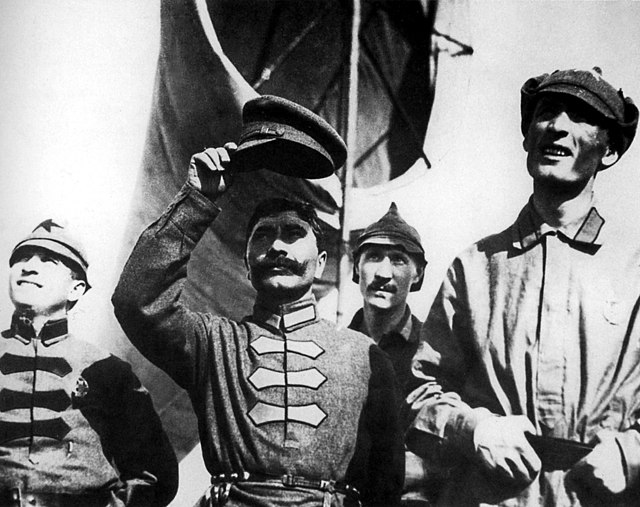
‘An armoured tank is nothing to frighten a skilled cavalryman,’ wrote Bzhishkian of the experience in his 1930 memoirs. [4] He would not live to see World War Two and history’s final judgement on that question.

The Polish retreat was chaotic but, Davies points out, tenacious. The most spectacular battles were on horseback; Russian sabres were sometimes defeated by Polish lances. On one occasion a Polish cavalry division commander personally defeated and killed his Soviet counterpart during a battle which delayed the Red advance by two or three days.

Nonetheless the movement was all in one direction, and to the Polish soldier, in Piłsudski’s words, the Soviet advance was ‘like a heavy, monstrous, uncontainable cloud.’ [5]

Today’s cover image. A Red Cavalry fighter, photographed in 1922

The Curzon Line

On July 11th the Allies tried to step in with a peace proposal. [6] Imagine a posh English politician gesturing at a map and saying, ‘Pans, comrades, why not draw the Soviet-Polish boundary just here.’ This here was known as the Curzon Line. It gave the Soviets a lot more territory than they had when the Poles first attacked, and also gave the Poles a lot more than what they stood to lose if Bzhishkian and Tukhachevskii kept advancing. 

The Allies proposed this border because they still believed the Soviet Union would collapse and be replaced by a conservative Russian Empire, and they were keen to establish relatively generous borders for their hypothetical future ally.

The Curzon Line, with information allowing you to compare its borders to modern-day Poland. In today’s terms, Wilno is Vilnius and Lwów is Lviv.

Whatever the motivations of the Allies, it suited the Polish government to quit before they got any further behind, and they agreed. [7]The offer was Moscow’s to take or leave – not humble beggars anymore. 

The Soviet leaders entered into a debate, dynamic as was the Bolshevik tradition but short and to the point. The question at issue was whether to launch a counter-invasion of Poland or, having repulsed the Polish invasion, to make peace. Unhelpfully, the British tacked on a provision that the Soviet Union should recognise Baron Wrangel and let him hold onto Crimea, which Moscow would never do.

On either July 16th or 17th, Trotsky on behalf of the Red Army command made the case for accepting the peace proposal – though he never accepted the point about Wrangel. Rykov, Radek, Stalin and others also opposed crossing the Curzon Line. Of Radek, Lenin later said, ‘I was very angry with him, and accused him of “defeatism”.’ [8] Lenin was in favour of advancing on Warsaw, and so were most of the Polish communists resident in Russia. 

The Debate

The broad arguments of the two sides – let’s call them the peace party and the war party – are laid out below in the form of a dialogue, in my words. Where I am directly quoting, I have indicated it using inverted commas.

War: 

We have been subjected to a full-scale invasion. We have driven back our enemy, but if we do not pursue him to his lair and finish him off, he will strike again. Just look at what happened in South Russia – how many times did we have to fight our way across the Don and the Kuban? And now Wrangel is trying to raise the Kuban in revolt yet again. Woe to he who does not carry matters to a finish! We have every right to invade and to destroy this regime of criminal military adventurers, who have brought so much suffering and destruction on the working people of Soviet Ukraine and Soviet Belarus. 

The Russian peasant uses his scythe to behead, Itchy-and-Scratchy-style, the Polish Pan (landlord) and Wrangel.

Peace:

From a military perspective, to invade Poland is insane. It is not like Denikin or Kolchak; it is not a question of fighting officers, undisciplined Cossacks and raw conscripts. We face 750,000 Polish troops. It is ‘a regular army, led by good technicians.’ Even if the Red Army takes Warsaw, its supply lines would be stretched too thin to occupy Poland for long. [9] The Soviet Union is crying out for peace. We won’t survive another winter of war. Hunger and disease will be rampant. The regime may even fall apart. 

War:

We do not assess these problems purely from a military perspective. It is not a question of conventional war or occupation. The mass of the Polish people, the working class and poor peasantry, will join us in our war against the Polish landlords and bourgeoisie. 

And we must also consider the perspective of world revolution. In Britain the ‘Hands off Russia!’ campaign is making headway; on 9th and 10th May, British dockers refused to load munitions onto a ship bound for White Poland. There is a developing revolutionary situation in Italy, with soviets in Turin and factory occupations; and in Germany we’ve seen the defeat of the Kapp Putsh by a workers’ general strike and even the organisation of a workers’ Red Army in the Ruhr. If we defeat Poland, we open the way to Germany, and may trigger revolutionary events there and elsewhere. Imagine if Budennyi or Bzhishkian arrived in Berlin just on time to prevent another massacre of communists like that of January 1919. 

We also want peace. But this latest onslaught by the Allies shows that they are hell-bent on our destruction. We cannot hope for peace except by breaking out of our isolation.

Peace: 

The Polish workers and poor peasants are unlikely to join us. By pursuing the Polish army into Poland, we will drive them into the arms of Piłsudski and his military-Bonapartist clique. It is still the honeymoon period of Polish independence. Resentment of all things Russian is still understandably strong. ‘This is the historical capital from which ‘Chief of State’ Piłsudski hopes to draw interest.’ [10]

We too see the perspective of world revolution. But if we are defeated, it will be a setback for the revolution everywhere.

War:

The key question, then, is the attitude of the Polish masses. The Polish revolution has always marched in step with the Russian; our anthem ‘Varshavianka’ refers to the Polish revolutionary tradition. In 1905 the Poles held out for longer against the Tsar than the workers of Moscow. In 1919 there were reports of Soviets in Cracow. [11] There were ‘village republics’ where the farmers took collective control of the land. On May Day this year, the demonstrations in Warsaw, Łódź and Czechostochowa were anti-war and anti-government – remarkably, a mere week after the beginning of the Polish invasion. A railway strike in Poznań, beginning the day after the invasion, turned into a week-long pitched battle between strikers and the authorities. [12]

The reports from the Belarussian Front have been most encouraging. Arrogant Polish landlords return on the coat-tails of their army and try to grab the land, and this angers the people and the rank-and-file soldiers. The Poles barely hold the frontline zone, which is traversed freely by refugees, deserters, bandits, petty traders, cocaine dealers and Polish Communist partisans. We have reports of mutinies and of harsh reprisals by Polish officers against the men – including executions. More recently, Polish soldiers returning from leave are condemning Piłsudski as the puppet of the landlords and questioning the aimlessness of the war. On July 26th an infantry unit rose from their trenches singing The Internationale and preparing to cross over to us; they were only prevented by their own side opening fire on them from behind. [13]

And we have many talented Polish communists here in Russia, who are enthusiastic to carry the revolution to their homeland; on May 3rd 90 Polish delegates met in Moscow. In Kharkov and Smolensk we have printed masses of material in the Polish language – 280,000 copies in Smolensk alone. We will guarantee the Polish worker, soldier and farmer an independent Soviet Poland. We even have a Polish brigade, 8,000-strong, on our Western Front, to form the nucleus of a Polish Red Army.

A Polish poster from the 1920 war. The struggle for national independence – ‘the historical capital from which […] Piłsudski hopes to draw interest.’

Peace: 

Taken as a whole, the indications are not nearly so favourable. The Polish Socialist Party received only 9% of the vote in January 1919. The Polish Communist Workers’ Party is illegal and has very little support in Poland.The Cracow Soviet was put down. The ‘village republics’ were suppressed with draconian severity. The Piłsudski government is Bonapartist in character; it does not simply represent the landlords or the bourgeoisie, but tries to play a balancing act. It has embarked on land reform of its own accord, which saps the agitational strength of our land programme. The Polish landlords who are trying to claw back parts of Belarus and Ukraine are supported by the Polish officers, but opposed by government agencies [14]. 

The Polish soldier on the Belarussian Front is demoralised, it is true. But the Polish soldier defending the approaches to Warsaw may prove to be a more formidable opponent. 

To invade would not hasten revolution – it would delay it. We cannot tolerate Wrangel in Crimea for a moment longer than is necessary – on that we agree. Let us then focus as much of our strength as possible on Wrangel. But let’s talk to the Allies, and agree on the Curzon Line as our border with Poland. 

The Advance to Warsaw

Intra-Bolshevik debates were often conflicts between audacity and caution. Today audacity won out. All agreed that the Soviet Union could not build socialism in isolation from the rest of the world. The key strategic imperative was to break out. Up to this point it was assumed this would happen through an indigenous revolution in another country, but this war represented another kind of opportunity. The war party won the vote, and the Red Army was ordered to sweep on into Poland.

Kalinin and Trotsky review the troops. Trotsky argued against carrying the war into Poland, but according to Davies, once the vote had been taken, few took the war more seriously than Trotsky.

From July 19th to August 7th the Communist International held its Second Congress, a bigger and more impressive affair than the First Congress back in March 1919. Among the 220 delegates was Alfred Rosmer who has given us an often-quoted description of a large map of Eastern Europe that was on display outside Lenin’s office. Visitors watched as little flags were moved across it to mark the positions of the armies; in July, all the red flags were moving west. ‘The advance of the Red Army was stunning; it was developing at a pace which nonplussed professional soldiers ,as only anarmy born of revolutionary enthusiasm is able to do.’ Tukhachevksii’s Western Front took Minsk on July 11th, Vilnius on July 14th, Grodno on July 19th, crossed the Bug River on August 1st and by August 10th was closing in on Warsaw. [15] Some of Hyak Bzhishkian’s Kavkor had in fact run on ahead, west of Warsaw.

Semyon Budennyi, undated. While Tukhachevksii advanced on Warsaw, Budennyi spearheaded the advance on Lviv in the southern sector.

In the Southern Sector, the Red Army captured Rivne and Kamianets-Podilsky on July 4th. Budonnyi is reported to have said that if he had as many riders as the old Tsarist army – that is, 300,000 – ‘I would plough up the whole of Poland, and we would be clattering through the squares of Paris before the summer is out.’ For better or for worse, he had only 16,000, which along with the Red Army’s South-Western Front, aimed to capture the city of Lviv.

What struck Rosmer in a conversation with Lenin, however, was how the Soviet leader was just as interested in what he had to say about developments in the French Socialist Party as he was in Poland. For Lenin, then and always, it was all one struggle. [16]

In August 1920, the crux of that struggle lay not in the Ruhr Valley or the factories of Turin but on the Vistula River. The humble beggars had come to Piłsudski’s doorstep.

References

  • [1]Davies, p 74
  • [2] Davies, 142
  • [3] Trotsky, How the Revolution Armed, Volume 3,‘Postal Telegram No 1886-B’
  • [4] Davies, p 148
  • [5] Davies, p 148
  • [6] Smele, 156
  • [7] Mawdsley, 349
  • [8] Zetkin, Clara. Reminiscences of Lenin, January 1924. International Publishers, 1934. ‘The Polish War.’ https://www.marxists.org/archive/zetkin/1924/reminiscences-of-lenin.htm#h04
  • [9] Numbers from Smele, 165; ‘good technicians,’ Mawdsley, 255
  • [10] Trotsky, How the Revolution Armed, Volume 3,‘The war with Poland – reportMay 5th’
  • [11] Read, 111
  • [12] Davies, 113
  • [13] Davies, 78-91, 151
  • [14] Davies, 82-3
  • [15] Smele, p 156
  • [16] Rosmer, Alfred. Lenin’s Moscow, 1953, Bookmarks, 1971. P 52-53. Budennyi quote from Davies, 120