08: The Fight for Kazan

Listen to this series on Youtube or in podcast form

The Fall of Kazan (5 to 7 August)

Looking out from revolutionary Moscow to each point of the compass in August 1918, the prospect ranged from threatening to dire. In Part 7 we saw how the Don Cossack revolt was battering at Tsaritsyn and Voronezh. Tsaritsyn lay on the steep right bank of the Volga river. On the left bank of the same river, but eight hundred kilometres north, lies the city of Kazan.

Kazan is the thousand-year-old capital of the Tatars, with a mosque-dotted skyline and a Kremlin of white limestone. It was the site of key battles in Russia’s history.
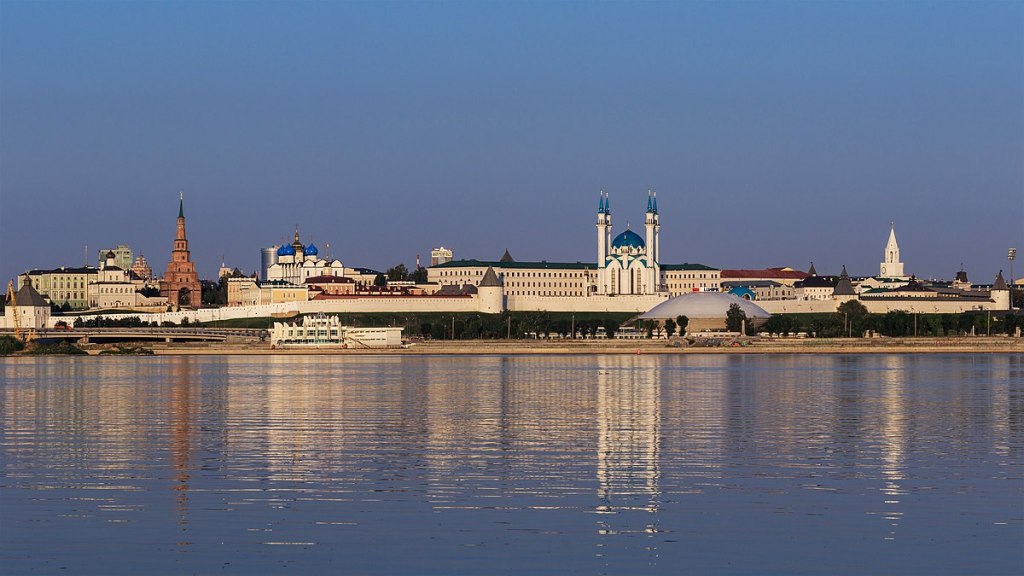
Kazan’s White Kremlin, seen from the Volga

From the city, Jukums Vacietis commanded the Red Army Group on the Eastern Front. Vacietis was the former commander of Latvian Rifles. Though he was himself a Left SR, he had put down the revolt in Moscow, and it had been his idea to fire shells at short range into the Left SR stronghold, harming no-one but shattering the morale of the insurgents. No sooner had the dust settled in Moscow than Murav’ev, defender of Petrograd and conqueror of Kiev, rose up on the Volga with the intention of leading Red and White alike against Germany. Vacietis had taken over in Kazan after the failure of this Murav’ev mutiny. But the staff in his new HQ were leftovers from the Murav’ev days, and in spite of the energy and enthusiasm for which he was known, he faced a steep challenge in trying to get the Red Army organised.  

Vacietis was tasked with resisting Komuch, the Right SR-dominated regime which claimed the democratic mandate of the Constituent Assembly. Twelve million people inhabited the food-rich territory on which Komuch carried out its experiment in Democratic Counter-Revolution. This territory was growing thanks to the victories of the People’s Army and the Czech Legion. Beyond Komuch – the officers’ government at Omsk, the warlords of Siberia and the Trans-Baikal, the Japanese occupation force. From the Volga to the Pacific counter-revolution was in the saddle.

Many local Soviets had given up without a fight. Some Red Guard units had immortalised themselves with heroic – but in the short term futile – martial deeds; others had fled or deserted or fallen to pieces.

By August the Soviet government was turning its attention to this Eastern Front. Around 30,000 soldiers were transferred from the west to the Volga in a few weeks over that late summer, a dangerous gamble seeing as Germany might yet attack in the West. They were explicitly threatening to do so; if the Reds failed to deal with the Whites, Germany would invade and deal with both.

It was decided to send out the war commissar Trotsky by train. After scrounging around the chaos and shortages of Moscow to procure a train and supplies, he set off on August 7th. The day before he had sent a dispatch ahead of him:

Any representative of the Soviet power who leaves his post at a moment of military danger without having done all he could to defend every inch of Soviet territory is a traitor. Treachery in wartime is punished with death.[i]

But by the time this message arrived in Kazan, the city was already under attack. There was fighting in the streets, and many representatives of the Soviet power had already left their posts – or worse.

A month to the day after his battle in the streets of Moscow, Vacietis was directing a desperate battle, first outside Kazan on the riverbank and then on the streets of the city itself.
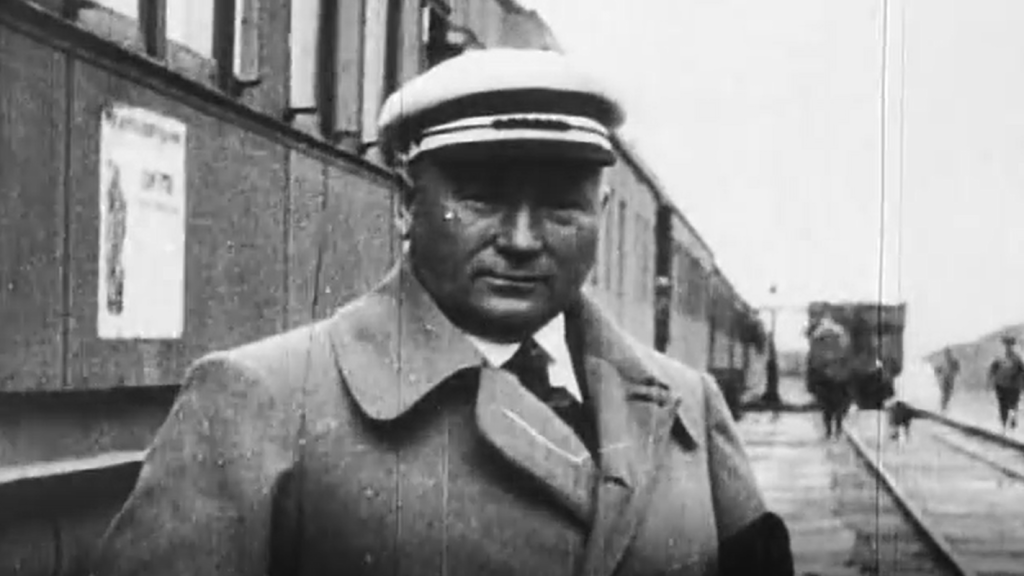
Jukums Vacietis, commander of the Latvian Rifles and later of the Eastern Army Group

The People’s Army and the Czechs had launched a lightning attack on the city of Kazan on August 5th. The officers who led this assault were doing so in defiance of direct orders from Komuch and from the Czech top brass, who had a more cautious policy. But the officers reasoned that ‘Victors are not court-martialled.’ They brought up heavy guns on tugs and barges and forced a landing with a ‘microscopic force’ of only 2,500. They failed on the first attempt, then got a foothold. The following day, the 6th, they broke through to the streets, and there was heavy fighting in Kazan itself.[ii] One Latvian unit held off the enemy time after time with ‘self-sacrifice and heroic courage, regardless of heavy losses in dead and wounded.’[iii]

But the local Red Guards were poorly-disciplined, could not shoot well, could not build barricades. The staff officers, friends of the late Murav’ev, deserted Vacietis and went over to the enemy. The Red commander ended up trapped in his own HQ, under fire. He barely escaped with his life – the enemy entering his HQ even as he was going out the back door – fighting his way out of the city and fleeing across the river with a few dozen riflemen.

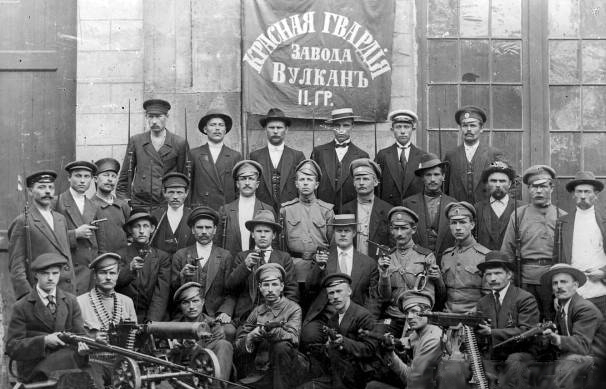
It was the same old story. In the months after October 1917, a few thousand sailors and Red Guards had gone out on the railways and conquered all of Russia. But the challenge was much greater now. Factory workers were up against crack detachments made up entirely of officers. Whenever some Red units made a bold and professional stand, they would be undermined by mass panic and treachery in other units.

By the morning of the 7th, Kazan had fallen to the Whites. The local bishop and the staff and students of the university joined in the counter-revolution wholeheartedly. Komuch seized half of Russia’s gold reserves from Kazan’s vaults, worth 700 million roubles.

Men with weapons and white armbands conducted house-to-house searches, killing ‘Bolsheviks’ on the spot. Red prisoners were torn apart by a ‘well-dressed mob.’ ‘Young women slapped them and spat in their eyes.’ ‘For several days the streets were strewn with disfigured, undressed corpses.’[iv]

Resistance at Sviyazhsk (8 to 28 August)

The stiff resistance of the Latvian Rifles had bought a few hours. This proved significant. Some Red units regrouped at the nearby town of Sviyazhsk, and when the Whites tried to seize the town’s railway bridge, the Reds held on and drove them back.

The Reds numbered around ten thousand, holding on around Sviyazhsk in ‘a line of pathetic, hastily-dug trenches,’[v] defending the Romanov railway bridge and barring further advance from Kazan. Effectively, Kazan and Sviyazhsk faced each other from either end, and from opposite banks of, a twenty-kilometre stretch of water. The Red force at Sviyazhsk was the Fifth Army, forming part of Eastern Army Group.
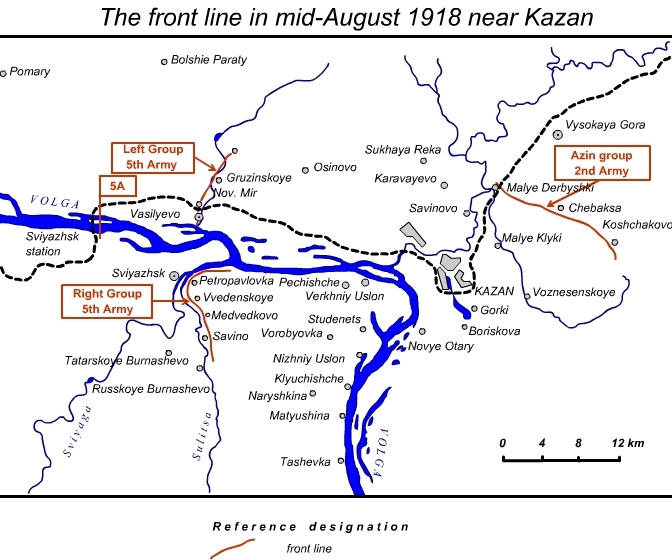
…and another, perhaps clearer, map. Source unknown – like most images I use, I found it on the priceless Wikimedia Commons.

Sviyazhsk was a rustic settlement scattered for some distance along the right bank of the river. It lay twenty to thirty kilometres west of Kazan and it was the first stop on the line to Moscow. Its railway station commanded the bridge.

It was at this small railway station that Trotsky arrived from Moscow. Film footage of his arrival shows no great ceremony or dramatic speech – simply an awkward muddle as a man standing next to the War Commissar tries and fails to find some important document or other.[vi]

The locomotive detached and drove away from Trotsky’s train – a signal that he was here to stay. The carriages remained in the railway yard, turning into offices and depots. A second train arrived from Moscow – this one carrying 300 cavalry, an aeroplane, a mobile garage for five cars, a radio-telegraph office and a print shop.

A still from Dr Zhivago (1965, Dir David Lean). I have big problems with the historical accuracy of this movie but damn, David Lean can frame a shot. The train here is fully-armoured with naval guns, though it’s not visible in this still. Later in the war, Trotsky would travel in an armoured train of this kind. But at Kazan his train was basic and unarmoured. (I do not own the rights to this image, just found it and screenshotted it on Youtube.com.)

Vacietis made a hand-over to Trotsky, and left to assume overall command of the front.

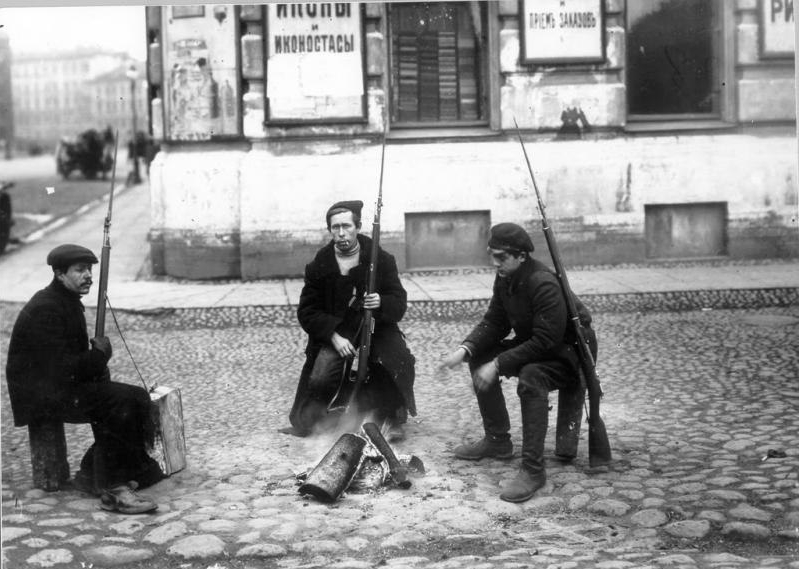
Conditions were grim. Larissa Reissner, a writer and Red Army soldier, described the defenders of Sviyazhsk ‘sleeping on the floors of the station house, in dirty huts filled with straw and broken glass.’ The Red Army soldier was ‘a human being in a torn military coat, civilian hat, and boots with toes protruding.’ It was a rainy month. Kazan kept up the pressure. ‘Planes came and went, dropping their bombs on the station and the railway cars; machine guns with their repulsive barking and the calm syllables of artillery, drew nigh and then withdrew again.’[viii]

A company of Communists from Moscow who had arrived by train with Trotsky barely knew how to handle their rifles, but fought bravely. On the other extreme was a Latvian unit, hardened veterans, but shattered by the defeat at Kazan and angry at the lack of basic supplies. They threatened mutiny. Trotsky immediately had their officer put up in front of a tribunal and imprisoned.

Nature of the Red Army

We are already acquainted, from previous posts in this series, with the kind of people who made this stand at Sviyazhsk.

34,000 of the 50,000 Red Guards had been incorporated into the new Red Army, along with volunteers who were former soldiers. The all-volunteer Red Army numbered 300,000 in May 1918, but it is likely that only a minority actually had weapons. The others remained in the rear performing auxiliary duties. At first a Red Army soldier needed a reference from a trade union or left-wing political party to join. But from June, the Soviet government brought in conscription in response to mass desertion and to the military crisis.

We are fighting for the greatest good of mankind, for the rebirth of the entire human race, for its emancipation from oppression, from ignorance, from slavery. And everything that stands in our way must be swept aside. We do not want civil strife, blood, wounds! We are ready to join fraternally in a common life with all our worst enemies. If the bourgeoisie of Kazan were to come back today to the rich mansions that they abandoned in cowardly fashion, and were to say: ‘Well, comrade workers’ – or if the landlords were to say: ‘Well, comrade peasants, in past centuries and decades our fathers and grandfathers and we ourselves oppressed, robbed and coerced your grandfathers and your fathers and yourselves, but now we extend a brotherly hand to you: let us instead work together as a team, sharing the fruits of our labor like brothers’

 – then I think that, in that case, I could say, on your behalf: ‘Messrs landlords, Messrs bourgeois, feel free to come back, a table will be laid for you, as for all our friends! If you don’t want civil war, if you want to live with us like brothers, then please do … But if you want to rule once more over the working class, to take back the factories – then we will show you an iron fist, and we will give the mansions you deserted to the poor, the workers and oppressed people of Kazan…[xix]

This is the second-last main narrative post in Season One of Revolution Under Siege, a series about the Russian Civil War. Catch you again in two or three weeks’ time for the conclusion; in the meantime there will be smaller side-posts and a podcast version of this episode. Thanks for reading.

‘to settle the question whether homes, palaces, cities, the sun and the heavens are to belong to the working people, to the workers the peasants, the poor, or to the bourgeois and the landlords […] I am today eating an eighth of a pound of bread, and tomorrow I shall not have even that, but I shall just tighten my belt, and I tell you plainly – I have taken power, and this power I shall never surrender!’

And then there were Red partisan units, armed bands of poor peasants led by local charismatic leaders. One Red commander on the Northern Front described how difficult it was to incorporate them into the Red Army:

We certainly had a lot of trouble with them at the front. They often upset all our plans and arrangements; they never conformed to any general scheme, but just trusted to their own inspiration. The “Wolf Pack” band did specially good work; it was commanded by a sailor, and consisted entirely of sailors, soldiers and workmen. An anarchist band also distinguished itself; it was not a particularly large one-barely two hundred men, but a very compact body, firmly knit together by the reckless courage of all its members.[ix]

So the defenders of Sviyazhsk would have been a mix of former Red Guards; veterans of the Great War; adventurous guerrillas of the ‘Wolf Pack’ variety; and new peasant conscripts. In addition, thousands of communists answered an appeal and joined the army.
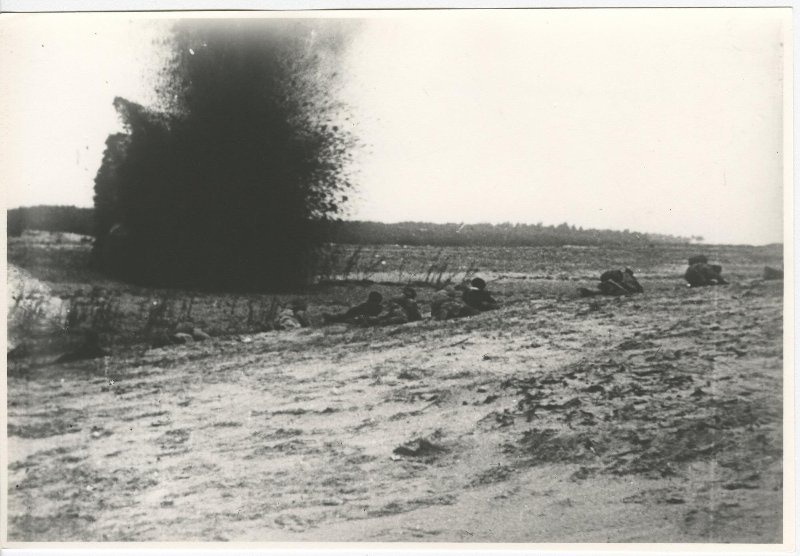
Red Army soldiers under shell fire during the struggle for Kazan

One in every twenty-five Red Army soldiers was an international volunteer; Reissner even mentions Czechs in the Red camp at Sviyazhsk, fighting against their own countrymen on the opposite bank. Many wore their own national army’s uniform, in defiance of orders. There was a good reason for this, a reason which many conscripts discovered to their cost. Some conscripts showed up for enlistment dressed in their worst clothes, assuming that they would trade them in for a uniform. But the Red Army had no uniforms! So they had to go to war in the most threadbare and ill-fitting garments they owned. They wore a red badge with a hammer-and-plough device, or an upside-down red star; apart from that, it was impossible to tell who was Red and who was White.

There were sixty different makes of artillery in Red service during the war, and thirty-five different varieties of rifle from American Springfields to Japanese Arisakas. No doubt some of the same variety was on display at Sviyazhsk.[x] You can easily imagine the mess caused by incompatible ammunition, parts, or training. 

There was no formal organisational structure and there were no training centres. All army ranks had been abolished; ‘commander’ was a post held, not a title or a distinction. Outside of the military sphere, in day-to-day life, subordination of lower ranks to higher was not allowed. Some years later, one private got his commander into deep trouble by polishing his boots. Erich Wollenberg writes that the commander was accused of acting in an aristocratic spirit. He was let off the hook when it became clear that the private had been acting on his own initiative.

The commanders were drawn from three main sources. First, and well in evidence during the struggle for Kazan, were the military cadres. These were communists who had infiltrated the old Tsarist army during 1917. After the October Revolution they had to make the switch from dissidents in the old army to leaders of a new army. They had enough humility to stay in their lane and defer to actual trained soldiers on military matters.

Second, former corporals and sergeants of the old army. (Some, like Kliment Voroshilov in the South, commanded whole armies). In general these former Non-Commissioned Officcers – numbering around 130,000 – lacked the humility of the military cadres, and considered themselves superior to the commissioned officers. Sometimes they were right about this and sometimes they were wrong. In other words, the tsarist officer was known by the red board on his shoulder; the former NCO was known for the chip on his shoulder.

Third, around 22,000 former officers had been brought into the Red Army by this point. Some were revolutionaries, like Tukhachevsky. Others were conscientious public servants and patriots who believed, as we have seen in Part 7, that ‘the people are not mistaken.’ Many were conscripts, working under compulsion. Some were simply waiting for the chance to betray their men to the Whites. Years later, Trotsky was poring over memories from the struggle for Kazan when he realised that a particular artillery officer at Sviyazhsk had been trying to kill him.
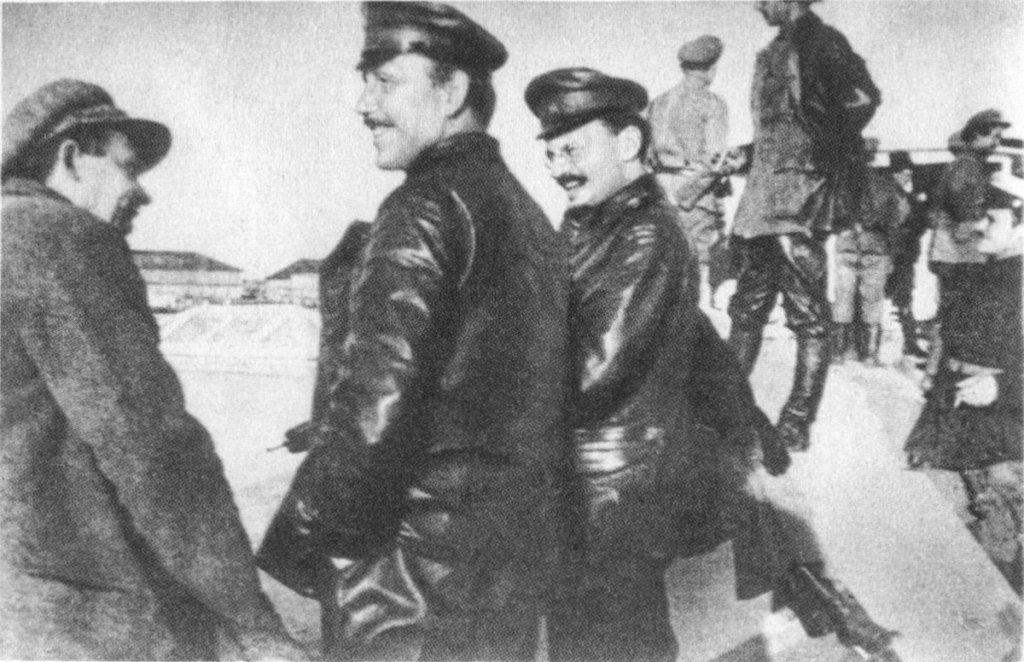
Trotsky and the poet Damian Bedny near Kazan

Red Cohesion

The scene of Red soldiers enduring shellfire and rain on a dreary riverbank in early autumn has not been deemed worthy of a dramatic military painting by any artist. This is understandable. But day by day something momentous was happening. According to one historian, these were ‘operations which we may with hindsight deem to have been key to the eventual outcome of the civil wars.’[xi] According to another, the moment of the struggle for Kazan was one of two at which the existence of the Soviet state hung in the balance.[xii]

Behind and around the Reds at Sviyazhsk, tens of thousands of soldiers were being drawn up and prepared for a counter-attack on Kazan. This took time, especially in the chaotic conditions of Russia in 1918. If Sviyazhsk did not hold, this concentration of forces could not take place, and there was little hope of recovering Kazan. If the Red Army could not concentrate its forces and take Kazan, then what use was it? For the Reds, there had been no significant victories since the start of full-scale civil war. If Sviyazhsk, the Fifth Army and Eastern Army Group had been shattered, the damage to morale might have constituted a death-blow to the revolution.

This was not a straight battle but a test of cohesion. Red forces had broken and fled countless times since the Czechoslovak revolt. What was to stop them breaking again, under daily attack and with poor supplies?

The old Tsarist army had held together under fire through drill and traditional hierarchies and violent disciplinary measures. The new Red Army needed a new kind of cohesion.

Over the month of August, through trial and error and through will, the Red Army found ways and means. In small ways at first, they began to cohere.

The train carriages from Moscow got to work. Boots and food started to arrive. Reinforcements came – from tiny bands to large regular units. Telephone and telegraph wires were strung out across the countryside. Order began making its first inroads against chaos. The war commissar’s carriage was in the station, and he himself was touring the river-bank under enemy shells. Political newspapers improved morale, linked the dreary riverbank to the world revolution.

A panorama of modern-day Sviyazhsk

It must have had an impact on a conscripted krasnoarmeyets (Red Army member) from a village background to share trenches and cheap cigarettes and long discussions with workers from the towns, with communists and anarchists and SRs, veterans of the revolutionary storm of 1917 or even of underground and exile; people who had fought as Red Guards or partisans in the struggles of early 1918.

The Baltic sailors arrived, the shock troops of 1917 in their military vessels, straight from the sea to the Volga via the Mariinsky canal system. Artillery skirmishes between Red and White flotillas took place three or four times a day on the Volga. To the immense satisfaction of the Red soldiers, the White vessels were driven back.

A small airfield was set up, and an anarchist pilot named Akashev put in charge of scouting from the air and dropping bombs into Kazan. White planes were now being answered by Red, and this gave heart to the defenders of Sviyazhsk.

Morale was improving. But it was still shaky. Every day saw attacks on Sviyazhsk or other positions. From time to time units would abandon their positions, break under fire, refuse to follow orders.

But another factor in Red cohesion at Sviyazhsk was indicated by Trotsky’s order of August 14th:

It has been reported to me that the Petrograd guerrilla detachment has abandoned its position…

The soldiers of the Workers’ and Peasants’ Red Army are neither cowards nor scoundrels. They want to fight for the freedom and happiness of the working people. If they retreat or fight poorly, their commanders and commissars are to blame.

I issue this warning: if any unit retreats without orders, the first to be shot will be the commissar, and the next the commander.

Soldiers who show courage will be rewarded for their services and promoted to posts of command.

Cowards, self-seekers and traitors will not escape the bullet.

For this I vouch before the whole Red Army.

Raids (28-30 August)

The attack on Kazan by the White forces had been a brilliant and daring exploit. But weeks had passed and no further progress had been made. Every day the Reds grew stronger. From the point of view of the Whites, another daring operation was called for.

Raid by Land

On August 28th 2,000 White Guards crossed the river under cover of darkness. They made a wide circle around the Red lines. After an exhausting forced march, they arrived at a railway station behind Sviyazhsk, killed its small garrison to a man, and left it in ruins. They cut the railway line to Moscow.

An armoured train with naval guns was sent out from Sviyazhsk to intercept the Whites. But the Whites took it and burned it, and its remains lay by the roadside only a kilometre or two from town, a visible warning. The Whites advanced on the Sviyazhsk railway station and on the key bridge next to it.
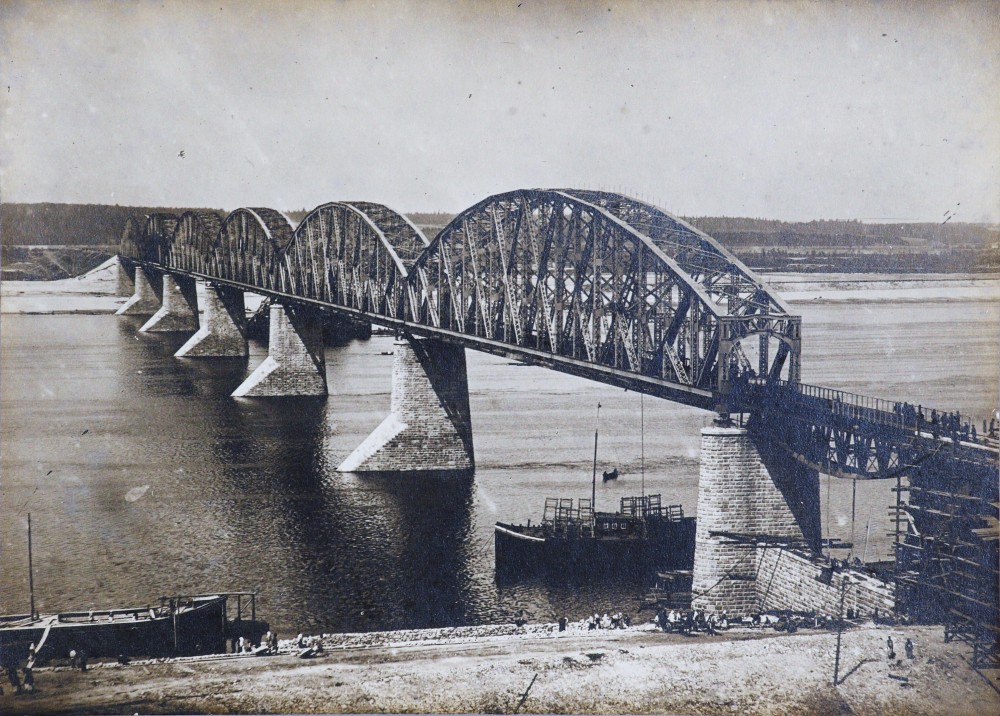
The railway bridge at Sviyazhsk near Kazan (not Athlone).

The front was under pressure and shaky; Trotsky could only spare two or three companies to turn and face the White infiltrators. To compensate, he emptied the train of every one of its personnel: clerks, wireless operators and cooks. They were armed and sent out one kilometre to block the White advance.

Reissner describes the eight-hour battle which ensued:

The staff offices stood deserted; there was no “rear” any longer. Everything was thrown against the Whites who had rolled almost flush to the station. From Shikhrana to the first houses of Svyazhsk the entire road was churned up by shells, covered with dead horses, abandoned weapons and empty cartridge shells. The closer to Svyazhsk, all the greater the havoc. The advance of the Whites was halted only after they had leaped over the gigantic charred skeleton of the armored train, still smoking and smelling of molten metal. The advance surges to the very threshold, then rolls back boiling like a receding wave only to fling itself once more against the hastily mobilized reserves of Svyazhsk. Here both sides stand facing each other for several hours, here are many dead.

The Whites then decided that they had before them a fresh and well organized division of whose existence even their intelligence service had remained unaware. Exhausted from their 48 hour raid, the soldiers tended to overestimate the strength of the enemy and did not even suspect that opposing them was only a hastily thrown together handful of fighters with no one behind them except Trotsky and Slavin sitting beside a map in a smoke-filled sleepless room of the deserted headquarters in the center of depopulated Svyazhsk where bullets were whistling through the streets.[xiii]

The Whites withdrew. But the Red Army was not just battling against the Whites. It was faced with its own inexperience and the accumulated trauma of a summer’s worth of shattering defeats. One intention of the raid was to damage the Reds’ morale. In this it was not a failure. The raid sent a fresh wave of panic through the Fifth Army.

Mutiny

The 2nd Numerny Petrograd Regiment, a body of 200, broke. This was not a band of peasant conscripts or partisans, but a unit of worker-militants led by commissar Panteleev.[xiv]

Not only did this unit break; led by their commander and commissar, the 200 stormed on board a steamship that lay at anchor on the Volga, hijacked it and set sail.

A Bolshevik sailor named Nikolai Markin acted fast.

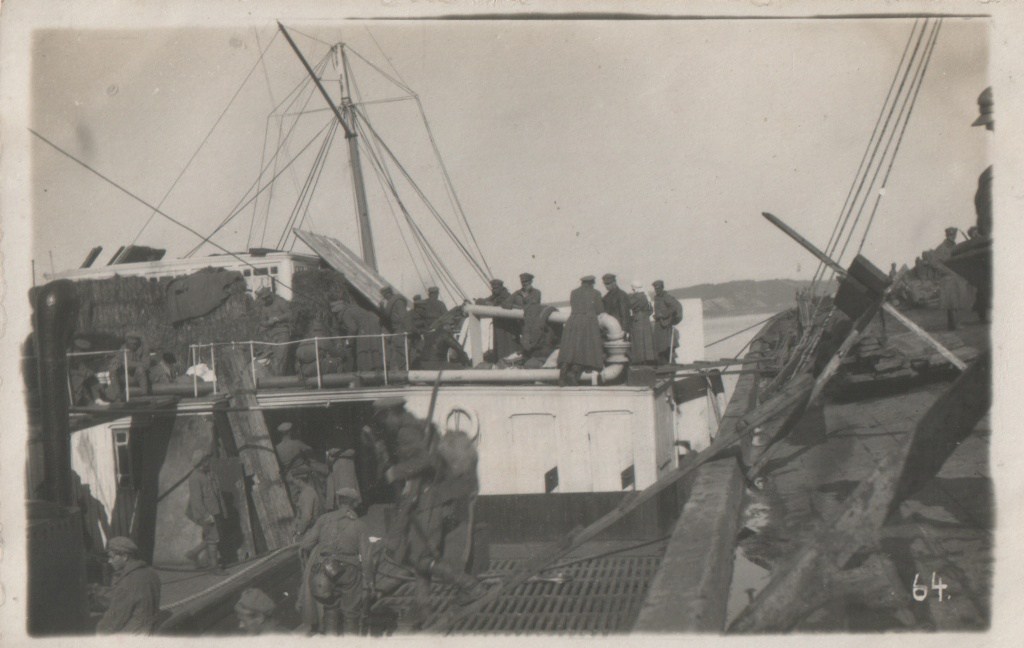
Boarding an improvised gunboat with a score of tested men, he sailed up to the steamer held by the deserters, and at the point of a gun demanded their surrender. Everything depended on that one moment; a single rifle-shot would have been enough to bring on a catastrophe. But the deserters surrendered without resisting. The steamer docked alongside the pier, the deserters disembarked.[xv]

At once Trotsky assembled a tribunal to pronounce judgement on the Regiment. Its decision was announced on August 30th in Order No 31, authored by the War Commissar:

The brave and honorable soldier cannot give his life twice – for himself and for a deserter. The overwhelming majority of the revolutionary soldiers have long been demanding that traitors be dealt with ruthlessly. The Soviet power has now passed from warning to action. Yesterday twenty deserters were shot, having been sentenced by the field court-martial of the Fifth Army.

The first to go were commanders and commissars who had abandoned the positions entrusted to them. Next, cowardly liars who played sick. Finally, some deserters from among the Red Army men who refused to expiate their crime by taking part in the subsequent struggle.[xvi]
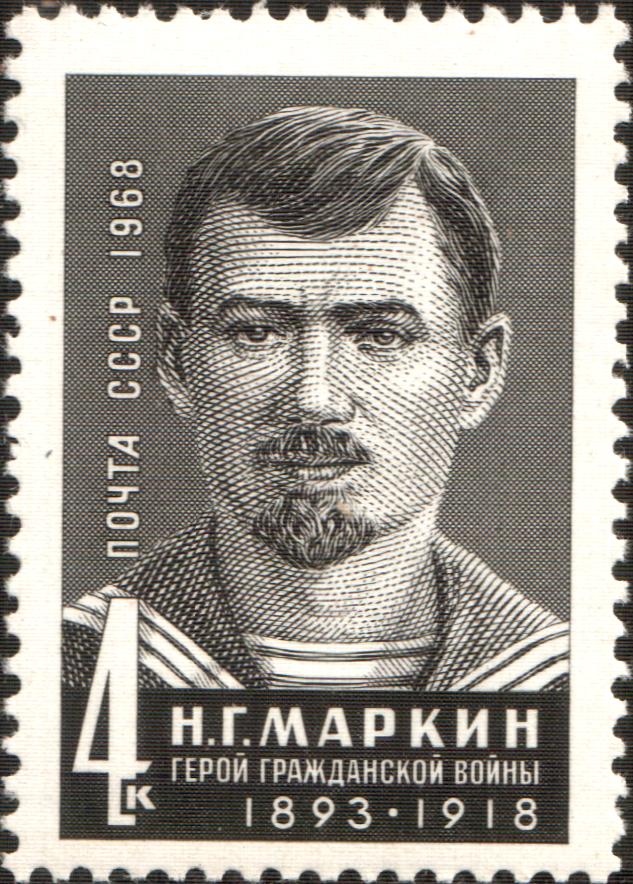
The sailor Markin, who would go on to be killed in action in October 1918

Raid by Water

The Reds took the initiative. That very night there was a daring raid by small Red torpedo-boats on the White flotilla docked at Kazan. Trotsky and the sailors Markin and Raskolnikov were on this raid personally. They came under fire. At one point Trotsky’s boat was separated from the others, disabled by machine-gun bullets, pierced by a shell, lit up by a burning oil-barge, and stuck on a half-sunken enemy vessel. The occupants of the boat thought they were as good as dead.

But the other vessels had already gone into Kazan harbour, where they wrecked the enemy flotilla and destroyed artillery on land. The Whites were in too much chaos even to realise they had a chance to kill the War Commissar, much less to do so.

In the days after the raid, the pilots under the anarchist aviator Akashev brought good news. The Second Red Army, commanded by a Red Cossack, had advanced to within ten or fifteen kilometres of Kazan from the north. In all, 25-30,000 Red soldiers were now closing in on Kazan on both sides of the river. There began an exodus of the wealthier classes, and there was an uprising of workers within the city.

Threats rang out from Red lines: any White who deserted now would be pardoned, but White collaborators could expect confiscation of property, imprisonment or death. Dozens of Whites had already deserted and come over to the Reds. To those who held out in Kazan, ‘Remember Yaroslavl’ was the chilling threat. The Red commanders contemplated, but never carried out, an artillery bombardment of the city.

Meanwhile, the Whites put down the workers’ revolt within Kazan with a massacre.

The Recapture of Kazan (1 to 9 September)

On September 1st news reached Sviyazhsk of the shooting of Lenin (which we mentioned in a previous post, ‘Controversies: Terror’). Trotsky hurried back to Moscow. He was not present when the Fifth Army, after a month at Sviyazhsk, crossed the Volga and made a landing at Kazan. But Reissner was there:

On September 9 late at night the troops were embarked on ships and by morning, around 5:30, the clumsy many-decked transports, convoyed by torpedo boats, moved toward the piers of Kazan. It was strange to sail in moonlit twilight past the half-demolished mill with a green roof, behind which a White battery had been located; past the half-burned Delphin gutted and beached on the deserted shore; past all the familiar river bends, tongues of land, sandbanks and inlets over which from dawn to evening death had walked for so many weeks, clouds of smoke had rolled, and golden sheaves of artillery fire had flared.

[…] yesterday, words of command were restlessly sounding and slim torpedo boats were threading their way through smoke and flames and a rain of steel splinters, their hulls trembling from the compressed impatience of engines and from the recoil of their two-gun batteries which fired once a minute with a sound resembling iron hiccups.

People were firing, scattering away under the hail of down-clattering shells, mopping up the blood on the decks … And now everything is silent; the Volga flows as it has flowed a thousand years ago, as it will flow centuries from now.

We reached the piers without firing a shot. The first flickers of dawn lit up the sky. In the grayish-pink twilight, humped, black, charred phantoms began to appear. Cranes, beams of burned buildings, shattered telegraph poles – all this seemed to have endured endless sorrow and seemed to have lost all capacity for feeling like a tree with twisted withered branches. Death’s kingdom washed by the icy roses of the northern dawn.

And the deserted guns with their muzzles uplifted resemble in the twilight cast down figures, frozen in mute despair, with heads propped up by hands cold and wet with dew.

Fog. People begin shivering from cold and nervous tension; the air is permeated with the odor of machine oil and tarred rope. The gunner’s blue collar turns with the movement of the body viewing in amazement the unpopulated, soundless shore reposing in dead silence.

This is victory.

The Whites had abandoned Kazan. In the face of the Red build-up, they had calculated that they could not hold the city. The advancing Reds found in ‘the courtyard of the prison, a row of fresh corpses: the arrival of the Red cavalry […] had interrupted the executions.’[xvii]

The Red Cavalry enter Kazan
Komuch troops fleeing from Kazan

By mid-September, there would be 70,000 fighters of the Red Army on the Eastern Front, throwing back the Czechs and Komuch at all points. In Part 5 we briefly mentioned the workers of Troitsk, Verkhne-Uralsk and Ekaterinburg, who formed a partisan army and made a fifty-day march, in constant battle, out of hostile territory. A few days after the recapture of Kazan, this march came to an end when they linked up with the Third Red Army near Perm.

Almost simultaneous with the fall of Kazan, a Red army under Mikhail Tukhachevsky took Simbirsk from Komuch. This battle saw a series of daring and innovative exploits on the Red side: an unmanned locomotive thundered across an iron bridge through White barricades, followed by a manned and armoured train; Red Army soldiers infiltrated behind enemy lines and organised an uprising of railway workers (Simbirsk, home town of Lenin, is today called Ulyanovsk).

But it is perhaps a mistake to focus on these kinds of spectacular operations. As we have seen, at Kazan itself daring exploits were more a feature of White tactics. Revolutionary élan was in evidence on the Red side, but it was not a new phenomenon. What the Red Army had learned at Kazan was plain professional soldiering. The victory was won not necessarily with reckless death-defying charges, but through stoic endurance. It was a victory of supplies, logistics and politics, all contributing to cohesion. (That is one reason, I suspect, why it has not been deemed worthy of a dramatic painting or of the Mosfilm treatment).[xviii] What happened at Sviyazhsk was the synthesis of the zeal of the commissar and the technique of the specialist.

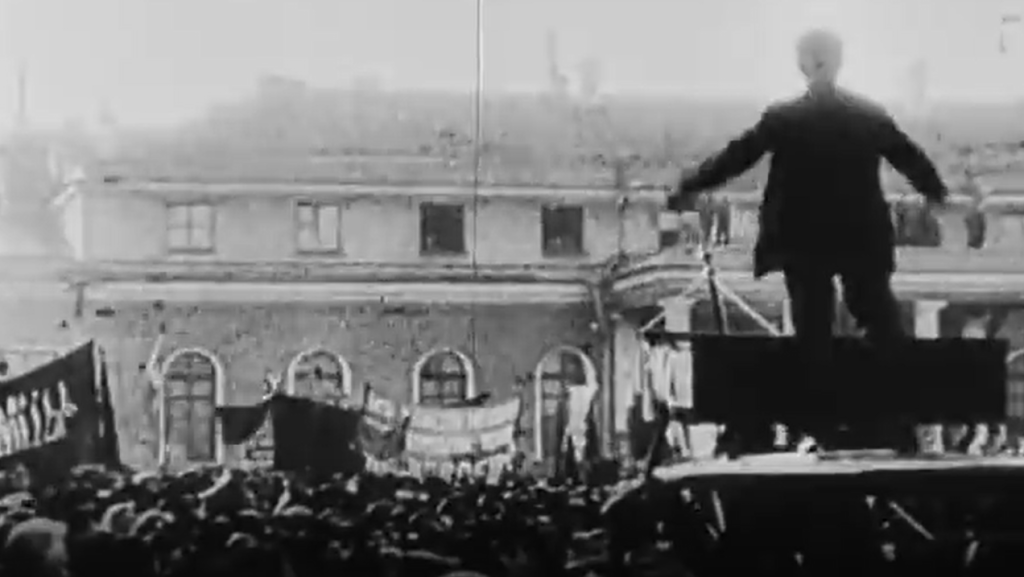
In their thousands, the people of the re-conquered Kazan attended revolutionary meetings in the streets and in the main theatre, celebrating the victory.

< Back to Contents


In addition to the sources below, I found this article on the Civil War museum at Sviyazhsk useful and illuminating.

[i] Trotsky, Leon. How the Revolution Armed, ‘The Fight for Kazan,’ https://www.marxists.org/archive/trotsky/1918/military/ch33.htm

[ii] Mawdsley, Evan. The Russian Civil War, p 79-80

[iii] Trotsky, Leon. How the Revolution Armed, ‘The Fight for Kazan,’ https://www.marxists.org/archive/trotsky/1918/military/ch33.htm

[iv] Serge, Year One, p 320

[v] Serge, Year One, p 332

[vi] Axelbank, Herman (dir.), Tsar To Lenin, 1937

[vii] Trotsky, Leon. My Life: An Attempt at an Autobiography, 1930. Chapter 33, ‘A Month at Sviyazhsk.’https://www.marxists.org/archive/trotsky/1930/mylife/ch33.htm

[viii] Reissner, Larissa. ‘Svyazhsk.’ Republished in Fourth International, June 193. https://www.marxists.org/history/etol/newspape/fi/vol04/no06/reissner.htm

[ix] Wollenberg, Erich, The Red Army, Chapter 2

[x] Khvostov, Mikhail. The Russian Civil War (1) The Red Army, p 17

[xi] Smele, The ‘Russian’ Civil Wars, 87

[xii] Mawdsley, 268

[xiii] Reissner

[xiv] Service, Robert. Trotsky. Macmillan, 2009. P 221

[xv] Trotsky, My Life https://www.marxists.org/archive/trotsky/1930/mylife/ch33.htm

[xvi] Trotsky, Leon. How the Revolution Armed, ‘The Fight for Kazan,’ https://www.marxists.org/archive/trotsky/1918/military/ch33.htm#baugust24

[xvii] Serge, Year One, p 339

[xviii] Another reason, I suspect, is that it is impossible to erase Trotsky from the events. The closest thing we’ve got is the 2017 Russian TV series Trotsky which presented, in episode 1, a distorted portrayal of the execution of Panteleev and the others. I have written about this lamentable TV series here.

[xix] Trotsky, Leon. How the Revolution Armed, ‘The Fight for Kazan.’ https://www.marxists.org/archive/trotsky/1918/military/ch33.htm#baugust24
07: How Tsaritsyn became Stalingrad (Premium)

Become a paying supporter to get access

Access to this article is limited to paying supporters. If you already subscribe by email, thank you. But if you want to become a paying supporter, please hit ‘Subscribe’ below.

Donate less than the price of a coffee, and you can access everything on this blog for one year.

If you don’t feel like donating, most of my posts are still 100% free, so browse away, and thanks for visiting.

Home Page/ Archives

When did the Russian Civil War begin and end? (Premium)

Become a paying supporter to get access

Access to this article is limited to paying supporters. If you already subscribe by email, thank you. But if you want to become a paying supporter, please hit ‘Subscribe’ below.

Donate less than the price of a coffee, and you can access everything on this blog for one year.

If you don’t feel like donating, most of my posts are still 100% free, so browse away, and thanks for visiting.

Home Page/ Archives

05: Czech Revolt in the East

If you look up a map of the Russian Civil War, you will see that the Reds were reduced to a small part of Russia. How did that happen? Mostly due to the Czech Revolt.

This post will tell the story of how the Eastern Front of the Russian Civil War blazed up in Spring 1918. The major players were the Allied powers, the Right SRs, the officers and the Cossacks. The biggest part of the heavy lifting, however, was done by an outfit called the Czechoslovak Legion, an improbable but enormously significant presence in Russia in 1918.

THE ALLIES

The first piece of context here is the implacable hatred with which the October Revolution was greeted by the wealthy and powerful in the Allied countries.

All over the world there were many who sympathised with the Revolution – from the IWW in the United States to followers of the late James Connolly in Ireland.

But in politics and media it was a different story. Newspapers reported that all women over the age of eighteen had been made public property; that Lenin, ‘alias Zederblaum’[i] was secretly Jewish, and that he and Trotsky were busy murdering one another in drunken brawls over gambling debts; that Red Guards, who were ‘chiefly Letts [Latvians] and Chinese’, had spent the spring of 1918 gunning down crowds of people in the cities.

The viewpoint of the Allied leaders was distorted; they saw the revolution only through the prism of the war. With the Russians out of the war, they believed, the Germans would soon be in Paris and the Turks on the  borders of India. The Russian revolutionaries were referred to as ‘Germano-Bolsheviks.’ Count Mirbach, the German ambassador, was described by the US ambassador as ‘the real dictator of Russia.’ It was taken as a fact that the Bolsheviks were funded by German intelligence and that the Red Guards were led and trained by German officers. The Allied leaders seriously imagined that from the POW camps of Russia would be recruited a new German army, millions strong, armed and equipped from the Allies’ own bloated supply depots in Vladivostok and Murmansk.

Anti-Semitic conspiracy theories were expounded by, among many others, Winston Churchill (to whom the Reds were a ‘strange band of Jewish adventurers’) and the London Times (they were ‘adventurers of German-Jewish blood in German pay’).

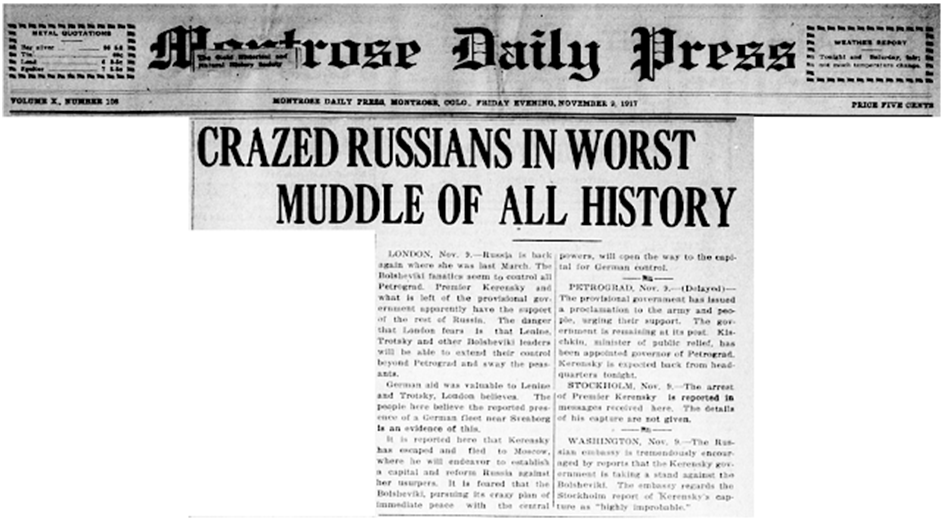
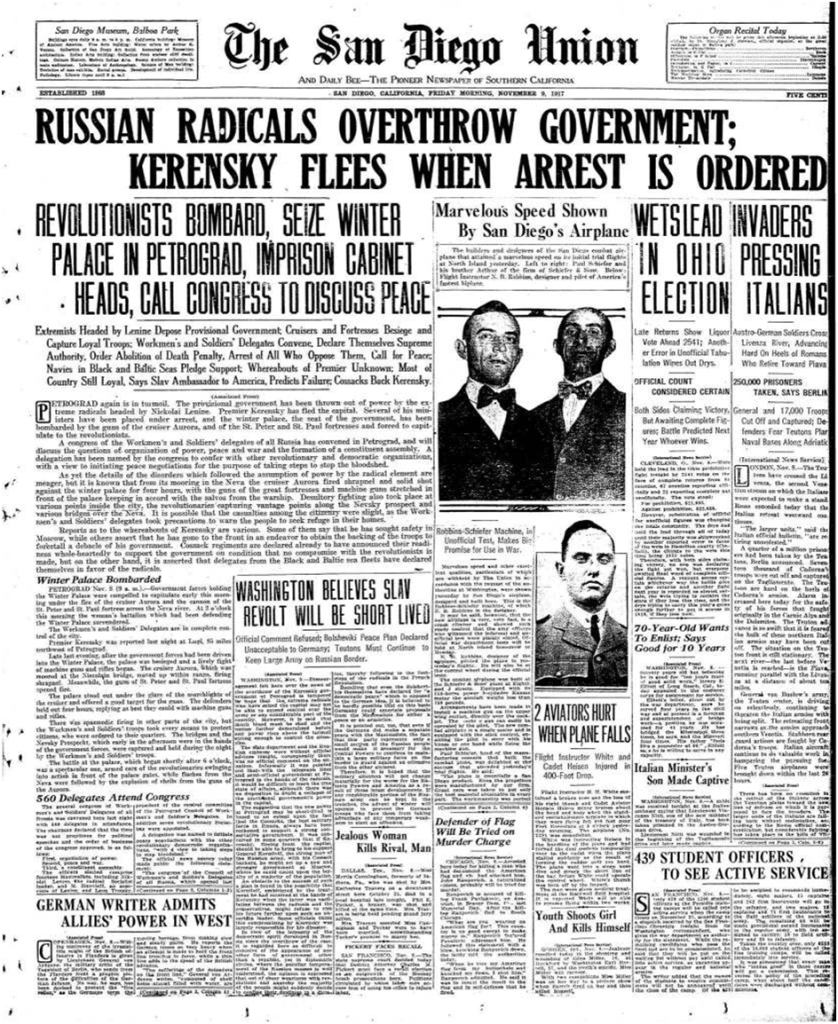
Nov 9th 1917. From https://www.germansfromrussiasettlementlocations.org/2017/11/the-bolshevik-revolution-beginning-of.html

Western journalists knew so little about the Bolsheviks that they confused them, perhaps through a clumsy translation, with the SR Maximalists. The Bolsheviks were an open mass party which rejected terrorism and had hundreds of thousands of members; the Maximalists were a conspiratorial terrorist outfit with a membership of one thousand. But even without the translation problems, many in the Allied camp probably would not have known the difference. They behaved as if a few hundred bohemian bomb-throwers had stumbled into power.

Some were, in hindsight, more sensible: the Tory Arthur Balfour reasoned that hostility to the Soviets would push them into the arms of the Germans, while a pragmatic accommodation with the Soviets might deny the Germans resources and the opportunity to redeploy their armies to the west.[i]

But they were up against others whose grasp on reality was less firm: to Lord Robert Cecil the Soviet regime was ‘outside the pale of civilised Europe’ – and it was treated as such: western diplomacy boycotted Moscow.

“Revolt will be short lived”!

Journalists who were actually in Russia in the first half of 1918 tried to convey the reality. Louise Bryant from the US bore witness to a revolution that was remarkable for its clemency and tolerance, that had mass support and that had already made drastic improvements to the lives of workers, women and peasants. On Stockholm on her way out of Russia in early summer, she met ‘a correspondent from one of our biggest press agencies,’ who immediately described the Bolsheviks as ‘scum.’

I felt myself forced to ask one more question. ‘If you had to choose between the Bolsheviki and the Germans, which would you prefer?’

Without hesitating he replied, ‘The Germans.’

‘Have you ever been in Russia?’

‘No.’[iii]

Why were they so hostile? We can dismiss any notion that their hostility was based on a prophetic fear of Stalinist totalitarianism. On the contrary, they denounced ‘anarchy,’ ‘chaos,’ ‘adventurers,’ etc. The picture of Bolshevism in their heads was quite the opposite of the totalitarian caricature. The real reasons were as follows:

  • Because the Bolsheviks had pulled Russia out of the war and published the secret treaties between Russia and the Allies. This became especially urgent from Spring 1918, as German forces, reinforced by divisions redeployed from the quiet eastern front, made a devastating offensive, and later Turkey seized Baku.
  • Because the revolution had renounced Russia’s debts to the Allied countries and had nationalised foreign-owned industries.
  • Because the Bolsheviks had made a socialist revolution, which might inspire the workers to take power in other parts of the world.

THE ALLIES

From the very start, Allied powers supported the White Guards. On December 2nd the British cabinet voted to give money to the counter-revolutionary armies of Alexeev and Kaledin.[ii] On December 23rd, Britain and France did a ‘carve-up’ of their respective spheres of influence in Russia: Britain’s ‘sphere’ corresponded suspiciously to British money invested in the oil of the Caucasus, France’s to French money in Ukrainian coal and iron.

Early on, the Soviets tried to come to an understanding with the Allies. With the ever-present threat of the German military, even after the signing of the Brest-Litovsk treaty, a pragmatic orientation to the Allies made sense. There was cooperation early on, for example in relation to Murmansk – where a British battleship fired a salute to the Red Flag, and an Allied train went to the aid of Red Finns against White Finns.

Some Bolsheviks opposed this cooperation on principle, but Lenin spoke for most when he said, ‘We will accept guns and potatoes from the Anglo-French imperialist bandits.’

The Americans were reluctant to intervene at first. President Wilson believed his democratic peace plan, known as the Fourteen Points, would induce the Russians to rejoin the war, and I read that 30,000 copies of it were pasted up by American agents all over the walls of Petrograd.[iii]

Early on, the Soviet regime planned to have a mass civilian militia instead of a standing army. It was in response to the threat of the German military that the Soviet regime shelved this idea and began, from February, to build the Red Army. The Red Army’s first battles at Pskov and Narva, commemorated annually in Russia and beyond even to the present day, were not against the Whites or the Allies but against the German invasion of late February.

Meanwhile in Ukraine the Red Army fought alongside an Allied force against the Germans. This force was the Czechoslovak Corps or Legion.

A Red commander paid tribute to the Czechs’ fight against the German advance: ‘The revolutionary armies of South Russia [sic] will never forget the brotherly aid which was granted by the Czech Corps in the struggle of the toiling people against the hordes of base imperialism.’[iv]

The Germans were ‘the hordes of base imperialism’! Germano-Bolsheviks indeed.

But the World War was the all-consuming priority. Allied representatives promised aid, if only the Soviets would force their own people back into the trenches. They would not. Allied attitudes hardened.

Russia was meanwhile crawling with Allied military missions, officials and agents, a legacy of the war. By May 1918 this apparatus was busy making links and distributing funds. AJP Taylor writes, ‘they imagined that somewhere in Russia was to be found some group of people who wanted to continue the war.’[iv] 

The wealthy, the officers and the professional classes did want to continue the war. They felt humiliated and threatened by the revolution, believed that the fatherland and/or civilisation were about to perish, and still possessed enough wealth, connections, self-confidence and skills to fight back. These people formed leagues, networks, councils, and linked up with foreign powers. Funds were transferred, plans laid, promises made.

At this point the intelligentsia were deeply conflicted about the revolution, symbolised in the split within the SRs. Looking at where the two sides stood in May 1918, it is difficult to imagine that they had ever been in the one party. The Left SRs held high positions in the Soviets, the fledgling Red Army and the Cheka, while the Right SRs were in the various leagues and councils of the underground counter-revolution, shoulder-to-shoulder with Black Hundreds and Tsarist generals.[v] In that milieu they nursed their grudges over the Constituent Assembly and waited for a chance to strike back.

Thus the Allies saw the Soviets as an enemy, and possessed the assets on the ground to wage a struggle against them.

The original purpose of intervention was to rebuild a front against the Germans in Russia, either with the Reds or over their dead bodies.

It is often denied that the Allies wanted, at this stage, to overthrow the Reds. But this second aim of intervention, the overthrow of the Soviet regime, was neatly encapsulated in the first aim from the very beginning.

If the destruction of the Soviet power was only of secondary concern at this point, that is only because the Allies had contempt for that regime. They believed that the Tooting Popular Front had seized power by accident in a temporary episode. They believed the Soviet regime would collapse sooner or later, with or without their intervention.

The first aim was foremost while the war continued; the second aim became obvious when intervention not only continued but deepened after the war’s end.

But counter-revolution would not have assumed the explosive form it did without the Czech Legion. The time has come to explain what this force was doing in Russia.

CZECH LEGION

On Russian soil in 1918 there were tens of thousands of Czech and Slovakian soldiers. Czechia and Slovakia were oppressed by the Austro-Hungarian Empire. A Czechoslovak Legion was initially recruited from among immigrants in Russia, then from among prisoners of war. They were induced to fight with the promise of an independent state after the war. By 1917 the Czechs made up a whole Corps, numbering 30,000-70,000 and fighting on the Eastern Front against the Germans and Austrians, under Russian officers and with liaisons and attachés from the Allied powers.

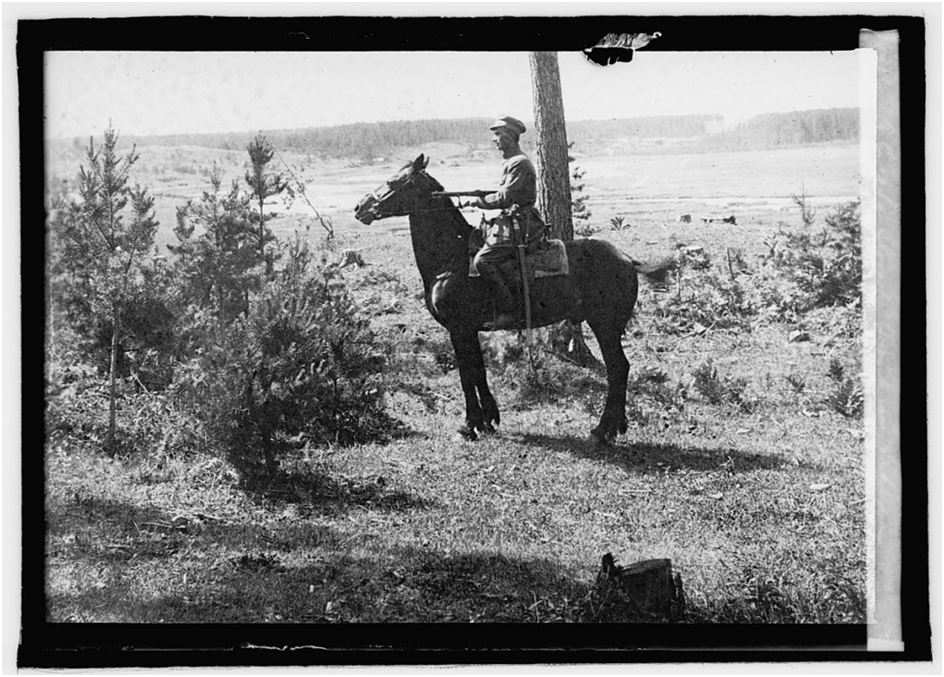
A Czechoslovak scout

The Czechs[vi] did not join in the Russian Revolution. While the Russian army disintegrated, the Czechoslovak Legion remained cohesive. The Russian soldier deserted and went home to his land. The Czech had no home. He was fighting against Germany and Austria to secure one, and he was determined to carry on the fight.  

Virtually all other military forces, both White and Red, were either in the final stages of collapse or just coming into being. In the Legion, then, the Allies possessed a unique asset that could really test the strength of Soviet power: a military force that was large, cohesive and present.

Various telegrams and other communications between British agents on the ground and their superiors in London are referred to in the postscript which Peter Sedgwick has added to Victor Serge’s book Year One of the Russian Revolution, published by Haymarket Books, 2015. Taken together they show the outlines of the Allied plans, which had four main elements:

  • A revolt of the Czech Legion against Soviet power, possibly linking up with the White warlord Semyonov, who was raiding across the border from China.[v]
  • Several central Russian towns to be seized by officers, Black Hundreds, Right SRs etc, designed to encircle Moscow.
  • These Czechs and White Guards to link up with the British, French and US forces at Archangel’sk, in the far north of Russia.
  • Another element of the plan was outlined by Balfour, previously a critic of intervention: the Czechs could be used to trigger a conflict, drawing in Japan and the US who had been reluctant up to that point. ‘If we act, the Japanese will; if the Japanese do, the United States will.’[vi]

General Lavergne of the French mission in Russia, after explaining this plan to a colleague, added, ‘But I shall feel guilty because, if our plan succeeds, the famine in Russia will be terrible.’ The plan did not succeed entirely, but as we will see the resulting famine was indeed terrible, probably beyond Lavergne’s ability to comprehend.

The French had a second misgiving about the plan: they would rather have the Czechs on the Western Front. But these were misgivings, reservations, not opposition. Simply put, Allied agents ‘had been plotting for [a Czechoslovak revolt] since… late 1917.’[vii]

The Czechs themselves, for the most part, wanted to get out of Russia and to fight on the Western Front. Both the Tsar and Kerensky had refused to let them go. The Reds, however, made a sincere effort to grant this wish. At first there was no ill-feeling between the Reds and the Czechs; the Czech rank-and-file were mostly republican or social-democratic in their sympathies. Czech leader Masaryk had ignored appeals from Alexeev to join the White Guards. The Reds allowed them to travel with 168 rifles and one machine-gun per carriage – this shows trust, not draconian suspicion (and on top of this, the Czechs had concealed weapons).

But the Soviets were bedevilled by the challenges of transporting tens of thousands of soldiers out of a vast, hungry, war-torn territory. First it was decided – by the Reds and the Allies – that the Czechs were to circumnavigate the globe via North America to get from the Eastern Front to the Western Front. So the Soviets began to move the Czechs from European Russia to the Pacific Ocean. But on April 4th Japan (a member of the Allies) made a first tentative landing at Vladivostok in the far east, which was the Czechs’ destination. Later in the year the Japanese would occupy eastern Siberia with an army of tens of thousands, so Moscow’s fear that the landing was part of a full-scale invasion was reasonable. This fear meant that the Czechs were left stranded for a week, strung out in detachments all along the Trans-Siberian Railway from the Volga to Vladivostok. Tension was rising: on April 14th a Czech congress demanded more weapons, plus control over their locomotives. 

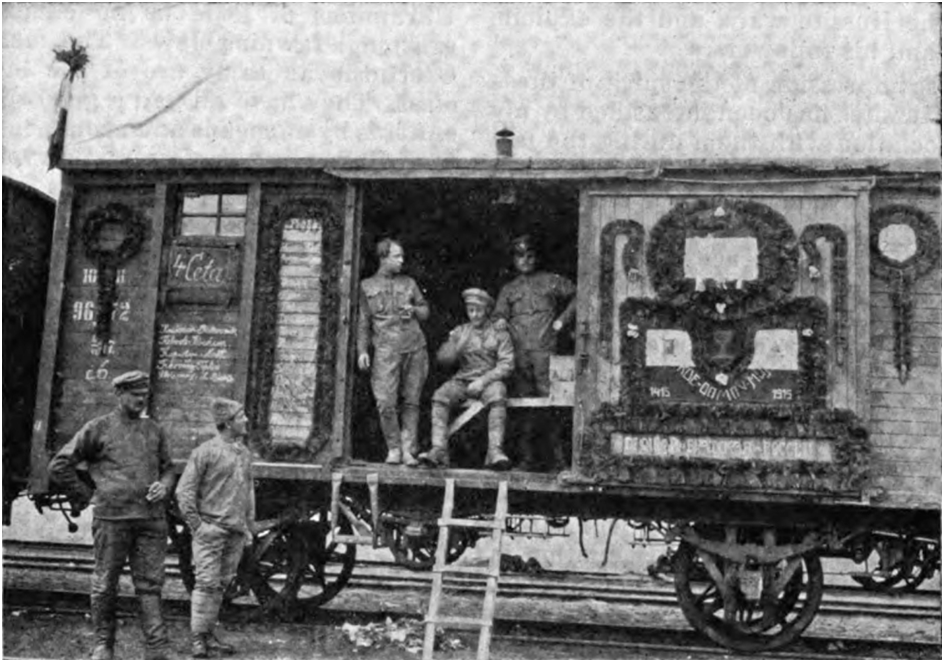
Czechs on the railways

Meanwhile it was far from pleasant for the Czechs to be high and dry at railway stations spread across the whole breadth of revolutionary Russia. Raids by White warlords caused further delays, and these delays bred distrust. Local soviets were sometimes truculent, even hostile. The Czechs, egged on by SRs and Allied agents, suspected that the Soviets were working hand-in-hand with the Germans and were somehow plotting to hand them over. The Soviets, on their side, suspected that the Czechs might join the White-Allied cause.

Czech fears were delusional in that there were no German soldiers within thousands of kilometres of even the westernmost of the Czech detachments. But millions of people were moving across Russia at that moment in the opposite direction to the Czechs, prisoners of war from the German, Austro-Hungarian and Turkish empires, released and being borne home (Among them was Josip Broz who would later be known as Tito, Bela Kun who would lead the Hungarian Soviet Republic, and the writer Jaroslav Hašek). The Czechs identified these former POWs as proxy Germans, as a threat. Even if they weren’t a threat, they were still a nuisance to the Czechs, burdening the railway system and causing further delays. The tragedy is that they were mostly subject peoples of Austria, like the Czechs, and like the Czechs all they wanted to do was go home – and, no doubt, like the Czechs they were frustrated with the state of the railways and the often-squalid and chaotic conditions in Russia.

In short, there was a massive armed-to-the-teeth traffic jam on the railways, and no solution in sight. An alternative plan to move half of the Czechs north and ship them out of Archangel’sk was agreed by the Allies and the Soviets. But the Czechs were angered by this plan, and further frustrated by another week-long delay caused by White attacks.

On May 14th, Czechs going east and Hungarians going west met at a railway station in the Ural town of Chelyabinsk. In that same town at that moment a Czech congress was taking place, discussing how to get out of Russia.

At first the Czechs and Hungarians were friendly enough; the Czechs shared rations. Then an argument broke out, and a Hungarian threw a scrap of iron at a group of Czechs. Someone fell – scholars are not sure if it was a fatality or an injury. Czechs lynched the Hungarian.

The Chelyabinsk town soviet investigated the murder and arrested several Czechs for questioning. The Czechs were furious. They sent two battalions into town, disarmed the Red Guards, seized the arsenal and freed their comrades.

The situation in Chelyabinsk was actually settled by negotiations. But by then word of it had got out, and there was no going back. ‘To the Bolsheviks,’ says Silverlight, ‘the Chelyabinsk incident must have looked like unprovoked aggression.’ Trotsky, the Commissar for War, ordered the arrest and disarming of the entire Czechoslovak Corps.

I’ve mentioned that there was a conference going on in Chelyabinsk during all this drama. Allied agents met with the leaders of the Czech Legion at this conference and on May 23rd the Czechs agreed to join an all-out armed struggle against the Soviets. Two days later, on May 25th, Trotsky ordered that the Czechs not just be disarmed, but that any armed Czechs be shot on the spot.

In some accounts I’ve read, all the above is summarised very quickly, and the impression is given that Trotsky’s second, more severe order to disarm the Czechs was the inciting incident.

While Trotsky issued his orders, violence was flaring up in half a dozen places along the Trans-Siberian Railway. In town after town, the Czechs drove out Soviet power. There were 15,000 Czechs in Vladivostok – who were still there because the Allies had, through negligence or design, failed to provide ships to get them out. On June 25th these Czechs seized the town and linked up with the Allied naval forces which had been gradually massing in the harbour all year. By this stage they were fully committed to all-out war.

Silverlight attributes this all to a string of misunderstandings. This is a common trope. I am less charitable. It seems clear to me, beneath the usual plausible deniability, that the British and French governments each played a role in using the Czechs to trigger a war. French policy was more reluctant (they wanted the Czechs on French soil to defend Paris, on which the Germans were advancing) but they were also more active in funding Russian counter-revolutionary groups. It’s difficult to see how things could have gone down the way they did without the Allies’ utterly deluded project of rebuilding a front against Germany.

The Czechs’ perspective seems to have been that the Bolshevik adventure would collapse and a new Eastern Front for World War One would take shape in Russia. What they ended up doing was setting up a new Eastern Front within the Russian Civil War. Their tragedy is that all they wanted to do was get the hell out, but in their impatience they triggered a war from which they would struggle to extricate themselves for two more years.

The plans of Britain and France were partly frustrated. Their forces in the Arctic would have been too little, too late to help the Czechs or the Whites. That would be if the Czechs had consented to march north, which they did not. The plan for White-Guard risings fell short by a long way, as we will see in the next post. In short, the French and British conspiracy came off about as well as any plan of such ambition and scale could be expected to, in the confusion and vast distances of revolutionary Russia. Also, they spectacularly underestimated the stability and social base of the Soviet regime.

But that last point was not at all obvious in the Spring and Summer of 1918. The result of all these plans was an earthquake under the feet of Soviet power. The Czech Revolt presented an opportunity for all the organisations of counter-revolutionaries and many of the Cossack hosts to rise up. ‘Revolt flared along the powder trail of the [Czech Legion’s] scattered elements, stretching over 4900 miles of the Trans-Siberian Railway.’[viii]Moscow was cut off from a vast and rich territory, from tens of millions of workers and peasants.

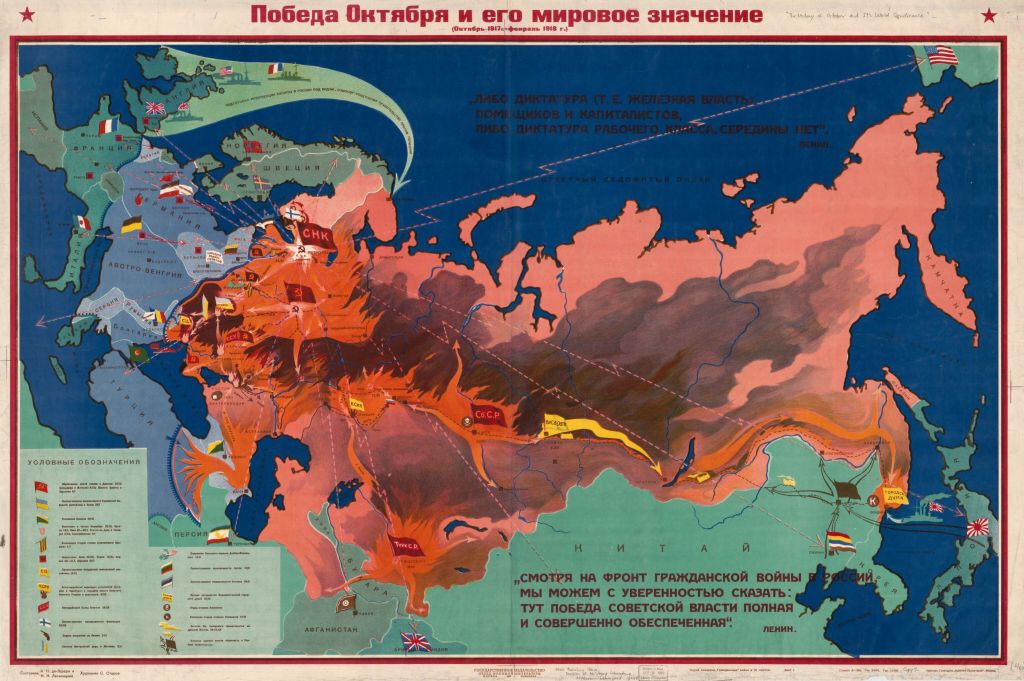
Another detail from Map 3 of the series. Moscow and Soviet territory are in the north-west corner. Note what a vast expanse of territory they don’t hold. The Green men represent Allied-oriented soldiers – Czechoslovaks, for the most part, stretched out across the Trans-Siberian from The Middle Volga all the way to Lake Baikal. The French flag represents the French officers who staffed the Legion – they were formally part of the French Army. The yellow flag surrounded by outward-thrusting yellow arrows is marked ‘Komuch’. The sinuous red arrow may represent the workers of Ekaterinburg, Troitsk and Verkhne-Uralsk in their heroic march under Blyukher (I’m not sure if the geography is right so it might represent something else). The execution of the royal family is marked by an X over the crown. See the green-and-white Siberian flag raised at Omsk. All the yellow pockets represent the Right SRs – the ones in the far east are marked “SR detachment” and “People’s Army.”

KOMUCH

Under the wing of the Czechs, new White governments sprouted like mushrooms after rain. They expanded, shrank, absorbed one another peacefully or at gunpoint.

The most interesting of the new governments was led by the Right SRs. In early June Czechs were passing through Samara on the Volga on their way east. Local Right SR party members convinced the Czechs to stay and to help them seize power. The Czechs agreed. On June 9th at dawn they overthrew Soviet power in Samara. That evening the Committee of Members of the Constituent Assembly was set up. The name, abbreviated as Komuch, claimed the dubious electoral mandate which we looked at in Part 3.

Komuch was later referred to by Soviet historians as part of the Democratic Counter-Revolution. It is tempting to put scare quotes around the word ‘Democratic’ there; in the formal sense of being elected, the rule of law, democratic freedoms, etc, Komuch was no more ‘democratic’ than any other force operating in the war-torn Russia of 1918. The Constituent Assembly was in its name, but it never got a quorum of deputies together in one place. According to a report from a Komuch organ, ‘At Simbirsk, most of the Red Army soldiers captured in the town were shot. There was a real epidemic of lynchings.’ In August Komuch set up its own repressive police organ to parallel Moscow’s Cheka.

But the term ‘Democratic Counter-Revolution’ does not refer to democratic forms. It refers to property. Komuch was bourgeois-democratic in the classical sense that it was anti-landlord but pro-capitalist. It did not attempt to give the landlords back their land, but it ended workers’ power in the factories and brought back the private owners.

Cathedral in Samara, some time around 1918

FAILURES OF THE RED ARMY

How was the new Red Army coping with all this?

When the Czechoslovak Legion revolted in the east, the Red Army was a thousand-plus miles away and facing in the other direction. As Mawdsley says, ‘the new army was pointed backwards.’[ix] Along with the simultaneous Cossack Revolt in the South, the Czech Revolt marked the real start of the Civil War. It should be obvious how little the Red side expected or prepared for, much less planned or wanted, that war. The Red Army had designated the Volga and the Urals as ‘Internal’ not ‘Border’ regions. So little did the Soviet government anticipate civil war in the east that their contingency plan in the event of German invasion, as we have mentioned, was to retreat east and form an ‘Uralo-Kuznets Republic’ in the Urals and Siberia. That was obviously off the agenda now.

Meanwhile in the Urals and along the middle third of the great arc of the Volga, local Soviets surrendered or fled without a fight. Where the Red Guards tried to fight back, they suffered humiliating defeats. Trotsky held out hope, manifested in alternating dire threats and magnanimous appeals, carrots and sticks, right up until November, that the Czechs could be split along class lines like the Don Cossacks in January 1918. It was not to be.

Trotsky, Commissar for Military and Naval Affairs

Irregular ‘detachments’ of workers, thrown together from whatever volunteers presented themselves, had been sufficient in the early months after the October Revolution. But now full-scale civil war had broken out. To win, the Reds needed a real army. This was something they did not have. Facing the Czechs near Chelyabinsk, for example, was a force of 1,000 armed Red Guards, made up of thirteen local detachments numbering from nine members to 570, each with its own commander, each pretending it was autonomous.

By the river Kyshtyma, Red Guards heard a rumour that the enemy were approaching their home villages; whole units deserted the frontline to defend their own homes.

Nearby, the Seventh Ural Regiment was absent from its positions. The commander reported: ‘The men wanted to get themselves dry and have a sleep; they decided to go off only for half an hour but are still sleeping; I can’t do any more.’[x]

KOMUCH IN POWER

Faced with this kind of feeble resistance, or even sometimes no resistance at all, the Czechs took over the Middle Volga region. Komuch would set up shop in each locality before the dust had settled. French officers would start to appear in great numbers. Students and Russian officers would go on a reign of terror against local workers, and Komuch would make half-hearted and impotent appeals for the killing to stop.

According to the Czechoslovak nationalist leader Beneš, ‘The Czechoslovak army on principle shoot every Czech found fighting with the Red Guards and captured by them, for instance at Penza, Samara, Omsk etc (200 at Samara).’[xi]

Czech Legion members, later in 1918

Komuch would restore the bosses to their factories and end fixed grain prices. On the other hand it would confirm the peasants in the ownership of the land. It flew red flags over public buildings and held peasants’ conferences. It formed a military force called the People’s Army. It even attempted to set up a Soviet – which was hastily disbanded after it passed a Bolshevik resolution!

At its height, this state had twelve million people in its territory. It held rich land, key transport links and important cities such as the capital, Samara. It included at its furthest reaches the factory town of Izhevsk. The munitions workers there, who were loyal to the Right SRs, rose on their own initiative to join Komuch – a unique episode of an armed workers’ revolt against rather than for the Soviets. ‘The Samara Komuch never paid much attention to distant Izhevsk.’[xii] But the Izhevsk workers formed a cohesive unit in successive White armies.[xiii]

Mawdsley asks, ‘Did the [Izhevsk] rising foreshadow what would have happened had the People’s Army succeeded in striking west?’ There are good reasons to doubt it. It is striking that in a territory embracing 12 million people, there was only one Izhevsk.

The wealthy classes owed a lot to Komuch, but they did not repay it with loyalty. The well-off citizens were happy to carry out terror in the rear, but in general did not deign to go anywhere near the frontline. One business owner summed up the attitude of the wealthy to the struggle between Komuch and the Reds: ‘When two dogs are fighting, a third shouldn’t join in.’ In the eyes of the bourgeoisie, the Right SRswere on the same canine level as the Bolsheviks.

Recall Lenin’s anxious remark as he contemplated the Komuch territory on a map: ‘I know the Volga countryside well. There are some tough kulaks there.’ He was born and raised in Simbirsk, which fell to Komuch on July 22nd. We can safely assume that the Middle Volga kulaks (the relatively rich peasants) were happy to be out of the grip of Soviet power; now they could sell their grain at whatever price they liked, or indeed not sell it at all. But the poor and middle peasants showed no enthusiasm for the new regime. The Right SRs had received a very impressive vote in this region in the Constituent Assembly elections, but in the end that didn’t translate to very much.

Komuch attempted to recruit 50,000 soldiers from the rural population, but only managed 10,000-15,000. After this failure 30,000 were conscripted. There was no time to train them up, and arms were in short supply, so a large part of the People’s Army was shut up in barracks. There were small, capable detachments under a talented and popular commander, a Russian officer of the Czech Legion named VO Kappel. With considerable Czech assistance, these detachments took town after town. But they were always on an exhausting itinerary, being shuttled up and down the Volga fighting the Reds in one place after another.

In general, as we have seen, workers were hostile to Komuch. For every Izhevsk, there were several stories of heroism on the part of Red-aligned workers. The people of Ekaterinburg, Verkhne-Uralsk and Troitsk, miners and factory workers, formed a partisan army to oppose the Czechs. This army consisted of 10,000 fighters, followed by civilians in carts with their samovars and household linen. Surrounded, they had to fight their way over mountain ridges and across rivers, covering 1,000 miles in fifty days. Arms were scarce; many fought with pikes and clubs and even old weapons from museums. They manufactured their own bullets wherever they could find equipment. At around the same time, a similar Anabasis was taking place in the South, where the Taman Red Army escaped from the Kuban Cossacks.

Vasily Blyukher, leader of the 10,000-strong partisan army of Ekaterinburg, Troitsk and Verkhne-Uralsk

Heroism by itself was not sufficient to win this war. But it mattered. When Service writes that the October Revolution was basically a matter of Trotsky firing up a bunch of ‘disgruntled’ soldiers, and when Ulam claims that the Bolsheviks deliberately fomented chaos in order to step into a power vacuum, and when a documentary on the Russian Revolution gives no reason for its success except ‘the skilful use of black propaganda,’[xiv] they are wide of the mark. The revolution was not some trick played behind the backs of the people. It would not have survived without the sincere enthusiasm of millions. The heroic marches in the Urals and the Kuban were of minor military significance in themselves. But they were evidence of that enthusiasm and spirit of self-sacrifice, which would prove decisive over the next few years.

SAMARA AND OMSK

While Komuch fought with the Reds to the west, it was waging a peaceful but bitter struggle with a rival White government that had sprung up to its east: the Provisional Siberian Government.

The vast expanse of Siberia was populated by Russian settlers and a wide range of indigenous peoples. Class distinctions were not so stark here as elsewhere, and the Communist Party had received only 10% of the Constituent Assembly votes – as against 25% nationally. Three-quarters of Siberian votes had gone to the SRs. Since then, ‘hamfisted’ attacks on the farmers’ co-operatives had damaged the popularity of the Soviets. There were solid Red Guard units in Siberia – but they were away beyond Lake Baikal far to the east, battling the warlords Semyonov and Ungern. Meanwhile there were several Cossack hosts ready to kick off rebellion at any moment – the Siberian Host alone numbered 170,000 – and an underground White network of 8,000 officers, one-third of them concentrated in the city of Omsk.

When the Czech revolt took place, all this dry kindling went up in flames. The Cossacks and the officers rose up. Here as on the Volga, Czech assistance was key; there was only one city (Tomsk) which the Siberian Whites captured without their assistance. But Soviet power was wiped off the map of Siberia. Workers took to the forests and formed the nuclei that would later become Red partisan armies.

From the chaos emerged a new power, centred on the city of Omsk: the Provisional Siberian Government, founded at the end of May.[xv] This government flew a white-and-green Siberian flag – white for snow and green for the coniferous trees of the taiga. This was a nod to a tradition of Siberian regionalism, which The Provisional Siberian Government (henceforth ‘Omsk’ for short) managed to bring on board, albeit in a way that was only ‘skin-deep.’[xvi] It was a stern conservative regime which represented the rifles and sabres of Tsarist military remnants rather than any popular mandate, even a contrived one.

The Iron Bridge, Omsk

In Siberia the SRs were even more popular than on the Volga. But in Siberia, even more so than on the Volga, this support base punched below its weight. This proved how passive and confused that vote was. There was an elected Siberian Regional Duma, which Komuch and the SRs attempted to convene, but the Omsk Government shut it down. This was one of many significant clashes between Komuch and Omsk.  

Komuch was not the only example of the Democratic Counter-Revolution. At this point it’s worth getting ahead of ourselves chronologically to look at the trajectory of some of the other governments in a similar mould to Komuch. The British in Persia linked up after the fact with an uprising in the Transcaspian region on 11-12 July. The Reds were chased out, and a Transcaspian Provisional Government led by SRs and Mensheviks ruled there until January when it was replaced by the ‘far more conservative’ Committee of Social Salvation. In July 1919 this government merged with the White regime of General Denikin in the south of Russia. In short, this Central Asian equivalent of Komuch was cannibalised by the reactionary generals.

The snows of North Russia saw the same political developments as the sands of Central Asia, only at a faster pace. On August 2nd the British forces landed at Archangel’sk. On the same day, the Archangel’sk Soviet was overthrown in a military coup, and the Supreme Administration of North Russia came to power. This was staffed by Right SRs and led by Chaikovskii of the Popular Socialist party. On September 6th the local military forces, supported by the Allies, overthrew this ‘moderate socialist’ government. Chaikovskii was first deposed, then brought tentatively back into the fold, then exiled.

Smele writes:

On the day of Chaikovskii’s departure, 1 January 1919, there duly arrived at Archangel’sk General EK Miller, who was to become military governor of the region for the remainder of the Civil War in the North. They must have passed each other in the harbour; socialist democracy was leaving Russia as White militarism disembarked.[xvii]

The ‘Democratic Counter-Revolution’ had suffered the same fate in Central Asia and in the Arctic Circle: a government of ‘moderate socialists’ had come to power with the help of right-wing authoritarian officers and Allied interventionists, only to realise sooner or later that it existed on their sufferance, that it had no social base of its own, that in the polarised conditions of civil war the fate of ‘moderates’ could not be a happy one.

Would things turn out the same way for Komuch?

Later we will trace a similar conflict between ‘moderate socialists’ and militarism in the relationship between Komuch and Omsk. But at the height of the revolt in Siberia, in July, seismic events occurred behind Red lines, and these will be the focus of the next post.


Sorry the footnotes are a mess. I’ll sort them out when I get a chance. Though they are in two different formats, it should still be possible to follow up any quotes or facts.

[i] Robert Silverlight, The Victors’ Dilemma: Allied Intervention in the Russian Civil War, p 8-9

[ii]Silverlight, 10

[iii]Silverlight, 19

[iv]Silverlight, p 33

[v]Silverlight, p 35

[vi]Silverlight, p 36

[i] Tsederbaum (not Zederblaum) was actually the name of Lenin’s former comrade, now opponent, Julius Martov of the Menshevik-Internationalist faction.

[ii] Ransome, Arthur. The Truth About Russia. 1918. https://www.marxists.org/history/archive/ransome/1918/truth-russia.htm

[iii] Bryant, Louise, Six Red Months…, Chapter XXXI. https://www.marxists.org/archive/bryant/works/russia/ch31.htm

[iv] Taylor, AJP. The First World War…, p 205

[v] Dr Zhivago imagines that, at the fictional battle of Yuriatin, the Red and White commanders are former neighbours and revolutionary comrades from Moscow. While I have questions about the novel’s timeline, I think this detail is plausible enough.

[vi] It is fair to refer to them as Czechs since only around one in ten were Slovaks.

[vii] Smele, The ‘Russian’ Civil Wars, 68

[viii] Mawdsley, The Russian Civil War, 64

[ix] Mawdsley, 82

[x] Serge, Year One, 311

[xi] Serge, 496

[xii] Mawdsley, 90

[xiii] Khvostov, The Russian Civil War – The White Guards, p 46. They addressed one another as ‘comrade’ and attacked to the music of accordions. They maintained their cohesion right to the end of 1920, after which many settled on farms in Manchuria.

[xiv] See (or don’t!) Service, Robert, Trotsky: A Biography, Belknap Press, 2009, Ulam, Adam B, Lenin and the Bolsheviks, 1965, The Russian Revolution (documentary film), Dir. Cal Seville, 2017

[xv] For the first month of its life it bore the name ‘Western Siberian Commissariat’

[xvi] Smele, 70

[xvii] Smele, 72

03: The SR Time Bomb

Listen to this post on Youtube or in podcast form

In May 1918 the simmering civil war in Russia went suddenly to boiling point. The working class was looking west to the danger of German imperialism, not south to the Cossacks or east to Siberia. But in May twin explosions of revolt occurred in the South and in the East. In a few months, the Soviets lost control over two-thirds of the territory of Russia.

These revolts were brought about by three major forces. The first is familiar to us, their motivations obvious: the officers and the Cossacks, who were involved both in the south and in the east. The second is the foreign interventionists; German invasion in the south triggered the revolt there, and Allied intervention played a key role in the explosion in the east. The third, active in the east but not in the south, was the Socialist Revolutionary Party. This surprising new addition to the White cast of characters will receive the most attention from us in the coming episodes.

But to understand the motivation of the SRs, we have to back-track to a profound humiliation they suffered in January of 1918.

Down at the Depot

At this moment, in the early days of the year, the calendar had not yet been changed and the struggles in Kyiv and on the Don were not yet concluded.

By a quiet canalside in Petrograd stood a naval depot, and inside the sailor Raskolnikov was arguing until he was hoarse. His real name was Ilyin – his alias ‘Raskolnikov’ suggests the Russian word for ‘heretic’ and is also the name of the killer in Dostoevsky’s Crime and Punishment. Raskolnikov was in his late 20s, an ‘Old Bolshevik’ by the standards of his comrades. He had known the inside of Tsarist prisons, and was a respected leader among the Kronstadt sailors. 

The scene inside the depot club was one familiar to those who had lived through the revolutions of 1917: a mass meeting of sailors in the dim light of electric lamps, orators on the low platform inciting them to revolt against the government. But the speakers on the platform were not Bolsheviks. They were leaders of the Socialist Revolutionary party.

A parliament called the Constituent Assembly was due to open in a few days’ time, and in that assembly would sit a decisive majority of right SR deputies. They planned to wrest control from the Bolsheviks and from the Soviets, and they would need a few thousand armed sailors and soldiers to give physical force to whatever moral force their parliamentary majority could command.

‘You Bolsheviks have blood on your hands,’ an SR speaker growled from the platform of the sailors’ club, shaking his finger.

But Raskolnikov was there to answer their arguments. His memoirs do not record what exactly he said, but it worked. The SRs were defeated in the depot, as they were in every unit of the garrison.

They settled for calling a street demonstration on January 4th, the day the Constituent Assembly was due to meet. Also, they still had their majority in the Constituent Assembly. How had they managed to win this majority in the first place?

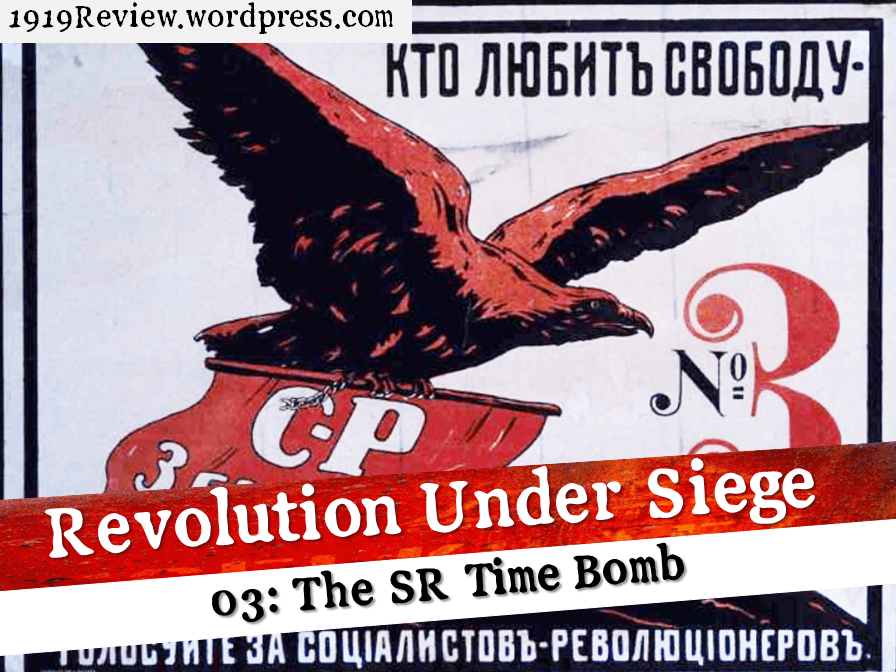
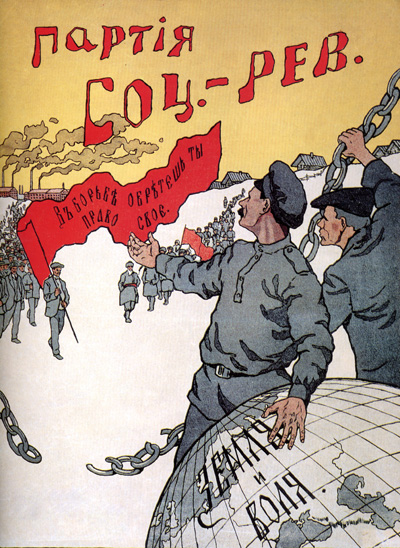
The cover image is an election poster for the SR party

THE SOCIALIST REVOLUTIONARY PARTY

Before 1917, the Socialist Revolutionary party were a presence in the revolutionary milieu. Their members took pride in their roots in the terrorist movement which had claimed the lives of Tsars and ministers. But the party was changing. In 1904 the SR Maximalists, a group of around a thousand members, split away. They were dissatisfied that the party was becoming moderate, respectable, middle-of-the-road. But as we will see, the SR tradition never really let go of terrorism.

During the year 1917, the Socialist Revolutionaries were a key force in the Provisional Government. Along with the Mensheviks, they were the ‘moderate socialists’ who continued the war, dragged their feet on the land question, insisted on coalition with the right, and presided over an economic crisis that threatened the cities with mass unemployment and famine.

There was trouble in the ranks of the party. In the words of Smith, ‘From May [1917] left-wingers in the SRs began to crystallize as an embryonic party, by virtue of their support for the peasants’ seizure of landowners’ estates, their hostility to the ‘imperialist’ war, and their backing for a pan-socialist government.’ The party now had 700,000 members, and ‘by autumn most party organizations in the provinces had come out in favour of power to the soviets.’[i]

The leader of the Left SRs was Maria Spiridonova whom we met in Part 1, whose brutal treatment in prison had shocked the world.

Bryant writes: ‘An All-Russian Peasants’ Conference was held in Petrograd shortly after the [October Revolution]. The majority of the delegates came right Socialist Revolutionists–in three days they had joined the left wing; had elected Spirodonova president and gone over to the Soviets, marching in a body to [the Soviet headquarters]. There were two All-Russian Peasants’ assemblies–both did the same thing.’[ii]

A peasants’ congress in 1917

Unlike Lenin and the Bolsheviks, the SRs had a severe aversion to splits. As late as the October Revolution itself, the Left and Right SRs were still formally in one party, even though they were on opposite sides of the barricades. Kerensky, the last leader of the Provisional Government, was a Right SR; he sent Krasnov and his Cossacks to attack Petrograd a few days after the October Revolution. An officer named Murav’ev defeated the Cossacks and captured Krasnov – and this Murav’ev was a Left SR. The Left and Right SRs were literally shooting each other in the streets. But they were doing so under the same banner and with the same party membership card in their pockets. The split did not happen until December 1917.

ELECTIONS

Elections to the Constituent Assembly were held in the weeks after the October Revolution. The Constituent Assembly Elections were yet another thing the Provisional Government had promised but had kept delaying, and which the Bolsheviks delivered a few weeks after taking power. The irony was that Bolsheviks believed that the Soviets were a superior form of democracy to any parliament.

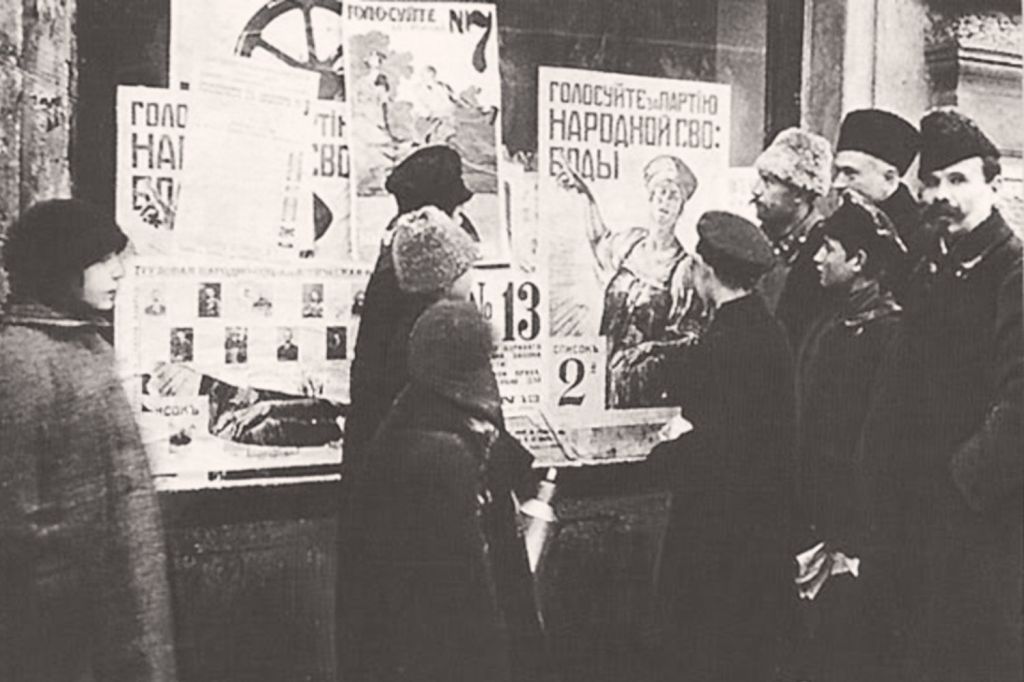
Voters in Petrograd consider the election posters – far more artistic and political than, for example, modern Irish election posters

They won a very impressive vote in the cities and the armies. But the SRs were the hands-down winners of the election. Here are the results by percentage of votes cast.

  • SRs: 39.5 per cent
  • Bolsheviks: 22.5 per cent
  • Constitutional Democrats: 4.5 per cent
  • Mensheviks: 3.2 per cent
  • Minority nationalist parties (including Ukrainian SRs & Ukrainian social democrats): 3.3 per cent[iii]

The SRs had by now finally split into Left and Right. But in a time of poor literacy and terrible communications – there was a shortage of paper for ballots, never mind leaflets – the split was not widely understood. Even those electors who fully understood it faced a head-scratching question of who to vote for, because in the vast majority of electoral districts the Left and Right SRs, who were shooting each other in the streets, were still on the same electoral list!

The system of voting for a party list as opposed to an individual candidate operates today in many countries, such as Sweden. It places the emphasis on programme rather than individuals (Note the appeal to vote for “list 3” on the SR election poster above). But because the Left SRs had been so reluctant to split, they had walked into a terrible trap. The electoral lists had been drawn up by the leadership of the SRs back in September, and favoured candidates of the right.

If the Left SRs had split much earlier and had time to develop their profile as an independent party, they might have won the Constituent Assembly election. In the few areas they did stand independently they performed badly. The SR party had a reputation as fighters for the peasantry, a reputation mostly earned by Left SRs. As it was, votes cast for the Left SRs’ programme and record went to elect people diametrically opposed to them.

The Right SRs’ majority did not impress the Bolsheviks or the Left SRs They saw the whole thing as basically a re-run of the Provisional Government, the same tired bankrupts seizing the chance to impose themselves on the country all over again. The farce of the electoral lists was an additional proof of the superiority of Soviet democracy.

 ‘THE GUARD IS TIRED’

On the day when the Constituent Assembly met, deputies from left and right alike arrived with pistols in their pockets. The Right SRs dominated the proceedings numerically. There were 230-240 on the right of the Assembly, against 130-140 on the left – a hundred or so Bolsheviks, and only 40 Left SRs.

It was an ugly day, marked by booing and heckling and tense manoeuvres. The Bolsheviks and Left SRs initiated ‘Whistling, uproar, shouts of ‘Get down!’, rattling and banging of desks… a fearful, inhuman roar and din […] a frenzied racket and loud, piercing whistles.’[iv]

Meanwhile a demonstration organised by the Right SRs filled the streets outside. During the day tensions would mount, and at one point sailors opened fire on the crowd, killing several. The crowd melted away.

The left put forward Spiridonova as their candidate for president, but she was easily defeated by the candidate of the right, Viktor Chernov, former agriculture minister.

Next the Bolsheviks proposed their position: that the Constituent Assembly could assume some authority on the condition that it recognised the supremacy of the Soviet. This was the mirror image of the Right SR position: that the Soviet could assume some authority as long as it recognised the supremacy of the Constituent Assembly.

The Bolsheviks’ proposal was defeated by a wide margin, and they and the Left SRs walked out. 

The meeting went on without the left. For a few hours, the Right SR deputies in the hall could fantasise that they were governing and shaping the new Russia, laying the foundations for an orderly constitutional capitalist republic. They elected as president Viktor Chernov who was a Right SR, but who had a ‘left-ish’ profile because he had criticised coalition during 1917.

But as 5am approached a sailor walked up to the podium and asked them to close the meeting, ‘Because the guard is tired.’

On the surface the remark seemed trivial, but it was rich in possible meanings. The Right SRs for their part took it as a veiled threat (it probably was) and quit the building without uttering a word of protest.

The Constituent Assembly never met again. It sank like a stone into murky water and the ripples appeared to settle at once. Workers, peasants, soldiers and sailors – those who, throughout 1917, had answered any undemocratic moves with mass resistance – did not lift a finger. They did not give a damn about the Constituent Assembly, did not accept its right to rule. If it demanded they choose between it and the Soviet, it was no contest. Tens of millions had voted for a party with ‘socialism’ and ‘revolution’ in the name, and socialist revolution it would be.

But the Right SRs and their supporters never forgot the humiliation of that day. Parliamentary democracy had been brushed aside with contempt by Soviet democracy, which got on with its work as if the Constituent Assembly elections had never taken place.

The chaos that began in May 1918 would give the Right SRs an opportunity to take revenge for this humiliation, and to make another bid for power. In this, the aid of the western Allies would prove to be of more practical use than their dubious parliamentary majority. But as we will see, the name of the Constituent Assembly would be quite literally inscribed on their banners.

<Back to Contents


[i] Smith, S. A. Russia in Revolution, p. 110

[ii] Bryant, Louise, Six Red Months in Revolutionary Russiahttps://www.marxists.org/archive/bryant/works/russia/ch09.htm

[iii] Smith, 155

[iv] Raskolnikov, FF, Tales of Sub-Lieutenant Ilyin, https://www.marxists.org/history/ussr/government/red-army/1918/raskolnikov/ilyin/ch01.htm

02: White Guards

‘My heart is heavy. My feelings seem to be split in two: I hate and despise the savage, cruel, senseless mob, but still I feel the old pity for the soldier: an ignorant, illiterate man, who has been led astray, and is capable both of abominable crimes and of lofty sacrifices!’

Anton Denikin, The Russian Turmoil; Memoirs: Military, Social and Political, 1920, Chapter xxxii

January 1918. Four thousand armed men had gathered by the Don River to begin a counter-revolution that would shake Russia for years to come. This week we’re going to take a closer look at the White Guards, those who rose up in arms against the October Revolution. Then we will examine how things went down when they had to face the Red Guards for the first time.

Anton Denikin first met Lavr Kornilov on the plains of Galicia at the start of the World War. The two Tsarist generals served side-by-side on the same front in what Denikin called ‘incessant, glorious and heavy battles’ as their thousands of soldiers fought their way over the Carpathian Mountains and down into Hungary. Denikin was impressed by Kornilov’s ability to train up ‘second-rate’ units into ‘excellent’ condition, by his scrupulousness and by his personal prowess. Later in the war Kornilov became a celebrity after he broke out of an Austrian prison.Denikin was big and avuncular and Kornilov thin and severe, but both came from humble backgrounds and both were utterly dedicated to the army as an institution, and these facts helped them to see eye-to-eye.

Military officers saw themselves as a caste removed and above society. Around 1898 a cavalry lieutenant had explained his perspective on the world: at the centre, highest in his regard, were his own regiment. Next came other cavalry units, then the rest of the army. Beyond – the ‘wretched’ civilians. First came the relatively ‘decent’ civilians, then ‘the Jews’, then ‘the lower classes’ and last of all the socialists, communists and revolutionaries. In regard to the last group, ‘Why these exist nobody knows, and the emperor really is too kind. One ought to be able to shoot them on sight.’ A lieutenant in 1898 might be a colonel or general by 1918.

Back in the old days, Russian military officers were generally noble or at least bourgeois in origin. Each generation of officers dated the ‘good old days’ to a decade or two earlier, but already by the 1870s a third of officers hadn’t even finished primary school.

But in these latter days, according to Denikin, the gates of the officer training schools had been flung open to ‘people of low extraction,’ with the result that the officer corps had ‘completely lost its character as a class and as a caste.’[1] (Denikin apparently subscribed to the principle of Groucho Marx: ‘I don’t want to be part of any club that would have me as a member.’) The old bonds that had held the army together – the church, the monarchy – grew weak. What was to blame for this weakening – the decay of the moral fabric of society? The corrupting influence of city life? Workers were now motivated by base material desires rather than spiritual riches; the ikon in the corner of the workshop no longer satisfied them.

Russian soldiers in World War One

The war with Japan in 1905 and its attendant revolution were disasters for the prestige of the Russian state. It appeared few lessons were learned for the Great War. In 1914-15 the old army – what was left of it ‘as a class and as a caste’ – was broken under the German, Austrian and Turkish guns. There were crippling shortages of rifles, uniforms and shells. Over two million soldiers of the Russian army perished in the war. The civilian deaths, the wounded, prisoners of war – each of these categories also numbered in the millions.

Many officers fought with great courage. But they saw their gains thrown away through incompetence, corruption, stupidity and shortages. They grew angry with the government.

According to General Denikin, ‘It is hardly necessary to prove that the enormous majority of the Commanding Officers were thoroughly loyal to the monarchist idea and to the Tsar himself.’[2] Accordingly, they blamed the Tsar’s German wife, and they obsessed about Rasputin, blamed everything on his ‘corrupting influence.’

General Denikin (the guy in the middle with the beard) during World War One.

Mutiny

The February Revolution came. The high-ranking officers, blindsided, suffered a tumult of emotions. They were disappointed in themselves – they should have engineered a ‘palace coup’ in order to head off this movement. They were angry at the moderate politicians who had stepped into the void – these scoundrels had abolished the monarchy. They were mortally afraid of the tidal wave of workers and of the mutinies in army and navy. The peoples of Finland, Ukraine, Poland, the Baltic states, Central Asia and the Caucusus were ‘Russian in spirit and in blood’[3] – but now, for some reason, they wanted self-determination. This amounted, in the eyes of the officers, to the dismemberment of holy Russia.

Something good might yet come out of the Revolution, and it was no use in any case trying to swim against the stream. It could perhaps be guided into safer channels. Denikin would carefully distinguish between ‘the real Democracy,’ by which he meant ‘the bourgeoisie and the civil service’ and the ‘Revolutionary Democracy’ – the socialist parties, whose supporters were ‘semi-cultured’ and ‘illiterate.’ If the ‘real Democracy’ could get the upper hand over the ‘Revolutionary Democracy,’ things might yet be salvaged.

But the portents were not good. Chapter VII of Denikin’s memoirs describes his reunion with his old comrade-in-arms Kornilov at a dinner in the house of the War Minister in late March. Denikin found him tired, morose and pessimistic. The condition of the Petrograd garrison was beyond comprehension to Kornilov: they were holding political meetings, engaging in petty trade, hiring themselves out as private guards. He spoke of ‘the inevitability of a fierce cleansing of Petrograd.’ Already the highest-ranking officers were contemplating coups and civil war. During the street demonstrations of April, Kornilov proposed to disperse the crowds with artillery and cavalry – and even though the government rejected this idea, he made practical preparations to do so.[4]

Soon, thanks to a Soviet decree, officers had to answer to elected committees of the rank-and-file. This was an incredible humiliation for men born and raised and trained to value rigid hierarchy. The death penalty was abolished; the officer no longer held power of life and death over the men. The men, it appeared, now held that power over the officers. This was confirmed when sailors massacred over forty officers in one incident.

The officer corps hated the new Provisional Government for pandering to the Soviet, and they loathed the Soviet itself. The soldiers’ delegates were, they complained, a bunch of clerks and shiftless rear garrison men. The proceedings of the Soviet were a display of ignorance and coarseness that embarrassed Russia before the whole world. 

And there were too many ‘foreigners.’ Pointedly, Denikin in his memoirs listed by nationality the personnel of the Presidium of the Soviet Central Committee:

1 Georgian

5 Jews

1 Armenian

1 Pole

1 Russian (if his name was not an assumed one)

To him, this was proof that the Soviet was dominated by an ‘alien element, foreign to the Russian national idea.’[5]

This quote from Denikin gives us a good insight into how the White Guard officer saw the world. When members of the minority groups held high office, they were suddenly no longer ‘Russian in spirit in blood,’ but ‘foreign,’ ‘alien.’

When the officers spoke of the socialist leader Trotsky, they always called him ‘Bronstein’ or ‘Bronstein-Trotsky,’ as if they were thereby making an important point.

Kornilov

The Constitutional Democrat party was a bastion of Denikin’s ‘real Democracy:’ it was a party of business-owners and bureaucrats. After the July Days, a near-revolution in Petrograd, the Constitutional Democrats and the top brass of the military deepened their collaboration.

The figurehead of this movement was General Lavr Kornilov. At a conference in August 1917 the Constitutional Democrats carried him on their shoulders and cheered him to the rafters.

General Lavr Kornilov

General Kornilov made his move in August. But the attempted coup was not just a failure; it backfired and strengthened the Bolsheviks (China Miéville’sOctober, published by Verso Books in 2017, contains a lively account of this episode).

Denikin was one of Kornilov’s co-conspirators. After the failed coup, Denikin ended up in a cell seven foot square. In early mornings, soldiers would cling to the bars of the window to curse and threaten him:

Wanted to open the Front […]’

‘[…] sold himself to the Germans […]’

‘[…] wanted to deprive us of land and freedom.’

‘You have drunk our blood, ordered us about, kept us stewing in prison; now we are free and you can sit behind the bars yourself. You pampered yourself, drove about in motor-cars; now you can try what lying on a wooden bench is, you ——. You have not much time left. We shan’t wait till you run away—we will strangle you with our own hands.

Denikin covered himself with his cloak. In that moment all he could think was: ‘What have I done to deserve this?’

He thought back over his life – humble origins, promotion on his own merits, valour in combat. By the standards of the institution he served, he had always been relatively kind to the men under his command, in that he declined to beat them up.

As he thought over it all, his rage mounted. He rose, throwing aside his cloak.

‘You lie, soldier! It is not your own words that you are speaking. If you are not a coward, hiding in the rear, if you have been in action, you have seen how your officers could die.’

His tormentors, awed by his words and unable to contradict them, retreated.

Not all the soldiers were hostile. ‘On the first cold night, when we had none of our things, a guard brought [General] Markov, who had forgotten his overcoat, a soldier’s overcoat, but half an hour later—whether he had grown ashamed of his good action, or whether his comrades had shamed him—he took it back.’

But Kornilov was not daunted. The attempted coup and its aftermath represent the germinating seeds of the White Armies. He and all his co-conspirators ended up imprisoned at Bykhov monastery. Bykhov was just down the road from the general staff HQ. There Generals Alexeev and Dukhonin kept in close contact with him. So Kornilov, through proxies, was able to carry on his work and to build an underground league of officers and cadets. Another co-conspirator, the Don Cossack General Kaledin, was along with Alexeev preparing a base for counter-revolution in the Don Country in the South.

Kornilov and friends. Still from the documentary Tsar to Lenin.
Red Guards rally to resist the Kornilov coup. Still from the documentary Tsar to Lenin.

The Politics of the Kornilov Movement

Kornilov and his supporters opposed the Soviet, but what was their own vision for the future of Russia and its Empire? They were in favour of a military dictatorship, but it would not remain in power forever. Its task would be to ‘restore order.’ Once order was restored – in other words, once all the working-class leaders were dead or imprisoned and their parties crushed, once the Soviet was liquidated and all weapons taken out of the hands of workers, once the soldiers had been forced back into the trenches, and all the national minorities induced to temper their demands – then, and not until then, the power would be handed to a legitimate government. Perhaps it would be led by another absolute monarch like Nicholas. But some of the officers were for a constitutional monarchy, and some even for a republic. There could be elections once order was restored. As soon as the masses were put back in their place and there was no chance of the socialists winning, it would be safe to have an election.

It is sometimes said that the White movement embraced the full spectrum of political opinion from monarchist to social-democrat. There were in reality no leftists among the Kornilovite officers; the entry of ‘moderate socialists’ into the White camp was a later (and a brief and unhappy) development, which we will deal with in later chapters.

But the White officers themselves placed very little stock in all these political questions. They uttered the ‘p’ word with the distaste they otherwise reserved for ‘Bronstein.’ The political questions could be settled after order was restored. They were mere soldiers and not politicians – thank God! They had neither the right nor the desire to pre-determine the results of some future election.

From Denikin’s memoirs, the reader can see that what really mattered was not the form of government that was to follow; what mattered was the ‘fierce cleansing.’

But these plans were left bobbing in the wake of history. The October Revolution struck. The Provisional Government and its few defenders were, as we have seen, hapless. The Kornilov movement took belated action.

The cadets, officers and Cossacks rose up in Moscow and in Petrograd in a bloody series of episodes over several days. It was in Moscow that the counter-revolutionaries first received the nickname ‘White Guards’ from their enemies. It was a reference to the French Revolution; white was the colour of the Bourbon monarchy. If it was supposed to be an insult, it backfired. The White Guards wore the name with pride. But in both cities they were defeated. In Petrograd their leader, General Krasnov, was released on parole. In Moscow the surrendered White Guards were all allowed to walk away, some still carrying their arms. Even Antony Beevor, whose book Russia: Revolution and Civil War paints an ugly picture of the revolutionaries, acknowledges the magnanimity of the Reds on this occasion.

After defeat in the two great cities, Generals Kornilov and Alexeev decided to play a longer game. They gave the order to rendezvous in the far south of Russia by the river Don, where they had reportedly stockpiled 22,000 rifles.[6]

Thousands of individual officers began the journey south. Peasants and soldiers did not show the same clemency as the authorities in Petrograd and Moscow. ‘The fugitive officer en route for the south became an outlaw figure for the soldiers, to be killed on sight.’[7] But they persevered. Many survived the journey by throwing aside the red shoulder-boards that marked them out as officers. Others disposed of their uniforms entirely, and went on to fight in civilian clothes.

Kornilov simply rode out of his prison and set off for the Don. His ‘guards’ had joined him. They fought their way across the land. When Kornilov reached Novocherkassk by the Don he found General Alexeev and four hundred volunteers already mustered. The weeks passed and four hundred grew to four thousand as more officers, cadets and students arrived.

THE COSSACKS

These southern lands, north of the Caucusus mountains and between the Black Sea and the Caspian, had in living memory borne witness to a war more fierce and total than the Civil War. In the Nineteenth Century the Russian Empire had massacred and exiled the Muslim Circassian people. The Cossacks settled on rich black soil stolen from the Circassians. They adopted the style of the vanquished: long narrow-waisted coats and silver-inlaid daggers. Non-Cossack immigrants flooded in later, and they were despised by the Cossacks and called ‘aliens.’

Painting by Mitrophan Grekov. A lone rider, probably a Cossack, returns to his homestead in winter.

The Cossacks fought on horseback with swords and lances and carbines. Again and again the state had sent them in to crush protests. Now, true to form, the Don Cossack leaders had given a safe haven to the Volunteer Army.

But the Cossack lands were not a single conservative block. For many the supposed privileges were a burden. One-third of the Cossacks were poor, and equipping themselves for war put them in permanent debt. The Cossacks were outnumbered by their poor tenants – the so-called aliens – and oppressed by the big landlords. In the cities and towns there were artisans and workers influenced by the left-wing parties.

For the young Cossacks, the experience of the World War was shattering. For three years, ‘Russian soldiers were sent into battle without rifles or were deliberately shelled by their own when, in their trenches, they were understandably reluctant to go over the top.’[8] The young Cossacks witnessed all this, and they shared trenches and bivouacs with town folk who talked of revolution. By 1917 the refrain of the young Cossacks was: ‘We must saddle our horses and go to the Don; the war is pointless.’[9]

So they made the long journey home through lands teeming with revolution. At the frontlines, officers had kept order by beating and killing the rank-and-file soldiers. Now, as an army of nine million men collapsed, many an officer was shot by the railway stations and roadsides. When the Cossacks came riding back into their villages, the old men called them cowards and traitors, and said they had been bought off by the Reds or by ‘the Jews.’ But the young Cossacks had met and talked with these Reds, these Bolsheviks. The Revolution promised them an end to this war and to the military obligations, and a settlement of the land question. The young frontline veterans, the frontoviki, were uneasy at the presence of the Volunteer Army, at the sight of officers in their distinctive shoulder-boards mustering in the Don country for counter-revolution.

THE STRUGGLES ON THE DON AND KUBAN

Even before the October Revolution, local Soviets had taken power in eighty different towns. After October, the dam burst. Workers and peasants rose up in town after town, village after village, and bands of Red Guards took to the railways to spread Soviet power to wherever the old regime held on.

There were workers’ uprisings in Rostov and Taganrog, two towns by the Don. Counter-revolution soon followed: Volunteers and Cossacks crushed the risings ‘and [shot] the captured Bolshevist members of the Rostov Soviet.’[10]

The leader of the Don Cossacks was Ataman Kaledin, a cavalry general who had commanded an entire army in the Great War. He had been part of Kornilov’s coup attempt, though the Provisional Government had never dared to come after him for fear of kicking the Cossack beehive.

In spite of their common struggles and their successes in Rostov and Taganrog, Kornilov found Kaledin less than welcoming. The Volunteers were forbidden to carry arms in the Cossack capital Novocherkassk. Kaledin must have known that his Cossacks were not all of one mind, and that too open an allegiance to the White Guards could provoke a reaction. He declined to deepen the collaboration, and the Volunteer Army were packed off to the nearby town of Rostov.

Kaledin and Kornilov faced a favourable situation. To the east the Orenburg Cossacks had risen up. To the west a Rada or parliament had taken power in Ukraine. This was a nationalist movement which opposed the Bolsheviks. The Volunteer Army would make uneasy bedfellows with Ukrainian nationalists, whose claims to autonomy they rejected, but the Rada had given the officers free passage over their territory while arresting Red Guards. The task, therefore, was to strike out over Ukraine and link up with the Rada in Kyiv and form a solid front of counter-revolution in the south.

Kaledin led his Cossacks in an invasion of the Donbass region of Ukraine. This was, as we mentioned in Part One, the area where Kliment Voroshilov had worked as a miner, farm labourer, shepherd and metalworker before his sixteenth birthday.

Rodzianko, a representative of the ‘real [bourgeois] Democracy’, with Kaledin and Kornilov. Still from the documentary Tsar to Lenin.

Now workers like Voroshilov took up arms and barred the path of the Cossacks. There was no shortage of arms: rifles and machine-guns poured into the region from Moscow and Petrograd, and in every mining and factory town Red Guard units sprang up – here a few hundred fighters, there a few thousand. Armoured trains thundered in bearing Siberians, Latvians, sailors and Red Guards from the big cities. The Cossacks fled back to the Don.

We have now reached the moment at which we began, with thousands of Red Guards taking the railways south to the Don Country as 1917 turned to 1918. When they reached the Donbass, the Reds divided their forces. Most rolled on to Kyiv to overthrow the Rada, led by a former Tsarist officer named Muraviev who had reinvented himself as a revolutionary and was most likely an adventurer. The battle in Kyiv was bloody, with atrocities on both sides and Muraviev indulging in an early excess of terror, driven by ugly prejudices against Ukrainians.

Meanwhile about 16,000 went south to the Don to face Kornilov and the Volunteer Army.

A 1920s poster showing the economic importance of the Donbass region, in red. I think it says ‘Donbass: Heart of Russia’ – which would obviously be a controversial, even chauvinistic thing to say today

Detail from a pictoral map of the Caucusus issued by a USSR tourism agency in the 1930s. The names I have added ae underlined in red. Places to note here are the Don and Kuban rivers, Taganrog, Rostov and Novocherkassk, and finally Ekaterinodar.

The Cossacks decide

In a movie or a videogame, the Red Guards would no doubt have met the White Guards in a field somewhere and fought a single decisive clear-cut battle. In that situation the Whites would have won. The four thousand Volunteers knew how to fight, and the Cossacks were numerous and fierce. The Reds were far from home, poorly-organised and barely trained.

White Guards (as depicted by a Red artist)

But there was no straight fight. These were not extras or NPCs, but human beings with doubts and fears. Each side met the other in a halting, hesitating way, one small detachment blundering into another; one outflanking and the other retreating, each unsure of the ground it stood on politically and tactically, with frequent ceasefires and negotiations. The fight would jump back and forth from one railway junction or small town to the next.

The Red Guards were more in their element behind enemy lines. Small numbers were sent ahead into the Cossack lands armed not with rifles but with documents such as the Soviet government’s December 1917 appeal to toiling Cossacks, promising a settlement of the land question but guaranteeing that they would not touch ‘simple soldier Cossacks,’ and declaring them free of the old military obligations that had put the poorest into permanent debt.[xi]

All this work paid off. On January 10th a Congress of Cossacks met at Kamenskaya. It was the birth of a movement of Red Cossacks. Enraged, Ataman Kaledin sent troops to arrest the delegates. But these troops went over to the Soviets. From this point on, Kaledin lost more and more soldiers every day – not to shells or bullets but to political arguments. The Don Cossacks had suffered a decisive split between rich and poor, old and young, village and frontline.

The Volunteer Army was still superior in discipline and training. On January 15th near Matveyev Kurgan, the burial mound of a legendary outlaw, a Red force of 10,000 suffered a bad defeat. But Matveyev Kurgan is a few hours’ walk from the town of Taganrog. The workers there had risen up before and been crushed by Volunteers and Cossacks. Now they struck again as soon as they heard the Reds were nearby. There followed two days of street fighting that ended on January 19th when the Whites were chased out. Reportedly, fifty captured cadets were brutally massacred by the workers. The revolution had returned to Taganrog, a day’s march from Rostov. Meanwhile a second Red force of 6,000 was advancing on Novocherkassk. Kaledin’s loyalists were not numerous enough to stop them. All they could do was retreat, burning railway stations and tearing up tracks as they went.

Reds triumph over Whites (from the same poster as above)

Kornilov could see that the game was up for Ataman Kaledin and his Don Cossacks. On paper, the Don Host numbered tens of thousands. But politics had intruded into military calculations. Many had gone over to the Reds, and of those who had not, most would not answer when Kaledin called.

But to the south across the steppe was the country of the Kuban Cossacks. The Whites hoped that the Kuban Cossacks might prove more solid. Kornilov and his Volunteer Army packed their bags, shouldered their rifles and marched out onto the steppe. The Don Cossacks were incensed at this betrayal. There were shots fired at the White Guards as they fled the Don Country.

The Volunteers had escaped out of the reach of the Red Guards from Moscow and Petrograd. But, as we will see below, wherever they went the revolution was close behind, or even lying in wait.

Ice March

Kornilov could see that the game was up for Ataman Kaledin and his Don Cossacks. On paper, the Don Host numbered tens of thousands. But politics had intruded into military calculations. Many had gone over to the Reds, and of those who had not, most would not answer when Kaledin called.

But to the south across the steppe was the country of the Kuban Cossacks. The Whites hoped that the Kuban Cossacks might prove more solid. Kornilov and his Volunteer Army packed their bags, shouldered their rifles and marched out onto the steppe. The Don Cossacks were incensed at this betrayal. There were shots fired at the White Guards as they fled the Don Country.

The Volunteers had escaped out of the reach of the Red Guards from Moscow and Petrograd. But, as we will see below, wherever they went the revolution was close behind, or even lying in wait.

ICE MARCH

The time was out of joint. In February, the Soviet government changed the calendar so that it was in step with the rest of the world. Overnight Russia leapt ahead by two weeks. In South Russia, time was passing quickly in more ways than one. Ataman Kaledin, who had commanded a whole army under the Tsars, could now call on only 100-140 men.

He blamed Kornilov.

‘How can one find words for this shameful disaster?’ he said in a speech before the Cossack assembly. ‘We have been betrayed by the vilest kind of egotism. Instead of defending their native soil against the enemy, Russia’s best sons, its officers, flee shamefully before a handful of usurpers. There is no more sense of honour or love of country, or even simple morality.’[xii]

After this speech, Kaledin retired to his rooms in the Ataman’s Palace and shot himself in the heart.

By the end of February Novocherkassk and Rostov had fallen to the Reds. A Don Soviet Republic was founded, with an SR Cossack named Podtelkov as its president. The last supporters of the late Kaledin galloped out into the wilderness, praying for better days.

General Kornilov and his Volunteer Army, meanwhile, had marched out onto the Kuban Steppe, several thousand officers and civilians burdened with heavy artillery and carts full of the sick and wounded. Their journey went down in history as the First Ice March.

…a long column of soldiers wound its way out of Rostov, marching heavily over the half-melted snow. The majority were wearing officers’ uniforms […] Behind the numerous wagons of the baggage train came crowds of refugees: elderly, well-dressed men in overcoats and galoshes, and women wearing high-heeled shoes. […]

‘Have you anything to smoke?’ a lieutenant asked Listnitsky. The man took the cigarette Eugene offered, thanked him, and blew his nose on his hand soldier-fashion, afterwards wiping his fingers on his coat.

‘You’re acquiring democratic habits, lieutenant,’ a lieutenant-colonel smiled sarcastically.

‘One has to, willy-nilly. What do you do? Have you managed to salvage a dozen handkerchiefs?’

The lieutenant-colonel made no reply. Tiny green icicles were clinging to his reddish-grey moustache.

From And Quiet Flows the Don, Mikhail Sholokhov, 1929; trans Stephen Garry 1934, Penguin Classics 2016, pp 495-496

The officers were facing this bleak expedition in the hope that they could link up with the Kuban Cossack Host.

But the Revolution made its way to the banks of the Kuban river while the Volunteers were still toiling over the steppe. When they reached the Kuban Cossacks, they found the same thing they had left behind: a Cossack host that had mostly gone over to the Reds. And beyond lay the Caucusus Front, where hundreds of thousands of veterans had mutinied and were coming north to join the revolution.

February turned to March and spring did not come. Rain gave way to snow and cold winds, and the Volunteers’ clothes were crusted with ice. Under pursuit, forced to avoid railways and settlements, they fought forty battles in fifty days.

‘Take no prisoners. The greater the terror, the greater will be our victory.’[xiii] To judge by these words of Kornilov, the suffering only made them more determined.

In April their fortunes seemed to turn. They joined up with a force of White Kuban Cossacks, bringing their total fighting strength to 6,000 and adding two more generals to their already impressive collection. They decided to march on the Kuban capital, Ekaterinodar (now Krasnodar), a city of 100,000 people.

They had escaped from the Red Guards of Petrograd and Moscow. They needed the resources of a city; but where there were cities there were workers, and where there were workers there were Red Guards.  

From April 10th to 13th the Volunteer Army attacked Ekaterinodar. But 18,000 Red Guards were waiting for them. The vast numbers of people who flooded into the Red Guards whenever the Whites raised their head was a sign of the popularity of the Revolution. The fact that the Whites could at first only muster a few thousand is a reflection of their narrow – though very determined – support base.

Hundreds of Whites were killed the fighting. Kornilov had made his HQ in a farmhouse on the edge of town; on the morning of the 13th a shell scored a direct hit on the roof. Kornilov was killed. The Volunteer Army gave up the fight and once again fled out onto the steppe.

The End of the First Wave of Civil War

Another one of those pictorial maps showing the flame of revolution spreading outward from the central cities.
In finer detail. Clockwise from top: The Finnish Civil War begins. The Yellow flag shows the rising of Dutov at Orenburg. The blue line shows the front with Turkey and the soldiers returning radicalised from that front. The Green and Yellow flag is planted in T’blisi and probably represents the Georgian independence movement. Lots of pointy arrows, flames and contrasting dark and fiery colours around Ekaterinodar and Rostov. Flames too in the Donbass and further into Ukraine. The Green arrow is the rising of the Polish Corps. The blue arrows represent German attacks – of which more next week.

On April 23rd the Soviet leader Lenin declared victory: ‘It can be said with certainty that, in the main, the civil war has ended… on the internal front reaction has been irretrievably smashed by the efforts of the insurgent people.’

Even before the Volunteer Army’s defeat at Ekaterinodar, Lenin had sounded a similar note: ‘A wave of civil war swept over all of Russia, and everywhere we won victory with extraordinary ease.’[xiv]

There had been serious fighting on every point of the compass. A Tsarist army corps made up of Polish soldiers revolted in Belarus. A street battle erupted in Irkutsk in Siberia. A warlord named Semyonov raided and rampaged beyond Lake Baikal. Cossacks in the south of the Ural Mountains rose up and seized Orenburg.

Everywhere the result was the same. In response to these challenges, local workers and poor peasants volunteered for Red Guard units, usually in their thousands or tens of thousands. There was no Red Army yet. This was the time of the otryad, the informal ‘detachment’, some formed on local initiative, others sent out from Moscow or Petrograd; numbering anything from a few dozen to thousands; armed with anything from a few rifles to an armoured train (or even, in the case of Irkutsk, bows and arrows[xv]). Just like on the Don, everywhere political appeals were decisive. The Red Guards knew how to disarm the enemy with class politics. When that failed, they had their rifles.

Victor Serge, a communist who later criticised his own side for excessive use of violence, wrote that this wave of struggle was won ‘with neither excesses nor terror.’[xvi] It’s clear that he means terror directed and sanctioned by the Soviets; elsewhere he makes no secret of the fact that rogue bands of sailors and soldiers were killing officers and carrying out massacres like in Sebastopol. Important outliers in Kyiv and Kokand, both in February 1918, should be noted. But when two right-wing figures were murdered in their hospital beds by sailors in January 1918, the Soviet press condemned this atrocity. In general the noises from key Bolshevik leaders indicated that they believed the Russian revolution, unlike the French, could avoid terror and mass executions.

At this point the Soviet regime was still a democratic one. The government was a coalition between the Bolsheviks and the Left SRs. The Third Congress of Soviets met on January 15th, around the time the Don Cossacks split. At this congress we see not just Bolsheviks and Left SRs but also Right SRs, Menshevik-Internationalists and Anarchists. It’s striking that the Right SRs were tolerated even though they had taken part in the uprisings in Moscow and Petrograd.

This was how things stood in the military situation and the political regime in early Spring 1918. The violence appeared to be over.

That spring, a renewal of the war with Germany seemed far more likely than a new wave of civil war. At the end of April the forces of the White Guards consisted of several thousand men, encircled and leaderless, on a blasted steppe on the very edge of Russia. At that moment the first Red army units had been formed, but they did not face the Don or the Volga; they faced the German armies to the west.

But with hindsight we know that the real Civil War had not even begun. Starting in May, a chain of catastrophes would fan the dying embers of armed struggle to an inferno that would not die down until the end of 1920, and that would still be blazing in parts of Russia as late as 1923. What the Red Guards had just endured was nothing compared to what was coming down the line. A bloody summer lay in wait. The war of irregular ‘detachments’ that had triumphed by the Don and Kuban rivers would fall far short of the challenges. To survive, the Soviet republic would need to build a regular professional army.

< Back to Contents

Back to Home Page

The cover image for this post is by A. Kokorin, one of the very fine illustrations from The Iron Flood by Alexander Serafimovich, 1973 edition.

Transitions, sound effects, music and dialogue on the video and audio versions of these podcasts are not my property but are included under fair use. Credits for the audio version of this post are as follows:

Music from Alexander Nevsky by Sergei Prokofiev.

Intro from Anastasia (1997, dir Don Bluth and Gary Goldman)

Dialogue from Fall of Eagles, Episode 12 (1974, Elliot & Burge, BBC)

Transitions from Battlefield 1: In the Name of the Tsar (2017, Dev. Dice)

[1] https://www.gutenberg.org/files/43680/43680-h/43680-h.htm Chapter VII


[1] Denikin, Anton. The Russian Turmoil. Memoirs: Military, Social, and Political, 1920. Project Gutenberg. https://www.gutenberg.org/files/43680/43680-h/43680-h.htm. p 17

The cavalry lieutenant is quoted in Reese, Roger, Red Commanders, Press of the University of Kansas (2015), p 15 and the detail about primary school completion among officers in the 1870s comes from the same source.

In addition to the sources listed here as direct citations, I have constructed the narrative drawing heavily from Smele (The ‘Russian’ Civil Wars), Mawdsley (The Russian Civil War), Smith (Russia in Revolution) and Serge (Year One of the Russian Revolution).

[2] Denikin, p 16

[3] Denikin, p 21

[4] Trotsky, LD, History of the Russian Revolution, Volume I, Gollancz, 1932, Chapter XVII, p 353-358

[5] Denikin, 91

[6] Kirienko Yu. K. KrachKaledinshchyna. Accessed and translated at Leninism.su. Another document from the same website to which I have referred is AM Konev, Red Guard on the Defense of October [sic; Google translate] https://leninism.su/revolution-and-civil-war/4142-krasnaya-gvardiya-na-zashhite-oktyabrya50.html. The documents on this site are extracts from works by Soviet scholars, but they are abridged and edited in suspicious ways – ellipses cover the defeat at Matveyev Kurgan, for example. Accordingly I have relied on these documents only for secondary matters, for the odd detail or quote, not for major questions.

[7] Serge, Victor. Year One of the Russian Revolution, p 123

[8] Carleton, Gregory. Russia: The Story of War, Harvard University Press, 2017, p 146

[9] Kirienko

[10] Serge says the Cossacks refused to take part, but Kirienko names the Cossack leader Nazarov as the one who crushed the Rostov uprising. The detail about the Rostov Soviet members being shot comes from a timeline at the end of Wollenberg’s book The Red Armyhttps://www.marxists.org/history/ussr/government/red-army/1937/wollenberg-red-army/append02.htm

[xi] Carr, EH. The Bolshevik Revolution Volume 1, Pelican Books, 1950. p 300-301

[xii] Serge, 125

[xiii] SA Smith, Russia in Revolution, ‘Violence and Terror,’ beginning p 196

[xiv] Mawdlsey, The Russian Civil War, (Birlinn, 1982, 2017) p 29, 38

[xv] According to AM Konev, the Reds took out White machine-gunners using ‘well-aimed arrows from among the indigenous Siberian hunters’.

[xvi] Serge, Victor. From Lenin to Stalin, Pioneer Publishers, trans Ralph Manheim, 1937. https://www.marxists.org/archive/serge/1937/FromLeninToStalin-BW-T144.pdf.&nbsp; p 28.

01: Red Guards

Listen to this post on Youtube or in podcast form

In November 1917, three hundred factory workers gathered in the village of Tushino near Moscow. One of them later recalled: ‘We faced a struggle against the Cossacks, and we workers had scores to settle.’[1] They held the rifles with which, one month earlier, they had fought for Soviet power. In Moscow they were given olive-khaki army gear and sent on by rail, with thousands of other armed workers, to Kharkiv. Of these thousands of armed passengers, many were in civilian clothes, others army jackets that had known Galician mud and German shrapnel. The closest thing to a common uniform was a red armband. Some wore a metal cap badge in the shape of a red star, some with a hammer-and-plough device. The hammer-and-sickle, which would become the symbol of communism in the 20th Century, had not yet caught on. The red star was, for some reason, worn upside-down. They wore ammunition belts criss-crossed over their chests. Bullets were scarce, and they wanted to keep them jealously in arm’s reach.

At Kharkiv, a city that was solid for Soviet power, they mustered before setting off for the southern extremity of European Russia. These were the Red Guards, the closest thing the Russian Revolution of October 1917 had to an army, and they were going to the country of the Don Cossacks and into battle.  

One observer recalls the aspect of the Red Guards in these early months: ‘they still had a poor command of the rifle, and there was nothing to say about the bearing of a soldier [sic]. But on the other hand, fire sparkled in everyone’s eyes, everyone was full of courage.’

Another source describes the Red column under the former Tsarist officer Muraviev: ‘They were oddly dressed, totally undisciplined people, covered from head to toe with every kind of weapon – from rifles to sabres to hand-guns and grenades. Arguments and fights constantly flared up among their commanders.’[2]

A member of the Red Guards

These commanders were elected by the rank-and-file. Some of them were sergeants and corporals of the old army. Others were members of the radical left parties, the Left Socialist Revolutionaries and the Bolsheviks. Key decisions were taken at mass meetings.

The Red Guards, rising from the slums and shop floors, were going south to fight an army that was their opposite in every way. A force called the Volunteer Army, three or four thousand strong, had gathered by the Don River for one purpose: to crush the October Revolution. It was made up mostly of officers and cadets. Over one in five of these men were members of the hereditary nobility – who made up only 1.3% of the population at the time. It’s entirely possible that the Volunteer Army contained as many generals as privates.[3] They were known by a nickname that was just a few weeks old – the White Guards.

The Red Army as such did not yet exist, and the Volunteers were only the first and the smallest of the White Armies. But this campaign in the Cossack lands at the start of 1918 was like a caricature of the Civil War – an army without officers, squaring up to an army made up primarily of officers.

The cover image is from D. Bisti, ‘Lenin and Red Guards,’ USSR, 1967

The Reds had a decisive edge in numbers, the Whites in expertise and discipline. But there was a third force which was native to those lands, and whose leaders were allied to the White cause. That third force was the Don Cossack Host.

In this chapter we’re going to look at the origin of the Red Guards, at how these armed factory workers ended up travelling far from home to fight the officers and Cossacks. In the next chapter we’re going to examine the origin of the White Guards, before telling the story of what happened when these two forces met.

To get a notification when that post drops, leave your email address here:

The Reds

We will begin by looking at three revolutionaries. Taken together they provide a portrait of the Red Guards and of the revolutionary milieu from which this army emerged.

Kliment Voroshilov was typical of the Red Guards. His dad was a railway worker. He began his working life at age seven as a miner, then as a farm labourer under a ‘kulak’ (a wealthy peasant), then as a shepherd – all this before age 12, when he got a place in a village school. But by age fifteen he was toiling again, this time in a metal works. At seventeen he was under arrest for striking. In 1903, as a metal worker in the Hartmann Factory in Lugansk, eastern Ukraine, he came into contact with socialists. By 1918 he was a well-known workers’ leader in the Donbass region.

Vasily Chuikov was the eighth of twelve children of a peasant family, his mother a devout Christian on the staff of the local church, his father a bare-knuckle boxer. Chuikov finished his education at the age of twelve and moved to Saint Petersburg, where he worked in a factory that made spurs for cavalry officers.

Maria Spiridonova came from a well-off family. In 1906 she was enraged by the violence and sadism of a local official. So, she walked up to him one day and shot him dead. Police and Cossacks arrested her. There followed a notorious case which made headlines around the world: Spiridonova suffered torture, sexual assault, and finally a sentence of death commuted to life imprisonment. But with the Revolution came amnesty, and Spiridonova emerged as the leader of the Left Socialist Revolutionary party.

These individuals will feature again from time to time in the narrative that follows, but their main importance lies in the information about late imperial Russia and its revolution that can be gleaned from these biographical sketches.

In Western Europe the first generations of the working class were made up, by and large, of the children of artisans; the workers of Russia were the grandchildren and great-grandchildren of serfs. As late as 1917 a staggering number of them still owned land in some distant village.

There were illiterate oral poets of admirable genius who found machine work intolerable and who drifted from unskilled job to unskilled job; village youths stunted by malnutrition; commuters who, after their 10-14-hour day, got only a few hours in which to sleep; women who earned 15 kopeks a day before the war but 1.5 roubles during it; seasonal workers leaving behind their crafts or fields, barely understanding how wages and piece-work operated; foremen who were part of the worker-collective; white-collar workers who were outside it. During the First World War there were conscripted labourers from Central Asia, and Chinese workers brought in en masse by gangster-like contractors.

 There were settled, established workers and recent migrants from the village. There were the workers of Petersburg, where gigantic metaland textile works employed thousands or tens of thousands, and there were the smaller workshops of the other cities. Even within the Petersburg steelworks, the fitters looked down on those in the foundry, the rolling-mill and the forge, whose faces ‘through the deep tan of the furnace’ appeared coarse.As late as the eve of revolution most workers still contributed their kopeks to buy oil for the religious ikon lamps that they kept in the corners of their workplaces.

The greatest concentration of workers was in Petersburg. (Saint Petersburg was later called Petrograd, then Leningrad). Working-class people lived three, four or five to a single-room apartment or to a cellar, paying high rents. Workers on different shifts would share a single bunk. Outside Petersburg it was common to sleep in a company-owned barracks. Shifts were ten, eleven, twelve hours. Overcrowding and overwork constituted mass and merciless social violence: 100,000 died in a cholera epidemic in 1900. One in four children died before they were a year old.[4]

Of course, there were things in modern city life that one could enjoy, even on low pay and long hours. Workers consumed the daily newspapers and illustrated periodicals with their ads and sensational stories. They read fiction about detectives and explorers and romance. Single working women spent one-fifth of their income on clothing, often employing seamstresses to copy fashionable styles. The young male metal worker, unless the strains of working life drove him into the trap of vodka addiction, would save up for a smart suit, a watch, a straw hat, and go out walking on a Sunday afternoon.

And there were, of course, political parties which offered solutions to the desperate conditions in which workers lived. There were the Social Democrats, a socialist party which split into the moderate, loosely-organised Mensheviks and the militant, tight-knit Bolsheviks (this split began in 1903 and culminated in 1912). Others looked to the peasant majority instead of the workers, or were inclined to a romantic rather than a scientific outlook. These would join the Socialist Revolutionaries, the SRs, a broad party with roots in the terrorist movement of the 19th Century. There were also Tolstoyans and Anarchists.

Three-quarters of people in the Russian Empire were illiterate, but a majority of workers could certainly read. ‘Every morning on the works train it was rare for someone not to read a newspaper or book, rare if you lived only for your wage and your family.’ They read Sherlock Holmes and Karl Marx and plenty in between. For some, ‘tales of Cossacks, of arrests and torture by the [secret police], of people hanged, and others forced to flee to some unknown destination became more interesting than adventure stories.’ [5] In the smoke and grime of factory and mining districts or in the noise and disorder of overcrowded housing, they would tackle the dense legion of words printed on thin paper under titles like Iskra, The Spark, Novaya Zhizn, New Life and RabocheyeDyelo, the Workers’ Cause. After political meetings, meditating on what they had learned, or on whatever fierce controversy had been aired, they would walk home along the unpaved, barely-lit streets of the working-class districts. In winter this would mean trudging in darkness through a river of mud.

 The police, if they had reason to believe that a young man was a member of the Social Democrats, would arrest him and then play a simple trick that played on the psychology of party loyalty:

A prisoner’s mother, for example, would call on the colonel of gendarmerie and ask to be allowed a meeting with her son.

‘Well, you know, your son is accused of belonging to the Socialist-Revolutionary Party,’ the gendarme would say to her in a categorical tone.

‘Oh, come, Colonel,’ the mother would reply, in amazement: ‘my son has always been a convinced Social-Democrat.’

The gendarme would rub his hands with glee. That was all he needed.[5]

They risked it, because what was said in those meetings and what was printed on that cheap paper struck a chord with their own experiences, and offered a way forward. The bounty of nature and the great power of modern industry should not be in the hands of a wealthy few; they should be the collective property of the whole people. But the bosses and the state worked hand-in-hand to crush any strikes and protests. How to overcome the violent power of the state? The Social Democrats had an answer: the working class, through its decisive numbers in the big cities, through its control of production and transport, would bring down Tsarism.

But was it possible to build socialism in a country where two-thirds of the population were small property owners? Aid must come from advanced industrial countries, such as Germany. Germany was home to the most developed and impressive socialist movement in the world. On whom the Russian Mensheviks and Bolsheviks tried to model themselves. The revolution must be international, must embrace the industrialised countries of the West, or it would fail. But surely those advanced countries like Germany would have a revolution long before Russia ever got around to it.

Thoughts along these lines would have run through the head of the socialist worker as they negotiated the mud and open cesspits of the unlit streets. They would have wondered whether the working class could really defeat the system; whether the toiling people could really run and govern a country.

Scene from Dr Zhivago (Dir David Lean, 1965) showing a workers’ demonstration coming up against the forces of the Tsarist autocracy

Revolution & Reaction

1905 was a year in which these questions were posed in real life. The workers of fifty towns and cities established councils directly elected from each workplace. These workers’ councils were known as Soviets, and in places they became parallel revolutionary governments. Workers formed defence groups to protect the Soviets, and these groups became known as Red Guards.

But the Russian army stayed loyal to the Tsar. 100,000 Cossacks were mobilised to crush the revolution by a charter that confirmed their privileges. Affluent liberals supported the revolution at first, but by the end of the year they were frightened and weary. They met the Tsar a lot less than half-way. There were disorders in the countryside, but by and large the cities were isolated.

The Tsarist government hanged 3,000 revolutionaries and killed more in various pogroms and repressions. There was street fighting in Łódź and Moscow; the Polish and Russian Red Guards fought bravely but it wasn’t enough to overcome a professional army.

Years of reaction followed. There were 410,000 members of state-sponsored ultra-right organisations and they were on a rampage. Jewish people were targeted for arson, looting and massacres; 600 anti-Semitic rampages took place.[7] Millions fled to Western Europe or North America. It was in this context that the above-mentioned Maria Spiridonova shot dead a Tsarist official.

The revolutionary parties were beaten down, disarmed and wracked with internal division. The Bolsheviks and Mensheviks made their split final. The SRs polarised into Left and Right but remained in one party. Their subsequent painful history proves that there are worse things in political life than splits.

The first Red Guards – workers at the barricades in 1905

But Tsarism had been forced to make some concessions on trade unions and elections. And the 1905 revolution had filled out abstract theory with concrete experience. The Soviets showed how the workers could form their own alternative government, their own participatory democracy, their own councils. On the other hand, the Red Guards had been no match for the army. The revolutionary worker had new questions to ponder, often from exile or a prison cell: could the insurgent people wage a successful civil war, or would the next revolution also be drowned in blood?

WAR

The First World War began in the summer of 1914. The horrors of modern warfare – machine-guns and apocalyptic artillery bombardments – were compounded by all the worst kinds of waste, incompetence, shortages and harsh discipline. The worker drafted into the army or navy found himself under an autocrat worse than the factory boss: the Russian officer, who was entitled to punch a soldier in the face, to humiliate him publicly, to spit on him. The Tsar’s regime was vicious both in defeat (Over a million people were banished from the borderlands as the Germans advanced) and in victory (A repressive anti-Semitic regime was installed in Lviv when it was briefly conquered).

The first tremor of revolution came in Central Asia. An attempt to impose conscription in 1916 triggered a rebellion. The army went in, killed an estimated 88,000 rebels and civilians, and sent 2,500,000 fleeing into China. According to Jonathan Smele, that was 20% of the population of Central Asia at the time.

In the big cities of European Russia, events in Central Asia were not at the forefront of the minds of working-class people. That place was occupied by the food crisis. The burden of feeding the army made an absolute mess of the food supply system, and the price of bread kept rising.

At first the war produced an atmosphere of patriotism that smothered all dissent. The Bolshevik Party, riding high in 1912-1914, had been reduced to 12,000 members by 1917. But the same patriotism fuelled indignation at the criminally poor leadership.

Nobody expected the Revolution of February 1917. Women workers in Petrograd triggered a decisive battle which drew in hundreds of thousands of participants and raged for five days. Each night the insurgent people would retire across the bridges to the working-class suburbs. Each morning they marched out again and resumed the struggle. They had few weapons so they used stones and even sheets of ice. They burned and looted police stations, beat and killed the police. Regiment by regiment, the soldiers of the garrison joined the revolution. This mutiny was decisive. The Tsar abdicated his throne and was imprisoned.

Tsar and people – the February Revolution depicted in a contemporary illustrated paper. This and the others in the slideshow above come from this great source.

The key leaders of this movement ‘on the ground’ were the members of local committees of the various socialist parties, the workers who had trudged home after meetings and pored over Iskra sitting on their shared bunks in their overcrowded flats and cellars. They had torn down a 300-year-old dynasty in five days.

The power vacuum was filled by elements of the old regime and its tame opposition. They formed a self-appointed Provisional Government, and most people were inclined at least to give them a chance.

At the same time the Soviets, the great workers’ councils of 1905, re-emerged. They spread from Petrograd to every city and even to the regiments and villages, forming a brilliant system of participatory democracy – rough and ready, not yet embracing the entire population, but sensitive to the moods of the masses, reflecting the popular will at every turn. The delegates were subject to recall and re-election. In this honeymoon of the February Revolution, the Socialist Revolutionaries and Mensheviks had a decisive majority in the Soviet. Both supported the Provisional Government.

The key leaders of this movement on the ground were the members of local committees of the various socialist parties, the workers who had trudged home after meetings and pored over Iskra sitting on their shared bunks in their overcrowded flats and cellars. They had led their workmates and neighbours in tearing down a 300-year-old dynasty in five days.

The power vacuum was filled by elements of the old regime and its tame opposition. They formed a self-appointed Provisional Government, and most people were inclined at least to give them a chance.

At the same time the Soviets, the great workers’ councils of 1905, re-emerged. They spread from Petrograd to every city and even to the regiments and villages, forming a brilliant system of participatory democracy – rough and ready, not yet embracing the entire population, but sensitive to the changing moods of the masses. The delegates were subject to recall and re-election.

A local example can stand in for what was happening in many places: at the Provodnik works in Tushino near Moscow, a few dozen workers disarmed the factory guard. A mass meeting of workers and their families elected them as the new factory guard, the workers’ committee and the factory fire brigade, and sent delegates to the Moscow Soviet. Management soon found that the quickest way to procure supplies was via these workers and the Soviet system.[8]

In this honeymoon of the February Revolution, the Socialist Revolutionaries and Mensheviks had a decisive majority in the Soviet. Both supported the Provisional Government.

Hopes ran high at first and there was a mood of euphoria and national unity. But as the months passed the mood hardened. The Provisional Government was determined to continue the war. It was punishing those who dared to touch the property of the wealthy landowners. At factories whose workers were less vigilant than those at Tushino, bosses began lockouts, sabotage and threats of closure. The food situation got worse. Over the summer, the economy fell into crisis.

From April on, the Bolsheviks put forward a tough and clear position calling for the overthrow of the Provisional Government and for a socialist revolution. At first this was not a popular position, but as the summer wore on, those who had supported the Mensheviks and SRs switched to the Bolsheviks. Their slogans – ‘Peace, Bread and Land’ – ‘All Power to the Soviets’ – at first anticipated and then expressed the growing popular clamour.

The membership of the Bolsheviks rocketed from 12,000 to 350,000. In September, they won a decisive majority in the Soviet.

What had changed since 1905? This time, a mass movement of the rural toilers was sweeping the countryside, seizing the estates of the nobility, and the army was crumbling under the weight of desertions and mutinies.

What was Bolshevism? The name now carries all kinds of connotations, some very bad. But if we return to the factory in Tushino we get a different picture. This factory of five thousand had five hundred Bolsheviks as early as April and one thousand by September.

Staff at this factory organised a clubhouse on factory grounds where they had a library and a temperance society, an orchestra, amateur theatre, dancing, poetry and prose readings. Chekhov and Nekrasov were staples.

There was an entrance charge to all our social events, with the proceeds going either to victims of the old regime or to the library and other club facilities. It was always difficult to accommodate everyone who wished to visit the club. Artistic hand-drawn posters were put up in railway stations, workshops, villages, and hamlets a long way from the factory […] The whitecollar staff[…], who had formerly kept their distance from the workers, also came along to the theater, so the barrier between them and us began to break down spontaneously.

The working day was reduced to eight hours and all overtime was abolished, but the factory continued to operate and to produce as before the Revolution. [9]

The Red Guards

Vasily Chuikov, the son of the church secretary and the bare-knuckle fighter, found himself unemployed in Petrograd in 1917. But through one of his numerous brothers, he found something to occupy his time: he joined the Red Guards. In a few months’ time he would be shooting at cavalry officers, rather than making spurs for them.

Red Guards in Autumn 1917

The Red Guards had been re-founded by Bolsheviks, but they answered to the multi-party Soviet. They were armed with weapons seized from the burning police stations or factory security guards, or donated by workers in the war industries. Many had no weapons at all, and drilled with wooden sticks. Soon there were units in every ward of the city, some formed on a factory-by-factory basis and patrolling on company time. By July there were 10,000 members in Petrograd. After the failed coup by the right-wing General Kornilov in August-September the workers’ army numbered 20,000 in 79 factories. By November there were 200,000 nationally. They had pistols, rifles, the odd machine gun, even a few armoured cars. On duty, many Red Guards wore their Sunday best: their shirts, ties and waistcoats, watch-chains and fedoras or straw hats.[10]

Many soldiers and sailors supported the Red Guards. Kronstadt, home of the Baltic Sea fleet, was a rock-solid bastion of Bolshevik, anarchist and Left SR sailors.

Recruitment to the workers’ militia was as strict as to any other organization. The candidacy of each prospective member was discussed at a session of the factory committee, and applicants were often turned down on the grounds that they were regularly drunk or engaged in hooliganism or had behaved coarsely with women. [11]

By autumn, anxiety had settled on the Red Guards. Winter was coming. The economic crisis was getting worse, and famine was already a reality. Maybe the Bolshevik leaders were just like the other party leaders – all talk. Maybe the opportunity for revolution would pass. Maybe this movement would fall apart, and there would be hell to pay – a defeat bloodier and more total than that of 1905.

But on the night of October 24th-25th the Petrograd Red Guards were called out onto the streets.[12] The Provisional Government was attempting to shut down the Bolshevik newspaper. In response the Military Revolutionary Committee of the Soviet went on a long-planned offensive. The Red Guards and their soldier and sailor allies occupied the city. Rifles, machine-guns and cannon could be heard firing, but there was no real battle.

The Provisional Government waited in the Winter Palace as the Reds occupied the streets outside. The defenders of the Winter Palace consisted of cadets and the Women’s Battalion.[13]At first the cadets and women vowed to commit suicide sooner than surrender. But hours later, confused and demoralised, they let the Red Guards in with a shrug of the shoulders. It was less a ‘storming’ of the Winter Palace than a long confused siege merging with a gradual infiltration.

At last the defenders laid down their weapons. The Red Guards and soldiers, these children of serfs who had lived three to a cellar, ‘broke into the Palace and after rushing up the 117 staircases, through 1,786 doors and 1,057 rooms at last, at ten past two in the morning, entered the room where the ministers of the bourgeois Provisional Government were and arrested them.’[14]

The Reds inflicted no fatalities. Apparently they suffered six, two by friendly fire.[15]

Red Guard unit from the Vulcan factory

The journalist Louise Bryant, following up a rumour, interviewed another casualty of that night, a young woman who was injured. 

Well, that night when the Bolsheviki took the Winter Palace and told us to go home, a few of us were very angry and we got into an argument,’ she said. ‘We were arguing with soldiers of the Pavlovsk regiment. A very big soldier and I had a terrible fight. We screamed at each other and finally he got so mad that he pushed me and I fell out of the window. Then he ran downstairs and all the other soldiers ran downstairs…. The big soldier cried like a baby because he had hurt me and he carried me all the way to the hospital and came to see me every day.[16]

This is a human portrait, but not a very flattering one, of the soldiers of the revolution. The wider world was told a very different story: that the women were raped en masse. As late as 1989, western sources were still embellishing the original lie. We read (in Anthony Livesey, Great Battles of World War One, Marshall, London, 1989) that ‘The Bolsheviks, who hated them for wanting to fight to the end, raped, mutilated and killed any who fell into their hands.’ The second part is so outrageously false that it almost feels redundant to point out that the first part is wrong too; they didn’t fight to the end. In fact, they were ambivalent about the government they were defending.

After the Revolution

Who will govern us then?’ demanded one daily newspaper which appeared on the day of the October Revolution. ‘The cooks, perhaps […] or maybe the fishermen? The stable boys, the chauffeurs? Or perhaps the nursemaids will rush off to meetings of the Council of State between the diaper-washing sessions. Who then? Where are the statesmen? Perhaps the mechanics will run the theatres, the plumbers foreign affairs, the carpenters the post office. Who will it be?[17]

As if in answer, the Congress of Soviets was meeting at the Smolny Institute. The vast majority of the delegates approved of the insurrection. The Mensheviks and SRs, who had once commanded a majority, were now reduced to a rump. The Congress without delay passed decrees taking Russia out of the war, transferring the noble and church estates to tens of millions of peasants, and declaring the right of self-determination for nationalities. The new regime did in a few days what the Provisional Government had dragged its feet on for nine months.

In those days, Red Guards and sailors patrolling in the streets were harangued by well-dressed citizens who accused them of madness, anarchy, bloodthirsty violence, etc. The revolutionaries listened, sometimes puzzled, sometimes keenly interested, to their heated arguments and fabricated atrocity stories.

Red Guards on sentry duty

Before the year was out the revolution had spread to most cities and towns. The local Soviet would simply form a Military-Revolutionary Committee and take over. That’s not to say it was straightforward or peaceful. There was street fighting in Moscow and in Irkutsk, and a Cossack-cadet rising in Petrograd. The Red Guards won in each case. But already in October a counter-revolutionary army was gathering by the Don River. It was one thing to defend your own familiar streets. It was quite another to travel a thousand kilometres to the edge of Russia, the home turf of the notorious Don Cossacks, to fight a legion of officers. But there was nothing else for it. The Red Guards took up arms and went south to the Don.

In the next chapter we will look at the White Guards and the Cossacks and try to understand why they took up arms against the Revolution. Finally, we will look at what happened when Red and White met in South Russia at the start of 1918 in the first front of the Russian Civil War.

<Back to Contents


On the audio version, the music and transitions are as follows:

Music: From Alexander Nevskyby Sergei Prokofiev – ‘Battle on the Ice’

Battle sounds: From All Quiet on the Western Front, 1979, Dir. Delbert Mann. Youtube.com

Speech: From Young Indiana Jones Chronicles, Roger Sloman as Lenin. Youtube.com

[1]Dune, p 96

[2] The first quote is from AM Konev, The Red Guard in the Defence of October, available on the website Leninism.ru, describing Red Guards in Irkutsk. The second is from Smele, Jonathan. The ‘Russian’ Civil Wars 1916-1926, Hurst & Company, London, 2015 p 56, describing Red forces in Ukraine.

[3] There were ‘very, very few’ rank-and-file soldiers in the Volunteer Army – Serge, Year One of the Russian Revolution, (1930; Haymarket, 2015) p 123. We can make a list of 15 generals who were in the VoljnteerAmry in 1918: Pokrovsky, Erdeli, Ulagay, Shkuro, Kazanovich, Kutepov, Wrangel, Borovsky, Shilling, Lyakhov, Promtov, Slushov, Yuzefovitch, Bredov. From Khvostov, Mikhail and Karachtchouk, Andrei. The Russian Civil War (2) White Armies. Osprey Publishing, 1997 (2008) p 13-14

[4] Smith, SA. The Russian Revolution and the Factories of Petrograd, February 1917 to June 1918. Unpublished dissertation, 1980. University of Birmingham Research Archive, etheses depository. Pp 22, 53;

Smith, SA, Russia in Revolution, Oxford University Press, 2017, Chapter 2: From Reform to War;

Dune, pp 11-12

[5] Dune, pp 15, 19

[6] Raskolnikov, FF. Tales of Sub-Lieutenant Ilyin, 1934 (New Park, 1982), ‘DPZ’, https://www.marxists.org/history/ussr/government/red-army/1918/raskolnikov/ilyin/index.htm

[7] Foley, Michael. History of Terror: The Russian Civil War, Pen and Sword, 2018

[8] Dune, pp 36-7. 47

[9] Dune, 38, 40-41, 47

[10] Serge, Year One of the Russian Revolution, pp 68-70

[11] Dune, 51

[12] This date is going by the Julian calendar – the date by the Gregorian calendar was 6/7 November. In early 1918 the Soviet regime changed from the Julian to the Gregorian calendar.

[13] The Women’s Battalion was a unit of several hundred enthusiastic women volunteers for the war against Germany. To their frustration, they had been used for propaganda purposes and not sent into battle – until now.

[14] The USSR: A Short History, Novosti Press Agency PublishingHouse, 1975 p 109. This book is an interesting souvenir whose account of Soviet history is riddled with omissions.

[15] Taylor, AJP, The First World War: An Illustrated History. Penguin, 1963. (1982) p 200

[16]Bryant, Louise, Six Red Months in Russia, George H Doran Company, 1918. Available online athttps://www.marxists.org/archive/bryant/works/russia/index.htm

[17] Faulkner, Neil. A People’s History of the Russian Revolution, Pluto, 2017, p 209

Celtic Communism? Appendix 1: James Connolly

At the start of our four-part series ‘Celtic Communism?’ we asked whether the claims of James Connolly with regard to Gaelic Ireland were ‘just one of those unfortunate examples of Connolly giving ground to romantic nationalism.’ It’s time to answer that question.

In the late 19th century in Ireland there was a revival of old Irish sports, language, history, music and legends. This movement rose up in defiance of British imperialism and fed into the 1916 Rising and War of Independence in the early 20th Century.

Most of the prominent Irish nationalists were bourgeois figures, including ruthless strike-breaking bosses like William Martin Murphy. There were Irish nationalists who felt aggrieved that poor old Ireland did not have any colonies in Africa. The first party which bore the name ‘Sinn Féin,’ founded in 1905, had the exceptionally cranky idea of ‘dual monarchy’ at the heart of its programme.

There were authors on both sides of the Irish Sea who read Anglo-Irish history as a struggle between “Saxon and Celt” – the Saxon coldly logical, the Celt emotional (An idea brutally satirised by Shaw in his play John Bull’s Other Island). To Connolly’s endless chagrin, certain authors liked to claim that one of the essential, eternal features of the ‘Celtic race’ was ‘veneration for aristocracy.’ 

The masses of Ireland wanted to fight British imperialism, and that aspiration was bound up with a desire not only to champion their suppressed culture but to seize the land, to end poverty, to unionise and struggle for a ‘Workers’ Republic.’ There was a gap, to put it mildly, between this and the programme of the bourgeois nationalists. This gap was papered over with nationalist and religious phrases that dripped with sentimentality and chauvinism.

In this context James Connolly was a breath of fresh air:

Ireland as distinct from her people, is nothing to me: and the man who is bubbling over with love and enthusiasm for Ireland, and can yet pass unmoved through our streets and witness all the wrong and the suffering, the shame and the degradation brought upon the people of Ireland – aye, brought by Irishmen upon Irishmen and women, without burning to end it, is in my opinion, a fraud and a liar in his heart, no matter how he loves that combination of chemical elements he is pleased to call Ireland.

It’s unfair that he’s remembered by many as a garden variety Irish nationalist when in fact he spent most of his life skewering bourgeois nationalism without mercy.

It would be unfortunate but not incredible if in these struggles Connolly succumbed from time to time to some of the ideas and assumptions of his opponents.

What is romantic nationalism?

The Gaelic cultural revival was part of a global phenomenon in the 19th Century. In any country in Europe a cadre of town intellectuals could be found trying to convince several million peasants and industrial workers that they were all united in a common imagined community, intimately related down to the very fibre of their being with this or that 8th century steppe nomad people or Iron Age confederation of clans. A lot of our ‘knowledge’ of history even today is influenced by these assumptions and agendas.

In many cases this represented, as in Ireland, an oppressed people asserting themselves after centuries of oppression. But it was abused to give the poor a spurious common cause with the rich – and against the poor of other countries. The 19th Century obsession with race came from a desire to justify slavery and imperialism. But it found many other evil uses in the hands of the wealthy: it provided a convenient way to divert people from the fight against wealth inequality or for women’s rights. 

James Connolly’s agenda was the opposite. He wanted to combine the struggle for liberation with the struggle for socialism. He always insisted that socio-economic and class conflicts were the true driving force behind uprisings for Irish freedom.

His key point about Gaelic Ireland was that it possessed a social order incompatible with feudalism and capitalism. The English conquest of Ireland was foremost a social struggle, not a racial one.

However he went too far and made claims that he didn’t need to make in order to prove this point. The language and tone were too strong and have aged poorly. See if you can read this without cringing: ‘It is a system evolved through centuries of development out of the genius of the Irish race, safeguarded by the swords of Irishmen, and treasured in the domestic affections of Irish women.’

Those who read Connolly often got the wrong impression about Gaelic Ireland. Aodh De Blácam was a fascinating and eclectic writer of the time who, in his book Towards the Republic, combined Bolshevism with Catholicism and the most romantic Irish nationalism imaginable. He appears to have taken Connolly at his word and believed that Gaelic Ireland was communist, no ifs or buts. I think De Blácam got the opposite impression to what Connolly intended – instead of providing an argument for seeing the Anglo-Irish question as a social rather than a racial one, Connolly had inadvertently provided the ingredients for an eclectic synthesis.

But De Blácam’s synthesis was a short-lived piece of accidental cultural wildlife. It could not have really come into being or thrived outside the years 1917-1923 or so, when ‘Soviet’ was a word to conjure with in Ireland. Just as you can’t hold Connolly responsible for those who obtusely read him as a Catholic and nationalist or as merely a left-leaning Republican, you can’t blame him for everyone who gives him a one-sided reading.

There is nuance and specificity in Connolly’s treatment of the Gaelic Irish. In The Re-Conquest of Ireland he writes of them

shaping their castes and conventions to permit of the closest approximation to their ideals of justice […] all were members having their definite place, and in which the highest could not infringe upon the rights of the lowest – those rights being as firmly fixed and assured as the powers of the highest, and fixed and assured by the same legal code and social convention.

Here Connolly acknowledges the existence of inequality – of people of ‘high’ and ‘low’ status with fixed rights. He even uses the term ‘caste.’ When he writes of ‘their ideals of justice’ he hints at the fact that ‘their’ ideals and ‘ours’ are not the same. This is a gesture of recognition toward the strange and alien nature of Gaelic Ireland to modern eyes.

He includes important qualifiers in Erin’s Hope:

They did not, indeed, regard all forms of productive property as rightfully belonging to the community; but when we remember that the land alone was at that time of importance, all other forms of property being insignificant by comparison […]

The chief, as Mill has justly observed, was but the managing member of the tribal association, although in the stress of constant warfare they usually limited their choice to the members of one or two families […]

In Labour in Irish History, regarding the destruction of the Irish social order by Cromwell and co, he says:

Such an event was, of course, inevitable in any case. Communal ownership of land would undoubtedly have given way to the privately owned system of capitalist-landlordism, even if Ireland had remained an independent country, but coming as it did in obedience to the pressure of armed force from without, instead of by the operation of economic forces within, the change has been bitterly and justly resented by the vast mass of the Irish people, many of whom still mix with their dreams of liberty [with] longings for a return to the ancient system of land tenure – now organically impossible.

That hard-headed passage is very far from national romanticism.

So Connolly was not surrendering to romantic nationalism. He’s not giving them ground. He’s giving them hell. He’s taking Gaelic Ireland away from them and saying, in effect, ‘You don’t get to make political hay from this. You don’t get to laud ancient Ireland in one breath and condemn socialism in the next.’ Or to use his own memorable phrase: Capitalism is the most foreign thing in Ireland.

Overall, many of his comments don’t really stand up to scrutiny. For example, it was not warfare which limited the pool of candidates in Gaelic Ireland, but the laws themselves. It was de jure not de facto. The essential political point he’s making is entirely correct, but he goes too far.

In the sense of ‘Battle not with monsters lest ye become a monster,’ ie, in the sense that romantic nationalism may have rubbed off on Connolly in the course of his struggles against it, you could say that he gave ground to it. If we return to the question with which we began, we come to a different answer. Overall, this is not an example of Connolly surrendering to nationalism but of Connolly fighting nationalism on its home turf and, against the odds, coming out of the scrap with his honour intact.

Celtic Communism? Pt 4 – Conclusion (Premium)

Become a paying supporter to get access

Access to this article is limited to paying supporters. If you already subscribe by email, thank you. But if you want to become a paying supporter, please hit ‘Subscribe’ below.

Donate less than the price of a coffee, and you can access everything on this blog for one year.

If you don’t feel like donating, most of my posts are still 100% free, so browse away, and thanks for visiting.

Home Page/ Archives

Celtic Communism? Pt 3: The Un-Free (Premium)

Un-free – premium – see what I did there?

I’ll get my coat…

We started this series by looking at what James Connolly had to say about early Irish history and asking, ‘Was Gaelic Irish society in any meaningful sense socialist? Or was this just one of those unfortunate examples of Connolly giving ground to romantic nationalism?’

In parts 1 and 2 we looked mostly at customs around kingship in the years 800-1200 CE, drawing out examples of the democratic and egalitarian features of Gaelic Ireland. As one of my readers summed it up:

Become a paying supporter to get access

Access to this article is limited to paying supporters. If you already subscribe by email, thank you. But if you want to become a paying supporter, please hit ‘Subscribe’ below.

Donate less than the price of a coffee, and you can access everything on this blog for one year.

If you don’t feel like donating, most of my posts are still 100% free, so browse away, and thanks for visiting.