
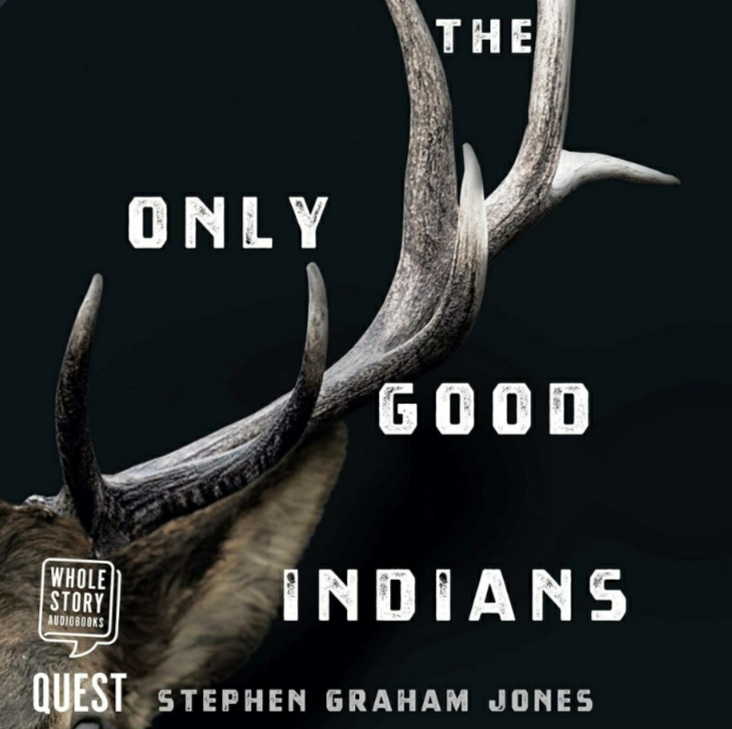
The Only Good Indians by Stephen Graham Jones (Saga Press, 2020). Audiobook narrated by Shaun Taylor-Corbett.
Here are two images of this novel that sum it up best: a sweat lodge made from random old blankets, sleeping bags and jackets so that it looks like, the narrator says, a pile of hobos; and a woman with the head of an elk.
This is US horror writing in the mould of Stephen King: garage-door social realism; characters whose internal monologues bring them to life as much as their words and actions; incomprehensible passages about sports; monsters and apparitions that feel like an extension of the mundane world and are all the more horrible for that.
But as it goes on The Only Good Indians reveals a folk-tale quality that you don’t find in King.
It’s set around a Blackfoot reservation in the present day, and the story is steeped in the grim conditions in which the Indians live (that’s the term the author and characters use). Lewis has made it to his mid-30s without dying of diabetes or an overdose or suicide or a car crash, or freezing to death after passing out, and he considers that a small miracle. Don’t tempt fate: the first quarter of the book depicts his complete unravelling, his descent into blood-soaked psychosis. The apparition of the elk-head woman drives him to it.
Lewis is one of four friends in the crosshairs of this monster. When they were in their early twenties, they committed a transgression which involved blowing a pregnant elk to pieces with rifle fire. Ten years later a dangerous elk spirit has come for revenge – not only to kill them but to destroy everything they love.
Each one of these Indian characters feels like a traumatised survivor of some terrible war. Each one of them has managed to get through some bad shit and to put their lives together. As death comes to claim them one by one, it feels wasteful and hopeless. The worst part is, it feels true: people who fight their way up out of a bad situation and build new lives for themselves are always prey to some demon from the past catching up with them.
Twice while reading this novel, once at the one-quarter mark and once at the three-quarter mark, I stopped reading and put it aside, disgusted with it. ‘So it’s like that,’ I thought. ‘Every woman in the story has to die a horrible – and improbable – death.’ The brutality felt capricious and meaningless. We’re supposed to think the elk-head woman was pushing an open door when she turned Lewis into a murderous ghoul, but to me when the killing started it felt too abrupt. It’s difficult to get invested in one character only to switch to some others two-three hours in.
But both times I gave it a week and came back to it, and found myself drawn in again. It’s not really like that. It really is going somewhere, building up to something. Not every woman and man dies. There is a way out.
Denorah, the teenage daughter of one of the four men, is the only ‘calf’ any of them produced. She is a brilliant basketball player, someone who will really make her tribe proud one day. After a long sequence involving the makeshift sweat lodge which builds slowly from tense humour to pure horror, Denorah finds herself in the crosshairs of the elk-head woman. The final struggle falls to her.
That’s where I am now: in the last half-hour of the audiobook with no idea if the ending is going to come down on the side of the things I liked or the things I didn’t like. While he nearly lost me once or twice, now I’m convinced Jones knows what he’s doing, and I’m keen to see how it all ends.
[Edit 26 May 2024: the ending brought it all together. Even better than I hoped.]
 The 1919 Review