
The Unspoken Name by AK Larkwood, Tor, 2020
The Unspoken Name begins with a description of a shrine in the mountains, and of the child sacrifice ritual practised there by a bunch of tusk-faced people. Our main character is Csorwe, who has been singled out as a future offering to the cave-dwelling god known as the Unspoken Name. The wizard Sethennai comes to visit – a charismatic fellow with purple skin and pointy ears – and saves her from her fate. She runs away with him to discover the world beyond the morbid religious order in which she was raised.
Yes, this is the story of that brilliant Le Guin novel The Tombs of Atuan. And like the Earthsea novels, the world conveyed here is clear and vivid. But in The Unspoken Name there are two major differences. First, all of that happens in the first few chapters; it’s only the set-up. Second, this pointy-eared wizard Sethennai is no Ged. Yes, he’s rescued Csorwe from death and hired her as his assistant. But she’s going to spend the rest of the novel figuring out that he is a bad person.
Sethennai is not malicious or sadistic; he doesn’t cackle when he hurts someone. Nor is he a ‘loveable rogue’ or anti-hero. Nor is he a torn, tormented character. He’s not for redeeming. He is simply a powerful, ambitious man who sees no wrong in using people and then discarding them.
This is bad enough for Csorwe, who hero-worships him even as he sends her into terrible danger for his own selfish reasons. His other assistant, Tal, is in love with him. Tal’s narrative voice is a perfectly-judged blend of pain and humour.
Csorwe meets a young magician, Shuthmili, and the two young women gradually fall in love. Maybe, the reader hopes, this can drive a wedge between Csorwe and Sethennai. But Shuthmili has to break with her own corps/ cult of creepy psychics.
You may have noticed something: I’ve got this far without talking much about setting. Characters and relationships are the rocket fuel of this story. On paper, there’s too much plot. But the way it works out, it never feels heavy or dense. It’s very unlike Earthsea in a lot of ways – but like Earthsea, it feels light even when it really isn’t.
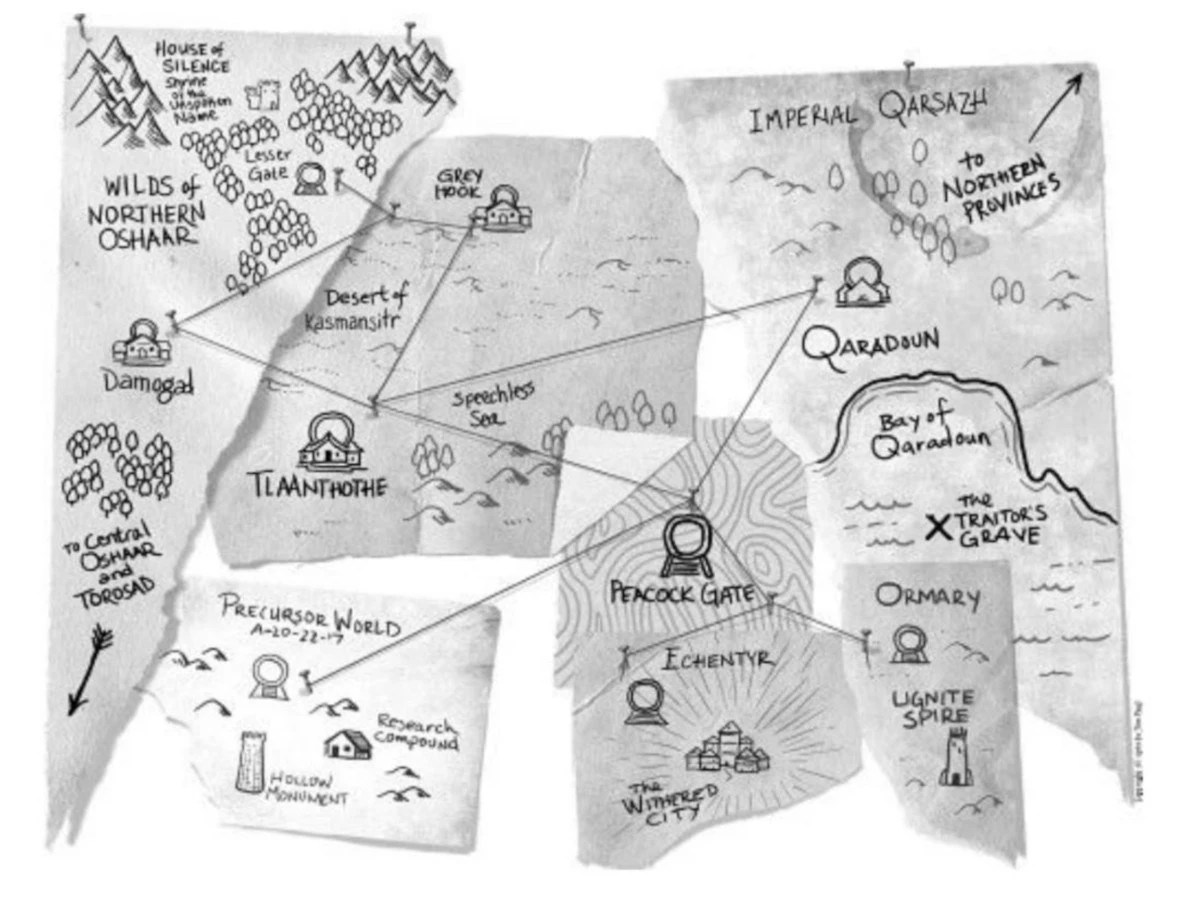
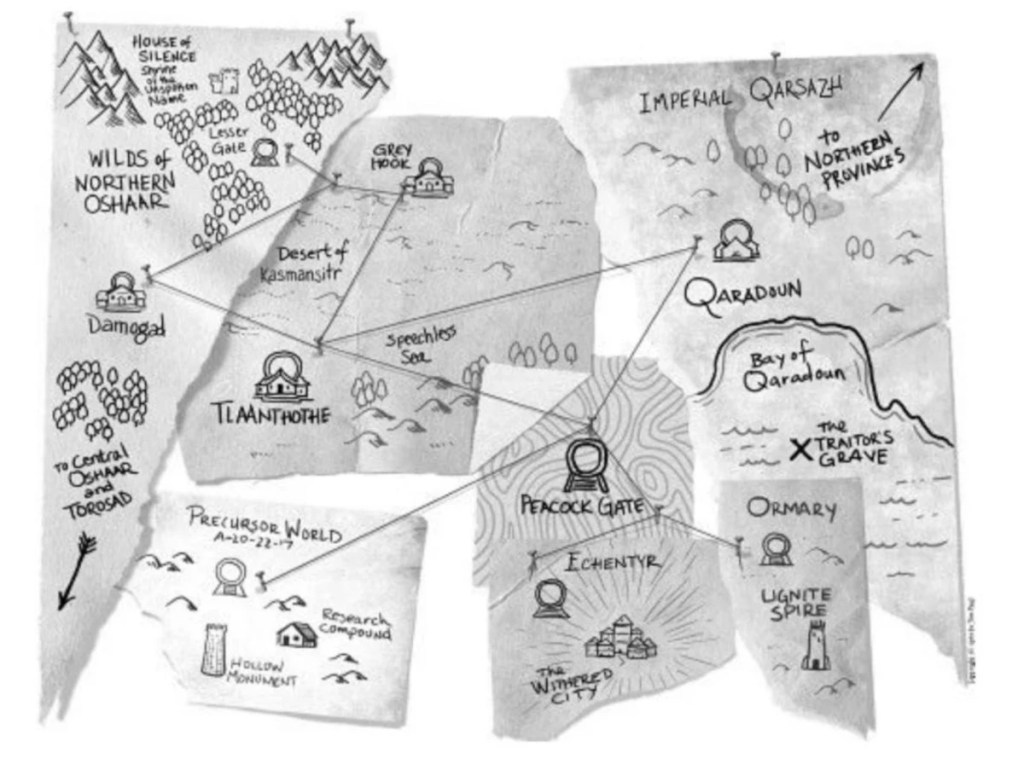
The setting is distinct enough that it’s not easy to slot it in to some corresponding real world era, but it’s kind of early modern. It’s a vast number of worlds, linked through a maze and a system of portals, navigated by flying ships. Oshaar (Csorwe’s home), Tlaantothe (Sethennai’s domain) and Qarsazh (Shuthmili’s home) are all different worlds – maybe planets, maybe universes. But many or most of the worlds are old, decaying, succumbing to entropy, abandoned. So this is a diverse setting, rich in ancient magical ruins for the characters to explore and to have adventures in, with a deep past.
By the end, Csorwe is ready to dismiss the Unspoken Name, the god for whom she was going to be killed. There is a very creepy moment when she at last confronts him, but the way it turns out there is more pity than horror. The story has outgrown him.
Another interesting point: it is very gently suggested that the Oshaaru are orcs, the Tlaantothe people are elves and the Qarsazhi are humans. But they all behave as humans with tusks or pointy ears.
The Thousand Eyes by AK Larkwood, Tor, 2022
To begin with, I thought The Thousand Eyes trod on the edge of being boring. Not so much so that I put it down, but I didn’t have a sense of where it was going. The main characters from the first novel, minus Sethennai, have formed a mercenary gang. They are bantering and exploring ruins.
Then I was irritated when the story took a sudden turn. They revive an ancient god who wants to conquer the world, and this evil god possesses the body of one of our main characters. I was irritated because I don’t care for this ‘possession’ trope.
But before the dust settled on that, the story took another turn. And I was hooked. What Larkwood did with the story was simple and bold: she jumped forward in time twenty years. The ancient god, in the body of the main character we know and like (I won’t say which one), has carved out an empire. We meet older and more cynical versions of our other characters, plus one their optimistic offspring, as they conspire to resist and overthrow the evil empire.
Suddenly, it’s all gone a bit Star Wars, and I mean that as a good thing. It’s a story with momentum, full of cool concepts and images, driven along by strong characters who have a simple and awesome goal: to overthrow an empire.
Tal’s gallows-humour narrative voice gains extra pathos given the bitter years that have passed. Our characters come to realise that to overthrow the evil empire there’s one man they are going to need on their side: Sethennai. Damn! They’ve just got over that guy, and now they have to go back and beg him for help.
This time, the plot is simpler and the story stronger; still, some of the twists and turns towards the end have gone fuzzy in my memory just a few months after I read it.
The Thousand Eyes is more about the fate of cities and religions and nations than was The Unspoken Name. For all that, the political world-building is not entirely to my taste. Political struggles are not moved by socio-economic forces or institutions. The destinies of leaders and empires are decided by a handful of characters, by their command of magic and not their command of the state apparatus; by their relationships with each other, not by their relationship with the means of production. The people, in theory, matter. But even the wealthy and powerful don’t have any real deciding power over the outcome of events.
And given the way the story is put together, it would be unsatisfying if they did; while there is an epic struggle at the heart of it, this remains a story about a small circle of friends and frenemies. The stakes are always first and foremost personal.
I’m really looking forward to the third book and I gladly recommend the first two.
 The 1919 Review