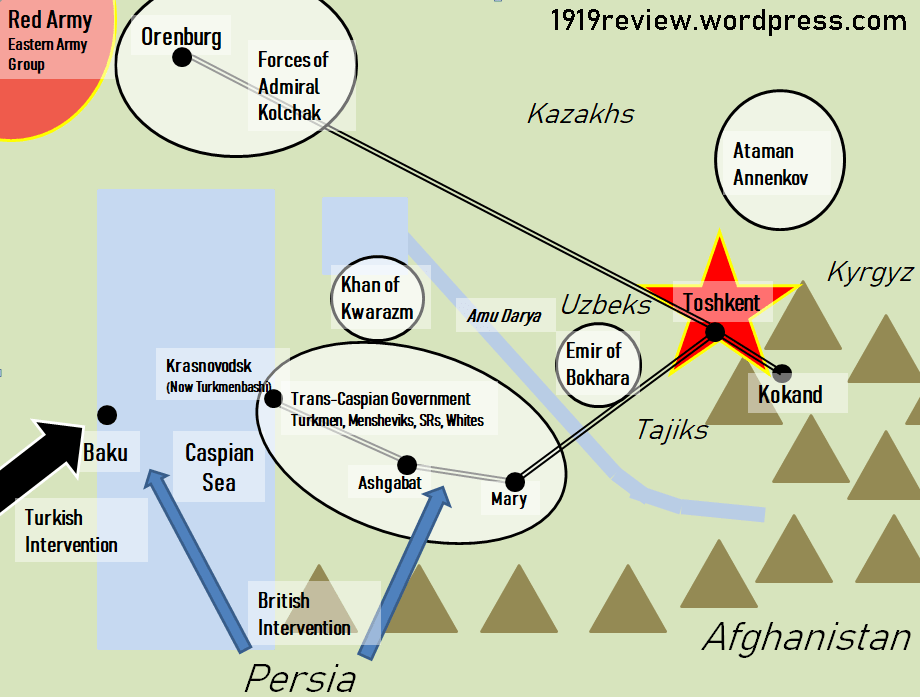
Most of the placenames mentioned below. Thanks Google Maps
Become a paying supporter to get access
Access to this article is limited to paying supporters. If you already subscribe by email, thank you. But if you want to become a paying supporter, please hit ‘Subscribe’ below.
Donate less than the price of a coffee, and you can access everything on this blog for one year.
If you don’t feel like donating, most of my posts are still 100% free, so browse away, and thanks for visiting.
In July 1918 the ground was shaking under the feet of Soviet power. We have already looked at the situation in ‘Central’ and South Russia, and in the Urals and Siberia: atamans invading, Czechs in revolt, officers, Cossacks and Right SRs forming rival governments, foreign powers invading, insurrections in Moscow, Kazan and Iaroslavl.
Central Asia was one section of this panorama of general catastrophe. The customary apology which I make on the podcast for mispronouncing Slavic names must now be accompanied by another customary apology: that a disproportionate part of my material comes via British military officers with a gift for languages, a high tolerance for deserts, a racist attitude to ‘the natives’ and a loathing for the anti-war and egalitarian programme of the Soviets. These guys bring their biases to the table, and the simple truth is that I wasn’t able to find much material from the other side or even from a balanced standpoint.
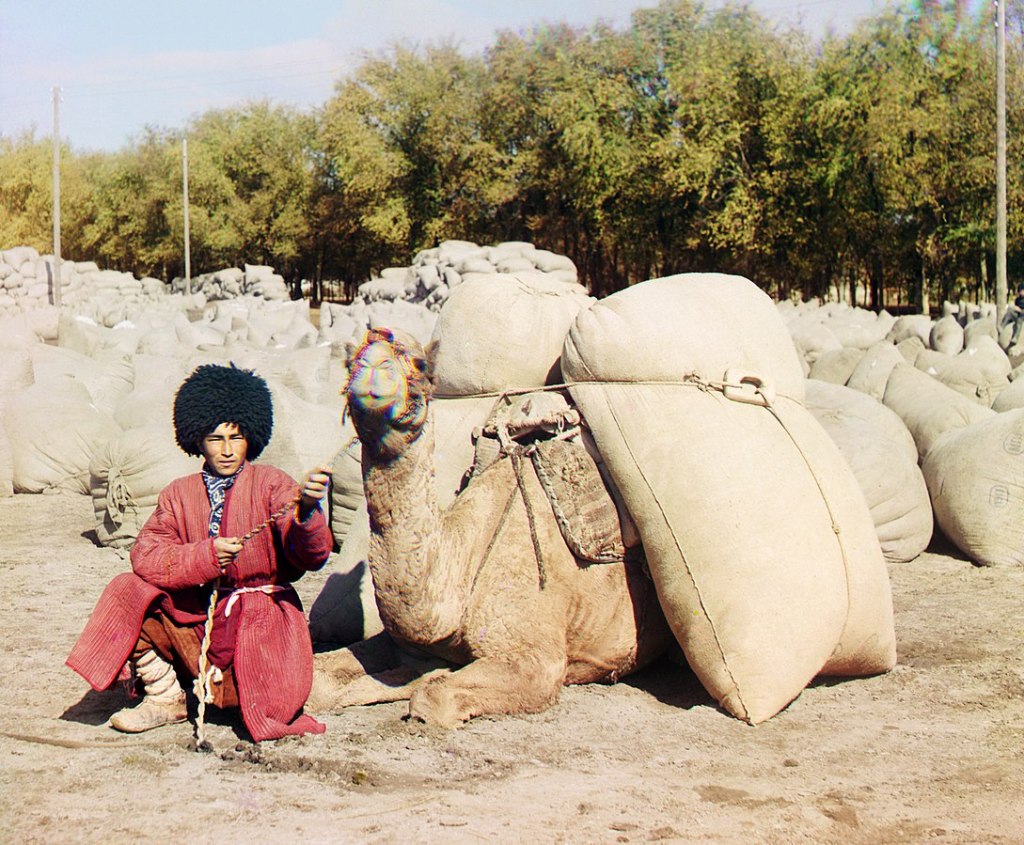
A Turkmen, photographed some time between 1905 and 1915. These guys are going to be important in this post.
Turkmens and Punjabis
Civil War proper came to Central Asia with the formation of the region’s first major White government. Here is how that happened.
We have seen how the main support base of the Toshkent Soviet consisted of oilers and drivers on the railways. As we saw, these workers refused to support the Menshevik-led railway strike. But in the Trans-Caspian region (modern-day Turkmenistan), the Mensheviks had the ear of the railway workers. Toshkent sent out an agent, a Latvian named Fralov, to coerce these railway workers into cooperating. According to his enemies (What follows is drawn from Teague-Jones, 83-85), Fralov arrived with a hundred ‘armed Austrians and Magyars,’ and soon developed a reputation for brutality and drunkenness. Apparently local railway workers were furious, but not all that surprised, when Fralov shot three of their representatives at Kizil Arvat.
Around July 11th, news of these killings arrived at the main city, Ashgabat.
Other news would no doubt have been arriving in Ashgabat around the same time: that there was street fighting in Moscow; a mutiny on the Volga led by one of the top commanders of the Red Army; that Britain, Japan and France had taken Murmansk and Vladivostok under their ‘temporary protection;’ and that the United States had just agreed to intervene in Russia. And that’s just the factual news. No doubt other wild rumours would have been in the mix too.
It must have seemed to local people in Ashgabat that the Soviet regime was about to collapse. Why should they tolerate the likes of Fralov any longer?
Local railway workers cut the telegraph wires and proclaimed a revolution against Soviet power. The town militia sided with the railway workers. Turkmen groups joined in, including officers like the Tsarist-era general Oraz Sardar. They killed nine commissars, some of them simply lynched on the spot. The rebels seized the town armoury and distributed 6,000 rifles on a ‘first come, first served’ basis, to whoever showed up asking for one. They also seized 17 million roubles.
200 of the rebels got together on a train and set off for Kizil Arvat. They found Fralov and his followers on the station platform. Fralov was (this is, again, according to his enemies) sitting in an armchair, passed out from drink, with his wife and his companions around him. The train full of insurgents pulled up, the doors opened, and the insurgents immediately opened fire, gunning down Fralov and everyone else on the platform.
From this revolt the Trans-Caspian Government emerged.
65% of the inhabitants of Trans-Caspia were nomadic Turkmens, living in auls or villages near cultivated oases. They dressed in soft leather moccasins and leg wrappings, cotton shirts and pantaloons, long kaftans and big papakha hats of sheepskin. The working-class revolution was at first incomprehensible to the nomads, on top of which Red forces seized their horses and crops. They were also motivated to join the revolt by a desire for self-government. They calculated that the British or the Whites might grant it in return for help against the Reds.
Russians made up only 8% of the population. ‘The Russians, both Red and White, were dependent on the railway, or confined to it. They could not operate and could not even exist save in the immediate vicinity of those two shining steel rails… The Turkmans had the whole of the vast interior in which to roam about.’ (Teague-Jones, p 186)
Like Toshkent, it was a Russian-dominated regime. The leaders were Menshevik railway workers, schoolteachers, counts, Right SR activists, Russian generals and Turkmen patriarchs.
British agents had crossed from Persia, a short distance as the crow flies but withkut roads or raios, over mountains. A British force, large, but not as large as its officers wanted the world to believe, was centered on Masshad (Yes, the British in this period could simply drop a whole army into Iran). Contacts between the new White regime and British agents preceded the anti-Soviet revolt (through General Junkovsky) and developed afterwards, mainly through Lieutenant Reginald Teague-Jones. This meant advice and advisors, diplomatic recognition, money and armed forces. The money was a grudging trickle, and the soldiers numbered only a few hundred. But to the ‘democratic counter-revolutionaries’ of Ashgabat, who felt completely out of their depth, it was comforting to have the British Empire at their back. It enhanced their prestige to the point that, getting ahead of ourselves and taking the long view, it at least doubled the lifespan of the regime.
The new White government sat astride one of the two railways which connected Central Asia with the old Russian Empire; in other words it cut Toshkent off from Moscow. So the Toshkent Soviet sent a thousand fighters across the river Amu Darya. This army, like the formations of early 1918, was run by committees. Theirs was the highest proportion of internationals, recruited from the prison camps of the Great War. The British officer Teague-Jones saw women fighters among their dead. (Mawdsley, 328, Teague-Jones, 194. The credulous British officer also repeats some grotesque and improbable second-hand rumours about ‘their women.’)
Battle at Kaahka
An early battle outside the town and railway station of Kaahka on August 28th was characteristic of this strange linear ‘railway war.’ Teague-Jones (104-110) describes it from firsthand experience.
On the Trans-Caspian side were a few hundred untrained Turkmen, fewer Russians – including some officers and artillery – and a handful of British officers with 500 Punjabi sepoys. Their camp was a collection of carriages on the sidings, fifteen fighters to a car. The Russians would sing at night. Some of the trains were armoured – the Trans-Caspians even discovered that machine-compressed bales of cotton had excellent stopping power against bullets, and covered their trains with them.
Meanwhile there were numerous Russian officers who could have been at this battle, but chose instead to hang around the capital, Ashgabat, with nothing to do because they were too racist to serve in an army whose officers included Turkmen. (Teague-Jones, 125)
The Trans-Caspian forces set up a defensive line in a dry riverbed just outside of Kaaahka to the west, crossing the railway line at right angles. Their eyes followed the railway uphill to a bare ridge. That way, out of sight, were the Reds, who had already been repulsed by Indian machine-guns on August 25th. Soviet aviators flew overhead, scouting the ground.
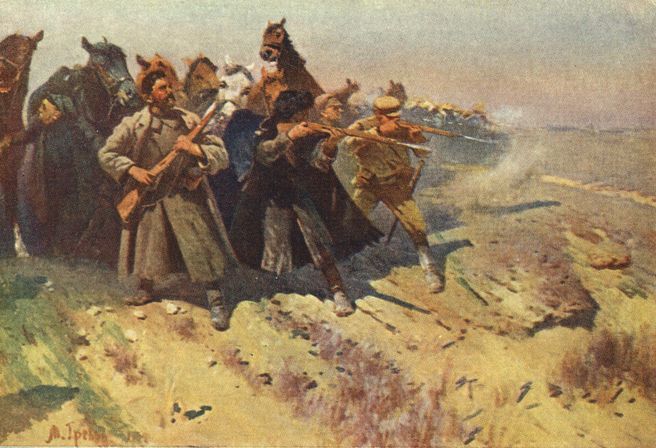
When the Reds struck, the blow was sudden and fell on the left flank. In the morning they seized an old ruined fortress then advanced into the gardens on the outskirts of town. The Trans-Caspians had to climb out of their ditch and pelt across to the railway station and the gardens in complete disorder. Until midday confused firing raged in the gardens, where nobody could see very far. The British considered the Russians incompetent. Friendly-fire incidents on the Trans-Caspian side led to frenzied suspicions of the Turkmen. The Punjabis could not tell White from Red – you probably couldn’t either, if you were there – and didn’t know who to shoot at. The artillery on both sides was pretty much useless (because the personnel and equipment alike were poor), but its noise and debris no doubt added to the terror and confusion of the fighters.
Painting by Mitrophan Grekov (Probably depicting South Russia rather than Central Asia)
It was one of those clumsy battles so typical of the early Civil War. If the Reds had pressed the attack they probably would have taken the town. But the commanders didn’t know, and if they had somehow known they could not have communicated it to the fighters.
This was also a typical battle of the Civil War in Central Asia- fewer than a thousand combatants per side, drawn from a dizzying array of nationalities. At its most simple, it was a war between Russians, over the heads of the local Muslim population. The latter might feature as allies or auxiliaries but there was not even a pretence – at any point on the White side, and at this early stage on the Red side – that the war was being fought on their behalf. From Mensheviks to British officers, the aspiration of the Turkmens to rule in their own land was regarded as a sinister plot.
At a stretch, you might even boil it down to a war between different factions of social-democratic railway workers – but that would efface the clear class difference between the two Russian factions, the preponderance of the upper class and intelligentsia on the White side. It was a war of accidental alignments and improbable allies: Turkmen nationalists and reactionary Russian officers; Punjabi machine-gunners and Menshevik train drivers; Hungarians fighting for the Toshkent Soviet; slave-trading bandits in the service of a government whose link with the most powerful empire in the world was a junior officer whose friends called him Reggie.
Soviet Toshkent
By late 1918 Toshkent was fighting a war on three fronts: this Trans-Caspian railway war, a struggle with Kolchak’s forces for the Orenburg-Toshkent Railway, and a war against a Cossack host based in modern-day Almaty, Kazakhstan. They had a treaty with Bokhara, but they had heard rumours that a whole regiment of Britain’s Indian Army was stationed in the city. This turned out to be false, but over a dozen Red spies sent to find out were caught strangled by the Emir of Bokhara. (Hopkirk, 85) Like Moscow on a smaller scale, Toshkent was under attack from several angles.
Next we will examine how things stood behind Red lines, in Soviet Toshkent.
Thousands of Germans and tens of thousands from Austria-Hungary lived in 25 camps near Toshkent. Since the Revolution, they were free men. But there was no way home, unless they fancied a stroll across a continent and through a Civil War and a World War, so most still lived in the camps, where they had no protection from the cold, few medicines and little food. 70 died every month in the winter of 1917-18. By the summer hundreds were dying every month due to the heat and the worsening supply situation. Outside one camp sprawled a graveyard in which lay 8,000 dead.
(Antony Beevor, quoting British Consul-General Harris several thousand miles away in Irkutsk, implicitly blames this on the Reds who ‘turned them loose,’ not on the Tsar who locked them up here in massive numbers without providing for their nutritional and medical needs – page 197).
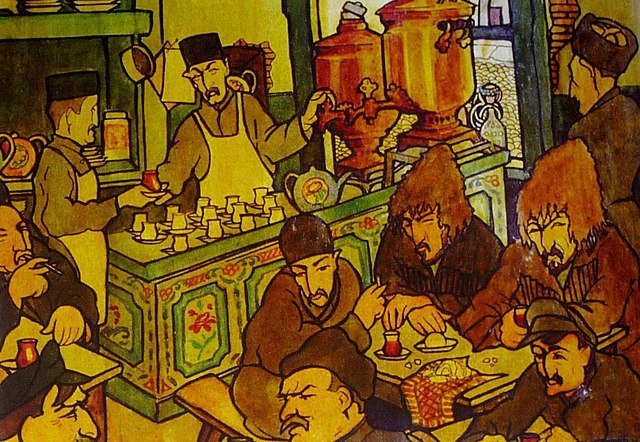
Many had settled in villages or in Toshkent itself, enough that their field-grey uniforms became part of the scenery under the mud walls and domes of the city, and in the chaikhana, tea houses. Some lived as beggars, others married local Muslim or Russian women and settled down. A hundred of them set up a shoe factory. For some reason – and this happened in the Trans-Baikal region as well – many of the captives from Austria-Hungary were accomplished musicians, and every restaurant in Toshkent soon employed an orchestra made up of former prisoners.
A Chaikhana in 1930, depicted in 1947 by Boris Romanovsky
The regime was based on the local working class – transport workers obviously, but there were also, for example, Chekists who used to be shop assistants and circus clowns. Like Stalin in Tsaritsyn, the local leaders were inclined to dismiss signed credentials issued in Russia’s capital cities as ‘merely a scrap of paper,’ and to view the authority of the central government with ambivalence: ‘we do what seems right to us.’ (Hopkirk, 26)
Across the former Russian Empire, civil war had cut across food supplies that were already stretched to breaking point by the years of the Great War. This was worse in Central Asia, which relied on imports. The Toshkent Soviet forced nomads and farmers to hand over food and cotton. The conflict over food was no doubt exacerbated by the colonial arrogance of Toshkent and its agents: according to the official Civil War history published years later, ‘many of the local Bolsheviks,’ to say nothing of the SRs, ‘distorted the policy of the Party on the national question and committed gross mistakes in their dealings with the native population.’ (Hopkirk, 29)
As time went by the Bolsheviks gained more of the balance of power in the coalition. But the vast majority of the local Bolsheviks had not been party members for even a year. Cut off from Moscow, there was no way to integrate them into the party. They hared off in their own direction politically. In relation to the Muslim majority, they were as sensitive as bulls in a china shop. But they also rejected the idea of an alliance with the peasantry. These were some of the ‘infantile disorders’ of newly-minted, ultra-left communists against whom Lenin would soon write a book.
The thing about history is that daily life doesn’t stop in respectful silence when memorable events pass by; twenty minutes’ walk from barricades that will be written about 100 years later you can generally find somewhere to sit out on the terrace and order a cuppa. In Toshkent when British agents arrived there in August The Prisoner of Zenda was showing in the cinema and an Englishman with a troupe of performing elephants was passing through. The British imperialists were worried that the Austro-Hungarian prisoners were getting ready to invade India. But when the Britons walked into a tea-house frequented by the ex-POWs, they would be greeted with a good-natured rendition of ‘It’s a Long Way to Tipperary.’
Western visitors such as these witnessed, and heard rumours about, the Toshkent Cheka carrying out arrests, beatings and executions. But judging by the same testimonies, the local security regime was clumsy. There was a serious White underground in the city known as the Toshkent Military Organisation (which included the brother of General Kornilov, himself also a general). Its agents were continually escaping just before arrest or having messages passed to them after arrest. Such messages were regularly baked into the bread rolls served up in the town’s prison, which was still staffed by the old Tsarist prison guards. It appears (from Hopkirk, 77) that a foreign agent looking for false papers could afford to be picky, such was the supply from Toshkent’s underground.
The British agents had many meetings with the Toshkent commissars, mainly the Left SR Minister for Foreign Affairs, Damagatsky. One of these meetings turned awkward when Damagatsky brought up the recent battles in the Trans-Caspian region, and showed the British agents shell-fragments with English writing to back up the reports he had received of terrible clashes with British-Indian troops along the railway line. The British agents knew that ‘the Bolsheviks [sic], they had to admit, would have been perfectly justified in interning them’ (Hopkirk, 31) since their two countries were now at war. But they bluffed their way out, claiming that the shells were among those donated by Britain to the Tsar, and that the Indians were just bandits. Even after the British landing at Archangel’sk and the beginning of Red Terror after August 30th, the British agents were left at liberty in Toshkent.
It seems obvious to me, and various authors I’ve read agree, that the British Colonel Frederick Marshman Bailey was up to his neck in the White underground, preparing a revolt. Certainly he gave funds to White agents (Hopkirk, 63). But Kolesov, the Soviet President, did not see it this way at the time. ‘My government have grave suspicions of you,’ he warned Bailey, but ‘He added that personally he had none.’
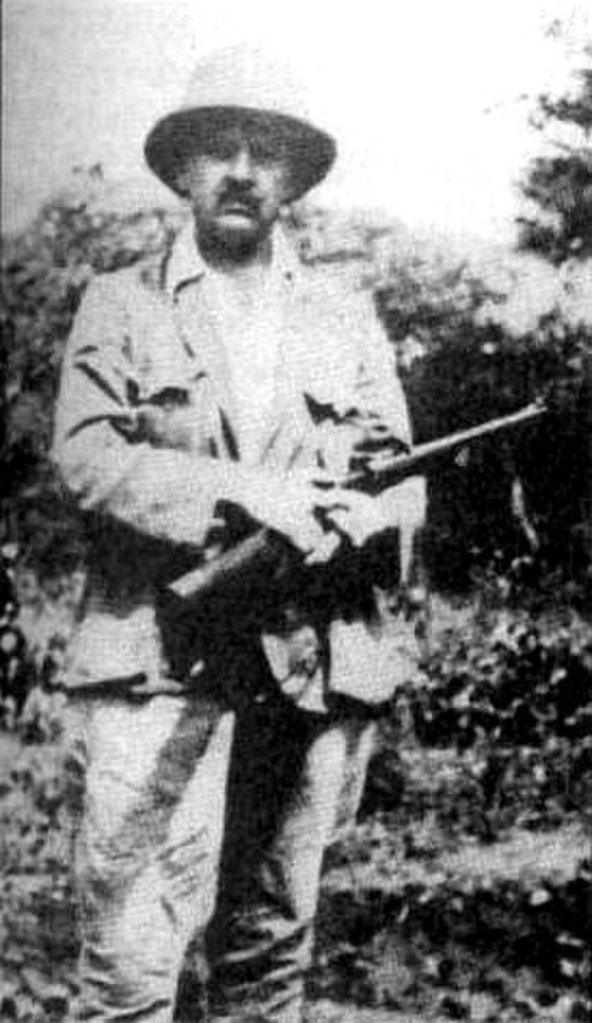
FM Bailey. I can easily find pictures of these British interventionists, and memoirs written by them, and books written about them. Alas it’s not so easy to find material from the other side.
Bailey took the hint and, when he had found false papers that were perfectly to his liking, he disguised himself as an Austro-Hungarian soldier and disappeared. The heat was on: one of his co-conspirators, Pavel Nazarov, was soon arrested.
Hopkirk remarks ‘It is surprising perhaps that they did not attempt to torture’ Nazarov. Surprising – only if, like Hopkirk, we take the second-hand rumours of Chinese and Latvian torture specialists at face value. (43)
In spite or Bailey’s flight and Nazarov’s arrest, the White underground continued to organise its rising. So sloppy was the Soviet apparatus of repression that this White agent Nazarov, who was on the Toshkent equivalent of Death Row, was notified in advance that the White uprising he had been organising would take place on January 6th at 10AM.
And, give or take twenty minutes, so it did.
Pavel Nazarov, underground White Guard organiser in Toshkent
The Osipov Revolt
Toshkent’s Commissar for War was a Bolshevik – like all Toshkent Bolsheviks, one of very recent vintage – named Osipov. He had been a junior officer before the Revolution. He was all of twenty-three years old on the morning of January 6th 1919 when he picked up the phone in the barracks of the Second Turkestan Regiment and summoned his fellow government ministers to meet him there at once. The regiment, he told them, was about to mutiny and must be talked out of it.
Eight commissars arrived, one by one. Osipov had each one shot dead. While this trap was being sprung, Osipov’s co-conspirators were blowing open the gates of the prison and seizing parts of the city. 2,000 of the garrison’s 5,000 soldiers joined the revolt.
Osipov got drunk (According to legend he was drunk when he killed his fellow commissars). Those of White sympathies celebrated in the streets. The former head of the Cheka, who had joined the revolt, paraded through town on a horse with an escort of Cossacks, declaring that the new government would end bloodshed and bring stability. In the meantime, anyone who resisted would be shot. Six more commissars were killed, bringing the total to fourteen. The insurgents controlled most of the city, but had failed to take the railway stations or arsenals.
Red commanders of the Toshkent Citadel, 1918
Those celebrating and lynching in rebel-held parts of the city could not ignore the sounds of artillery, rifles and machine-guns. The battle was still raging. The railway workers again proved to be the key force in the situation: they vacillated, but seeing open White Guards and counter-revolutionaries on the side of the rebels, they stuck with the Soviet. Here is yet another sense in which this was a ‘Railway War.’
The decision of the railway workers tipped the scales. After a couple of days the rebels were clearing out of town and running for the mountains. Osipov and his supporters grabbed a load of gold from the state bank and fled to a fate that remains a mystery to this day.
For days afterwards, Red forces pursued the rebels into the mountains. For weeks, severe retaliation came down on the heads of anyone who had supported the rebels. Brun, the Danish officer sent to look after the prisoners-of-war, was imprisoned because he broke curfew. He avoided execution himself, but witnessed enough, surely, to traumatise him for life. He saw a crowd of condemned men trying to storm out of a prison and being beaten back. Some nights he heard people begging for their lives outside his window. He saw teams of gravediggers at work and saw the bloodstains on the ground. He estimated that 2,800 were killed in all. One chance detail: there was one Red executioner who required an extra alcohol ration in order to kill in cold blood. Is that why Osipov, too, was drunk when he ambushed and summarily executed his comrades?
My sources leave me with important questions unanswered. Here Kolesov disappears from the record – was he one of the unlucky Fourteen Commissars? On which side of the Toshkent barricades were to be found those demoralised fighters who had participated in the slaughter and looting in Kokand? It appears that some Muslims participated on both sides – but were there more on one side or the other? What role did the SRs and Mensheviks play in these events?
One thing is clear: this was another battle between Russians, fought over the heads of the native population.
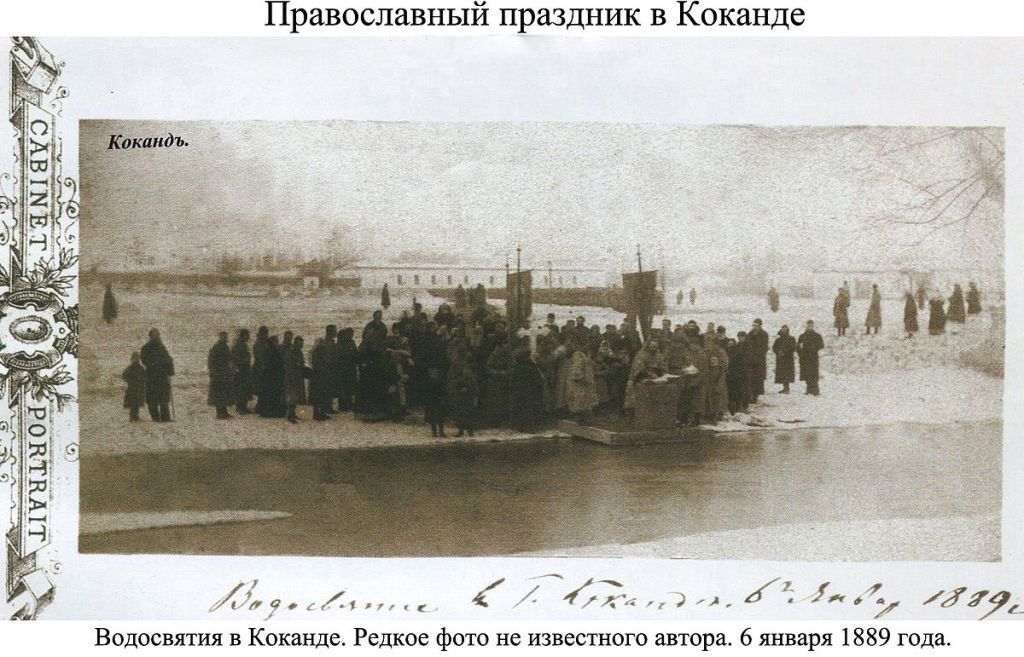
A Russian Orthodox congregation in Kokand, 1889
The British agent Bailey had, before the uprising, fled Toshkent disguised as an Austrian soldier. By mid-February he felt things were safe enough to return. A few weeks later he celebrated Easter at a crowded mass in the city’s Orthodox cathedral. At midnight the congregants – who must have been disproportionately White sympathisers – stood up, exchanged kisses and declared ‘Christ is Risen.’ Maybe they were hoping that the tide would turn for their cause in 1919. But it was to the other side, to the Toshkent Soviet, that redemption would come in that year.





 The 1919 Review