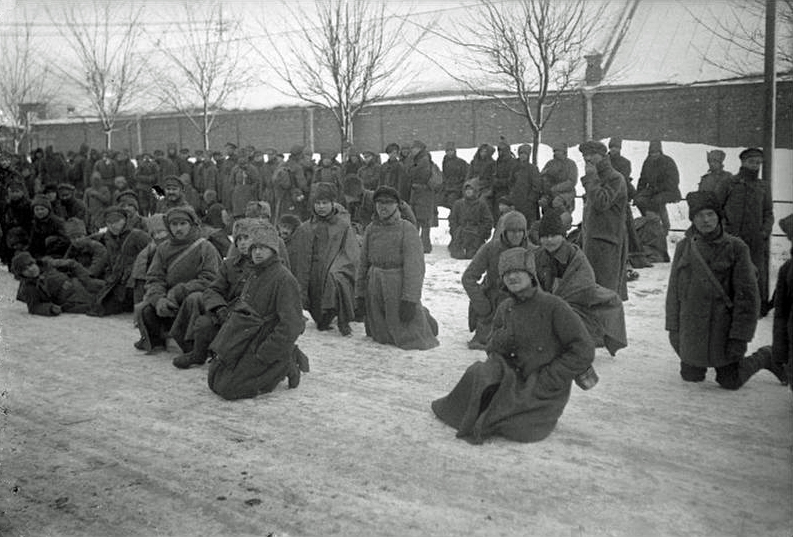
Beevor’s Russia, Part 2: Back-dating Terror

Review: Russia: Revolution and Civil War, 1917-1921 by Antony Beevor

Welcome to Part Two of my review of Russia: Revolution and Civil War, 1917-1921 by Antony Beevor. The previous post looked at some of the distortions and mistakes in the book. It also acknowledged some of the book’s good points. This post will set out to deconstruct the book’s overall narrative. We will expose how it shuffles around timelines and how it assumes, with zero evidence, that the events of the Civil War unfolded according to some master plan created by Lenin.

Before we begin, for the sake of balance I want to say that I don’t think the author is a liar or an idiot. My guess is that this book was produced (1) with a complacent attitude, without the author challenging the assumptions he held at the start of the project and (2) too quickly.

Back-dating famine and terror

First, let’s take a look at how the book juggles with the timeline, and what effect this has on the reader’s understanding of events.

Last week we saw how selectively Beevor quotes the writer Maxim Gorky. Likewise, he quotes Victor Serge without giving a fair indication that Serge was actually a Communist.

Beevor uses quotes from Serge to give a very bleak description of St Petersburg in January 1918 ‘after just a couple of months of Soviet power’ (Page 156). It was indeed bleak at that time. And it had been before the October Revolution too, and even before the war, working-class districts had unpaved and unlit streets. The problem is this: Beevor is quoting from Victor Serge’s novel Conquered City, and that novel is set between early 1919 and early 1920. Serge was not in Russia in January 1918. He was describing the city a year-plus later, after six to eighteen months of full-scale Civil War – not after ‘a couple of months of Soviet power.’

Beevor is back-dating the social and economic collapse of Petrograd in order to mix up cause and effect. He wants to blame economic collapse on the Revolution, not on Civil War.
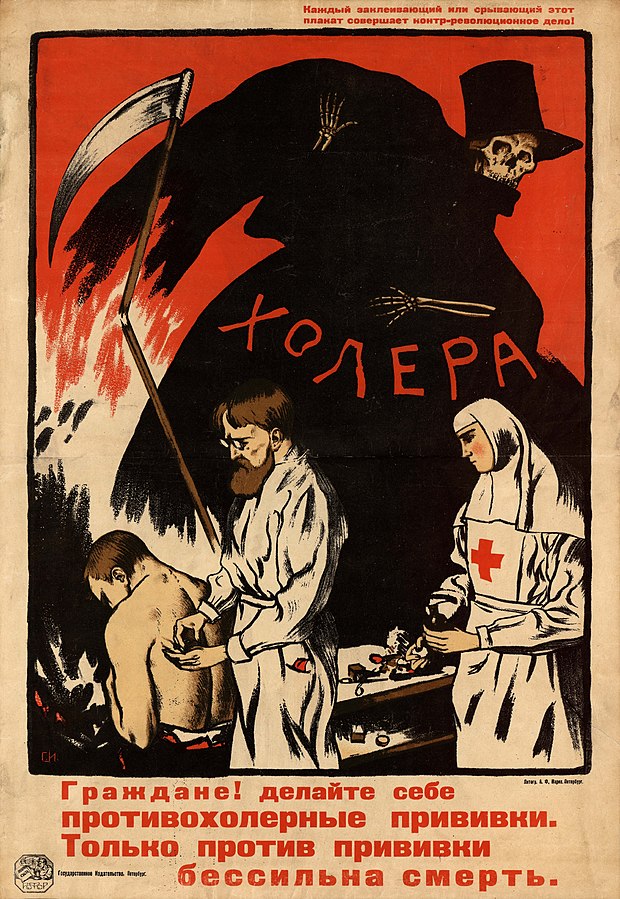
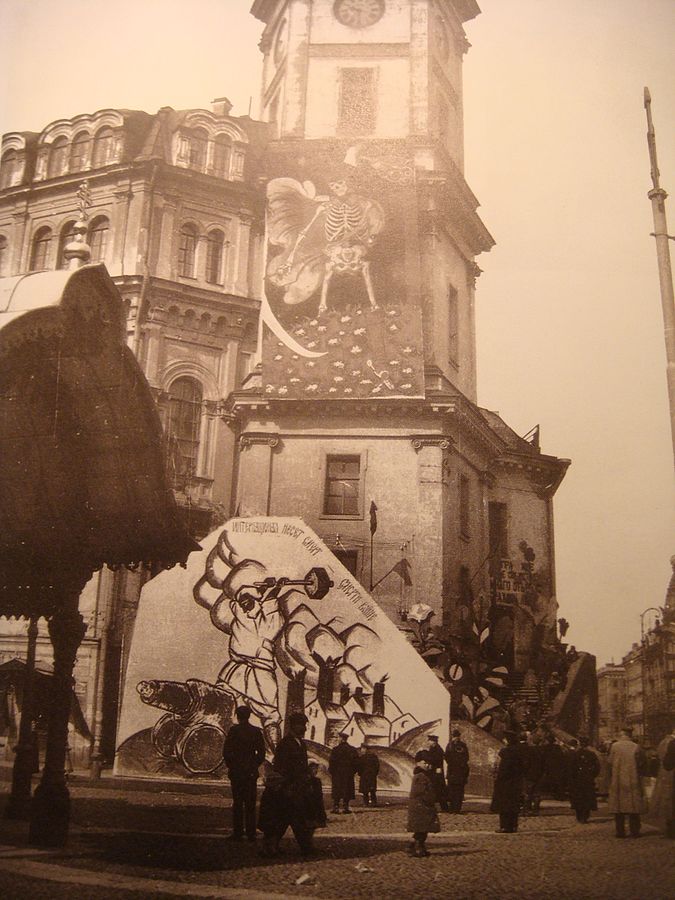
A Soviet poster from the Civil War era shows a looming menace labelled ‘Cholera’

We see the same pattern with the question of terror.

Red Terror did not begin until months into full-scale Civil War.[i] There were important outliers – the killing of officers in Kyiv (which Beevor describes[ii]) and the massacre by Russian settlers in Kokand, modern-day Uzbekistan (which he does not mention), which both occurred in February 1918. But in general, Red Terror escalated over the summer as the military and economic crisis deepened, then hit full-force at the start of September 1918.

There is state terror and then there is mob violence. Russia: Revolution and Civil War tries to blur the line between the two. Tsarist Russia was an empire of 150 million people with a threadbare state apparatus even before the Revolution,[iii] in which twelve million had been given rifles and boots and sent into a war whose traumatizing horror Beevor acknowledges. Unsurprisingly, there was mob violence and crime, and there would have been, revolution or no revolution.

He quotes an account by a bourgeois observer as evidence that the Soviets were conducting an onslaught of terror against the more affluent people: ‘They stir up the population and incite them to take part in raids and riots. This is not going to end well. There are robberies in the streets. They take people’s hats, coats and even clothes. Citizens are forced to stay at home after dark’ (Page 97-98).

Here is the note I left in my ebook:

like clearly this is a scared bourgeois conflating crime and ‘bolshevism’, not an accurate account of bolshevik activities [sic]

Did the Soviets encourage criminal gangs and robberies? No. In fact, the draconian security measures brought in by the Soviets were partly directed against such criminal activity.

Page 137: ‘Echoes of the atrocities in the south soon reached Moscow’ in early 1918 – reading this sentence I thought, ‘That’s just another way of saying you’re about to report some unconfirmed rumours you found in diaries and letters.’ Sure enough, that’s what he does, and even accepting everything at face value, you can see that this is the violence of mobs and of local self-appointed revolutionary leaders.

In the last post I mentioned Beevor’s class bias – how he tends to credit sources written by wealthy and middle-class people, and to dismiss or ignore sources written by workers. We see it at work in the example above. It is with this one-sided approach to his sources that he invents a whole new wave of Red Terror that supposedly began instantly following the Revolution. He gathers an imposing collection of anecdotes about violent acts, giving the impression that the Soviets organized it all. The number of anecdotes makes a certain impression, but no attempt is made to quantify this phenomenon.

Why does this matter? Because having back-dated the economic collapse, he is now back-dating the Red Terror. He is telling a story in which, within a few weeks of the October Revolution, Terror is in full swing and Saint Petersburg has regressed to the Stone Age.

Is this really what Russia was like mere weeks after the October Revolution? No, this is what Russia was like a year after three-quarters of its territory was seized by insurgent officers, Cossack hosts and invading foreign armies.

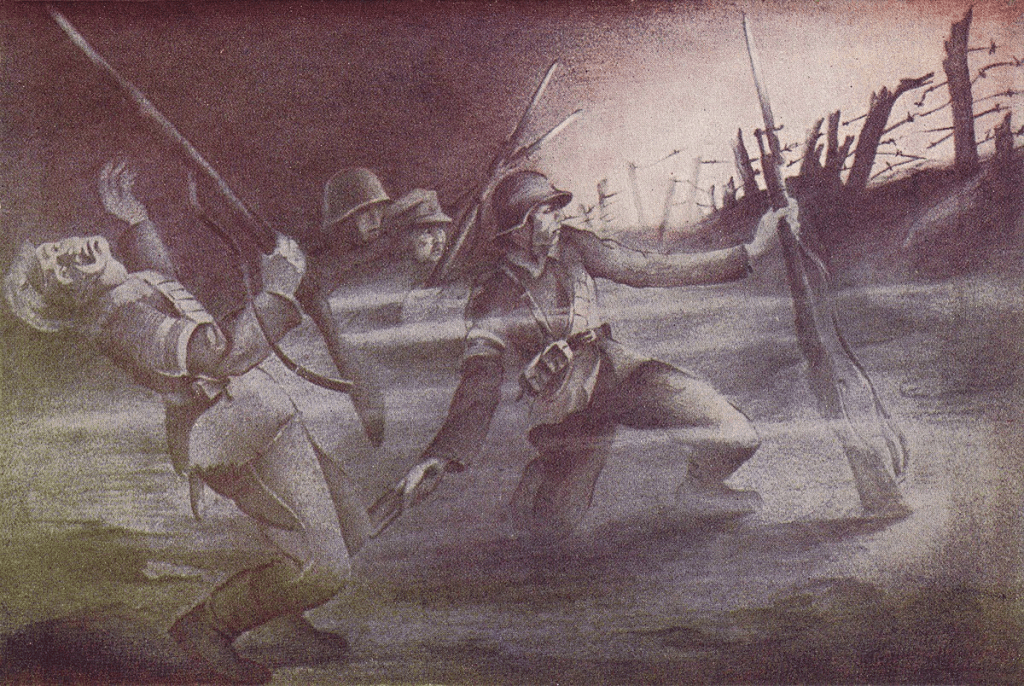
Cover image: a White Army poster. A worker is being convinced to sign up for Denikin’s army

Blind taste test

To illustrate further why this matters, I’m going to invite you to play a game, a kind of historical blind taste test. I’m going to give a brief account of two governments in two different parts of the world, decades apart. Let’s call them Govt A and Govt B. One is the Soviet Union. See if you can guess which one.

Govt A came to power in a coup in October 19__. It immediately set out on a nationwide purge of political opponents. By summer, somewhere between half a million and two million unarmed people had been killed by Govt A. Peaceful opposition parties and organisations with mass membership were not just banned but destroyed by terror, all within a few months of that October coup. Ten years later, a million peaceful oppositionists were still imprisoned in a vast network of concentration camps.[iv]

Govt B came to power in October 19__. By April of the following year Govt B had been threatened by a series of armed revolts led by military officers, but it remained a multi-party regime. In May a civil war began when most of the country’s territory was seized by insurgent forces and foreign armies. Even months into this war, congresses whose delegates were elected from field and factory still met. But eleven months after coming to power, Govt B began a campaign of terror which lasted three years and claimed somewhere between 50,000 and 280,000 lives.[v] Ten years later, the entire prison population was around 192,700.[vi]

So take your guesses. Scroll down for the answer.

.

.

.

.

.

.

.

.

Govt A is the Suharto regime in Indonesia (1965). Govt B is the Soviet regime in Russia (1917).

Suharto killed far more people in a far shorter span of time. The murder of a handful of generals by a conspiracy of junior officers was used as a pretext for massive violence against groups who had no connection to that inciting incident. On coming to power, Suharto immediately exterminated the unarmed Communist Party of Indonesia, the feminist organization Gerwani, and the trade unions. There were no exacerbating circumstances. There was no tragic upward spiral of violence. There was not the slightest element of self-defence.

It’s a very different story with the Soviet regime, which had enthusiastic popular support in the cities and at least acceptance elsewhere, and which resorted to repression only in the context of all-out war on its territory. To what extent repression was justified is a question that is not relevant to this book review. Right now all we’re doing is clarifying the context and what actually happened.

Because in essence, Beevor’s goal in the first half of Russia: Revolution and Civil War is to convince the reader that Govt B was Govt A, that Lenin was Suharto. He wishes to tell a story in which the Soviet regime, like the bloody right-wing military coups in Indonesia (1965), Chile (1973) or Spain (1936), seized power then immediately murdered the opposition. But this is simply not what happened in the Russian Revolution.
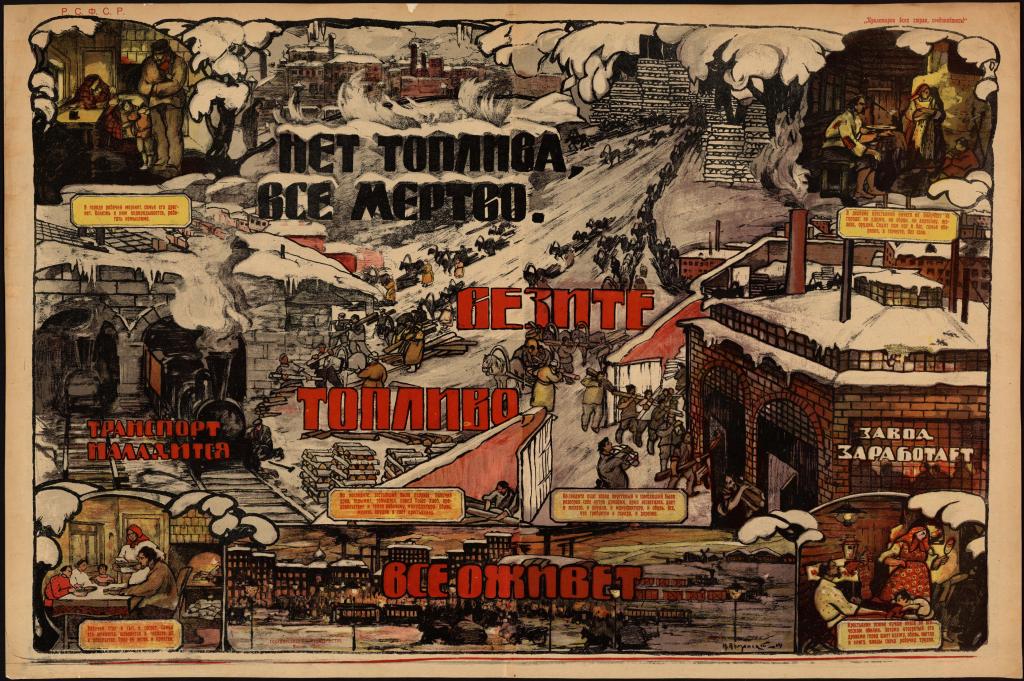
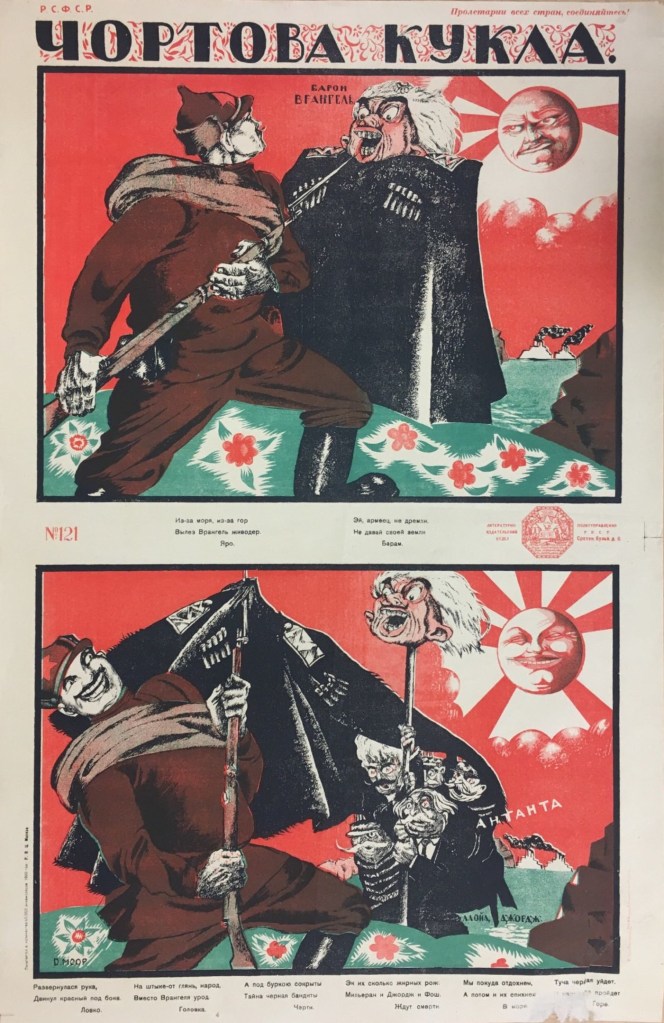
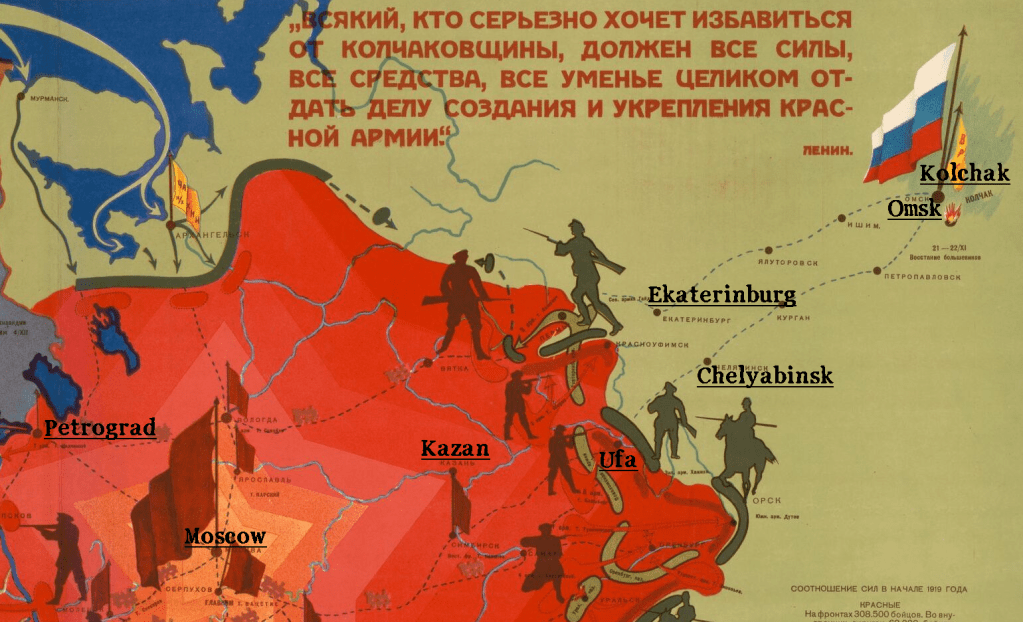
This Civil War-era Soviet poster gives a panorama of life during that time.

The Master Plan

A more nuanced criticism of the Bolsheviks is that they were utopian and irresponsible, that the October insurrection triggered a chain of events that forced them to adopt terror and dictatorship, and later to degenerate into Stalinism. I don’t agree with this view; I blame invasion, insurgency and blockade for the Civil War and the mass mortality which attended it.

But whichever of those two arguments you accept, Beevor’s argument stands off to one side with a demented look in its eyes. He believes that Lenin planned it all in advance – the Civil War, the confiscation of grain, terror, the suppression of opponents, one-party rule. Of course, there is absolutely no evidence that Lenin had such a plan. But for Beevor, the lack of evidence shows only that Lenin was dishonest and hid his real intentions! Childish stuff.

Just in case you think I am caricaturing Beevor’s position, here is what he says:

  • Grain requisitioning was in fact an emergency response to famine; but for Beevor, it was an act of malice long premeditated in the mind of Lenin. ‘The peasants were encouraged to believe that the land would be theirs to own and work as they saw fit. There was no mention of the need for grain seizures to feed the cities or the forced collectivisation of farms.’ (Page 50) Grain seizures were not foreseen, though Fitzpatrick comments that the Bolsheviks themselves were probably more surprised by it than the peasants, from whom contending armies had seized supplies since time immemorial. And it was fair enough not to mention forced collectivisation, right? Seeing as, well, in Russia in these years, it wasn’t Communist policy and in fact it actually didn’t happen..?
  • The withering of Soviet democracy was an effect of Civil War, famine and polarisation; but in this account, it was the fulfilment of a secret blueprint for a one-party state. ‘In his determination to achieve total power for the Bolsheviks, Lenin did not make the mistake of revealing what Communist society would be like. All state power and private property, he claimed, would be transferred into the hands of the Soviets – or councils of workers – as if they were to be independent bodies and not merely the puppets of the Bolshevik leadership.’ (p 50) ‘And because he knew very well that his plan of complete state ownership was not popular, he simply paid lip service to the idea of handing the land over to the peasants and factories to the workers.’ (Page 62) The casual reader, for whom this is the first thing they ever read on the Russian Revolution, would not suspect that such documents as ‘The State and Revolution’ or ‘The impending catastrophe and how to combat it’ ever existed. They would assume that what Beevor is saying is based on some document or other written by Lenin where he reveals his secret plans. There is no such document. The casual reader (and maybe even Antony Beevor) would be surprised to learn that four Soviet congresses met in 1918 and that by the end of the war there were still large numbers of factories democratically run by their workers.
  • The other elements of the master plan, the Cheka and Lenin’s supposed plan to deliberately start a Civil war, are dealt with here.

We can say categorically that there is no evidence that such a master plan ever existed. If you look at what the revolutionaries actually wrote, said and did, it is clear that they favoured a gradual socialisation of the economy, the sharing-out of land rather than collectivisation (collectivisation was to be a gradual and voluntary process lasting decades), and multi-party democracy in the Soviets.

Later, some Communists made a virtue of necessity. But still, more than traces of the original plan are visible down through the years. In early 1919 the Soviets were willing to surrender most of the territory of Russia to the Whites, just to end the war – hardly consistent with the supposed master plan. Right after the abrupt ending of Beevor’s narrative, millions were demobilised from the Red Army, the Cheka was radically downsized and curtailed, and the New Economic Policy (NEP), which favoured the peasants, was brought in.[vii]
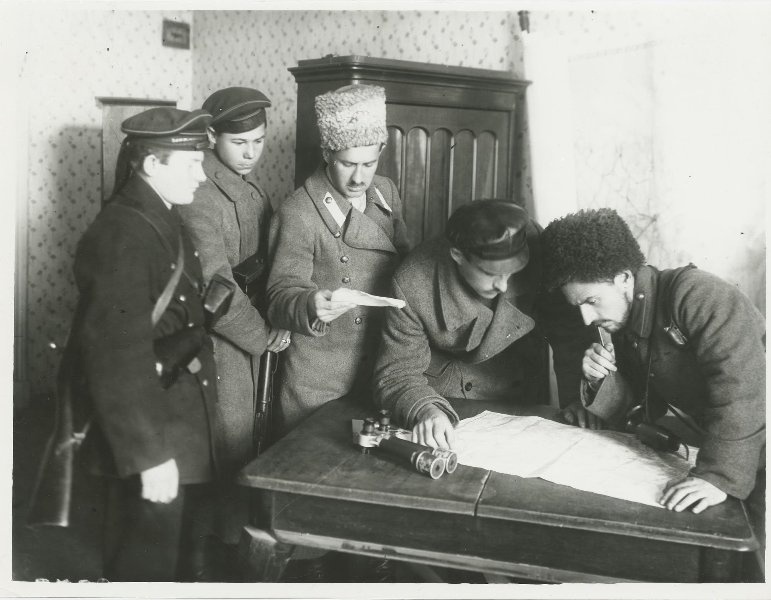
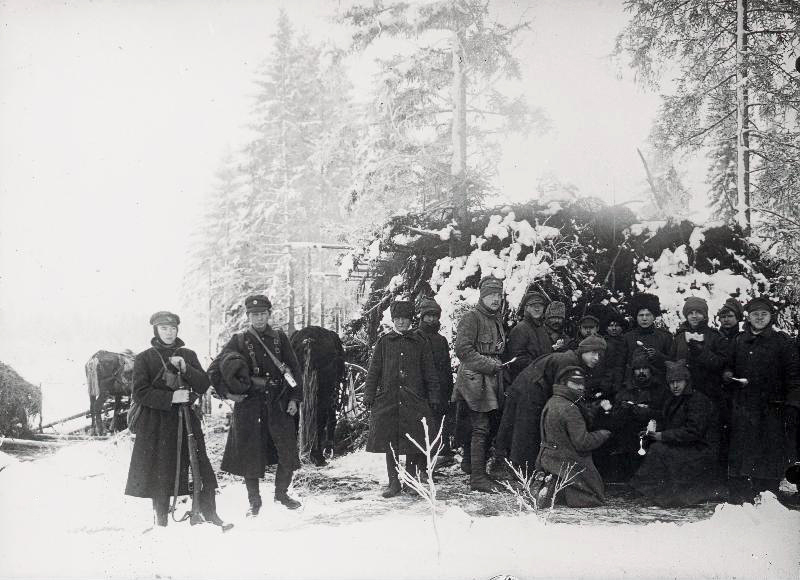
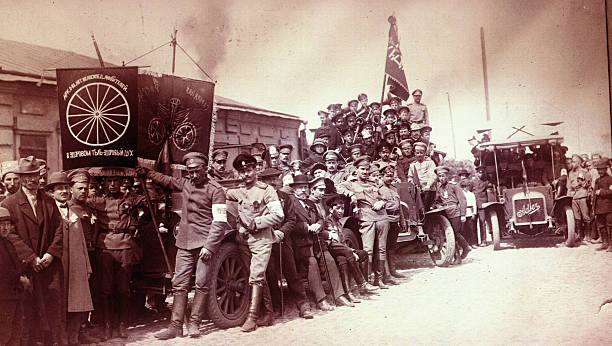
Headquarters of naval cadets near Narva, September or October 1919. What are they reading? Lenin’s master plan?

This point applies to the back-dating which I described earlier. Why does it matter if a writer shuffles things around by a few months? Isn’t this a justified simplification for the sake of clarity? In his point of view it probably is. But months, weeks and even days can matter a great deal. Torture, invasions and the USA Patriot Act were not brought in before September 11th 2001. Likewise events before May 1918 and after May 1918 must be judged by different criteria. For example, a radical economic plan from the Left Communists was actually rejected by the Party in March 1918. But in the context of the extreme military and economic emergency that very quickly emerged, most aspects of it were adopted out of necessity and became known as ‘war communism.’

I don’t accept Beevor’s narrative. I believe that the forced seizure of grain was an emergency response to famine, not an act of senseless vandalism born under the malicious cranium of Lenin.

The reasonable debate you can have here is whether they were effectice or fair reaponses. But because Beevor has set out to tell a certain story, we never get that far.

The crises which led to terror, requisitioning, dictatorship etc are treated as if they were results of terror, requisitioning, dictatorship etc. Beevor leaves the uninformed reader with the impression that the officers and Cossacks rose up in arms because they were outraged by a situation which did not arise until months later – and which arose due to their insurrection! In this way, Russia makes an absolute mess of cause and effect.

Blame on both sides of the equation

In passing, note how no opportunity is missed to condemn the Reds. The ‘Bolsheviks’ are blamed for supposedly failing to cooperate with others, but they are also blamed whenever someone with whom they cooperate does something bad (Muraviev); they are blamed for crime, and also for the draconian security measures which were partly directed against crime; they are blamed for the mistreatment of civilians by the Red Guards, and also for the harsh discipline which put an end to this behaviour. Further explanation is required, surely, when blame is placed on both sides of the see-saw.

Conclusion

This is a vigorous but crude book because, for all its grisly detail, it dispenses with nuance. The author has decided to convince us that Lenin is like Suharto, even like Hitler (more on that next post!). He’s not the first but it’s a bold move. This all-out ‘take-no-prisoners’ approach gives the writing some vigour, but it goes against the grain of reality, compelling the author to back-date key developments and, furthermore, to insist that these developments were the fulfilment of a secret master plan. What emerges is something compelling but not convincing.

A more skilful demonisation of the Reds would emphasise that ‘the road to hell is paved with good intentions,’ etc, etc, would use the bright colours as well as the dark, would not neglect to use the elements of tragedy which so obviously present themselves. Most accounts, from every side of the political spectrum, do this to some extent. But Beevor has taken a gamble, and gone for something bolder. He has fallen short, because reality does not correspond to the story he is trying to tell.

So Russia: Revolution and Civil War lands with some force, but it does not stick. Even those who are stunned into an uncritical acceptance of Beevor’s narrative will be able to see clear daylight through the gaps in the narrative, and may later reconsider, especially if they end up reading a few other bits and pieces on the same topic.

Go to Revolution Under Siege Archive

Go to Home Page/ Archive

Sources

My previous post on Russia: Revolution and Civil War


[i] This is not just my contention. Here is just one example which I have to hand as I write, from an account not sympathetic to the Soviets: Silverlight, The Victors’ Dilemma, Page 15: ‘real oppression did not start until the Terror, several months later.’

[ii] This massacre of officers cannot be justified with reference to existential threats. Estimates of the death toll range from the low hundreds to the thousands. But important parts of the context are missing from Beevor’s account: the suppression of the Kyiv Arsenal revolt by the Rada, the killing of prisoners by the Rada, and the fact that the Red Guard force which carried out the massacre was a notably undisciplined one led by the adventurer Muraviev, an officer who had recently joined the SRs. Needless to say, the broader context (his account of the conflict between Rada and Soviet) is one-sided.

[iii] ‘in 1900 an individual constable in the countryside, assisted by a few low-ranking officers, might find himself responsible for up to 4,700 square kilometres and anywhere between 50,000 and 100,000 inhabitants.’ Smith, Russia in Revolution (p. 19)

[iv] See The Jakarta Method by VIncent Bevins, PublicAffairs, 2020

[v] The lower figure comes from Faulkner, ‘The Revolution Besieged’ in A People’s History of the Russian Revolution and the higher figure from Smith, Russia in Revolution: ‘One scholar estimates that between October 1917 and February 1922, 280,000 were killed either by the Cheka or the Internal Security Troops, about half of them in the course of operations to suppress peasant uprisings.’ (p. 199)

[vi]  Peter H Solomon Jr, Soviet Penal Policy, 1917-1934: A Reinterpretation 

[vii] None of this is secret lore. On the land question, see the collection The Land Question and the Fight for Freedom. On the rejection of the Left Communists’ proto-war communist plans, see Year One of the Russian Revolution by (none other than) Victor Serge. On the Soviets’ peace plan, see any history of the Civil War. On the downsizing of the Cheka, see Smith: ‘At the end of 1921 there were 90,000 employees on the official payroll of the Cheka, but by end of 1923 only 32,152 worked in OGPU.’ (Russia in Revolution, p. 296).
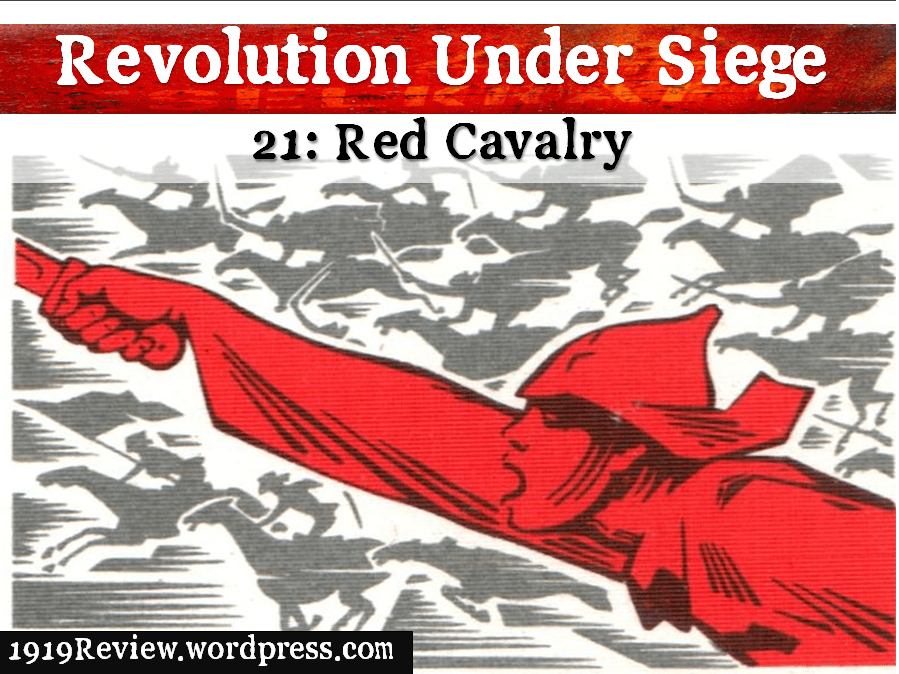
21: Red Cavalry (Premium)

‘[T]he Bolsheviks are failing… their regime is doomed.’

Winston Churchill to Lord Curzon, Autumn 1919 (Kinvig, Churchill’s Crusade, p 305)

January 15th, 1920

The date by which, in Autumn 1919, British military officials predicted Moscow would fall to the Whites

‘Na konii, proletarii!’

‘To horse, proletarians!’ Red Army slogan, 1918-1919

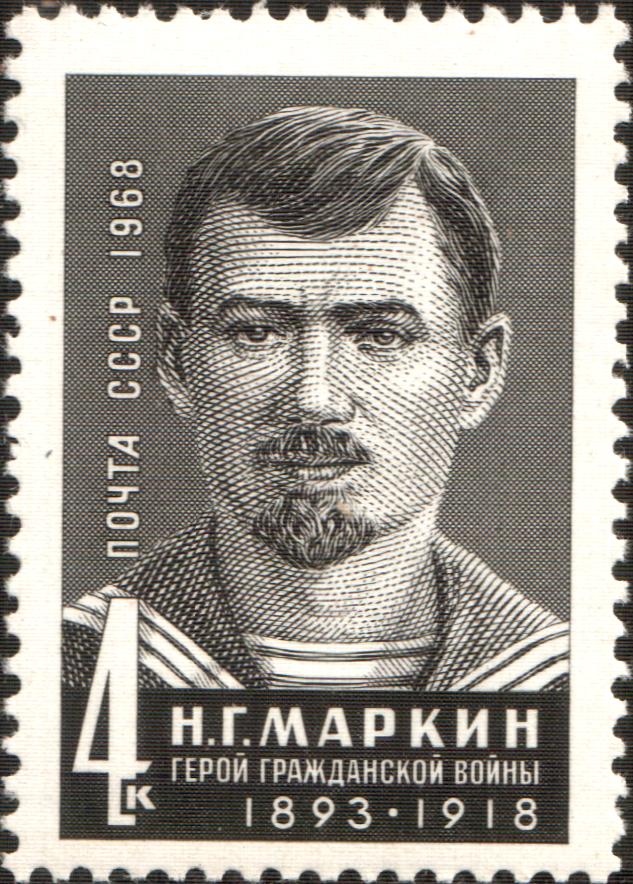
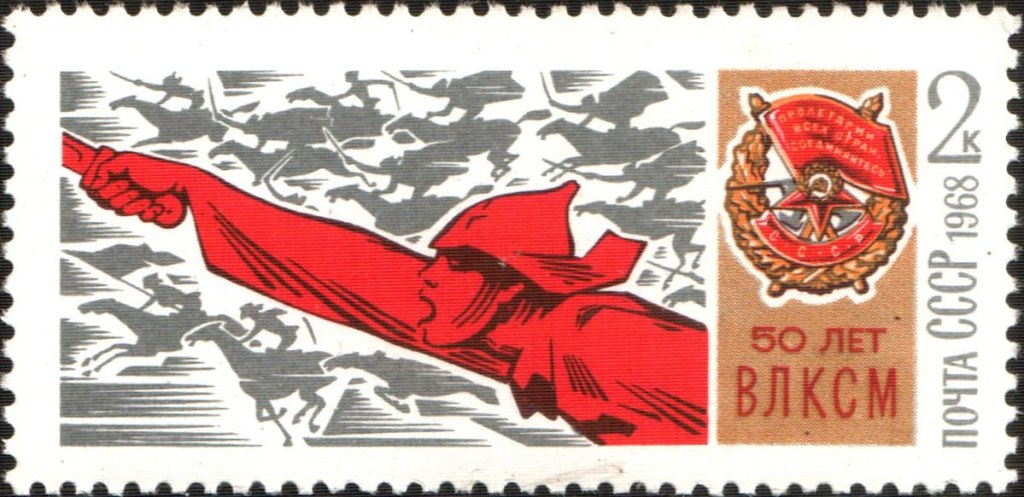
Today’s cover image: a 1968 postage stamp commemorating the Civil War-era Red Cavalry

Become a paying supporter to get access

Access to this article is limited to paying supporters. If you already subscribe by email, thank you. But if you want to become a paying supporter, please hit ‘Subscribe’ below.

Donate less than the price of a coffee, and you can access everything on this blog for one year.

If you don’t feel like donating, most of my posts are still 100% free, so browse away, and thanks for visiting.

Go to Revolution Under Siege Archive

Go to Home Page/ Archive

Sources

20: The Battle of Petrograd

At the climax of the Civil War, a White Army made a bold attack on Petrograd, the city whose working population and garrison had made the October Revolution almost exactly two years earlier.

The city was no longer called Saint Petersburg, and not yet Leningrad – as if to remind us that the Civil War-era Bolshevik regime was something separate not only from Tsarism but from Stalinism. But even within that era, Petrograd in 1917 and in 1919 were two different cities. Petrograd in 1917 was inhabited by over two million people; the city of 1919 had a population of 600-700,000. One was an industrial giant, the other had a skyline of idle chimneys rising into cold smokeless air. Petrograd in 1917 was already a city of bread lines and food riots; by 1919, cut off from the places that had for hundreds of years supplied it with food and fuel, it was barely surviving on public canteens, the spoils of requisitioning squads, rations, and the black market. It was a starved, brutalized and cynical city.

Two years after the Revolution, did the popular masses of Petrograd still have the ability, or even the desire, to fight for it? The answer to that question will represent a judgement on the Soviet state and the Red Army.

Iudenich

If you’ve read John Reed’s book Ten Days that Shook the World, you will know that a force of Cossacks tried to seize Petrograd in the days following the October Revolution. This was a force of just 700. The attacker in 1919 was a White Army of tens of thousands, led by the war hero General Iudenich.

Right on the doorstep of Petrograd lay the Baltic States, which, first under German occupation and then under British clientship, had served as an incubator for White armies. One White army which mustered in Estonia became known as the North-West Army, an aggregation of officers and reactionaries who swore allegiance to the Tsar. Admiral Kolchak, reigning as Supreme Leader of the White armies in distant Omsk, appointed General Iudenich to command this Baltic army in mid-1919.

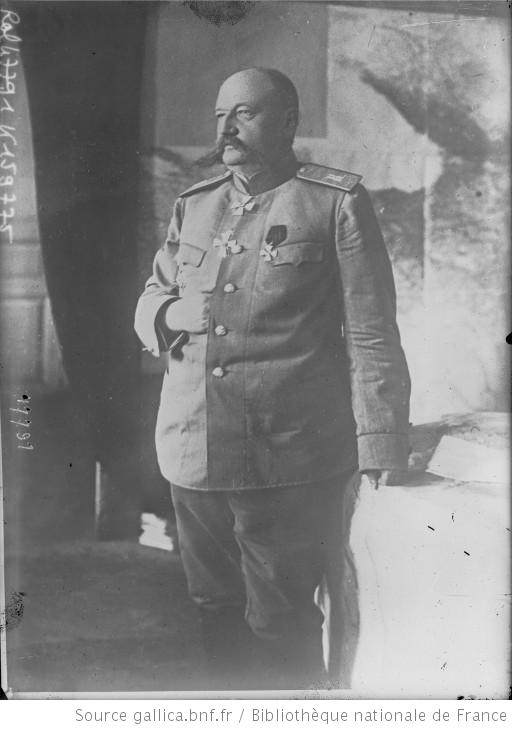
Iudenich had conquered a supposedly impregnable mountain fortress from the Turks in the First World War. He had served in the anti-Soviet underground in Petrograd; one wonders how this was feasible given his fame and distinctive appearance (he was a large man with long tusk-like moustaches). He had fled Petrograd in late 1918. Then for the first few months of his command he lived in a hotel in Helsinki with what we can charitably call a government-in-exile – the oil baron Lazonov held three different portfolios, and the ministers were more rivals than colleagues.[i]
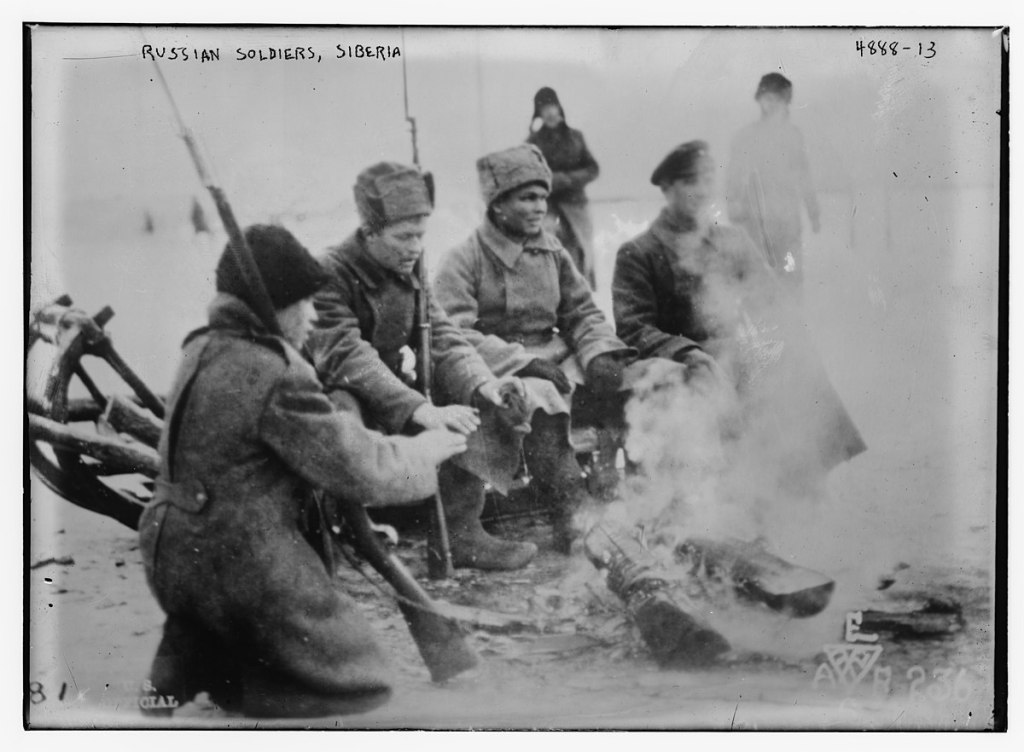
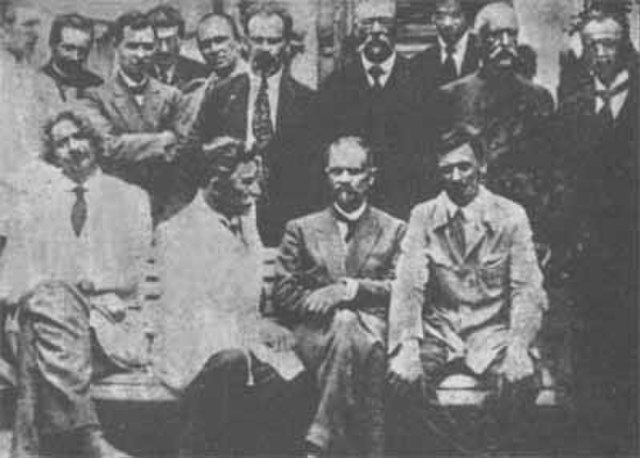
Soon after he assumed command, in May 1919, his North-West Army made an initial assault on Soviet territory. There was a spasm of fear in Petrograd. But Iudenich contented himself, for now, with conquering Ingermanland, a sliver of the Russian-Estonian border area.

We learned very little about the Russian Civil War in school, but we did memorise the names of the three White generals – Kolchak, Denikin and Iudenich. The army under Iudenich was not in the same league as the other two – 20,000 fighters to their (roughly) 100,000 each. This was because he had no Cossacks in his neighbourhood and no large population from which to recruit. On the other hand, he had some distinct advantages. The Estonian border is only 130 kilometres from St Petersburg (Dublin to Enniskillen, or London to Coventry) – there were no vast Russian expanses between him and his objective. Of all the White armies his had the shortest lines of supply and communication with the Allies; British naval forces controlled the Baltic and could slip vessels right into Kronstadt harbour. Lastly, if he played his cards right, Iudenich might be able to bring in two neighbouring states on his side.

How to Lose Finns and Alienate Estonians

The Whites and the Finnish and Estonian governments were common enemies of the Soviet regime. Between them, Finland and Estonia could send enough soldiers into Russia to boost Iudenich’s numbers up from 20,000 to 100,000. But the national question was a massive weak spot for the White Russians. They often enraged their potential allies. In Autumn 1919 they would appoint a ‘Governor’ of the Estonian capital city – a city over which they had no control anyway. Iudenich insisted: ‘There is no Estonia. It is a piece of Russian soil, a Russian province. The Estonian government is a gang of criminals who have seized power, and I will enter into no conversations with it.’[ii]

The British mikitary tried to get them to make friends. Brigadier-General Marsh threatened Iudenich: ‘We will throw you aside. We have another commander-in-chief all ready.’

On another occasion Marsh, in person, issued an ultimatum to a gathering of White Russians. He declared that they had 40 minutes to form a democratic government which recognized Finland.[iii] Such measures usually don’t work for parents or teachers (‘I’m going to count to three! One…’) and they didn’t work for a Brigadier-General either. But they show the role which Britain took on itself.

British officers were match-makers, kingmakers, fixers, naval support, and a source of massive supplies of arms and uniforms. They operated a veritable taxi service across the Baltic for various anti-communists to meet up and try to overcome their differences. In spite of everything, Estonia ended up joining the attack on Petrograd – a degree of cooperation which surely would have been impossible without patient British intervention.

Things were no better as regards Finland. In summer 1919 the Finnish government offered the Whites an alliance in exchange for some small territory in Karelia. Iudenich’s superior Kolchak reacted with the words: ‘Fantastic. One would suppose Finland had conquered Russia.’[iv]

In late 1918 and early 1919 the Soviet government supported Estonian and Lithuanian socialists in a series of wars against the British-backed nationalist regimes. But by summer, the Reds had recognised that the potential for a Soviet Baltic was lost for the near future, and they were willing to make a deal with the governments of the Baltic States. For example, on August 8th they offered to recognize Estonia in exchange for the town of Pskov.

Operation White Sword

In summer 1919, General Denikin’s forces conquered southern Russia and swathes of Ukraine, then in the autumn surged north toward Moscow. These victories told Iudenich it was time to make his long-awaited move on Petrograd.[v]

From July British aid began to pour into the hands of Iudenich. And on October 12th, North-West Army began Operation White Sword, a two-pronged advance toward Petrograd. Meanwhile the Estonian Army attacked along the coast and laid siege to the fortress of Krasnaya Gorka. There were 50,000 soldiers in the White Army, with 700 cavalry, four armoured trains, six planes and six tanks.

White Armies always exhibit interesting disproportions, and this one was no exception: one in ten of the 18,500 combat troops were officers, and there were nearly as many generals (53) as there were artillery pieces (57).[vi]

Against this, the Reds were in disarray. Their Baltic Fleet was bottled up in Kronstadt Harbour by the British fleet. The approaches to Petrograd were held by the Red 7th Army. Its 40,000 personnel were not all armed, and had been mostly idle for months. The defeat in Estonia early in the year; the transfer of the best elements to other fronts; and the Liundqvist Affair, in which one of the top officers turned out to be a White spy, all sapped morale. With the onset of the offensive, despair and panic broke out amid the frontline soldiers and soon took hold in Petrograd. 7th Army’s soldiers ran away, dropping their weapons. An entire regiment went over to the Whites.

So great were the early failures of Red Seventh Army that leaders on both sides almost took for granted the fall of Petrograd. The newspapers in the west spent the week reporting that it was imminent. They were not delusionary: in Moscow on October 15th Lenin spoke in favour of surrendering the city. It would be a temporary concession, he argued: the city was home to countless thousands of communists, each one a potential insurgent; let the Whites rest upon it as on a bed of nails.

In early October the pressure on the Southern Front was intense. Whether to defend Petrograd or to let it fall was a decision which, in the words of the Red commander Kamenev, ‘burned in my brain.’ If reinforcements were sent to Petrograd, would there be enough to defend Moscow?

But Trotsky and Stalin both protested against the idea of surrender. Lenin relented, and Stalin took over command of the Southern Front while Trotsky and his armoured train took off for Petrograd.

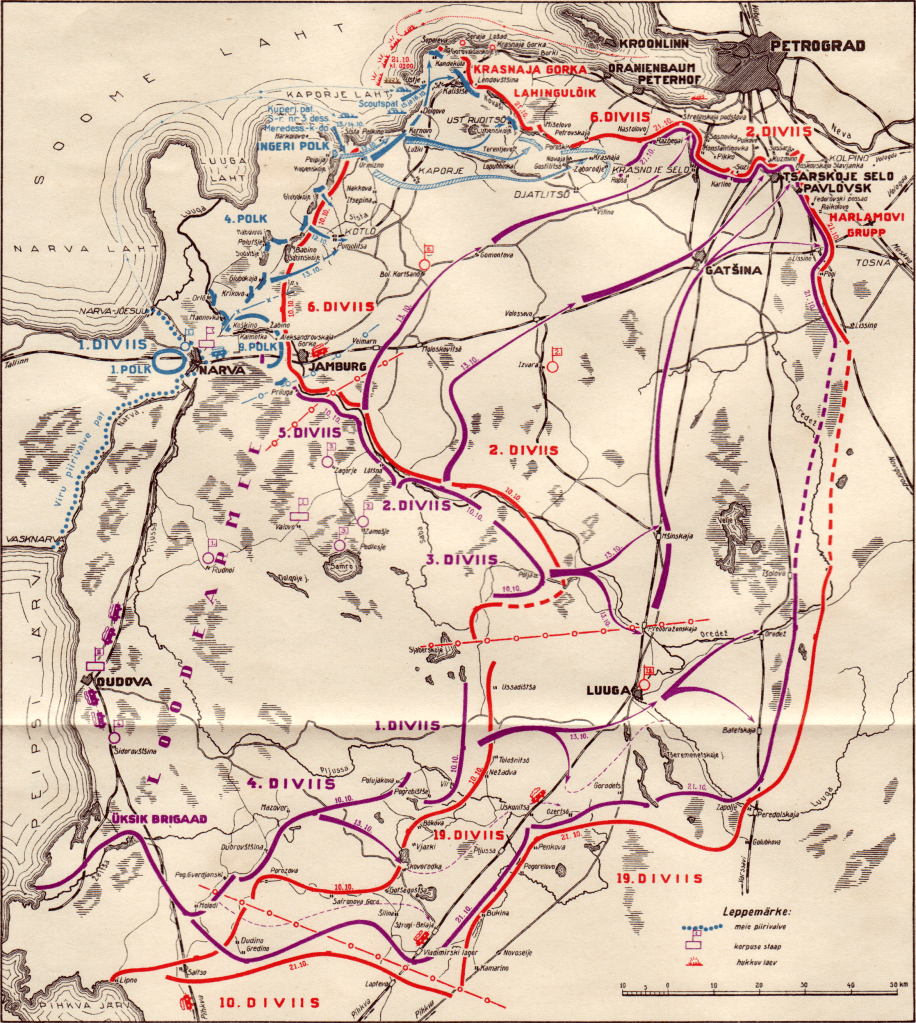
An incredibly detailed map of the whole operation in Estonian. Estonian forces are shown in blue, Whites in purple.

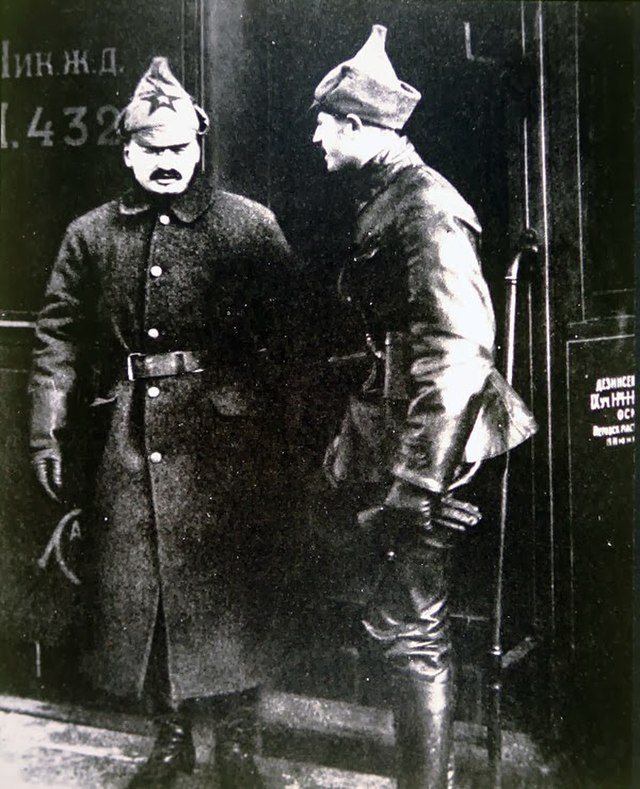
Trotsky’s Armoured Train

The rail line from Moscow to Petrograd was in danger of being cut off by the inland prong of Iudenich’s advance. So for Trotsky and his staff it must have been an anxious journey.

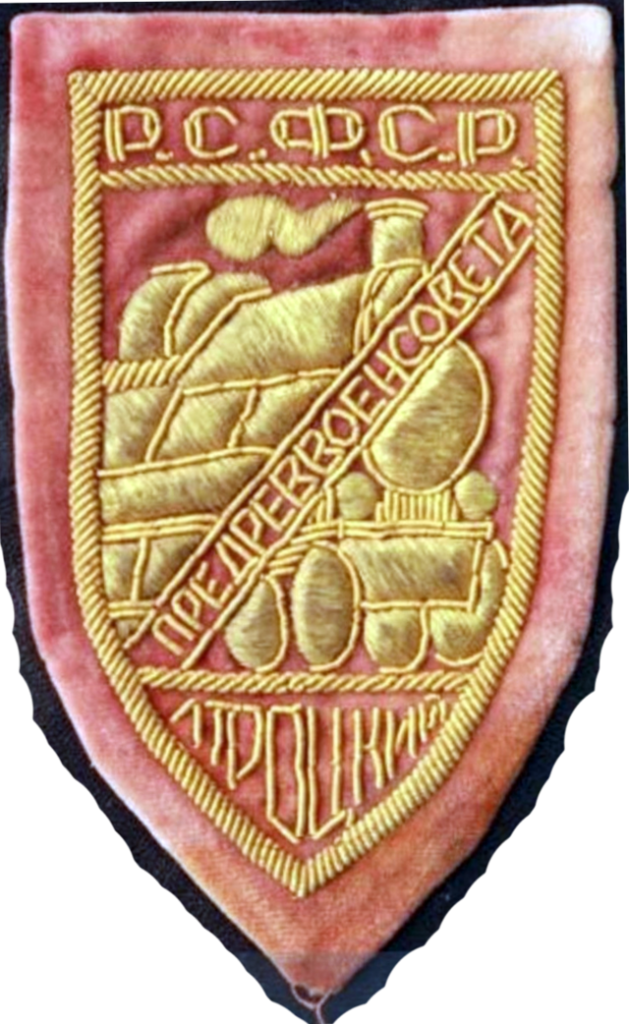
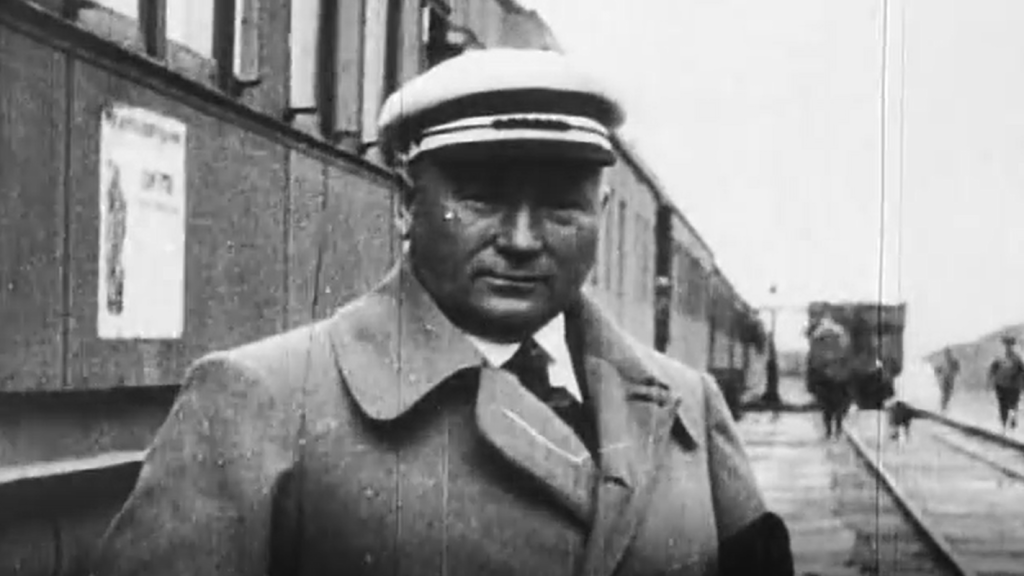
This was the same train on which the war commissar had arrived at Kazan in August 1918. In the intervening year it had been encased in armour and given three back-up locomotives. Wherever it went, even when it passed a small village, flyers and newspapers rolled off its printing press and Trotsky himself would give a speech. ‘Workers and peasants who listened to him were frequently entranced.’ By the end of 1918 the train had over 300 personnel – it was ‘a full military-political organization.’[vii] It initiated changes at the front, tied the front to the rear and delivered the ‘ideological cement’ which held together the Red Army.[viii]

By war’s end it had visited every front and covered 120,000 kilometres on 36 trips, had been in battle thirteen times and suffered 30 casualties. After the war, the train itself was awarded the Order of the Red Banner [ix] – a whimsical notion, like something out of Thomas the Tank Engine.

The Stone Labyrinth

The arrival of Trotsky in Petrograd had an electrifying effect, by all accounts (including his own). Trotsky and his staff shook up the demoralised local officials by force of argument and, where deemed necessary, by sacking and replacing people. The mood changed in the city overnight as the population saw stern measures being taken first of all at the top, while food rations were doubled.

A plan was drawn up to turn the city into a fortress. Trotsky said that it was better if the Whites were defeated outside the city because ‘Street battles do, of course, entail the risk of accidental victims and the destruction of cultural treasures.’[x] But if that should fail, he was prepared for urban warfare in a plan that anticipated Stalingrad. The army of Iudenich would be lost and ground down in the ‘stone labyrinth’ [xi] of hostile streets.  

Trotsky was able to mobilise the population to dig trenches, to barricade the streets, and to search, house by house, for White agents. His memoir captures the mood:

The workers of Petrograd looked badly then; their faces were gray from under nourishment; their clothes were in tatters; their shoes, sometimes not even mates, were gaping with holes.

“We will not give up Petrograd, comrades!”

“No.” The eyes of the women burned with especial fervor. Mothers, wives, daughters, were loath to abandon their dingy but warm nests. “No, we won’t give it up,” the high-pitched voices of the women cried in answer, and they grasped their spades like rifles. Not a few of them actually armed themselves with rifles or took their places at the machine-guns.Detachments of men and women, with trenching-tools on their shoulders, filed out of the mills and factories. The workers of Petrograd looked badly then; their faces were gray from under nourishment; their clothes were in tatters; their shoes, sometimes not even mates, were gaping with holes.

“We will not give up Petrograd, comrades!”

“No.” The eyes of the women burned with especial fervor. Mothers, wives, daughters, were loath to abandon their dingy but warm nests. “No, we won’t give it up,” the high-pitched voices of the women cried in answer, and they grasped their spades like rifles. Not a few of them actually armed themselves with rifles or took their places at the machine-guns.

The Bashkirs

Alongside these traditional supporters, Petrograd hosted new and improbable allies. The Bashkir cavalry, the Muslim nomads who had come over to the Reds back in February, happened to be on a visit to the city. We find this description in a novel written by an eyewitness:

They seemed to be happy riding through a town where the horses’ shoes never struck the soil, where all the houses were made of stone… but which was unfortunately lacking in horse troughs. And life must be sad there since there are neither beehives, nor flocks, nor horizons of plains and mountains… their sabres were bedecked with red ribbons. They punctuated their guttural singing with whistle blasts … Kirim always wore a green skullcap embroidered in gold with Arabic letters, even under his huge sheepskin hat. This man was learned in the Koran, Tibetan medicine, and the witchcraft of shamans … He also knew passages of the Communist Manifesto by heart.[xii]

According to western newspapers, pecking at crumbs of rumours in Helsinki, the Bashkirs brought with them a new strain of typhus. Not improbable; the country was riddled with it. Nor is it improbable that this was a racist myth.

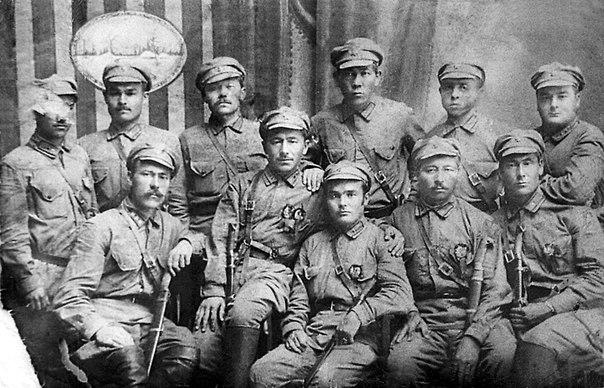
A group of commanders of a Bashkir division in 1919

The Bashkirs caused a stir in Helsinki for other reasons too. Finland had 25,000 troops facing Petrograd, threatening the prospect of a second front. It must have been a tempting prospect for the White Finns: if they helped take Petrograd they could hold onto some of the territory they would grab in the process. But the White Russians alienated them, and the war hawk Mannerheim was out of power, and there was an anti-war mood among the public. Trotsky had, since September 1st, been making the most of these factors by alternating generous peace proposals with dire threats. In response to any Finnish invasion, he said, the Soviets would unleash a horde of Bashkirs to ‘exterminate’ the bourgeoisie of Finland.[xiii]

The First Soviet Tanks

The Whites made rapid progress toward the city. Early in the campaign the Reds were outnumbered. But throughout the campaign, even later when the scales shifted, the White Guards punched above their weight. They would sneak around Red positions, open fire at them from multiple directions, and set off a stampede of red-star caps and bogatyrkas in the direction of Petrograd.

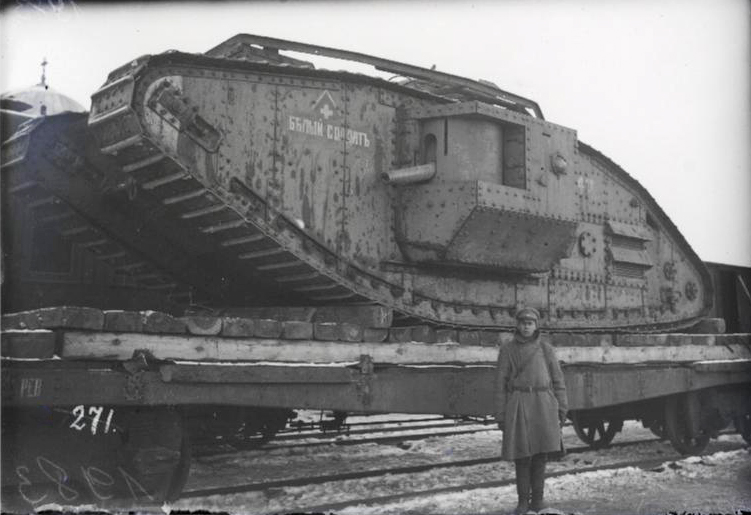
As at Tsaritsyn, the Whites had only six British tanks. In such small numbers and in this mode of warfare they were of little practical use. But the sight of the crushing treads of these bullet-proof killing machines, or even the rumour of them, terrified the Red soldiers.

In response, the steelworks of Petrograd began to produce the first Soviet tanks. These were not marvels of engineering. Different accounts describe them as almost static, or as tactically useless. But they proved to be a psychological antidote to a psychological threat. The sight of Red ‘tanks’ rolling out of the Putilov works or taking their places in the defensive lines was a source of great encouragement to the Red fighters, who made cheerful puns playing the word ‘Tanka’ and the name ‘Tanya’ against each other.

Seventh Army was heartened by all these changes. ‘The rank-and-file of the Red army got some heartier food, changed their linen and boots, listened to a speech or two, pulled themselves together, and became quite different men,’ writes Trotsky. The Mensheviks put aside their differences with the Bolsheviks and rallied to the defence of the city.

Meanwhile ‘field tribunals did their gruesome work.’[xiv] White organizations – the National Centre and the Union for the Regeneration of Russia – operated underground in the city and the Cheka worked to root them out. Notices would appear bearing lists of ‘COUNTER-REVOLUTIONARIES, SPIES, AND CRIMINALS SHOT.’[xv] The judgments of the Cheka were quick and ruthless.

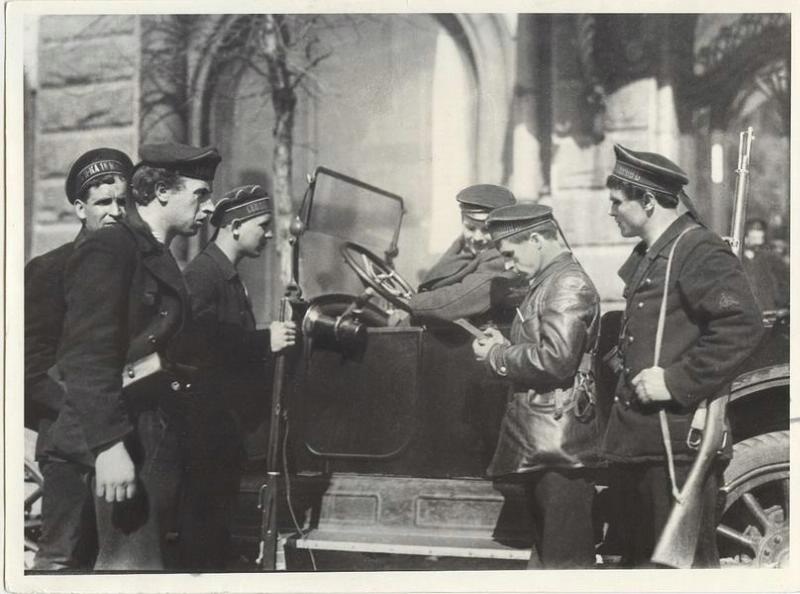
Sailors check passes in Petrograd, 1919

Could Iudenich take Petrograd?

The historian Mawdsley dismisses the threat posed by Iudenich on the basis that his army was relatively small. Trotsky agreed. In his view, even if the Whites took the city, they would not be able to hold it or to build on their success.

There  are grounds to disagree with both Mawdsley and Trotsky on this. In this war, numbers counted for less than morale. In the Caucasus, 20,000 Whites had defeated 150,000 Reds. If panic had been allowed to continue in Petrograd, even a large army would have been unable to hold it.

If Petrograd fell it would later be recaptured, all things being equal. But how could all things possibly stay equal if Petrograd fell? We must consider the moral effect on Red and White soldiers, and beyond Russia. Among the Allies it would give a tremendous boost to the hawks like Churchill. The Finnish government might open a second front, and the Estonian government might commit fully to the war. A White Petrograd would be as open to British shipping as Tallinn or Helsinki. Military and economic aid could pour in just as it had poured into Tallinn.

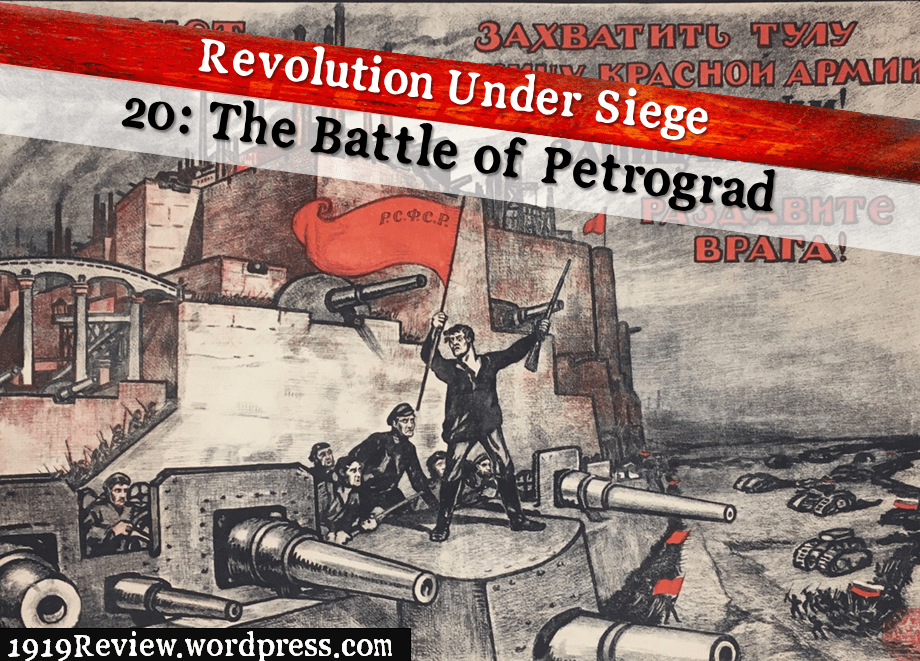
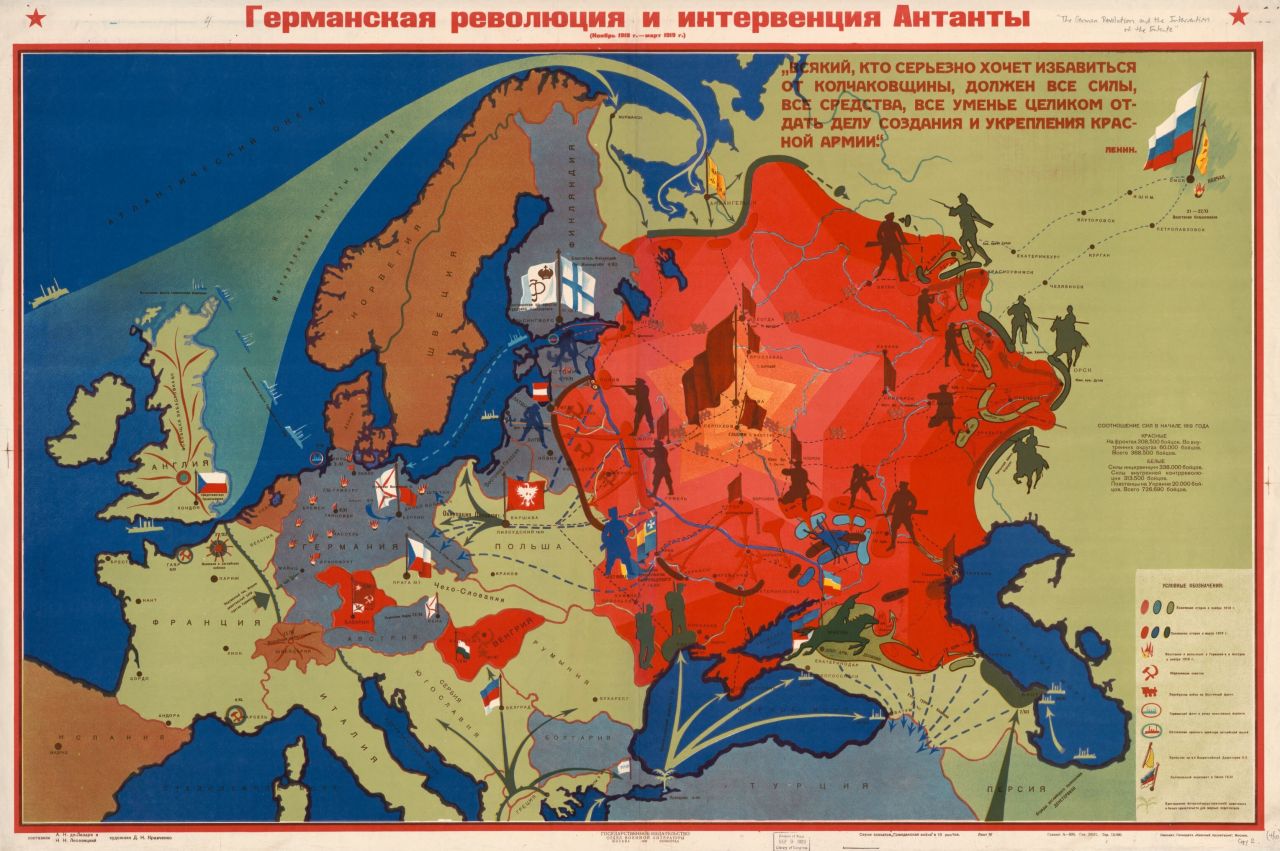
Today’s cover image: A poster from the time shows the Soviet Union as a gigantic industrial fortress under attack. This image is a fantasy, like something from Mortal Engines. It is a kind of metaphor, not an actual representation of the defences which Petrograd or Moscow enjoyed!

But the prospect of a White victory was made dimmer by discord behind the lines. In Latvia, a rival White Russian general thought this would be a great moment to try and conquer Riga, the Latvian capital. Not only did this distract the British and the Estonians; the resulting in-fighting, from October 8th, guaranteed that there would be no attack on Russia from the Latvian border, so the entire 15th Red Army, which had been stationed there, now began a slow advance north to join the battle for Petrograd.

The White commanders often let their personal pride get in the way of success. The Latvian diversion is one example; another came when a division commander ignored orders to cut the Moscow-Petrograd railway line because he wanted to be the first into Petrograd.[xvi] This allowed reinforcements from Moscow to bolster the defence.

The Commissar for War Saddles Up

The White advance continued in spite of these challenges. Away in England, Churchill was confident of success, promising a massive consignment of equipment, enough for Iudenich to equip a whole new army, and predicting that there would be ‘lamentable reprisals’ – White Terror – when the city fell.[xvii]

The Reds did not have a cordon or a trench line in front of the city. They had concentrated striking groups which, in theory, were supposed to pounce on less numerous White detachments. But the Reds were on edge. Gatchina was lost on October 17th when some Red cadets came under impressive volleys of fire, took fright, and fled. It turned out to be the work of a single enemy company hiding in the town’s park.

Just the next day Trotsky happened to be in the division headquarters at Aleksandrovsk when a mob of Red soldiers came hurrying past. Winded and panic-stricken men halted to report that an enemy force had appeared on their flank, so they had briefly opened fire then retreated ten kilometres.

The officers at division headquarters consulted their maps and informed the fleeing soldiers that the ‘enemy force’ was actually a Red column. The commander of the fleeing soldiers must have flushed with shame. His battalion had shot at their own friends then fled in terror, leaving a gap which the Whites, at this moment, would be exploiting.

Trotsky took hold of the nearest horse and mounted it in the midst of the hundreds of frightened soldiers. They were at first confused by the spectacle of the war commissar riding around issuing orders to them directly, face to face. They watched him chase down, one by one, all those soldiers who were still retreating, and with stern commands prevail on them to turn around.

A voice was yelling, ‘Courage, boys, Comrade Trotsky is leading you.’

It was Trotsky’s orderly Kozlov, an old soldier from a village in Moscow province. He was running around after Trotsky, waving a revolver in the air and repeating his commands. To a man, the battalion advanced with the war commissar mounted in their midst. After two kilometres, writes Trotsky, ‘the bullets began their sweetish, nauseating whistling, and the first wounded began to drop.’ They did not slacken their pace, but ran quick enough to break a sweat in the late October chill.

Combat was joined. The regimental commander who had taken fright at a friendly unit was, it appears, eager to redeem himself. He went fearlessly into the line of fire and was wounded in both legs. The battalion advanced the remaining eight kilometres under fire until the position it had fled from was ‘thus retaken by some brawny lads from Kaluga, where they drawl their a’s,’ and Trotsky returned to HQ on a lorry, which picked up the wounded as it went.

Serge imagines the War Commissar as, seated in the truck, he ‘wiped the sweat off his brow. Ouf! He had almost lost his pince-nez.’[xviii]

But in spite of feats like this, the frontlines closed in on the outskirts of the city. The Whites could see in the distance the sunlight on the golden dome of St Isaac’s cathedral in the middle of Petrograd, and they boasted that they would be marching down the Nevsky Prospekt in the coming days.

But as the fighting came closer and closer to Petrograd, the resistance grew tougher. At the Pulkovo Heights south of town the Red frontline at last began to hold. The British had sunk the warship Sevastopol in a raid on Kronstadt Harbour months before; somehow the Reds raised it up and restored its guns to working order. Along with all the naval artillery concentrated in Kronstadt, the guns of the Sevastopol pointed inland and let loose terrible volleys on the Whites.

Cadets from the training schools were rushed to the frontlines. The coastal fort of Krasnaya Gorka had defeated the Estonian advance along the shore, so 11,000 Kronstadt sailors were freed up to join the defense of Petrograd.[xix]

Estonian soldiers try to take Krasnaya Gorka in October 1919

Pulkovo Heights

The Whites were given an order to capture the Pulkovo Heights, a rise just south of the city, on the night of October 20th-21st. But at 11pm the Reds went on the attack, jumping the gun. High-explosive shells manufactured in Britain or France exploded over the heads of Bashkir cavalry, of young peasant conscripts in khaki, of sailors in black. The sailors and worker-volunteers ‘fought like lions.’ They charged at tanks with bayonets and revolvers.[xx] The attackers took heart when the makeshift Red tanks joined the battle: ‘The Red troops greeted with delight the appearance of the first armoured caterpillar.’[xxi]

The Whites were at the end of their supply lines and, in the words of Isaac Deutscher, the power of the Red Army was like a compressed spring ready for the recoil.[xxii] The Reds no longer had any space behind them into which to retreat. Supplies and communications, for once, ran smoothly thanks to the proximity of Petrograd and its supplies, infrastructure and volunteers. But the Whites were determined and brave, and Iudenich brought up reserves to bolster them. On October 22nd the Whites held firm in a day of terrible fighting.

The Reds now had a massive superiority in numbers. Morale was transformed from a few days before: units tried to out-perform one another. The sailors were ‘splendid’ because they knew the Whites would take no prisoners from among them.[xxiii] Trotsky’s train crew was in the thick of the fighting in these days: three were killed, six wounded, and three shell-shocked.   

On October 23rd the Reds recaptured the key suburb of Tsarskoe Selo. Meanwhile 15th Army – the army which had been freed from the Latvian border thanks to White in-fighting – was advancing slowly into the deep rear of the Whites. White soldiers began surrendering by the dozen.

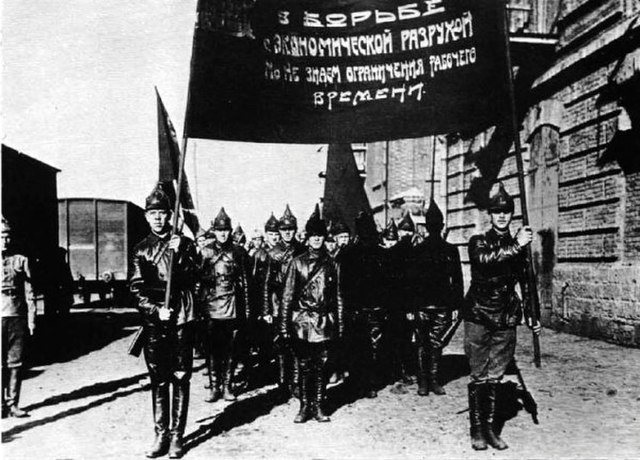
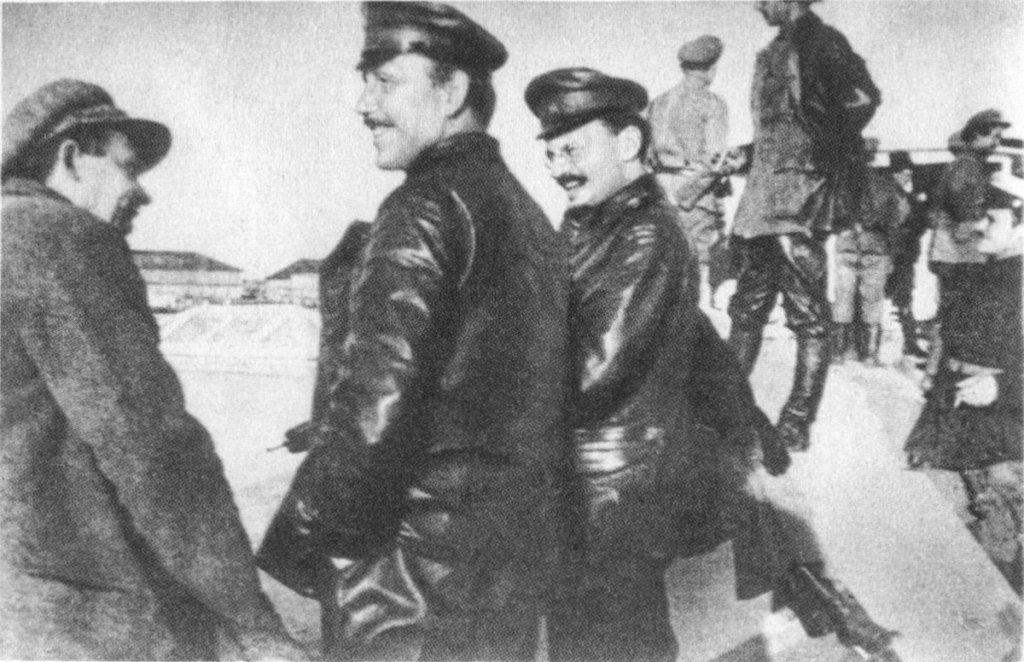
The guard of Trotsky’s train, whose distinctive leather uniform is discernible here

Red Initiative

The Whites began a fighting retreat, and the Red Army pursued.

Trotsky’s orders contained humanistic messages. Enemies who surrendered must be spared – ‘woe to the unworthy soldier’ who hurts a prisoner. ‘Only a tiny minority’ of the Whites, both officers and enlisted soldiers, are determined enemies, argued an order of October 24th. On the same day, an order urged ‘Red warriors’ to draw a distinction between the British government and the British working people.[xxiv] A later order (No 164) says that peasants conscripted by the enemy will be paid, given horses and allowed to keep their uniforms if only they hand over their rifles.

Draconian tones reassert themselves in italics in an order of October 30th (No 163), a sign that the White retreat was a controlled one and that the fighting was still formidable: anyone who tries to start a panic, calling on our men to throw down their arms and go over to the Whites, is to be killed on the spot.’

Iudenich fought hard until November 3rd, then began a general retreat toward the Estonian border. Trotsky was for sending the Red Army after them into Estonia. But Chicherin and Lenin argued against this, and prevailed.

When the forces of Iudenich reached the border, the Estonians first denied them entry then let them in, disarming and imprisoning them. The White army was already afflicted by typhus, and in prison conditions it only got worse. The Estonian government fed them only on lampreys and forced them to cut down trees through the Baltic winter. It is estimated that 10,000 perished  [xxv] – if so, the Estonians killed more of them than the Reds.

Before the end of the year, Estonia and Soviet Russia had signed an armistice, and a peace treaty soon followed. Over the next year the Soviet Union sealed peace treaties with Latvia and Lithuania as well.

The Battle of Petrograd was a judgment on two years of Soviet power. Looking at the depressed and almost lifeless city in autumn 1919, you’d be forgiven for thinking that there was nothing left of the spirit of revolution. But thousands of the city’s workers fought or participated in the battle. Early on, the Red Army was prone to humiliating attacks of panic – but strong leadership, tight supply lines and an urgent threat brought out its strengths in the end, and once the initiative passed to their side these strengths proved overwhelming.

In this post we have seen the working class of the young Soviet Republic and its army tested on the relatively small scale of one city. During those weeks, Central Russia went through a trial that was bigger in scale to the point where it was qualitatively different. That will be the subject of the next episode – the final chapter of this second series of Revolution Under Siege and the decisive chapter of the whole story.

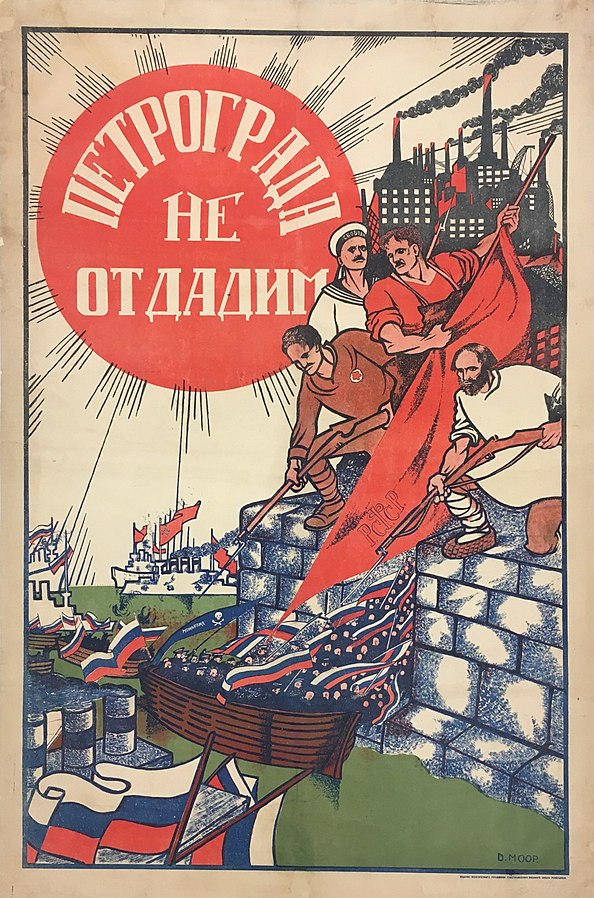
A poster from 1919 shows, strangely, a White attack by sea. But the message applies: the text reads ‘We will not give up Petrograd’

Go to Revolution Under Siege Archive

Go to Home Page/ Archive

Sources


Memoirs of Trotsky: https://www.marxists.org/archive/trotsky/1930/mylife/ch35.htm#:~:text=%E2%80%9CTo%20defend%20Petrograd%20to%20the,extinction%20if%20it%20met%20serious

[i] Smele, Jonathan, The ‘Russian’ Civil Wars, Hurst & Company, London, 2015, p 128

[ii] Kinvig, Clifford, Churchill’s Crusade, Hambledon, 2006, p 272

[iii] Kinvig, 275-6

[iv] Kinvig, 273

[v] Churchill believed that Iudenich could take Petrograd, so much so that he had moved on to second-order concerns: earlier in the year he had communicated to Iudenich his concern that the conquest of Petrograd would turn into one massive pogrom: ‘Excesses by anti-Bolsheviks if they are victorious will alienate sympathy British nation [sic] and render continuance of support most difficult’ (Kinvig, 274)

[vi] Smele, 129

[vii] Service, Robert, Trotsky, Belknap Press, 2009, p 230-231

[viii] Smele, 132

[ix] Smele, 132,3

[x] Trotsky, How the Revolution Armed, ‘Petrograd Will Defend Itself From Within As Well’ https://www.marxists.org/archive/trotsky/1919/military/ch135.htm

[xi] Mawdsley, p 276

[xii] Serge, Victor, Conquered City, 1932, trans Richard Greeman, New York Review of Books, 2011, p 169-170

[xiii] Trotsky, How the Revolution Armedhttps://www.marxists.org/archive/trotsky/1919/military/ch134.htm

[xiv] Kinvig, p 284

[xv] Serge, Conquered City, p 189

[xvi] Beevor, Antony, Russia, Orion, 2023, p 365

[xvii] Beevor, 366

[xviii] Serge, Conquered City, p 186

[xix] Serge, Conquered City, p 124

[xx] By some accounts the tanks were not present at this decisive struggle.

[xxi] Trotsky, How the Revolution Armed, ‘The Turning Point’ https://www.marxists.org/archive/trotsky/1919/military/ch141.htm

[xxii] Deutscher, The Prophet Armed, 1954, Verso Books, 2003, 365

[xxiii] Serge, Conquered City, 185-6

[xxiv] The Soviet Union had suffered thousands of deaths from the weapons of the British navy and millions of deaths from a British blockade, and was at that moment fighting against three armies in British uniforms and with British rifles, and furthermore had, on the night of October 21st, lost three destroyers with all hands to British mines; but Order No. 159 ended with the words: ‘Death to the vultures of imperialism! Long live workers’ Britain, the Britain of Labour, of the people!’ All references to Volume II of How the Revolution Armed.

[xxv] Kinvig, 286

Ebb Tide of World Revolution (Premium)

Fighting in Berlin, January 1919

The Russian Civil War was turning against the Reds in Russia at the end of the summer of 1919. In the East there were setbacks. In the South the situation was dire. From the West a White Army threatened Petrograd. Meanwhile the global revolutionary struggle was taking the same turn, only more sharply. That will be the focus of this post.

Become a paying supporter to get access

Access to this article is limited to paying supporters. If you already subscribe by email, thank you. But if you want to become a paying supporter, please hit ‘Subscribe’ below.

Donate less than the price of a coffee, and you can access everything on this blog for one year.

If you don’t feel like donating, most of my posts are still 100% free, so browse away, and thanks for visiting.

Go to Revolution Under Siege Archive

Go to Home Page/ Archive

Sources

19: ‘To Moscow!’ (Premium)

This post is about the most decisive campaign of the Russian Civil War, in which the armies of Denikin swept toward Moscow. We will be following three White Armies on a front spanning the huge distance from Crimea to the Volga.

This is a lot to wrap our heads around, so let’s start smaller: with a single combatant in these operations. British support was a key factor in the campaign we are about to describe. So let’s focus on a British officer.

The man who took Tsaritsyn

When in 1921 Major Ewen Cameron Bruce was jailed and stripped of his medals, it was the shabby end of a stunning career in the service of the British state…

Become a paying supporter to get access

Access to this article is limited to paying supporters. If you already subscribe by email, thank you. But if you want to become a paying supporter, please hit ‘Subscribe’ below.

Donate less than the price of a coffee, and you can access everything on this blog for one year.

If you don’t feel like donating, most of my posts are still 100% free, so browse away, and thanks for visiting.

Go to Revolution Under Siege Archive

Go to Home Page/ Archive

Sources

18: The Chelyabinsk Trap

On the Eastern Front in July 1919, the White regime of Admiral Kolchak was reeling after its armies were driven out of the Ural Mountains. But the Siberian Whites made an audacious throw of the dice, triggering one of the largest battles of the Civil War.

To set the scene for us, here is the diary of General Alexei Pavlovich Budberg, a minister in Kolchak’s government. He recorded his horror and frustration as things fell apart:

July 19th 1919:

Head is spinning from work […] To our disadvantage, the Red Army soldiers at the front were given the strictest order not to touch the population and to pay for everything taken […] The admiral gave the same orders […] but with us all this remains a written paper, and with the Reds it is reinforced by the immediate execution of the guilty.

July 20th 1919:

[…] self-seekers and speculators are white with fear and flee to the east; tickets for express trains are sold with a premium of 15-18 thousand rubles per ticket.

July 22nd 1919:

The Ministry of Railways receives from the front very sad information about the outrages and arbitrariness committed during the evacuation by various commanding atamans and privileged rear units and organizations; all this greatly complicates the hard work of evacuation […]

Kolchak’s soldiers in retreat

Hints of a planned White counter-attack do not give Budberg any relief. On the contrary, he was filled with foreboding:

July 23rd 1919:

Something mysterious is happening at headquarters: operational reports have been temporarily suspended…

In the rear, uprisings are growing; since their areas are marked on a 40-verst map with red dots, their gradual spread begins to look like a rapidly progressing rash.

July 24th 1919:

The mystery […] has been aggravated: to all my questions I receive a mysterious answer that soon everything will be resolved and that very big events will take place that will drastically change the whole situation.

July 25th 1919:

Only today did I learn at headquarters that [General] Lebedev, with the cooperation of [General] Sakharov, wrested from the admiral consent to some complex offensive operation in the Chelyabinsk region, promising to completely eliminate the Reds […]

Undoubtedly, this is Lebedev’s crazy bet to save his faltering career and to prove his military genius; it is obvious that everything is thought out and arranged together with another strategic baby Sakharov, who also yearns for the glory of the great commander.

Both ambitious people obviously do not understand what they are doing; after all, the whole fate of the Siberian white movement is put on their crazy card, because if we fail, there is no longer salvation for us and we will hardly be able to restore our military strength…

Chelyabinsk

The city of Chelyabinsk lies amid a cluster of lakes, a few hours by rail east of where the Ural Mountains fall away to the plains. It can be regarded as ground zero of the Russian Civil War: it was there that a brawl between Czechs and Hungarians led to the revolt of the Czechoslovak Legion.

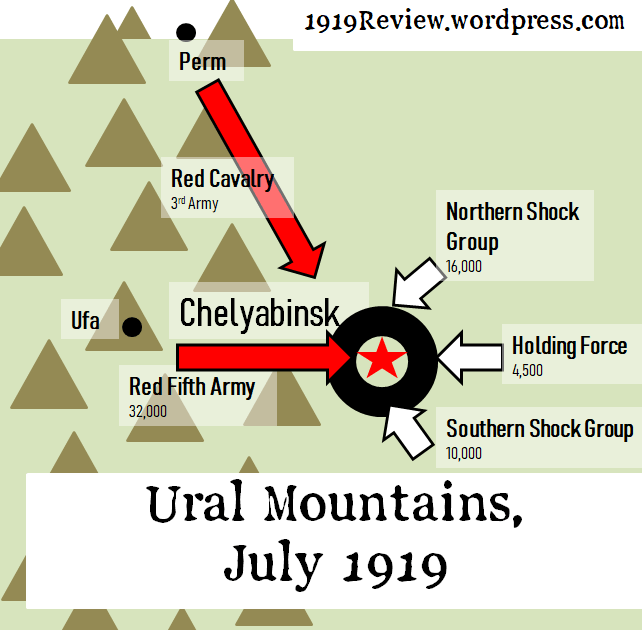
At the end of July the Red Fifth Army came down from the Mountains into the lake country. This was the same Fifth Army that had held the line at Sviyazhsk and then crossed the Volga to seize Kazan. Trotsky and Vacietis counselled caution and rest for Eastern Army Group after it drove back the White Spring Offensive. But the new commander-in-chief, the military specialist Kamenev, argued for a hot pursuit of the Whites right into the heart of Siberia. So far Kamenev had been vindicated. The same Chinese Reds, led by Fu I-Cheng, who had lost Perm the year before had recaptured it. The Red commander Frunze had taken Ufa after a terrible and bloody fight with Kappel.[i]

Now the Fifth Army was advancing on Chelyabinsk. But Kolchak, on the advice of his young generals Lebedev and Sakharov, had decided to turn the city into an elaborate trap. The Reds would be allowed to seize the city – then encircled in it, and destroyed.

On July 24th a workers’ uprising began in the city. It was led by an underground Bolshevik organisation that had suffered under the counterintelligence operations of the ‘very cruel’ Colonel Sorochinsky. The Red Fifth Army hurried to the aid of the rebels, and linked up with them. Railway employees sabotaged the White defence: they derailed one armoured train and diverted another into a dead end. The city fell, and the Reds captured many rifles and machine-guns. Morale was good, energy high: Red detachments at once began scouting and advancing out from the city through the suburbs and villages.

But to the north, south and east, White shock groups and formations were closing in on the city to encircle and destroy the Fifth Army.

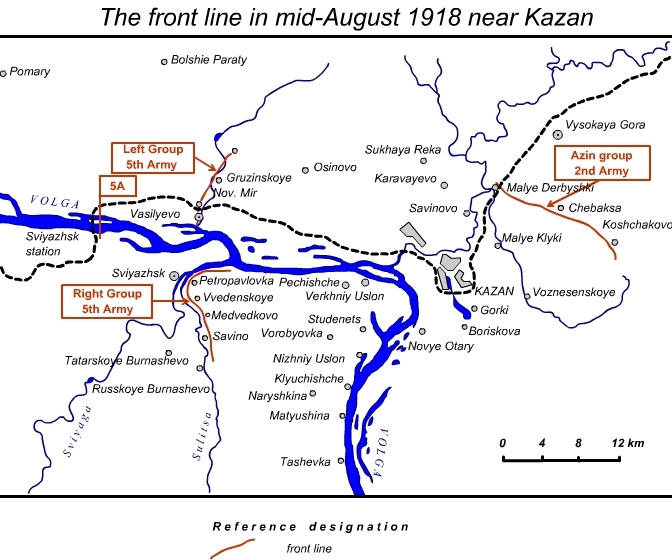
Let’s pause and get a proper sense of scale. The last time this series zoomed in on a particular battle, that of Kazan, it was easy enough to visualise. In an arena measuring forty kilometres by twenty, there were between ten and twenty thousand soldiers per side.

The Battle of Chelyabinsk compels us to think bigger, on a scale of at least 80 square kilometres.

There were 32,000 rifles and swords in the Red Fifth Army. On the side of the Whites, there were around 30,000 as well: the Northern shock group numbered 16,000, the southern shock group 10,000, and there were 4,500 to the east holding the line between the two.

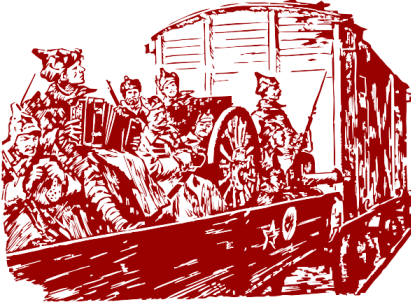
Red soldiers on a train carriage

The Trap

Let’s zoom in on one of those fighters, a White cavalry officer named Egorov.

At four in the morning of June 25th Egorov was waiting with his regiment at a crossroads near one of the several lakes north of Chelyabinsk. Egorov’s Mikhailovsky Regiment consisted of 150 mounted soldiers – ‘rather motley,’ by his own admission, old and young, mostly infantrymen mounted rather than ‘real’ cavalry – along with soldiers on foot.

They were ordered to gather here before seizing the village of Dolgoderevenskaya, north of Chelyabinsk.

Egorov and his men were still stinging from the postscript added to their orders: ‘I advise the regiment commander, Colonel Egorov, to abandon this time the usual delay…’

Adding insult to injury, the Mikhailov Regiment was on time. They were waiting in the early hours of the morning for the Kama Division to show up.

‘To the right and left I hear voices: “Why wait for the Kamtsy?.. Move!.. Enough of the Reds!”’

Egorov decided it was time. The regiment sneaked up close to the village. A local Cossack boy told them there were many Reds in the village, but a lot of them were asleep.

The attack began. White cavalry broke through the outskirts of the village without a shot being fired, and before most of the Reds were awake the White cavalry had dispersed all over the streets while infantry attacked from the west.

‘And only after that,’ writes Egorov, ‘the first rifle shots were heard.’

He was watching from a nearby hillside. The rifle fire intensified, and the sound of the Russian war-cry, ‘Urrah!’ came to him. After an hour of fighting, the Reds fled to the next village. 

As Egorov entered the village he heard someone shout: ‘Mister Colonel! Trophies!’

His men were looting what the enemy had left behind: gramophones and field-kitchens. Egorov reckoned the Reds had, in their turn, taken the gramophones from the houses of priests and merchants.

But the Whites got carried away in the celebrations. The Reds counter-attacked and caught them unawares. Fortunately for Egorov, the Kamtsy arrived – the stragglers Egorov had not bothered to wait for – and they had artillery. By three in the afternoon the Reds had been driven back again. Egorov and his cavalry mounted up, and this time pursued them, and drove them out of the next village as well. The Reds began to retreat all along the front.

Egorov’s assistant, a Tatar, had taken a bullet in the arm during the day’s fighting. He was unperturbed. That night at dinner he drank heartily. Then he excused himself, went out into the hall, and removed the bullet with a penknife.

These battles were part of the advance of the northern shock group. It was very successful; it reached the Yekaterinburg-Chelyabinsk railway line, cutting off the Fifth Army and threatening it from the rear.

On 27 July the southern shock group advanced. Its purpose was to link up with the northern group, completing the encirclement. The southern group was commanded by Colonel Kappel, who had led the Whites at Kazan. Kappel was a relic of the late Komuch government and its ‘People’s Army,’ now serving Kolchak and the Whites. There were others present at Chelyabinsk for whom Komuch had served as a Red-to-White pipeline or gateway drug. The workers’ militia of Izhevsk were there, going into battle to the sound of accordions.

Meanwhile the 4,500 White Guards in the middle advanced west into the outskirts of Chelyabinsk.

Another White veteran recalled: ‘On one of the days, apparently on the 27th or 28th […] we found ourselves 3-4 versts from Chelyabinsk and were about to have dinner there.’

He and Egorov and Kappel had good reasons to feel confident. Many would have believed that just as Denikin was advancing in South Russia, they were about to turn the tide in the east.

‘Siberian bicycle and autocycle fighting squad,’ June 1919

Resistance

According to the plan, the Reds should have been panicking and falling to pieces by now. Generals Sakharov and Lebedev were young officers who had learned most of what they knew during the period of the Czechoslovak Revolt of 1918. They had led irregular detachments against untrained Red Guards.

But these Reds in Chelyabinsk were made of something else. They held firm. Kappel engaged in heavy battles to the south of the city, but his forces could not break through.

The Chelyabinsk revolutionary committee put out a call, and 8,000 miners and other workers joined the defence, arms in hand. 4,500 others joined work detachments, building defences and supporting the troops. The centre group of Whites could not advance further, and got bogged down in the outskirts.

Why couldn’t the Whites make any headway? We noted in a previous episode that they had raised two divisions of young conscripts. These forces had not even been trained when they were flung into the battle at Chelyabinsk. To encircle an enemy army would have been a challenge at the best of times. The White officers were ordered to spring the trap with personnel who did not know what they were doing.

In Russia, soldiers with rifles are called streltsi, literally ‘shooters.’ One veteran wrote to the Chelyabinsk local newspaper in the 1970s, recalling his days as an officer leading White streltsi:

 I was a participant in the battles near Chelyabinsk on July 25-31, 1919, not in the Red Army, but in the White Army, in […] the 22nd Zlatoust regiment of Ural mountain shooters, which they practically were not [sic], since […] they were not even trained at all how to shoot.

During the battle, up to 80% of the 13th Siberian rifle division went over to the Reds. They surrendered in their thousands, bearing US Remington rifles and wearing British uniforms.

It wasn’t just the new conscripts. In the headlong retreat since May, divisions had winnowed to regiments, regiments to, in one case, a ragged group numbering only seventy. Typhus had raged through the White units. Many of the replacements were young Tatars, like Egorov’s friend. Many of these couldn’t speak Russian.

Kappel’s Volga Corps had taken a battering in recent months. Instead of getting time to recover, they, like the new recruits, were thrown into battle.

Today’s cover image is a detail from this poster. It’s actually from a later date in the Civil War, from 1920 and the campaign of Baron Wrangel.

On the other side, the Red Fifth Army was experienced and energetic. And they had a political backbone: in the 27th Division alone there were 600 Communist Party members.

But the fighting was fierce. According to one source there were 15,000 Red and 5,000 White casualties.[iii] According to other sources, the Whites lost 4,500 killed and wounded, while 8,000 or even 15,000 were captured, and the Red casualties numbered 2,900.

The Reds held on in the centre and south, then reinforced the vulnerable north. They built up a shock group of their own and between July 29th and August 1st defeated five enemy regiments north of the city. I assume this involved sweeping through the villages Egorov and co had taken nearly a week earlier. Perhaps the gramophones changed hands again.

Cavalry units from the Third Red Army at Perm were hurrying to the aid of Chelyabinsk and threatened the Whites’ northern shock group. The Izhevsk militia was sent to meet them, but the Izhevtsi suffered heavy losses at the village of Muslyumovo. The northern shock group had itself suffered a series of shocks. Its position was untenable.

Back in Omsk, General Budberg was asked by Kolchak what he thought of the Chelyabinsk Operation.

July 31st

I reported to him that I think that now it is necessary to immediately stop it and order to do everything possible to withdraw the troops involved in it with the least damage to them.

The admiral was silent, but asked to speed up the dinner, then went into the office to Zhanen, where he signed a telegram to Lebedev about the retreat; he is very gloomy and anxious.

August 1st

Everything connected with the Chelyabinsk adventure, and most importantly, my powerlessness to stop it and prevent all its consequences, led me to the decision to ask the admiral to dismiss me from my post, and if it is impossible to give [me] a place to the front, then to [accept my resignation].

Budberg’s request was refused, and so he was forced to around Omsk as an agonised and impotent witness to further disaster.

Red advance

From August 1st the Reds were on the offensive. The White retreat eastward grew more chaotic.

Many in the White camp had warned against the Chelyabinsk operation. They favoured instead a defensive strategy: digging in behind the Ishim and Tobol rivers and buying time to train up the new units. After ‘the trap failed to close’[iv] at Chelyabinsk, the White armies were demoralised and sorely depleted. Digging in was less feasible than before, but even more urgent.

The Siberian Whites were not finished all at once. In late July the Siberian Cossack host joined Kolchak’s cause – too late to help at Chelyabinsk, but just in time to give Kolchak and others a false hope in a renewed offensive strategy. Nonetheless the Red advance across Siberia was indeed delayed by serious battles with the Cossacks and on the defence lines of the rivers.

Crisis in White Siberia

But the Battle of Chelyabinsk is not so much a story of Red victory as one of White defeat. That defeat is interesting because in every way it was symptomatic of the crisis that was developing in Kolchak’s Siberia.

Behind White lines there reigned a regime of corruption and terror that exceeds the most lurid caricatures of the Red side. Untrained and demoralised men sent to fight the partisans would torment the farmers, burn villages, loot, torture and kill. Bodies hung from the telegraph-poles along the Trans-Siberian railway.[v] Further east under Semyonov and Ungern, as we have seen, things were even worse.

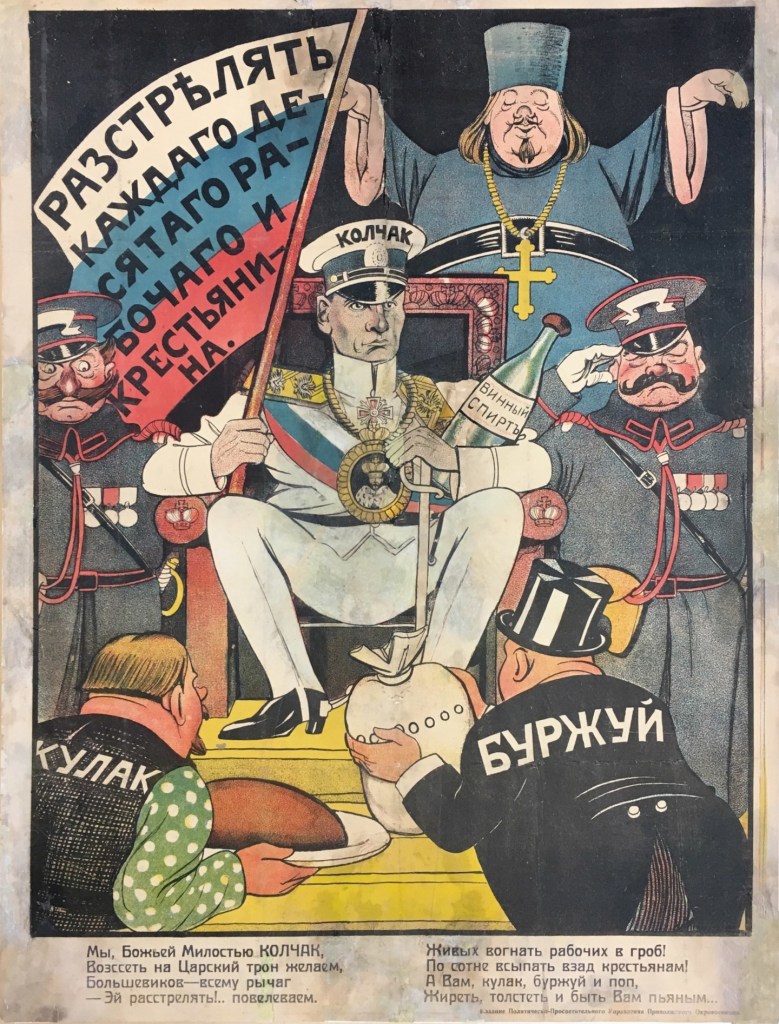
Kolchak in a Red propaganda poster, served by ‘Kulak’ and ‘Burzhui.’ The flag reads ‘Shoot every tenth worker and peasant.’ Most of the symbolism here is accurate enough as war propaganda posters go. But the generals flanking Kolchak should be young phony whizz-kids rather than old duffers. The open monarchist trappings are improbable. The sword is appropriate, as in 1917 Kolchak refused to hand his sword over to a sailors’ committee. Finally, though the Reds would not have realised this at the time, the ‘Burzhui,’ far from handing over bags of money, actually proved self-centred and stingy toward the White Siberian regime. Unless this top-hatted figure represents the international ‘Burzhui,’ who were very generous indeed.

Budberg lamented how among the middle and wealthy classes of the towns everyone felt free to criticise, but never lifted a finger to help in any practical way. It seemed everyone was out for themselves, embezzling without the slightest shame. In the White capital city, Omsk, many wealthy and well-educated people were concentrated. But the poor could not afford to eat and attempts by the state to provide the most basic relief or public services always somehow ended in a dead-end of bungling and embezzling.

The Czechs, whose revolt had given birth to the Eastern Front at Chelyabinsk the year before, were growing disgusted with the White cause, and becoming almost as much of a pain to the Whites in 1919 as they had been to the Reds in 1918. The first stirrings of mutiny were already evident. And in the woods the partisan forces were growing and developing. Meanwhile the Socialist Revolutionary Party were raising their heads again, active both among the partisans and the Czechs. They were the ghost at Kolchak’s feast: he had jailed them after his coup in November 1918, and shot many after the Omsk revolt of December.

Kolchak’s army had come to resemble, in miniature, the Tsarist army of 1917 – in June there had been cases of the men shooting their officers and changing sides. No wonder – the officers had brought back Tsarist practises such as flogging men and striking them in the face. In October, a mass of newly-raised conscripts was sent to the front, and melted away without a trace. Of 800,000 ‘eaters’, only one in ten were fighters; many soldiers travelled with their families in tow. They looted the locals to feed themselves. Some of their supply trains stretched out to 1,000 carts.

‘These were not military units,’ said one disgusted officer, ‘but some kind of Tatar horde.’[vi] Many of those fighting and dying were actually Tatars, so this is a fine example of all the cultural sensitivity we would expect from a White officer.

The battle at Chelyabinsk showed that a spectacular role reversal had taken place. In 1918, the Whites were the professionals, the elite soldiers, and the Reds were the undisciplined rabble. But the rabble had developed into an army. And on the other hand, when the Whites tried to move from elite detachments and all-officer companies to a mass army, they degenerated into a rabble. Their best units were better than the Reds, but their worst units were far worse. The Whites of 1919 were incomparably stronger on paper. But – and this was especially true in Siberia – they had the worst of both worlds. Compared to the early Red Guard formations, they had all the raggedness and all the indiscipline, but none of the political motivation.

Many on the White side noticed the change in the aspect of the Reds. ‘A White leader who visited Tobolsk after it was briefly recaptured was impressed at reports of how well the Reds had behaved.’ And General Budberg wrote that ‘we are not up against the sovdepy and Red Guard rabble of last year but a regular Red Army.’[vii] ‘Sovdep’ was a White nickname for the Reds, based on the words ‘Soviet’ and ‘Deputy.’ Budberg considered the Reds’ battle plans to be plodding and basic. But even basic plans were, in his view, better than none, or than the ‘too clever by half’ manoeuvres of Lebedev and Sakharov.

The Chelyabinsk battle also revealed another key weakness of the White Guards. On November 4th Kolchak complained that his army recruited from among ‘Bolshevik-minded elements’ who at the first opportunity ‘crossed over to the Red side.’ As a result, officers ‘refused to dilute their units’ with new recruits! ‘We had to recruit with great selectiveness, while the enemy freely used local manpower which was favourable to him.’[viii] In other words, the Whites were hindered by the small fact that most people didn’t want to fight for them, and favoured the Reds (even in relatively conservative Siberia).

It is true, as Beevor says (p 344), that ‘A civil war was not an election […] because the vast majority of people wanted to stay out of trouble.’ It is not possible to ascertain the will of the people by ballot in the middle of a civil war. We have to go with cruder measures, such as asking which side could reliably recruit thousands and which side could reliably recruit millions. Judging by this crude but immensely significant measure, the people preferred the Reds to the Whites.

Often the story of the Civil War is one of cruelty and dashed hopes. But the victory at Chelyabinsk was one worthy of a popular revolution. The workers’ rebellion at Chelyabinsk and the participation of thousands of volunteers in the battle underlines this democratic aspect.

The Battle of Chelyabinsk showed how Fifth Army had developed from the semi-irregular force that fought at Kazan into a professional army. But most of Siberia still lay before it, and far behind to the west, Tsaritsyn and Kharkiv had already fallen. Denikin’s advance on Moscow was already well under way.

Go to Revolution Under Siege Archive

Go to Home Page/ Archive

Sources


[i] Beevor, 323

[ii] Smele, 113

[iii] Mawdsley, 210

[iv] Mawdsley, 210

[v] Beevor, 238

[vi] Mawdsley, p 211

[vii] Mawdsley, 208

[viii] Mawdsley, 214

The diaries of General Budberg came from militera.lib.ru_

In addition, this episode could not have been written without a collection of sources compiled by an internet user named igor_verh on https://forum.axishistory.com/viewtopic.php?t=192991. (The name at first raised alarm bells for me but the site’s description says it is apolitical. Its focus seems to be wargaming).

The sources are as follows, copied and pasted from the post: 

http://war1960.narod.ru/civilwar/chelybinsk1919-1.html
http://www.book-chel.ru/ind.php?what=card&id=4415
http://www.hrono.ru/sobyt/1900sob/1919chelyab.php
http://kadry.viperson.ru/data/pressa/3/ … 983007.txt
http://chelyabinsk.rfn.ru/rnews.html?id=97133
http://city.is74.ru/forum/showthread.php?t=43062&page=2
Memories of M.V. Belyushin – the former ensign of 22th Zlatoust mountain riflemen regiment about battle near Chelyabinsk in the summer of 1919:
http://east-front.narod.ru/memo/belyushin.htm
The downfall of the 13th Siberian Rifle Division in the battles near Chelyabinsk in 1919:
http://east-front.narod.ru/memo/meybom1.htm
Sanchuk P. “Chelyabinsk operation in summer 1919”, publication in magazine “War and Revolution”, № 11, 1930:
http://elan-kazak.ru/sites/default/file … chuk/1.pdf

Review: The Don Flows Home to the Sea by Mikhail Sholokhov (Premium)

‘Cossack versus Red Army . . a war of unparalleled savagery […] A story of incredible brutality, well-larded with sexual adventures […] This book makes compulsive if horrifying reading; it is on a plane of human conduct as bestial as if it had occurred in the Dark Ages.’

From the blurb to The Don Flows Home to the Sea: Part One, 1960 Four Square Books edition

Become a paying supporter to get access

Access to this article is limited to paying supporters. If you already subscribe by email, thank you. But if you want to become a paying supporter, please hit ‘Subscribe’ below.

Donate less than the price of a coffee, and you can access everything on this blog for one year.

If you don’t feel like donating, most of my posts are still 100% free, so browse away, and thanks for visiting.

Go to Revolution Under Siege Archive

Go to Home Page/ Archive

09: Behind White Lines

Listen to this post on Youtube or as a podcast

In Stephen King’s novel The Stand two new societies emerge in a post-apocalyptic USA, based on opposite sides of the Rocky Mountains. A democratic society takes shape in Boulder, Colorado. Meanwhile in Las Vegas power is seized by a supernatural madman who punishes drug users with crucifixion. Only one of these two regimes can survive.

That great, flawed horror epic comes to mind because this post is about two distinct White regimes which emerged on either side of the Ural Mountains in Russia in 1918, and how one consumed the other. As we saw in Part 5, the Czech Revolt led to dozens of White-Guard governments popping up. The Right Socialist Revolutionary (SR) party set up a regime called Komuch (the Committee of Members of the Constituent Assembly) based in the Volga town of Samara. They wanted a republican, democratic counter-revolution, with a mandate from the Constituent Assembly and all the ‘t’s crossed and the ‘i’s dotted. Meanwhile across the mountains a faction of officers and Cossacks set up the Provisional Siberian Government at Omsk, a military dictatorship with a thin Siberian Regionalist veneer.

The most important difference was that Samara was anti-landlord and Omsk was pro-landlord. They were at loggerheads on the land question.

These two regimes did not use direct violence against one another – until the very end, when the outcome was no longer in any doubt. They were supposed to be on the same side against the Reds. But relations were tense; Omsk boycotted Samara’s manufactured goods, and Samara boycotted the grain of Siberia.[i] In August the Omsk regime shut down the Siberian Regional Duma – an elected body dominated by Right SRs, of which the Omsk regime itself was an ungrateful child. Komuch was never secure even within its own territory: ‘Russian officers as well as business and middle-class circles much preferred the state-conscious anti-Communism of Omsk.’[ii] And that territory was shrinking. In a strange twist of fate, the military men of Omsk resided safely a thousand miles in the rear while the Right SRs – civilian politicians – led the regime that was actually fighting the Reds on the Volga. From early September that fight was going very badly. As we saw in Part 8, Kazan and Simbirsk had fallen, and this had thrown Komuch into crisis.

Omsk

While Komuch had grown weaker, the Provisional Siberian Government had grown stronger. The Omsk government did not rest on popular support. Its political wing consisted of junior government officials, conservative refugees from central Russia and the Siberian Regionalists. Its military wing consisted of officers and Cossacks, assisted by a battalion of British soldiers from the Middlesex Regiment. This military wing had built itself up to a force of 38,000 by September, poaching officers from Komuch instead of helping them in any serious way.

The ‘Novoselov Affair’ of September 1918 manifested something that had been obvious for some time. The Siberian Regionalists wanted to increase their presence in cabinet, and a politician named Novoselov was their chosen candidate. But he was abducted by Cossacks and murdered. It was a clear signal, Smele suggests, that anyone who tried to challenge the officers and Cossacks would be found dead some fine morning by the banks of the Irtysh River.

Members of the Provisional Siberian Government

The western Allies looked on with impatience, and demanded Komuch and Omsk get their act together and present a united front. The result was the state conference at Ufa on September 23rd 1918. Ufa is a mountain town half-way between republican Samara and military Omsk. It was as if Stephen King’s two post-apocalyptic tribes held a conference somewhere in Utah. At the Ufa (not Utah) conference a wide array of different counter-revolutionary governments came together. Intellectuals, ‘moderate socialists’ and former terrorists sat down to discuss cooperation with Black-Hundred generals, foreign agents and Cossacks.

Chernov

The centre of gravity within the SRs had swung from the Right to the Centre. This Centre was embodied in Viktor Chernov, the leading figure in the party, a stout man with a powerful presence who had served as Minister for Agriculture under Kerensky in 1917. During the few hours’ life span of the Constituent Assembly, the deputies had elected him president of Russia. Unlike most Right SRs, he had actually criticised the policy of coalition with the right during the year 1917, though like the others he had dragged his feet on land reform. In the view of his supporters, the October Revolution had vindicated his criticisms; in the view of the officers, he was largely responsible for ‘the weak and indecisive policy that led to the downfall of Mr Kerensky’s government.’[iii]

Now, along with others, he had arrived in Komuch territory arguing for the Right SRs to take a hard line at the Ufa conference. He was up against the resistance not only of officers and Cossacks but of many in his own party. The historian Radkey writes that many Right SRs had become ‘fervent patriots, partisans of the Entente, and devotees of the cult of the state.’ By 1917 ‘a large segment of the Populist intelligentsia had become [Constitutional Democrats] without admitting it.’[iv] We have already seen how the Left SRs split from the party in disgust at these developments. But the divisions ran deeper still. Even Chernov’s centre was divided into a right centre and a left centre. Chernov himself was prevented from going to Ufa by his own comrades, in case his presence upset the Omsk faction.

Viktor Chernov

The Ufa conference opened with a religious service, then talks began. The numbers of delegates heavily favoured the left, but the various factions all had veto power, tipping the balance back to the right. On the other hand, the need to keep the Czechs happy and to impress the Allies put a certain weight on the scale for the left. Countering this in turn was the real balance of forces between Samara and Omsk, which worsened for Samara every day as the Reds advanced.

One sore point was the Constituent Assembly. The Right SRs insisted that it was the only legitimate state power in Russia, sanctioned by the elections of December 1917. Omsk refused to recognise this body, ‘elected in the days of madness and made up chiefly of the anarchist element.’[v] It appears the Omsk officers believed no election could be considered valid until half the Russian working class was dead or behind barbed wire, and until a knout-wielding Cossack could be placed next to every polling station to glower at the voters. An election held in conditions where the workers were organised and confident could not be considered legitimate in their eyes.

It could be argued that Samara won this round. The Omsk government accepted the legitimacy of the Constituent Assembly in principle. But they would not allow it to assume power until January 1919 at the earliest, and even then it must assemble a quorum of 250 elected deputies. To assemble such a quorum, in the chaos of Russia in 1918, was impossible; it had taken Chernov months to make his way to Samara. So it was a hollow victory for Komuch; the generals’ ‘recognition’ was meaningless.

The Ufa Directorate

The outcome of the conference was a merger of Samara, Omsk and other statelets into a government called the Ufa Directorate. Its programme: abolish the Soviets; return lost territories to Russia; resume the war against Germany; and set up a democratic regime.[vi] The Right SRs also changed their land policy to favour the White landlords with whom they were making a deal.[vii]

On paper, the five-member Directorate had a Socialist majority – a concession to the Czechoslovak Legion, who were increasingly war-weary and cynical of the rightward trajectory in the White camp. 

But this was only on paper. Just two of the five members of the Directory were SRs, and they were the two most conservative and least authoritative SRs who could be found. The other member of the Directorate with ‘Socialist’ credentials was Tchaikovsky, who was safely in the Arctic Circle at the time, performing socialist fig-leaf duty for another White government.

The Right SR Central Committee had previously voted 6:2 in favour of Chernov’s position that the SRs should fight against ‘the left-wing Red dictatorship [and] an equally despotic Right-wing White dictatorship’ that would probably emerge. ‘In order to fulfil its historic role,’ the party ‘must emerge as a Third Force and fight a determined war for democracy on two fronts.’[viii]

But the same Central Committee flew in the face of this resolution when it voted 4:3 in favour of the Ufa agreement.

Toward the climax of The Stand, that compelling and problematic 1978 horror novel, the democrats from Boulder go to confront the dictator at Las Vegas. They are armed only with their own courage and moral rectitude, along with a mandate from a supernatural higher power.

You can read the book yourself to find out how this plan works out for them. But you only need to read on another few paragraphs to find out how the same method worked out for the SRs when they entered the Ufa Directorate.

If the comparison seems far-fetched, consider these words by the Right SR Avksentiev: ‘We must put our head in the lion’s mouth. Either it will eat us, or it will choke on us.’[ix]

Life in the lion’s mouth was not comfortable. The officers resented what little influence the Right SRs had in the Directorate . In their view, Chernov was whispering in their ears urging them to set up democratic soldiers’ committees inside the White Army. In fact Chernov was not supported by a majority on his Central Committee, let alone by Avksentiev. But he was the bogeyman conjured up by the ‘Siberians’ to add colour to the implausible assertion that the Directorate was dominated by elements who were only two steps away from Bolshevism. ‘The name ‘socialist’ was for them synonymous with ‘traitor.’’[xiii]

‘I drink to dead Samara!’

Meanwhile the Reds were advancing across Komuch’s territory.

The 6,000 workers of Ivashchenko near Samara rose up against the Whites. But this rising was premature; Komuch still had enough strength to put down the rising, killing 1,500.[x] The officers of the People’s Army went from village to village conscripting the peasants. They used the old tried-and-tested Tsarist recruitment methods: public floggings and violent reprisals for deserters and their families.

But they were not so bold in early October, when the Red Armies closed in on Samara. The White volunteers were too few to defend the town. The Czechs retired without a fight. The peasant conscripts deserted to the Reds. The Cossack Dutov withheld any aid. Nobody would defend Samara, but it gets worse; no-one could be found to organise its evacuation. It was a rout, everyone for himself (Chernov included) crowding onto trains to get away.

An SR leader named Volsky was reportedly found drunk and despairing, smashing glasses and ranting: ‘I drink to dead Samara! Can’t you smell the corpse?’

Czech officers taunted Constituent Assembly deputies: ‘Where’s your Army?’ ‘Government? You the government?’

As Samara fell to the Reds, Komuch lashed out at its Red prisoners, killing 306 of them.

This picture appears to show a Red triumphal procession on Sadovaya Street, Samara, in late 1918 or early 1919.

In spite of its name the Ufa Directorate spent most of its existence governing from railway cars, and officially moved to Omsk in early October. The Novoselov Affair had demonstrated that no civilian politician should push their luck in Omsk, where drunken officers still sang ‘God Save the Tsar.’ The Council of Ministers which served under the Directory was dominated by people more associated with Omsk than Samara. In that city the SR politicians felt the same sense of insecurity and isolation that they had felt in Petrograd in 1917, and in the words of Serge, ‘The very same illusions fortify their spirits. The vocation of parliamentary martyr rises in their breasts.’[xi] Think of Avksentiev with his head in the lion’s mouth. I don’t know what they were thinking; that if they did everything by the book, hosts of constitutional angels would come to their aid… Or that they would get their reward in parliamentary heaven.

Why all the hostility between Samara and Omsk? One way of looking at it is that the generals were too stubborn to recognise that the Right SRs could be a useful political fig-leaf for their cause. They could have kept many Right SR leaders on side by making a few superficial concessions. Their association with the Right SRs was used at the time and is still used today to claim democratic credentials they did nothing to deserve. But the other way of looking at it is that the generals were sophisticated enough to realise that the Right SRs were of little use even as fig-leaves. The Right SRs had only a very narrow base in 1918; their most reliable supporters were the Czechoslovak Legion. Their electoral mandate, such a powerful instrument in constitutional politics, might have been expected to translate into something impressive in the language of civil war. But it simply did not translate.

The Bolsheviks were wise not to recognise the authority of the Constituent Assembly – because practically no-one else did.

Two devastating scenes remained to be played out in the tragedy of the Right SRs. Their protagonist was Admiral Alexander Kolchak.  

The Council of the Supreme Ruler

Alexander Kolchak arrived in Omsk in mid-October and was given the Ministry of War and the Marine.

Kolchak was a naval officer from a well-off military family. He explored the Arctic Circle in 1903, travelling by dog-sleigh and spending 42 nights on the open sea. After the disaster of the Russo-Japanese war he approached the Duma (the rigged Tsarist parliament) with plans for naval reform. During World War One he served as an admiral first on the Baltic and then on the Black Sea. During the Revolution, he defied a sailors’ committee by throwing his sword into the sea and declaring the men unworthy of him. ‘Many organisations and newspapers with a nationalist tendency spoke of him as a future dictator.’[xiv]

Still from the movie Admiral (2008) dir. Andrei Kravchuk. Kolchak, centre, confronted by the sailors’ committee, draws his ceremonial sword prior to throwing it overboard.

 He spent a long time abroad on various wartime plans and projects with the US and other Allies which came to nought. He became an agent of the British state, and was called by London ‘the best Russian for our purposes in the Far East.’[xv] He returned to Russia with the Japanese invasion forces and tried to organise armed detachments in Manchuria and the Far East. Thence he came to Omsk.

A conspiracy coalesced around him, with or just-about-possibly without his knowledge. According to one of his comrades, he ‘had no part in the plot, but was in favour of a military dictatorship.’[xvi]

General Knox and other British officers in Siberia. Kolchak was their guy, and they supported his coup.

He had just returned from a tour of the front when it all kicked off. On the night of November 17th, a Cossack detachment arrested many Right SRs, including the two members of the Directorate. The Council of Ministers assumed power. There was a battalion of the British Middlesex Regiment stationed in Omsk at the time, and their leader General Knox knew about the coup before the event and did nothing because he hated the Directorate and was a ‘great champion’ of Kolchak.[xvii] The Omsk garrison commander was on board too. It was a clean sweep.

The Czechs were appalled; but the French and the British dissuaded them from taking any action, the French verbally and the British by physically defending the conspirators. So the coup was bloodless. A new power took over, calling itself the Council of the Supreme Ruler.

The ministers offered the vacant position of Supreme Ruler to Kolchak. He accepted the position, it appears, with a heavy heart, refusing it on the first offer.

Today’s cover image, another still from Kravchuk’s Admiral. Kolchak in the centre, flanked by the church, plenty of Russian flags, the military, and the flags of Britain and France. This is a very pro-White Guard film. For example it begins with the Admiral sinking a German ship using the power of prayer.

Apologists for the coup preferred not to use the word. It was simply ‘the change;’ one regime ‘gave place’ to another; ‘the directorate ceased to function, and its place was taken by Admiral Kolchak and his ministry,’ who ‘[took] the authority… into their own hands.’ It had been necessary, because the Right SRs had prepared the ground for the Bolsheviks in October 1917, and ‘The same fate now threatened the Directorate.’[xviii]

The Komuch deputies were holding a congress in the mountain town of Yekaterinburg when news arrived of the coup – news, soon followed by armed bands of Siberian Whites who surrounded the venue and arrested them all. The Czechoslovak general Gajda saved them from being murdered by taking them into his custody. There was one last attempt to raise the banner of Komuch with yet another congress, this time in Ufa on December 2nd. It was shut down by Kolchak’s men.

Alone and on the run, Chernov decided to propose a deal to the Reds. They would have the support of the Right SRs if they would only recognise the Constituent Assembly. Still he clung to it. And why wouldn’t he? With it, he was president of Russia. Without it, he was an isolated politician alone on the run.

The Right SRs were legalised – not due to Chernov’s efforts, and needless to say the Constituent Assembly was not recognised. Chernov went to Moscow where he lived in hiding for a year or so before leaving Russia forever.

Back in Siberia, meanwhile, the Regionalist tradition was openly discarded in favour of old-fashioned Russian chauvinism.[xix]

The lion had closed its jaws and, without choking, swallowed the head of the Right SRs. Chernov blamed his own party: ‘our comrades were among those who helped Kolchak’s dictatorship to happen. They pulled down the bulwark of democracy with their own hands.’[xx]

Detail from Russian Civil War pictorial wall map #4, ‘The German Revolution and Entente Intervention’ with some of the captions translated by me. Some details, such as the position of the frontline, are from a later date. The yellow flag in the NW corner represents the Ufa Directorate. The larger tricolour next to it was the flag adopted by the Council of the Supreme Leader. The little explosion is dated and marks the Omsk coup which overthrew the Directorate.

Kolchak had emerged as one of the two paramount leaders of the White cause. In Spring 1919 the Allies would recognise him as superior to Denikin. He was ‘Supreme Ruler’ and not ‘dictator,’ says Smele, ‘so as to maintain the decorum of the civic spirit.’

The note Kolchak struck in his first major address to the Russian people should be familiar to anyone acquainted with Denikin and his ‘I am not a politician, just a simple soldier’ routine:

I am not about to take the road of reaction or of disastrous party politics, but my chief aim will be the creation of a fighting army, victory over the Bolsheviki, and the establishment of justice and order so that the nation may without interference choose for itself the form of government that it desires.[xxi]

The Stand

Joshua Rossett, an aid official from the United States, gives an insight into the perspective on Kolchak held by many in the Pacific port of Vladivostok. He paints a picture of the intelligentsia, workers, peasants and well-meaning Americans all working hard to deal with humanitarian problems, united under the zemstvo, or local government. Then comes the shock of the Omsk coup. He describes Omsk, and the Ufa Directorate which preceded it, as a coup by food hoarders.

At the last local elections in Vladivostok, 35,000 votes were cast. A commissar came down from Omsk and began striking names off the voter rolls, eventually leaving only 4,000 – whom Rossett says were monarchists and speculators.

Rossett had a more visceral shock when local authorities asked a Russian cavalry officer to provide escort for 600 prisoners – men, women and children, mostly Red, some criminals. They were infected with typhus and had to be moved into quarantine. The officer at first refused, then then ‘with genuine enthusiasm’ offered to kill them all.

(From The Rise of a New Russian Autocracy by Joshua Rossett, printed by the Independent Labour Party, 1919)

Very soon there was resistance to the new regime – not from civic-minded people angry at Kolchak’s disregard for the Constituent Assembly, or from appalled American aid workers, but from peasants. They deserted from the White army, refused to supply food, resisted the return of old landlords and old Tsarist officials. The hand of the Supreme Ruler came down heavy on them with hundreds of townships bombarded or burned and peasants ‘shot in dozens.’[xxii] The Red workers had long since fled from White rule in their home towns and set up guerrilla armies in the endless forests of Siberia. Now they were joined by masses of peasants.

The guerrillas composed songs about the untouched forest that sheltered them: ‘Sombre taiga, danger-ridden, Massed, impenetrable trees! Yet we rebels, safely hidden in thy glades, found rest and ease.’[xxiii]

Soon resistance flared up right at the heart of Kolchak’s power. The last scene in the tragedy of Komuch was the December revolt in Omsk. Communists based in the city led a workers’ uprising against the Supreme Ruler. It was crushed, and in response Kolchak lashed out indiscriminately to his left. Serge says that 900 were killed in the repression. Many of the remaining Right SRs and Mensheviks, who had taken no part in the uprising, were included in the massacre. Mawdsley writes: ‘Prominent SRs, including several Constituent Assembly delegates, were summarily executed.’ Of those who were lucky enough to get away, many went over to the Reds. The less lucky survivors sat huddled in cold dungeons, shoulder-to-shoulder with the Communists as 1918, the year of Komuch, withered and died.

From Admiral.

Consolidation

The Russian Civil War is so chaotic and confused that when, from time to time, a pattern emerges in the whirlwind of events, we should pause and examine it. In the White camp over the course of 1918 we can trace the following pattern:

  • Step 1: Foreign Intervention
  • On the river Don in May 1918, the Germans intervened.
  • On the river Volga in May 1918, the Czechs intervened.
  • Step 2: Local revolt with a ‘democratic’ flavour
  • Aided by the Germans, the Don Cossacks rose up against the Reds and established a state.
  • Aided by the Czechs, the Right SRs rose up against the Reds and established a state.
  • Step 3: In the shelter of the revolt, reactionary forces coalesce
  • Behind the shelter provided by the Germans and the Don Cossack state, there arose a military dictatorship of officers and Kuban Cossacks.
  • Behind the shelter provided by the Czechs and the Right SR state, there arose a military dictatorship of officers and Siberian Cossacks.
  • Step 4: Tensions between democratic and reactionary wings
  • Nonetheless the Don Cossacks were on unfriendly terms with the Volunteer Army, and the Right SRs were on unfriendly terms with the Omsk regime.
  • Step 5: Reactionary wing defeats democratic wing
  • The Don Cossacks spent their strength at Tsaritsyn, then their remains (as we will see in future posts) were cannibalised by the Volunteer Army.
  • The Right SRs spent their strength at Kazan, then their remains (as we have just seen) were cannibalised by the Omsk regime.

The parallels should be noted well because in them we can see the complex mess of factions tending to resolve itself into united and powerful White armies. Cossack autonomy, Siberian regionalism and Democratic Counter-Revolution – transitional forms, gateway drugs – fall by the wayside and everywhere the White cause takes the form of a far-right military dictatorship.

< Back to Contents


[i] Mawdsley, Evan. The Russian Civil War, p 145

[ii] Pereira, NGO. ‘The Idea of Siberian Regionalism in late Imperial and Revolutionary Russia.’ Russian History, vol. 20, no. 1/4, Brill, 1993, pp. 163–78, http://www.jstor.org/stable/24657293.

[iii] Bechhofer, CE. ‘What happened in Omsk? Admiral Kolchak’s Credentials.’ Current History, Vol 10, no. 3, pt 1, June 1919, 484-485. Accessed on Jstor.org https://www.jstor.org/stable/45324453?seq=1#metadata_info_tab_contents

[iv] Pereira

[v] I copied and pasted this quote word-for-word from a reliable source – but I can’t remember which one! When I find it again (probably as I comb through my notes in search of something completely different six months from now), I will post a proper citation here.

[vi] Serge, Victor. Year One of the Russian Revolution, p 346

[vii] Smith, SA. Russia in Revolution, p 169

[viii] Trapeznik, Alexander. The Revolutionary Career of Viktor Mikhailovich Chernov (1873-1952). Masters’ thesis, University of Tasmania, 1988, p 283

[ix] Smele, Jonathan. The ‘Russian’ Civil Wars, p 74

[x] Serge, Year One 344

[xi] Serge, Year One, p 377

[xii] Mawdsley, 153

[xiii] M. I. Smirnov. “Admiral Kolchak.” The Slavonic and East European Review, vol. 11, no. 32, Modern Humanities Research Association, 1933, pp. 373–87, http://www.jstor.org/stable/4202781.

[xiv] Smirnov

[xv] Smele, 291

[xvi] Smirnov

[xvii] Smith, p 170

[xviii] Bechhofer

[xix] Pereira

[xx] Trapeznik, p 285

[xxi] Bechhofer

[xxii] Serge, Year One, p 378

[xxiii] Wollenberg, The Red Army, Ch 2 https://www.marxists.org/history/ussr/government/red-army/1937/wollenberg-red-army/ch02.htm

08: The Fight for Kazan

Listen to this series on Youtube or in podcast form

The Fall of Kazan (5 to 7 August)

Looking out from revolutionary Moscow to each point of the compass in August 1918, the prospect ranged from threatening to dire. In Part 7 we saw how the Don Cossack revolt was battering at Tsaritsyn and Voronezh. Tsaritsyn lay on the steep right bank of the Volga river. On the left bank of the same river, but eight hundred kilometres north, lies the city of Kazan.

Kazan is the thousand-year-old capital of the Tatars, with a mosque-dotted skyline and a Kremlin of white limestone. It was the site of key battles in Russia’s history.

Kazan’s White Kremlin, seen from the Volga

From the city, Jukums Vacietis commanded the Red Army Group on the Eastern Front. Vacietis was the former commander of Latvian Rifles. Though he was himself a Left SR, he had put down the revolt in Moscow, and it had been his idea to fire shells at short range into the Left SR stronghold, harming no-one but shattering the morale of the insurgents. No sooner had the dust settled in Moscow than Murav’ev, defender of Petrograd and conqueror of Kiev, rose up on the Volga with the intention of leading Red and White alike against Germany. Vacietis had taken over in Kazan after the failure of this Murav’ev mutiny. But the staff in his new HQ were leftovers from the Murav’ev days, and in spite of the energy and enthusiasm for which he was known, he faced a steep challenge in trying to get the Red Army organised.  

Vacietis was tasked with resisting Komuch, the Right SR-dominated regime which claimed the democratic mandate of the Constituent Assembly. Twelve million people inhabited the food-rich territory on which Komuch carried out its experiment in Democratic Counter-Revolution. This territory was growing thanks to the victories of the People’s Army and the Czech Legion. Beyond Komuch – the officers’ government at Omsk, the warlords of Siberia and the Trans-Baikal, the Japanese occupation force. From the Volga to the Pacific counter-revolution was in the saddle.

Many local Soviets had given up without a fight. Some Red Guard units had immortalised themselves with heroic – but in the short term futile – martial deeds; others had fled or deserted or fallen to pieces.

By August the Soviet government was turning its attention to this Eastern Front. Around 30,000 soldiers were transferred from the west to the Volga in a few weeks over that late summer, a dangerous gamble seeing as Germany might yet attack in the West. They were explicitly threatening to do so; if the Reds failed to deal with the Whites, Germany would invade and deal with both.

It was decided to send out the war commissar Trotsky by train. After scrounging around the chaos and shortages of Moscow to procure a train and supplies, he set off on August 7th. The day before he had sent a dispatch ahead of him:

Any representative of the Soviet power who leaves his post at a moment of military danger without having done all he could to defend every inch of Soviet territory is a traitor. Treachery in wartime is punished with death.[i]

But by the time this message arrived in Kazan, the city was already under attack. There was fighting in the streets, and many representatives of the Soviet power had already left their posts – or worse.

A month to the day after his battle in the streets of Moscow, Vacietis was directing a desperate battle, first outside Kazan on the riverbank and then on the streets of the city itself.

Jukums Vacietis, commander of the Latvian Rifles and later of the Eastern Army Group

The People’s Army and the Czechs had launched a lightning attack on the city of Kazan on August 5th. The officers who led this assault were doing so in defiance of direct orders from Komuch and from the Czech top brass, who had a more cautious policy. But the officers reasoned that ‘Victors are not court-martialled.’ They brought up heavy guns on tugs and barges and forced a landing with a ‘microscopic force’ of only 2,500. They failed on the first attempt, then got a foothold. The following day, the 6th, they broke through to the streets, and there was heavy fighting in Kazan itself.[ii] One Latvian unit held off the enemy time after time with ‘self-sacrifice and heroic courage, regardless of heavy losses in dead and wounded.’[iii]

But the local Red Guards were poorly-disciplined, could not shoot well, could not build barricades. The staff officers, friends of the late Murav’ev, deserted Vacietis and went over to the enemy. The Red commander ended up trapped in his own HQ, under fire. He barely escaped with his life – the enemy entering his HQ even as he was going out the back door – fighting his way out of the city and fleeing across the river with a few dozen riflemen.

It was the same old story. In the months after October 1917, a few thousand sailors and Red Guards had gone out on the railways and conquered all of Russia. But the challenge was much greater now. Factory workers were up against crack detachments made up entirely of officers. Whenever some Red units made a bold and professional stand, they would be undermined by mass panic and treachery in other units.

By the morning of the 7th, Kazan had fallen to the Whites. The local bishop and the staff and students of the university joined in the counter-revolution wholeheartedly. Komuch seized half of Russia’s gold reserves from Kazan’s vaults, worth 700 million roubles.

Men with weapons and white armbands conducted house-to-house searches, killing ‘Bolsheviks’ on the spot. Red prisoners were torn apart by a ‘well-dressed mob.’ ‘Young women slapped them and spat in their eyes.’ ‘For several days the streets were strewn with disfigured, undressed corpses.’[iv]

Resistance at Sviyazhsk (8 to 28 August)

The stiff resistance of the Latvian Rifles had bought a few hours. This proved significant. Some Red units regrouped at the nearby town of Sviyazhsk, and when the Whites tried to seize the town’s railway bridge, the Reds held on and drove them back.

The Reds numbered around ten thousand, holding on around Sviyazhsk in ‘a line of pathetic, hastily-dug trenches,’[v] defending the Romanov railway bridge and barring further advance from Kazan. Effectively, Kazan and Sviyazhsk faced each other from either end, and from opposite banks of, a twenty-kilometre stretch of water. The Red force at Sviyazhsk was the Fifth Army, forming part of Eastern Army Group.

…and another, perhaps clearer, map. Source unknown – like most images I use, I found it on the priceless Wikimedia Commons.

Sviyazhsk was a rustic settlement scattered for some distance along the right bank of the river. It lay twenty to thirty kilometres west of Kazan and it was the first stop on the line to Moscow. Its railway station commanded the bridge.

It was at this small railway station that Trotsky arrived from Moscow. Film footage of his arrival shows no great ceremony or dramatic speech – simply an awkward muddle as a man standing next to the War Commissar tries and fails to find some important document or other.[vi]

The locomotive detached and drove away from Trotsky’s train – a signal that he was here to stay. The carriages remained in the railway yard, turning into offices and depots. A second train arrived from Moscow – this one carrying 300 cavalry, an aeroplane, a mobile garage for five cars, a radio-telegraph office and a print shop.

A still from Dr Zhivago (1965, Dir David Lean). I have big problems with the historical accuracy of this movie but damn, David Lean can frame a shot. The train here is fully-armoured with naval guns, though it’s not visible in this still. Later in the war, Trotsky would travel in an armoured train of this kind. But at Kazan his train was basic and unarmoured. (I do not own the rights to this image, just found it and screenshotted it on Youtube.com.)

Vacietis made a hand-over to Trotsky, and left to assume overall command of the front.

Conditions were grim. Larissa Reissner, a writer and Red Army soldier, described the defenders of Sviyazhsk ‘sleeping on the floors of the station house, in dirty huts filled with straw and broken glass.’ The Red Army soldier was ‘a human being in a torn military coat, civilian hat, and boots with toes protruding.’ It was a rainy month. Kazan kept up the pressure. ‘Planes came and went, dropping their bombs on the station and the railway cars; machine guns with their repulsive barking and the calm syllables of artillery, drew nigh and then withdrew again.’[viii]

A company of Communists from Moscow who had arrived by train with Trotsky barely knew how to handle their rifles, but fought bravely. On the other extreme was a Latvian unit, hardened veterans, but shattered by the defeat at Kazan and angry at the lack of basic supplies. They threatened mutiny. Trotsky immediately had their officer put up in front of a tribunal and imprisoned.

Nature of the Red Army

We are already acquainted, from previous posts in this series, with the kind of people who made this stand at Sviyazhsk.

34,000 of the 50,000 Red Guards had been incorporated into the new Red Army, along with volunteers who were former soldiers. The all-volunteer Red Army numbered 300,000 in May 1918, but it is likely that only a minority actually had weapons. The others remained in the rear performing auxiliary duties. At first a Red Army soldier needed a reference from a trade union or left-wing political party to join. But from June, the Soviet government brought in conscription in response to mass desertion and to the military crisis.

We are fighting for the greatest good of mankind, for the rebirth of the entire human race, for its emancipation from oppression, from ignorance, from slavery. And everything that stands in our way must be swept aside. We do not want civil strife, blood, wounds! We are ready to join fraternally in a common life with all our worst enemies. If the bourgeoisie of Kazan were to come back today to the rich mansions that they abandoned in cowardly fashion, and were to say: ‘Well, comrade workers’ – or if the landlords were to say: ‘Well, comrade peasants, in past centuries and decades our fathers and grandfathers and we ourselves oppressed, robbed and coerced your grandfathers and your fathers and yourselves, but now we extend a brotherly hand to you: let us instead work together as a team, sharing the fruits of our labor like brothers’

 – then I think that, in that case, I could say, on your behalf: ‘Messrs landlords, Messrs bourgeois, feel free to come back, a table will be laid for you, as for all our friends! If you don’t want civil war, if you want to live with us like brothers, then please do … But if you want to rule once more over the working class, to take back the factories – then we will show you an iron fist, and we will give the mansions you deserted to the poor, the workers and oppressed people of Kazan…[xix]

This is the second-last main narrative post in Season One of Revolution Under Siege, a series about the Russian Civil War. Catch you again in two or three weeks’ time for the conclusion; in the meantime there will be smaller side-posts and a podcast version of this episode. Thanks for reading.

‘to settle the question whether homes, palaces, cities, the sun and the heavens are to belong to the working people, to the workers the peasants, the poor, or to the bourgeois and the landlords […] I am today eating an eighth of a pound of bread, and tomorrow I shall not have even that, but I shall just tighten my belt, and I tell you plainly – I have taken power, and this power I shall never surrender!’

And then there were Red partisan units, armed bands of poor peasants led by local charismatic leaders. One Red commander on the Northern Front described how difficult it was to incorporate them into the Red Army:

We certainly had a lot of trouble with them at the front. They often upset all our plans and arrangements; they never conformed to any general scheme, but just trusted to their own inspiration. The “Wolf Pack” band did specially good work; it was commanded by a sailor, and consisted entirely of sailors, soldiers and workmen. An anarchist band also distinguished itself; it was not a particularly large one-barely two hundred men, but a very compact body, firmly knit together by the reckless courage of all its members.[ix]

So the defenders of Sviyazhsk would have been a mix of former Red Guards; veterans of the Great War; adventurous guerrillas of the ‘Wolf Pack’ variety; and new peasant conscripts. In addition, thousands of communists answered an appeal and joined the army.

Red Army soldiers under shell fire during the struggle for Kazan

One in every twenty-five Red Army soldiers was an international volunteer; Reissner even mentions Czechs in the Red camp at Sviyazhsk, fighting against their own countrymen on the opposite bank. Many wore their own national army’s uniform, in defiance of orders. There was a good reason for this, a reason which many conscripts discovered to their cost. Some conscripts showed up for enlistment dressed in their worst clothes, assuming that they would trade them in for a uniform. But the Red Army had no uniforms! So they had to go to war in the most threadbare and ill-fitting garments they owned. They wore a red badge with a hammer-and-plough device, or an upside-down red star; apart from that, it was impossible to tell who was Red and who was White.

There were sixty different makes of artillery in Red service during the war, and thirty-five different varieties of rifle from American Springfields to Japanese Arisakas. No doubt some of the same variety was on display at Sviyazhsk.[x] You can easily imagine the mess caused by incompatible ammunition, parts, or training. 

There was no formal organisational structure and there were no training centres. All army ranks had been abolished; ‘commander’ was a post held, not a title or a distinction. Outside of the military sphere, in day-to-day life, subordination of lower ranks to higher was not allowed. Some years later, one private got his commander into deep trouble by polishing his boots. Erich Wollenberg writes that the commander was accused of acting in an aristocratic spirit. He was let off the hook when it became clear that the private had been acting on his own initiative.

The commanders were drawn from three main sources. First, and well in evidence during the struggle for Kazan, were the military cadres. These were communists who had infiltrated the old Tsarist army during 1917. After the October Revolution they had to make the switch from dissidents in the old army to leaders of a new army. They had enough humility to stay in their lane and defer to actual trained soldiers on military matters.

Second, former corporals and sergeants of the old army. (Some, like Kliment Voroshilov in the South, commanded whole armies). In general these former Non-Commissioned Officcers – numbering around 130,000 – lacked the humility of the military cadres, and considered themselves superior to the commissioned officers. Sometimes they were right about this and sometimes they were wrong. In other words, the tsarist officer was known by the red board on his shoulder; the former NCO was known for the chip on his shoulder.

Third, around 22,000 former officers had been brought into the Red Army by this point. Some were revolutionaries, like Tukhachevsky. Others were conscientious public servants and patriots who believed, as we have seen in Part 7, that ‘the people are not mistaken.’ Many were conscripts, working under compulsion. Some were simply waiting for the chance to betray their men to the Whites. Years later, Trotsky was poring over memories from the struggle for Kazan when he realised that a particular artillery officer at Sviyazhsk had been trying to kill him.

Trotsky and the poet Damian Bedny near Kazan

Red Cohesion

The scene of Red soldiers enduring shellfire and rain on a dreary riverbank in early autumn has not been deemed worthy of a dramatic military painting by any artist. This is understandable. But day by day something momentous was happening. According to one historian, these were ‘operations which we may with hindsight deem to have been key to the eventual outcome of the civil wars.’[xi] According to another, the moment of the struggle for Kazan was one of two at which the existence of the Soviet state hung in the balance.[xii]

Behind and around the Reds at Sviyazhsk, tens of thousands of soldiers were being drawn up and prepared for a counter-attack on Kazan. This took time, especially in the chaotic conditions of Russia in 1918. If Sviyazhsk did not hold, this concentration of forces could not take place, and there was little hope of recovering Kazan. If the Red Army could not concentrate its forces and take Kazan, then what use was it? For the Reds, there had been no significant victories since the start of full-scale civil war. If Sviyazhsk, the Fifth Army and Eastern Army Group had been shattered, the damage to morale might have constituted a death-blow to the revolution.

This was not a straight battle but a test of cohesion. Red forces had broken and fled countless times since the Czechoslovak revolt. What was to stop them breaking again, under daily attack and with poor supplies?

The old Tsarist army had held together under fire through drill and traditional hierarchies and violent disciplinary measures. The new Red Army needed a new kind of cohesion.

Over the month of August, through trial and error and through will, the Red Army found ways and means. In small ways at first, they began to cohere.

The train carriages from Moscow got to work. Boots and food started to arrive. Reinforcements came – from tiny bands to large regular units. Telephone and telegraph wires were strung out across the countryside. Order began making its first inroads against chaos. The war commissar’s carriage was in the station, and he himself was touring the river-bank under enemy shells. Political newspapers improved morale, linked the dreary riverbank to the world revolution.

A panorama of modern-day Sviyazhsk

It must have had an impact on a conscripted krasnoarmeyets (Red Army member) from a village background to share trenches and cheap cigarettes and long discussions with workers from the towns, with communists and anarchists and SRs, veterans of the revolutionary storm of 1917 or even of underground and exile; people who had fought as Red Guards or partisans in the struggles of early 1918.

The Baltic sailors arrived, the shock troops of 1917 in their military vessels, straight from the sea to the Volga via the Mariinsky canal system. Artillery skirmishes between Red and White flotillas took place three or four times a day on the Volga. To the immense satisfaction of the Red soldiers, the White vessels were driven back.

A small airfield was set up, and an anarchist pilot named Akashev put in charge of scouting from the air and dropping bombs into Kazan. White planes were now being answered by Red, and this gave heart to the defenders of Sviyazhsk.

Morale was improving. But it was still shaky. Every day saw attacks on Sviyazhsk or other positions. From time to time units would abandon their positions, break under fire, refuse to follow orders.

But another factor in Red cohesion at Sviyazhsk was indicated by Trotsky’s order of August 14th:

It has been reported to me that the Petrograd guerrilla detachment has abandoned its position…

The soldiers of the Workers’ and Peasants’ Red Army are neither cowards nor scoundrels. They want to fight for the freedom and happiness of the working people. If they retreat or fight poorly, their commanders and commissars are to blame.

I issue this warning: if any unit retreats without orders, the first to be shot will be the commissar, and the next the commander.

Soldiers who show courage will be rewarded for their services and promoted to posts of command.

Cowards, self-seekers and traitors will not escape the bullet.

For this I vouch before the whole Red Army.

Raids (28-30 August)

The attack on Kazan by the White forces had been a brilliant and daring exploit. But weeks had passed and no further progress had been made. Every day the Reds grew stronger. From the point of view of the Whites, another daring operation was called for.

Raid by Land

On August 28th 2,000 White Guards crossed the river under cover of darkness. They made a wide circle around the Red lines. After an exhausting forced march, they arrived at a railway station behind Sviyazhsk, killed its small garrison to a man, and left it in ruins. They cut the railway line to Moscow.

An armoured train with naval guns was sent out from Sviyazhsk to intercept the Whites. But the Whites took it and burned it, and its remains lay by the roadside only a kilometre or two from town, a visible warning. The Whites advanced on the Sviyazhsk railway station and on the key bridge next to it.

The railway bridge at Sviyazhsk near Kazan (not Athlone).

The front was under pressure and shaky; Trotsky could only spare two or three companies to turn and face the White infiltrators. To compensate, he emptied the train of every one of its personnel: clerks, wireless operators and cooks. They were armed and sent out one kilometre to block the White advance.

Reissner describes the eight-hour battle which ensued:

The staff offices stood deserted; there was no “rear” any longer. Everything was thrown against the Whites who had rolled almost flush to the station. From Shikhrana to the first houses of Svyazhsk the entire road was churned up by shells, covered with dead horses, abandoned weapons and empty cartridge shells. The closer to Svyazhsk, all the greater the havoc. The advance of the Whites was halted only after they had leaped over the gigantic charred skeleton of the armored train, still smoking and smelling of molten metal. The advance surges to the very threshold, then rolls back boiling like a receding wave only to fling itself once more against the hastily mobilized reserves of Svyazhsk. Here both sides stand facing each other for several hours, here are many dead.

The Whites then decided that they had before them a fresh and well organized division of whose existence even their intelligence service had remained unaware. Exhausted from their 48 hour raid, the soldiers tended to overestimate the strength of the enemy and did not even suspect that opposing them was only a hastily thrown together handful of fighters with no one behind them except Trotsky and Slavin sitting beside a map in a smoke-filled sleepless room of the deserted headquarters in the center of depopulated Svyazhsk where bullets were whistling through the streets.[xiii]

The Whites withdrew. But the Red Army was not just battling against the Whites. It was faced with its own inexperience and the accumulated trauma of a summer’s worth of shattering defeats. One intention of the raid was to damage the Reds’ morale. In this it was not a failure. The raid sent a fresh wave of panic through the Fifth Army.

Mutiny

The 2nd Numerny Petrograd Regiment, a body of 200, broke. This was not a band of peasant conscripts or partisans, but a unit of worker-militants led by commissar Panteleev.[xiv]

Not only did this unit break; led by their commander and commissar, the 200 stormed on board a steamship that lay at anchor on the Volga, hijacked it and set sail.

A Bolshevik sailor named Nikolai Markin acted fast.

Boarding an improvised gunboat with a score of tested men, he sailed up to the steamer held by the deserters, and at the point of a gun demanded their surrender. Everything depended on that one moment; a single rifle-shot would have been enough to bring on a catastrophe. But the deserters surrendered without resisting. The steamer docked alongside the pier, the deserters disembarked.[xv]

At once Trotsky assembled a tribunal to pronounce judgement on the Regiment. Its decision was announced on August 30th in Order No 31, authored by the War Commissar:

The brave and honorable soldier cannot give his life twice – for himself and for a deserter. The overwhelming majority of the revolutionary soldiers have long been demanding that traitors be dealt with ruthlessly. The Soviet power has now passed from warning to action. Yesterday twenty deserters were shot, having been sentenced by the field court-martial of the Fifth Army.

The first to go were commanders and commissars who had abandoned the positions entrusted to them. Next, cowardly liars who played sick. Finally, some deserters from among the Red Army men who refused to expiate their crime by taking part in the subsequent struggle.[xvi]

The sailor Markin, who would go on to be killed in action in October 1918

Raid by Water

The Reds took the initiative. That very night there was a daring raid by small Red torpedo-boats on the White flotilla docked at Kazan. Trotsky and the sailors Markin and Raskolnikov were on this raid personally. They came under fire. At one point Trotsky’s boat was separated from the others, disabled by machine-gun bullets, pierced by a shell, lit up by a burning oil-barge, and stuck on a half-sunken enemy vessel. The occupants of the boat thought they were as good as dead.

But the other vessels had already gone into Kazan harbour, where they wrecked the enemy flotilla and destroyed artillery on land. The Whites were in too much chaos even to realise they had a chance to kill the War Commissar, much less to do so.

In the days after the raid, the pilots under the anarchist aviator Akashev brought good news. The Second Red Army, commanded by a Red Cossack, had advanced to within ten or fifteen kilometres of Kazan from the north. In all, 25-30,000 Red soldiers were now closing in on Kazan on both sides of the river. There began an exodus of the wealthier classes, and there was an uprising of workers within the city.

Threats rang out from Red lines: any White who deserted now would be pardoned, but White collaborators could expect confiscation of property, imprisonment or death. Dozens of Whites had already deserted and come over to the Reds. To those who held out in Kazan, ‘Remember Yaroslavl’ was the chilling threat. The Red commanders contemplated, but never carried out, an artillery bombardment of the city.

Meanwhile, the Whites put down the workers’ revolt within Kazan with a massacre.

The Recapture of Kazan (1 to 9 September)

On September 1st news reached Sviyazhsk of the shooting of Lenin (which we mentioned in a previous post, ‘Controversies: Terror’). Trotsky hurried back to Moscow. He was not present when the Fifth Army, after a month at Sviyazhsk, crossed the Volga and made a landing at Kazan. But Reissner was there:

On September 9 late at night the troops were embarked on ships and by morning, around 5:30, the clumsy many-decked transports, convoyed by torpedo boats, moved toward the piers of Kazan. It was strange to sail in moonlit twilight past the half-demolished mill with a green roof, behind which a White battery had been located; past the half-burned Delphin gutted and beached on the deserted shore; past all the familiar river bends, tongues of land, sandbanks and inlets over which from dawn to evening death had walked for so many weeks, clouds of smoke had rolled, and golden sheaves of artillery fire had flared.

[…] yesterday, words of command were restlessly sounding and slim torpedo boats were threading their way through smoke and flames and a rain of steel splinters, their hulls trembling from the compressed impatience of engines and from the recoil of their two-gun batteries which fired once a minute with a sound resembling iron hiccups.

People were firing, scattering away under the hail of down-clattering shells, mopping up the blood on the decks … And now everything is silent; the Volga flows as it has flowed a thousand years ago, as it will flow centuries from now.

We reached the piers without firing a shot. The first flickers of dawn lit up the sky. In the grayish-pink twilight, humped, black, charred phantoms began to appear. Cranes, beams of burned buildings, shattered telegraph poles – all this seemed to have endured endless sorrow and seemed to have lost all capacity for feeling like a tree with twisted withered branches. Death’s kingdom washed by the icy roses of the northern dawn.

And the deserted guns with their muzzles uplifted resemble in the twilight cast down figures, frozen in mute despair, with heads propped up by hands cold and wet with dew.

Fog. People begin shivering from cold and nervous tension; the air is permeated with the odor of machine oil and tarred rope. The gunner’s blue collar turns with the movement of the body viewing in amazement the unpopulated, soundless shore reposing in dead silence.

This is victory.

The Whites had abandoned Kazan. In the face of the Red build-up, they had calculated that they could not hold the city. The advancing Reds found in ‘the courtyard of the prison, a row of fresh corpses: the arrival of the Red cavalry […] had interrupted the executions.’[xvii]

The Red Cavalry enter Kazan
Komuch troops fleeing from Kazan

By mid-September, there would be 70,000 fighters of the Red Army on the Eastern Front, throwing back the Czechs and Komuch at all points. In Part 5 we briefly mentioned the workers of Troitsk, Verkhne-Uralsk and Ekaterinburg, who formed a partisan army and made a fifty-day march, in constant battle, out of hostile territory. A few days after the recapture of Kazan, this march came to an end when they linked up with the Third Red Army near Perm.

Almost simultaneous with the fall of Kazan, a Red army under Mikhail Tukhachevsky took Simbirsk from Komuch. This battle saw a series of daring and innovative exploits on the Red side: an unmanned locomotive thundered across an iron bridge through White barricades, followed by a manned and armoured train; Red Army soldiers infiltrated behind enemy lines and organised an uprising of railway workers (Simbirsk, home town of Lenin, is today called Ulyanovsk).

But it is perhaps a mistake to focus on these kinds of spectacular operations. As we have seen, at Kazan itself daring exploits were more a feature of White tactics. Revolutionary élan was in evidence on the Red side, but it was not a new phenomenon. What the Red Army had learned at Kazan was plain professional soldiering. The victory was won not necessarily with reckless death-defying charges, but through stoic endurance. It was a victory of supplies, logistics and politics, all contributing to cohesion. (That is one reason, I suspect, why it has not been deemed worthy of a dramatic painting or of the Mosfilm treatment).[xviii] What happened at Sviyazhsk was the synthesis of the zeal of the commissar and the technique of the specialist.

In their thousands, the people of the re-conquered Kazan attended revolutionary meetings in the streets and in the main theatre, celebrating the victory.

< Back to Contents


In addition to the sources below, I found this article on the Civil War museum at Sviyazhsk useful and illuminating.

[i] Trotsky, Leon. How the Revolution Armed, ‘The Fight for Kazan,’ https://www.marxists.org/archive/trotsky/1918/military/ch33.htm

[ii] Mawdsley, Evan. The Russian Civil War, p 79-80

[iii] Trotsky, Leon. How the Revolution Armed, ‘The Fight for Kazan,’ https://www.marxists.org/archive/trotsky/1918/military/ch33.htm

[iv] Serge, Year One, p 320

[v] Serge, Year One, p 332

[vi] Axelbank, Herman (dir.), Tsar To Lenin, 1937

[vii] Trotsky, Leon. My Life: An Attempt at an Autobiography, 1930. Chapter 33, ‘A Month at Sviyazhsk.’https://www.marxists.org/archive/trotsky/1930/mylife/ch33.htm

[viii] Reissner, Larissa. ‘Svyazhsk.’ Republished in Fourth International, June 193. https://www.marxists.org/history/etol/newspape/fi/vol04/no06/reissner.htm

[ix] Wollenberg, Erich, The Red Army, Chapter 2

[x] Khvostov, Mikhail. The Russian Civil War (1) The Red Army, p 17

[xi] Smele, The ‘Russian’ Civil Wars, 87

[xii] Mawdsley, 268

[xiii] Reissner

[xiv] Service, Robert. Trotsky. Macmillan, 2009. P 221

[xv] Trotsky, My Life https://www.marxists.org/archive/trotsky/1930/mylife/ch33.htm

[xvi] Trotsky, Leon. How the Revolution Armed, ‘The Fight for Kazan,’ https://www.marxists.org/archive/trotsky/1918/military/ch33.htm#baugust24

[xvii] Serge, Year One, p 339

[xviii] Another reason, I suspect, is that it is impossible to erase Trotsky from the events. The closest thing we’ve got is the 2017 Russian TV series Trotsky which presented, in episode 1, a distorted portrayal of the execution of Panteleev and the others. I have written about this lamentable TV series here.

[xix] Trotsky, Leon. How the Revolution Armed, ‘The Fight for Kazan.’ https://www.marxists.org/archive/trotsky/1918/military/ch33.htm#baugust24

What if the Russian Civil War was averted? Part 1 (Premium)

Become a paying supporter to get access

Access to this article is limited to paying supporters. If you already subscribe by email, thank you. But if you want to become a paying supporter, please hit ‘Subscribe’ below.

Donate less than the price of a coffee, and you can access everything on this blog for one year.

If you don’t feel like donating, most of my posts are still 100% free, so browse away, and thanks for visiting.

Home Page/ Archives