
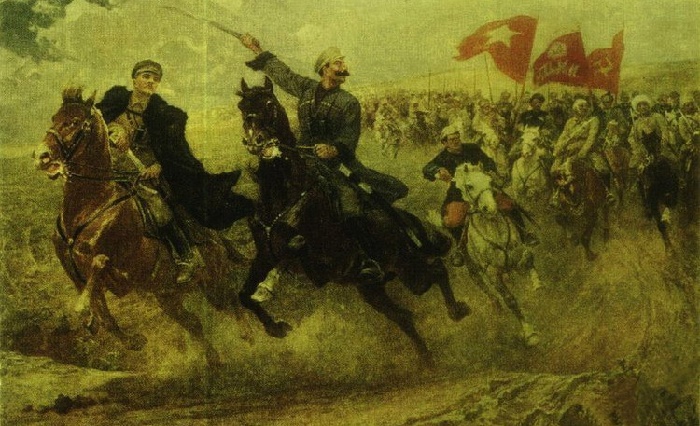
This post is to keep you, my much-appreciated readers, up to date with my plans for Revolution Under Siege, my ongoing series on the Russian Civil War.
First, thanks to everyone who’s read it (or listened to it), shared it, posted or said good things about it.
I was proud that this year I got out of a Eurocentric mould and wrote about the war in Central Asia. Series Four will follow late this year and in the early part of next year, and it will focus on the seismic events of 1920. In the first quarter the war starts groaning and grinding to a halt, and we see the exhausted peoples of the Soviet Union at last turn toward the long-postponed tasks of reconstruction. But in spring the war somehow lurches forward again with the invasion of Ukraine by Poland and the revival of the White Guards in Crimea. It grinds on full-force nearly to the end of the year. The endurance of the population is stretched past breaking point. At the same time, with the main White Armies broken, the war spins out in all directions, sometimes in skirmishes, sometimes in massive campaigns, from Siberia to Persia.
The opening episode will pick up where my series on 1919 left off, with the headlong retreat of the Whites – and with a particular focus on the murderous anti-Semitic pogroms which they committed as they cleared out.
I’ve rewritten and updated the Introduction and the first two episodes of Series 1, Red Guards and White Guards. Partly it’s a redraft but there’s a lot of new material there, most from an excellent source which I’ve at last got around to reading in the last few weeks, Notes of a Red Guard by Eduard M. Dune, edited by Koenker and Smith. Here is an eyewitness who can tell us about the incredible outpouring of creativity and energy in a worker-controlled factory in 1917, about what it was like to fight in Moscow during the October Revolution, and about how the Red Guards defeated the Cossacks and the Whites in South Russia in early 1918. And that’s just the first few chapters.
Today I started to look at a memoir from the other side, Asian Odyssey by Dmitri Alioshin. So far it’s proving to be pretty useful as well. I’m hoping it can give me an insight into the collapse of the Whites in Siberia, and the reconstitution of a part of the remnant into the absolute horror show that was the regime of the ‘mad baron’ Ungern-Sternberg. So far, I’ve learned that if you were a White Russian officer in Siberia in 1918-19 and fancied having your very own Colt 45, you just had to send out Ivan, your orderly, to pickpocket one from an American soldier.
That’s what the 1919 Review is all about – practical, up-to-date life advice.
Revolution Under Siege Archive
 The 1919 Review
Thanks for the advice about how to obtain small arms at short notice
LikeLike