
Vinculum in Vita, my brothers
The social media algorithms, in their infinite wisdom, have been pushing posts from ‘trad’ groups at me lately. Where I come from, a trad group means fiddles and bodhráns in the corner of a firelit pub. But on the internet, various pages with names like Trad West have hijacked the word as short for something vague called ‘traditionalism.’
One of their slogans is ‘Reject Modernity – Embrace Tradition.’ But these page’s authors don’t seem to have any clear idea of what they mean by ‘modernity’ and ‘tradition.’
Tradition is a moving target. Sometimes it’s ancient Rome, sometimes the Renaissance, sometimes the 18th Century, sometimes the Victorian period, sometimes the mid-20th century. Now and then it is even the 2000s. If you think you are beginning to grasp what they mean by ‘tradition,’ suddenly they drop a phrase like ‘Men used to hunt mammoths,’ and you realise that ‘tradition’ is also supposed to include the Stone Age.
Might it be that ‘tradition’ is the sum of all the positive contributions of previous generations? But that’s without substance. That’s just ‘tradition is stuff I like from the past, but also from now, and not the stuff I don’t like from the past. Or from now.’ It can’t be that shallow and stupid, can it? They must have thought it through a bit better than that.
Modernity is just as hard to pin down. I have gathered that it is a phenomenon which includes, but is not limited to, vaping, pornography and photos of ugly mid-century buildings.
Modernity is Enlightenment ideas. But Tradition is Enlightenment architecture.
Modernity is buildings from the middle of the 20th century. But Tradition is men wearing suits in the middle of the 20th century.
Modernity and tradition, for these people, are not actual definable historical phenomena. They are like the Byzantium imagined by WB Yeats. They are a vibe. They are playdough objects that live entirely in the imagination
Buildings
A lot of the posts are about buildings. My favourite one was a post which compared a Victorian painting of Ancient Rome with a photograph of a run-down tower block in a modern city. Buildings used to look like this, and now they look like this! Do they really believe that every person in the whole Roman Empire lived in a palace or a temple? Ancient Rome had squalid tower blocks – they were called insulae (I learned that when I was 12, ffs).
There’s a lack of self-awareness in the choice of images. The admins assume we agree that certain types of buildings were just objectively beautiful. They assume we, like them, get all sweaty and excited at the sight of a couple of doric columns and a cupola. Because liking a particular type of building means you are a more virtuous and more cultured person.
Anatomy of a post

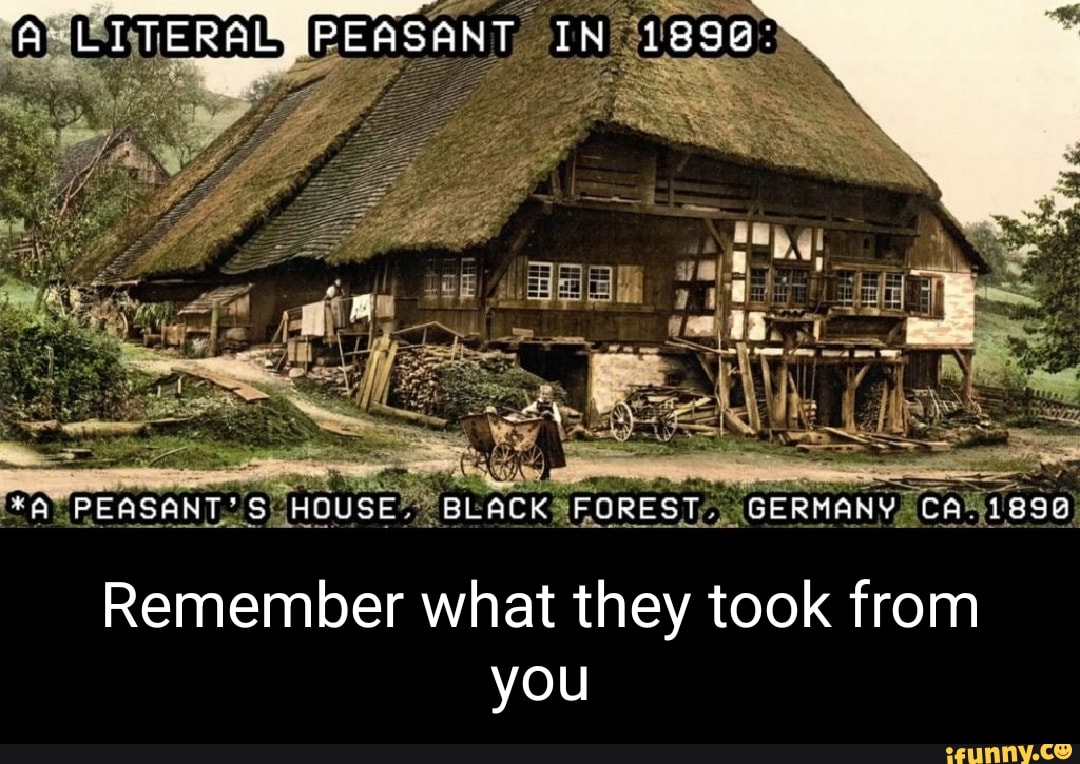
Let’s take a moment to look at one particular building-related post. It’s a colour photograph of a large thatched building. The caption claims that this is a ‘literal peasant’s house’ from 1890s Germany. It is contrasted with an image of miserable commuters on a subway. The implication is that German peasants back in traditional times (whenever they were) had it better than modern people.
There are so many things wrong with this, it’s easiest to respond in bullet points.
- The 1890s were known as the fin-de-siécle, famously a time when a lot of people were anxious about modernity, worried that civilisation and technological advance were leading to ‘decadence.’ The 1890s were modern.
- The Industrial Revolution had long since taken place by the 1890s. In fact, the Second Industrial Revolution had taken place. There were trains, telegraphs, trams, motor cars, power plants… and, obviously, photography.
- And Germany was one of the foremost industrial powers in the world. It had a parliament, a colonial empire and cutting-edge technology and industry.
- So, taking the caption at face value, this is not a ‘traditional’ house. It is a house from an advanced capitalist country in modern times.
- Peasant classes are extremely heterogeneous. It is to be expected, even if this were the Middle Ages or the classical period (not the heart of modern Europe), that a minority of peasants would have large houses.
- That house – how do I put this politely? – it doesn’t exactly correspond to the trad taste in architecture.
I guess they see this photograph and think that most peasants for most of medieval history lived in massive houses. Thanks to traditionalism (which is to say, thanks to god, but also the Romans, and also the men who hunted mammoths).
I hate to break it to you, but that house doesn’t have Wifi. It might not even have an indoor toilet. And you don’t know how to do farming. You have lived in a suburb your entire life and work in an office. You would absolutely hate it if you got dropped into the 1890s, or a neolithic mammoth hunt (apparently those two things belong in the same category).
An intelligent trad might make a legitimate reply along the following lines: ‘I would be ill-equipped to live in, say, Ancient Rome. But that is because modernity has ruined me. That’s why I hate modernity and am trying to get away from it.’
I too am alienated from and critical of today’s capitalist civilisation. But any kernel of sympathy I might have for these guys evaporates whenever they utter anything. They want to move backwards, to a miserable and oppressive past where they imagine they would be top dogs.
To finish up, I want to give the reader a flavour of what it’s like to scroll through these pages, as best I can sum it up with the written word.
That Nordic Chad meme guy puts in an appearance in about 90% of all posts. These trad memesmiths don’t realise there are diminishing returns on this. Nordic Chad has become a sock puppet for whatever the trads want to say.
There’s posts about how women should stay at home and not get jobs, and how your wife should come to live on your farm in financial dependence and isolation. If the Nordic Chad meme guy mistreats his isolated and dependent wife, don’t worry – he will pray to God for forgiveness and improve himself by pretending to read Meditations by Marcus Aurelius (You know Marcus Aurelius is traditional and based because his name has a lot of ‘us’es in it).
Next, a picture of Nordic Chad explaining traditionalism over the histrionic objections of a crying soy-face pink-haired opponent (A lot of the memes are just drawings of people flying into a rage at the trads, unable to handle how based they are).
Next, a picture with the caption, ‘Why do buildings look like this now? [picture of some tasteless modern building] when they used to look like this?’ [picture of an equally tasteless Victorian building]
Or worse, that meme above, only instead of a tasteless Victorian building, it’s a not-real painting of a fictional building.
Next, an ad for merch. Naturally there’s a store. Because nothing says traditionalism and stoicism like the words ‘Half price while stocks last! Link in bio.’ Glad they have the merch, just in case the isolated family homestead thing falls through. Which, as a historical phenomenon, it did.
I just ran ‘link in bio’ through Google Translate into Latin to see how it would have sounded if Marcus Aurelius had written it at the end of every chapter of Meditations. If you change ‘bio’ to ‘biography’, it actually sounds good: Vinculum in Vita. The trads can have that one for free, as a motto that accurately sums up their whole deal.
 The 1919 Review
Yeah, what is tradition and traditional? The word ‘trado’ [to hand on] That which is worthwhile handing down the generation(s), knowledge of mamooth’s grazing habits not included.
LikeLike