
Hi folks. I’m going to dig deep into Cixin Liu’s The Three-Body Problem and its 2024 Netflix screen adaptation. This first post will look at the book’s most fascinating character, Ye Wenjie. The Three-Body Problem is really her story – how and why she betrayed humanity, and the consequences of that betrayal.
I enjoyed the TV show. If you’re looking for a big rant where I complain about every aspect of it, you will be disappointed. But its version of Ye lacks the novel character’s depth, doesn’t hit us as hard emotionally (Due to the script and not due to fine performances by Zine Tseng and Rosalind Chao). Mostly I’m not criticising so much as saying, ‘Look here – this is interesting what they did here and what effect it has.’
The writing in Cixin Liu’s trilogy (I’ve read the first two) is sometimes stilted or technical or slow. But there is great prose here, especially in the Ye Wenjie sections:
- Page 294: ‘In the deep silence of midnight, the universe revealed itself to its listeners as a vast desolation.’ (a line repeated to great effect later)
- Page 299: ‘Above her, the Red Coast antenna lay open, silently, like a palm toward the universe.’
The screen version lacks this prose but makes up for it with strong visuals. It’s held together by compelling characters who have natural dialogue and interactions. It’s slick enough that it got a lot of eyeballs onto screens; it was a success, and there’s a point past which you can’t argue with that. It brought the main gist of the book to a much wider audience. I’m glad more people got to experience this great thing.
Page and screen are autonomous, and I’m not going to judge one for deviating from the other. Nonetheless about some of these deviations I have plenty to say.
Cultural Revolution
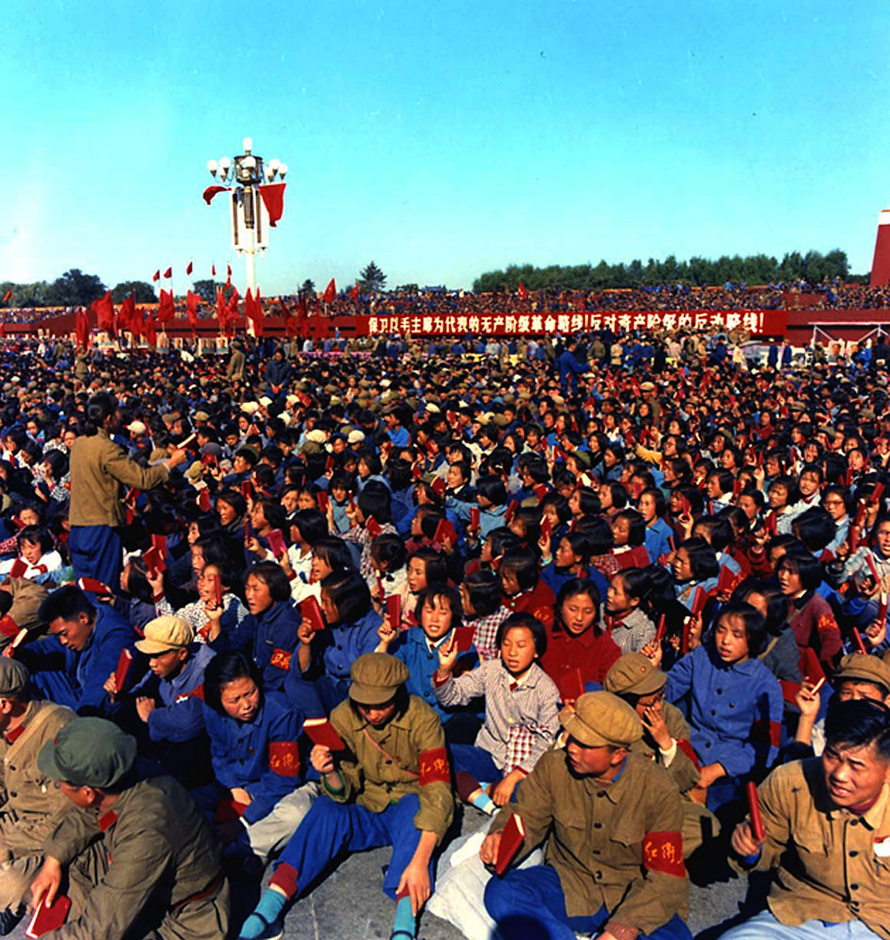
The Three-Body Problem by Cixin Liu begins with a panorama of Beijing at the height of the Cultural Revolution, with factionists killing one another in street battles. Next we see a stage in a university square. Student paramilitaries denounce and beat a physics professor; they go too far and kill him.
The Netflix TV adaptation begins the same way. But the Netflix audience – and the western reader – mostly has no idea what the Cultural Revolution was. It’s not the business of the screenwriters to give you a history lesson. But western ignorance about China might leave many viewers with questions about this scene. For example, Jordan Peterson – who presents himself as very well-read and knowledgeable – thinks the Cultural Revolution (1966-1976) and the Great Leap Forward (1958-1962) were the same thing. His complete ignorance didn’t give him any pause for thought – he put out that claim in a published book, Maps of Meaning, and while he was at it he declared in passing that 100 million people died in this 18-year-long composite event.
I’m pretty ignorant about a lot of things too – never read Jung. But I’ve visited China and read a few books about the place. The Cultural Revolution took place twenty-odd years after the communist victory of 1949. The 1949 Revolution overthrew the landlord class and delivered a massive expansion of health and education; hence why students who were babies in 1949 are, by 1967, so keen on it and on its foremost leader, Chairman Mao Zedong. But Mao messed up with a campaign called the ‘Great Leap Forward,’ contributing to a terrible famine, and afterwards he was sidelined.
The Cultural Revolution began four years later. It was half a student uprising against government figures who were perceived as conservative or bureaucratic; half Mao’s power play to get back in full control. It was a mess that got way out of hand. The way it’s depicted on text and screen seems fair to me, but the original Chinese reader had more context than the Netflix viewer or western reader.
On the page and on screen we experience the same terrible episode: a teenage girl named Ye Wenjie watches as her father, a theoretical physicist, is publicly humiliated and killed. In the book, we are privy to her own thoughts and memories. Long ago, before the Revolution, her father met Einstein. Einstein pointed to a ditch-digger on the streets of Beijing and asked how much the guy earned. Instead of a deep discussion on the nature of the universe, Professor Ye’s only dialogue with Einstein consisted of telling him that the ditch-digger probably earned 5 cents an hour.
This is one example of an opening that is rich in contrasts; likewise it is bizarre and unsettling how a discussion on theoretical physics is combined with a scene of pseudo-revolutionary ritual persecution and public torture.
This is a moment of cruelty and hysteria, a moment when the human species comes across very badly. This does two things: it sets Ye Wenjie on a course to betray humanity, and in its depiction of a hysterical political rally it prefigures the later development of the Earth-Trisolaris Organisation. The first, at least, comes across clearly enough on the screen as on the page – the second, not so much.

Red Coast Base
After the worst excesses of the Cultural Revolution, the youth were rusticated en masse, sent out to the countryside to do hard labour and keep out of trouble. That’s where we next catch up with Ye Wenjie: with a logging crew in Inner Mongolia. She watches as ‘vast tracts of grasslands became grain fields, then deserts.’
Ye Wenjie sees the environmental destruction and concludes that humanity is to evil what an iceberg is to the sea – composed of the same material but just in a different form. Her dawning environmental consciousness is warped in this misanthropic direction by her previous experiences. To make matters worse, the first person she trusted since her father’s death, Bai Mulin, betrays her. Long before having any idea that she will one day communicate with aliens, she concludes that ‘To achieve moral awakening required a force outside the human race.’
She gets her chance when she is sent to the mysterious Red Coast Base. Pages 46-48, describing the mysterious dish in use, are very tense, exciting and mysterious. The climax is when the birds fall out of the sky. Here the TV show hews close enough to the book. Again, what we lose in interior monologue, we gain in strong visuals.
Ye Wenjie doesn’t like living at Red Coast base but it suits her. She seeks isolation after her experiences; it seems safer. But here, in her relationship with the commander and commissar, there is room for further betrayals, petty ones this time (pages 174-5).
The TV show hurries through the Red Coast portion of the book in a couple of flashbacks. This is a shame because, alongside the surreal videogame sequences, it’s the best part of the novel.
An example of what we lose: on pages 180-183 we get to see internal government documents where the top-tier Chinese communist leaders discuss how to contact aliens. The first draft is full of heated revolutionary rhetoric but it is dismissed as ‘utter crap’ – don’t send big-character posters into space! A more sober draft follows.
To its credit, the TV show keeps the part where Ye Wenjie figures out that the sun can be used as an amplifier for radio transmissions into space. The explanation in the book is too technical, but on screen it’s just right.
Her idea is dismissed, but she goes ahead in secret. She sends the transmission to the sun. In the book this is an awesome moment, even as Ye herself loses hope:
Ye saw the rest of her life suffused with an endless grayness. With tears in her eyes, she smiled again, and continued to chew the cold mantou.
Ye didn’t know that at that moment, the first cry that could be heard in space from civilization on Earth was already spreading out from the sun to the universe at the speed of light. A star-powered radio wave, like a majestic tide, had already crossed the orbit of Jupiter.
Right then, at the frequency of 12,000 MHz, the sun was the brightest star in the entire milky way.
As a plot point, this comes across clearly on the screen. But the sheer awesomeness of this moment is lost in translation. Likewise the moment, some years later, when she has a choice and betrays the human race. Everything has been leading up to this, but it’s still just enough of a leap that it shocks the reader. This is why Ye Wenjie is a great villain in the book.
The show leaves out some plot points too. In it, Ye has a baby with Mike Evans, her American collaborator. In the book, she has her baby with chief engineer Yang who works at Red Coast base. But in the book we see her commit an incredibly cold-blooded murder of commissar Lei. By an unhappy chance, killing Lei obliges her to kill her husband Yang at the same time. She kills them both – including the father of her child – without hesitating.
Our view of this character changes fundamentally at this point – her betrayal of humanity is made real and manifest. This betrayal is not mediated by a computer screen or a radar dish.
The Earth-Trisolaris Movement
Something crucial happens in the book: Ye Wenjie goes to a local village and lives with the farmers there to have her baby. They donate their blood to save her and house and feed herself and her baby. In return, she teaches their children. This is a lovely section of the book. It’s a rebuke to the anti-human attitude she has adopted. ‘Something finally thawed in Ye Wenjie’s heart.’ (316-321) We see Ye in a different setting and mood from the military-scientific base and the Cultural Revolution era. Her horrific experiences were not the full picture; most of us human beings, while we have our burdens to bear, live lives that are far happier than hers. We do not experience such repeated and concentrated doses of inhumanity. And if she hadn’t, she wouldn’t have betrayed humanity. When we exploit and brutalise one another, we degrade humanity’s faith in itself, humanity’s integrity. When we harm a fellow human we harm ourselves as well.
Her next experiences set her back into her misanthropic groove. Her mother, who helped do the father to death, washes her hands of what she did, and even blames the dad for it. (324-5)
Ye Wenjie then meets the three Red Guards who killed her father – in the TV show, there is thankfully a version of this scene. After their revolutionary ardour was exploited for political ends by a faction in the state, the three teenage girls were doomed to years of hard labour. There’s nothing left in them but bitterness, and they have suffered too much to be remorseful. I found this interesting; the mother is unrepentant because she has moved up in the world, and the girls are unrepentant because they haven’t.
This entirely depressing experience counteracts all Ye’s tendencies toward ‘thawing.’ But we have seen that she has a soft side.
This is relevant when we fast-forward a few decades to the development of the Earth-Trisolaris Organisation (ETO), a political group which is determined to help the aliens to conquer Earth.
In the TV show it is not named as such, and we learn very little about it. This is a weakness of the screen version. Why would some humans wish to collaborate with aliens? What internal debates would such a movement have? These fascinating questions are explored and dramatized in the book but not on the TV show.
They call each other ‘comrade,’ evoking the Cultural Revolution, but this is not a movement of idealistic students. ETO is made up of people drawn from the political, technical and financial ‘elites;’ it is explained that their grasp of science and their knowledge of the darker side of humanity makes them willing recruits. This tracks – Mike Evans is the son of a billionaire and thus alienated from humanity (no pun intended). Efforts to recruit ‘common people,’ meanwhile, have failed due to their ‘instinctive identification’ with humanity. (344-5)
ETO funds all kinds of anti-science groups. This is touched on in just a single line in the show which is really a missed opportunity to say something very relevant to the post-Covid world.
ETO is divided into two factions:
- The Adventists wish to eliminate the human race. They realise the Trisolarans might not be much better, but don’t care.
- The Redemptionists, on the other hand, have developed elaborate fantasies about Trisolaran civilization, and think the aliens will save humanity from itself.
A new and small third faction, the Survivors, is drawn from the small number of recruits from among the ‘common people’ – they hope to survive the war by collaborating with the Trisolarans.
Much like the Red Guards in 1967 Beijing, the two factions are on the brink of an internal civil war. Ye Wenjie doesn’t much like any of the factions, who have departed from her original vision, but she especially hates the Adventists and plans to wipe them out.
I’ve been praising the book a lot, but it has problems. From a zoomed-out distance, the ETO is compelling. But when Liu tries to show it in real life and real time, it fails to convince. Wang Miao infiltrates the ETO with comical ease; he attends a casual introductory chit-chat in a café, and is immediately invited to a major conference. The events of the conference contain subtle echoes of the Cultural Revolution scene at the start, and culminate in a moment of dramatic action. But the whole thing is stilted. Take it from a seasoned activist: this is not how internal disputes within a revolutionary party work. You don’t just have one meeting where you bring up everything all at once, and then trash it all out on the spot. Political conflict can be dishonest, drawn-out, and dirty – or, to put it kindly, it is richer and more interesting than how it’s presented here.
Having said that, there’s proper drama in the showdown between the two factions, and that’s before the jackboot of the state kicks down the door and Da Shi and his men storm in. The TV show, by contrast, has a flattened ETO.
Until next time…
Next week I’ll look at the other major strand of the novel The Three-Body Problem: Wang Miao’s storyline set in the present day and concerning a flickering universe, a loutish and morally dubious cop, and a mysterious videogame. Of course, I’ll be comparing the original with how it was adapted for the screen.
Did you enjoy reading this? Subscribe to get an email notification whenever I post:
Or browse the blog’s full archive.
 The 1919 Review
I preferred the television version, the book could be hard going in places. Neither explained satisfactorily why the Trisolaris ship in the Panama Canal could only be attacked by this ultrathin filament or string
LikeLike
The stated reason was to save the messages stored on the servers, but the process would have buried the servers irretrievably in mangled rubble, so im not sure it holds up
LikeLike