
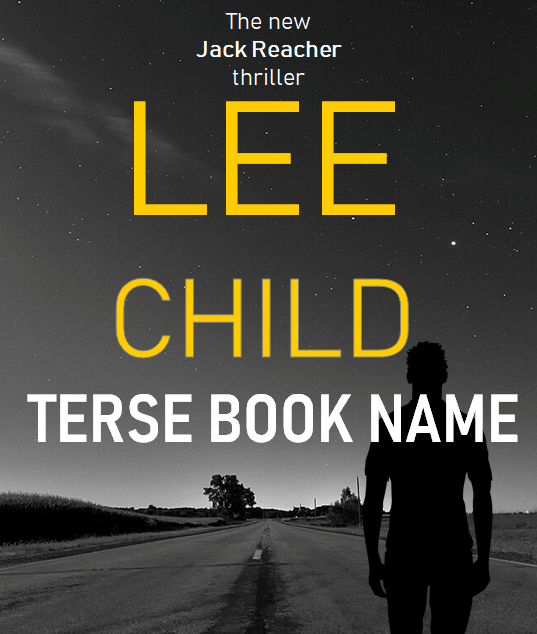
Years ago I started but did not finish a Lee Child book, Killing Floor. The things I remembered most vividly from that book, more than a decade later, were the eggs and coffee. Why did I return, all these years later? A few reasons, but most of all because I wanted to see if the eggs and coffee still tasted the same.
You see, people compare Lee Child to Ian Fleming. Both phenomenally successful and violent page-turners, obviously. But the similarities run deeper. James Bond and Jack Reacher are not really about violence, or even sex. A large part of the appeal is travel, food and drink. James Bond flew to glamorous places and pickled his insides with fancy wining and dining. (I had to put down You Only Live Twice half-way through because the entire novel to that point was travelogue). Jack Reacher buses and trudges through un-glamorous places – close-to-home, bleak, dirty places – now and then dropping into a diner to order some eggs and a litre of coffee.
Now I’ve read three Jack Reacher novels in three months (that’s fast for me). Here they are, in the order that I read them:
- The Midnight Line (2017), Lee Child, read by Jeff Harding (Jack Reacher finds a class ring from his officer training school in a pawn shop, and sets out on a quest to find its owner)
- Killing Floor (1997), Lee Child, read by Jeff Harding (twenty years and twenty books before The Midnight Line, Jack wanders into a small town only to be arrested and accused of a murder)
- One Shot (2005), Lee Child (Five people are gunned down by a sniper in a city. The man arrested for the crime asks for one Jack Reacher – who’s already on his way)
What first piqued my interest was learning that the author is actually English. So it’s an English guy writing these familiar and jaded descriptions of the underbelly of the US heartland. That adds a layer of interest to every sentence. Why is he doing this, how is he getting away with it, and how is it so good?
Child doesn’t describe the taste or texture of the eggs or coffee in pornographic detail (It’s usually something like, “He had some eggs. They were good. The coffee was good too.”) But the food descriptions still get readers in the door. Can’t explain why, but I always feel rewarded when Reacher consumes his mundane fare.
Here follow more generalisations about Lee Child based on the three books I’ve read.
There are always cars. I’m car-blind – when an author tells me what kind of car it is (“a big coup deville” or a “large domestic model” or a “tan Buick”) it means nothing to me, and I don’t know what a given make or model is supposed to signify. But I know that James Bond cars are always that decade’s version of “fancy and expensive” while Reacher’s are more down-market. Reacher always borrows a few cars in his adventures and the reader gets to drive that particular car vicariously. The car stuff mostly goes over my head but I like how he drives across the States describing the natural and social scenery as he goes; transport is a medium through which to read the landscape. The circles described by irrigation booms are like marksmanship targets. A Georgia prison is described almost like the fortress of some evil sorcerer. In Midnight Line a truck driver briefly becomes a laconic therapist to Reacher.
Reacher always finds a way to have sex without it seeming shoehorned in. It might be central, it might be a sub-plot or it might be a coda, but it’s got to be in there. Reacher manages this while clearing a low bar that James Bond doesn’t: he’s not awful to women. He actually likes them, without a hint of contempt, and they like him.
This is good going for Reacher, when you consider that he regularly goes three or four days without changing his underpants (but we are assured that he uses “a whole bar of soap in the shower,” a defense which I find endearingly juvenile). If he carries a toothbrush, can he not carry some folded briefs and socks, maybe in his inside jacket pocket? But I guess Child is wiser not to get into all this.
I’m not a total novice to this kind of book. I’ve read Point of Impact (1993) by Stephen Hunter – the novel on which the movie Shooter is based. It’s a near-contemporary of early Lee Child and a cracking read. But the main character is an asshole. Not just to women, but also to men who talk too much (‘like a woman’).
Swagger and Reacher are both alienated from society (a character as lethal as them, while also being a boy scout, would be just unsettling). But Swagger is bitter, the distillation of a kind of post-Vietnam War resentment. Reacher starts off by telling us he’s angry that a president he didn’t vote for is cutting funding to the coast guard, an echo of his own redundancy – but he’s not bitter and he doesn’t retreat to his cabin in the mountains. He is alienated from the state and thinks the cherished myths of his society are bullshit. But he loves his country, and not in an abstract sense. He likes plenty of its people, its nature, the towns and cities and the vitality that flows on its highways. It’s a machine and he takes quiet delight in how well he understands its workings. Like what city a fugitive will be in after X number of days, what type of hotel he will stay in, and what false name he will adopt.
The stories always end with Reacher and his hastily-assembled team of allies assaulting the warehouse (or mansion or snowplough depot) where the bad guys are holed up. There will be not more than half-a-dozen action scenes before that, punctuating the story with thuds and cracks. My gruesome favourite was when he stalked five guys through a house in Killing Floor. But it has to be established that a guy is very bad before Reacher kills or maims him in a crunchy way; if the guy is only sort-of bad he only hurts him in a crunchy way.
One of the conventions of this genre relates to texture. Supposedly we are here for the murder mystery. But that’s not enough. In between the murdery and mysterious bits there are the moments where we are given access to insider information about interesting things like forgery, prescription drug abuse or guns. But even that’s not enough. In between all that, we want to follow the protagonist through a whole lot of relatable everyday life stuff like car rentals and jean sizes. The battles, puzzles and lore, in order to seem real to the reader, must be connected by a tissue made of the same stuff as our real and tangible world. The headbutts have to go crunch, and the narrator has to seem like an insider, but most importantly the eggs and coffee have to taste right.
 The 1919 Review

You’ve hit the nail on the head here. I never fully realised why I liked Reacher so much, but this is it, right here. I highly recommend you keep reading (especially the earlier ones). Would love to hear more on this!
LikeLike
Many thanks, and your own comments on the Reacher tv show were interesting too. Makes me want to watch the first season at least
LikeLiked by 1 person
You have put my own formless reaction into words.I know exactly what you mean about the power of what are on the face of us very sparse descriptions of eggs and coffee
LikeLike