
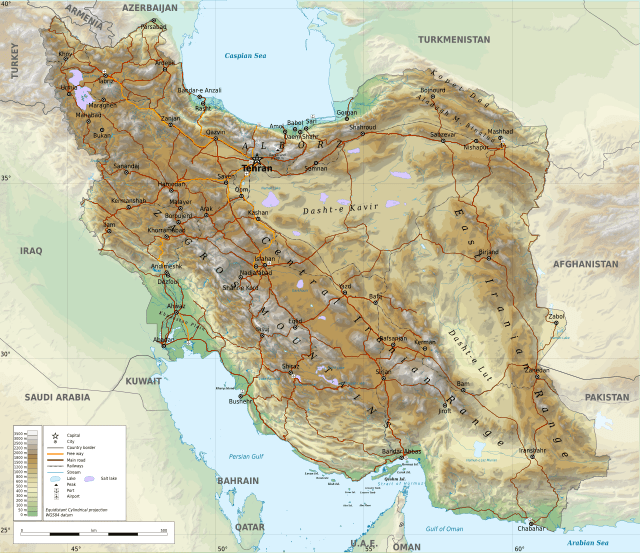
The long-predicted US/Israeli war against Iran has begun. I will be at the anti-war rallies, just so you know where I’m coming from. But this post is going to address a simple question in a factual way with as little rhetoric and moral judgements as I can manage. So I regret that I’m going to be mentioning various reactionary chancers as if they are serious people whose words mean anything.
That question: What advantages does Iran have in the current war?
I don’t know who’s going to win this war. The advantages enjoyed by the US are obvious, and include a military organisation of peerless strength, practically unlimited material resources and the vocal support of governments around the world. But it strikes me that Iran enjoys many advantages that are not as immediately obvious but that carry great weight.
1: Home turf
This is not a war between peers of equal strength. But it is not ‘superpower versus dysfunctional geopolitical minnow’ either. This is a global empire versus a regional power.
It is obvious which side is stronger. But the stronger power still has to apply its strength effectively. Here, the aggressor’s supply lines are stretched while the defender has its resources and its population right there, to hand. The US has to bring its personnel half-way across the world and keep them supplied. An important regional power, with a well-educated population of 92 million and a strong military, can leverage this advantage.
On the other hand, the US has a vast apparatus of bases half-encircling Iran. There are 40,000-50,000 US personnel under Central Command (Centcom, covering the ‘Middle East’, Central Asia and Egypt). Centcom has existed since the early 1980s and has fought several wars. Bases housing up to 10,000 personnel have histories going back decades. So the war is not ‘US versus Iran, on Iran’s home turf’. It is Centcom (and tiny but heavily-armed Israel) versus Iran. This diminishes Iran’s ‘home turf’ advantage but not entirely. This apparatus of US bases has to be sustained from outside at great expense. If it expends a lot of munitions or loses a lot of soldiers or machines, these have to be made good across those long supply lines.
2: US military assets can become political liabilities
It’s not, in every situation, a good thing for the US to have a wealth of targets within range of Iranian strength. From his statements about the war possibly being over in two to three days, it’s clear Trump wanted another ‘one and done’ spectacle in Iran: strike hard, receive capitulation, declare victory, pick another country to shake down next. Hegseth’s remarks today acknowledge it will be a longer affair but insist that it won’t be Iraq.
If we can say that there is a ‘Trump doctrine’ of quick wars – one-night stands or weekend flings with no strings attached – then that doctrine has been exposed for its serious weaknesses. It demands that Trump pick his battles carefully, which he has not done on this occasion. And that goes back to those US bases.
On Day Two of the war I wrote the following note for this post: ‘It’s going to be the US asking for peace, this week or next – and Iran saying no, we won’t stop hitting Israel, hitting your bases, until we are convinced we are secure.‘ That’s in essence what has happened since I wrote that note. Trump made tentative peace overtures, the Iranians said no and kept shooting, and Trump and co started making different noises, saying the war would be four or five weeks, not three days.
Those US bases, to be clear, are a net negative for Iran. But in this situation, they are hostages. They mean that Iran can hit back, with no shortage of targets. The war ends when Iran says so, or when it has nothing left to throw at those bases. This is not a weekend fling. The US is committed, even though it didn’t want to be.
3: Iran’s back is to the wall
The US struck Iran without warning, in the middle of negotiations that appeared to be going well. Negotiating in bad faith and assassinating a leader who enjoyed considerable authority and prestige in his country and beyond – these things come at a cost. The twelve-day war last year (when Israel and Iran traded missile strikes until the US waded into the fray and bombed Fordow) saw Iran’s government take a moderate and cautious posture. This time Iran has retaliated, apparently without holding back.
I don’t know enough about Iran to advance a sweeping thesis about how its people will rally behind the government. The lack of military mutinies during the recent protests is an important sign that though the regime is widely hated it is not on the brink of being overthrown. Based on historical examples, I’d say that even many who hate the government would temporarily set aside their differences and get behind the war effort.
4: The US does not know what it is doing
The strategic aim of Israel is clear enough: destroy Iran as a regional power so as to institute US/Israeli hegemony unchallenged over southwest Asia. For this aim, regime change is not necessary. Chaos will suffice. Civil war will suffice. But Israel does not have a hope of achieving these aims without strong, active US backing.
So, does the US share Israel’s strategic aim, or is it in this for different ends? My impression would be that most of the US ruling class, beyond Trump, even beyond the Republican Party and into the Democratic leadership, supports this basic strategic aim. But unlike the Israeli population, the US population emphatically does not support this. Open pursuit of such sweeping war aims would lead to political crisis at home. Hence fake war aims concerning the protests which were crushed months ago and a non-existent nuclear weapons programme (which Trump apparently destroyed last year anyway, if anyone can remember that far back). There is a lazy conflation of conventional missiles and nuclear missiles. Even at that, nobody is fooled. The half-arsedness of the case for war is striking in comparison to the elaborate efforts made in 2002-3 to win public consent for the invasion of Iraq.
The US is in a longer war, like it or not. Iran has rejected peace overtures and escalated, because the Trump regime made a sham of diplomacy. Trump will escalate in turn, because he is not ready to make concessions and appear weak. Both sides have an incentive to escalate well beyond where we are now. But the Iranians know what they are fighting for. The Americans don’t.
And what are the US options for escalation? As I see it:
- Bomb Iran on the scale that they bombed North Korea or North Vietnam
- Foment civil war
- Use nuclear weapons
- Invade and occupy the country
The first two probably won’t work, but they will try them more likely than not. The third and fourth are obviously more than the US public will accept. That’s not to say I rule them out. Neither Trump, Rubio nor Hegseth has ruled out ‘boots on the ground.’ They would be fools to try and occupy the country, even with the aid of hypothetical Iranian allies (who have not yet materialized). The mountains of Iran would be the tomb of Trumpism. Then again, they are in fact fools.
5: US allies may not be as steadfast as they appear
The Gulf States and Jordan have adopted a public posture condemning Iran. But privately there must be fury toward Trump. They wanted the talks to result in lasting peace because peace is conducive to tourism and commerce, which are existentially important especially to the UAE. So will we see these Arab states kick out the US military bases? I doubt that. But I don’t think they’ll join in the war either.
At the same time, many will want to keep on good terms with the United States. There is widespread hostility to Iran in these countries. There is a basis for a perspective of staying in with the Americans and enduring several years of war in order to see Iran defeated. But then what? A collapsed Iran would be a source of endless instability and violence. Right now it’s all condemnations of Iran, but I’d say there’s a ‘Wait and see’ approach in terms of practical actions. If Iran doesn’t fold quickly, and I don’t think it will, the Arab governments might push the US for peace.
Open questions
This is a new and strange kind of war, an air and naval war, very technical on one end (ballistics, trajectories, etc) and very visceral on the other (devastating explosions, death, terror, destruction). It hinges on technical questions about the capabilities of missiles and drones and of the systems designed to intercept them. There are key questions here which only people with specialist knowledge can answer (I don’t have specialist knowledge). A good place to start for that: Military Realism has written on the limits of missile defence as well as about some of the technical questions relevant here. Meanwhile vital statistics and facts on Iran can be found in this detailed profile by Joseph Shupac at the Geographic Investor.
There’s a remarkable story about 2002 wargames conducted by the US military simulating a war with Iran. Retired Marine Lieutenant General Paul Van Riper, playing as the Iranians, defeated the American side using, crucially, motorcycle messengers and small boats. It was partly with this in mind that I asked here on January 31st ‘how would things go in the US if some hundreds or thousands of naval and air personnel died in a couple of days?’ We are four days into the war, and US fatalities are in single digits while 500+ Iranian civilians have been killed according to the Red Crescent. It is unclear to what extent US facilities and materiel have been damaged. The advantages I have listed here will count for little if Iran is simply unable to impose sufficient costs on the US in particular. But there are costs other than human lives: in buildings destroyed, supplies spent, trade disrupted.
I have questions that the next few weeks will probably answer, but in the meantime I’d appreciate any comments that can address them. Can Iran sink US vessels? Can Iran withstand the economic cost of war? China and Russia joining the war seems very unlikely, but will they throw lifelines to Iran? What is the size of Iran’s arsenal, how much of it can be destroyed by air strikes, and how quickly can it be replenished? How much of that arsenal can the US and its allies absorb with interception systems – can they hold out for a few more days, or is it weeks or months?
Here is, not a prediction, but a scenario: three years from now the price of everything is through the roof. 50 Iranian refugees are being moved into a disused hotel down the road from your house. All the Trump admirers in your town are calling this an invasion.
Here’s another scenario: within the next couple of months, spooked by damaged bases, spent munitions, economic shocks and an anti-war mood, and with the Iranian state failing to collapse, the US backs down instead of escalating. The world is spared the many terrible consequences of the collapse of Iran into civil war and chaos, or of another long war on the scale of the Russia-Ukraine conflict. Trump shakes hands with the new Ayatollah and declares that he’s a wonderful guy.
 The 1919 Review
Thanks for the shout-out! I appreciate it. And enjoyed this analysis.
From my own point of view, I’m interested in how resilient the Iranian system is to the “EPIC FURY” being rained down. How long long will their stocks of ballistic missiles last, especially as more and more launchers get hit? And, conversely, how long will stocks of American and Gulf states’ air defence missiles last? Everyone is saying that they have ample stocks, so there must be a serious supply problem. This will be a key determinant IMO.
The other one will be political and national will. Does the American public have the stomach for a long war with higher prices, more insane spending, and body bags? I doubt it.
Does the Iranian public have the will to get behind their somewhat hated regime? Does this war foment insurrection or rally them around the flag? I’m in no way an Iran expert, but I suspect the latter.
But then it’s a question of whose will runs out first. You’re right that Iran’s economy will be devastated, but economics has never been decisive in war when there’s a willingness to fight.
LikeLike