Review: Prevail by Jeff Pearce, Simon & Schuster, 2014
Prevail by Jeff Pearce is about the Italian fascist war in Ethiopia in the 1930s. Pearce deals with the 1935-6 invasion, the guerrilla struggle, the British intervention and liberation in 1941, and the global impact of the struggle.
This book is important because the Italo-Ethiopian War is often reduced to a bullet point on a list of ‘events leading up to’ the Second World War, or as an episode in the history of appeasement, with the camera focused on white diplomats tugging their collars. In this book the white diplomats get some attention, but the focus is on African protagonists and their epic struggle against conquest. No doubt there have been other good books in English about the war, but I haven’t happened across them. Neither has popular culture, with the exception of Bob Marley, brought it to the attention of the English-speaking world. Eurocentrism has cheated us of a fascinating story.
I hadn’t really read anything on this topic before, so below is a list of twenty interesting facts I learned from Prevail. I hope they give you an appetite to read further.
Ethiopian troops on the way to the Northern Front, 1935
The Invasion 1. The Ethiopian armed forces were made up primarily of the retinues of petulant aristocrats. These guys were wedded to obsolete modes of warfare and refused to submit to any general plan. At one point the foot-soldiers, when they managed to storm some Italian position, ran all the way back to the rear just to throw trophies at the feet of their emperor – to his immense frustration! It was these organic weaknesses, as much as the shortage of modern weaponry, which made the war an unequal struggle.
2. Emperor Haile Selassie was a retiring and dignified character, to the point of being frustratingly passive at times. But in his modesty he is a foil to the strutting and ranting Mussolini, and at one point in the war he did personally mount an anti-aircraft gun and fire on Italian bombers.
3. The Italians justified their war by claiming they wanted to end slavery in Ethiopia. Humanitarian intervention, in other words. Plus ça change…
4. The fascists started the war by engineering stage-managed ‘incidents’ where they could semi-plausibly claim to have been attacked by Ethiopian troops. Japanese imperialism performed the same tricks in China at the time.
5. After starting the war, the Italian state angled for international sympathy by promoting atrocity stories. One Italian pilot was shot down and his grisly fate at the hands of enraged locals was made into headlines. Meanwhile the Ethiopians were being killed in their thousands. Plus ça change…
6. The British and French diplomats sold Ethiopia down the river. Mussolini admitted in 1938 that if the British government had closed off the Suez Canal, the invasion simply could not have gone ahead. They didn’t even have to start a war with Mussolini! Why did they sell out Ethiopia? One answer is appeasement. But in addition, they didn’t want to support an anti-imperialist struggle which might give dangerous ideas to their own imperial subjects.
This grainy image apparently shows the use of mustard gas, which Italian planes dropped on Ethiopian forces
Global Impact
7. The war was seen all over the world as a proxy struggle over racism and imperialism. Thousands marched against the war in Harlem, New York. There were protests in Ghana (Gold Coast), South Africa, and many other places. News from Ethiopia would trigger brawls and riots between Italian-Americans and African-Americans.
8. A year before the International Brigades were recruited to fight in Spain, thousands of Black people from the US volunteered to fight in Ethiopia. As the last independent country in Africa, Ethiopia was a potent symbol of resistance to white supremacy – even if as an absolute monarchy it was an unlikely icon for progressive forces. But very few of these volunteers ever made it there; the US government cracked down hard.
9. Two Black aviators made it from the US to Ethiopia. One was a prima donna and con artist, the other a dedicated and brave pilot who would go on to fly Haile Selassie’s personal plane throughout the 1935-6 struggle.
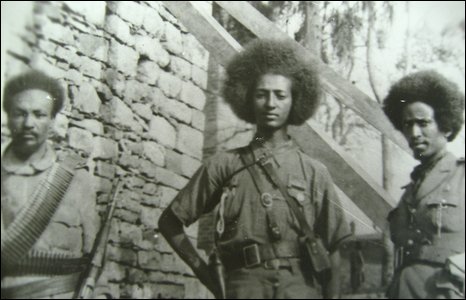
Ethiopian guerrillas on the move
Occupation and Guerrilla Struggle
10. The Italian occupation in Ethiopia was incredibly racist, brutal and vindictive, even by the low standards of European imperialism in Africa. There was a massacre of one-fifth of the population of Addis Ababa when the Italian troops and their allies were given three days to loot and destroy the city. this was a reprisal after the Ethiopian resistance tried to assassinate a top Italian official.
11. Guerrilla struggle continued after the defeat of the Ethiopian armed forces in 1936 right up to 1941. Groups called the Black Lions and the Patriots (Arbegnoch in Amharic) carried on a struggle from remote areas. Some key leaders were women. The young men grew massive afros.
12. Sylvia Pankhurst, who was previously well-known as a suffragette and communist, became the foremost champion of the Ethiopian cause in Britain. She printed a newspaper documenting Ethiopian resistance victories. It’s difficult not to admire her dedication to internationalism even though it seems she was uncritical of reactionary features of Ethiopian society. On her death she was given a state funeral in Ethiopia.
An Ethiopian irregular soldier carries a wounded comrade
13. The Ethiopian war was a key moment in history for other socialist, black freedom and pan-African leaders. Pearce cites the contemporary writings and activities of CLR James, Kwame Nkrumah, Marcus Garvey, Leon Trotsky and many others.
14. Josephine Baker, an African-American singer who was one of the most famous people in the world at the time, made a vocal statement in support of Mussolini’s invasion. Pearce explores the possible reasons for this bizarre action.
15. Haile Selassie lived in exile in England from 1936 to 1941 and allegedly snubbed Marcus Garvey.
Members of the Argebnoch
Liberation
16. World War Two changed the political landscape and made Ethiopia a soft spot for the Allies to strike blows at Italy. Britain and France, remember, controlled all the surrounding countries as imperial colonies. Even so, intervention was grudging, delayed and under-funded.
17. The British intervention was led by some glorious English eccentrics and consisted of just 2,000 guys – Sudanese, Ethiopians and British. But they brought supplies, arms and trained military specialists to the Ethiopian resistance, which transformed the situation. It was not an easy struggle, but the Italian forces were overstretched and hated by the local people. They were defeated quite rapidly.
18. After liberation, the British state set about looting everything they could get their hands on – treasure, machinery, vehicles, etc. They stripped bare an already underdeveloped country. Selassie was further enraged by Ethiopia’s treatment at the hands of the Allies. Even though they died in their thousands in the anti-fascist struggle, the Ethiopians were not recognised as a constituent part of the Allied cause.
19. Selassie gave little reward to the youth who had made up the ranks of the Patriots. Ethiopia remained a very conservative and stagnant society under his rule – though the impact of war and occupation could not have helped in its development.
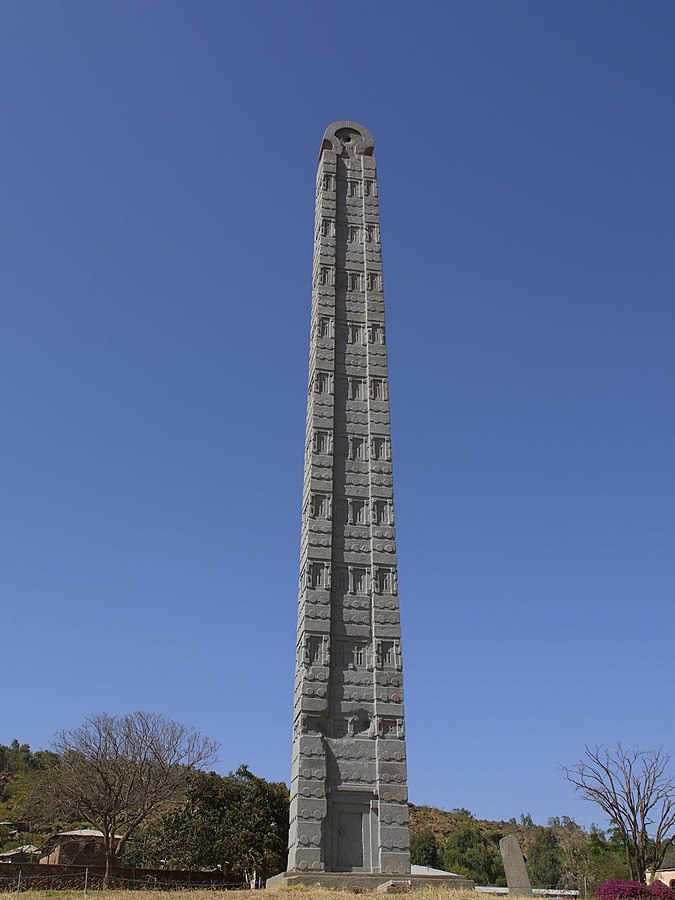
20. During the war, the Italian fascists looted a huge monument called the Aksum obelisk, which stood in Rome for decades. It was only returned to Ethiopia in 2005 – a symbol of how unrepentant the powers-that-be in Italy remained for a long time after the whole brutal affair.
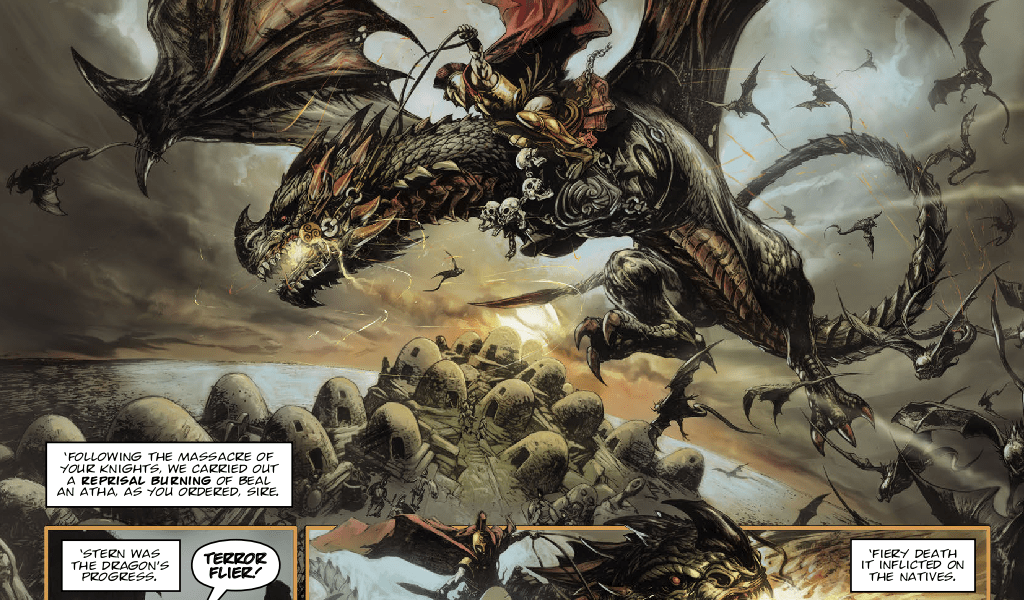
Is Sláine a primeval soul who poses challenging questions to us from the depths of Celtic myth or a knock-off Conan the Barbarian? This is the question I posed and struggled with in my three-part series looking at 40 years of Sláine.
Become a paying supporter to get access
Access to this article is limited to paying supporters. If you already subscribe by email, thank you. But if you want to become a paying supporter, please hit ‘Subscribe’ below.
Donate less than the price of a coffee, and you can access everything on this blog for one year.
If you don’t feel like donating, most of my posts are still 100% free, so browse away, and thanks for visiting.
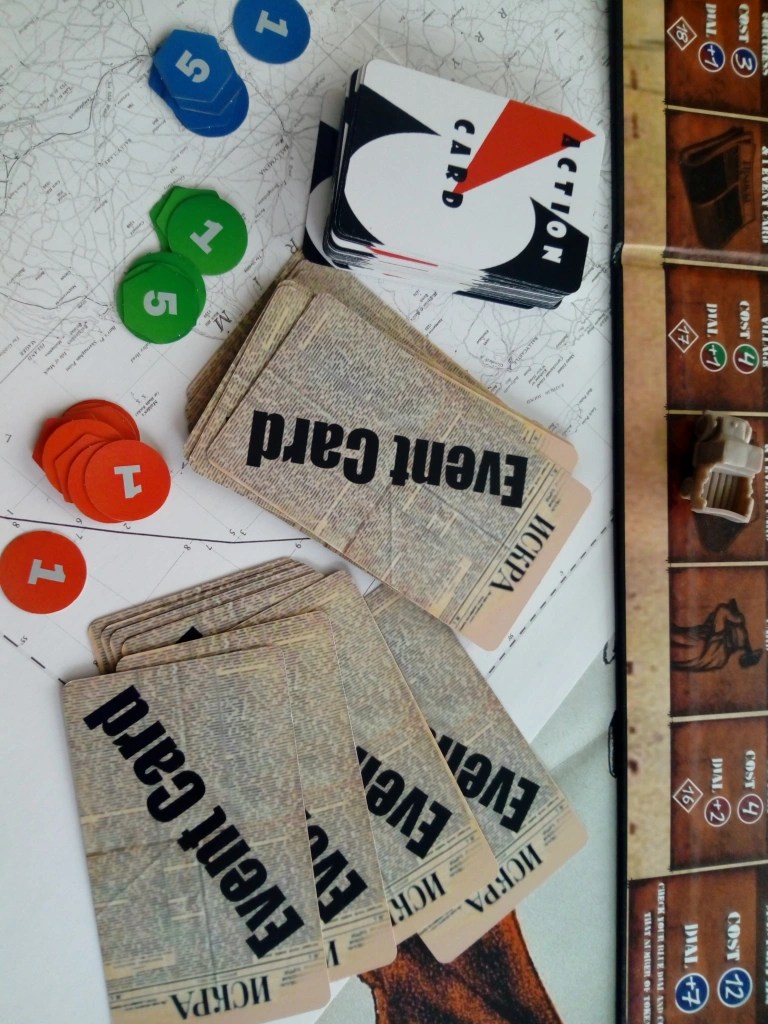
I think the game works well, especially the interplay between the two phases. There are plenty of moving parts, but they are mostly easy to grasp and add depth, unpredictability and balance, and turn every game into a unique story.
Still, there are things I want to tighten up. I have exciting ideas for a second edition, but I doubt I will even start working seriously on that in 2023.
Instead, here is a Rules Update. The main purpose of these changes is to make the game run faster and more smoothly, to make it easier for first-time players. At the same time, they can be implemented fully with all existing copies of the game.
The rule changes are attached here as a handy PDF for you to print and stick into your game manual. They are also written out below.
PREVIOUSLY, players received token payouts when they passed Corner Districts. NOW, every player collects all tokens due to them, of every colour, at the beginning of their turn.
Combat
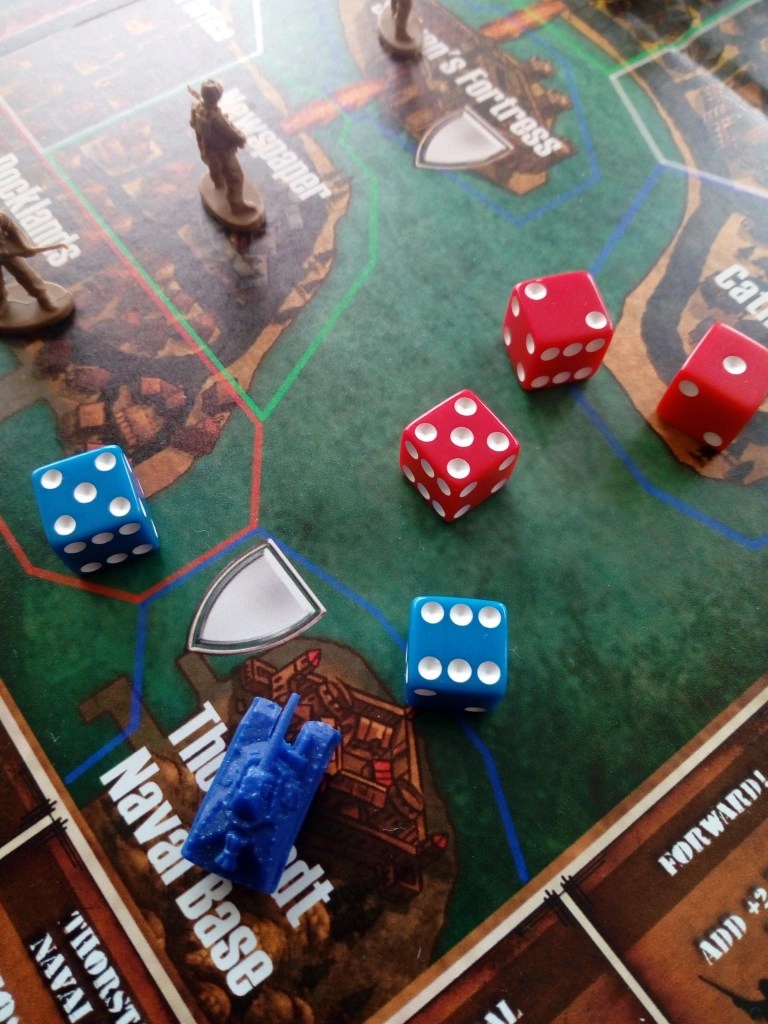
PREVIOUSLY, combat worked according to a system inspired by Risk. NOW, combat is simpler. Both players roll D6. Whoever rolls higher is the winner. Subtract the lower from the higher number. The losing player loses that number of soldiers, to a maximum of 3. On a tie, the attacker loses 1 soldier. Repeat until one side retreats or is destroyed.
FOR EXAMPLE:
Player 1 rolls 6 and player 2 rolls 4. Player 2 loses 2 soldiers.
Player 1 rolls 4 and player 2 rolls 4. Because player 2 is defender, Player 1 loses 1 soldier.
Player 1 rolls 1 and player 2 rolls 6. The difference is 5, but a maximum of 3 soldiers may be lost per combat. So player 1 loses 3 soldiers.
Action Cards
PREVIOUSLY, an unlimited number of action cards could be used per turn. NOW, only 2 Action Cards may be used per turn. This applies both to Power Struggle phase and to Insurrection phase.
Key Areas
PREVIOUSLY, when a player seized a Key Area in Insurrection mode, they would gain D3 reinforcements (Key Areas are the places outlined in white on the board). NOW, each Key Area gives a preset number of reinforcements, once per insurrection, as follows:
Telegraph Office & Telephone Exchange – 1
Levsky Prospekt Upper – 1
Levsky Prospekt Lower – 1
Fillippov Estate – 2
Kantankurov Estate – 2
Prison – 2
Duganenko Station – 3
Vinland Station – 3
Khazag Station – 3
In summary: Key Areas in the city centre give 1; Estates and the Prison give 2; Railway Stations give 3.
(The thinking behind this rule change is as follows: first, to reduce the amount of dice rolling; second, to rebalance the map away from the centre and toward the periphery.)
PREVIOUSLY, reinforcements spawned at the player’s base. NOW, reinforcements spawn at the Key Area.
Launching an Insurrection
PREVIOUSLY, a player needed a minimum of 15 points across all dials to launch an Insurrection. NOW, instead of a points limit, there is a ‘grace period’ lasting two turns from the beginning of the game during which nobody can launch an Insurrection. Once those two turns are up, anyone may launch an Insurrection.
Rolling Doubles
PREVIOUSLY, a player would get a second move if they rolled doubles for movement. NOW, this rule is removed.
I hope these new rules work well, and I appreciate any feedback to BolshevikBoardgames.wordpress.com
Things I’d like to change, but won’t just yet
There are other things I’d like to change, but can’t yet. There is an anomalous empty space at the top of the map which I’d like to change to a Key Area named ‘Kulpovo Heights’ or something. For colour blind people, I would imagine that the board as a whole is in places frustratingly low-contrast. I named the naval base ‘Thorstadt,’ a play on ‘Kronstadt,’ but since then I’ve learned there was a guy with a similar name whose ideas I don’t like, and I want to avoid anyone thinking it was some kind of homage to him.
But these changes would require interfering with design, and that’s a can of worms I don’t want to open until I have clear ideas (and a clear schedule!) for a more general redesign.
I’d like to change movement, too – making it less about dice rolls and more about players making choices and sacrifices. But that will require playtesting and balancing. I’d be very pleased if I could figure out a way to eliminate some of the physical assets – like cards, tokens, dials, the second manual – without sacrificing depth. This would make the game cheaper on The Gamecrafter and less daunting for new players.
In the meantime, if anyone wants to experiment with their own House Rules, please feel free to send me feedback on how it works.
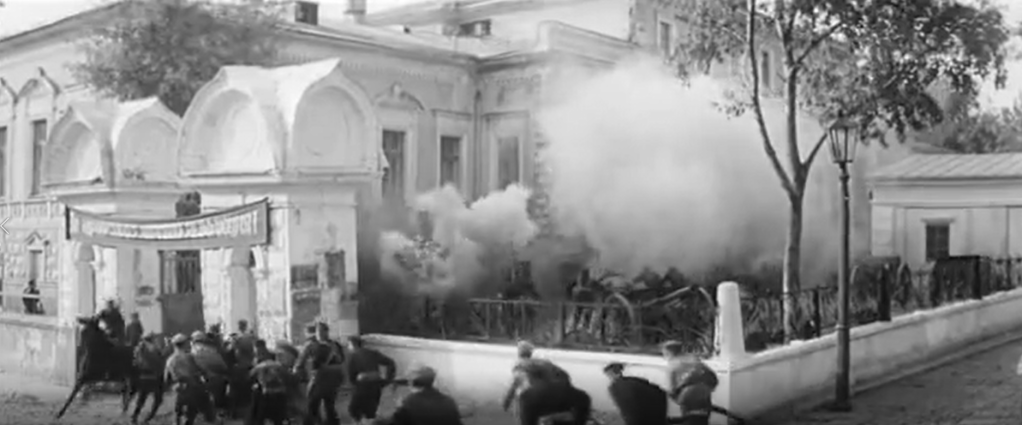
Street fighting during the Civil War. From the Mosfilm movie The Sixth of July, dir Yuli Karasik, 1968
Become a paying supporter to get access
Access to this article is limited to paying supporters. If you already subscribe by email, thank you. But if you want to become a paying supporter, please hit ‘Subscribe’ below.
Donate less than the price of a coffee, and you can access everything on this blog for one year.
If you don’t feel like donating, most of my posts are still 100% free, so browse away, and thanks for visiting.
Review: Russia: Revolution and Civil War, 1917-1921 by Antony Beevor
Welcome to Part Two of my review of Russia: Revolution and Civil War, 1917-1921 by Antony Beevor. The previous post looked at some of the distortions and mistakes in the book. It also acknowledged some of the book’s good points. This post will set out to deconstruct the book’s overall narrative. We will expose how it shuffles around timelines and how it assumes, with zero evidence, that the events of the Civil War unfolded according to some master plan created by Lenin.
Before we begin, for the sake of balance I want to say that I don’t think the author is a liar or an idiot. My guess is that this book was produced (1) with a complacent attitude, without the author challenging the assumptions he held at the start of the project and (2) too quickly.
Back-dating famine and terror
First, let’s take a look at how the book juggles with the timeline, and what effect this has on the reader’s understanding of events.
Last week we saw how selectively Beevor quotes the writer Maxim Gorky. Likewise, he quotes Victor Serge without giving a fair indication that Serge was actually a Communist.
Beevor uses quotes from Serge to give a very bleak description of St Petersburg in January 1918 ‘after just a couple of months of Soviet power’ (Page 156). It was indeed bleak at that time. And it had been before the October Revolution too, and even before the war, working-class districts had unpaved and unlit streets. The problem is this: Beevor is quoting from Victor Serge’s novel Conquered City, and that novel is set between early 1919 and early 1920. Serge was not in Russia in January 1918. He was describing the city a year-plus later, after six to eighteen months of full-scale Civil War – not after ‘a couple of months of Soviet power.’
Beevor is back-dating the social and economic collapse of Petrograd in order to mix up cause and effect. He wants to blame economic collapse on the Revolution, not on Civil War.
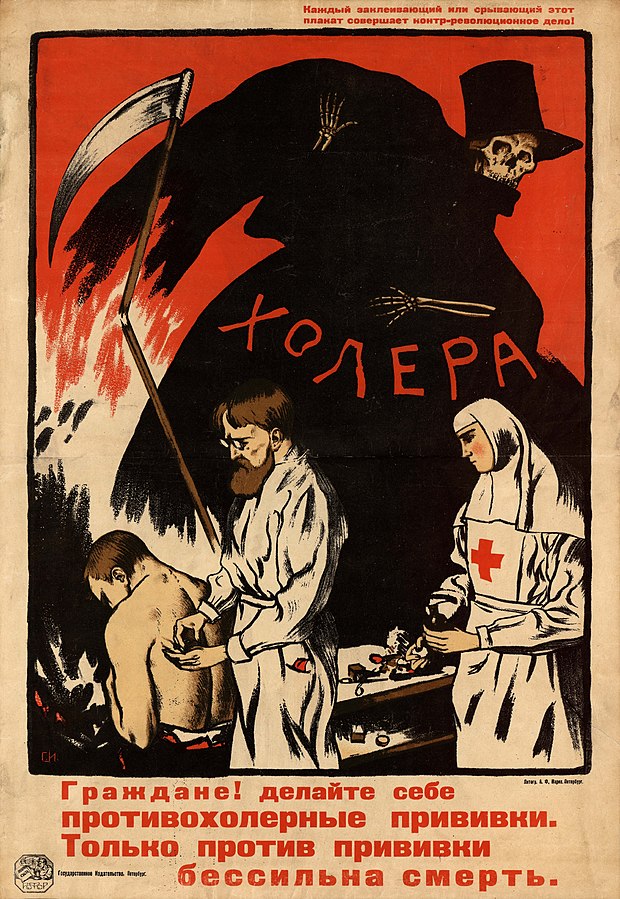
A Soviet poster from the Civil War era shows a looming menace labelled ‘Cholera’
We see the same pattern with the question of terror.
Red Terror did not begin until months into full-scale Civil War.[i] There were important outliers – the killing of officers in Kyiv (which Beevor describes[ii]) and the massacre by Russian settlers in Kokand, modern-day Uzbekistan (which he does not mention), which both occurred in February 1918. But in general, Red Terror escalated over the summer as the military and economic crisis deepened, then hit full-force at the start of September 1918.
There is state terror and then there is mob violence. Russia: Revolution and Civil War tries to blur the line between the two. Tsarist Russia was an empire of 150 million people with a threadbare state apparatus even before the Revolution,[iii] in which twelve million had been given rifles and boots and sent into a war whose traumatizing horror Beevor acknowledges. Unsurprisingly, there was mob violence and crime, and there would have been, revolution or no revolution.
He quotes an account by a bourgeois observer as evidence that the Soviets were conducting an onslaught of terror against the more affluent people: ‘They stir up the population and incite them to take part in raids and riots. This is not going to end well. There are robberies in the streets. They take people’s hats, coats and even clothes. Citizens are forced to stay at home after dark’ (Page 97-98).
Here is the note I left in my ebook:
like clearly this is a scared bourgeois conflating crime and ‘bolshevism’, not an accurate account of bolshevik activities [sic]
Did the Soviets encourage criminal gangs and robberies? No. In fact, the draconian security measures brought in by the Soviets were partly directed against such criminal activity.
Page 137: ‘Echoes of the atrocities in the south soon reached Moscow’ in early 1918 – reading this sentence I thought, ‘That’s just another way of saying you’re about to report some unconfirmed rumours you found in diaries and letters.’ Sure enough, that’s what he does, and even accepting everything at face value, you can see that this is the violence of mobs and of local self-appointed revolutionary leaders.
In the last post I mentioned Beevor’s class bias – how he tends to credit sources written by wealthy and middle-class people, and to dismiss or ignore sources written by workers. We see it at work in the example above. It is with this one-sided approach to his sources that he invents a whole new wave of Red Terror that supposedly began instantly following the Revolution. He gathers an imposing collection of anecdotes about violent acts, giving the impression that the Soviets organized it all. The number of anecdotes makes a certain impression, but no attempt is made to quantify this phenomenon.
Why does this matter? Because having back-dated the economic collapse, he is now back-dating the Red Terror. He is telling a story in which, within a few weeks of the October Revolution, Terror is in full swing and Saint Petersburg has regressed to the Stone Age.
Is this really what Russia was like mere weeks after the October Revolution? No, this is what Russia was like a year after three-quarters of its territory was seized by insurgent officers, Cossack hosts and invading foreign armies.
Cover image: a White Army poster. A worker is being convinced to sign up for Denikin’s army
Blind taste test
To illustrate further why this matters, I’m going to invite you to play a game, a kind of historical blind taste test. I’m going to give a brief account of two governments in two different parts of the world, decades apart. Let’s call them Govt A and Govt B. One is the Soviet Union. See if you can guess which one.
Govt A came to power in a coup in October 19__. It immediately set out on a nationwide purge of political opponents. By summer, somewhere between half a million and two million unarmed people had been killed by Govt A. Peaceful opposition parties and organisations with mass membership were not just banned but destroyed by terror, all within a few months of that October coup. Ten years later, a million peaceful oppositionists were still imprisoned in a vast network of concentration camps.[iv]
Govt B came to power in October 19__. By April of the following year Govt B had been threatened by a series of armed revolts led by military officers, but it remained a multi-party regime. In May a civil war began when most of the country’s territory was seized by insurgent forces and foreign armies. Even months into this war, congresses whose delegates were elected from field and factory still met. But eleven months after coming to power, Govt B began a campaign of terror which lasted three years and claimed somewhere between 50,000 and 280,000 lives.[v] Ten years later, the entire prison population was around 192,700.[vi]
So take your guesses. Scroll down for the answer.
.
.
.
.
.
.
.
.
Govt A is the Suharto regime in Indonesia (1965). Govt B is the Soviet regime in Russia (1917).
Suharto killed far more people in a far shorter span of time. The murder of a handful of generals by a conspiracy of junior officers was used as a pretext for massive violence against groups who had no connection to that inciting incident. On coming to power, Suharto immediately exterminated the unarmed Communist Party of Indonesia, the feminist organization Gerwani, and the trade unions. There were no exacerbating circumstances. There was no tragic upward spiral of violence. There was not the slightest element of self-defence.
It’s a very different story with the Soviet regime, which had enthusiastic popular support in the cities and at least acceptance elsewhere, and which resorted to repression only in the context of all-out war on its territory. To what extent repression was justified is a question that is not relevant to this book review. Right now all we’re doing is clarifying the context and what actually happened.
Because in essence, Beevor’s goal in the first half of Russia: Revolution and Civil War is to convince the reader that Govt B was Govt A, that Lenin was Suharto. He wishes to tell a story in which the Soviet regime, like the bloody right-wing military coups in Indonesia (1965), Chile (1973) or Spain (1936), seized power then immediately murdered the opposition. But this is simply not what happened in the Russian Revolution.
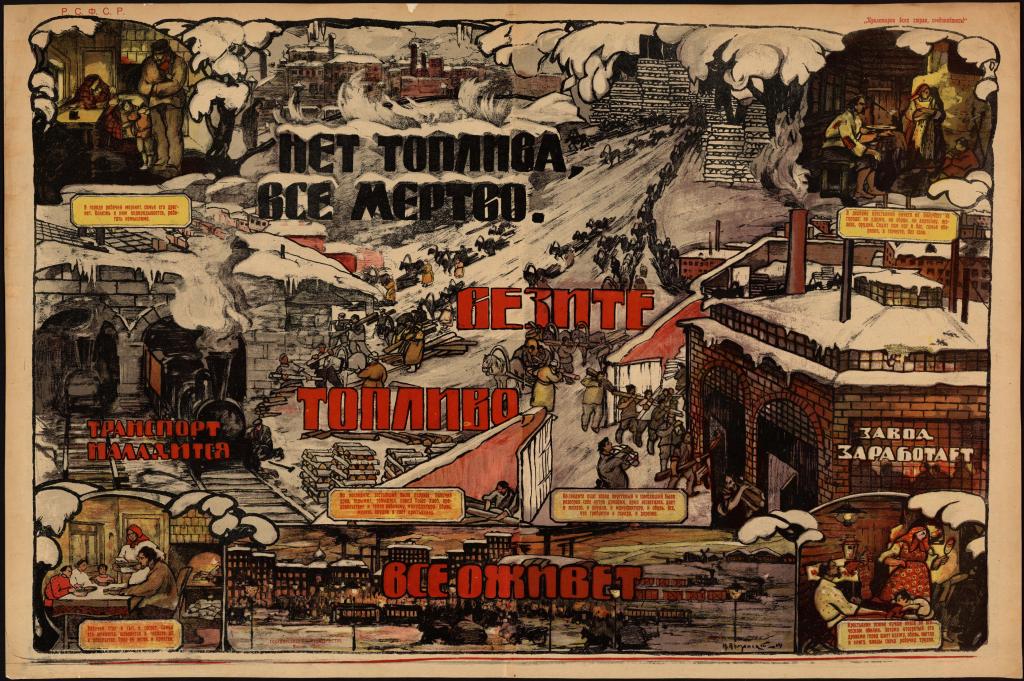
This Civil War-era Soviet poster gives a panorama of life during that time.
The Master Plan
A more nuanced criticism of the Bolsheviks is that they were utopian and irresponsible, that the October insurrection triggered a chain of events that forced them to adopt terror and dictatorship, and later to degenerate into Stalinism. I don’t agree with this view; I blame invasion, insurgency and blockade for the Civil War and the mass mortality which attended it.
But whichever of those two arguments you accept, Beevor’s argument stands off to one side with a demented look in its eyes. He believes that Lenin planned it all in advance – the Civil War, the confiscation of grain, terror, the suppression of opponents, one-party rule. Of course, there is absolutely no evidence that Lenin had such a plan. But for Beevor, the lack of evidence shows only that Lenin was dishonest and hid his real intentions! Childish stuff.
Just in case you think I am caricaturing Beevor’s position, here is what he says:
Grain requisitioning was in fact an emergency response to famine; but for Beevor, it was an act of malice long premeditated in the mind of Lenin. ‘The peasants were encouraged to believe that the land would be theirs to own and work as they saw fit. There was no mention of the need for grain seizures to feed the cities or the forced collectivisation of farms.’ (Page 50) Grain seizures were not foreseen, though Fitzpatrick comments that the Bolsheviks themselves were probably more surprised by it than the peasants, from whom contending armies had seized supplies since time immemorial. And it was fair enough not to mention forced collectivisation, right? Seeing as, well, in Russia in these years, it wasn’t Communist policy and in fact it actually didn’t happen..?
The withering of Soviet democracy was an effect of Civil War, famine and polarisation; but in this account, it was the fulfilment of a secret blueprint for a one-party state. ‘In his determination to achieve total power for the Bolsheviks, Lenin did not make the mistake of revealing what Communist society would be like. All state power and private property, he claimed, would be transferred into the hands of the Soviets – or councils of workers – as if they were to be independent bodies and not merely the puppets of the Bolshevik leadership.’ (p 50) ‘And because he knew very well that his plan of complete state ownership was not popular, he simply paid lip service to the idea of handing the land over to the peasants and factories to the workers.’ (Page 62) The casual reader, for whom this is the first thing they ever read on the Russian Revolution, would not suspect that such documents as ‘The State and Revolution’ or ‘The impending catastrophe and how to combat it’ ever existed. They would assume that what Beevor is saying is based on some document or other written by Lenin where he reveals his secret plans. There is no such document. The casual reader (and maybe even Antony Beevor) would be surprised to learn that four Soviet congresses met in 1918 and that by the end of the war there were still large numbers of factories democratically run by their workers.
The other elements of the master plan, the Cheka and Lenin’s supposed plan to deliberately start a Civil war, are dealt with here.
We can say categorically that there is no evidence that such a master plan ever existed. If you look at what the revolutionaries actually wrote, said and did, it is clear that they favoured a gradual socialisation of the economy, the sharing-out of land rather than collectivisation (collectivisation was to be a gradual and voluntary process lasting decades), and multi-party democracy in the Soviets.
Later, some Communists made a virtue of necessity. But still, more than traces of the original plan are visible down through the years. In early 1919 the Soviets were willing to surrender most of the territory of Russia to the Whites, just to end the war – hardly consistent with the supposed master plan. Right after the abrupt ending of Beevor’s narrative, millions were demobilised from the Red Army, the Cheka was radically downsized and curtailed, and the New Economic Policy (NEP), which favoured the peasants, was brought in.[vii]
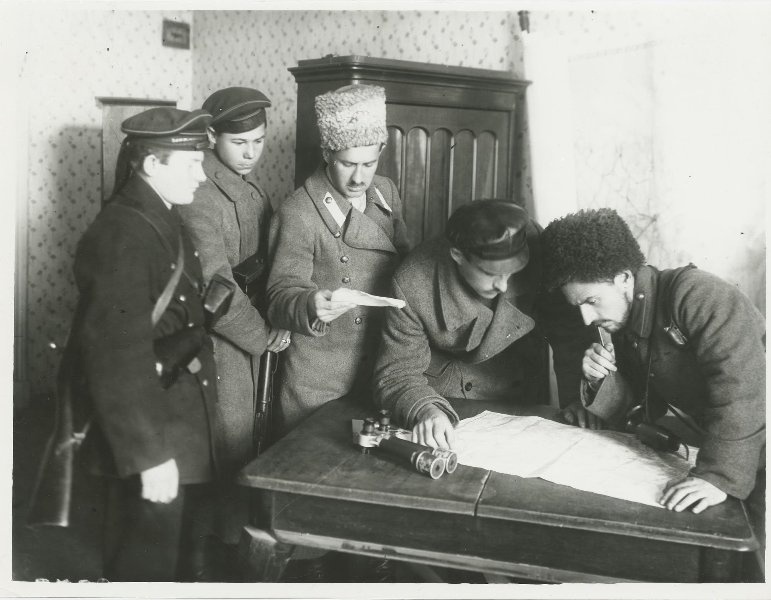
Headquarters of naval cadets near Narva, September or October 1919. What are they reading? Lenin’s master plan?
This point applies to the back-dating which I described earlier. Why does it matter if a writer shuffles things around by a few months? Isn’t this a justified simplification for the sake of clarity? In his point of view it probably is. But months, weeks and even days can matter a great deal. Torture, invasions and the USA Patriot Act were not brought in before September 11th 2001. Likewise events before May 1918 and after May 1918 must be judged by different criteria. For example, a radical economic plan from the Left Communists was actually rejected by the Party in March 1918. But in the context of the extreme military and economic emergency that very quickly emerged, most aspects of it were adopted out of necessity and became known as ‘war communism.’
I don’t accept Beevor’s narrative. I believe that the forced seizure of grain was an emergency response to famine, not an act of senseless vandalism born under the malicious cranium of Lenin.
The reasonable debate you can have here is whether they were effectice or fair reaponses. But because Beevor has set out to tell a certain story, we never get that far.
The crises which led to terror, requisitioning, dictatorship etc are treated as if they were results of terror, requisitioning, dictatorship etc. Beevor leaves the uninformed reader with the impression that the officers and Cossacks rose up in arms because they were outraged by a situation which did not arise until months later – and which arose due to their insurrection! In this way, Russia makes an absolute mess of cause and effect.
Blame on both sides of the equation
In passing, note how no opportunity is missed to condemn the Reds. The ‘Bolsheviks’ are blamed for supposedly failing to cooperate with others, but they are also blamed whenever someone with whom they cooperate does something bad (Muraviev); they are blamed for crime, and also for the draconian security measures which were partly directed against crime; they are blamed for the mistreatment of civilians by the Red Guards, and also for the harsh discipline which put an end to this behaviour. Further explanation is required, surely, when blame is placed on both sides of the see-saw.
Conclusion
This is a vigorous but crude book because, for all its grisly detail, it dispenses with nuance. The author has decided to convince us that Lenin is like Suharto, even like Hitler (more on that next post!). He’s not the first but it’s a bold move. This all-out ‘take-no-prisoners’ approach gives the writing some vigour, but it goes against the grain of reality, compelling the author to back-date key developments and, furthermore, to insist that these developments were the fulfilment of a secret master plan. What emerges is something compelling but not convincing.
A more skilful demonisation of the Reds would emphasise that ‘the road to hell is paved with good intentions,’ etc, etc, would use the bright colours as well as the dark, would not neglect to use the elements of tragedy which so obviously present themselves. Most accounts, from every side of the political spectrum, do this to some extent. But Beevor has taken a gamble, and gone for something bolder. He has fallen short, because reality does not correspond to the story he is trying to tell.
So Russia: Revolution and Civil War lands with some force, but it does not stick. Even those who are stunned into an uncritical acceptance of Beevor’s narrative will be able to see clear daylight through the gaps in the narrative, and may later reconsider, especially if they end up reading a few other bits and pieces on the same topic.
[i] This is not just my contention. Here is just one example which I have to hand as I write, from an account not sympathetic to the Soviets: Silverlight, The Victors’ Dilemma, Page 15: ‘real oppression did not start until the Terror, several months later.’
[ii] This massacre of officers cannot be justified with reference to existential threats. Estimates of the death toll range from the low hundreds to the thousands. But important parts of the context are missing from Beevor’s account: the suppression of the Kyiv Arsenal revolt by the Rada, the killing of prisoners by the Rada, and the fact that the Red Guard force which carried out the massacre was a notably undisciplined one led by the adventurer Muraviev, an officer who had recently joined the SRs. Needless to say, the broader context (his account of the conflict between Rada and Soviet) is one-sided.
[iii] ‘in 1900 an individual constable in the countryside, assisted by a few low-ranking officers, might find himself responsible for up to 4,700 square kilometres and anywhere between 50,000 and 100,000 inhabitants.’ Smith, Russia in Revolution (p. 19)
[iv] See The Jakarta Method by VIncent Bevins, PublicAffairs, 2020
[v] The lower figure comes from Faulkner, ‘The Revolution Besieged’ in A People’s History of the Russian Revolution and the higher figure from Smith, Russia in Revolution: ‘One scholar estimates that between October 1917 and February 1922, 280,000 were killed either by the Cheka or the Internal Security Troops, about half of them in the course of operations to suppress peasant uprisings.’ (p. 199)
[vi] Peter H Solomon Jr, Soviet Penal Policy, 1917-1934: A Reinterpretation
[vii] None of this is secret lore. On the land question, see the collection The Land Question and the Fight for Freedom. On the rejection of the Left Communists’ proto-war communist plans, see Year One of the Russian Revolution by (none other than) Victor Serge. On the Soviets’ peace plan, see any history of the Civil War. On the downsizing of the Cheka, see Smith: ‘At the end of 1921 there were 90,000 employees on the official payroll of the Cheka, but by end of 1923 only 32,152 worked in OGPU.’ (Russia in Revolution, p. 296).
That was, until I Googled a few of the mainstream media reviews. Apparently it’s ‘a masterpiece,’ ‘grimly magnificent‘ and ‘a fugue in many tongues.’ Since the moment I was exposed to this gushing, I have felt an urge to point out that the emperor has no clothes. Judged as a work of popular history, Russia is deeply flawed. Judged as a work of anti-communist demonology, it’s spirited but crude. The fact that it demonises the Red side would be a selling point for some, but many have failed to notice what a clumsy demonisation it is.
So I’ll be reviewing the book in a short series of posts. This first post will deal with the things I liked about the book, and then go into some serious criticisms of its one-sidedness, its bias toward the rich, its credulity and its general sloppiness.
Positives
Fortunately, the whole book is not as bad as that one chapter I looked at before. That chapter is merely on the bad side of average. Overall, the book has some strong features which manage to shine through.
First, it is a detailed narrative history of the Russian Civil War, a rare thing in the English language, which gives the book a certain value in itself.
Second, Beevor had the help of researchers in Eastern Europe, so there is a wealth of new material here that I haven’t come across elsewhere.
Third, when it is in narrative mode and not moral judgement mode, the book is well-written. For example, the section on the year 1919 is mostly good, and if I was reviewing only that one-fourth of the book I wouldn’t have much bad to say.
Fourth: the book deals with White Terror as well as Red. I was honestly surprised because most western accounts pass over anti-communist atrocities in tactful silence. However, even in this treatment of White Terror there are big problems, which I’ll point to below. Another thing to stick a pin in and come back to later: here as elsewhere, Beevor’s own evidence makes a joke of his conclusions.
Not every element of the book is crude. The narrative is strong at times. In short, for its style it is readable, and for its content it is a useful resource. Per-Ake Westerlund has written a useful review in that spirit.
Now, on to the bad points.
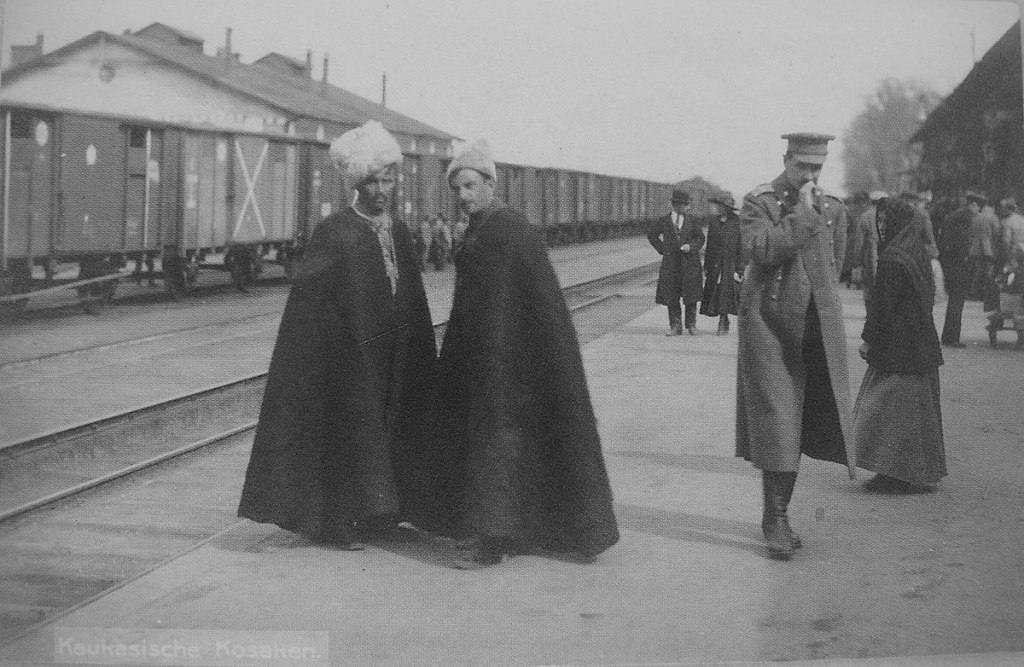
Cossacks and a White officer in Odessa railway station, 1919
What were they fighting about?
In its review the Wall Street Journal asks: ‘If the American Civil War ended slavery, and the English Civil War restrained the monarchy, what did the Russian Civil War achieve?’
If this book was the only thing you ever read about the Russian Revolution, you could be forgiven for asking such a question. The most striking feature of Russia: Revolution and Civil War is its complete inability to see anything positive in the revolution. It’s such a one-sided book, you would probably be appalled to find out there are well-read people (such as me) who regard the Revolution as a great event in world history. If you uncritically accept everything Beevor says, you could only regard me as a dangerous lunatic for holding such a belief.
I suppose it is true that the seizure of the land of the nobility by the peasants was not an enjoyable experience for the nobles. But what about the point of view of the peasants themselves? Weren’t they happy to get more land? And weren’t they a hundred times more numerous than the nobles? Beevor doesn’t even ask the question. But when the peasants began ‘to seize their landlords’ implements, mow their meadows, occupy their uncultivated land, fell their timber and help themselves to the seed-grain,’ he describes it as ‘violence’! (p 50-51)
Was there nothing inspiring in the fact that millions of poor people organized themselves and exercised power through workers’ councils? Apparently not; Beevor dismisses Soviet democracy in a few lines.
The author acknowledges how bad the Great War was, so how can there be nothing positive or even viscerally satisfying for him in the revolt of the soldiers? Was the liberation of women really such a trifling matter that it can pass without any mention at all in 500 pages? How about free healthcare? The world’s first planned economy, which provided healthcare, education and housing to 200 million people and turned a semi-feudal country into the world’s second industrial power?
Isn’t it at least interesting for a military historian that, in the Red Army, formal ranks were abolished and a regime of relative egalitarianism prevailed between commanders and soldiers? That sergeants, ensigns, steelworkers and journalists found themselves commanding divisions and armies, and won? 3/4 of the way through this post I wrote you will find a bullet-point list of similar points.
What, indeed, did the Russian Revolution achieve? Nothing at all – unless we count the achievements.
By failing to deal with these points, the book is neglecting to tell us what the Reds were fighting for, or what the Whites were fighting against. The whole thing becomes a leaden nightmare. People in funny hats are dying of typhus and hacking each other to pieces with sabers for no apparent reason.
Every writer on history makes decisions about what to include and what to leave out. Beevor left in all the bits about dismemberment and torture chambers and rats gnawing at the soft parts of people, and left out all of the above. That’s his prerogative. But isn’t it manipulative? Isn’t it morbid? If you are that reader who has never read anything else on the subject, don’t you have a right to feel cheated?
Baking the evidence
The first half of the book, especially, exhibits all the features I outlined in my previous post.
Whenever Beevor comes across a quote from a communist that can be interpreted in a negative way, he proceeds to bake it, to over-interpret it until it is twisted beyond recognition. I imagine him sitting at his keyboard and muttering ‘Gotcha,’ before he ascends to the pulpit with a scowl on his face to deliver a sermon whose theme is the wickedness of the Bolsheviks.
One example: in June 1917 a Menshevik stated that no political party in Russia was prepared to take power by itself. Lenin responded that his party was ‘ready at any moment to take over the government.’ The meaning of this statement is blindingly obvious: they were ready to form a single-party government if necessary, though still open to a coalition government. But Beevor ascends to the pulpit. Apparently it was a ‘startling revelation’ which ‘proved that Lenin cynically despised the slogan “All power to the Soviets”’ and sought ‘absolute control.’ A large part of the texture of the book consists of moments like this.
At other times he caricatures wildly, or presents his own very strange interpretations as if they were factual statements. A street protest in April 1917 is described as a ‘tentative coup’ and a ‘little insurrection’ – ‘tentative’ and ‘little’ are doing a lot of heavy lifting. Any kind of peaceful, democratic Bolshevik political activity – visiting soldiers and talking to them; winning a Soviet election – is invariably described as ‘infiltration.’
Lenin, who Beevor loves to hate
Credulity
In addition, Beevor gives credence to dodgy sources. One example: it has been generally accepted for 100 years that the October Revolution in Petrograd was almost bloodless. Or so communist propaganda would have us believe!
Beevor quotes the memoirs of one Boyarchikov, describing a clash at the telephone exchange during the fateful first night of the Revolution. There is a fierce gun battle in which loads of people are killed. After the fight, the pro-Soviet Latvian Riflemen pick up all the dead and the wounded, the enemy’s and their own, and throw them out of an upper-storey window! Next they throw the dead and dying into the river, presumably to hide the evidence (Page 99-100).
This account is obviously absurd. A slaughter such as the one described would have had many, perhaps hundreds, of participants and witnesses, and the press would not have been shy about spreading the news. Why would the Latvians throw their own comrades out of a window and then into a river? For that matter, why would they even do that to the enemy?
You might wonder why someone would make up such a Ralph Wiggum-like story. The answer is that the October events in Saint Petersburg triggered a veritable fever dream of fabricated atrocity stories. The detail about the bodies being dumped in the river was probably invented to explain the lack of corroborating evidence, ie, a massive pile of dead bodies, or a politicised mass funeral.
Beevor repeats some of the discredited rumours from the time: that the Women’s Battalion were ill-treated, and that the Bolshevik Party was funded by ‘German gold.’ In both cases he admits that there’s no evidence, but this doesn’t stop him from bringing it up in the first place, or from writing words to the effect of shrugging his shoulders and saying ‘I guess we’ll never know.’ It’s the old ‘shouted claim, mumbled retraction’ trick.
Russian and Finnish Red Guards, 1918. CC-BY Tampere 1918, kuvat Vapriikin kuva-arkisto. Finnish Civil War 1918 Photo: Museum Centre Vapriikki Photo Archives.
Only trust the affluent
In addition, he describes too much of the story from the point of view of officials who were trying to suppress the revolution, or members of the intelligentsia and bourgeois who were observing it with detachment at best, or horror at worst. Rarely does he condescend to show what a worker, peasant or rank-and-file soldier experienced or thought. As individuals, working class people enter the narrative only as sadistic persecutors. As a mass, they enter the narrative only as a ‘blindly’ destructive force which ‘the Bolsheviks’ exploit for their own ends.
This is because Beevor only trusts bourgeois and middle-class testimony. Second-hand rumours recorded in officers’ letters or bourgeois diaries are gospel. Later in the book he remarks, surprised, that the Red Army was magnanimous and fair after its conquest of Omsk. He accepts this about Omsk only because he has a first-hand account from a solid bourgeois citizen confirming that it was the case. Instances where the Reds were magnanimous to poor people are not relevant.
When Beevor spent a few pages writing about a failed attempt to get Tsar Nicholas’ brother to assume the throne, I left the following note in my ebook (Here it is with the original typos, because they’re funny):
jesus christ, this is a historian in the 21st century, obsessing about dynastic minutiae while ignlring the sociology and street politics where historyis really beimg decided [sic]
This book must be confusing for the casual reader. How did the Bolsheviks take power? Did they convince everyone to support them with a flashy German-funded ‘press empire’ (Page 76) or was it by prevailing upon a bunch of simpletons to ‘repeat slogans’ until they were blue in the face? (Page 93) In theory both could be true, I suppose, but it doesn’t really explain why a tiny party grew so rapidly to the point where it was able to lead the Soviet in a popular insurrection.
Eyewitness accounts of the February Revolution which described soldiers firing machine-guns at demonstrators were ‘repeated constantly’, he says, but it is ‘impossible to tell’ if these accounts are true, even though he admits that there were machine-guns trained on them and that rifles were fired at them (Page 34). What contempt for the working-class authors of these eyewitness accounts.
His default ‘point of view’ in the narrative is that of the affluent person ruined by the Revolution, or even just inconvenienced. For example he bemoans the lack of ‘privacy’ for wealthy people who had to share their large homes with multiple poor families. Not a word about the lack of privacy suffered for decades by working-class people who lived in slums (often three to a room, often sharing beds) or in company barracks. He laments the fact that formerly wealthy families had to sell their goods in the streets. No hint of sympathy for the vast majority of families, who never got to own such goods at all until after the revolution.
‘Revolution could also reveal that the downtrodden harboured some terrifying prejudices,’ he says, and then tells us an anecdote about a stall holder who made an anti-Semitic comment. Of course, the not-so-downtrodden (Tsar Nicholas, and all those generals and ministers who Beevor loves to quote, and the entire Orthodox Church, and the entire White movement) held the exact same prejudices, but in their case it is apparently not terrifying.
Early on, he briefly acknowledges how squalid and difficult life was for 90% of people under the old regime. But he does so in a way that’s not meant to evoke sympathy or understanding; it’s just more icky details to make the book even more ‘grimly magnificent.’ The effect is to humiliate and dehumanise the poor. And he goes on to humiliate and dehumanise them with a sweeping, derogatory remark here and a prejudiced quote there in every other chapter. Usually through the safe remove of quotation marks, but with insistent repetition, Beevor describes workers, peasants and Russian people generally with phrases like ‘Asiatic savagery,’ ‘children run wild,’ ‘ignorant,’ ‘blind,’ ‘dark mass,’ ‘grey mass,’ ‘anarchic Russia.’
But as we noted, when Lenin calls rich people parasites, Beevor charges him with incitement to genocide!
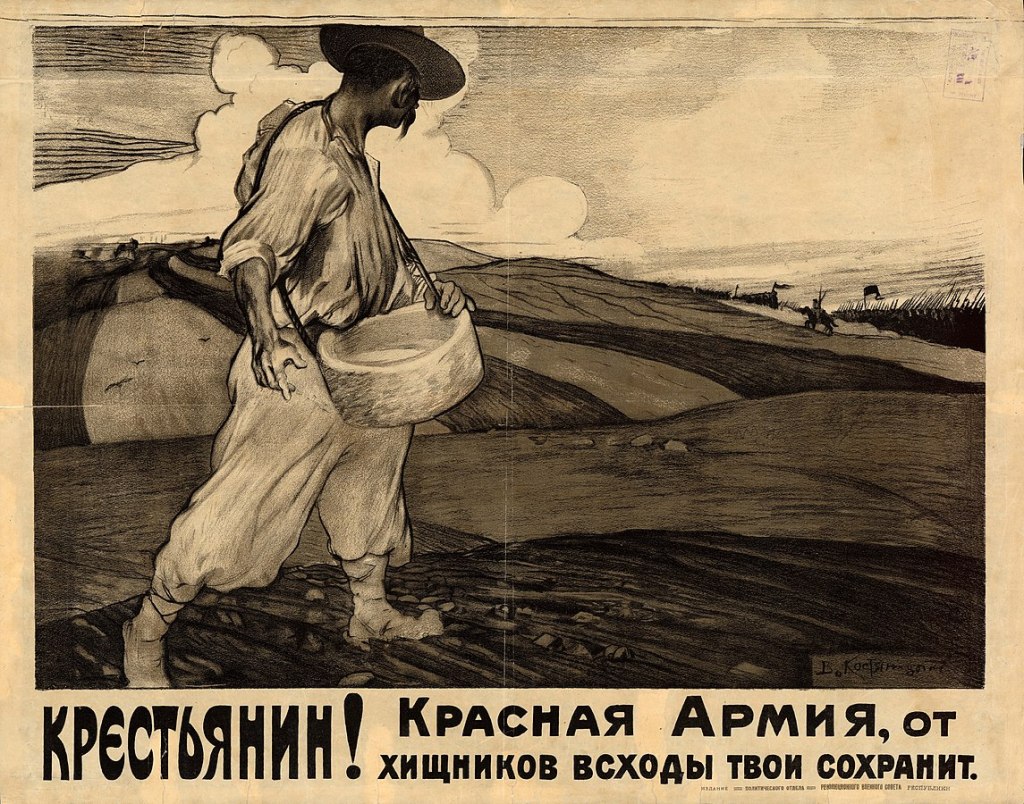
A Russian peasant, depicted in a Red Army poster
Stalinism
One reviewer writes that Beevor ‘comments occasionally on the ways events foreshadow (‘give a foretaste,’ he calls it) of horrors to come.’
(As an aside, imagine being so impressed by the phrase ‘Give a foretaste’ that you would note it in your gushing review. Has she never read a book before?)
Russia: Revolution and Civil War actually makes no mention of Stalinism, of the later development of a bureaucratic tyranny that was responsible for such crimes as the Great Terror of 1936-39, the catastrophe of forced collectivisation and the mass deportation of minorities. This is probably because the book is too busy alternating between narrative and moralising to bother with analysis, but it is actually refreshing. Beevor does, however, set things up so that his star-struck reviewers can easily kick the ball into the net: they repeat in chorus, like the sheep from Animal Farm, that this book proves Lenin was just as evil as Stalin.
The reviewers don’t show any understanding that the violence and suffering of the Civil War was completely different in scale, in context and in character from the atrocities of Stalinism. Nor do they appear to suspect that anyone apart from the Bolsheviks might have been responsible for the Civil War and for the violence and suffering that ensued. More on that in future posts.
Sloppiness
Russia: Revolution and Civil War is often sloppy. Beevor repeats several times that Lenin was cowardly, but provides only one example (he went into hiding when the government wanted to arrest him, which seems pretty reasonable). Then he goes on to provide several examples of the Bolshevik leader being personally brave. Each time he remarks on it as a strange exception! Similarly, he says that Lenin is intolerant, but goes on to note one ‘exception’ after another. He doesn’t modify his characterizations, just lets them stand even when they’re full of holes.
Lenin is a key character in the first half of the book, but disappears in the second half – which suggests the heretical idea that maybe he didn’t have complete totalitarian control over events. The atamans of Siberia are introduced – then never followed up on. The narrative ends with Kronstadt, as if the author simply got tired; but at this point the Whites were still in Vladivostok. The introduction and conclusion are insubstantial, especially in comparison to the leaden weight of the book. They are like the wings of a fly growing out of the flanks of an elephant.
Another confusing point: Beevor notes in passing, half-way through the book, that Lenin was good friends with the writer Maxim Gorky. Up to this point Beevor has frequently quoted Gorky, always cherry-picking his most extreme criticisms of the Bolsheviks, never giving a more balanced impression of Gorky’s politics. The reader will wonder how Gorky could possibly stand to be in the same room as Lenin, and how for his part the ‘intolerant’ Lenin could be friends with Gorky. If reality corresponded to Beevor’s unbalanced account of the Revolution, then Gorky would have lasted about six weeks before being shot by the Cheka. As opposed to having a park in Moscow named after him!
As I noted before, much is made of the Cheka in December 1917 – all twenty of them. The development of this institution is not described in the rest of the book either; the Cheka just enters stage left and immediately starts slaughtering people. More on that next week.
In the chapter I reviewed before, Beevor was simply too strident and excitable to give an inch on anything. In the examples above he’s more conscientious, mentioning facts that are inconvenient to the case he’s making. But in failing to reconcile his characterizations with the evidence, he is making a bit of a mess that will leave readers scratching their heads.
And there I will leave you, perhaps scratching your own head; if you read the book and thought Beevor was courageously bearing moral witness to some hitherto-undiscovered chapter of history unsurpassed in horror and squalor, I hope I’ve given you something to think about.
Please subscribe and keep an eye out for Part 2 of this review.
‘[T]he Bolsheviks are failing… their regime is doomed.’
Winston Churchill to Lord Curzon, Autumn 1919 (Kinvig, Churchill’s Crusade, p 305)
January 15th, 1920
The date by which, in Autumn 1919, British military officials predicted Moscow would fall to the Whites
‘Na konii, proletarii!’
‘To horse, proletarians!’ Red Army slogan, 1918-1919
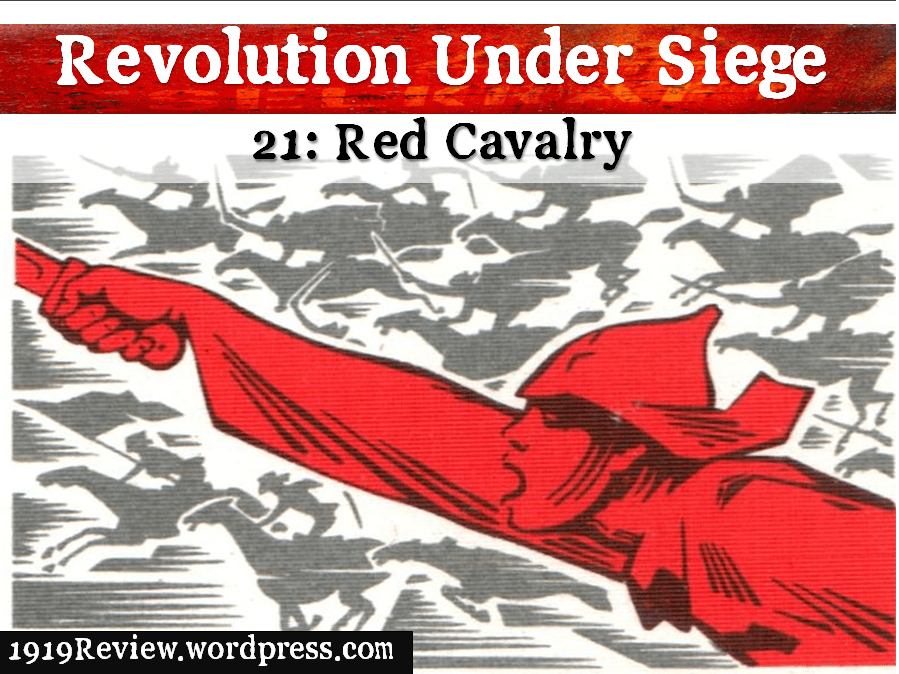
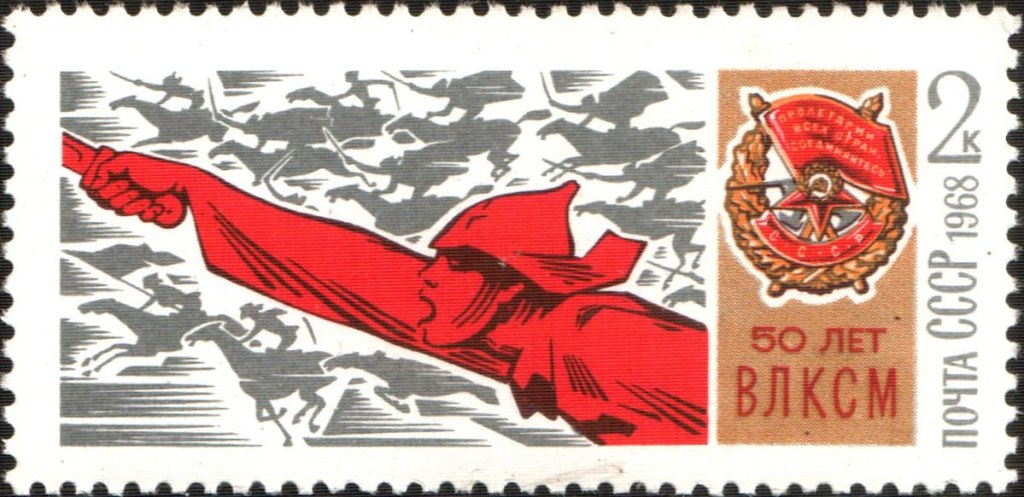
Today’s cover image: a 1968 postage stamp commemorating the Civil War-era Red Cavalry
Become a paying supporter to get access
Access to this article is limited to paying supporters. If you already subscribe by email, thank you. But if you want to become a paying supporter, please hit ‘Subscribe’ below.
Donate less than the price of a coffee, and you can access everything on this blog for one year.
If you don’t feel like donating, most of my posts are still 100% free, so browse away, and thanks for visiting.
So it turns out The Witcher is better without The Witcher.
A long time ago I watched the first 3 or 4 episodes of The Witcher and never warmed to it. I liked the monster fights. But the production varied in quality from ‘dripping with Gothic atmosphere’ to ‘just plain tacky.’
The prequel series Blood Origin caught my attention by accident over the Christmas. Now, since watching it I’ve tried to read a review or two to find out why so many people (but not everyone) hated it. This one from Polygon was largely incomprehensible to me. It’s not just that I disagreed; I did not understand what the criteria were by which the series was being judged.
To my eyes, it was not a series that undermined the precious canon or a mess of a story which invited me to pick it apart to explain how it failed. It was a pulp swords-and-sorcery adventure which looked and sounded good, which had a cast of fun, engaging characters, which was focused and disciplined at a tight four episodes. The class war elements set up in the first episode with the rabble-rousing song ‘The Black Rose’ paid off in spades at the end when a revolution was part of the final showdown.
That review from Polygon says: ‘There’s a class conflict that keeps getting hinted at through a song Élie [sic] is famous for, but there’s never much consideration of what that actually means, in-universe, beyond “lower-class folks are hungrier than their elite counterparts.”’
I said of Andor that I didn’t need it to be a Ken Loach film. Well… I don’t need a three-hour fantasy story even to be Andor, let alone Ken Loach. The class war element was not at all simplistic – it was just focused and coherent.
One last quote from that review: ‘When Élie promises Scían the chance to reclaim the sacred sword of her people, it’s introduced in the conversation with no explanation for how Élie would’ve even known it was gone.’
Not only did that not bother me, it didn’t strike me as a thing which might conceivably bother anyone. Éile has lived in this world all her life and presumably knows about various things. If she has shoelaces (I can’t remember) she probably learned to tie them at some point in her life, but we don’t need a flashback explaining this.
Who first came up with the trope of making Elves speak the Queen’s English? In this, the elves have Welsh, Irish and other regional accents. If that’s a feature of The Witcher (I can’t remember) then good for The Witcher. Tolkien-variety elves are a mythical reflection of Celtic peoples as seen through Anglo-Saxon eyes.
They got the tone just right. It doesn’t take itself too seriously, but then it doesn’t let silly banter undermine the serious moments either. After just two and a half episodes, we get a sequence where the seven adventurers sit down and have a party. That strikes me as a difficult thing to pull off; the writers have got to warm the viewers up to the characters and the characters to each other. Blood Origin pulled that off.
The cast was uniquely diverse. I say ‘uniquely’ because off the top of my head I can’t think of another TV series or movie in the genre that does such a good job of reflecting the diversity of our species in its cast.
I felt it could have gone on just a bit longer, another episode or two, and that the promised ‘Conjunction of the Spheres’ ended up being skimmed over. Neither of these things was a deal-breaker for me; in fact I was relieved that it wasn’t a sprawling, incoherent mess that was too busy setting up hypothetical future seasons to tell its own story. I could forgive it for erring in the other direction.
Finally and crucially, I was relieved that platinum-blonde Solid Snake was nowhere to be seen. I don’t want to criticise The Witcher too much because that would be churlish in this context. Geralt of Rivia has an iconic look, I suppose, but I never found him interesting in my limited exposure to the show. His absence leaves a lot of room for other characters to throw their weight around.
Anyone familiar with the stuff I write about here on The 1919 Review might suspect that I only enjoyed this show because it had two things I liked: class struggle and Irish stuff (‘Inis Dubh’ means ‘Black Island’). But if they hadn’t been there, I would still have enjoyed it: I read a lot of science fiction and fantasy, and I appreciate a punchy, well-crafted tale of sorcery and adventure with strong characters and a vulgar edge. Blood Origin is all that.
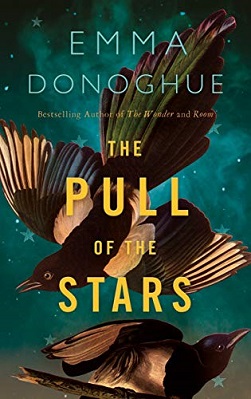
Emma Donoghue’s The Pull of the Stars begins like a movie sequence full of long tracking shots, following a nurse on her commute through the dark of early-morning Dublin streets in the autumn of 1918.
There are masked men spraying the gutters with disinfectant, children assembling at the train station for evacuation to the country, fear on the tram at every cough and spit: this is the height of the ‘Spanish Influenza’ pandemic.
After what she calls ‘the grippe,’ the next item in order of relevance to our narrator, Nurse Julia, is the ongoing First World War. It’s in its last few weeks, but she does not dare to hope that rumours of mutinies and moves toward peace are true. The war is as inescapable as the pandemic in the way it shows up in a wealth of details in this everyday experience.
The struggle for independence is a distant third, or perhaps it’s even further down the list of priorities for Julia. She passes the burnt-out ruins of O’Connell Street which still haven’t been rebuilt after the 1916 Easter Rising, which she dismisses in her mind as an act of crazy violence by a handful of extremists (Later she says to a rebel supporter, with icy understatement, ‘I got some experience with gunshot wounds during that week.’)
More relevant than the national question is the patriarchal influence of the Catholic Church: it is considered unseemly for Julia to cycle to the church-run hospital where she works.
It could be argued that the author is laying it on thick with the sheer amount of historically relevant things jostling for attention in every paragraph of Julia’s commute. But it’s authentic: these were extraordinary times and history was not something you could escape, least of all in the routine of everyday life. Reconstructing this extraordinary and forgotten moment is an important feat.
Later we will learn that Julia has never heard of Thomas Ashe, the Irish Republican who died on hunger strike in 1917. We never see her reading a newspaper, so it’s believable that the whole thing would have escaped her attention. And it’s not just plausible, it’s kind of refreshing. There was other stuff going on.
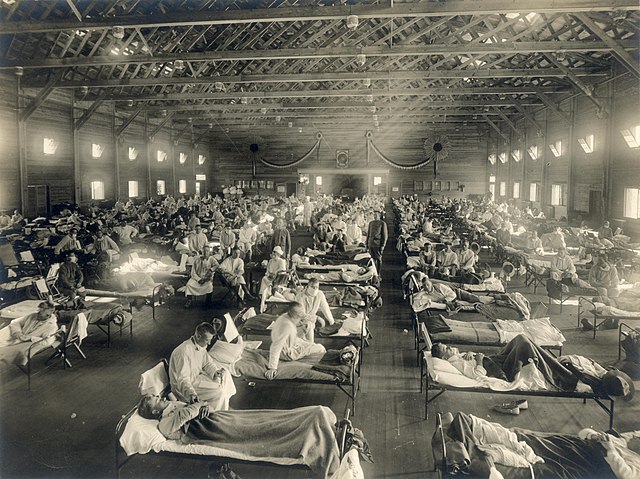
An emergency hospital set up in Kansas, USA, to deal with the Flu pandemic
Getting caught up in the work
When Julia arrives at her hospital she and the reader get caught up in her work. Before you know it, you’re a third of the way through the book and you care deeply about the current condition of each of her patients. She’s looking after maternity patients who also have the virus; she has to keep these women and their babies alive. It’s one thing after another. We are swept up in the technical (and gruesome) details of the craft and the personalities which populate the cramped room.
When a volunteer arrived to help Julia, I was so invested in the work that I felt a rush of crazy gratitude toward this fictional character.
This character is Bridie Sweeney, and we will learn a lot about her over the next three days. And when we know Bridie’s story, we will question whether it’s enough for Julia simply to save the lives of these women and their infants. Many of them are destined for the orphanages, laundries, mother and baby homes andindustrial schools, a vast half-hidden Gulag which Bridie refers to as ‘The Pipe.’ Meanwhile infants in Dublin have a worse chance of surviving than soldiers in the battles of the ongoing war.
Changing attitude to the rebels
There is the gradual intrusion of Dr Kathleen Lynn, a real-life character. She is at first a troubling rumour – the hospital is scraping the bottom of the barrel and hiring a terrorist! – then a reassuring, compassionate and professional presence in the makeshift maternity/fever ward. We can see Julia, not consciously but no less obviously, changing in her attitude toward Lynn and the other ‘terrorists’ who led the 1916 Rising. People are dying every day anyway, argues Lynn – not from gunshot wounds, but from poverty and squalor caused by capitalism.
Lynn is perhaps a too-perfect character, who always has a clever and compassionate answer to every challenge. But it’s not like she’s Pearse or Connolly; she’s an underrated figure and long overdue a tribute in fiction.
A Covid novel
Like Oisín Fagan’s Nobber, The Pull of the Stars is a book about a past pandemic which was written just before Covid. The writer was not thinking of lockdowns, masks, jabs and Zoom calls. But the mind of the reader is dominated by comparisons.
What we see in the book is a lot worse than what Irish people have gone through in recent years, for the simple reason that in 1918-1919 there were apparently no half-way serious public health measures. There was no vaccine. Bad and all as our health service is today, there was no health system worthy of the name in 1918.
The attitude of the state is conveyed in poster slogans. One says: ‘Would they be dead if they’d stayed in bed?’ As Julia notes, it’s much more difficult for working-class people to stay in bed for days. Another says that ‘THE GENERAL WEAKENING OF NERVE-POWER KNOWN AS WAR-WEARINESS HAS OPENED THE DOOR TO CONTAGION. DEFEATISTS ARE THE ALLIES OF DISEASE.’
But there was always a strong element of that in public health messaging during Covid as well – scolding people instead of helping them, demanding sacrifices instead of providing basic supports. The hospital in The Pull of the Stars– overcrowded, understaffed; every nook and cranny turned into a ward, the canteen banished to the basement – will be drearily familiar to many who worked during Covid.
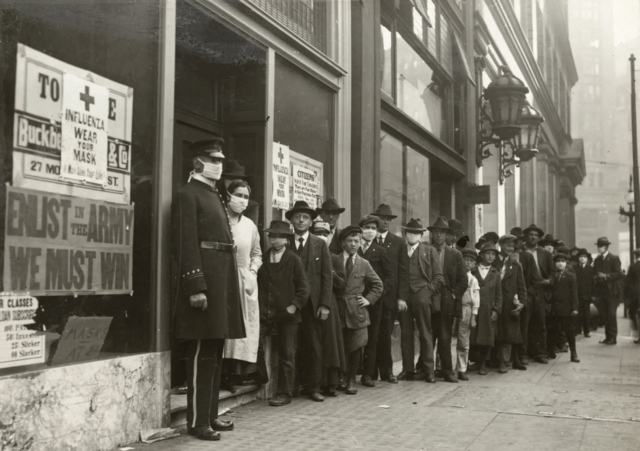
Face coverings and recruitment posters in San Francisco, USA, during the pandemic. In this novel, Kathleen Lynn is a mask skeptic
Midwifery
Earlier I said the opening was cinematic, but later on The Pull of the Stars reminds us what movies can’t do but novels can. It is unflinching in its treatment of the details of nursing and midwifery – there is no misguided delicacy, in other words. You won’t see this in Call the Midwife or Emma Willis: Delivering Babies. TV won’t show this stuff, and actually it couldn’t even if it tried.
I don’t know enough about the history of obstetrics to say how accurate it all is, but nothing rang false to me.
Changes
Equally convincing is the way Julia changes. The extreme circumstances, along with a whirlwind experience of love and loss, move her deeply. Lynn’s socialist politics appear to have a catalysing effect. At the end of the novel Julia makes a radical decision which puts her on a collision course with the nuns.
The real reckoning in the novel is not with the pandemic. The ‘Spanish’ Flu merely shines a revealing light on empire, patriarchy, capitalism and the church. Above all else, it’s the horrors of ‘The Pipe’ that bring about change in Julia’s character. I’d bet that the Tuam Babies scandal was closer to the mind of the writer than the Bird Flu or SARS.
There is some implausibility in the ending. But Donoghue has succeeded in convincing us that this was a historical moment rich in implausibility. This is a rich and strange and terrible time when people might do extraordinary things. The choice Julia makes is moreover justified on a thematic and story level – a miracle that is ‘earned’ by tragic losses earlier.
This is a short novel and, I found, a gripping one. I’m interested in this period in history so I drank in all the detail. More importantly, Donoghue’s narrative of a midwife caring for a handful of pregnant invalids is somehow more exciting than any epic action scene I’ve read lately.








 The 1919 Review