The Warmth of Other Suns by Isabel Wilkerson

Have you ever heard of the Great Migration? I had heard of it before reading this book; I had a dim idea that it had something to do with black people moving to the northern cities during World War Two. It turns out, it’s much bigger than that. Isabel Wilkerson’s book The Warmth of Other Suns opened my eyes to the scale of this migration and how central it is to black history. In 1910, 10% of black people lived outside the South. The black population of Chicago was only 44,103. By 1970 that 10% had risen to 43%, and that 44,103 had topped 1 million. They were moving northward in their masses for over fifty years. It was not just a massive demographic shift. It was, says Wilkerson, “the first step the nation’s servant class ever took without asking.”

This is a big book, but I got through it pretty quickly. The author focuses on three individual migrants from different decades, states and backgrounds. She writes about them so well and they are such interesting people, that I remember their names six months after I read the book: Ida Mae Brandon Gladney who went to Chicago, Robert Pershing Foster who went to California, and George Swanson Starling who fled death threats in Florida and became a train porter in New York. In between, the author zooms out to an overall narrative, placing their travails in context. 

I thought I knew about the racist Jim Crow laws in the Southern US. But I never realised just how dystopian, sick, mad and brutal it was. Black and white people could not tread on the same steps or hold the same rail entering a train. Black motorists had to give right of way to white motorists. Black schools got second-hand textbooks begged from white schools. Ocoee 1920 and Rosewood 1923 were two of many pogroms I’d never heard of before. The lynching of Claude Neal (1934) was another episode which was almost beyond belief. Sheriff McCall is another name you’d do well to google if you’re looking to be horrified. Between 1889 and 1929 someone was lynched on average every few days. 

“Scott and Violet Arthur arrive with their family at Chicago’s Polk Street Depot on Aug. 30, 1920, two months after their two sons were lynched in Paris, Texas. The picture has become an iconic symbol of the Great Migration. (Chicago History Museum)”

George Starling attracted my interest because of his role as a labour organiser. In a very informal way, he organised black fruit pickers in Florida to demand better wages. It worked fine until word reached him that the bosses were planning to lynch him. Then he had to high-tail it to the north. Robert Pershing Foster gives an insight into the world of the black bourgeoisie and upper middle class – which always existed, throughout the Jim Crow period and after. But I guess it was Ida Mae’s story that got under my skin the most. We see her as a young wife in Mississippi picking cotton, and we see her as an old woman in the Chicago home she moved into back in the white flight era, observing through her upstairs window the comings and goings of the familiar neighbourhood drug dealers and sex workers.

Generally the black migrants benefited from their migration to the north. Stereotypes about the new black communities in the north – that they had big dysfunctional families, that they didn’t work, that they were uneducated – were all rubbish. 

But often the book’s title reads like bitter irony; the sun wasn’t much brighter in the north. Foster’smigration involved driving for days across the desert being turned away from every motel because of his skin colour – in Arizona, which was not a Jim Crow state. Wilkerson paints a picture of how a ghetto neighbourhood was born. I always assumed ‘white flight’ from the inner city to the suburbs was some slow gradual process. It was not. The first black family would move into the neighbourhood, and at once all the whites would descend into a hysterical frenzy. They would be gone within months or even weeks. 

That is, if they didn’t try to drive out the new black families. There were 58 bombings in 4 years in one Chicago neighbourhood as white concerned residents fought a guerrilla war against peaceful black families. Wilkerson gives an account of the absolutely horrifying events in 1951 in Cicero, a suburb of Chicago, when one black family tried to move in. 

I remember my schoolbooks mentioned that Martin Luther King got a cold reception when he tried to organise black people in the northern cities. I always assumed, in a vague way, that he organised some meetings to which nobody showed up. What actually happened: he organised large marches that were beaten off the streets by violent white mobs. Northern mobs.

What I got out of this book was, first, an acquaintance with Ida Mae, George and Dr Foster, three fascinating individuals. Second, an appreciation of what a massive phenomenon the Great Migration was; think of any famous black person, and chances are they or their parents or grandparents were part of this epic story.

Third, what a crazy dystopia the USA was and is. That country has never really reckoned with this past, not really. For most of my life, the standard way for Americans to deal with the past has been to pretend that Martin Luther King agreed 100% with whatever the hell they happen to believe (Only people in the overlap of the Venn diagram of Protestantism and Socialism can actually claim that honour). This cosy consensus has been fracturing since Trayvon Martin, Mike Brown and George Floyd, and since Trump rose to prominence as a political figure in 2015. I don’t know what the next consensus will be or whether it will be closer to the truth or further away, but it will take a long time to emerge and will be the outcome of an epic political and social struggle. The Warmth of Other Suns deals with a historical episode that ended in the 1970s but it’s impossible to read a book like this without it provoking all kinds of reflections about the present and the future.

The Warmth of Other Suns by Isabel Wilkerson, Random House, 2010

Do you want to read more like this? Subscribe here:

Or browse my full archive:

Go to Home Page/ Archive

What I’m Reading: Asian Odyssey

Asian Odyssey by Dmitri Alioshin (Henry Holt and Company, New York, 1940, accessed on hathitrust.babel.org 25 May 2024)

This is a violent, vicious, cursed book. It’s also deeply engrossing and at times it approaches real beauty in the descriptions of nature and exotic ways of life. It purports to be a true story, making it a historical source. It rings true and mostly  corresponds to other sources I’ve read. But it can’t possibly all be true. 

So, yeah, it’s a strange one. 

Let’s try to sum up the story. Dmitri Alioshin is the son of a Russian merchant family in Harbin, China. He is a university student when the Russian Revolution takes place. He joins the White Armies to fight against the Red Army. He arrives at his frontline unit just on time to experience the decisive Red offensive and the collapse of White Siberia. Through wild adventures, some bloody, some farcical, he escapes at last to Mongolia. Here the remnants of the Whites fight on. He joins an armed band in raids against the Chinese and over the border into Soviet territory. His band is forced at gunpoint into the army of the ‘mad baron’ Ungern-Sternberg, and Alioshin bears witness to all kinds of unspeakable horrors in the course of one final campaign. After the defeat of Ungern, he escapes across the Gobi desert and back into China along with a small band of survivors. There is a final round of battles, both against the Reds and against White rivals.

You can get a taste of Alioshin’s book here, in this chapter of Revolution Under Siege where I quote him a lot. A lot of it is there in miniature: lyrical descriptions of nature and scenery; valuable first-hand accounts of war; absolutely ghoulish details like the cup made from the skull of a Red partisan. There is romance in how he describes the wilds of Asia and the people who live in it. He meets more than one picturesque old hermit. Many times he has to flee on foot across harsh and beautiful landscapes. He lives among the nomads of Mongolia, and gives us a powerful sense of what that was like.

Many times, he is within a whisker of death. Several times, he gives a frank account of himself killing someone with his bare hands; other times the reader doesn’t even need to read between the lines to figure out that Alioshin has participated in some unspeakable atrocity, such as forcing hundreds of people into a building and setting it on fire. Regarly  he is a witness to atrocity – to men being burned or frozen, to the sack of a city, to a gang-rape. 

You wonder if he’s making a lot of it up, if he’s credulous, if he’s pushing some agenda. Often he reports an atrocity second-hand, and this is a relief, because we have another degree of separation that allows us to say, ‘That’s probably bullshit. At least, I hope so.’ But sometimes it’s first-hand and there’s little comfort.

What really struck me was how benevolent the Reds come across in comparison to the Whites. He never stops saying that the ‘communists’ are terrible, and on occasion he gives examples of friends who were shot by the Red Army, or tells us that between Red and White neither side ever took any prisoners (It’s possible that this is true for the parts he experienced, but in relation to the whole it’s not accurate). But after the defeat of White Siberia, Alioshin disguises himself as a doctor, somehow becomes a major in the Red Army and then a high official in local civilian government. The Red soldiers he meets are kind, the officials less so. One nurse, an ‘exemplary communist,’ sees through his disguise (p 84), but she shrugs her shoulders and lets him go. The Reds are a soft touch!

How to begin to describe the depravity of the Whites, as recorded in these pages? Ungern is the worst, but he is only the most prominent star in a constellation of Colonels and Generals who are, variously, backstabbing, cowardly, incompetent, bloodthirsty, bigoted, sadistic and callous. Colonel Sipailov has his girlfriend serve drinks to a group of officers, then he takes her into the next room, strangles her to death, drags her body back into the room in a sack and proudly shows it to the officers (250). This Sipailov is only one of several officers who keep trying to ambush, poison or hang the young Alioshin. Why? Paranoia, office politics, casual cruelty. 

Alioshin’s narrative is clear and sober – a contrast to the blood-drenched insanity he is describing. Explicitly, he only allows a hint of regret. But implicitly the older Alioshin seems to be telling us that he realises now what he didn’t realise then: that his cause was evil. Or else he’s just looking for money by refashioning his war stories into a sensational mix of ultra-violence and orientalist romance. 

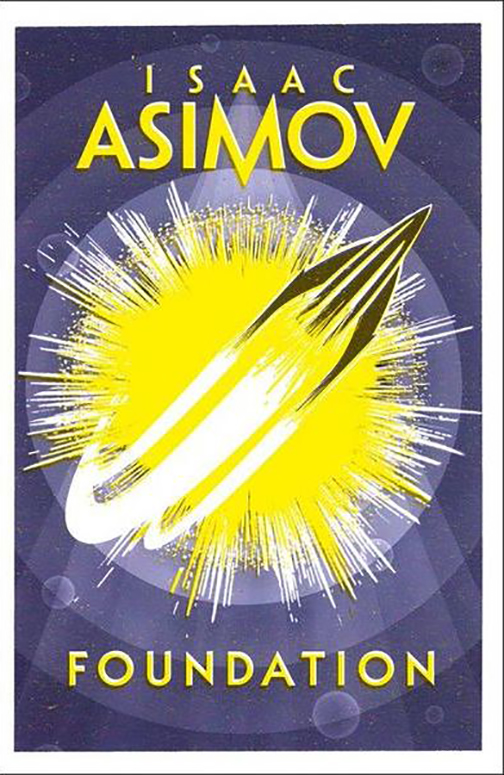
What I’m Reading: Foundation by Isaac Asimov

‘Seldon crises are not solved by individuals but by historic forces. Hari Seldon, when he planned our course of future history, did not count on brilliant heroics but on the broad sweep of economics and sociology. So the solutions to the various crises must be achieved by the forces that become available to us at the time.’ 

– Hober Mallow, ‘The Merchant Princes,’ Foundation by Isaac Asimov

A lot of what’s fresh and brilliant in Isaac Asimov’s Foundation, written as long ago as World War Two, have since become so common in the genre that they almost escape notice when you encounter them in these pages. 

We have travel by hyperspace (‘hyper-space, that unimaginable region that was neither space nor time, matter nor energy, something nor nothing’); weapons called blasters; roguish but ultimately moral traders; cities which cover entire planets; galactic empires with a civilised core and a wild outer rim. We even have a planet called ‘Korellia’ which reappears as the shipbuilding world of Corellia in Star Wars. 

A galaxy without women

The first thing that strikes the reader is that the characters are all male. From a Galactic population numbering – what did he say, a quadrillion? A quintillion? – there are almost no women the author believes are interesting enough for us to meet.  

Here follows a list of female characters in Foundation

  • A telephone operator (!) 
  • A servant who tries on a gizmo
  • The Commdora of Corellia

And, if we really want to be generous:

  • Hober Mallow’s hypothetical mistress (Maybe I’m pushing it now)
  • Housewives are key to Mallow’s scheme to bring down the Korellian Republic (…That’s pushing it.)

The next thing that strikes you is that this book was apparently written as if Isaac Asimov had a very limited special effects budget. The first part contains compelling descriptions of space travel and the city-planet Trantor, but the rest is almost like a stage play: largely a series of conversations in rooms, mostly between seated men. 

Discussing this with friends, I thought of radio dramas, a popular medium in the 1940s when Asimov was writing. He wasn’t writing with an eye to radio adaptation, as far as I know, but maybe he listened to a lot of them and they influenced his style. The 1970s BBC radio play of the Foundation series proves how well it translates to the medium. 

A galaxy without ‘great men’

The lack of a balanced representation of humanity in the cast of characters is pretty awful. But I like the morality and the philosophy of history this story expresses – that it is not ‘great men’ but great impersonal forces that shape history. True greatness lies in predicting and adapting to the currents of history – not holding back the tide, but riding the wave. Real material relations are more important than ideas and words. Don’t be fooled by pomp and regalia; the empire is losing crucial technical skills. Don’t be intimidated by military thugs and their death machines; those machines must be operated by human beings, who can be influenced in clever ways. 

The ‘greatest’ figures in Foundation history are not strutting macho types. Hardin and Mallow alike embrace a kind of humility and acceptance, as well as cunning and unscrupulousness.

Both Hardin and Mallow embark on too-clever-by-half plans that would, in reality, totally demoralise their own people long before they bear fruit. This is a common failing in fiction: the illusion that conflicts have to be solved by clever tricks in order to be narratively satisfying.

In fairness, the climaxes to ‘The Mayors’ and ‘The Merchant Princes’ are very satisfying. Defeat turns to victory in a matter of moments. These eukatastrophes are seamless and well-plotted. 

Cynicism

They use religion to harness the Four Kingdoms to the chariot of the Foundation. But religion is superseded – by the time of Mallow, it is necessary to realise that trade is the new superweapon of Terminus. And trade itself will one day be superseded, become an obstacle: 

‘So, then,’ said Jael. ‘You’re establishing a plutocracy. You’re making us a land of traders and merchant princes. Then what of the future?’

Mallow lifted his gloomy face, and exclaimed fiercely, ‘What business of mine is the future? No doubt Seldon has foreseen it and prepared against it. There will be other crises in the time to come when money power has become as dead a force as religion is now. Let my successors solve those new problems, as I have solved the one of today.’

The flip side of the novel’s cleverness is the smug attitude that comes through. You read this book and feel like you, Isaac Asimov and Salvor Hardin are the three smartest people in the universe, and all these trillions of people are stupid. It celebrates cynicism and manipulation. Hardin controls the press behind the scenes and takes power in a coup. This is to say nothing of the invented religion and how it brainwashes people. This is not moral, of course, but we are supposed to accept that it’s an example of ‘doing what’s right’ in spite of any silly ‘morality.’

A galaxy without violence?

We are told that ‘violence is the last refuge of the incompetent.’ The author’s distaste for violence is rare and refreshing. He’s just not interested in it. The novel is better because of this. But the novel’s philosophy does not renounce violence; it just puts violence in its place, as the enforcer and copper-fastener of things already established by culture, economics and politics. It is not the last refuge of the incompetent; it is a necessary, though subordinate, stage of conquest. 

Consider the following exchange of dialogue: 

Jorane Sutt: You’re a Smyrnian, born in Smyrno, one of the former Four Kingdoms. You’re a Foundation man by education only. By birth, you’re an Outlander and a foreigner. No doubt your grandfather was a baron at the time of the wars with Anacreon and Loris, and no doubt your family estates were taken away when Sef Sermak redistributed the land.

Hober Mallow: No, by Black Space, no! My grandfather was a blood-poor son-of-a-spacer who died heaving coal at starving wages before the Foundation.

This passage tells us a lot: 

  • That the Foundation made war on Anacreon and Loris (two of the Four Kingdoms) some time in between the events of ‘The Mayors’ and ‘The Merchant Princes.’ 
  • That the Foundation has brought about a land revolution in the Four Kingdoms through the dispossession of the nobility. In other words, not just a war but a revolutionary war has taken place between two episodes. To cement in place and enforce the outcome of ‘The Mayors,’ war and revolution were still necessary. 
  • That the resolution of the second Seldon Crisis was not the end of Sermak’s political career (Sermak was the leader of the pro-war party in ‘The Mayors’). In fact, Sermak was heavily involved in the subjugation of the Four Kingdoms, to the extent that the land revolution is attributed to him. The pro-war Actionist Party have their day after all. 
  • People like Hober Mallow come from a background where before the Foundation they were denied any opportunities in life. The coming of the Foundation has been revolutionary, opening new opportunities for them. 

All of this is between the lines. Foundation is short and well-paced, but in places there’s a depth and density to it. These lines remind us that even though the novel leaves violence to one side, the universe in which the novel is set is just as violent as ours. The worst ‘barbarism’ in the novel is that which the Empire carries out on Siwenna – atom-blasting the population in revenge for a rebellion which that population didn’t even support.

This brings us back to the points about how it’s written like a radio play. Of course, it was written for magazines and presumably each instalment had to be kept fairly short. Most of what happens in the novel happens through dialogue, but Asimov puts that dialogue to work. The dialogue is good as drama, but it really shines as worldbuilding. It’s nutritious stuff around which your imagination can sketch in the galaxy outside the four walls of the room where, inevitably, men are talking.

What I’m Reading: Judge Dredd Case Files Volume 03

Judge Dredd: The Complete Case Files Volume 03, progs 116-154 (Rebellion/ 2000AD, 1979-1980, 2008). Written by John Wagner and Pat Mills. Art by Brian Bolland, Dave Gibbons, Mike McMahon, Brendan McCarthy, Ian Gibson, Garry Leach, Ron Smith, John Cooper, Barry Mitchell

My Sláine series remains relatively popular, so clearly a lot of people share my fascination with 2000AD comics. Years ago the whole Judge Dredd back catalogue was re-released in these huge ‘Case File’ tomes. The best I’ve seen to date has been Volume 02 (which I’ve praised here before). That included two great epic storylines, the Cursed Earth saga and Judge Cal. There’s nothing as brilliant or as large-scale here; Volume 03 collects a few one-off stories and short series. Some of these I’d come across before in other volumes years ago, such as the first appearance of Judge Death. Others were new. 

Of the series, my favourite was one where a plague of poisonous spiders threatens a small town in the Cursed Earth, and Dredd has to help a community of mutants to resist. Then the spiders infest part of Mega-City One, so without a moment’s hesitation Dredd has the whole neighbourhood bombed flat. The spiders didn’t get under my skin, but a mutant talking horse named Henry Ford did. When the mutinous, grumbling mount got bitten and I thought he was going to die, I felt pretty sad. He survived, only to witness in horror Dredd’s incineration of a whole sector of the city. 

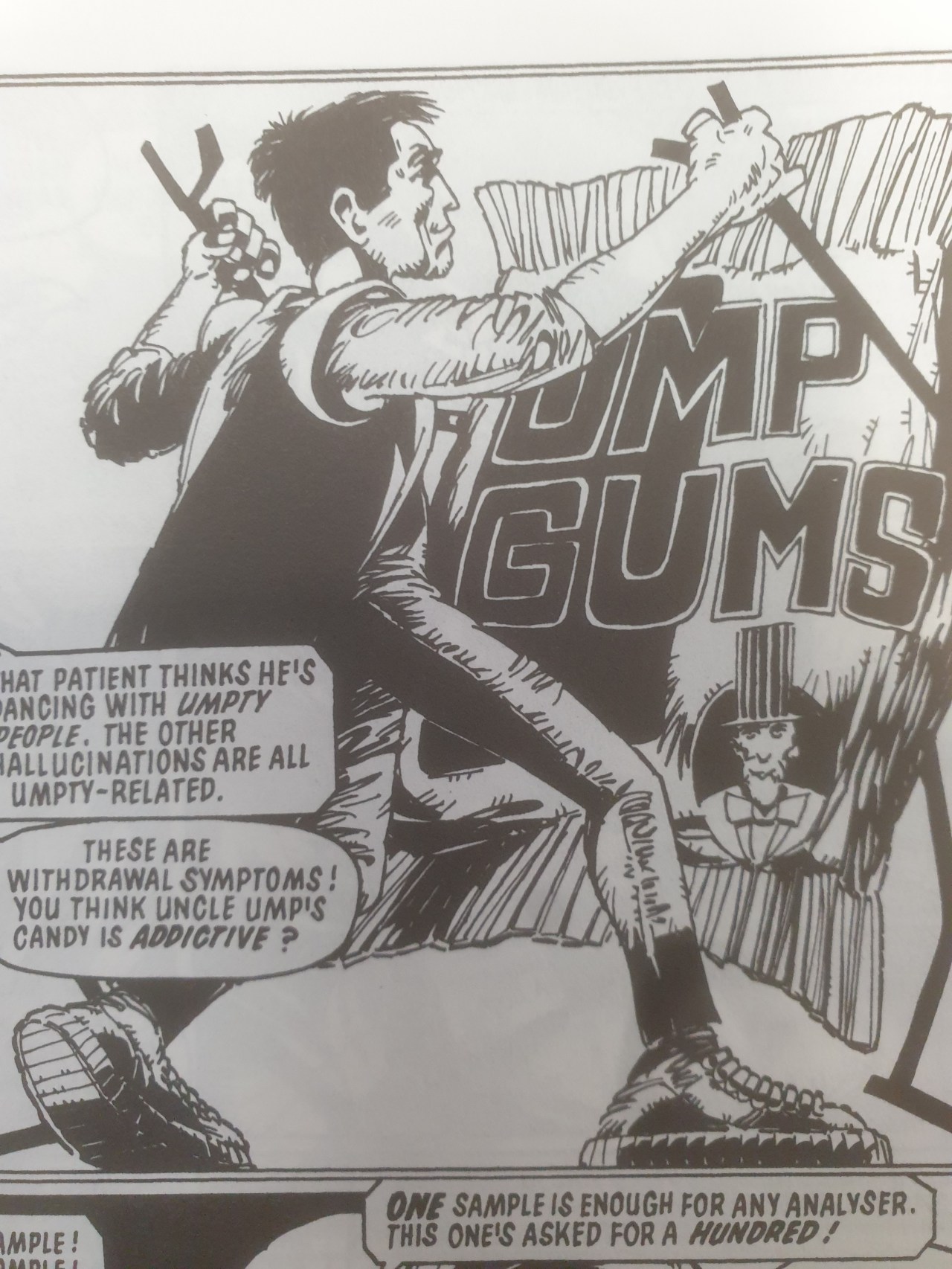
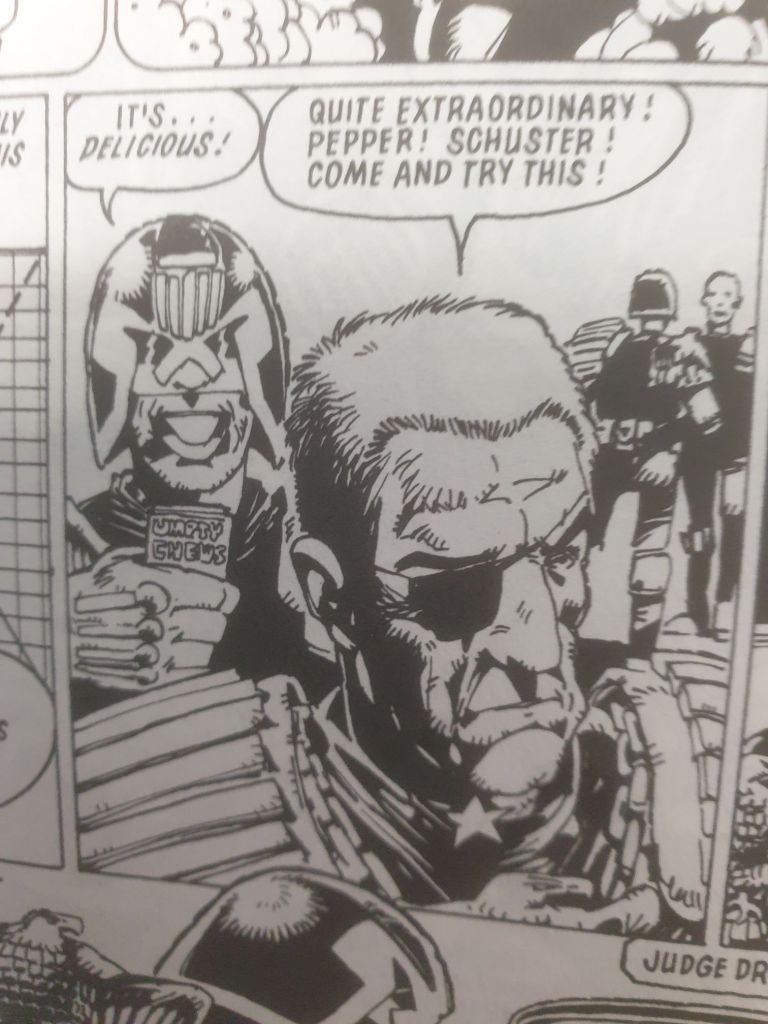
Of the one-offs, far and away the best was the one about Uncle Umpty’s candy. This is so funny and so sad at the same time. It’s very short but it feels like there’s a lot in it. A kind, whimsical and talented old man invents a range of sweets that taste unspeakably wonderful and aren’t addictive or harmful in any way. On principle Dredd does not approve. But on tasting it, Dredd declares ‘It’s delicious!’ and actually smiles. But this little story sums up how absolutely pathological the society and culture of Mega-City One are: people go mad for Uncle Ump’s candy, leading to a breakdown in law and order. The judges take extreme measures against this wonderful old man just to ensure that his candy is gone forever. 

The people of Mega-City One are very, very stupid. They are an unkind caricature of the people of capitalist societies: prone to fads and mindlessly acquisitive. But the ultimate consequence of their frenzied consumption is that they can’t be allowed to have nice things at all. They almost (almost, but not quite) deserve this ultra-punitive law enforcement system. Outside of contrived ticking time-bomb situations, the more conventional (but not necessarily bad) storylines where it’s a choice between the status quo and the annihilation of billions of people, the Judges plainly do more harm than good. Judge Death (‘The crime is life! The sentence is death!’) is only Judge Dredd taken to the logical conclusion of his misanthropy. Sometimes he plays it atraight as a Dirty Harry type. Sometimes he gives a hint of remorse or compassion; sometimes it’s not that, but only his sheer integrity leading to the same outcome. And sometimes, as with Umpty Candy, he is a brilliant and merciless caricature of himself.

Genuine Concerns

Imagine the panic if refugees, or some minority community, had committed a crime wave like the one the far right have unleashed on Ireland over the past year or so.

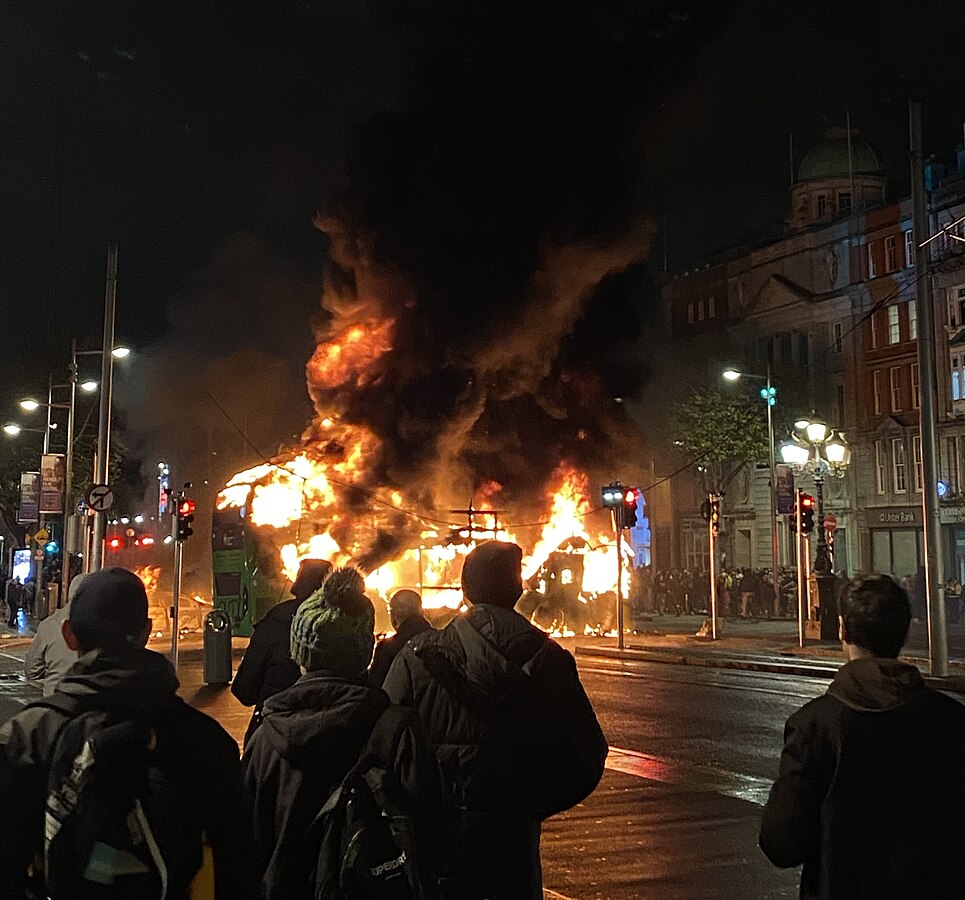
Imagine if refugees had rioted, burned buses and trams, smashed shops; carried out dozens of arson attacks all over the country; burned homeless encampments and threatened homeless people with blunt weapons; protested outside politicians’ homes, hung them in effigy, issued death threats, harassed and beat up election candidates.

That alleged sex trafficker who’s on ice in Romania says that Ireland is being ‘invaded.’ McGregor says ‘we are at war.’ But these asylum seekers are children, men and women of all ages, and none of them have weapons or transport. They all speak different languages from one another, have different religions, don’t have any common political cause, and are scattered all over the country. They can just about afford nappies, but they can’t afford tanks. They came here to get away from war. Is that an invasion? Maybe ask someone who’s actually experienced an invasion, like – just for example – a refugee.

We keep hearing that, in contrast to the bad protesters who burn things and the alleged MMA sex offenders who want to see blood on our streets, there are decent and good protesters who have ‘genuine concerns.’

I’m a tolerant kind of person, but I’m losing patience with all this. What are these ‘genuine concerns’? Are they really more serious and genuine than the fear many felt when there was a pall of smoke hanging over Dublin?

I suppose some people are concerned because some of the refugees, while running for their lives, did not wait 6-8 weeks to apply for a passport off the government which was trying to kill them. That’s true, as far as it goes.

When you read in the papers about some shit show where protesters have barricaded a road or shouted at terrified children, and there’s an interview with the chairperson of some local group with a name like Concerned Citizens Who Are Definitely Not Racist, mostly they use their airtime just complaining that the government isn’t giving them information. There are endless variations on this theme. But I don’t want to be a referee for their emails with Roderic O’Gorman. Nobody does. Find more interesting things to complain about, or go home.

Sometimes the Concern is Genuine, but the object of that concern is complete bullshit. Yes, asylum seekers are vetted. No, they commit fewer crimes than the rest of us (and it doesn’t follow that me and you should be deported).

The vague passive anti-refugee sentiment is like, ‘The government is putting a roof over their head but not over mine.’ It’s been two decades of hardship with austerity overlapping with the housing crisis, then Covid and the price gouging campaign by grocery chains and energy companies. You can see where some of the rage is coming from.

But there would be no housing shortage at all if we had public housing, rent controls and an eviction ban instead of this feeding frenzy for landlords and investment funds. We could put a roof over everyone’s head, if we were willing to tell housing profiteers to get a real job. Raise that with the leaders of the far right, some of whom are deep in this racket themselves, and you’ll find out pretty quick how little they care about homeless people. From what I can see, most of the far-right leaders and influencers are small business and property owners, not people on the front lines of economic hardship.

I’m aware that it costs money to accommodate refugees. Taxpayers’ money, no less. To put it into perspective, it has trebled over the last year to a figure just south of what we spend on Housing Assistance Payments (ie, on the state subsidizing crazy rents by shovelling money into the bank accounts of landlords). Two things. First, people only complain about the ‘cost to the taxpayer’ of things they were already angry about anyway. Second, like HAP, nearly all of that money goes to people who own large or multiple buildings. The government looks after the big property owners, whatever happens. According to today’s Independent, only 1% of asylum seekers are in state-owned facilities where people can be housed for a fraction of the cost.

These numbers tell us that if we didn’t have any refugees, we could be giving twice as much HAP to landlords, and they could be jacking up the rent even higher to keep up. What a tragic missed opportunity.

A picture taken during the November 2023 riots in Dublin. From Wikimedia Commons, credit to CanalEnthusiast.

Meanwhile I have ‘genuine concerns’ of my own. I’m concerned about racist thugs setting shit on fire and beating people up. I’m concerned about garbage from social media five years ago suddenly appearing on election posters. Peter Casey has that poster where he looks like Father Jack – the slogan is STOP THE MADNESS. I agree, only I think he’s THE MADNESS.

I have genuine concerns about racism. 85,000 Ukrainian refugees were accepted pretty much overnight and without a murmur of protest, and on much better conditions than other nationalities. But the fury over 30,000 international protection applicants has turned Irish politics upside down. I don’t grudge the Ukrainians anything, and I don’t want assholes to protest them – but the shortage of beds is obviously due to the bigger group, not the smaller group. Has this really not occurred to anyone?

I have genuine concerns about the media. Dread washes over me when I walk into a shop, because when I glance at the newspapers I see headlines dripping with hostility.

I have legitimate concerns about the way Fianna Fáil, Fine Gael and increasingly Sinn Féin are giving ground. On December 4th the state just told male asylum seekers, ‘Nope, we’re not housing you anymore;’ now Harris is clearing out those Grapes of Wrath tent camps and milking it for the cameras. Sorry Peter Casey, I think it’s MADNESS to be up in arms about the state being supposedly a soft touch – when it’s done less than the bare minimum to respect the right to asylum.

Fianna Fáil and Fine Gael both report that the main issue on the doors is migration. Sinn Féin report housing is still the main issue, which tracks with recent polling. But regarding housing, says one prominent blueshirt, ‘the conversation on this issue is less heated than it was five years ago.’ Palpable relief! The far right present themselves as anti-establishment warriors, but they have taken the heat off the government for the housing catastrophe. Maybe that Fine Gaeler is talking it up, but the more migration goes up the agenda, the more housing slips down.

Anyway, what’s the far right’s solution on housing? The IFP say ‘House the Irish first.’ So a 1950s Northern Ireland-style segregated housing system, where people arbitrarily deemed ‘not Irish’ go to the back of the queue, regardless of need or how long they’ve been waiting. I suggest a snappier slogan: ‘Apartheid for Ireland.’

The world is getting more violent and the climate is getting more unstable. More people are going to be forced to leave their homes. A lot more. We can make these refugees into (very unconvincing) scapegoats for housing shortages and violence and whatever else. Or we can be serious about it.

Barring massive political change, I don’t believe any authorities from the EU down to our own government are going to be serious or compassionate. But we as individuals can still behave like human beings. If refugees come to your area, Syrian, Ethiopian, Ukrainian, whatever, don’t protest them (no, not even if you feel the government or IPAS messed something up). Do like they did in Borrisokane: go and talk to them. Some have fluent English, and the Translate apps have gotten good. Take those vague phrases like ‘military age males’ and tag them in your own mind with faces and names. You’ll find that they are regular people with entirely mundane needs and desires. But they are in a bad situation and they have come from a terrible one. They haven’t burned any trams (if one of them does, don’t worry, you’ll hear all about it) but they are the ones – far more than the protesters and more than me – who have genuine concerns.

Want to read more of my stuff? The full archive is right here on my home page.

What I’m Reading: The Only Good Indians

The Only Good Indians by Stephen Graham Jones (Saga Press, 2020). Audiobook narrated by Shaun Taylor-Corbett. 

Here are two images of this novel that sum it up best: a sweat lodge made from random old blankets, sleeping bags and jackets so that it looks like, the narrator says, a pile of hobos; and a woman with the head of an elk. 

This is US horror writing in the mould of Stephen King: garage-door social realism; characters whose internal monologues bring them to life as much as their words and actions; incomprehensible passages about sports; monsters and apparitions that feel like an extension of the mundane world and are all the more horrible for that.

But as it goes on The Only Good Indians reveals a folk-tale quality that you don’t find in King. 

It’s set around a Blackfoot reservation in the present day, and the story is steeped in the grim conditions in which the Indians live (that’s the term the author and characters use). Lewis has made it to his mid-30s without dying of diabetes or an overdose or suicide or a car crash, or freezing to death after passing out, and he considers that a small miracle. Don’t tempt fate: the first quarter of the book depicts his complete unravelling, his descent into blood-soaked psychosis. The apparition of the elk-head woman drives him to it. 

Lewis is one of four friends in the crosshairs of this monster. When they were in their early twenties, they committed a transgression which involved blowing a pregnant elk to pieces with rifle fire. Ten years later a dangerous elk spirit has come for revenge – not only to kill them but to destroy everything they love. 

Each one of these Indian characters feels like a traumatised survivor of some terrible war. Each one of them has managed to get through some bad shit and to put their lives together. As death comes to claim them one by one, it feels wasteful and hopeless. The worst part is, it feels true: people who fight their way up out of a bad situation and build new lives for themselves are always prey to some demon from the past catching up with them. 

Twice while reading this novel, once at the one-quarter mark and once at the three-quarter mark, I stopped reading and put it aside, disgusted with it. ‘So it’s like that,’ I thought. ‘Every woman in the story has to die a horrible – and improbable – death.’ The brutality felt capricious and meaningless. We’re supposed to think the elk-head woman was pushing an open door when she turned Lewis into a murderous ghoul, but to me when the killing started it felt too abrupt. It’s difficult to get invested in one character only to switch to some others two-three hours in.

But both times I gave it a week and came back to it, and found myself drawn in again. It’s not really like that. It really is going somewhere, building up to something. Not every woman and man dies. There is a way out.

Denorah, the teenage daughter of one of the four men, is the only ‘calf’ any of them produced. She is a brilliant basketball player, someone who will really make her tribe proud one day. After a long sequence involving the makeshift sweat lodge which builds slowly from tense humour to pure horror, Denorah finds herself in the crosshairs of the elk-head woman. The final struggle falls to her.  

That’s where I am now: in the last half-hour of the audiobook with no idea if the ending is going to come down on the side of the things I liked or the things I didn’t like. While he nearly lost me once or twice, now I’m convinced Jones knows what he’s doing, and I’m keen to see how it all ends. 

[Edit 26 May 2024: the ending brought it all together. Even better than I hoped.]

The Three-Body Problem on page and screen (2) The Flickering Universe (Premium)

Become a paying supporter to get access

Access to this article is limited to paying supporters. If you already subscribe by email, thank you. But if you want to become a paying supporter, please hit ‘Subscribe’ below.

Donate less than the price of a coffee, and you can access everything on this blog for one year.

If you don’t feel like donating, most of my posts are still 100% free, so browse away, and thanks for visiting.

Here you can browse the blog’s full archive.

The Three-Body Problem on page and screen (1) Betraying Humanity

Hi folks. I’m going to dig deep into Cixin Liu’s The Three-Body Problem and its 2024 Netflix screen adaptation. This first post will look at the book’s most fascinating character, Ye Wenjie. The Three-Body Problem is really her story – how and why she betrayed humanity, and the consequences of that betrayal. 

I enjoyed the TV show. If you’re looking for a big rant where I complain about every aspect of it, you will be disappointed. But its version of Ye lacks the novel character’s depth, doesn’t hit us as hard emotionally (Due to the script and not due to fine performances by Zine Tseng and Rosalind Chao). Mostly I’m not criticising so much as saying, ‘Look here – this is interesting what they did here and what effect it has.’

The writing in Cixin Liu’s trilogy (I’ve read the first two) is sometimes stilted or technical or slow. But there is great prose here, especially in the Ye Wenjie sections:

  • Page 294: ‘In the deep silence of midnight, the universe revealed itself to its listeners as a vast desolation.’ (a line repeated to great effect later)
  • Page 299: ‘Above her, the Red Coast antenna lay open, silently, like a palm toward the universe.’

The screen version lacks this prose but makes up for it with strong visuals. It’s held together by compelling characters who have natural dialogue and interactions. It’s slick enough that it got a lot of eyeballs onto screens; it was a success, and there’s a point past which you can’t argue with that. It brought the main gist of the book to a much wider audience. I’m glad more people got to experience this great thing. 

Page and screen are autonomous, and I’m not going to judge one for deviating from the other. Nonetheless about some of these deviations I have plenty to say. 

Red Guards during the Cultural Revolution – Tiananmen Square, Beijing, 1966

Cultural Revolution

The Three-Body Problem by Cixin Liu begins with a panorama of Beijing at the height of the Cultural Revolution, with factionists killing one another in street battles. Next we see a stage in a university square. Student paramilitaries denounce and beat a physics professor; they go too far and kill him.

The Netflix TV adaptation begins the same way. But the Netflix audience – and the western reader – mostly has no idea what the Cultural Revolution was. It’s not the business of the screenwriters to give you a history lesson. But western ignorance about China might leave many viewers with questions about this scene. For example, Jordan Peterson – who presents himself as very well-read and knowledgeable – thinks the Cultural Revolution (1966-1976) and the Great Leap Forward (1958-1962) were the same thing. His complete ignorance didn’t give him any pause for thought – he put out that claim in a published book, Maps of Meaning, and while he was at it he declared in passing that 100 million people died in this 18-year-long composite event. 

I’m pretty ignorant about a lot of things too – never read Jung. But I’ve visited China and read a few books about the place. The Cultural Revolution took place twenty-odd years after the communist victory of 1949. The 1949 Revolution overthrew the landlord class and delivered a massive expansion of health and education; hence why students who were babies in 1949 are, by 1967, so keen on it and on its foremost leader, Chairman Mao Zedong. But Mao messed up with a campaign called the ‘Great Leap Forward,’ contributing to a terrible famine, and afterwards he was sidelined.

The Cultural Revolution began four years later. It was half a student uprising against government figures who were perceived as conservative or bureaucratic; half Mao’s power play to get back in full control. It was a mess that got way out of hand. The way it’s depicted on text and screen seems fair to me, but the original Chinese reader had more context than the Netflix viewer or western reader. 

On the page and on screen we experience the same terrible episode: a teenage girl named Ye Wenjie watches as her father, a theoretical physicist, is publicly humiliated and killed. In the book, we are privy to her own thoughts and memories. Long ago, before the Revolution, her father met Einstein. Einstein pointed to a ditch-digger on the streets of Beijing and asked how much the guy earned. Instead of a deep discussion on the nature of the universe, Professor Ye’s only dialogue with Einstein consisted of telling him that the ditch-digger probably earned 5 cents an hour. 

This is one example of an opening that is rich in contrasts; likewise it is bizarre and unsettling how a discussion on theoretical physics is combined with a scene of pseudo-revolutionary ritual persecution and public torture. 

This is a moment of cruelty and hysteria, a moment when the human species comes across very badly. This does two things: it sets Ye Wenjie on a course to betray humanity, and in its depiction of a hysterical political rally it prefigures the later development of the Earth-Trisolaris Organisation. The first, at least, comes across clearly enough on the screen as on the page – the second, not so much.

‘Big-character posters’ bearing uncompromising political slogans, a hallmark of the Cultural Revolution, being pasted to a wall in 1967

Red Coast Base

After the worst excesses of the Cultural Revolution, the youth were rusticated en masse, sent out to the countryside to do hard labour and keep out of trouble. That’s where we next catch up with Ye Wenjie: with a logging crew in Inner Mongolia. She watches as ‘vast tracts of grasslands became grain fields, then deserts.’ 

Ye Wenjie sees the environmental destruction and concludes that humanity is to evil what an iceberg is to the sea – composed of the same material but just in a different form. Her dawning environmental consciousness is warped in this misanthropic direction by her previous experiences. To make matters worse, the first person she trusted since her father’s death, Bai Mulin, betrays her. Long before having any idea that she will one day communicate with aliens, she concludes that ‘To achieve moral awakening required a force outside the human race.’

She gets her chance when she is sent to the mysterious Red Coast Base. Pages 46-48, describing the mysterious dish in use, are very tense, exciting and mysterious. The climax is when the birds fall out of the sky. Here the TV show hews close enough to the book. Again, what we lose in interior monologue, we gain in strong visuals. 

Ye Wenjie doesn’t like living at Red Coast base but it suits her. She seeks isolation after her experiences; it seems safer. But here, in her relationship with the commander and commissar, there is room for further betrayals, petty ones this time (pages 174-5).

The TV show hurries through the Red Coast portion of the book in a couple of flashbacks. This is a shame because, alongside the surreal videogame sequences, it’s the best part of the novel. 

An example of what we lose: on pages 180-183 we get to see internal government documents where the top-tier Chinese communist leaders discuss how to contact aliens. The first draft is full of heated revolutionary rhetoric but it is dismissed as ‘utter crap’ – don’t send big-character posters into space! A more sober draft follows. 

To its credit, the TV show keeps the part where Ye Wenjie figures out that the sun can be used as an amplifier for radio transmissions into space. The explanation in the book is too technical, but on screen it’s just right.

Her idea is dismissed, but she goes ahead in secret. She sends the transmission to the sun. In the book this is an awesome moment, even as Ye herself loses hope: 

Ye saw the rest of her life suffused with an endless grayness. With tears in her eyes, she smiled again, and continued to chew the cold mantou.

Ye didn’t know that at that moment, the first cry that could be heard in space from civilization on Earth was already spreading out from the sun to the universe at the speed of light. A star-powered radio wave, like a majestic tide, had already crossed the orbit of Jupiter. 

Right then, at the frequency of 12,000 MHz, the sun was the brightest star in the entire milky way.

As a plot point, this comes across clearly on the screen. But the sheer awesomeness of this moment is lost in translation. Likewise the moment, some years later, when she has a choice and betrays the human race. Everything has been leading up to this, but it’s still just enough of a leap that it shocks the reader. This is why Ye Wenjie is a great villain in the book.

The show leaves out some plot points too. In it, Ye has a baby with Mike Evans, her American collaborator. In the book, she has her baby with chief engineer Yang who works at Red Coast base. But in the book we see her commit an incredibly cold-blooded murder of commissar Lei. By an unhappy chance, killing Lei obliges her to kill her husband Yang at the same time. She kills them both – including the father of her child – without hesitating. 

Our view of this character changes fundamentally at this point – her betrayal of humanity is made real and manifest. This betrayal is not mediated by a computer screen or a radar dish.

The Earth-Trisolaris Movement

Something crucial happens in the book: Ye Wenjie goes to a local village and lives with the farmers there to have her baby. They donate their blood to save her and house and feed herself and her baby. In return, she teaches their children. This is a lovely section of the book. It’s a rebuke to the anti-human attitude she has adopted. ‘Something finally thawed in Ye Wenjie’s heart.’ (316-321) We see Ye in a different setting and mood from the military-scientific base and the Cultural Revolution era. Her horrific experiences were not the full picture; most of us human beings, while we have our burdens to bear, live lives that are far happier than hers. We do not experience such repeated and concentrated doses of inhumanity. And if she hadn’t, she wouldn’t have betrayed humanity. When we exploit and brutalise one another, we degrade humanity’s faith in itself, humanity’s integrity. When we harm a fellow human we harm ourselves as well.

Her next experiences set her back into her misanthropic groove. Her mother, who helped do the father to death, washes her hands of what she did, and even blames the dad for it. (324-5) 

Ye Wenjie then meets the three Red Guards who killed her father – in the TV show, there is thankfully a version of this scene. After their revolutionary ardour was exploited for political ends by a faction in the state, the three teenage girls were doomed to years of hard labour. There’s nothing left in them but bitterness, and they have suffered too much to be remorseful. I found this interesting; the mother is unrepentant because she has moved up in the world, and the girls are unrepentant because they haven’t. 

This entirely depressing experience counteracts all Ye’s tendencies toward ‘thawing.’ But we have seen that she has a soft side. 

This is relevant when we fast-forward a few decades to the development of the Earth-Trisolaris Organisation (ETO), a political group which is determined to help the aliens to conquer Earth. 

In the TV show it is not named as such, and we learn very little about it. This is a weakness of the screen version. Why would some humans wish to collaborate with aliens? What internal debates would such a movement have? These fascinating questions are explored and dramatized in the book but not on the TV show. 

They call each other ‘comrade,’ evoking the Cultural Revolution, but this is not a movement of idealistic students. ETO is made up of people drawn from the political, technical and financial ‘elites;’ it is explained that their grasp of science and their knowledge of the darker side of humanity makes them willing recruits. This tracks – Mike Evans is the son of a billionaire and thus alienated from humanity (no pun intended). Efforts to recruit ‘common people,’ meanwhile, have failed due to their ‘instinctive identification’ with humanity. (344-5) 

ETO funds all kinds of anti-science groups. This is touched on in just a single line in the show which is really a missed opportunity to say something very relevant to the post-Covid world.

ETO is divided into two factions: 

  • The Adventists wish to eliminate the human race. They realise the Trisolarans might not be much better, but don’t care. 
  • The Redemptionists, on the other hand, have developed elaborate fantasies about Trisolaran civilization, and think the aliens will save humanity from itself. 

A new and small third faction, the Survivors, is drawn from the small number of recruits from among the ‘common people’ – they hope to survive the war by collaborating with the Trisolarans. 

Much like the Red Guards in 1967 Beijing, the two factions are on the brink of an internal civil war. Ye Wenjie doesn’t much like any of the factions, who have departed from her original vision, but she especially hates the Adventists and plans to wipe them out. 

I’ve been praising the book a lot, but it has problems. From a zoomed-out distance, the ETO is compelling. But when Liu tries to show it in real life and real time, it fails to convince. Wang Miao infiltrates the ETO with comical ease; he attends a casual introductory chit-chat in a café, and is immediately invited to a major conference. The events of the conference contain subtle echoes of the Cultural Revolution scene at the start, and culminate in a moment of dramatic action. But the whole thing is stilted. Take it from a seasoned activist: this is not how internal disputes within a revolutionary party work. You don’t just have one meeting where you bring up everything all at once, and then trash it all out on the spot. Political conflict can be dishonest, drawn-out, and dirty – or, to put it kindly, it is richer and more interesting than how it’s presented here. 

Having said that, there’s proper drama in the showdown between the two factions, and that’s before the jackboot of the state kicks down the door and Da Shi and his men storm in. The TV show, by contrast, has a flattened ETO.

Until next time…

Next week I’ll look at the other major strand of the novel The Three-Body Problem: Wang Miao’s storyline set in the present day and concerning a flickering universe, a loutish and morally dubious cop, and a mysterious videogame. Of course, I’ll be comparing the original with how it was adapted for the screen. 

Did you enjoy reading this? Subscribe to get an email notification whenever I post:

Or browse the blog’s full archive.

What if the Whites won the Russian Civil War?

It’s not difficult to come up with a scenario where the Whites win the Russian Civil War.

Don’t get me wrong. The White regimes were all weak internally, riddled with corruption and absurd hierarchies, lacking not only support from the popular classes but much enthusiasm or initiative from the old ruling classes. They were determined to return the land to the landlords, the factories to the bosses, and the colonies and minorities to the yoke of ‘Russia, one and indivisible.’ They crushed their allies in the intelligentsia, and bickered with the Cossacks.

All the same, I can see how they could have won. Not by themselves being stronger, but by their opponents being weaker.

The strengths of the Reds did not emerge automatically. Building a Red Army capable of winning the war was actually not the path of least resistance. A lot of what the Soviet regime achieved in the early years would not have been considered the most likely outcomes at the time.

Baron Wrangel, in a White poster

There are a number of more ‘realistic’ scenarios, each of which on their own would dramatically impair the chances of the Red side in the Civil War.

A) ‘BROAD’ COALITION
The Bolsheviks buckle to pressure immediately after the October Revolution. They kick out Lenin and Trotsky and go into coalition with the Mensheviks and Right SRs. The political compromises this entails (such as returning factories to the control of their old bosses, downgrading the Soviets) leave the working class and the pro-Soviet cohort of peasants confused and demoralised, and embolden the Kornilov movement.

B) WAR WITH GERMANY
Instead of signing the Treaty of Brest-Litovsk, the Soviet regime fights the German military. Its fledgeling forces are decisively crushed and several major Russian cities and provinces are occupied by the Germans.

C) NO RED ARMY
The Soviet regime does not build an army. The real reason is a lack of resolve, but the stated reason is that armies are by their nature authoritarian.

D) NO MILITARY SPECIALISTS
The Red Army does not allow officers from the old Tsarist military to serve. Instead the army is run entirely by NCOs and revolutionaries.

E) ULTRA-LEFT LAND POLICY
The Russian Communists, like their German, Baltic, Hungarian and Polish equivalents, place the nobles’ land under state control instead of allowing the farmers to share it out. The rural population are enraged at the Soviet regime. The army’s rank and file lose all enthusiasm.

F) CHAUVINISTIC NATIONAL POLICY
In this scenario, the Russian communists refuse to accept the right to national self-determination. They are thus unable to win over minority groups from the Whites, and their advance eastward stalls as they step on the feet of one minority grpup after another. In the west, Poland, Estonia and Finland give decisive aid and support to Denikin and Iudenich in summer/autumn 1919, so that Petrograd and Moscow fall to the Whites.

So what would be the consequences of a White victory? That depends on which scenario or combination of scenarios we choose from among the above. (B), war with Germany, would change the very nature of the White movement, creating a whole cohort of German proxies, clients and allies.

Let’s take scenarios D through F and combine them. So the Soviets alienate the farmers and the national minorities, while building an army that lacks technically competent leadership.

Iudenich takes Petrograd, Denikin takes Moscow, and in the east Kolchak recovers and prevents the establishment of a new Soviet base in the Urals.

A banner of the Central Asian Basmachi guerrilla movement

REPRESSION

In real life (Original  Timeline or OTL), when Iudenich was marching on Petrograd, the British minister Churchill felt the need to warn him not to let his troops engage in a massacre after taking the city. The same Churchill, when Denikin’s forces engaged in pogroms to the south, did nothing more than send a letter remonstrating with him. And it was not even a strongly-worded letter.

It’s safe to say that large-scale massacres, especially of Jews and politically active workers, would have accompanied and followed the capture of Moscow or Petrograd. Feeling keenly its own lack of support, the Whites would pander to all ultra-nationalist and ultra-religious tendencies. The bosses and landlords would demand the return of their factories and estates, entailing further violence, a wholesale scourging of the country.

At the same time, the resistance of the poor and of Soviet and Red Army remnants, the establishment or survival of new Red Army base areas on the periphery, the stubborn defence of this or that city, would prolong the war so that it would still be ongoing years later, including in European Russia itself. The Soviets had a far bigger base of support than the Whites, so the mopping-up phase of the war would take correspondingly longer. (Mawdsley even reckons that the Reds could have won the war even if they’d lost Moscow.)

FRAGMENTATION

Central Asia is independent. There is no way the Whites can bring it back into the fold the way the Reds managed to, and no way they can take it by force – though if they are foolish they might spend a decade or two trying. The region breaks away in several feudal regimes not at all corresponding to today’s borders.

There is inevitably a Polish- Russian War, even though earlier they cooperated against the Reds. It would be more bitter and prolonged than the Polish- Soviet war in OTL, because the White Russians would consciously inflame chauvinism instead of trying to tamp it down. There might also be Baltic wars, as White armies based in the Baltic states, with aid from German barons, drag the White Moscow regime into efforts to reclaim the old provinces.

Ukraine and Siberia remain hotbeds of partisan warfare for many years, and may even succeed in breaking away, especially if foreign powers (Japan in Siberia, Poland in Ukraine) have their way.

The irony is that in trying to hold onto ‘Russia, one and indivisible’ the Whites end up with a far smaller territory than the OTL Soviet Union. Within the truncated Russian land, mines, factories, forests, oil fields and railways are handed over to the Allies.

Fragmentation might even extend to the White camp itself, as the various White leaders and the disparate factions and contending foreign agents all struggle for power.

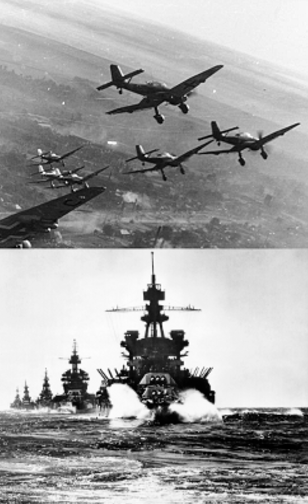
A Nazi German plane flies over Poland, 1939. In this scenario, how does a hypothetical Second World War turn out?

THE 20TH CENTURY

What would defeat in Russia mean for the international socialist movement? The prospects for revolution in other countries would be very dim for at least a couple of decades.

What would it mean for Russia in the 20th century? It’s impossible to say, because the White regime would be dynsfunctional and unstable to the point where you can’t predict how it would develop.

In the Indonesia scenario, the defeat of revolution means that Russia remains mired for decades in underdevelopment and crushing poverty under a tyrranical, genocidal regime.

In the China scenario, the defeat in the cities is the prelude to a long struggle in the rural expanse, culminating in the victory of a peasant-based radical movement.

We could consider a Spain, Germany, France or Italy scenario, but Indonesia and China are more to the point as countries suffering from underdevelopment. But a White victory would likely mean that fascism comes early into the world – and is known by a Russian name rather than an Italian, and its definition has secondary differences.

I think we’d be looking at a dysfunctional corrupt dictatorship whose economy is dominated by foreign capital. There would be a conflict between this neocolonial condition and the resentful imperialist designs of the regime and of its support base. Shiny hubs of foreign capital would contrast with brutal squalor all around. Resources are extracted, not developed. Russia would not industrialise as the Soviet Union did in the 1930s; it would be bled just slowly enough to keep it alive, and this process would be hailed as ‘investment.’ Reclaiming former glory would be the leitmotif of establishment politics.

You might wonder where this neocolonial fascist hellhole fits in to 20th Century history. But without the Soviet Union, the 20th Century as we know it doesn’t happen.

In this alternate timeline it’s still conceivable that a re-armed fascist Germany starts a Second World War to turn back the clock on the first. Would White Russia be its ally in grievance (kicking out the foreign capitalists, carving up Ukraine and Poland) or its victim? If the latter, a Russia which has not industrialised would be vulnerable to conquest. That is, unless the Allies consciously beef it up as a foil to Germany, allowing strategic to trump economic interests, like Taiwan or South Korea.

Regardless of how politics and war shake out in some alternate 20th Century, some things are certain, barring thermonuclear extinction. The 20th century was bound to be an era of anti-colonial resistance in Africa, Asia and Latin America, and of revolt by workers, women and minorities in Europe and North America. All these things were bound up in the Russian Revolution, but they were inherent in the global situation no matter how things went in Russia.