24: Escape to Crimea

This post tells how the White Guards fled South Russia in a state of complete chaos, but survived and established a new base in Crimea. This is Series 4, part 3 of Revolution Under Siege, an account of the Russian Civil War.

A Red soldier named Eduard Dune was captured during Denikin’s advance on Moscow. Among other terrible ordeals in captivity, he succumbed to typhus. Thirst and headaches gave way to two long comas; the second time, he woke up in the war-scarred city of Tsaritsyn, far away from where he’d passed out, and was soon loaded on a train bound for Novorossiysk. There he slowly recovered in an infirmary near the Black Sea port city, and as his faculties returned, he got active in underground work.

There were partisans in the hills near town, and he stole medical supplies from the infirmary and passed them to these ‘Green’ guerrillas. This close to the port of Novorossiysk, the supplies sent by the British government were piled up.

There was so much in storage that food supplies were lying under the open sky, and still the English continued to send more in ship after ship. Now that the White Army had their backs to the sea, the English had begun to supply all that had been promised when the army had stood near Moscow. The prisoners’ infirmary now enjoyed bed linens and other English hospital linen. In our storeroom lay trunks packed with English food products, including cocoa and dried vegetables. There was more than our cook could cope with.

There was a sand spit within sight of the infirmary where the Whites regularly took people for executions. The patients kept watch on this spot, collected intel and helped escapees. Dune and his fellow captive invalids stole papers from comatose typhus-inflicted Whites and supplied them to Red and Green agents in the city. They had a workshop on hospital grounds where they turned out false documents.

Novorossisyk had already been the site of things so strange and terrible they are difficult to visualise; way back in the fourth episode of this series, we followed the Bolshevik sailor Raskolnikov on his mission to scuttle the Black Sea Fleet. Very soon after that, the port fell to the Whites. Now, less than two years later, it was to witness one of the most surreal and pitiful scenes of the war.
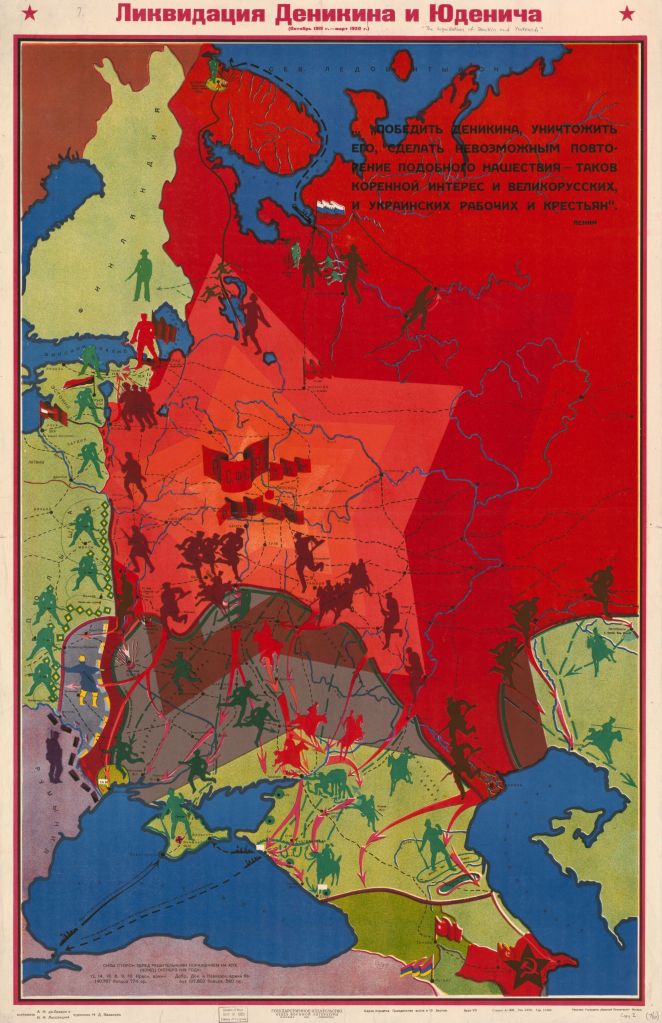
Russian Civil War pictorial map number 7, ‘Liquidation of Iudenich and Denikin.’ The White Guards (coloured green) are pursued southward. Trace the Red arrows across the Don River, over the Kuban steppe, and down the Black Sea coast. Note also in the map two things we’re not going to deal with in much detail here: the final victory in North Russia and the rise of Soviet power around Baku, Azerbaijan.

Rostov

Meanwhile the war was raging on, the Whites falling back, the Reds surging southward: in January Tsaritsyn (later Stalingrad, now Volgograd) saw its last battle of the Civil War when it fell to the Reds. But when the Whites reached their old base area of the Don and Kuban Countries, they rallied. The river Don, as if it was in sympathy, froze to let the Whites retreat across it, then thawed before the Reds could. Alongside this military recovery, the White civilian government, such as it was, promised reforms and tried to juice up some popular support. The Red Army hit the moat of the Don in disarray from its long advance, overstretched and agitated with internal disputes.

The Whites recaptured Rostov-on-Don on February 20th. But the Reds were by this time over the worst of their confusion, and it was the Whites’ turn to have some internal disputes. Denikin had made concessions to the Kuban Cossacks – not enough to stop them deserting, but enough to enrage the White officers. ‘What are we?’ they demanded. ‘Cannon fodder for the defence of the hated separatists?’

The First Red Cavalry Army (which by this time boasted 16,000 riders, 238 machine-guns, nineteen artillery pieces and eight armoured trains) crossed the Don and threatened the rear of Rostov; there was nothing for it but to abandon the town and fall back to Ekaterinodar (the city outside which a shell had killed the Whites’ chief inspirer Kornilov two years earlier) and then, after a short hopeless struggle, on to Novorossiysk.[1]

One of many grim chapters in Beevor’s recent book deals with the entry of the Reds into Ekaterinodar. He describes the summary murder of men falsely identified as officers, Kalmyks being massacred for no apparent reason, and dead White Guards being mounted on a locomotive as trophies. Beevor appears to be repeating contemporary rumours which his source’s author heard second-hand, which is consistent with some of my criticisms of the book. [2] But even allowing for exaggeration and rumour-mongering, such excesses probably did form a part of the picture of the Red Army’s advance in some areas.

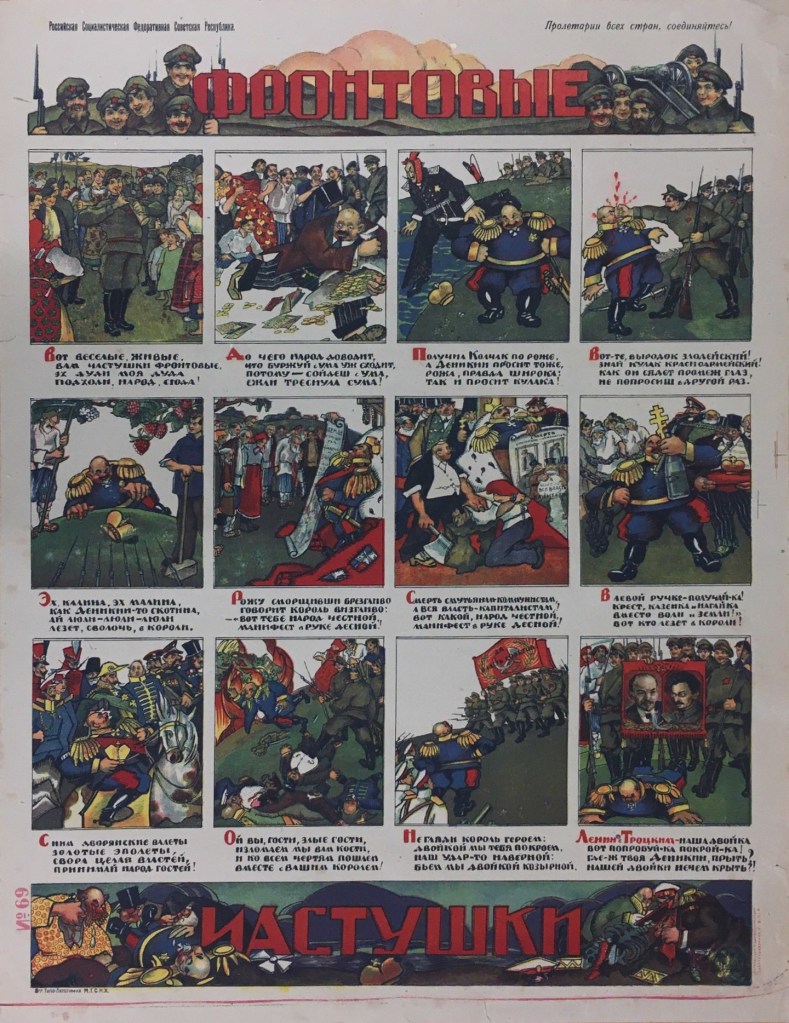
1st Red Cavalry Army
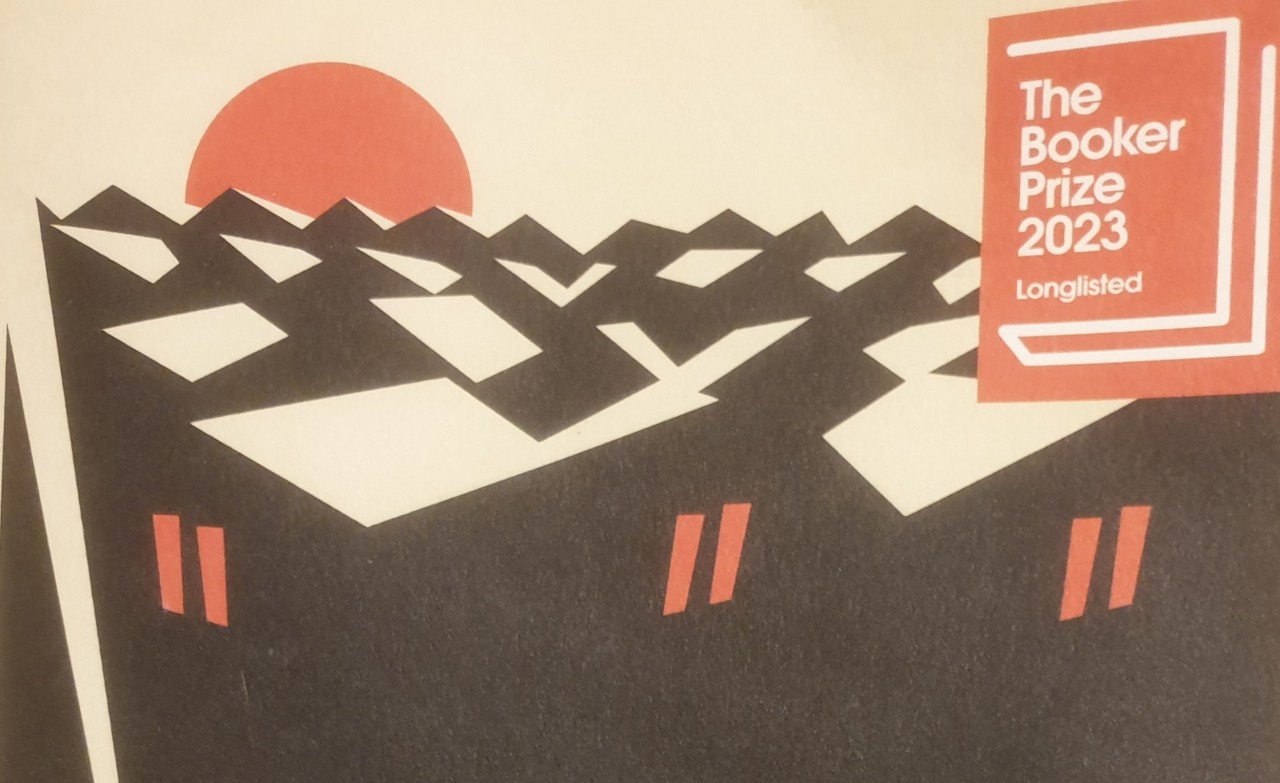
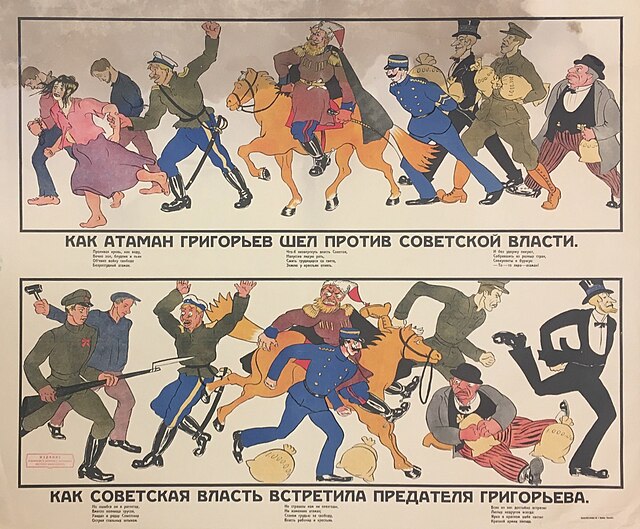
The cover image is a detail from this 1921 Soviet poster. Of the text, all I can tell you is that the heading means a frontline soldier. Thankfully the images are self-explanatory.

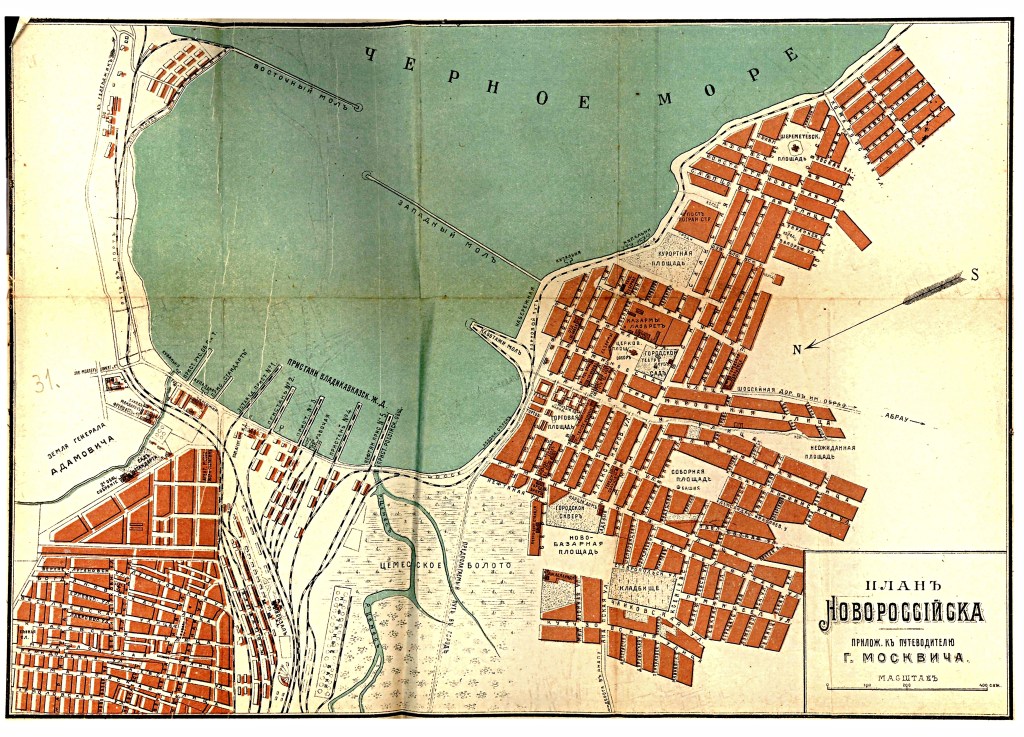
Novorossisk

The resumption of Red advance translated into rumours heard by Dune in the Novorossiysk infirmary: ‘The Whites had won victories with the aid of their cavalry, but ever since Trotsky had said, “Proletarians, to horse!” we too fielded a cavalry, and ours beat the Cossacks all hollow. The Red cavalry had captured all the English tanks.’

This was confirmed by what Dune could see with his own eyes; White Guard Russia was visibly shrinking and contracting around him. First, discipline grew lax, and he could get out into the city on errands. Once there he saw the streets fill up with a strange juxtaposition of affluence and squalor: cartloads of expensive household goods, and huge numbers of typhus-stricken refugees. White officers began taking entire battalions to join the Greens. Back at the infirmary, White Army supplies were stolen wholesale now instead of retail.

Moving away and up the chain of command from the humble soldier Dune, the British General Bridges was disgusted: ‘the whole affair was a degrading spectacle of unnecessary panic and disorder, and I urged the government by cable to dissociate themselves from the White Russians who had no prospects and little fight left in them.’ But Winston Churchill, Secretary of State for War and Air, overruled him. So the British remained and took responsibility for the evacuation of White officers and their wives and children. [3]

Suddenly the British project of pumping in great quantities of supplies and war materiel had to go into reverse: now the British were evacuating White officers and their families, and anyone else who could be crammed on board. At the quays, crowds pressed against the British Army cordon and the ships heaved with people. A tank drove slowly over a row of thirteen British aeroplanes, turning them to matchwood so that the Reds couldn’t use them. Then, of course, the tank itself was abandoned. Other engines of war littered the sea floor where they had been dumped. Tearful Cossacks shot their horses.

The other White naval evacuations were disasters, but Novorossiysk was the worst. [4] It was so bad, Denikin resolved to resign as soon as it was all over. The misery, destruction and desperation were extraordinary:

…the waterfront was black with people, begging to be allowed on board the ships… Conditions were appalling. The refugees were still starving and the sick and the dead lay where they had collapsed. Masses of them even tried to rush the evacuation office and British troops had to disperse them at bayonet point. Women were offering jewels, everything they possessed – even themselves – for the chance of a passage. But they hadn’t the ghost of a chance. The rule was only the White troops, their dependants and the families of men who had worked with the British were allowed on board. [5]
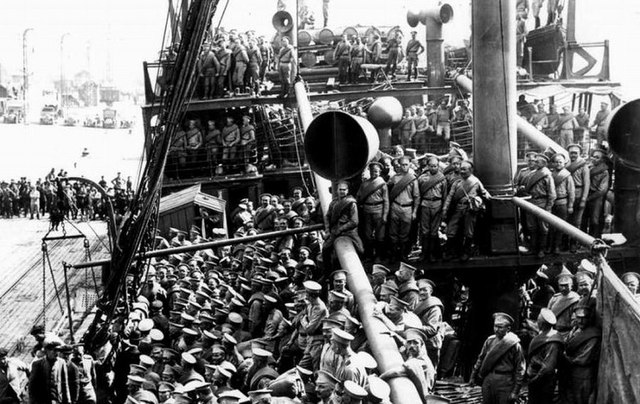
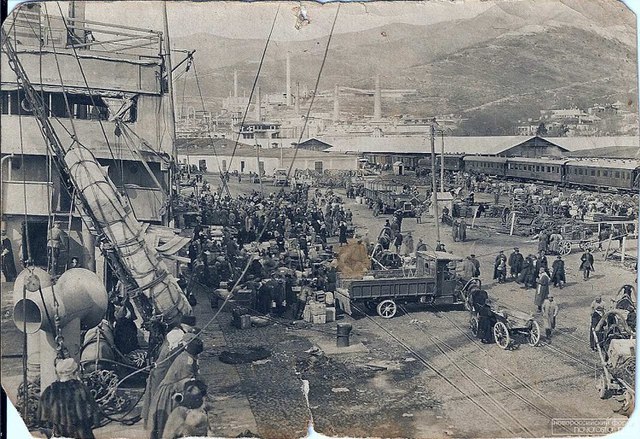
Above: the chaos at Novorossiysk.

The 2nd Royal Scots Fusiliers acted as a rear guard, supported by a naval bombardment (one of the ships firing was the Waldeck-Rousseau, which had mutinied the year before). On March 27th the Red Army arrived, lobbing shells after the fleeing ships. By then, 34,000 had been evacuated (A disproportionate number were Volunteers, which suggests the Don Cossacks got shafted).

The Reds found on the quays an indescribable landscape of dead horses and destroyed equipment – but also heaps of intact supplies, such as one million pairs of socks. General Bridges had not been permitted to abandon the Whites, but he had left food and clothing to try to alleviate the suffering of ordinary people in war-torn South Russia. The Reds captured 22,000 White Guards in the town, and 60,000 later surrendered further down the coast at Sochi.

Other Whites fled into the Kuban steppe, where they waged a guerrilla war. As for the Green armies, at the moment of victory they suffered a split between the pro-Communist elements and the various other forces who were in the mix, and soon dissolved. [6]
London

Meanwhile in London, time of death was called on the White cause. Field Marshal Henry Wilson wrote in his diary: ‘so ends in practical disaster another of Winston’s attempts. Antwerp, Dardannelles, Denikin. His judgement is always at fault.’

Several days later he wrote: ‘cabinet at 6pm. We decided, Curzon leading, finally to tell Denikin to wind up affairs and come to terms with the Soviet government. Great joy. Winston fortunately absent.’ [7]

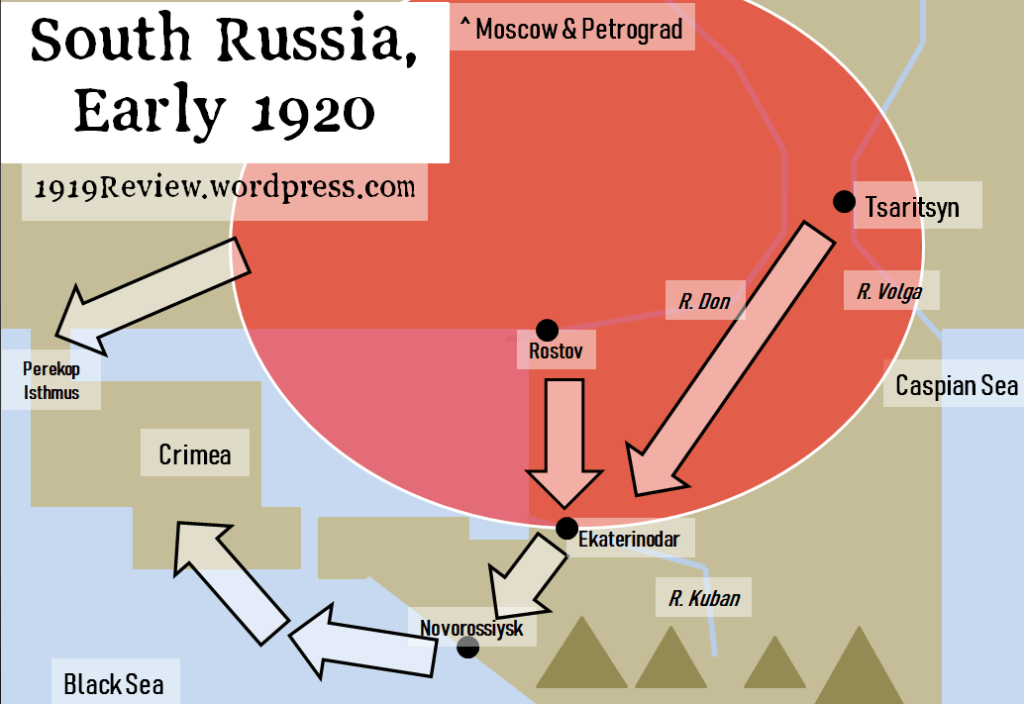
It was neither the first nor the last time the British had decided to withdraw from the Russian Civil War. They were sick of being on the sidelines of the bloody mess, acting as referee and sponsor, and occasionally stepping onto the pitch to play midfield, only to be frustrated again and again by the unexpected strength of the opposition and the shocking failures of their own side. In spite of all this, British intervention continued while the Whites made another throw of the dice. The fact that some tens of thousands of White Guards had escaped in one piece, plus an accident of geography and miitary fortune, gave the Whites an opportunity.  

During the chaotic White retreat across Ukraine, one White officer had fought his way through Makhno’s anarchists to reach Crimea. There he held the Perekop Isthmus, the narrow strip of land connecting Crimea to the mainland. This officer, who had entered Ukraine as one of Shkuro’s notorious ‘White Wolves,’ bore the evocative name Slashchev.

Because of Slashchev’s feat the Whites held onto Crimea, an area 27,000 square kilometres in size, or one-third the size of Ireland. The Reds had no fleet on the Black Sea and the Allies had, so Crimea was a natural fortress as well as a base area of manageable size and with a population of over a million. That’s where the British fleet obligingly left those 35,000 evacuated White Guards. We have the strange picture of masses of hardened veterans disembarking at seaside resort towns.

Crimea

The first item on the agenda was leadership. At a Council of War in April, power passed from Denikin to his rival and critic, the ‘Black Baron’ Wrangel. The military chieftains objected on principle to electing Wrangel. To be clear, they did not object to Wrangel himself, only to the idea of electing a leader. So they insisted Denikin appoint him. After the galling experience of handing power to his rival, Denikin had nothing left to do but depart for Constantinople on a British destroyer, never to return. [8]
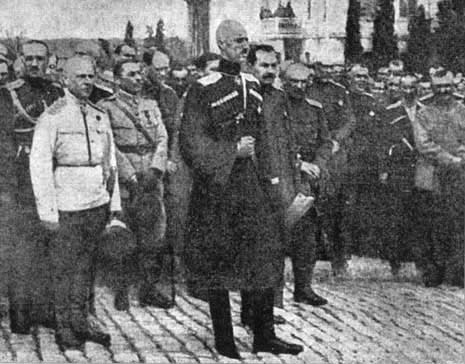
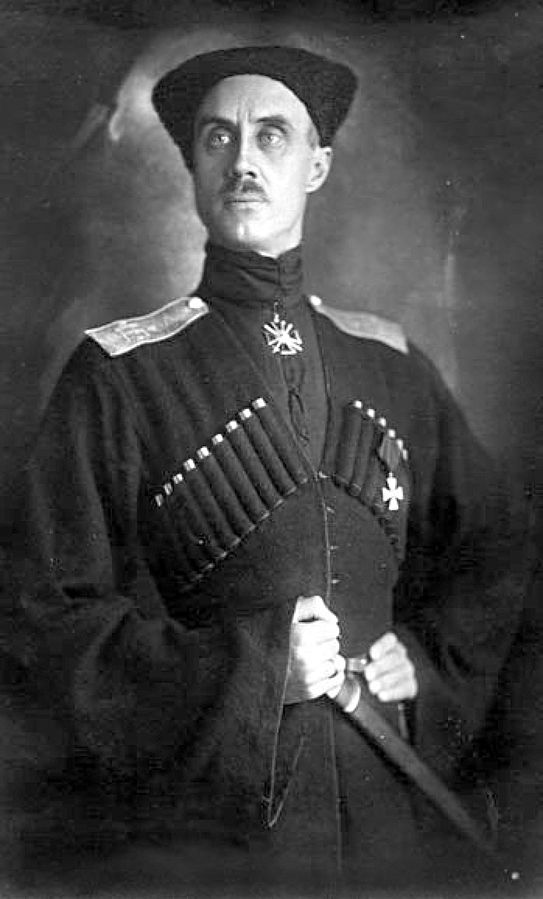
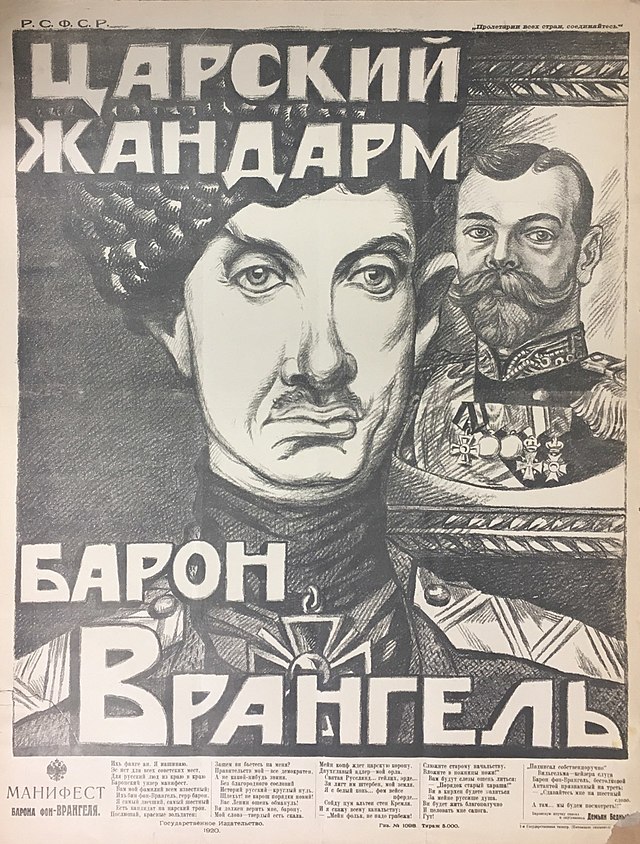
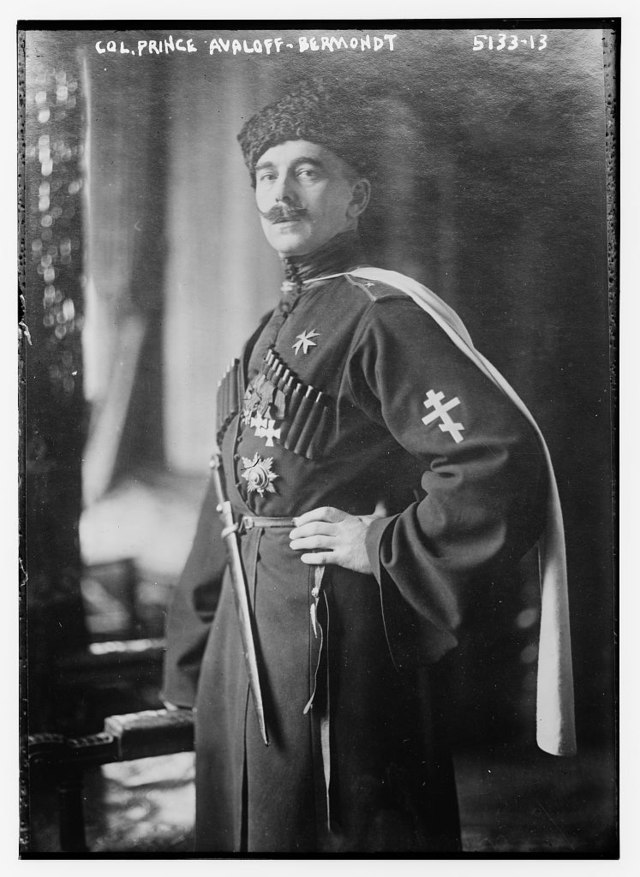
Above: photographs and a poster depicting Wrangel

Wrangel was not a graduate of Bykhov prison-monastery or a survivor of the Kuban Ice March, not at all one of the original Kornilov club. But with his height and striking features, he looked the part more than any other major White leader; Soviet cartoons and posters got great mileage out of him.

But there was still a line of continuity going all the way back to those origins as ‘the saga of the Volunteer Army continued in the Crimea.’ The elite ‘colourful units’ that were named after Markov, Alexeev, Kornilov and the others still existed as I Corps. [9] Like his predecessors, Wrangel called himself ‘Ruler’ and his army the ‘Russian Army.’

One of the themes that keeps popping up in this series is the role of the individual in history. Wrangel is a striking case study, because under him a new and distinct White Guard regime emerged in Crimea. Whereas Denikin’s regime was overstretched, ragged and undisciplined, Wrangel’s was every bit as lean and severe as he was.

In contrast to the previous White regimes, there was a functioning government and strict discipline. Reds who deserted were given a fair hearing. Looters were shot. Wrangel’s government would even pass a law redistributing landlords’ holdings to peasants – yes, the Whites were finally ready to cut their losses on that one, and the irony is that Wrangel, unlike Denikin, was actually of the land-owning nobility. His regime also made overtures to Tatars and Ukrainians, and cooperated with the Poles.

(L) Wrangel inspecting White pilots, and (R) his functioning government

Was this all down to Wrangel’s personality?

Perhaps not so much. Actually, the Baron had been a champion of the conservatives within the White movement against the more ‘liberal’ Denikin. Wrangel spoke of the need ‘to make leftist policies with rightist hands’ and pronounced a policy of ‘With the Devil, but for Russia and against the Bolsheviks.’ [10] Every living White Guard, one assumes, had learned extremely harsh lessons in 1919. Popular opinion and practical common sense would have favoured this new approach.
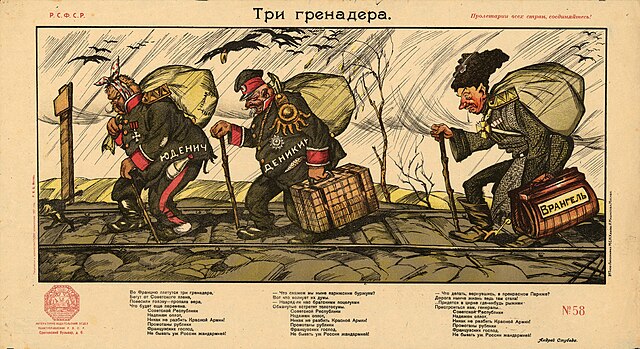
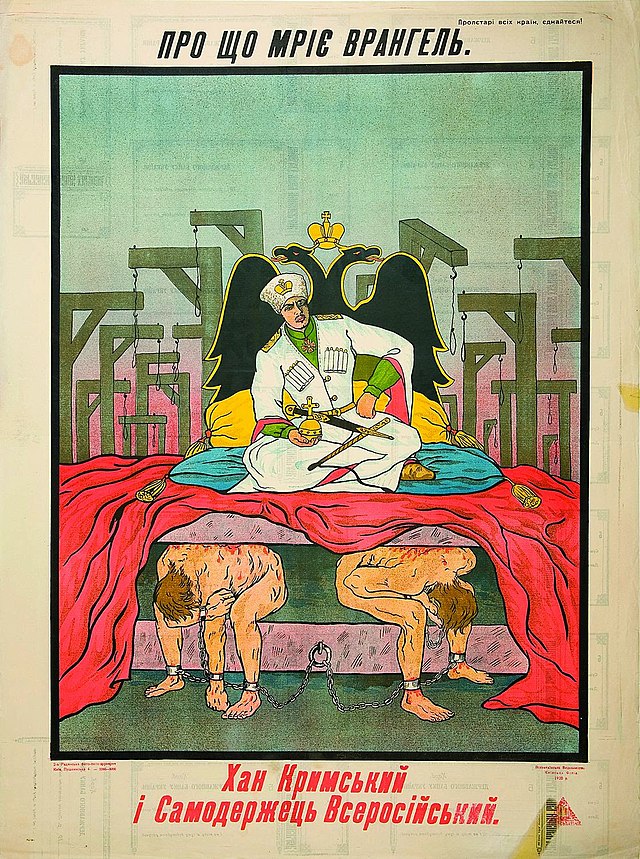
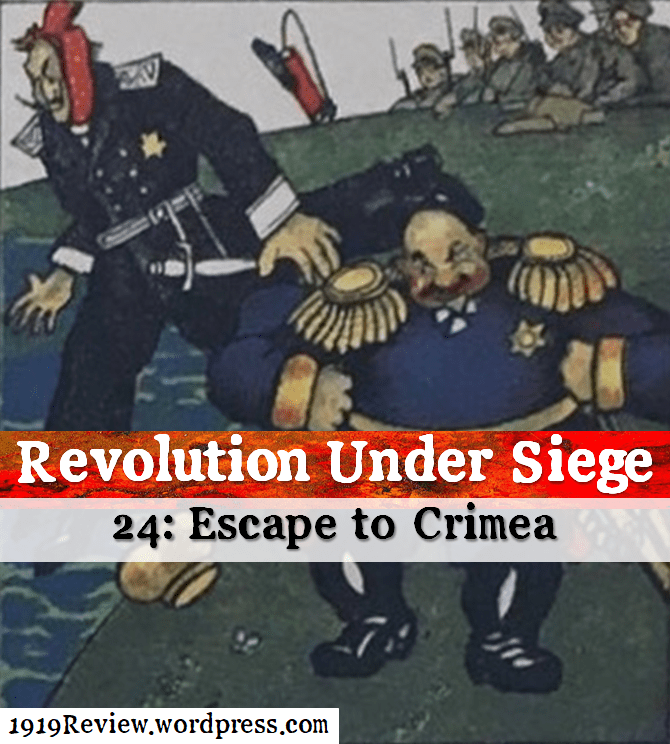
Above, images of Wrangel from the Soviet point of view. ‘Three grenadiers’ labelled Iudenich, Denikin and Wrangel; Wrangel as Khan of the Crimea; and ‘The Tsarist gendarme, Baron Wrangel’

What made this approach possible was the fact that an overwhelming mass of White Guards were now concentrated in a stable, small, self-contained base area. Just as one example of how Crimea insulated the Whites from the chaos that had messed things up before, the Cossacks could no longer do the old loot-and-desert routine. They didn’t have horses anymore, let alone horses that could swim across the Black Sea. The character of the new regime had more to do with the new base than with any other factor. But it is one of those interesting moments when so many things, right down to the physical appearance of the leader, produce the same impression: this was a White army, but leaner and smarter, confronting Moscow with a new type of challenge.  

Home Page/Archives

Revolution Under Siege Archive

References

[1] Mawdsley, pp 302-309. Special thanks are due to Mawdsley, on whose book I relied heavily for this post. Dune, 180-198

[2] Beevor, pp 431-2

[3] Kinvig, p 311

[4] Smele,p 140

[5] Kinvig, p 309

[6] Smele, p 140. Dune, p 211. On the Greens, see the notes from Diane Koenker and SE Smith in Dune’s memoirs, p 187

[7] Kinvig, p 312

[8] Mawdsley, p 309

[9] Mawdsley, p 364

[10] Ibid, p 363

The new texture behind the ‘Revolution Under Siege’ text is from the Wikimedia Commons image ‘Rust and dirt’ by Roger McLassus. Not that anyone is eagle-eyed enough to notice, but it is important to credit people

23: Hell March (Premium)

In this post we trace the collapse of White Siberia in late 1919 and early 1920. This is Series 4, Part 2 of Revolution Under Siege, an account of the Russian Civil War .

Become a paying supporter to get access

Access to this article is limited to paying supporters. If you already subscribe by email, thank you. But if you want to become a paying supporter, please hit ‘Subscribe’ below.

Give me less than the price of a coffee, and you can access everything on this blog for one year.

Back to Home Page/ Archives

Revolution Under Siege Archive

Appendix to ‘The Pogroms of 1919’

This short post expands on ‘The Pogroms of 1919,‘ making a few points about the relevance to modern politics. Because, as Immortal Technique said, ‘the past refuses to rest in its shallow grave.’

Go to Revolution Under Siege Archive

Avenger Street, which bears the name of Shalom Schwartzbard, is less than 35 kilometres from the Gaza Strip, and a short car journey from Ofakim, site of a battle during the October 7th 2023 Hamas raid. It’s remarkable that two significant places in Schwartzbard’s story, Ukraine and Palestine, are sites of conflict at the time of writing. But it has been the Israeli military response, its mass killing of tens of thousands of civilians, its bloody violation of hospitals, schools, ambulances, border crossings and refugee camps, that most reminded me of the genocide of 1919. I thought of Schwartzbard and his fifteen murdered relatives when I read of Abdel Kareem Rayan, a young man in Jabalia refugee camp in Gaza who showed journalists a list of 15 family members who were killed in Israeli airstrikes, and Dana Abuqamar, a student activist in Manchester who says 15 of her relatives were killed when a missile hit their residential building. Unfortunately there are many more such examples.

In September 2023 the Canadian parliament gave two standing ovations for Yaroslav Hunka, a Ukrainian by birth described by the Canadian house speaker as a ‘war hero’ who fought against Russia during World War Two. The 98-year-old Hunka was indeed a veteran – of the Waffen-SS, a notorious military organisation which fought Hitler’s genocidal war. There was an apology and even a resignation, but any adult should have known who fought against ‘Russia’ in World War Two.

The incident in the Canadian parliament reflects a thorny problem for ideological supporters of the United States, NATO, Israel and their allies in Eastern Europe. Ideologues must compose a historical narrative which is acceptable to Jewish Israelis but also to people in Eastern Europe and the Baltic States who, for whatever reason, want to rehabilitate collaborators and pogromists as ‘national heroes.’

In discussions about the several thousand collaborators the Nazis managed to recruit in Ukraine, we see scant mention of the far greater number of Ukrainians who fought in the Red Army against the Nazis.

Also ignored are the pogroms of 1918-1919. There is at least some critical discussion about the prevalence of Nazi iconography in the Ukrainian military. Invocations of the Rada and Petliura in modern Ukraine come in for less discussion in the West because very few people know who they were.

The pogroms serve as a reminder that until recently western leaders did not give a damn about either Ukrainians or Jews. For example, in the Russian Civil War, they kept on funding and supporting pogromists who called Ukraine ‘Little Russia’ long after it became obvious they were a lost cause.

Modern Russia, too, has consigned the pogroms of 1919 to oblivion. Putin spoke to a crowd of thousands at the re-interment of General Denikin in a place of honour in Moscow in 2005.

In 1919 and in the 1940s, the Jews were an unarmed captive population. In 1919 armed gangs would come to town and reign supreme for days or longer. In the 1940s the German military machine was bent on mass extermination. In the Middle East today, the Palestinians are the ones who are captive and vulnerable to unrestrained violence, in this case of settler pogromists and the Israeli army, armed to the teeth by the US. The Palestinians are the ones subjected to dehumanising language and narratives, caricatured, confined, treated with contempt and paranoia.

If you ask me, the 21st-century pogromists are the settlers who have killed hundreds in the West Bank since October 7th. The anti-Semitic threat comes from the growing far right in Europe and North America – not from supporters of basic human rights of Palestinians. Another worrying conclusion you can draw from the points above is that NATO interests now cut against a sincere reckoning with the history of anti-Semitism in Eastern Europe, and provide an opening for attempts to rewrite history, to trivialise the Holocaust, to blame the victims.

The killing and abduction of hundreds of Israeli civilians on October 7th was both cruel and strategically irresponsible. But here again we run into the double standards that are deployed to justify pogroms and genocide. For my arguments in favour of the dignity and humanity of Palestinians to receive a fair hearing, I am expected to include a caveat and a condemnation. But the ‘right to self-defence’ of Israel is invoked by world leaders without any conditionality whatsoever. The humanity of Israelis is – rightly – taken as read. The authoritarian and genocidal character of the government they elected does not diminish their humanity. The thousand atrocities committed by their military does not make civilians fair game. If the humanity of Palestinians were taken as read in the same way, the war would end tomorrow. And I don’t just mean the current onslaught on Gaza, I mean the whole ethnic cleansing project going back to the Nakba.

Those who have read a bit of history, for example on the pogroms of 1919, who have gotten a sense of how people are dehumanised as part of the groundwork for horrific atrocities, should have seen clearly years ago what was being done to the Palestinians, how the whole world was being primed for the slaughter that is now taking place.

Go to Revolution Under Siege Archive

Go to Home Page/ Archive

22: The Pogroms of 1919

This post is about the anti-Semitic massacres carried out by the White Armies and the Ukrainian Rada forces during the Russian Civil War. It is the first part of the fourth series of Revolution Under Siege, my account of the Russian Civil War.

Go to Revolution Under Siege Archive

Avenger Street

The Russian Civil War sent fragments spinning in random directions, to lodge in unexpected places. Years later, a piece of shrapnel from the war hit the ground with lethal effect in Paris. On May 26th 1926 Shalom Schwartzbard, a refugee from Ukraine, approached a man on Rue Racine, drew a revolver and shot him multiple times.

‘When I saw him fall,’ said Schwartzbard later, ‘I knew that he had received five bullets. Then I emptied my revolver [into the body].’

He handed his revolver to a police officer and, in case there was any doubt, confessed on the spot: ‘I have killed a great assassin.’

More details filtered out to a shocked public. Schwartzbard had fought for the French Army in World War One. After the Russian Civil War, he had returned to his home country of Ukraine to discover that fifteen members of his immediate family had been murdered in a wave of anti-Semitic violence. The man murdered on that Paris street was Symon Petliura, the Ukrainian nationalist leader whose forces were responsible.

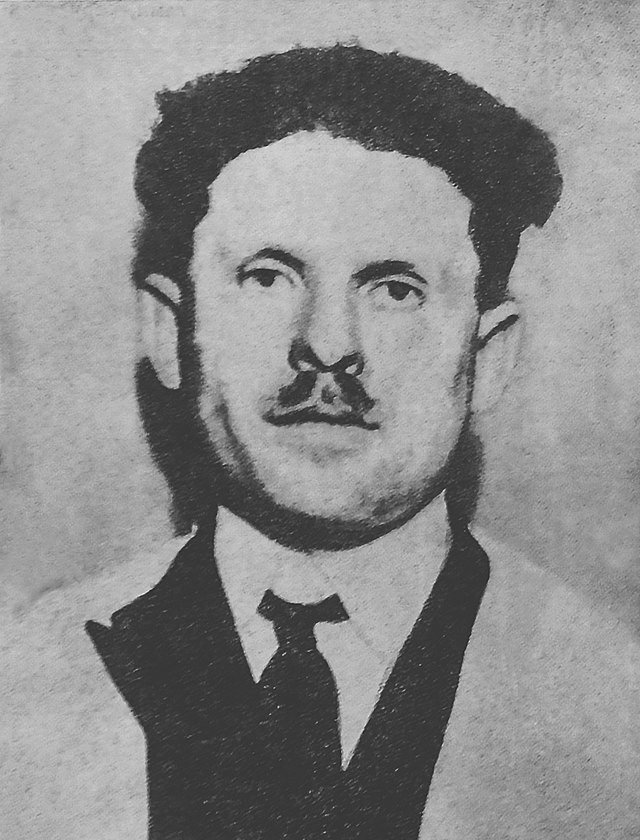
Shalom Schwartzbard

It is perhaps fitting that this blood was spilled on a French street. The French government was one of those which had by turns supported and spurned Petliura and his movement. France also supported other factions whose forces carried out pogroms, such as the White Armies and the Polish government.

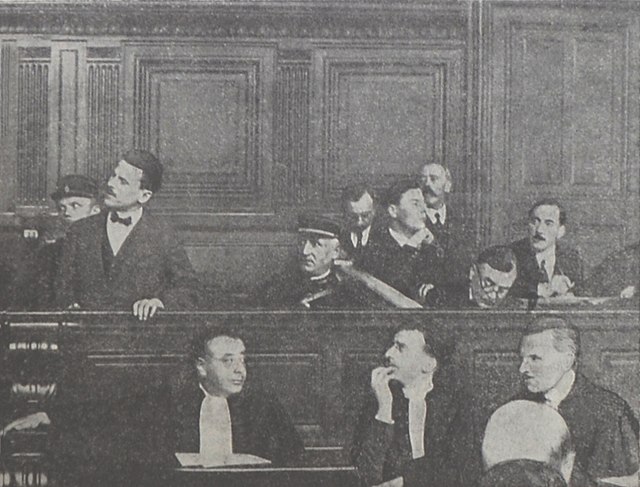
Schwartzbard’s murder trial turned into a kind of tribunal about the pogroms of 1919. France itself was no stranger to anti-Semitism – this was only twenty years after Captain Alfred Dreyfus, an innocent Jewish officer in the French army, was branded as a spy. But such a horrific picture emerged of the 1919 pogroms that the French jury acquitted Schwartzbard in spite of his obvious guilt.

The carnage of 1919 has its echoes in the warzones of today. There is a street in Kyiv, Ukraine named after Petliura. And in Beersheba in southern Israel we can find Avenger Street, subtitled Shalom Schwartzbard Street. [i]

This chapter will attempt to trace that fragment back to its source, examining the storm of pogrom violence which raged across the former Russian Empire.

The Schwartzbard Trial

The White Pogroms

In 1919 the White armies of General Denikin marched on Moscow. Killings of Jews often followed the conquest of a town or the capture of a Red unit. This was the first time that districts where Jews lived in large numbers fell under the control of the White Armies, leading to a wave of pogroms in August and September. They ‘combined “normal” undisciplined looting with ideological anti-Semitism.’[ii]

One Red unit retreating from the Don Country fell into the hands of a partisan ‘Green’ band of Cossacks. At first the Cossacks only killed those who tried to escape, and mainly concerned themselves with robbing from or bartering with their captives. When an officer of the advancing Whites appeared, however, these ‘Greens’ joined the Whites instantly, and lined the prisoners up for inspection.

Eduard Dune remembered the massacre which followed:

Many of the Cossacks had drunk more wine than they should have, but even the [White] commandant, who was sober, took us in with a vacant, sarcastic glance. He began his tour of the ranks without a single word; he would stop silently, look us over, and move on. […]

“Yid?” he asked Aronshtam, the brother of the brigade commissar.

“I am a Jew!” he replied.

“Two steps forward. Right face-run!”

Aronshtam turned to the right, but he didn’t run. He moved forward a step and looked back. The officer wasn’t looking at him, he was going on to the next man.

The Cossacks maliciously cried, “Run, you mangy sheep!”

But he didn’t know where to run, there was a half circle of Cossacks in front of him, Cossacks with rifles pointed. He approached almost to their muzzles, and then fell backward from a shot at point-blank range.

Stunned by the image of Aronshtam’s death, I tried not to look at the next shootings of “Yids,” which included Russians as well as Jews. [iii]

The White officer wanted to single out and murder Jewish people – or sometimes merely those he suspected of being Jewish. And the Cossacks were willing participants. Why?

The officer and the Cossacks grew up in Tsarist Russia, where Jews were openly persecuted. The Tsar’s secret police wrote and published the notorious Protocols of the Learned Elders of Zion, a book which purported to disclose the details of an alleged Jewish plot for world domination. Laws discriminated against them, and state-sponsored mobs from time to time waged brutal campaigns of arson, robbery, rape, assault and murder against them. These campaigns were known as pogroms. Naturally, this ethos of persecution permeated the upper classes and the army and seeped out through the whole society.

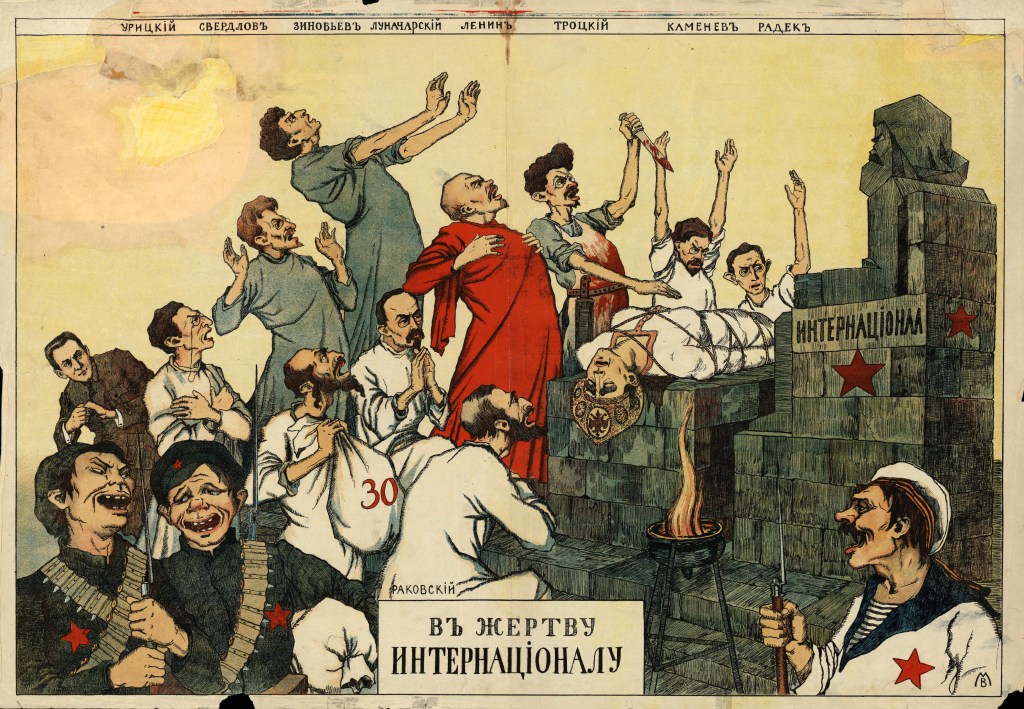
Beevor gives the impression that the Revolution, by empowering workers and poor people, thereby opened the floodgates for anti-Semitic violence. This stands reality on its head. Those who hated the Revolution shamelessly used anti-Semitism as a weapon against it. The Protocols circulated widely in the ranks of the White Armies; ‘Jew’ and ‘communist’ were practically synonyms in their propaganda; and they also published another forgery, the ‘Zunder Document,’ which was supposedly found on the body of a Red commissar – ‘evidence’ that the whole Revolution was a Jewish conspiracy.[iv] Famous White propaganda posters such as ‘Victims of the International’ and ‘Witness the Freedom in Sovdepiya’ were weighed down with anti-Semitic caricatures and tropes.

There was a spectrum of anti-Semitic delirium. On the extreme end was Baron Ungern-Sternberg, who believed he had a sixth sense which could identify Jews and who had an elaborate occult mythology to justify his desire to murder them all. On the more pragmatic end, White generals such as Budberg were not so unhinged. Still anti-Semitic assumptions were so much a part of their make-up that they took for granted the idea that ‘the Jews’ were behind the Revolution.[v]

In the early 20th Century, Jews were widely blamed for all the evils of life under capitalism and, conveniently, also for the revolutionary movements which developed in response to these evils. They were all-purpose scapegoats for modernity. For the reactionary officer who didn’t want to remove his head from the sand, it was far easier and more comforting to blame the Jews than to accept that the revolution was a mass movement with deep roots in Russian society.

The Soviet military commissar Trotsky was himself from a Jewish background, from a farm in South-West Ukraine. He answered the question of why Jews made up a ‘fairly high’ proportion of the Red leadership, although ‘far from constituting such a big percentage of the total as is maintained in White-Guard reports, leaflets and newspapers.’ He also noted that White officers not only hated the Jews, but imagined them to have superior talents.

Anti-semitism means not only hatred of the Jews but also cowardice in relation to them. Cowardice has big eyes, and it endows its enemy with extraordinary qualities which are not at all inherent in him. The socio-legal conditions of life of the Jews are quite sufficient to account for their role in the revolutionary movement. But it has certainly not been proved, nor can it be proved, that Jews are more talented than Great Russians or Ukrainians.[vi]

Jules Grandjean, an image of the Kishinev Pogrom of 1903

Denikin apparently issued several edicts against anti-Semitism. But they were ignored, and he didn’t try to enforce them.

The British chief rabbi counted ‘no less than 150 pogroms carried out by Denikin’s army,’ and the Red Cross reported that the ‘Retirement of Soviet troops signified for the territory left behind the beginning of a period of pogroms with all their horrors.’

Winston Churchill, the foremost advocate of intervention in Britain, was under pressure from his liberal coalition partners. Lloyd George urged him: ‘I wish you would make some enquiries about this treatment of the Jews by your friends.’

So Churchill made a half-hearted attempt to get Denikin to stop his men slaughtering Jewish people; ‘the Jews were powerful in England, he declared.’ Historian Clifford Kinvig remarks: ‘not the most altruistic expression of concern, it must be said.’

But General Denikin would not oblige. In fact, he formally refused to declare Jews equal before the law.[vii]

By mid-November 1919 Denikin’s advance had reached its limit. The retreat was orderly at first. But after the fall of Kharkiv to the Reds, panic set in. Baron Wrangel launched a tirade against Denikin. Denikin responded by accusing Wrangel of plotting a coup. Wrangel was fired and packed off to Constantinople. The Whites gave up most of Ukraine without offering resistance (a key exception was Crimea, which will be very important later). In Odessa another evacuation of White sympathisers took place, this one even more chaotic than the last. ‘Ships slowly listed under the weight of people clinging to the deckrails and scrambling aboard.’ The revolts in Denikin’s rear gathered pace.[viii]

The British general Holman spent the months of retreat jumping in aeroplanes to personally fly bombing missions against the advancing Reds. It must have been dispiriting that the flights kept getting shorter. Even after retreating to Ekaterinodar, his refrain did not change: ‘let’s take an aeroplane and a tank and bomb the blighters.’

General ‘bomb the blighters’ Holman, according to another officer, ‘is obsessed by the idea of wiping out the Jews everywhere and can talk of little else.’ He even asked a military chaplain why the Anglican church ‘did not start a crusade against them.’ Another Englishman, Commander Goldsmith, is quoted as saying that ‘a Russian Jew is quite the most loathsome type of humanity.’ [ix]

When so many powerful people in the Allied camp were themselves Anti-Semitic, it’s no wonder the Allies continued to support the Whites even though they murdered Jews.

The retreat saw a terrible wave of pogroms. The White Guards would sing: ‘Black Hussars! Save our Russia, beat the Jews. For they are the commissars!’ And they were as good as their word, once again inflicting terror on the Ukrainian towns and villages.

Kolchak’s forces in Siberia did not enter Jewish-majority areas, but still made their violent prejudices known, especially during retreats. They had killed 2,200 Jewish people in a pogrom just before they pulled out of Yekaterinburg on July 15th. Dragomirov, the White general presiding in Kyiv, allowed his forces to torment the Jews of that city for six days. [x]

Pogroms in Ukraine

From February 1917 through 1918, attacks on Jews throughout the former Tsarist empire were in general sporadic and small in scale. Nor did Petliura’s forces begin the massacres when they first took over large parts of Ukraine in late 1918. It was when the Petliura forces were defeated by the Red Army at the very end of 1918 and the start of 1919 and fled westward in demoralised fragments that they began attacking Jewish communities. These attacks carried on through 1919. The horrific atrocities of Ataman Grigoriev (See Chapter 17) constituted a major escalation.

The first large-scale pogroms were carried out by retreating Ukrainian Rada soldiers on December 31st 1918. The Proskurov Pogrom of February 1919 provides a vivid example of what a pogrom looked like. Rada forces under Ivan Samosenko entered the town of Proskurov (now Khmelnytskyi) and, under the slogan ‘Kill the Jews, and Save the Ukraine’, murdered 1,500 Jewish men, women and children in three or four hours, using sabres and bayonets. The pogrom was supposedly a reprisal for a failed Soviet uprising in the town.

Another hard-hit area was Chernobyl, where gangs under a warlord named Struck raided towns and boarded steam ships on the river Dnipro in order to carry out murders.

In the Brusilov/ Khodorkov area in mid-June 1919, 13-year-old Jack Adelman was woken in the middle of the night by gunfire. People he refers to as ‘bandits’ had seized the town.

My mother, sister and I quickly dressed and ran. My grandparents refused to leave. We joined hundreds of other Jews who quickly left town and walked or ran into the countryside. It soon got light and we saw several armed men on horseback come closer and closer. When they reached us, they ordered us back and lined us up near a sugar factory on the outskirts of the town. They separated the men from the women and children. I was thirteen years old, but very small and was left with the women and children. The men were driven back into town and locked up in a synagogue. This and adjacent buildings were set on fire. The men perished in the fire. One person survived. He was thirteen years old, but tall for his age. I never found out how he managed to survive.

The whole town burned down. Many people were killed, and more were wounded. One aunt of mine was badly wounded and died a few days later. Two of her daughters were wounded by swords but survived. I saw a teacher of mine sitting in the ditch off the road. I realized he was shot and killed while trying to hide in that ditch. I never really learned how many people died in this pogrom.

Around noon the bandits left after the entire town was destroyed. We headed toward the nearest railroad station, about twenty miles from our town. We finally came to Kiev a day or two later and there learned that my aunt was dead.

The dates suggest that the bandits were part of the Grigoriev revolt.

Adelman and his family experienced extreme poverty in Kyiv and then fled via Poland to the United States, where he would write the above account in a senior citizens’ writing group in the 1980s. He was one of millions turned into refugees by the violence.

‘The Ukraine Terror and the Jewish Peril,’ a contemporary pamphlet, contains numerous other graphic and disturbing accounts. Often the ordeal was drawn out over several days and involved a steady one-sided escalation – from robbery, the levying of collective ‘contributions,’ public humiliation and sexual assault to massacre. The survivors might again be extorted for ‘contributions.’[xi]

Pogroms were able to happen because the pogromists had the monopoly or near-monopoly on armed force. The pogromists had all the rifles, grenades, bayonets and sabres, and the victims were a helpless captive population.

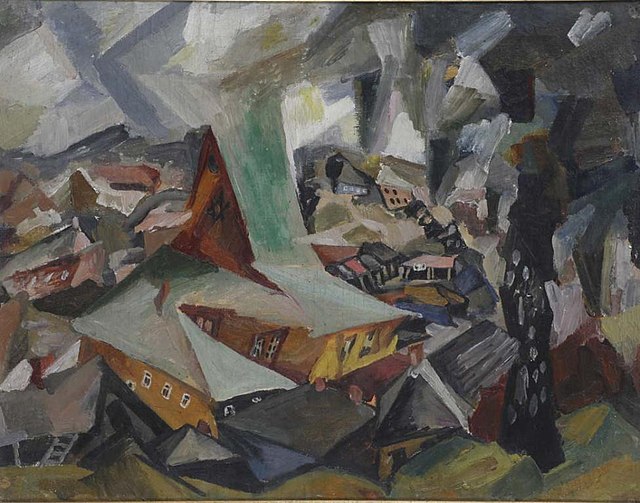
Issachar Ber Rybak, The Small Town After the Pogrom, 1917

Why Ukraine?

Jews made up 9% of Ukraine’s population. Because of historic persecution, they were concentrated in the cities and many were merchants and professionals. The natural antagonism between the farmer and the merchant was supplemented by national tensions and religious bigotry. Where the White officer assumed that Jews were traitors to Russia, Ukrainian nationalists tended to see them as agents of Russian imperialism. The Jews were general purpose, one-size-fits-all scapegoats.

Carr writes: ‘According to a Jewish writer, a member of the Rada called anti-Semitism at this time [1918] “our principal trump.”’ This suggests that at least some Ukrainian Nationalist leaders were happy to make political capital by fuelling anti-Jewish hatred.

Some historians defend Petliura today. His regime made some ‘efforts towards combating anti-Semitism within its lands’ and it is argued that he was ‘not culpable for events that were beyond the control of a weak and besieged government in a chaotic land.’ This is not a bad argument, but it must be extended to nearly all factions in the conflict. [xii]

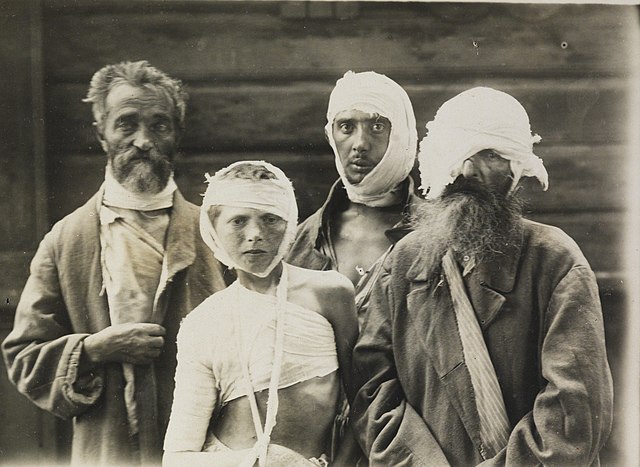
Injured survivors of pogroms, 1919

A 2013 article from the Times of Israel follows a descendant of Shalom Schwartzbard who is not sure who to believe – her relatives for whom Petliura was a villain or modern Ukrainian scholars who are trying to rehabilitate him.

“Petliura was not anti-Jewish — but as a leader, he was responsible,” said [Anatoly] Podolsky, [Director of the Ukrainian Institute for Holocaust Studies] who cited recent research into a pogrom in Proskurov in February 1919 in which 1,500 Jews were killed. One of Petliura’s military chiefs was the pogrom’s leader; Petliura ordered him executed, Podolsky said. [xiii]

Israel and Ukraine today are members of the same broad US-led coalition. Attempts to reappraise the history and rehabilitate Petliura align with modern political agendas. But they obviously clash with other modern political agendas, namely the United States’ arming of Israel. We can resolve this clash by pointing out that, whatever they may say today, very few politicians in Western Europe or North America in 1919 cared about either Ukrainians or Jews.

There is more ambiguity about the role of the Ukrainian anarchist Nestor Makhno. There are claims that he engaged in pogroms, though Makhno himself made a strong rebuttal.[xiv] Polish forces also carried out pogroms and, during the 1920 war with the Soviet Union, interned Jews en masse and discharged them from the army. There were also instances of Red units carrying out pogroms, especially in 1920 with Budennyi’s Red Cavalry in Poland but also earlier: in the pamphlet ‘The Ukraine Terror,’ we learn of bloody incidents in Rossava, February 11th to 15th 1919, and a couple of months later in Vasilkov. This was in a context where Red forces were newly mobilising in Ukraine and were still plagued by ‘partisanism’ and indiscipline.

The difference is that the Black and Red armies both ruthlessly punished those of their own soldiers who carried out pogroms, and this resulted in a much lower incidence. White officers responsible for pogroms were almost never punished.

Illustration of a pogrom in Lviv in 1914
Once again, destruction in Lviv, after a pogrom in November 1918.

Who were the worst offenders when it came to pogroms, the Ukrainain Rada or the White Armies?

Kinvig says it was Denikin and the Whites (p 232): ‘many, no doubt, [were killed] by partisan forces and bandit groups, but the majority, it seems, by Denikin’s armies’); Smele says it was probably Petliura and the Rada. ‘Most of these pogroms – and certainly the most brutal and extensive – occurred during the rule in those regions of the Directory of the UNR [the Rada] in 1918-19.’ (p 161)

Most pogroms were carried out by soldiers – soldiers who had received their training in the openly anti-Semitic institution that was the army of the Tsar. 15 million men passed through this army during World War One, and went on to fight for all sides in the Civil War. So whether it manifested in the White or in the Ukrainian Rada armies, or even amid the Reds or Anarchists, hatred of Jews was a legacy of Tsarist Russia. That said, the Red Army suppressed that legacy while the White Armies basked in it.

Conclusion

There were 1,500 pogroms in 1,300 localities across Ukraine and Galicia in 1918-1919. In all, somewhere between 50,000 and 200,000 lost their lives with another 200,000 ‘casualties and mutilations’ and millions forced into exile. Thousands were sexually assaulted and that some who served ‘in the local Soviets were even boiled alive (‘communist soup’).’ [xv]

If we compare these pogroms with the Holocaust twenty years later, we see some disturbing parallels. The two atrocities happened in the same regions and were visited on the same communities. There is a certain overlap between the White Guard, Baltic German and nationalist movements in Eastern Europe in 1918-19 and the Nazis and collaborators in the same region in World War Two. The White movement functioned as a greenhouse in which anti-Semitic ideas flourished which would later be employed by the Nazis.

On the other hand, the Holocaust killed millions whereas the victims in 1919 numbered in the low hundreds of thousands. The Holocaust was carried out not by locals (notwithstanding the participation of some) but by an occupying imperial power, Nazi Germany. Finally, the genocide of 1919 was carried out with primitive methods (often, literally, with fire and the sword) while the genocide of the 1940s was carried out with a developed industrial apparatus of death factories.

The pogroms of 1919 were certainly the worst massacre of Jews in modern times excluding the Holocaust, and they had both immediate and long-lasting impacts. The historian Budnitskii, quoted in Smele’s book (162), writes that ‘The experience of Civil War showed the majority of the Jewish population of the country that it could only feel secure under Soviet power,’ and in the 1920s Soviet Jews showed a very accelerated rate of assimilation. On the other side, the pogroms rebounded upon their perpetrators, causing moral rot and civil chaos within the White camp and hastening its defeat.

Monument to the victims of the Proskurov Pogrom
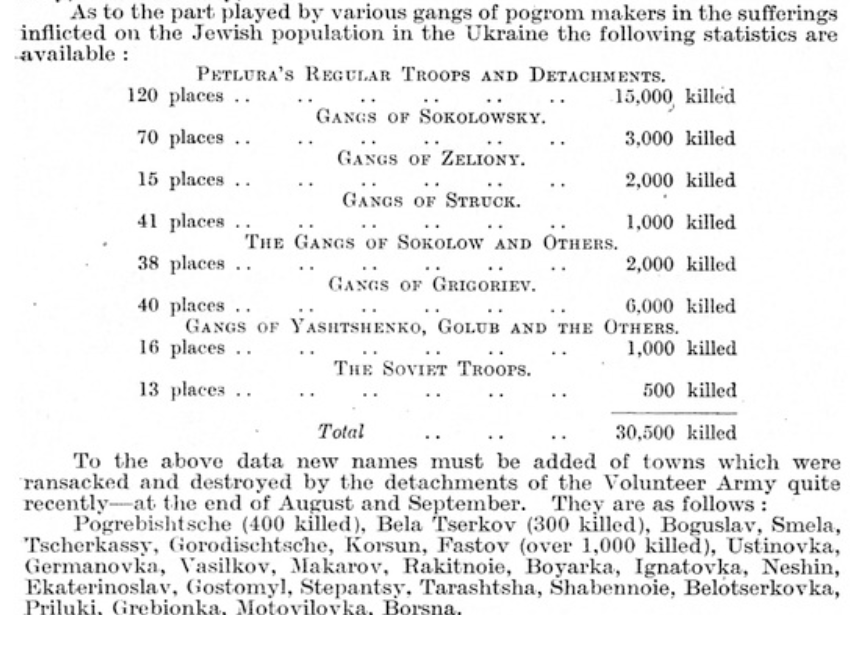
Table from ‘The Ukraine Terror and the Jewish Peril’, published in London, 1921 by the Federation of Ukrainian Jews. This was probably written in late 1919. The text itself states that there are many shortcomings with the statistics that would tend to understate the numbers.

Go to Revolution Under Siege Archive

Go to Home Page/ Archive

Sources

References

[i] Smele, p 163-4

[ii] Mawdsley, p 290

[iii] Dune, Eduard. Notes of a Red Guard, University of Illinois Press,1993. Eds Koenker, Diane and Smith, S.A. pp 163-164

[iv] Beevor, p 37. Palmer, James, The Bloody White Baron, Faber & Faber, 2009, p 97

[v] The Diary of General Budberg, entry for July 4th 1919. Accessed at militera.lib.ru

[vi] ‘The Red Army as seen by a White Guard’ in LD Trotsky, How the Revolution Armed, Volume 2: 1919. https://www.marxists.org/archive/trotsky/1919/military/ch20.htm

[vii] Kinvig, p 232

[viii] Smele, 136, Kinvig, 310

[ix] Kinvig, 307, 310, 232

[x] Beevor, p 391-2

[xi] ‘The Ukraine Terror and the Jewish Peril’, published in London, 1921 by the Federation of Ukrainian Jews. https://ufdc.ufl.edu/AA00007151/00001/images/0

‘Memories of a Ukrainian Pogrom’ by Jack Adelman, https://www.jewishvirtuallibrary.org/memories-of-a-ukrainian-pogrom

[xii] Smele, 160-64; Carr, EH. The Bolshevik Revolution Volume 1, 1950, Pelican, 1969, p 306

[xiii] ‘Did Shalom Schwatsbard avenge the pogroms or kill the wrong man?’ Hillel Kuttler, timesofisrael.com, 19 Jan 2013. https://www.timesofisrael.com/did-shalom-schwartzbard-avenge-the-pogroms-or-kill-the-wrong-man/

[xiv] ‘The Makhnovschina and anti-Semitism,’ Nestor Makhno, 1927. https://www.marxists.org/reference/archive/makhno-nestor/works/1927/11/anti-semitism.htm

[xv] Smith, SA, Russia in Revolution, p 188

Ages and Ages: An Appendix to my AoE2 post

Spinning off from my recent post on Age of Empires 2, here are my musings on what way I think the ‘ages’ should have worked in that game.

The earliest ‘ages’ would be nomadic and clan societies.

Nomadic

AoE2 could use a nomadic ‘age’ – in which, for example, the Mongols could exist on the move across the game map with their herds of sheep. Transitioning to a settled feudal existence would bring both benefits (such as the ability to build better fortifications and more diverse units) and costs (such as the decline in skill of horse archer units as the generation of former nomads is succeeded by their children, who are more familiar with stately pleasure domes). This ‘age’ would be available to any faction willing to pick up sticks. But it would be the default for the Mongols, the Seljuk Turks and others. The loading bar from Nomadic to sedentary could be triggered once you have built a couple of permanent structures, could be accelerated by building more, could be reversed by their destruction.

Clan

This is a relatively egalitarian clan society whose economy is based around common ownership, whose mode of warfare revolves around raiding. The ‘villagers’ could double as decent skirmisher units to represent the clan levy, alongside normal but basic military units. (Instead we have ‘The Dark Age,’ something which is neither here nor there: people who have farms but nonetheless live in tents, whose armed forces are guys with clubs.) The loading bar which brings this ‘age’ to an end could be triggered by the building of a certain number of military buildings and units – which brings about the development of a special military class.

Feudal

The consolidation of power by the feudal nobility could be the basis for a proper ‘Feudal Age’ – now we have mounted and armoured knights, motte and bailey castles, manors as the basic agricultural building. There would be no need for a ‘Castle Age;’ Feudalism would have enough mileage to encompass that. For example, upgrading the motte and bailey to a stone castle. The benefits include a free military unit for every manor you build; but the cost is, you lose the clan levy and reduce the ‘villagers’ to the feeble non-military units we are familiar with.

Renaissance

The next shift in ages could be triggered by buildings such as the Market – heavy use of markets and trade usher in the Renaissance. The traders could increase resource production at the cost of taking some of it out of the player’s control, making it subject to hoarding and market crashes.

Centralised Empire

We could also have an ‘age’ characterised by a strong emperor, centralised authority and an efficient civil service, as we see in medieval China. This social order could be difficult to achieve but versatile and robust.

I like this general idea because rather than ‘superior’ and ‘inferior’ ages we have social orders each of which come with their own costs and benefits. Yes, some social orders allow for more efficient resource-gathering and production. But each, played right, can work on its own terms. And each has considerable mileage within its own limits, reducing further the incentive to change. We also move beyond both national stereotypes (Rise of Nations) and the reductive ‘balanced’ approach of making all factions identical. We have minor or cosmetic differences between factions, but the real difference is between social orders.

Home Page/ Archives

Previous post on AoE2

Games that warped my young mind: Age of Empires 2

Click here for my previous entry in ‘Games that warped my young mind,’ discussing Red Alert 2.

Around the start of this millennium, the adults were worried about how Grand Theft Auto would turn my generation into serial killers. The ultra-violence of GTA was probably too outrageous and obvious to have much effect. Meanwhile, far less controversial games were warping the way we thought about the world. Today I’m going to take a critical look at a classic that is still widely-played today: Age of Empires 2. AoE2 is a strategy game from 1999 that purports to be set in the Middle Ages. But it gives a totally wrong impression of how the Middle Ages worked.

What’s my angle here? Do I think Age of Empires and Command and Conquer should have been banned? No, the world would be a less fun place without them. But all the ink spilled condemning GTA would have been better spent making an informed, sympathetic criticism of a game like AoE2. People who liked and enjoyed the game, but also had read a few books about the actual Middle Ages, should have had a platform to tell us what it got wrong.

Strengths

First, the strengths of AoE2. You don’t need me to tell you it’s a satisfying and addictive game. Take that as read. As for how it depicts the Middle Ages, there are good points. The campaigns strike a balance between compelling narrative, satisfying challenges and historical fidelity. The William Wallace campaign is a perfectly-ramped-up tutorial with a good story, and to this day ‘Falkirk’ and ‘Stirling’ are taking up space in my memory banks. Also, there are paragraphs of proper historical information on offer, if you care to pause the game and do some reading.

The gameplay itself has its strengths. It conveys one important lesson about history: before you can put armies in the field, you need to have a lot of people working hard producing stuff. And unlike in C&C where there’s one all-purpose resource (ore or tiberium), AoE and AOE2 demand that you build a relatively complex and diverse economy. Twenty minutes into a game, you have built a busy little town: your villagers are mining, farming, hunting and gathering, slaughtering sheep, cutting down trees; little boats are bringing in nets full of fish to your docks; little carts and trade cogs are moving between settlements. It’s diverse and interdependent, and as you play, human activity gradually consumes the forests and the wildlife, and the grass is turned into neat rows of crops. It’s not just satisfying to play and nice to look at; this basic rhythm of gameplay is authentic.

Genocide

So here are my criticisms of AoE2 from a historical perspective. I’m not going to talk about how the Elite Long Swordsman has the wrong type of sword or the Frankish blacksmith model is inaccurate. I am going to talk about its overall concept of society and warfare in the Middle Ages, and how it gave a whole generation fundamentally the wrong idea.

AoE2 still depends on the C&C formula in its basic structure: build a base, build an army, destroy the enemy. That’s OK in a game where you play as a military commander and your task is to destroy a military base. But in the AoE variant, you are not destroying a military base. You are destroying a whole society. You have to exterminate the ‘enemy.’ You have to level his city and his infrastructure. Not take it over – demolish it.

I won’t labour this point as it was expressed well in this post from acoup.blog. But while the grown-ups were worried about us jacking a car and doing hit and runs, we were meanwhile playing a supposedly more wholesome and educational game, in which we were required to do genocide. And 100% anachronistic and unnecessary genocide, at that. The fact that so many who grew up playing AoE have stood by while their countries killed vast numbers of people with bombs and guns has broader roots than one videogame, of course. But games like this are part of the tapestry. 

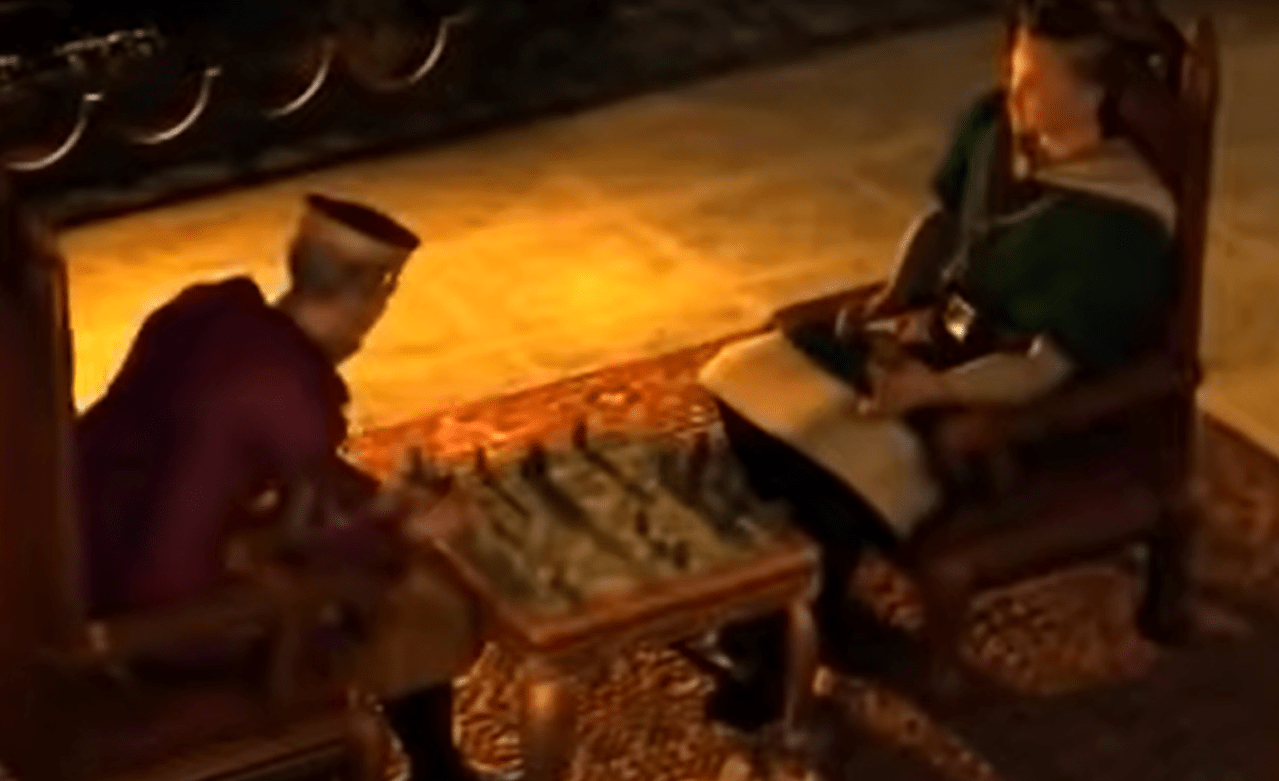
The intro video is clever. The game of chess is a nod to the fact that we are playing a game. Blunting the edge of many of the criticisms I will make here, the video suggests that like chess, the game you are about to play is only supposed to be an approximation of real life.

Society

Let’s return to that pretty medieval town you have built. How many farms have you got? Five, six, seven? And how many other buildings have you got – a monastery, a barracks, a castle, a market, a blacksmith, a stable, an archery range, a town centre…? You’ve got at least as many other building types as you have farms. You might easily have twice as many.

Throughout most of human history, and certainly in the Middle Ages in Europe, the overwhelming mass of the population worked in agriculture. In AoE2, the heavy toil which defined the lives of 95% of the population is represented by five villagers hoeing little plots of land. The farms, little patches on the margins of the base, are like gardening allotments on the edge of a housing estate.

Why does this matter? Because a lot of guys are walking around out there with the vague idea that if they had lived back in the middle ages they would have been knights. White people are actually the worst offenders with the ‘We used to be kings’ meme. In reality, most of us don’t have to go back as far as the Middle Ages to discover that our direct ancestors were super-exploited peasants with no freedom. It took the labour of a whole village to arm and mount a single knight. Again, AoE2 is only one artefact of the culture that produces these wrong ideas, but it is under-examined.

Sometimes you can see how shallowly the C&C formula is buried. Your attractive medieval settlement can stand in for a military camp, a city or an entire civilisation, depending on the scenario. But it is what it is: a base. Likewise the game treats the player as a commander in a modern military, with life-and-death control over the entire faction.

As soon as you read any real medieval history, it becomes clear how absurd this is. Medieval history is mostly about the church revolting against the king and/or the secular nobles, the nobles revolting against the king or feuding with one another, the peasants revolting against the nobility, and the town people revolting against all of the above. AoE2 is about players (human or AI) who have absolute control over an entire society, waging war on another equally monolithic society.

A real medieval polity was not united but feudal. A king had to negotiate through layers of autonomous lords and knights to get anything done. Its settlement pattern was very much dispersed, not nucleated like the AoE/C&C base. A ‘knight’ was not just a cavalry fighter who was good against archers and weak against pikes. For your medieval ancestor, the knight was the equivalent of your mayor, your boss in work, a military officer, and a made guy in the mafia.

There is a ‘Feudal Age’ in AoE2. But the game does not simulate feudalism – it simulates a caricature of a totalitarian communist state.

For those who haven’t played it, this is what actual gameplay looks like.

Ages

Speaking of ‘ages’ – in AoE2, the player progresses through four: the Dark Age, the Feudal Age, the Castle Age and the Imperial Age. Each age unlocks new buildings, units, technologies, etc. But these ages do not correspond to anything in real life. In the first AoE they roughly did. But not here. The game covers the period from around 500CE to around 1500CE. The ‘Dark Age’ does not correspond even roughly to 500-750, nor the ‘Feudal Age’ to 750-1000, etc. There is too little in the early ages by way of buildings, tech and unit types, then all of a sudden too much in the later ages. No, the Catholic church was not ‘unlocked’ a hundred or two hundred years after the First Crusade. Stuff from the ‘Castle Age’ was 100% around throughout this whole millennium.

All in all, the game does a particularly poor job of depicting the early Middle Ages. A battle in the ‘Dark Age’ is limited to guys with clubs hitting each other. But there was a bit more than that going on during the age of Al-Andalus, the Merovingians and the Tang Dynasty.

In the real middle ages, The Catholic Church pretty much had a monopoly on literacy, education, social services and bureaucracy across most of Europe for most of a millennium. In AoE2, the clergy don’t show up until the third ‘age’ of four.

The Marxist idea of a mode of production offers a better template for social development than the idea of a linear progression of ‘ages.’ (Here, I went off on a tangent proposing how this could actually work in a game, but to spare the reader I have moved it to an appendix which I will post next week.)

All I’ll say now is, instead of different ages, I wish we could see different social orders. Returning to the Marxist criterion: sure, the mercantilist and feudal social orders have a greater productivity of labour than the nomadic society or the trans-egalitarian clan society. But depending on the situation, the former were still capable of losing wars to the latter.

Factions

In a way, there’s a refreshing universality in AoE2, an ethos of common humanity. Beneath the different models, every faction is essentially the same (barring a special unit which is often only unlocked late in the game – the Vikings only get Berserkers after, historically, the Norse and Danes had long since settled down and ceased to Vike). It is really laudable, too, that AoE2 even before the recent DLCs had a more diverse roster of factions and cultures than most of the Total War series. This balance and symmetry is also good for playability.

It’s certainly less problematic than the approach of Rise of Nations (2004), which presented a roster of ‘Nations’ such as the British, the Japanese and the Bantu, each of which had the same essential features from the Stone Age right through to the Information Age (‘The Russians have the power of the motherland, giving them plus 3 attrition damage…’) Though I should mention that I’ve spent many enjoyable hours on Rise of Nations, including recently.

The Middle Ages saw clashes not just of class or religion or people, but of different types of society, as we can see when the Anglo-Normans confronted the Irish (check out my series Celtic Communism), or when the Norse and the Danes came to Britain.

Warfare

This brings us to the nature of warfare in the Middle Ages. Here AoE2 not only does a bad job of being historically accurate – it’s an area which I’ve always found weak in terms of gameplay.

Consider the historical battles which occur in the campaigns – the aforementioned Falkirk and Stirling, or the Battle of Hastings in the expansion pack. In real life, these were distinct battles that happened in specific places. In AoE2, they are about building a base, gradually wearing down the enemy bases, then finally destroying them. Actual battles rarely happen in AoE2. Every war is a war of attrition.

Here’s something I noticed at the moment I decided to abandon the hitherto-promising Bari campaign in one of the recent DLCs: AoE2 is supposed to be set in the Middle Ages, but actually what it simulates is closer to 20th Century warfare. In some scenarios you have limited forces and have to use them cleverly; that’s both better fun and more accurate. But in most scenarios, and in the vanilla game, your task is to churn out soldiers and rush them to the front, where each wave will gain a little ground before its complete destruction. Tactics are rudimentary.

That is why a scenario like Vinlandsaga works so well: AoE2 is better at simulating a drawn-out process of development, exploration, conquest and settlement than at simulating an individual battle. But even in Vinlandsaga, you somehow find yourself besieging and demolishing stone castles in the early Middle Ages in Greenland.

The violent part of the game is actually not much fun. Since tactics barely matter and there are no set-piece field battles, winning a war is reduced to producing soldiers in greater diversity and quantity than the enemy. You spend a fortune on them only to watch them, usually, die for minimal gains. It’s not very satisfying.

Conclusion

Like a lot of people, there are large chunks of human history that first entered my ken through the medium of videogames. This stuff is really influential on how millions of people think about the past. So there needs to be a culture of friendly historical critiques. I’ll still play a historically inaccurate but fun game over one that’s more accurate but less fun – I’ve spent a lot more time playing Creative Assembly games than Paradox games. Fair enough if developers generally allow gameplay to trump authenticity. But let’s be aware of the choices they have made.

Instead of such a culture of friendly criticism, I think strategy videogames have functioned as a transmission belt for a mechanistic and essentialist understanding of societies, nations and conflict. For example, I once came across a Youtube video which justified the genocide of indigenous peoples in the Americas with reference to their ‘spawn points’ and ‘tech tree’ – evidently a conscious shorthand, but un-ironic. The idea of societies composed of antagonistic classes is quite incomprehensible to people brought up to assume that each given faction or nation was a monolithic and totalitarian entity.

I’ve read more than one recent novel with a pre-modern setting in which the characters use terms like ‘subconscious’ (coined by Freud in the 1890s, right?) ‘genocide’, (coined in 1947) and ‘the military.’ It’s that last one that concerns us here. AoE2 is part of a culture that reifies the state, that tells us that the standing army and the modern nation have always existed. But the real Middle Ages were much stranger and much more interesting.

Games that warped my young mind: Red Alert 2

Home Page/ Archives

Appendix: Ages and Ages

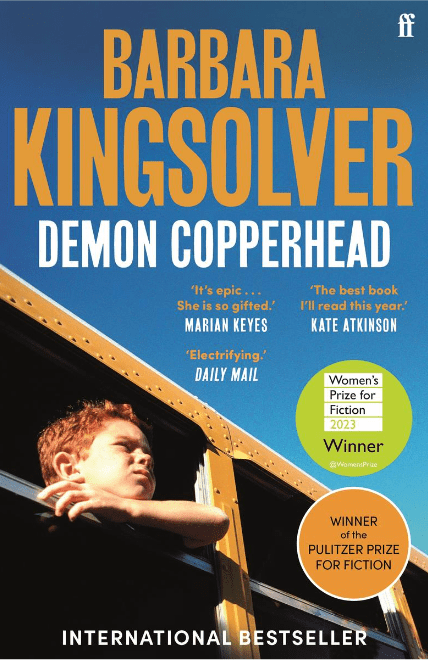
Review: Demon Copperhead by Barbara Kingsolver

Audiobook performed by Charlie Thurston

After I finished Demon Copperhead I read a couple of reviews and had a strange moment. Just for an instant, I felt surprised that this reviewer in the Guardian also knew Demon. I had approached the novel as an Award-Winning Book That People Should Read; then I started it and I was in Demon’s world, and prestigious literary awards were the last thing on my mind. When I finished it – or maybe emerged from it – a part of me was surprised to remember that it was a book after all.

Demon’s voice

The feature of the book which best explains this is there right from the start: the narrative voice.

The narrator and main character is Damon Fields, who has a nickname, like everyone on his home turf of Lee County, Virginia. He is dubbed Demon Copperhead – the echoes of David Copperfield by Charles Dickens are there if you want them, but you can enjoy this book all on its own. The book follows Demon from birth through his first two decades in this world. His community is shambling through a half-life of mass unemployment; his young single mother struggles with addiction; the opioid epidemic hits like a war when he is around 10 to 15 years old.

The great strength of this book is the gloss of humour that comes with having Demon as a narrator. When I say that it’s easy to read despite the heavy themes, maybe readers will think that means the book takes a flippant or mocking approach. But it’s compassionate and humane all the way through. When I say that Demon interrogates head-on the issue of how the media portray ‘hillbillies’ and ‘rednecks,’ you might think the narrative is weighed down with lectures. It has didactic parts, but they don’t weigh down the story at all. They drive it on. Real people lecture, and lectures can be compelling.

I don’t have personal experience of the setting or of most of the heavy themes in this book. I assume Kingsolver must know the locale and its people – it rings true. But it’s about a kid growing up at the same time as I was. From the tone of the narrative voice to the pop culture references, and even the particular flavour of juvenile humour, Barbara Kingsolver got Demon right. He seems like some kid I might have known growing up.

The literal voice of Charlie Thurston was strong in the audiobook. Again, I just can’t comment on the accuracy of the accent, but the performance was more than good enough. If I ever hear that voice on another book, or on TV, my first reaction will be, ‘Hey, that’s Demon.’

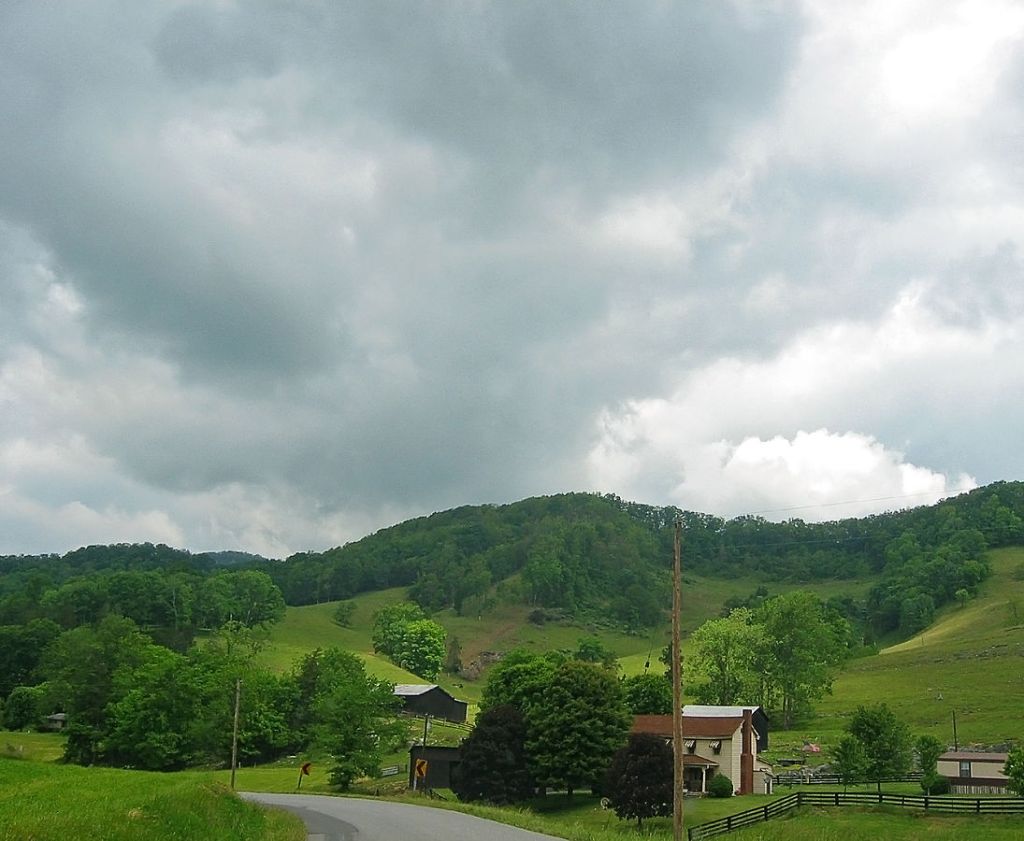
The lush landscape of Lee County, Virginia

Characters

Demon usually has at least a medium-sized list of things going on in his life, pulling him this way and that. He also has a satisfyingly large cast of characters coming and going. They are all well-developed so that I never had moments of ‘Who’s he again?’ You know you are dealing with good writing when you find yourself a little excited to see two characters together for the first time. ‘Huh,’ I said to myself, ‘so young Maggot and Swapout are doing break-ins together,’ or ‘Well, wouldn’t you know it, U-Haul and McCobb are in on the same pyramid scheme.’ On the other hand you feel genuinely relieved and pleased to see, for example, Tommy Waddles doing well in life.

In its world, ‘doing well’ is relative. When the adolescent Demon is sent to work at a dump beside a meth lab, it’s a great improvement in his fortunes because the owner of the adjacent garage lets him eat free hot dogs whenever he likes. Relief washes over you. Come to think of it, relief is the main feeling I associate with this book.

This book has great villains. It’s fair to say that U-Haul’s characterization lacks subtlety – he’s just a grotesque person. The McCobbs are a terrible foster family, in all kinds of fascinating ways, but they are not monsters. In a different and even worse foster home, Demon runs into an older boy known as Fast Forward. Fast Forward gets the younger boys to line up like soldiers for inspection each night. He shakes them down for money and snacks. He makes them take the fall for his mistakes. But he also gives them flattering nicknames, an identity, a sense of purpose and dignity in this hellhole. This is the source of his power, and that power makes him scary.

Then we have a moderate-sized pantheon of adults who just let Demon down. There’s those who, to paraphrase Demon, can’t see any more in young men like him than what can be wrung out of them by the end of the week on the battlefield, the farm field or the football field. Then there’s those who, out of misguided ‘tough love’ or in the heat of an argument, cut off support to young people just when they need them most of all. Then there’s the one who let Demon into his home, but also let in the monstrous U-Haul.

Then there are the social workers – the one who stays in the job but just doesn’t care, and the one who cares in her naïve way but quits the job as soon as she can. Demon understands why one doesn’t care, and the other quits – they get paid very poorly. Their work is a life-or-death question for him, but it is simply not valued by the state.

On the summit we have a cast of characters who are just solid gold, such as Angus/Agnes, a couple of teachers, June Peggott, and in his more limited sphere, Mr Dick.

Addiction

Kingsolver gets past the bullshit of judging addicts for their ‘personal choices’ to show why people fall into drug abuse. ‘This was done to you,’ June Peggott insists.

There is a moment early-ish in Demon Copperhead when Fast Forward throws a ‘pharm party’ for Demon and the other foster boys. They sit around on the floor eating hash brownies and taking pills. This should be an ominous moment – Demon’s first introduction to something that will later cause him a lot of suffering. But it isn’t. In this filthy and cheerless house, the boys are regarded as farm labour and nothing more. They are insulted and sometimes beaten, and not provided with clothes or proper meals. When it enters the story, the ‘pharm party’ does not present itself as something immediately dangerous. It’s a respite. The story tells us to face it: there’s nothing better on offer from their fosterer or from the Department of Social Services. Drug abuse is not the worst thing happening in this house. It doesn’t even rank in the top ten worst things.

But of course it is the beginning of something very bad. Later, when Demon is a teenager and is doing better, an injury puts him out of action and a doctor puts him on oxycontin. By now the opioid epidemic is raging. He descends into addiction – not all at once, and not putting everything else on hold. Life goes on around the addiction, but we see how it creeps in. His first experience with drugs was intimately bound up with his relationship with Fast Forward, and as he grows up relationships continue to be central to addiction. When Demon describes an incident of falling off the wagon as an act of love, and when he tells us that addiction is not for the lazy, we see what he means. We are dismayed to see him ruining his life, but his actions make sense in the situation he’s in. Sometimes his actions are even perversely admirable.

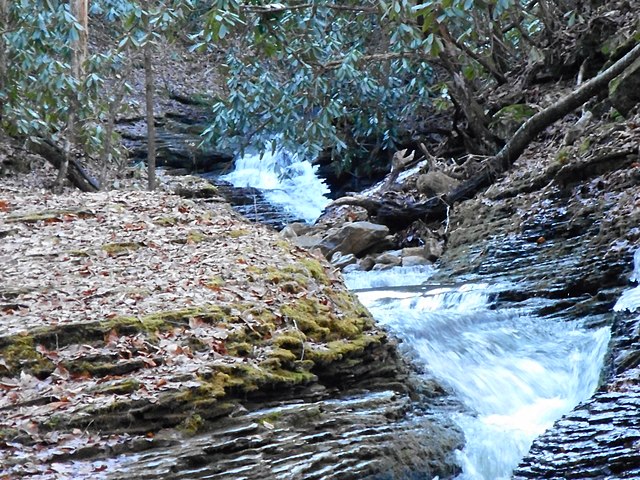
Devil’s Bathtub, in Scott County, Virginia

Dickensian

Several times, Demon descends into the depths of hell – in his lone quest to find his dad’s family; his forays to Atlanta and Richmond; and his fateful hike to the place known as Devil’s Bathtub.

But hell isn’t where Demon ends up. Plenty of other elements are in the mix: Demon’s artistic talents, plus a budding consciousness about the history of his area – the Whisky Wars, the Battle of Blair Mountain, the tension between urban and rural. As the story goes on, Demon learns how much the odds were stacked against him before he was even born. In a previous generation, his people organised in unions and took on the mining companies. Today they are cannon fodder for the drug companies. ‘This was done to you.’ These things come together organically in the final part of the novel.

Where does Charles Dickens come into it? No Dickens narrator ever talked like Demon, and I don’t think Dickens ever wrote much about sex or drugs. But like those narrators, Demon is incisive and funny, and he talks about the neglect and abuse of children, and tells stories of the lumpen adventures of orphans. He builds a world of scarcity and callousness so that the acts of generosity and friendship can stand out bright and clear. Also bright and clear is the impression that, in most essentials, nothing has changed in the intervening miles and years between David Copperfield and Demon Copperhead. The author’s decision to write the latter as a tribute to the former is not a gimmick; it carries real meaning. Capitalism means constant disorienting change but the underlying callousness stays the same, and we can recognise it in the 19th Century and in the 21st.

Review: Prophet Song by Paul Lynch

The questions Paul Lynch addresses in this novel are, first, ‘What if something like the Syrian Civil War happened in Ireland?’ and second, ‘What would that war mean for Eilish Stack, a mother of four living in the suburbs of Dublin?’

He is more interested in the second question than the first. But both are answered in long, consciously-crafted sentences, in uncompromising, unbroken columns of prose. Late in the story Eilish is running out her front door to search for her son when, in mid-sentence, ‘soundlessly she is raised from her feet and borne through the air rearwards with her arms held out in some counter-time of light and darkness holding pieces of cement in her mouth.’ (p 239) In other words, she was caught in the shockwave of an air strike. I like Lynch’s prose. You have to pay attention to get the full meaning from it, and it’s worth the effort.

The book opens with a scene in which two Gardaí who ‘seem to carry the feeling of the night’ knock on her door looking for her husband. He is a trade unionist, and the Gardaí are a from a new Gestapo-type unit who serve an authoritarian government. The trajectory from there to civil war and ruin is gripping, graceful and bleak.

Where are we? In Dublin, in the near future or in an alternate present. Personally, I would have liked page upon page of exposition about who this new governing party are, how they came to power, what their programme is, what their international relations are like, and so forth. I would have liked it, but that doesn’t mean it would have been a good idea. It’s not really the focus of the book. By transposing contemporary wars to a familiar setting, this book made me empathize with the victims of war. A focus on politics might have run a risk of diminishing that. An equivalent of Goldstein’s book-within-a-book from 1984 would have definitely diminished it. It has been compared to 1984, but this is an easier book to like than Orwell’s, and easier to read in spite of the depth of its prose. It’s not so didactic, and it gives a more varied, optimistic and genuine panorama of the human race. But the two are not really the same type of book – Prophet Song is a description, an impression, not an attempt at anatomy or analysis.

Lynch provides enough by way of sketches to give the reader a fair idea of the political background. There is a party or coalition called the National Alliance. Their supporters wear distinctive pins on their collars, hang the tricolour from their windows, and sing the national anthem even at weddings. They make ‘hieratic gestures’ as they speak ‘the cant of the party, about an age of change and reformation, an evolution of the national spirit, of dominion leading to expansion.’ (p 71) They have been in power for two years when, one September and in response to a crisis or supposed crisis whose nature the reader is not told, they introduce an emergency powers bill.

That winter (and here the novel opens), the National Alliance government begins arresting trade unionists. The Teachers’ Union of Ireland (TUI) are in the crosshairs and Eilish’s husband is a senior official. The union leads a protest march which is suppressed violently. In the manner of the Argentine junta, those who are arrested before and during the protest disappear, and the families receive no hint of whether they are alive or dead.

Each atrocity is given its due time and space to be felt and to have knock-on effects through the ins and outs of family life and, usually in the background, national life. We never go numb. Things escalate when Eilish’s son disappears too, though of his own volition. A shocking moment: her elderly father rings up to say that one of her boys was over at his house recently. The tall one. We are one with Eilish in her frustration. Is the confused elder mixing up yesterday’s memories with those of last year? Or was her son alive and at his grandad’s house a couple of days ago?  

As I was reading Prophet Song, the Israeli state was dropping thousands of bombs on Gaza. ‘There is light now where there used to be none, the buildings folded into rubble, the solitary walls and chimney flues, the staircase that climbs to a sudden drop.’ (p 233) Not Gaza, South Dublin. To call the book prophetic, of course, would be to miss the point. It could be Gaza five years ago, or ten or fifteen ; it could be Damascus, Mosul, Aleppo, Fallujah, Khartoum, Kherson, Kharkiv.

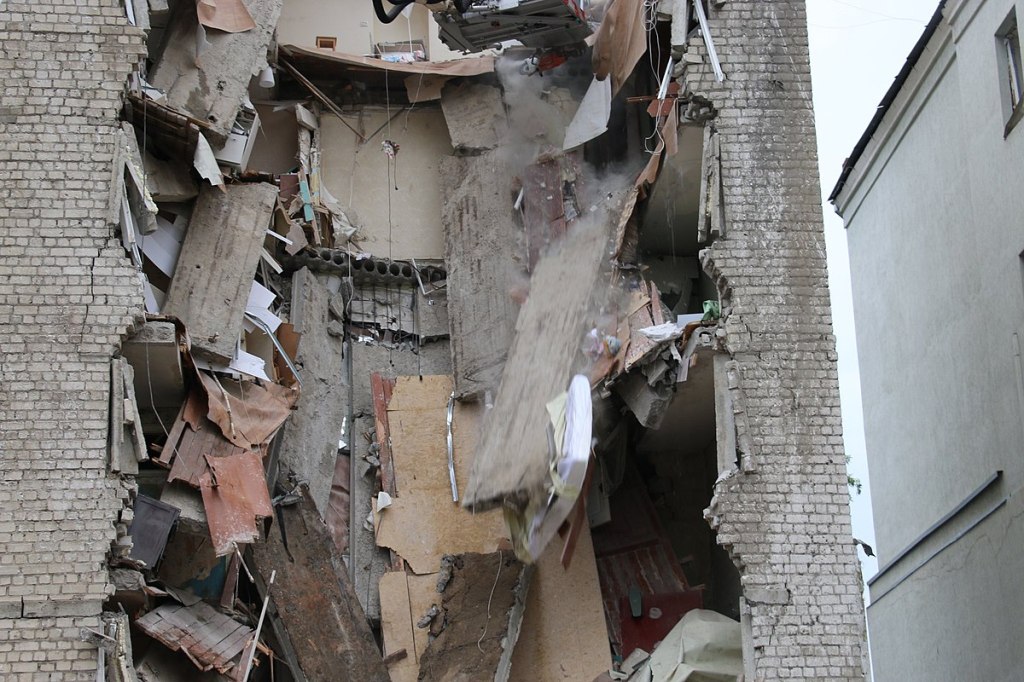
Damage from Russian shelling in Kharkiv, 2022

I’m not sure the Irish Defence Forces have enough artillery or air power to cause such destruction; the National Alliance must have received substantial aid from abroad. Foreign military aid is usually a major factor in civil wars, though it is not mentioned here. There is mention of Canada, Australia, Britain and Europe, none of whose governments appear to be friendly with Ireland’s. But there is no mention of the United States. Maybe Ireland has been sucked into fascism in the wake of America, and Washington is sending fighter planes and artillery to Dublin.

By the way, it’s unsettling how easy it is to think of such scenarios. Ten or twenty years ago a lot of people would have been saying that a story like this was implausible but that’s not even a part of the conversation around Prophet Song.

The fact that this could be Gaza underlines how the novel, while rooted in a specific place, manages to be universal. Hence the sketched-in historical and political background. The advantage is that it invites empathy. We might some day hear the song of the prophets of the god of war in our own backyard. The disadvantage is that wars actually do have specific causes, which we need to understand. People are often tempted to attribute it all to ‘human nature’ or eternal elemental forces or whatever – which cuts across empathy.

Eilish is in fight or flight mode from the start of the novel. The run-on sentences and three-page-long paragraphs convey a sense of short breath and a hammering pulse. She is under severe pressures and barely keeping her family together. All the same, her indifference to the political situation is something I find frustrating – frustrating in the way I might find a real person frustrating. But her language adds to the impression of a narrow-minded narrator. Addicts are ‘junkies’ and people ‘from the flats’ have a ‘feral’ appearance.

[Minor spoilers in the paragraph that follows]

At one point she scolds the rebel soldiers for arresting someone who’s out after curfew. ‘My eldest son left home to fight against the regime with you lot and here I stand now on the street being threatened, we wanted the regime out but not to be replaced with more of the same.’ (p 221) Okay – that’s a rare moment of outspoken bravery there from Eilish. But if she will not consent to the rebels enforcing a curfew in a warzone, then she’s just not serious about wanting them to win. As for her son, she fought tooth and nail to try to stop him joining the rebels, so what claim has she got over them?

I think the author was trying to highlight certain uncomfortable truths about war and revolution. In Syria, many of the rebel factions turned out to be worse than the government. In any war, neither side has a monopoly on inhumane behaviour. So I understand his choices here, but I think Eilish comes across more poorly than he intended in this moment.

On the other hand, the believability of her character is not diminished by these flaws. Maybe it says something good about the rebels that Eilish feels free to defy and criticize them in a way she has never done to agents of the state.

[Spoilers over]

The characters all feel real, from the family at the heart of the story to minor incidental characters, like the clown who saves Bailey’s life or the creepy official towards the end of the book. It’s the kind of story that keeps defying expectations, even though overall you know where it’s going. For example, if I tell you that a people smuggler shows up half-way through the story, you will have a certain image in your head. But you will probably not recognize the character as such when she appears, because this novel does not deal in stock figures.

While the family waits for news of the disappeared husband and father, blows keep raining down on them. Usually, they hold up admirably. Sometimes they pay back persecution with defiance. But sometimes you can detect something breaking beyond repair, as when Eilish thinks about the baby in her arms. Like Gabor Maté, who was an infant in the Budapest Ghetto in World War Two, he will grow up to be a damaged person. But ‘out of terror comes pity and out of pity comes love and out of love the world can be redeemed again.’ (p 304)

My criticisms are secondary, and of a kind that are only possible with a bold, compelling and well-crafted novel. While I’m questioning a few of the choices, I’m not lamenting them. Prophet Song invites this kind of interrogation and stands up well under it.

It ends at a familiar place, familiar and dreadful to those who watched the news in 2015 and 2016. In hindsight that is where it was always going to end.

At the beginning and the end, Lynch makes it clear that the force against which Eilish is contending is not a particular party or programme, but a general ‘darkness’ which was there from the start, already containing all the horrors to come. In the final fifty pages or so, that horror reaches a climax. The reader realises how the story has filled us with dread. Because here it is, what we were dreading all along – but it’s not what we expected. It’s worse.

But ‘it is vanity to think the world will end in your lifetime’ – there is some consolation in that ‘the end of the world is always a local event.’

Home Page/ Archives

School Resources: King Arthur – history or myth?

This is a lesson I created to teach kids aged 10-14 a thing or two about Post-Roman and Anglo-Saxon Britain, about feudalism/ manorialism, and about figuring out the blurry dividing line between history and myth.

5 ‘weird little guys’ of the Russian Civil War

I listen to Chapo Trap House and Hell on Earth, and those lads often coin a phrase – Maga Chud, Hot Couch Guy, Lanyard, etc. One of the little phrases they have pioneered on there, especially with reference to the podcast Blowback, is the idea that guys or weird little guys are a big part of what makes history interesting. They mean, basically, a character. A guy is some outrageous, fascinating, usually horrible individual, almost always a literal guy: Macarthur; Charlie Wilson in Afghanistan; Von Manstein and Gustavus Adolphus in the Thirty Years’ War. I think the ‘Great Man’ Theory of History is bullshit but I believe in the explanatory power of biography, particularly of the not-so-great man. An individual character can be a strong nail on which to hang a narrative.

My writing has progressed from an obsession with the Celts and the Gaels to an even deeper obsession with the Russian Civil War. That has involved wading through a sea of colourful characters. That’s no surprise: an empire collapsed, and with all institutions turned to dust, the force of personality briefly became a real material force. Any half-way charismatic character could ‘shark up a band of lawless resolutes’ and just have a go at conquering Russia.

I’m going to try and narrow it down to the five most interesting guys I’ve come across. But we can’t go with the obvious big names – Lenin, Trotsky, Kolchak or Denikin. For all their differences and their interesting features, these characters are straightforward. ‘Guys’ are hard to define but they have to defy expectations, or even to defy the laws of political gravity. It’s also difficult to rank them. Below, number 1 is definitely number 1 but the other four are joint second. Here goes.

5: Ataman Nikifor Hryhoriiv, aka Grigoriev, aka Servetnik

Top: Grigoriev and his movement, as depicted in a Red poster; bottom, Red army routing Grigoriev

Grigoriev was the pure distillation of the contemporary warlord. He fought for, or at least flirted with, literally every side that was active on his front of the war. Let’s go through the list. From the Tsarist Army he went to the Ukrainian Nationalist Rada (check); he helped overthrow them on behalf of the German-backed Hetman Skoropadsky (check); then he rejoined the Rada and helped overthrow Skoropadsky. Then he linked up with the Ukrainian Left SRs (check); next he brought his partisan horde into the Red Army and captured Odessa for them (check). In May 1919 he set up shop on his own when he launched a massive revolt against the Soviet power which covered about a third of Ukraine and which was accompanied by vicious anti-Jewish pogroms. After his revolt was put down he tried to make an alliance with Makhno and the Anarchists (check). They discovered that he had made a secret alliance with the Whites (check), so they killed him and brought his followers into their army.

Grigoriev is an easy pick for this list. He was notably rude and charmless, and he was pissed as a newt when he took Odessa. Frequently to be found RHUI – Riding a Horse Under the Influence – but he led from the front and for this he was admired by his men. In his drunken, fearless, martial, bigoted figure he embodied the chaos of his land in 1919. If the Reds had followed through on their plan to send him and his army to help the Hungarian Soviet, he probably would have ended up joining the Slovakians or something.

4: Larissa Reissner

Larissa Reissner was one of thousands of women who volunteered to fight in the Red Army, not to mention those who fought in, and even led, Red partisan forces.

She was also a great writer, and she left behind ‘Svyazhsk,’ an eyewitness account of the Battle of Kazan – in my opinion one of the best-written first-hand documents we have from this war.

After fighting in and writing about that battle, she went on to spy behind the Japanese lines in Siberia, disguised as a peasant woman. She was captured, because her disguise was utterly unconvincing, but she escaped. Along with her husband Raskolnikov (aka Ilyin, another contender for ‘guy’ status), she went to Kabul and negotiated a diplomatic agreement with the King of Afghanistan.

She knew many famous writers and artists, from Mandelstam to Akhmatova. Most Bolsheviks’ personal lives appear to have consisted of drinking tea and country hikes, but Reissner’s was far more interesting and colourful. Of how many people can we say that they conversed about poetry with Anna Akhmatova, and also spent a month in the squalor and danger of the frontlines at Kazan?

Larissa Reissner died young of typhus in 1926.  

3: Prince Pavel Rafalovich Bermondt-Avalov

This was a complex war, with foreign powers (Germany, Britain, Japan…) layered on top of national and ethnic movements (Estonians, Bashkirs, Armenians…), themselves layered on top of class factions (workers, peasants, intelligentsia, capitalists, landlords…). On top of that, people switched sides a lot (General X was a pro-German monarchist who was in favour of independence for Y nationality, now he’s a pro-Allied SR; tomorrow he will be a Red military specialist, but preparing a mutiny on behalf of the Green partisans…) For every political orientation, for every trajectory through this mess, there was an individual character, a guy.

Bermondt-Avalov is the best example. ‘Bermondtian’ came to mean a pro-German, anti-Baltic Nationalities anti-communist. He built up a White Army by recruiting Russian soldiers from German prison camps. As you might have guessed, he was a protégé of the German government, and became one of their instruments in trying to build up a Baltic German Empire in 1919 (Yes, after the war the Allies gave the Germans a chance to conquer the Baltic, just to have a go at the Soviets). For a time Bermondt-Avalov and co had to play nice with the British and the British-backed Latvian and Estonian Nationalists. But his German-backed Whites were very distinct from the Allied-backed Whites. While the latter marched on Petrograd, he decided it would be a great time to march on Riga – ie, to declare war on the British-backed Latvian government. The Latvian and Estonian Nationalists defeated him, but his war undermined the White attack on Petrograd.

I chose Bermondt-Avalov not because I know a whole lot about his personality, temperament, etc, but because he raised an army to fight the Reds and ended up fighting other anti-communists. He may have been more interested in establishing Baltic German power than in fighting communism, but the two were not necessarily mutually exclusive. The way things turned out, German-oriented Whites were a historical curiosity. But if the Allies had not intervened, or if the Germans had come out of World War One stronger, then the Bermondt-Avalovs would have represented something different.

He fled to Germany, served the Nazis, for some reason was deported to Yugoslavia in 1941, and went to the United States where he died in the 1970s.

2: Jukums Vacietis

Vacietis, AKA Vatsetis, is another guy who stood in the thick of the raging national and class cross-currents.

He was a son of farm labourers who rose through the ranks of the Latvian Rifles, an all-Latvian unit of the Tsar’s army. Unlike most of the soldiers of the Tsar they had strong and bitter reasons to resist Germany right to the end: if Germany conquered Latvia, then the arrogant Baltic German barons would oppress them and push them around even more than before. So even while revolutionary consciousness spread among the Latvians, their discipline and spirit did not diminish.

Vacietis and the Latvians were big supporters of the October Revolution. 72% of Latvian voters opted for the Bolsheviks in the Constituent Assembly elections of 1917. In the early months of the Soviet Union the Latvian Rifles were pretty much its only trained and cohesive military unit.

And after the mutiny of Muraviev (a guy in his own right: adventurer, anti-Ukrainian chauvinist, Left SR, briefly head honcho in the Red Army – he mutinied against the Reds and tried to bring Red and White armies together to fight the Germans) … Where was I? After the mutiny of Muraviev, Vacietis was effectively commander-in-chief of the Red Army. He never joined the Communist Party but though he was a ‘non-party man’ there were few more reliable than him in the eyes of the military commissar Trotsky. He was a big heavyset guy in a flat cap, grumpy, hard to get on with, but unflappable, full of energy. He was chased out of Kazan, fleeing room-to-room from the Whites and Czechs after his staff mutinied. He had to flee across the river in a rowboat. But where he landed, an army cohered around him. He was key to the operations to retake the city a month later.

He got in hot water in 1919 – partly for losing a debate over strategy, and partly because he fantasized out loud in front of his comrades about maybe someday being the next Napoleon. He was replaced with the less temperamental Sergei Kamenev (another non-party military officer who gets too little credit). He became a professor at the Red Army military academy after capital charges against him were proved false. But like most of his contemporaries in the Red Army, he did not survive the Stalinist terror of the late 1930s.  

1: Baron Roman Von Ungern-Sternberg

What can one say about the ‘Mad Baron’? Where do you start?

Ungern was one of those Baltic Germans that the Latvians were so worried about. If he’s anything to go by, they were right.

He was the most violent and cruel figure in this whole continent-spanning war. That’s saying something. He punished and killed people in painful and elaborate ways that you wouldn’t even think of if you put your mind to it. Murder without process was an everyday occurrence in his domains, and military discipline was like something from Saw. But it’s not obvious that he was a sadist, exactly; his motivations were even more twisted and demented.

He was a Buddhist of some kind, also influenced by Theosophy, but Lutheran in origin, Orthodox insofar as he served Tsarism. He believed in magic and occult secrets. Other White Guards looked to Europe to save them from Revolution, but Ungern saw Europe as the epicentre of the revolutionary earthquake. I am obliged to give him grudging points for consistency and rigour in that he rejected the whole Enlightenment and modernity along with the October Revolution.

His remedy for the revolutionary storm in the West? In the words of one of his disciples: ‘Here in these historic plains [Mongolia and adjacent parts of China and Russia] we will organize an army as powerful as that of Genghis Khan. Then we will move, as that great man did, and smash the whole of Europe. The world must die so that a new and better world may come forth, reincarnated on a higher plane’ (Alioshin, Dmitri. Asian Odyssey, H Holt and Company, New York, 1940, p 15).

Unlike most other White warlords, he did not get drunk, have orgies, or amass a fortune. He gave his own money to support his soldiers. He liked animals, or at least hated humans; if someone served bad food to the horses, he would lock them up and force them to eat it for days. He hated the Chinese, but idolized the Mongolians with an extreme romanticism.

It is sometimes said that he believed himself to be the reincarnation of Ghengis Khan. That’s probably not true. But the Mongolian theocracy declared that he was the reincarnation of another important figure from Mongolian history. They were grateful to him because he drove out the Chinese occupying forces from Mongolia – in the process carrying out an unbelievable sack and slaughter in the Mongolian capital city. So far, things were going well for his dreams of world conquest. But Mongolian communists, backed by the Soviets, soon defeated him, and he was tried and executed on Soviet soil.

There are too many other big characters to name or describe, and I will probably want to revise this list on further reading and reflection.

Honourable mentions to Shkuro, Mai-Maevskii, Frunze, Tukhachevsky… and at least twenty others.

Home Page/ Archives