
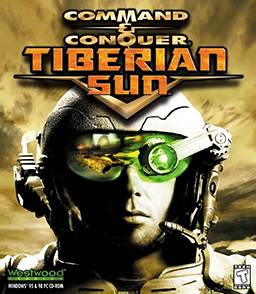
When I was 11 or 12 – or maybe it was some older and more embarrassing age – there was a field near my house that me and my friend called the Tiberium Field. You had to dash across it in twenty seconds flat, otherwise Tiberium poisoning would kill you and turn your body into a visceroid, an aggressive and indestructible blob of human tissues. In our heads, we were in Command and Conquer: Tiberian Sun.
So far, so nostalgic. This is a post where I talk about a 1999 strategy game, maybe to recapture the remembered leisure and innocence of the childhood that surrounded it.
But I never got past a few missions of Tiberian Sun, never owned my own copy, and I like it a lot more now than I did back then. If we’re talking nostalgia, I was always more of a Red Alert guy (who could have guessed?). At the time I thought Tiberian Sun was, in comparison to Red Alert 2, drab and self-serious, with a clumsy interface and confusing missions. Earlier this year when I bought the whole Command and Conquer back catalogue for a tenner, I didn’t expect that this would be the game I spent the most time on, the one where I actually finished both campaigns, the one that would haunt my imagination.
So this is not all nostalgia. Something else is going on here, and I’m going to try and find out what. And even within the nostaglia, there’s the question of how this game worked its way into my imagination in such a way as to turn the grass of that neighbourhood field into an expanse of deadly and valuable green crystals.
So how did this game warp my young (and not-so-young) mind?
The Tiberium-haunted world
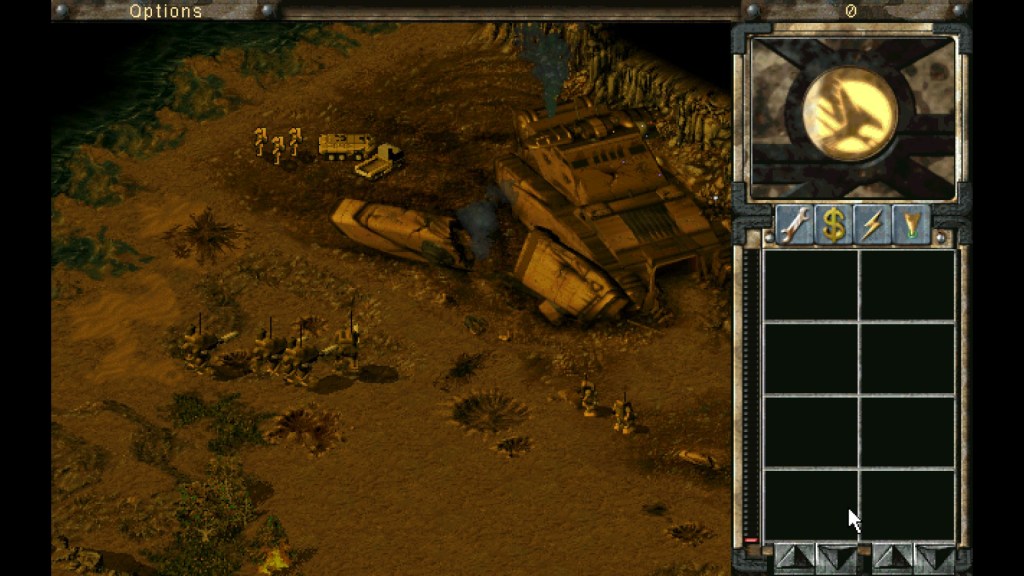
The first point in favour of Tiberian Sun (henceforth TS) is its setting. The world of the original Command and Conquer was sort of improvised. The developers said, let’s have something like the spice from Dune 2 – it works so well as a resource-gathering feature – but transplanted to another setting. The result is Tiberium, a strange green crystal native to some alien world which has begun to spread over Earth’s surface. There are two factions: the Global Defence Initiative (GDI), a one-world military defending the status quo, and the Brotherhood of Nod, which is part-Tesla, part-ISIS, part Comintern, and obsessed with using the Tiberium for obscure ends. My impression, having played only a little of the original C&C, is that whatever worldbuilding there is starts to peter out around there. The setting is just an excuse to have a war game on the Dune 2 formula. (I’ve talked about the Red Alert spin-off elsewhere.)
Tiberian Sun takes the worldbuilding more seriously. A couple of decades after the first game, the Tiberium infestation has advanced, and Planet Earth is now terminally sick. GDI and Nod are still fighting over ruined cities and land choked with alien crystals and alien weeds, skies torn by ion storms, poisoned air, mutated genetics. For more on the setting and its applicability as a prophecy for our times, I recommend this article from Eurogamer by Robert Whitaker.
Tiberian Sun captured that late-1990s sense of some vague impending doom. But in 2024 it offers a strange kind of relief. You can retreat into the barren comfort of a world that is already destroyed, where there is little to save. There are unexpected inheritances from Dune: like in Herbert’s book, the ground beneath your feet is more than a setting, it’s an actor with powers of life and death over the fragile humans and machines crawling on its surface.
The applicability to climate change and global warming (which we all absolutely knew about in the 1990s even though those in power did nothing) are obvious. It’s a metaphor for our times in another way too. GDI are coded as “good” but we never see them actually doing, or even promising, anything good. They never help anybody or change anything, until the Forgotten twist their arms. We side with GDI only because Nod are obviously and extravagantly worse. Yes, GDI is Harris and Nod is Trump. Neither side offers a way out of war and ecological destruction. But Nod at least offers its supporters the shallow pantomime of its rituals and chanting and bloody spectacles.
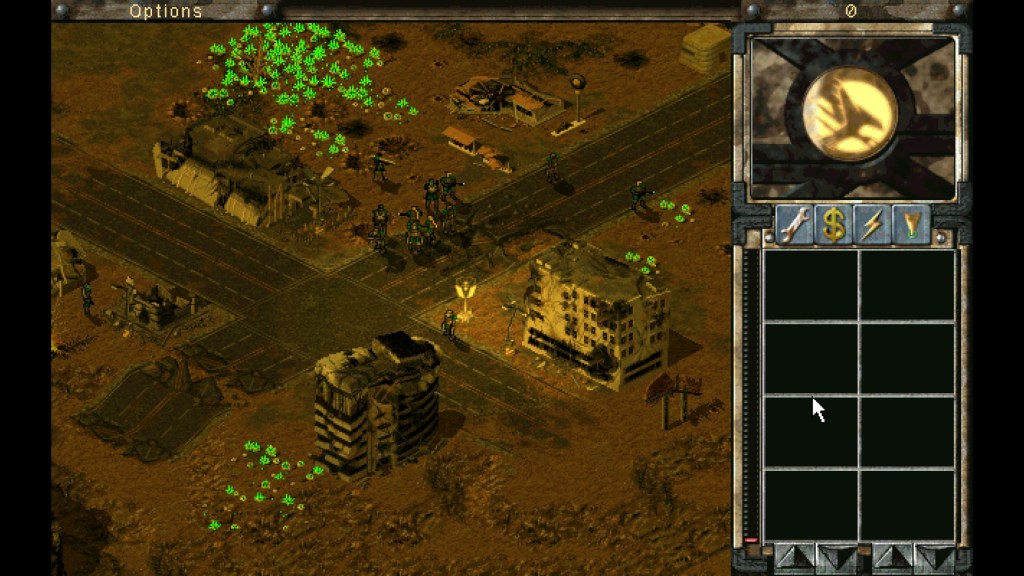
The setting itself tells a story: when we move our little men across the map, we see ruined high-rise buildings, contrasted with space-age-looking new settlements with solar panels and bunkers and greenhouses: the civilian world has retrenched into smaller and more resilient communities. Meanwhile war has advanced as a science. It’s all laser guns and visored helmets, giant walking battle mechs, cyborgs, explosive throwing discs, orbiting battle stations. Humanity is spending and innovating to fight more effectively, even as we have less and less to fight for. While the Red Alert setting just pits an evil faction against a good faction, Tiberian Sun (TS) takes place in a world that is messier and more ambiguous. In Red Alert, we don’t know why the Soviets are attacking the status quo. In TS, we don’t know why GDI are defending it.
Videogames then were violent, militaristic, imperialist – not in a the conscious and blatant way that Call of Duty is now, but as it were by default, by reflex. C&C is no exception. The GDI versus Nod struggle is at base the same old Imperialism versus Third World struggle, with the legitimate struggles of the global majority (“disenfranchised nations” seduced by Nod) packaged as evil fanaticism. In TS it is less explicit, filtered through layers of deniability in the worldbuilding, but we get signals, such as that the villains in Tiberian Sun have names that are Arabic, Latin and Slavic (he’s literally called ‘Slavik’). The Latino baddie is a drug smuggler who menaces the southwestern United States, playing into racist tropes. We see one South Asian guy in the ‘Global’ Defence Initiative, but the rest of the goodies are Americans.
The Forgotten
The music is not as conspicuously brilliant as that of Red Alert 2 but it has a greater range. There are moments of foreboding (‘Valves’) and loss (‘Approach’). If Red Alert 2 is a violent cartoon, Tib is a 1980s-90s action sci-fi movie – the vibe, to me, is sort of like Terminator 2, Aliens and Paul Verhoeven.
The melancholy themes probably belong to the third faction in Tib – unplayable and lightly sketched, but essential to the story (I suppose if GDI is Harris and Nod is Trump, they are Jill Stein or Cornel West). This is a loose confederation of clans who call themselves The Forgotten. They are people mutated by Tiberium exposure – insulted and belittled as ‘shiners’ by GDI and Nod alike, distrustful of GDI due to past atrocities, persecuted and imprisoned by Nod. They are few but they are pretty lethal in a fight.
The Forgotten are the conscience of this story. In the GDI campaign, it is only by overcoming prejudices and working with the mutants that GDI can defeat Nod. In the Nod campaign, you prevent any possibility of an alliance between GDI and mutants through a nasty trick. There’s more going on here than is usually the case in this series.
Tiberium Wars
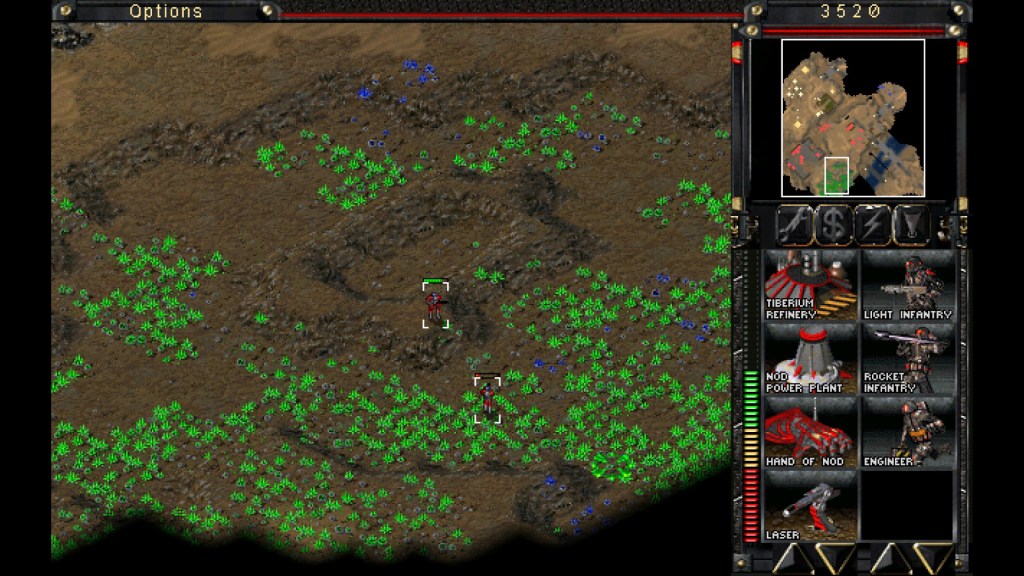
In Part Two of this review I’m going to be looking at two other strengths of Tiberian Sun – the cutscenes (you heard me) and the gameplay. But before I move on I want to comment on the 2007 sequel, Tiberium Wars and its expansion Kane’s Wrath (I haven’t played Tiberium Twilight). What I have to say about Tiberium Wars (TW) underlines what I’ve just said about TS.
I’ve played a lot of TW and enjoyed it, but it doesn’t have the same grip on me as its 1999 predecessor. And I don’t think it’s just nostalgia.
The graphics and the smoother interface are a huge upgrade on TS, marking a rapid development in just 8 years. The story is solid, far less silly, and it’s all in all a lot of fun to play. But the setting doesn’t feel as real to me, and I think I know why.
Tiberium Wars leans with dispiriting heaviness into a ‘Global War on Terror’ framing. Magazine ads for the game talked about fighting terrorism. Technologically, GDI has been downgraded – no more stomping robots. This is explained in-game as being due to budget cutbacks, but the effect of it (and probably the intention) is to make everything look a few-score degrees more like Iraq or Afghanistan, or some near-future 9/11. The expansion Kane’s Wrath thankfully leans back the other way, and was clearly crafted by people who loved TS.
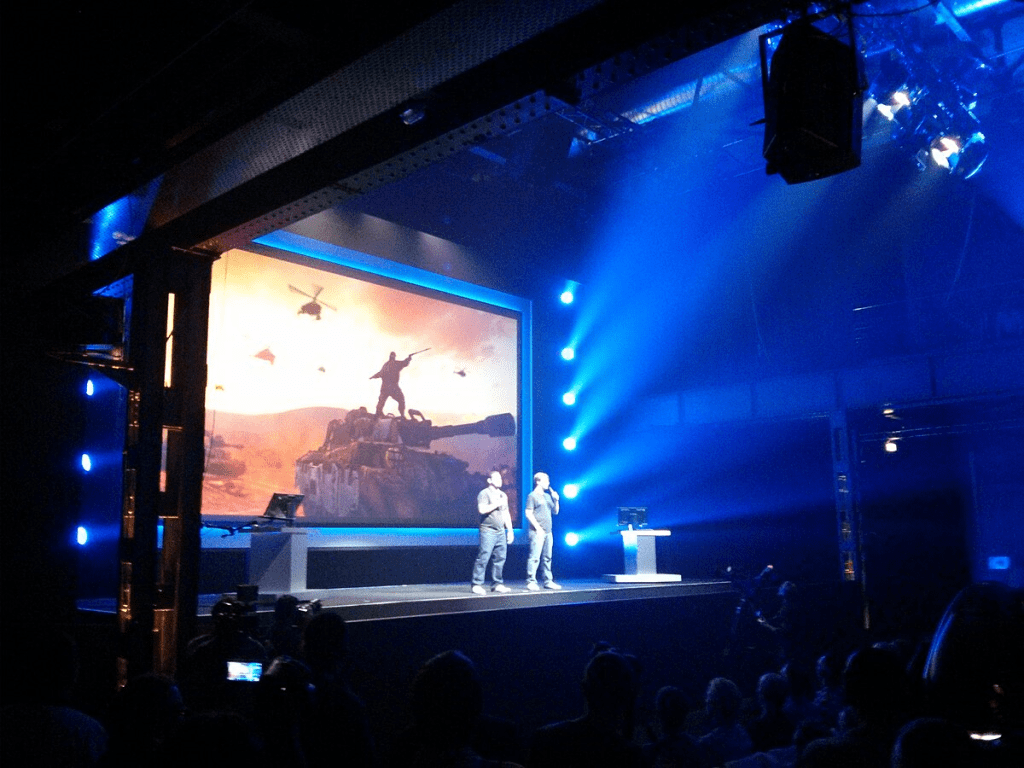
TW’s setting is retconned so that the Tiberium-infested world is divided up into uninhabitable Red Zones, Yellow Zones which are in a state of social collapse, and Blue Zones which are stable and prosperous. This is a marked contrast to Tiberian Sun, in which everywhere – Egypt, the USA, Norway, Germany, Britain, Mexico – was one of two things: a Yellow Zone or a snowy Yellow Zone. In TW, the Blue Zones we see are all either in the USA or in Germany. We always see them menaced and under assault. The first few missions are a bizarrely close remake of Red Alert 2, with the baddies invading hallowed American landmarks like the White House and the Pentagon (No! Please don’t destroy the White House or the Pentagon! Anything but them!). The Imperialism vs Third World framing is much more obvious and open. It’s no accident that the Forgotten are left out of the story of TW – they appear only as an Easter egg and they talk like super mutants from Fallout.
At base the reasons I don’t like it as much are political; I think it’s a shitty way to portray the majority of the human race, as if they have nothing better to be doing than besieging and menacing whatever dull place you live. But you don’t have to agree with that to see that these are two very different types of story and setting. Tiberium Wars is the same old C&C story about protecting the status quo. Tiberian Sun has more depth and ambition.
To receive an email when Part 2 of this article goes live, type in your email below:

 The 1919 Review