Bob Dylan, Phil Ochs and the 1960s (2014)

Bob Dylan, Phil Ochs and the 1960s

[This is another essay I wrote around 2014, migrated over from my old blog…]

In 1965 Bob Dylan played a new song of his to Phil Ochs (according to different accounts, it was either “Sooner or later” or “Can you please crawl out your window”). The two were travelling in a taxi when Ochs gave his opinion of the song: “It’s OK, but it’s not going to be a hit.” Dylan told the driver to stop and said, “Get out, Ochs. You’re not a folk singer. You’re just a journalist.”[1] Relations between the two were not usually hostile, but the incident was a manifestation of inherent tensions and conflicts within the folk revival and the radical movements of the 1960s.

These two very different men, at one stage described as the King (Dylan) and President (Ochs) of the topical protest song,[2] reflected and were affected by different aspects of the culture and politics of the 1960s. With a focus on Dylan and Ochs we will firstly explore the different aspects of the folk revival of the early 1960s, in particular the conflict between image and reality. Then we will look at how Dylan, like many activists and artists in the 1960s, substituted radical form for radical content. Finally, we will describe how Ochs reacted to the political defeats of the left in the late 1960s. In this the differences and to some extent the conflicts between the different aspects of the movement that they represented were clear.

Different aspects of 1960s culture and politics were immediately audible in the early music and lyrics of the two musicians. Ochs was journalistic, satirical, overflowing with facts and information while Dylan conveyed images and feelings. Ochs reacted to the Cuban Missile Crisis with a mocking exposure of US politics:

…some Republicans was a-goin’ insane

(And they still are).

They said our plan was just too mild, Spare the rod and spoil the child,

Let’s sink Cuba into the sea,

And give ’em back democracy,

Under the water!

“Talkin’ Cuban Crisis”, I Ain’t Marching Anymore, Elektra (1964)

Ochs’ first album – Ochs the journalist

This was a folk song in the tradition of Guthrie’s “Talking Sailor” and “Talkin’ Dust Bowl Blues”, musically simple and lyrically conversational or journalistic. While Dylan too wrote some “Talkin’” songs, he reacted to the Cuban Missile Crisis with a song that stood in a different part of the folk tradition:

I saw a newborn baby with wild wolves all around it
I saw a highway of diamonds with nobody on it
I saw a black branch with blood that kept drippin’

[…]

“A Hard Rain’s A-Gonna Fall”, The Freewheelin’ Bob Dylan, Columbia (1962)

This was a metaphorical prophecy, standing closer to eerie old ballads like “Nottamun Town” and shading into later 1960s psychedilia rather than to Ochs’ style of sassy, ironic, witty satire. A similar pattern is repeated with the Vietnam War. Even in later songs that were more metaphorical and image-based, Ochs remained specific and clear in his critiques:

Blow them from the forest and burn them from your sight

Tie their hands behind their back and question through the night

But when the firing squad is ready they’ll be spitting where they stand

At the white boots marching in a yellow land

“White Boots Marching in a Yellow Land”, Tape From California, A&M, (1968)

Dylan never directly referenced the Vietnam War, let alone any specific aspect of it, in his songs:

How many times must the cannon balls fly

Before they are forever banned?

“Blowin’ In the Wind”, The Freewheelin’ Bob Dylan, Columbia (1963)

The King of the Philistines his soldiers to save

Puts jawbones on their tombstones and flatters their graves

Puts the pied pipers in prison and fattens the slaves

And sends them out to the jungle.

“Tombstone Blues”, Highway 61 Revisited, Columbia (1965)

By the time he released “Tombstone Blues”, of course, Dylan had somewhat moved away from traditional folk patterns and was more and more concerned with word-painting metaphorical landscapes as a means of satire along with increasing rock elements. However, a tendency away from the specific and towards the general was inherent in the folk revival from the start, and particularly in the tendencies represented by Bob Dylan as opposed to Phil Ochs.
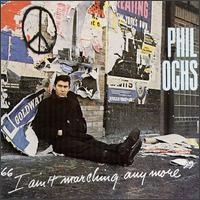
Ochs the activist

“Masters of War”, for instance, in Ochs’ hands might have been a thorough and witty exposure of the military-industrial complex; in Dylan’s hands it was a simple but extremely heartfelt and bitter condemnation of war profiteers – “I hope that you die” is a line that was so intense that Joan Baez, when covering the song, would not sing it.[3] But Dylan, when he sang it, seemed to mean it. While Greil Marcus sees “Masters of War” as too simplistic to do Dylan’s talents justice,[4] the song is in fact characteristic of Dylan in that it substitutes emotion and strong, simple images for argument.

By comparison, Ochs represented those who were more concerned with information and argument. Compare Guthrie’s “The biggest thing that man has ever done” with Ochs’ “I Ain’t Marching Anymore”: in both the singer takes on an immortal persona and describes a journey through history. Guthrie is the spirit of the working-man who “fought a million battles and I never lost a-one” and will now “kick [Hitler] in the panzers and put ’im on the run.”[5] Ochs is the American soldier who has fought in every American war but after every experience of cruelty, injustice and dishonesty, “I knew that I was learning/ That I ain’t marching anymore”. Each song has a wealth of historical detail backing up a clear political statement.

“I Ain’t Marching Anymore” was Ochs’ most successful song, remembered as “the anthem” of the anti-war movement. Ochs playing it in public was enough to provoke a spate of draft-card burnings.[6] Its lyrics were incorrectly reported by FBI agents. As a witness at the trial of the Chicago Eight, Ochs was forced to recite the lyrics word-for-word to the judge and jury.[7] This song was no crude attempt to transplant the spirit of the 1930s or 1940s into the 1960s; it was an extremely successful song that inspired young protestors and alarmed their opponents.

While Ochs was heavily influenced by Guthrie’s form and content, Dylan was far more interested in Guthrie’s image. After listening to Guthrie’s “Ballad of Tom Joad” repeatedly and obsessively and reading his autobiography Bound for Glory, Dylan left Minneapolis in December 1960, hitch-hiking east to find Guthrie. He dressed and spoke like Guthrie, invented various hobo back-stories for himself, and imitated Guthrie on his early album covers.[8]
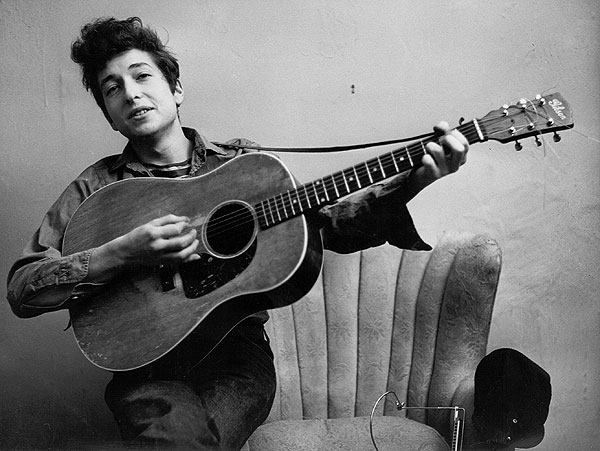
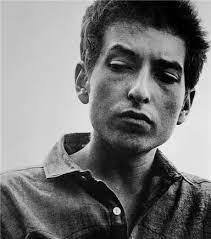
The attraction of Guthrie was the attraction of folk generally for middle-class young people like Dylan and Ochs. Cantwell explores this vital aspect of the folk revival, which he sees as “a form of social theatre” in which middle-class young people idolized and imitated the proletarian, rural and demotic folk singer. Hero-worship of rebel figures like Brando and Dean earlier in life gave way to an embrace of figures like Guthrie and Leadbelly, hobo rebels who were unlearned but had bitter life experience.[9] In hair and clothes 1960s radicals sought “to break with how successful people presented themselves in ‘straight’ society”[10]. Robes and flowers came later; the folk period was characterised by second-hand clothes associated with manual labour.

Dylan’s advice in “Subterranean Homesick Blues”, “don’t follow leaders”,[11] might have been very popular but he never sang anything like “don’t follow icons.” Ochs too understood the power of the icon in the contemporary US when in 1970 he joked (or perhaps seriously suggested) that “if there’s any hope for a revolution in America, it lies in getting Elvis Presley to become Che Guevara.”[12]

Hope for America: Elvis meets Che Guevara

Many 1960s activists believed that radical politics must be matched by radical means of representation. Students for a Democratic Society preferred “a kind of emotional and moral plain-speaking” to political theory,[13] and the folk revival which spoke lyrically in a proletarian voice and musically with great simplicity and a minimum of instruments. Though highly-educated, Yippies like Rubin and Hoffman thought they could only communicate their message through strong images and rhetoric. They revelled in state repression and police brutality, spoke in a “hip patois” punctuated with the inarticulate words “you know”, and made poetic statements such as “We demand the politics of ecstasy!” instead of concrete demands and arguments.[14] In embracing the image, therefore, Dylan was, in the context of the 1960s, making a kind of political statement, and was in tune with many political activists of the day.

Lasch believes that this emphasis on the image “imprisoned the left in a politics of theatre, of style without substance […] which it should have been the purpose of the left to unmask.” Farber argues that the Yippies’ emphasis on “facile slogans instead of careful explanation” meant that they “gave most Americans little chance to understand them.”[15] Ochs, though helping to found the Yippies, considered the idea of a “freak counterculture” to be “disastrous.” What was needed was “an organic connection to the working class.”[16] Radicalism in form and radicalism in content were two connected but at times antagonistic phenomena in the 1960s.

Even when Dylan was writing “protest” songs, their message was never clear. The line “How many roads must a man walk down/ Before you can call him a man?”[17] is a reference to the civil rights marches, but taken out of context it could just as easily be a reflection on maturity and coming of age, with metaphorical roads representing human experience. Dylan’s 1964 song “My Back Pages” seemed outright to disown many of his former beliefs, though he is characteristically unspecific here about what beliefs he is rejecting. He suggests that in even trying to define and express explicit politics “I would become my enemy/ In the instant that I preach.”[18] Dylan was not just embracing new forms of expression; he was identifying explicit and concrete means of representation and argument as inherently corrupt.

Generally over the next few years Dylan expressed politics only in terms that were general, surrealist and metaphorical. Employers “say sing while you slave and I just get bored”; Jack the Ripper “sits at the head of the chamber of commerce”. Alongside these metaphors there is a message of fatalism; Dylan says he wants to help the listener to “ease the pain/ of your useless and pointless knowledge.”[19] Joan Baez claimed that Dylan “ends up saying there is not a goddamned thing you can do about [social problems], so screw it.”[20] Dylan didn’t “need a weatherman to know which way the wind blows”; he gave the impression that he simply knew and understood the world instinctively and had no need for science or expert opinion. Meanwhile, there was nothing to do but “Look out, kid”; the best you can hope for is to “Keep a clean nose, put on some plain clothes”[21] and escape capture by the “agents”, “superhuman crew” and “insurance men” of Desolation Row.[22] Later Dylan was to encourage listeners to seek redemption in religion; before he turned to religion he pointed instead toward redemption in an image of street-wisdom, a “subterranean” lifestyle and an avoidance of futile conflict with the authorities.

Other lyrical subject matter included non-political romantic songs and evocations of a “subterranean” freak lifestyle. The most striking feature of Dylan’s mid-1960s material, however, was his increasing number of songs in the second person which were harsh, bitter personal judgements:

[…] you know as well as me
You’d rather see me paralyzed
Why don’t you just come out once
And scream it

“Positively 4th Street” (1965) Single, Columbia

Now you don’t talk so loud

Now you don’t seem so proud

About having to be scrounging your next meal

“Like a Rolling Stone” (1965) Single, Columbia

Well you walk into the room

Like a camel and then you frown

You put your eyes in your pocket and your nose on the ground

There oughta be a law against you comin’ around

You should be made to wear earphones

“Ballad of a Thin Man” (1964), Highway 61 Revisited, Columbia

Practically everyone Dylan knew from 4th Street in Greenwich Village and 4th Street in Minneapolis suspected that “Positively 4th Street” might be about them.[23] They need not have worried because these songs were primarily about Dylan himself. Ochs remembers how Dylan used to engage in verbal battles on nights out: it was “very clever, witty, barbed and very stimulating, too. But you really had to be on your toes. You’d walk into a threshing machine if you were just a regular guy, naive and open, you’d be ripped to pieces.”[24] Dylan was presenting himself as a kind of witch-hunter of phonies and bourgeois intruders who were, like the Thin Man, more comfortable discussing “lepers and crooks” with “great lawyers” and “professors” than they were mixing in Dylan’s culturally non-conformist milieu.[25]

It’s worth pointing out that in singing these songs Dylan had no qualms that he might tell any “lies that life is black and white” or become his own worst enemy “in the instant” that he preaches. Dylan’s judgemental songs are performances of his own streetwise image as well as portraits of uncool features for listeners to avoid unless they too wanted to be “ripped apart” by Dylan.

Music producer Paul Rothchild claimed that Ochs’ commitment to political causes was a cynical ploy along the same lines as this image-obsessed politics.[26] However, by all other accounts it is clear that Ochs’ commitment was genuine. He was the only musician who gave his word that he would come to the Chicago 1968 protests no matter what.[27] He would frequently turn down commercial gigs in favour of playing for free at political benefit gigs.[28] Abbie Hoffman remembers that “Phil never turned down anybody no matter what size the [political] group.”[29]

Ochs was, like the narrator of “The Biggest Thing the World had Ever Done” or “I Ain’t Marching Anymore”, a witness to more than his share of history. He was at the Newport folk festivals, the Berkeley Free Speech Movement and the first anti-war teach-in; he helped organise the Chicago ’68 protests; the “War is Over” rallies and “An Evening with Salvador Allende” were his brainchild; he visited Robert Kennedy in the White House and brought tears to his eyes singing “Crucifixion”; he was active in Mississippi when the bodies of three murdered civil rights activists were found. A great deal of Ochs’ person and career were deeply invested in the radical politics of his day.

At the Newport Folk Festival of 1966 Dylan performed songs with a backing rock band and an electric guitar, provoking outrage from many sections of the crowd.[30] During a tour of England he was called “Judas” by an audience member.[31] This was another manifestation of the inherent tensions and conflicts within radical politics and culture in the period. In the eyes of many on the folk scene, the modest, “authentic” and political folk genre was losing the prominent voice of Dylan to the corporate, egotistical, corrupted, apolitical world of rock.[32] Ochs believed that those who booed were engaging in “a most vulgar display of unthinking mob censorship. Meanwhile, life went on around them.”[33] Despite their differences in terms of content and form, Ochs in this period never abused Dylan, calling Highway 61 Revisited “the most important and revolutionary album ever made.”[34]

A large part of Ochs’ defence of Dylan must have been his own growing desire to try new musical styles. This resulted in his 1967 album Pleasures of the Harbor which was more poetic than political, incorporating orchestral arrangements rather than a simple guitar. The album received negative reviews but Ochs’ desire to find a new niche reflected changes that were taking place in the music business. Rothchild explains that though Ochs had been at home in “the pre-Beatle, pure folk era”, his producers were not convinced that he “was going to crack the pop world. He had the wrong image, the wrong voice” and his lyrics were not “relationship introspective.” The music business was no longer interested in folk, especially political folk with lyrics “of the intellect” rather than sex.[35] This shift was like a forewarning of even more significant changes afoot in politics.
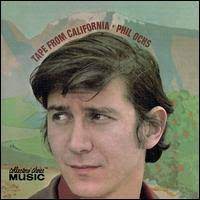
Phil Ochs, not sure where to go

Former SDS leader Tom Hayden believes that there were, speaking very generally, two main halves to the 1960s from a radical point of view. The first half was characterised by innocence and optimism, with a basic belief in the possibility of the redemption of the American dream.[36] The second “half” represented reality reasserting itself; a “clarification of where we really stood.”[37] This basic schema helps us to understand the waning of the civil rights movement and the rise of the Black Panthers; the collapse of SDS and the activity of “urban guerrillas”; overall, the change from optimism to either resignation or a more determined and dangerous form of struggle.

For Dylan the Kennedy assassination, race riots and the Vietnam War “transformed his attitude from one of wanting a moral reform and the cleansing of his society to one of despairing that this society was reformable at all” as early as 1964.[38] There was obviously no “clean break” at which the civil rights movement ended and the Black Panthers began, and Malcolm X had already raised similar ideas years before his death in 1965. Despite these ambiguities and others, we can say with confidence that the key events which contributed most to the demoralisation of activists occurred in 1968.

1968 in the US saw the assassination of Martin Luther King and the most widespread ghetto riots yet; the murder of Robert Kennedy; the repression of the Columbia University occupation; the Chicago Democratic National Convention protests; the strong vote for the ultra-conservative Wallace; and finally the victory of Republicans Nixon and Agnew in November.[39] Ochs was so closely integrated with the radical movements that to understand the significance of this year we need only look at the cover of his 1969 album “Rehearsals for Retirement”. It shows a gravestone which reads:

PHIL OCHS

(AMERICAN)

BORN EL PASO, TEXAS, 1940

DIED CHICAGO, ILLINOIS, 1968[40]
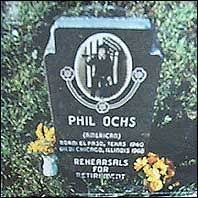
The album documented the changes that had taken place in that year in poetic, metaphorical terms:

I spied a fair young maiden and a flame was in her eyes

And on her face lay the steel blue skies […]

I’ll go back to the city where I can be alone

And tell my friends she lies in stone

In Lincoln Park the dark was turning

“William Butler Yeats Visits Lincoln Park and Escapes Unscathed” (1969) Rehearsals for Retirement, A&M

This expressed Ochs’ belief about Chicago that “something very extraordinary died there, which was America.”[41] Here idealized as a woman, the news Ochs brings back to Los Angeles is that illusions in a liberal, democratic USA are dead. Other songs illustrated this more violently:

And they’ll coach you in the classroom that it cannot happen here

But it has happened here […]

It’s the dawn of another age […]

We were born in a revolution and we died in a wasted war It’s gone that way before

“Another Age” (1969), Rehearsals for Retirement, A&M

Ochs expressed what this meant to him personally with the words “My life is now a death to me.”[42]

Ochs suffered from a long period of reduced output of songs and wild bouts of drinking and violent behaviour. The sudden, near-fatal attack on Ochs on a beach in Tanzania in 1973 caused his further deterioration. It is tempting to emphasize his father’s mental health problems and draw parallels with Ochs’ behaviour. However, we cannot separate Ochs’ mental health from the history and politics in which he had invested so much of himself, any more than we can separate his father’s mental health from his experiences in the Second World War.[43] The attack in Dar-Es-Salaam was simply a personal version of the kind of horrific and apparently meaningless event that had come to characterise the political world Ochs inhabited.
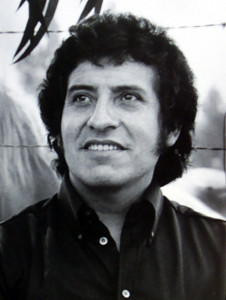
Victor Jara, Ochs’ friend and inspiration

It is an indication of his personal deterioration that he did not learn of the September 11 1973 coup in Chile until December. Ochs had visited Chile and made friends with fellow folk singer Victor Jara, who was tortured and killed along with thousands of others after the counter-revolutionary military coup. Ochs later confessed, “When that happened I said ‘All right, that’s the end of Phil Ochs.’”[44] Despite this he set about immediately and tirelessly organising a huge benefit gig, “An Evening with Salvador Allende”, which he managed to secure Dylan’s presence at by reciting to him the late Allende’s inauguration speech in full, from memory.[45]

He swung between intense periods of political activity, self-destructive idle depression and absurd business ventures until in 1975 he began to claim that Phil Ochs had been murdered by “John Butler Train”. For an individual who had always set so much store in icons and whose ambition it was to become one, and for a representative of a genre defined as “social theatre” and a movement that had invested so heavily in icons, images and theatrics, it is significant that the nadir of Ochs’ decline was his long, violent performance as John Train. A brief recovery preceded his suicide in April 1976.

The last sixteen years of Ochs’ 36-year life could be read as a history of the rise and fall of the radical movements of the “long 1960s.” As if to dramatise the death of the movement, Ochs as “Train” was a violent, cynical, misogynistic wreck. His drunken conspiracy-theory rants were like a dark, twisted parody of Ochs’ witty on-stage patter.[46] The “Train” stood for the boxcar-riding hoboes the young activists had once idolized[47] and so Train’s character seemed to be a dramatisation also of the fact that the working class, in whose image the folk revivalists had tried to construct themselves, had by and large not been won over by the radicals of the 1960s.[48] Ochs’ deterioration and suicide were a reflection of history and politics at least as much as they were personal.

A Melody Maker journalist was perceptive in describing Dylan and Ochs as the King and President, respectively, of the “topical song.”[49] If Dylan was a leader his style of leadership was ceremonial and symbolic like that of a modern monarch. From the start he neglected direct, specific protest lyrics in favour of radicalism in form and image. His travelling-hobo clothing and voice conveyed a radical message in and of themselves but this soon gave way to a rock-star image as his music turned increasingly toward experimentation, and his lyrics toward personal problems, definitions of coolness and fatalistic metaphorical depictions of the world around him. He rarely advised his listeners to take any action or condemned anything specific – instead he created in himself an ultra-cool radical image and icon capable of knowing and expressing intuitively what the world was like and who was cool and who was not. Accordingly the changes of the late 1960s did not detract from him significantly since he was invested in a politically uncommitted self-image rather than in politics itself.

Monarchs generally rule for life while Presidents only enjoy a limited term. In the US they are executive and military leaders. It is a fitting image for Ochs, who in his lyrics generally made it clear and specific what he stood for and what he opposed. His commitment to active politics was enthusiastic and generous. Ochs had been at home in Hayden’s optimistic and active “half” of the 1960s. With the onset of pessimism, retreat and demoralisation, especially after 1968, he characterised himself and the movement as powerful, but out of their element: “A whale is on the beach/ It’s dying.”[50]

Ochs, in his “Train” persona, believed that Dylan “in a cowardly fashion hid behind images – after his third album”. Dylan’s albums between 1967 and 1974 were widely perceived as weak[51] and “Train” imagined accosting Dylan with the words, “Listen, asshole, I can kill you as soon as look at you. You were Shakespeare at twenty-five, and now you’re dog shit.” This cannot be sincere because Ochs, along with most critics, was hugely impressed by 1975’s Blood on the Tracks.[52] Meanwhile Ochs’ defence of Dylan after Newport 1966 suggests that this resentment was not rooted in envy of Dylan’s success or talents. It seems instead that this was another manifestation of the inherent conflicts in the culture and politics of the 1960s. Ochs’ resentment stemmed from the fact that Dylan had at an early stage abandoned the political struggle to which Ochs had sacrificed his career, his sanity and most of his adult life. Rather than seeking social change Dylan, like the hippie movement, sought personal redemption; like the folk revival, he constructed an icon; like the Yippies and SDS he preferred intuition to analysis and images to politics.

Bibliography

Books

  1. Boucher, David and Browning, Gary (eds), The Political Art of Bob Dylan, Imprint Academic, 2009
  2. Cantwell, Robert, When We Were Good: The Folk Revival, Harvard University Press 1996
  3. Eliot, Marc, Phil Ochs: Death of a Rebel, Omnibus, 1990 (1978)
  4. Farber, David, The Age of Great Dreams: America in the 1960s, Hill & Wang, 1994
  5. Farber, David, Chicago ’68, University of Chicago Press, 1988
  6. Gill, Andy, The Stories Behind the Songs, 1962-1969, Carlton Books, 2011 (1998)
  7. Isserman, Maurice and Kazin, Michael, America Divided: The Civil War of the 1960s, New York, Oxford University Press, 2008
  8. Marcus, Greil, Bob Dylan by Greil Marcus, Writings 1968-2010, Faber & Faber, 2010

Albums

Bob Dylan:

  1. Bob Dylan, Columbia, 1962
  2. The Freewheelin’ Bob Dylan, Columbia, 1963
  3. The Times They are a-Changin’, Columbia, 1964
  4. Another Side of Bob Dylan, Columbia, 1964
  5. Bringing it All Back Home, Columbia, 1965
  6. Highway 61 Revisited, Columbia, 1965
  7. Blonde on Blonde, Columbia, 1966
  8. John Wesley Harding, Columbia, 1967
  9. Nashville Skyline, Columbia, 1969
  10. Blood on the Tracks, Columbia, 1975
  11. The Basement Tapes¸ Columbia, 1975

Phil Ochs:

  1. All the News That’s Fit to Sing, Elektra, 1963
  2. I Ain’t Marching Anymore, Elektra, 1964
  3. Pleasures of the Harbor¸ A&M, 1967
  4. Tape From California, A&M, 1968
  5. Rehearsals for Retirement, A&M, 1969
  6. Greatest Hits, A&M, 1970

Film

  1. Bowser, Kenneth, Phil Ochs: There But For Fortune, First Run Features, PBS American Masters, 2012

[1] Andy Gill, The Stories Behind the Songs 1962-1969, Carlton Books (1998, 2011), 128

[2] Marc Eliot, Phil Ochs: Death of a Rebel (1978), Omnibus (1990), 109

[3] Greil Marcus, Bob Dylan by Greil Marcus: Writings 1968-1010, Faber & Faber (2010), 410-12

[4] Marcus, 412

[5] Woody Guthrie, “The Biggest Thing That Man Has Ever Done”, The Columbia River Collection Smithsonian Folkways, (1941, 1988); Phil Ochs, “I Ain’t Marching Anymore”, I Ain’t Marching Anymore, Elektra (1965)

[6] Kenneth Bowser (writer and director), Phil Ochs: There But For Fortune, First Run Features (2012); 00:20:18, 00:46:30

[7] Eliot, 181

[8] Gill, 17-18, 32

[9] Robert Cantwell, When We Were Good: The Folk Revival, Harvard University Press (1996), 2, 17, 347

[10] Isserman and Kazin, America Divided: The Civil War of the 1960s, Oxford University Press (2008), 155

[11] Bob Dylan, “Subterranean Homesick Blues”, in Bringing it All Back Home, Columbia, (1965)

[12] Eliot, 97

[13] Isserman & Kazin, 180

[14] David Farber, Chicago ’68, University of Chicago Press (1988), 7, 20-23

[15] Christopher Lasch, The Culture of Narcissism: American Life in an Age of Diminishing Expectations, Abacus (1979), 81-82; Farber, Chicago, 225, 244-5

[16] Eliot, 163-4

[17] “Blowing in the Wind”

[18] Bob Dylan, “My Back Pages”, Another Side of Bob Dylan, Columbia (1964)

[19] Bob Dylan, “Maggie’s Farm”, Bringing it All Back Home, Columbia (1965); “Tombstone Blues”, Highway 61 Revisited, (1965)

[20] Gill, 94

[21] “Subterranean Homesick Blues”

[22] Bob Dylan, “Desolation Row”, Highway 61 Revisited, Columbia (1965)

[23] Gill, 126-7

[24] Gill, 127

[25] “Ballad of a Thin Man”

[26] Eliot, 76

[27] Farber, Chicago ‘68, 26

[28] Bowser, 00:09:04

[29] Bowser, 00.09:10

[30] Gill, 111

[31] Michael Jones, in The Political Art of Bob Dylan, ed. Boucher & Browning, Imprint Academic (2009), 75-80

[32] Jones, 82

[33] Eliot, 96

[34] Gill, 113

[35] Eliot, 119

[36] Bowser, 00:17:37

[37] Bowser, 00:38:05

[38] The Political Art of Bob Dylan, 38

[39] Isserman & Kazin, 319

[40] Phil Ochs, Rehearsals for Retirement, A&M (1969)

[41] “William Butler Yeats Visits Lincoln Park and Escapes Unscathed”, live performance in Vancouver, http://www.youtube.com/watch?v=VWEBlZ7C_lE&playnext=1&list=PLD33BBF4B10862910&feature=results_video, accessed 3/3/2013, 17:14

[42] Phil Ochs, “My Life”, Rehearsals for Retirement, A&M (1969)

[43] Eliot, 12

[44] Eliot, 256

[45] Bowser, 00:58:30 – 01:06:00

[46] Eliot, x-xv

[47] Eliot, 262. The following comes from the liner notes of a planned album written in 1975: “John stands for Kennedy, Butler stands for Yeats, Train stands for hobos at the missed silver gates.”

[48] Isserman & Kazin, 280

[49] Eliot, 109

[50] Phil Ochs, “No More Songs”, Greatest Hits, A&M, 1970

[51] Marcus, 7-27

[52] Eliot, 243, 255
School Resources: King Lear

More school resources this week. Material on King Lear for Leaving Cert, ie, ages 16-19.

Review: Nova by Samuel R Delany (1968)

In the 32nd Century, a crew of misfits blasts off from an obscure corner of our solar system on a quest to the heart of an exploding star.

Delany’s prose does justice to the awesome premise. Here is the moment of take-off: ‘And the moon fell into Neptune; Neptune fell into the sun. And the sun began to fall. Night exploded before them.’ (p 41)

Much later in the quest, the crew arrive at a sun known as the Dim, Dead Sister. It is described as follows: ‘the explorer who decided to name the outermost of the Dim, Dead Sister’s planets Elysium had indulged a poor joke. With all the planoforming devices available, it was still a frozen cinder ellipsing at trans-Plutonian distances from Her ghost-light, barren and uninhabited.’ (p 181)

It is no spoiler to throw in these two lines from the climax of the novel. A ship ‘received the shuttle boat like a cannon shot in reverse.’ (p 225) A while later, I won’t say what page, ‘the star went nova. The inevitable is that unexpected.’

Humanity has spread out across many stars and worlds, forming three distinct polities. A key contradiction of capitalism has been overcome by means of a technological innovation that makes labour fulfilling rather than alienating. But at the heart of the plot is a battle between corporations for an extremely rare fuel, Illyrion – so yeah, there are plenty of contradictions left in capitalism.

From the cover of the 1st edition

By attempting to harvest a massive quantity of Illyrion from the heart of a star as it goes nova (that is, explodes catastrophically!), ship’s captain Lorq Van Ray is not only risking his life and his senses, and not only attempting to settle a feud with some powerful enemies – he is also blasting wide open the economics and politics of interstellar humanity.

For the most part the novel follows through on its promise. Along the way, there’s a lot of food for thought, particularly in the discussions between two crew members, Katin and Mouse.

This is a novel set in a new interplanetary society, where people feel rootless – like the 20th Century with its urbanization. Someone complains (p 46) that ‘We live in an age when economic, political and technological change have shattered all cultural tradition.’ This is a platitude, but it’s deliberate; Delany is well aware that people in every age have said similar things. In this age as in others, people who say such things are mostly wrong, and the novel is quietly demonstrating this to us throughout.

This is a story about a sudden, revolutionary change, and that is offset by Delany’s focus on a deep human culture thousands of years old. The story blasts off, but the setting has a certain weight and grounding. Mouse, the artist, represents a cultural continuity. Before his mission across the stars, we get page after page about his adventures on Earth – an Earth that is not so different from our own.

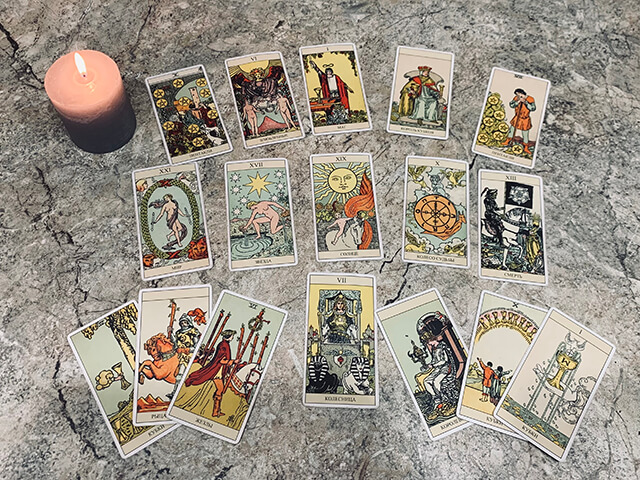
This is also where the tarot cards come in. Katin, the educated man, thinks that to be ‘skeptical about the Tarot’ is ‘a very romantic notion’, linked to ‘petrified ideas a thousand years out of date.’ (p 123) The people of this world believe in the scientific efficacy of tarot.

The flashback which explains Lorq Van Ray’s motivations is very strong. The climax of the story is exciting and really pays off. I love the syrinx, a musical instrument belonging to Mouse, an object which earns its keep in different and unexpected ways for the entire novel.

But Nova suffers from a slow middle – one of the most obvious cases I’ve seen in a while. Out of 240 pages, it meanders from about page 120 to page 200. There seems to be little purpose to the characters’ itinerary and activities. Katin’s lectures are interesting but not always relevant. My attention sagged when Delany began to dwell on the Tarot cards and picked up again when the bad guys suddenly showed up to crash the good guys’ hiding place.

I have a few other complaints. Sometimes the descriptions aren’t clear enough to do justice to an action scene – there was a fight involving nets and gas on a flight of steps which I just couldn’t visualize. On page 202 we are told, ‘a hand slapped Lorq’s sternum, slapped it again, again. The hand was inside.’ What does this phrase mean? Whose hand? It was inside his sternum? How?

Lorq, Katin and Mouse are good characters, and their rapport facilitates a lot of exposition, most of it neat. Katin seems confident and Mouse seems taciturn, shy. But Katin over-thinks and, beneath it all, he’s anxious. At one point Mouse has to reassure him, ‘Hey […] It’s all right. I like you. I was just busy, is all.’ (p 177) It’s rare for Mouse to speak, so it’s telling that when he chooses to speak his words are kind. But while the other members of the crew have their interesting quirks, they never really live up to their potential.

The slow middle didn’t put me off, and had enough interesting ideas, conversations and images to keep me reading. But it lacked that rocket fuel which powered the beginning and end. The premise, the beginning and the end are more than strong enough to compensate. In hindsight, too, there are motifs and undergirding ideas running through the structure of the story – the idea of sensory overload, and linked to it the image of a person walking into fire like a bug drawn to a light – that lend the story power and coherence.

Go to Home Page/ Archives

School Resources: Nazi Germany

Some history notes here for educators, along with questions and exercises. ‘How the Nazis took power’ consists of 3 worksheets explaining how the notorious genocidal dictator and his party seized power. It is aimed at students aged 16-18. It is text-heavy, to be used along with the accompanying slides which include visuals and more exercises. There is also a brief explainer on anti-Semitism.

The Manchukuo Mystery

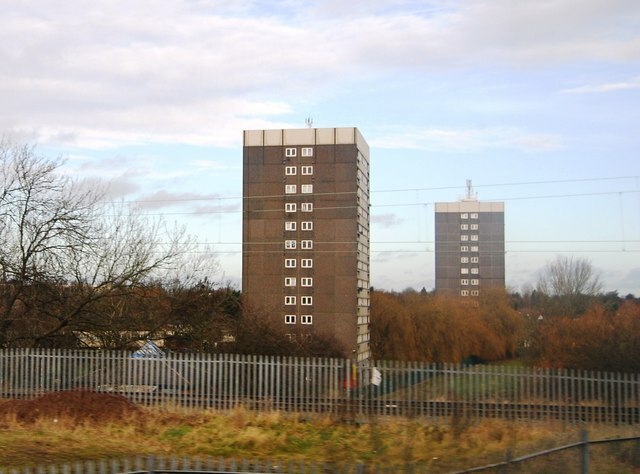
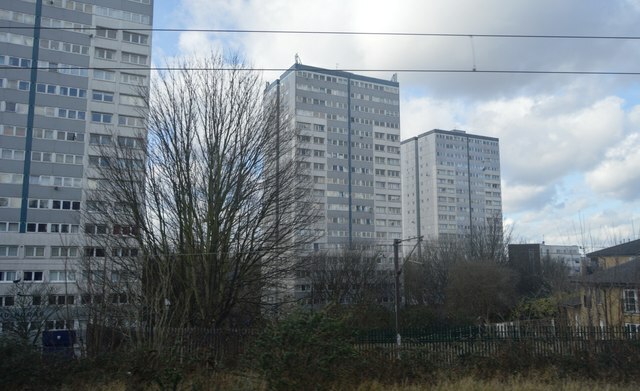
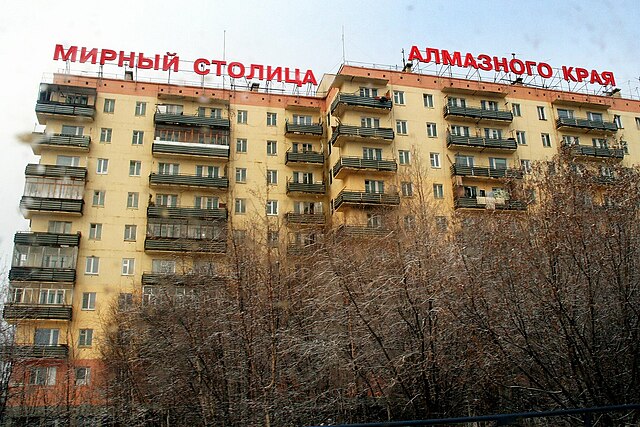
Have you ever seen buildings that look like these?


Maybe there are some of these majestic constructions in your town. Maybe you even live in one of these masterpieces. But have you ever stopped to wonder who built them, and why?
We can see these buildings in Britain and in Argentina, in the United States and in China, in Russia and in Iran, and in countless other countries. How can we possibly explain so many amazing buildings, built in the same style, built on such a scale and in such widely-separated parts of the world? Is it just a coincidence?
I’ve Done My Own Research and discovered the truth: that these buildings were all built by a civilisation called the Manchukuo Empire. This was a vast civilisation which spanned several continents and several centuries, though I have not yet confirmed which continents, or which centuries.

Lies of Big History

But Big History would prefer that you did not know about Manchukuo. If you dare to speak out against their dogma, you will be shouted down and ridiculed. They are very defensive. They will claim that their opinions count for more than yours or mine just because they have read actual books about history. This is a logical fallacy known as the Appeal to Authority. But I am a fearless maverick, I have excellent critical thinking skills, and I am immune to any appeals to authority.


The favourite argument trotted out by the shills of Big History and Big Archaeology is to say that the Manchukuo Civilisation never existed. But you can just Google ‘Manchukuo.’ See? There’s a Wikipedia page with that name. So even Wikipedia acknowledges that Manchukuo existed. How can anyone deny it?


But there is a sneakier version of this argument. They say that while something called Manchukuo did actually exist, it was actually something entirely different, a puppet state of Japan in China, that only lasted for a few years. These hair-splitting bores know no shame. They want you to believe that there are two completely different Manchukuos, one mythical and one real! They hope to bamboozle you with this convoluted nonsense. Compare this to my simple and straightforward answers.

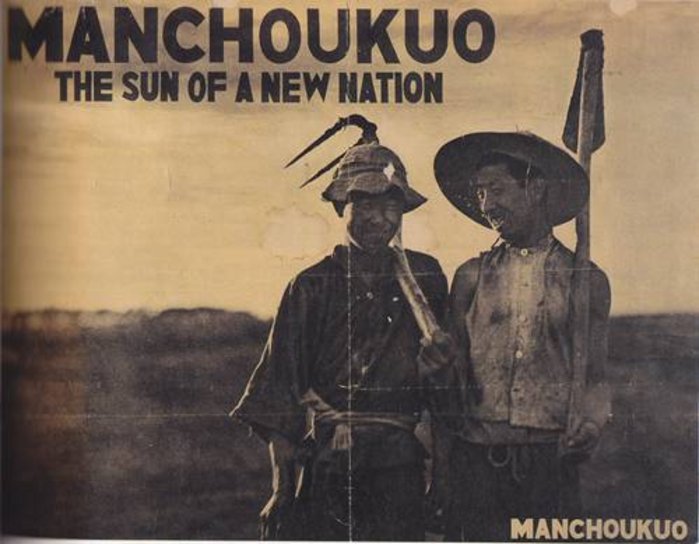
And it’s not just buildings. Here is a surviving Manchukuo poster!

The Manchukuo Code

But how did I discover the truth where so many have been led astray by the history establishment? The answer is simpel: I made an amazing discovery.

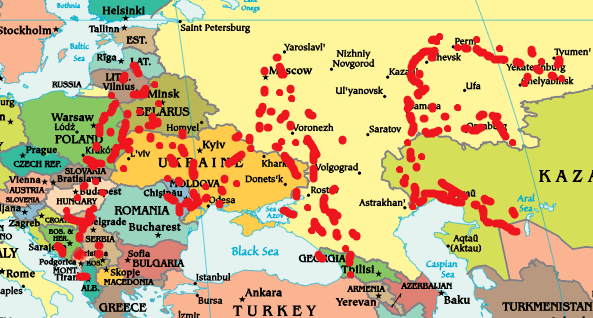
Driven by a passion for these magnificent buildings and a desire to uncover the truth behind their construction, I cross-referenced the locations of over 500 of them and tagged each one on a map.
The result was staggering:

Wow.


Assuming the Manchukuo had the same alphabet as us, which is not an unreasonable assumption as they probably invented alphabets and numbering systems, then the conclusion from my research is obvious. The Manchukuo Empire left its initials literally written on the face of the planet: M.E.


After I made this remarkable discovery, which was my discovery, made my me, everything else fell into place, because there is no other way to explain this remarkable discovery, which I made.

Features of Manchukuo Civilisation

The Manchukuo were not only more technologically-advanced than us (with access to amazing building techniques and possibly even telepathic powers) – they were also morally superior to us.


I can prove this using my critical thinking and logic:
I like this type of architecture personally, which means that, objectively, it is the best type of architecture. If it is the best type of architecture then it must be morally superior to other types of architecture. It follows that the people who built it must have come from the most wise and moral civilisation ever to have existed.


We know, too, that the Manchukuo were a technologically-advanced people. They must have been, to have built such awesome buildings in so many places. In fact, for one civilisation to have built so much in so many places it would have demanded superhuman powers and technology beyond what is considered possible today, which leads us to even more exciting and tantalising questions.

Hidden Agenda

But Big History and Big Archaeology have colluded with Big Architecture to erase Manchukuo from the record. Why? To protect their own professional reputations, and to further their own agenda. I have not yet figured out all the details of their twisted plans, but I think I’m beginning to understand.
You see, The Past Was Better Than Now. Right? Everyone knows that. And the Manchukuo Empire was Better Than Now. Therefore, the Manchukuo Empire must have existed in the past.

But Big History, Big Archaeology and Big Architecture (and don’t get me started on Big Urban Geography) are staffed by people with university degrees in the liberal arts. They are soy-eating rootless cosmopolitans who are too narrow-minded to be inspired by the manifest grandeur of The Past. They don’t get it. They don’t get what history and archaeology are for. They have whiny mid-Atlantic voices. They want to cut us off from our past with their timid attitudes, their red tape and their fussy theories. It doesn’t matter who you are, what walk of life, what income you have, these people are out to undermine your identity and your connection with the glorious past. They want to steal the past from you. They want to ruin it for you. They don’t want to let you enjoy it.


When you say that the Spartans were the direct ancestors of the US Marine Corps, when you say that the leading cause of the collapse of empires is limp-wristedness, when you say that aliens built all the pyramids in the world, they are the people who raise a finger and say in their nasal voices, ‘Well, actually…’


Listen not to the nasal voices. Heed not the scolding finger. Just look up at the magnificent buildings that tower over you like monuments. Buildings like these


And these


And these

And these.


The evidence is all around you: the Manchukuo Empire really did exist, and it can never be truly erased.

But how did the Manchukuo fit in with the Tartarian Empire and the Atlanteans? The hidden past is getting pretty crowded, and Big History won’t be able to keep it all a secret for much longer.
Only one question remains. Could the Manchukuo people have been giants, or aliens, or perhaps giant aliens?
Nobody can say for sure either way.

Home page/ archive

Review: Nine Days That Shook England by H. Fagan

‘That night must have been a night of terror for the young King and his Court. From a high turret the King looked out over the greatest city of his realm, which was now no longer his. Below him, stretching away far into the darkness of the June night, was the great rebel force, and there rose to his ears the hoarse murmurs of a vast multitude, alert and watchful. Away on the horizon was the glare of the burning mansions of his friends and counsellors, men of  the highest authority in the land, whose will and command was now as unheeded as the whimper of a puppy. To the West burned the prison and mansions in Westminster. Closer, in the fields of Clerkenwell, burned the buildings of the Knights Templar, whilst close by, almost near enough for him to stretch out his hand to touch the flames, burned the great palace of his uncle, John of Gaunt, now master of nothing but a few hundred troops on the Scottish borderlands. Yet nothing had changed, the land was still there, the river still flowed and the stars still shone.
‘All that had happened was that his people no longer obeyed his commands.’

Nine Days that Shook England by H. Fagan, P 190

Nine Days that Shook England (Victor Gollancz, Left Book Club, 1938) is ‘An Account of the English People’s Uprising in 1381.’ A vast rebellion of the peasants along with the poorer strata of clergy, knights and merchants came close to the overthrow of the English aristocracy. Pushed to the limit by exploitation, endless war, corrupt and incompetent ruling circles, and yet another poll tax, armed bands rose up to battle tax collectors, then united and marched on London and other towns. They conquered the capital with help from the masses inside the walls. But just as suddenly the ruling class dispersed them with a bold strike at their leadership, and put down the rebellion with over 7,000 executions and at least two stand-up battles.

Fagan is a very good writer, as you can see in the paragraph quoted above. Passages of comparable quality are many. The early chapters explain the socio-economic changes that laid the basis for the revolt, and do so in a way that any reader can easily understand and follow. The account is shot through with vivid and memorable moments and movements: he describes how an underground organisation called the Great Society built for the rebellion for years in advance. Wandering clergymen and outlawed peasants served as organisers for the Great Society.

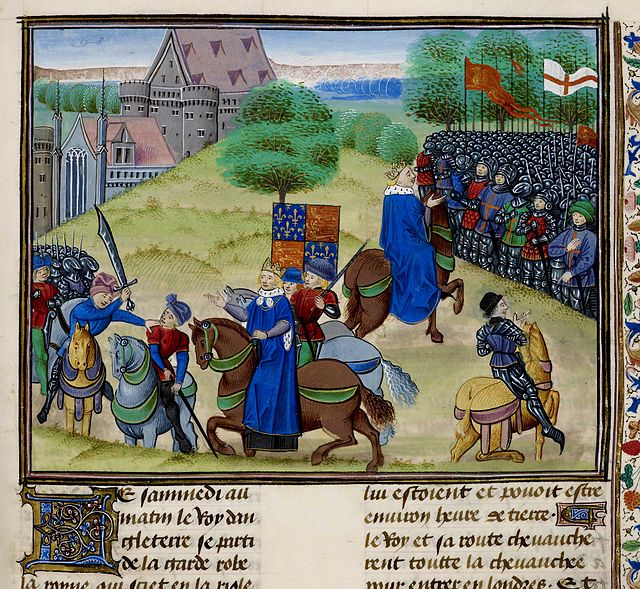
The above quote marks the high point of the revolt. Fagan then narrates the sudden turn by which the ruling class re-established control – through what must be one of the most shameful state murders in the history of England. Such a sudden and extraordinary turnaround demands a good explanation, and Fagan supplies one.

The state murder of the rebel leader Wat Tyler — from a medieval chronicle

The book is unfortunately weighed down with emotive verbiage. In itself, I have no major problem with the following passage…

‘…the indomitable spirit of the Englishman was roused. They became determined to fight for what had been given them by the King willingly and of his own accord. Soon many of them were dying heroic deaths in action against the forces of terror, for the defence of freedom and for the maintenance of their just rights.’

…but there’s too much of this kind of language. After a while, my mind became apt to spot such passages coming, and to switch into a kind of half-reading mode, not quite skimming but not quite taking it all in either.

Readers of today, or even readers of 50 years ago, will also have a problem with all the contemporary references. The references to Spain and Russia, while they were of course topical at the time, must have seemed of questionable relevance even then (There is even one approving reference to Stalin). The Great Society was not really anything like the Bolshevik Party – the comparison does a disservice to both. The comparisons are usually more skilful than that, but they are frequent and sometimes take up whole paragraphs.

I’ve never read anything else on the 1381 rebellion, so I can’t comment on accuracy or historiography. I can say that the story is compelling and coherent. My eyes were really opened to how well-organised the insurgents were, and how close they came to tearing down the English ruling class. It is impossible not to be moved by how the King betrayed the misplaced trust of the insurgents. Don’t be misled by the emotive passages: the author is unromantic and clear-eyed about the weaknesses of the insurgents’ political programme, about the unpleasant reality that English society was not yet ripe for a democratic revolution.  

Nine Days that Shook England was a take on medieval history that really was something new to me; I haven’t ever before read about a popular revolutionary movement in the Middle Ages. It is a dramatic story and there are plenty of good primary sources on it, and Fagan makes very good use of both the drama and the sources. Its problems we can file under ‘of its time.’ More than that: you will get more out of the book if you approach it both as a fascinating story from medieval history and as an intriguing artefact of the socialist movement in Britain in the 1930s. The didactic parts are not some spectacular artistic misjudgement; they are the flip side of the passion which drives the narrative.

Note:

The author, Hymie Fagan, was an interesting character in his own right. Here are some links: a few facts about his biography suffice to explain his revolutionary enthusiasm. The life story of his second wife, Marian Fagan, throws another very interesting light on things.

Home page/ archive

Scourge of God: The Basmachi

It is August 4th 1922, and the scene is a remote hillside in Tajikistan, near the Afghan border. Ismail Enver Pasha, the former war minister of Turkey, draws his sabre and leads a group of riders on a wild charge downhill into machine-gun fire. Somehow, the riders take out one machine-gun, but they are twenty-five against 300 Red Army soldiers.

Enver Pasha’s charge was an episode in a movement known as the Basmachi, the subject of this short post. This is a part of Class War and Holy War, a mini-series attached to my bigger project Revolution Under Siege.

The Basmachi were guerrilla forces active in Central Asia from 1918 on and off until the early 1930s, a divided and diverse constellation of irregular bands which attacked Red Army outposts and convoys. At times there were multiple armies numbering in the low tens of thousands active in different places.

The name apparently comes from the Uzbek verb basmak, ‘to attack,’ a word with connotations of banditry. But they called themselves kurbashi, fighters.

As far as I can see, this guerrilla movement drew on several sources of support all at once. Here they are, not in order of priority:

  • First, as noted, it reflected the failures and the atrocities of the Toshkent Soviet in its early phase, when Kokand was sacked and Russian settlers ran riot across the Fergana Valley. This caused the movement to emerge in early 1918.
  • Second, it was a response by desperate people to the harsh Civil War conditions and the attendant famine; the movement really became a force over the winter of 1919-20, when a 62% drop in the cultivated area of Turkestan had taken place and half the population was at risk of starvation. In this context the Red Army got first call on food, infuriating many local people.
  • Third, it was a spill-over from the White movement and the enraged old ruling classes, such as the army of Junaid Khan which cooperated with Kolchak, and the Emir of Bokhara, who was kicked out by his own people in 1920. From the start the movement was sponsored by these bastions of feudal reaction, and Khvostov in his book The White Armies treats the armed forces of Khiva and Bokhara unambiguously as a component of the Basmachi.
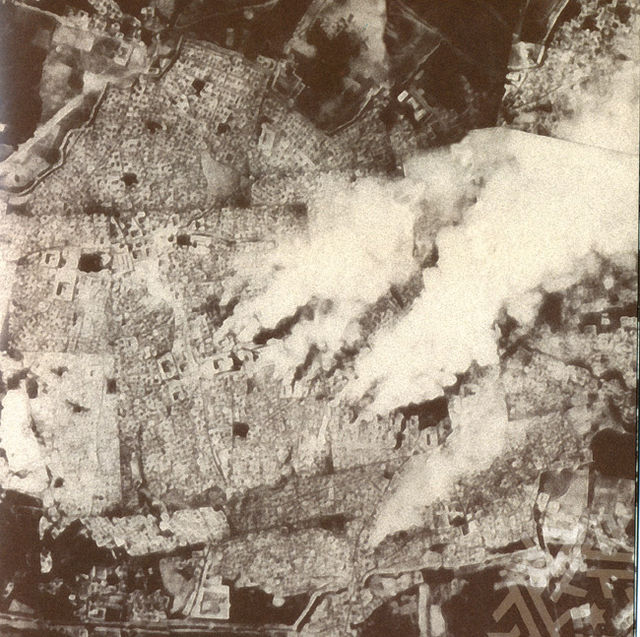
Fires in the city of Bokhara, September 1920, during the struggle between the Red Army and Young Bokharans on the one side and the Emir of Bokhara on the other. The Emir was a key sponsor of the Basmachi.

As I say, these sources of support are not presented here in order of importance, because to be honest I have no idea what that order was. A definitive history of the Basmachi has not yet been written. A full account of this fascinating movement is beyond my abilities, and their most active and significant phase falls outside the 1918-1920 period which is my focus in Revolution Under Siege and Class War and Holy War.

But they overlap with my narrative and serve as a sequel to it. Also, they throw a different light on the story I have told in Class War and Holy War, sometimes complicating and other times confirming the case I have made. You can read on and make up our own mind.

Phase One

The 1916 rebellion against conscription represents the prologue to the Basmachi. The first phase of the movement is its emergence after the Kokand massacre, mostly under the sponsorship of the Emir of Bokhara. It remains small until the summer of 1919-1920; in Summer 1920 it is strong enough to seize the Ferghana Valley. Meanwhile other bands are operating in other parts, such as one up by the Aral Sea helping Kolchak.

The Basmachi leader Madamin-Bek after his defection to the Reds, 1920

In Hiro’s account (42), the Soviets did not defeat the Basmachi with violence alone. Moscow sent in two renowned and capable generals, Frunze and Kamenev. Their approach was to return mosques and religious properties to Islamic authorities, to allow religious schools and courts to re-open, and to build a militia of poor Muslim farmers called the Red Sticks. Crucially, they confronted the Basmachi not with Russians but with Muslim units, which the Red Army by now had plenty of. (42-3)

Smele’s account (243) supports this: once the Whites were defeated, the Reds were able to wage heavy offensives against the Basmachi, combined with economic, religious and social concessions: NEP; the return of property to the clergy and the toleration of Islamic courts and schools.

Phase Two

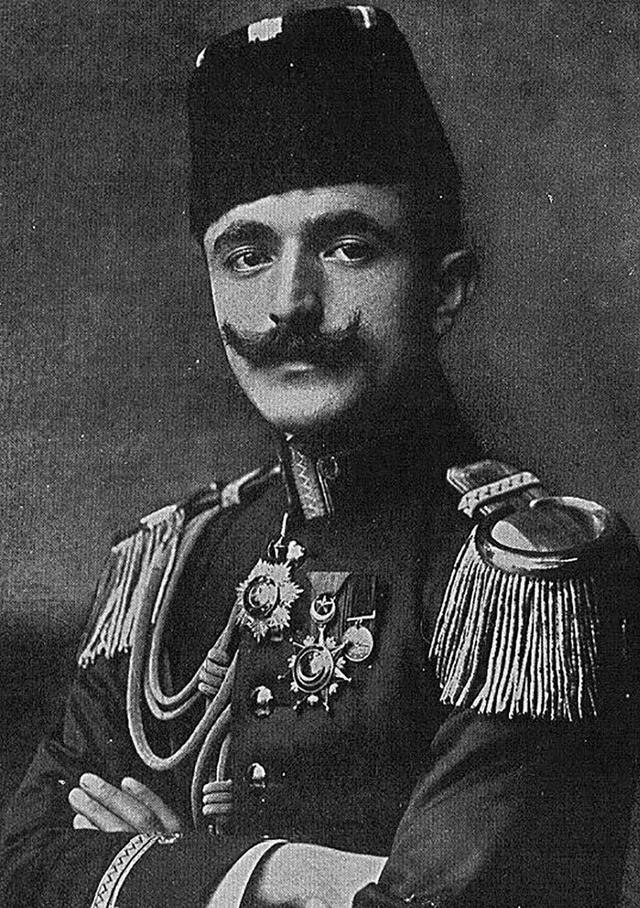
Here the scene shifts to Turkey and the spotlight to Enver Pasha. As a young army officer from humble origins, he led the Young Turks revolt of 1908. But as War Minister during Turkey’s disastrous First World War he lost a lot of prestige. In 1920 he fled to the Soviet Union, and made an improbable deal with Lenin. The peoples of Central Asia (at least some of them, anyway) had, during the war, looked to the Turkish Empire as a potential liberator from Russia. Enver Pasha now promised to use his prestige as a Turkish military leader, anti-clerical moderniser and revolutionary to win over the Central Asian nationalities more firmly to the Soviet banner.

So this seems to have been an example of the Soviet Union making a kind of concession to pan-Turkic identity in order to forge a closer bond. If so it was a complete disaster.

Enver Pasha

On November 8th 1921 Enver Pasha arrived at Bokhara. The next day he rode out ‘on a hunting trip’ with 24 followers. Now he showed his true colours – he not only joined the Basmachi, he recruited thousands to their cause. Had he been fooling the Soviets all along, or did he change his mind after Moscow signed treaties with Turkey in 1921?

Into 1922, Enver Pasha and the Basmachi went from strength to strength. His allies included the Emirs of Bokhara and of Afghanistan. He had 2,000 soldiers under his command, and 14,000 more in his broader alliance. He was ‘commander-in-chief of all the Armies of Islam,’ though privately he called his religious followers ’bigots.’ Soon he controlled Dushanbe (which he seized with just 200 guerrillas) and large parts of the old territory of Bokhara.

The Soviet Union sued for peace. Enver Pasha told them: ’Peace is only acceptable after the withdrawal of Russian troops from Turkestan soil. The freedom fighters, whose leader I am, have sworn to fight for independence and liberty until their last breath.’

But his movement faced serious problems. There were tensions between the various nationalities and between religious and secular tendencies. Many civilians supported the Reds or were neutral. Splits developed and Enver Pasha’s followers went to join other bands or even to join the Reds. In the summer, the Red Army defeated Enver Pasha in a regular battle, after which he was on the run in the direction of Afghanistan with a dwindling band. In early August he celebrated the Islamic festival of Bayram, enclosed mountain flowers in a letter to his wife, and died in that desperate charge into Red machine-guns. His body was only identified some days later.

(In passing, one well-read blogger has recently described Enver Pasha as follows: ‘the worst human being who happened to be a general [during World War One…] Ottoman Minister of War from 1914 to 1918, a vain, arrogant strutting sort of man who not only utterly botched the only battle in which he commanded directly (Sarikamish, Dec. 1914 – Jan 1915) but who also then blamed his defeat (falsely) on the Armenians and subsequently instigated and played a key role in the Armenian genocide. He then sold his services to the Soviets, before betraying them to side with the Basmachi movement, which didn’t go particularly well either.’ No-one else I’ve read mentions the connection to the Armenian genocide, probably because this was in the past a neglected subject. A friend, a Kurdish-Turkish communist, has described Enver Pasha to me as a quasi-fascist counterpart to the more left-leaning Kemal Ataturk – the two men embodying different facets of Turkish nationalism.)

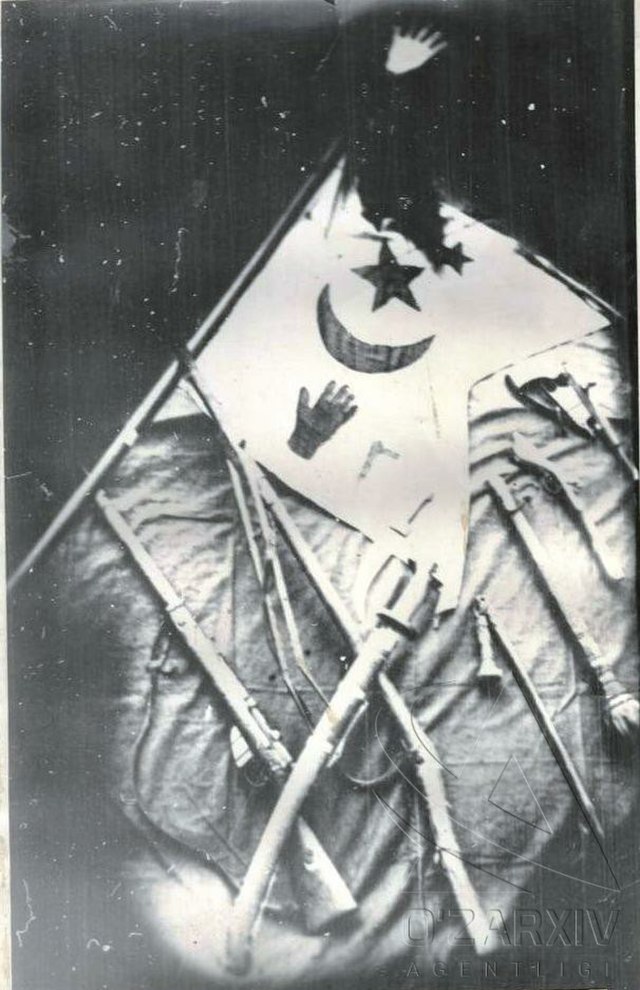
The banner of Ergash Kurbashi, taken by the Red Army

Phase 3

The Basmachi experienced a final revival in 1925-6. Their supporters stood for election in the Soviets, took over several in the region, and re-launched the insurgency. Only with their defeat in 1926 did the Soviet Union formally close the last front of the Russian Civil War, three years after the destruction of the last White Army.

But the movement was not finally destroyed until the early 1930s, the period of forced collectivisation and repression on a hitherto unseen scale.

Conclusion

A little while ago I wrote: ‘The peoples of Central Asia articulated demands for autonomy many times, but as far as I can see, demands for independence were few, inchoate and scattered. When they were put forward, they were complicated by being linked to broader identities: pan-Islamic or pan-Turkic ideas.’ It should be clear from the context that I’m talking about 100 years ago, not today.

But according to one author quoted by Smele, the Basmachi movement was nothing less than a civil war with the goal of national independence. Smele says this is going too far: this was a disunited and inchoate movement. I’d add that the khans and emirs were unambiguous counter-revolutionaries, not freedom fighters; and that European Russia, too, produced revolts of the rural population in anger at the severity of Civil War conditions.

Moscow confronted the Basmachi with concessions alongside military offensives. How effective was this strategy? On the one hand, the Basmachi were not finally defeated until the early 1930s, but they never threatened the ‘centres of Russian power’ and ‘frequently fought among themselves.’ (Mawdsley, 239) The Soviets played a long game, pushing the Basmachi campaign to a lower level, though they remained endemic. The fact that a long game of concessions was effective, and the fact that Moscow chose to pursue it, represent points against the view of the Basmachi as a movement representing a general desire for independence.

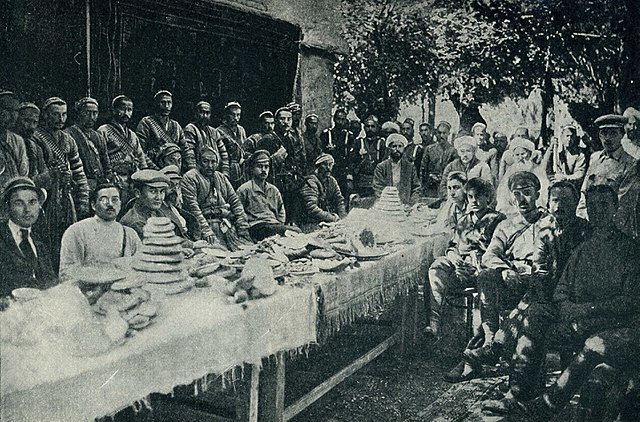
Negotiations between Soviet authorities and Basmachi in the Fergana Valley, 1921

Let’s not forget, though, that the Reds were fighting these guys for more than a decade. I don’t think the numbers quoted by Smele are plausible – apparently some say that over half a million Red soldiers died in combat with the Basmachi after the end of the Civil War – but it was a serious struggle. The Basmachi represented something more significant than the rural uprisings which Russia witnessed in 1921. It was not mere feudal reaction, but was in part a ‘scourge of god’ punishing the Toshkent Soviet for its undemocratic policy and the violence which served it. We can see feudal particularism, Pan-Turkism and Pan-Islam all in the mix. While it was something less than, or even other than, a movement for national liberation, it’s not difficult to see tendencies in that direction.

Revolution Under Siege archive

Home page/ archive

Notes on Stalinism in Central Asia (Premium)

Become a paying supporter to get access

Access to this article is limited to paying supporters. If you already subscribe by email, thank you. But if you want to become a paying supporter, please hit ‘Subscribe’ below.

Donate less than the price of a coffee, and you can access everything on this blog for one year.

Revolution Under Siege archive

Home page/ archive

Class War and Holy War: (4) Tackling ‘A Russian Ulster’

This post tells the story of how, having defeated the White Armies, the Soviet Union fought against racism and inequality in Central Asia.

Developments in Central Asia in the early years of the revolution were viewed with mounting alarm by Moscow. The Central Committee of the All-Russian Communist Party warned of the danger of the Soviet regime in Turkestan becoming ‘A Russian Ulster – the colonists’ fronde [revolt] of a national minority counting on support from the centre.’

Readers of the Russian socialist press before the revolution would have been reasonably well-informed on Irish politics (See Lenin’s 1913 article ‘Class War in Dublin’). The ‘Russian Ulster’ remark was made during the Northern Ireland pogroms of 1920-22. In what are known as the ‘First Troubles,’ gangs of loyalists burned a thousand homes and businesses, killed hundreds of people, and expelled Catholics from the Belfast shipyards along with many Protestant trade union activists.

Of course the comparison only goes so far (see the note at the end of this post). But it must have stung the Russian communists in Toshkent because it was true in many ways.

The Turkestan Communist Party was, in 1921, political home to ‘the communist priest, the Russian police officer and the kulak from Semirechie [East Kazakhstan, near China] who still employs dozens of hired labourers, has hundreds of heads of cattle and hunts down Kazakhs like wild beasts.’ In 1920 a veteran Bolshevik, Safarov, wrote: ‘National inequality, in Turkestan, inequality between Europeans and natives, is found at every step.’

And in response to racism in the region’s Communist Party, the minority of Muslim communists became nationalistic. ‘Militant Great Russian chauvinism and the defensive nationalism of the enslaved colonial masses shot through with a mistrust of the Russian – that is the fundamental and characteristic feature of Turkestan reality.’ Thus wrote Broido, another of the few ‘Old Bolsheviks’ of Turkestan, in 1920.

The Congress of the Peoples of the East in Baku, Azerbaijan in September 1920 was a remarkable event in which supporters of the Soviet regime from across Asia gathered, many in their national costume, many having made dangerous journeys. It was remarkable, too, for the spirit of free debate and criticism which prevailed. A Turkestan delegate condemned the ‘inadequacy’ of communism in Central Asia, demanding the removal of ‘your colonists now working under the guise of communism.’

He was met with applause and cries of ‘Bravo’.

‘There are among you, comrades,’ he continued, ‘people who under the mask of communism ruin the whole Soviet power and spoil the whole Soviet policy in the East.’

Safarov repeated the indictment at the 10th Party Congress in March 1921. (Carr, 338, 341)

A mosque in the Soviet Union, from a 1923 painting by Amshey Nurenberg

Moscow intervenes

EH Carr notes that though nationalities policy was discussed at the 8th Communist Party congress in March 1919, Turkestan was somehow not mentioned. Toshkent was after all as far away and as difficult to access as Soviet Hungary. But from July 1919 official statements began to recognise and to stress the importance of Turkestan. It was described as ‘the outpost of communism in Asia.’ With the realisation of its importance came recognition of the crimes and mistakes of the Toshkent Soviet. A 12 July telegram from the Party Central Committee, written by Lenin, insisted on ‘drawing the native Turkestan population into governmental work on a broad proportional basis’ and on no more requisitioning of Muslims’ property without the consent of local Muslim organisations.

The Tashkent leaders were resistant, but as soon as the rail link with Moscow was restored in October 1919, Moscow ‘despatched a team of ideological troubleshooters’ to Toshkent to respond to ‘reports of blood-letting and anarchy.’ (Hopkirk, 79) This official commission insisted that the ‘mistrust of the native toiling masses of Turkestan’ can only be overcome by offering them self-determination, a principle which was ‘the foundation of all the policy.’ Lenin’s further communications stressed ‘comradely relations’ between Russian and Muslim and urged communists to ‘eradicate all traces of Great Russian imperialism.’ (Carr, 339, 340)

Turkestan remained, however, just one relatively small front in a war fought on a continental scale, and Lenin and co were practical. This is unmistakeable in a coded telegram from Lenin to three Toshkent communist leaders dated December 11th 1919:

Your demands for personnel are excessive. It is absurd, or worse than absurd, when you imagine that Turkestan is more important than the centre and the Ukraine. You will not get any more. You must manage with what you have, and not set yourselves unlimited plans, but be modest.

You can look up this stuff on Marxists Internet Archive. A May 25 1920 telegram from Lenin to Frunze consists of a staccato and bluntly practical series of questions about the state of the oil wells. In two August 1921 letters settling a dispute between a pair of communist leaders in Turkestan, Lenin agrees that Moscow must buy ‘nine million sheep’ from Central Asian merchants. ‘They must be obtained at all costs!’ – hence ‘a number of concessions and bonuses to the merchants.’ But the consistent through-line is that ‘the Moslem poor should be treated with care and prudence, with a number of concessions’ – ‘systematic and maximum concern for the Moslem poor, for their organisation and education’ which must be ‘a model for the whole East.’

Some Bolsheviks (notably Stalin) held the idea that only the working class of a given nation should decide the fate of that nation (Jones). The problem with this position is illustrated starkly in Central Asia, where a few thousand foreign railway workers tried to exercise ‘self-determination’ over the heads of ten million Muslim farmers. But Lenin recognised that vast areas of the territory that fell within Moscow’s gravity well were underdeveloped (that is, even more so than the semi-feudal Russian metropole), and that a more sensitive and democratic policy was necessary.

Through 1919, according to Mawdsley (328), Muslims were given ‘more of a role in the state and party, thanks to Moscow’s influence. The centre kept overall control, but more than a semblance of power was given to progressive natives.’ For example, Turar Ryskulov was a Kazakh who joined the Bolsheviks in September 1917 and went on to hold numerous prominent and powerful government posts. (Smele, 333n42)

You might say, ‘Well, Moscow remained in real control,’ but that misses an important point. The peoples of Central Asia articulated demands for autonomy many times, but as far as I can see, demands for independence were few, inchoate and scattered. When they were put forward, they were complicated by being linked to broader identities: pan-Islamic or pan-Turkic ideas.

In January 1920 there arrived the first ‘Red Train’ of party activists fluent in native languages and there was a ‘rapid improvement during 1920’ in the Soviet authorities’ treatment of Muslims.

‘In the winter of 1920-21,’ writes Carr (340), ‘Friday was substituted for Sunday as the weekly rest day, and the postal authorities for the first time accepted telegrams in local languages.’ It’s really shocking that such basic measures were not in place before that time. But at least the ‘Russian Ulster’ was now steadily being dismantled.

Military conquests

Meanwhile the Red Army was consolidating its hold on Central Asia.

The Khanate of Khiva, south of the Aral Sea, had held out against the Reds. In January 1920 the Young Khivans, an indigenous progressive movement, began a revolt and invited the Red Army into the city. The result was the establishment of the Khorezm People’s Socialist Republic.

According to Rob Jones:

The new Russian Socialist Federation recognized the Khorezm People’s Soviet Republic as an independent state –publicly renouncing all claims to territory and offering a voluntary economic and military union with the new state. All property and land that once belonged to the Russian state, as well as administrative structures were handed over to the new government with no demands for compensation. Financial assistance was provided to build schools, to campaign to end illiteracy and to build canals, roads and a telegraph system.

The other major feudal power was Bukhara, which in 1920 suffered under famine conditions and under its regressive and violent Emir. In August 1920 the Young Bukhara movement called in the Red Army just like their counterparts in Khiva. There were four days of fighting in Bukhara. By October the Emir was running for the hills to join the Basmachi, while the First Congress of Bukhara workers met in his palace. (Hiro, 41; Carr, 340) There is even a story (Hopkirk, quoting M.N. Roy) that the women of the Emir’s numerous harem each chose to marry a Red Guard after a bizarre kind of speed-dating session.

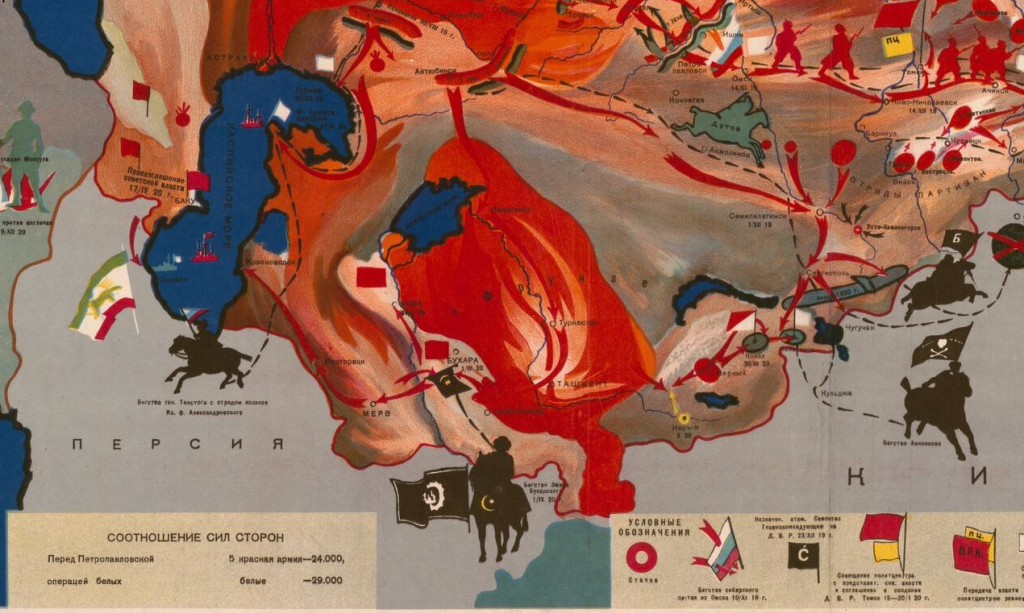
Detail from Pictorial Wall Map 08: ‘Liquidation of Kolchak and his followers.’ From the accompanying notes: ‘Former Tsarist Turkestan, essentially most of Central Asia, is represented as a giant fireball erupting out of
Tashkent. Red spearheads advance throughout as though they were spreading flames. Various centers of authority had arisen in Central Asia following the revolution, but the Red Army managed to turn the region into
a series of soviet republics by the end of 1920. Spread across the region is the name Mikhail Frunze, commander of the Turkestani Red Army, who defeated fierce guerilla opposition to set up a Turkestan Autonomous Soviet Socialist Republic in September 1920.’

In 1920 revolution in Europe was receding as an immediate possibility. Communist leaders turned their attention to the east: there were major independence struggles in India, and in Turkey a guerrilla movement was resisting Allied occupation. In Toshkent there was even a brief attempt to build a revolutionary army of Muslims from the Indian subcontinent.

Social Conquests

The October Revolution did not, as things turned out, attempt to overthrow the British Raj in India, but in the longer term it overthrew illiteracy in Central Asia. For example, in 1926 literacy was only 2.2% in Tajikstan; by 1939 it was 71.7%. 1,600 public libraries were opened across Turkestan. Along with this there was a dramatic rise in the availability of media; newspapers, periodicals, books and radio. Other socio-economic achievements included major road and rail projects and works such as the Fergana Canal.

Red victory in Central Asia brought massive changes to family life, with bans on child marriage and encouragement to women to learn to write. The proportion of women in the workforce in Uzbekistan was 9% in 1925, and 39% by 1939 as women entered into the civil service, schools, colleges, universities, hospitals and labs.

In a 1990 interview with the BBC’s Central Asian Service, a secondary-school teacher reflected on what the October Revolution and its extension to Central Asia meant for her:

I felt I was the luckiest girl in the whole world. My great-grandmother was like a slave, shut up her house. My mother was illiterate. She had thirteen children and looked old all her life. For me the past was dark and horrible, and whatever anyone says about the Soviet Union, that is how it was for me.

She could access free infant healthcare. She could also avail of measures which, in my country in 2023, are not even on the table for discussion: two years’ maternity leave with full salary, and a guaranteed childcare place for her children. (Dilip Hiro, 56)

The revolution in Central Asia was in large part a gender and family revolution, but it was above all a land revolution. From 1920, the major Muslim political parties saw an exodus of members to the Communist Party. Even in rural areas, communism gained popularity. ‘Contrary to the Muslim clerics’ dire warnings […] they [the communists] had concentrated on confiscating the lands of the feudal lords and distributing them to landless and poor peasants.’ (Hiro, 41)

A March 1920 decree returned Central Asian land that had been seized by Russian settlers – 280,000 hectares were given back to local people in a single year. The most notorious racists among the Russian population were deported back to Russia.

From March 1921, the New Economic Policy (NEP) was brought in across the Soviet Union. In Central Asia there was a danger it might cut across land redistribution (hence Lenin’s letters of August 1921 quoted above), but through skilful implementation it was a success. From 1925-1929 there was further redistribution of land at the expense of landlords and clerics. The beks, emirs and khans were simply finished as a ruling class.

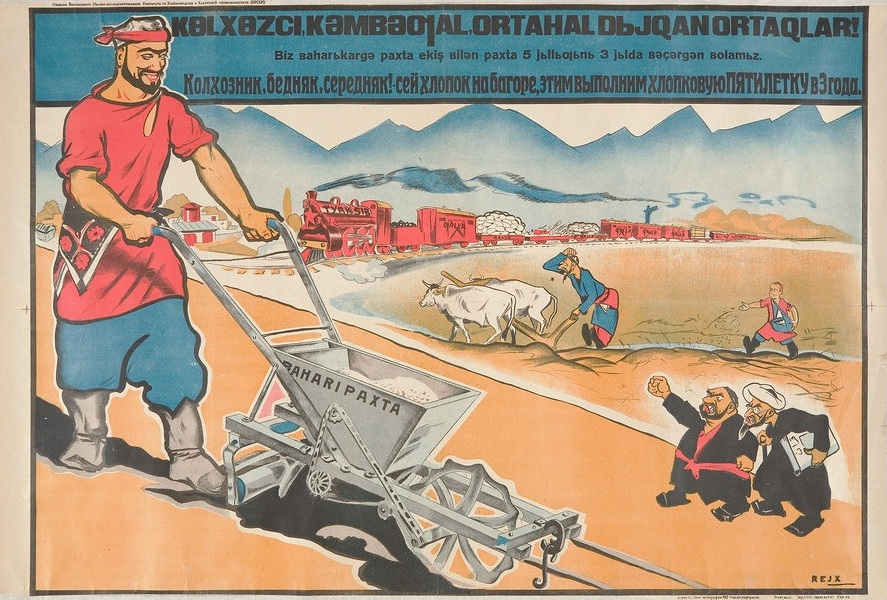
The former ruling classes rage at the economic  development being achieved by the proletariat. An Uzbek-language poster, published in Tashkent, 1920s. (Source)

Cultural Conquests

Under Soviet rule, the various languages of Central Asia were standardised with Arabic script on a Turkic base of vocabulary and grammar, with the exception of the Persian-influenced Tajik language. Lenin explicitly rejected forcing these languages into Cyrillic script, though as we will see this was later done under Stalin.

For Central Asian languages, this was a historic moment. For example the Kyrgyz language was set down in script for the first time in 1922. (Hiro, 46)

By 1923 there were 67 schools teaching in Mari, 57 in Kabardi, 159 in Komi, 51 in Kalmyk, 100 in Kirghiz, 303 in Buriat and over 2500 for the Tatar language. In Central Asia, the number of national schools, which numbered just 300 before the revolution, reached 2100 by the end of 1920.

[Jones]
Delegates of a Tatar language conference in Kazan

This article by David Trilling from Eurasianet.org points out that the surge in artistic achievement which followed 1917 continued for longer in Central Asia:

The 1920s saw an unfettered flowering of creativity in these regions, especially among Russian-trained artists based in Tashkent and Baku. While central publishing houses in Moscow and Leningrad were shifting to Socialist Realism, artists in the periphery continued the avant-garde movement, combining it with local traditions, according to the exhibit’s curator, Maria Filatova. She sees the colorful posters from the 1920s and early 1930s, with their longer texts and multiple figurines, as direct decendents of local calligraphy and miniature traditions.

Filatova feels the relative freedom of the 1920s makes the work from that decade artistically more interesting compared to what followed. The work is also revealing about that period in early Soviet history, when “socialist ideas coexisted with Islamic ideology.”

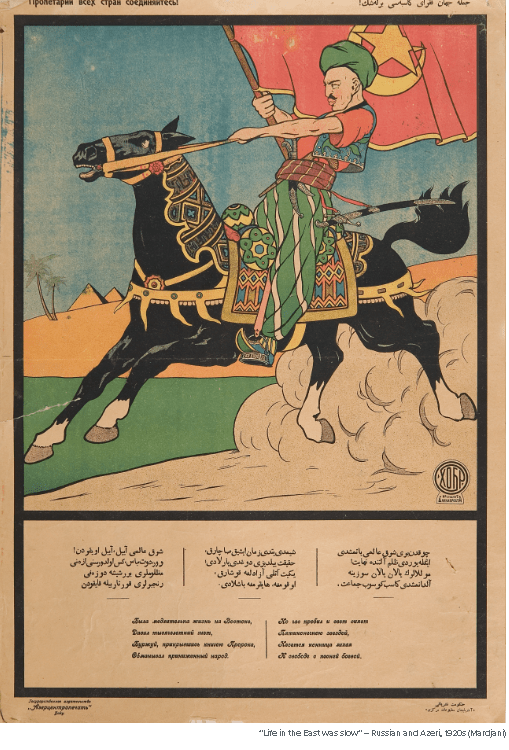
For example – the cover image for this post, part of the exhibition in question, an Azeri-language Red Army recruitment poster

Political Conquests

These socio-economic gains were the basis for the emergence of new states in Central Asia.

Early in the Civil War Ataman Dutov, a key White leader in the Urals, recognized the autonomy of the Kazakhs. But when Kolchak took over in late 1918, true to form, he suppressed it. So there was a split between the White Guards and the Kazakh people. In Autumn 1919 the Red General Frunze issued an amnesty for all the fighters of the Alash-Orda who had sided with the Whites; this proved a master-stroke politically and militarily. The Kazakhs came over to the Reds in great numbers and within 4 or 5 months the Reds had advanced all the way across the vast expanse of Kazakhstan.

Moscow quickly recognised a Kazakh Autonomous Soviet Socialist Republic (ASSR). Confusingly, it was at first known as the Kyrgyz ASSR, because Russians ignorantly called the Kazakhs Kyrgyz.

This Kazakh ASSR, population 6.5 million, was the first of the Soviet Republics of Central Asia. The others emerged in the next few years:

  • The Turkmens got the autonomous state for which they had been fighting, in the form of the Turkmenia SSR, population one million;
  • There emerged the Kyrgyz ASSR, population one million;
  • And in December 1926 the Tajik ASSR, population one million, separated from…
  • The Uzbek SSR, population 5 million.

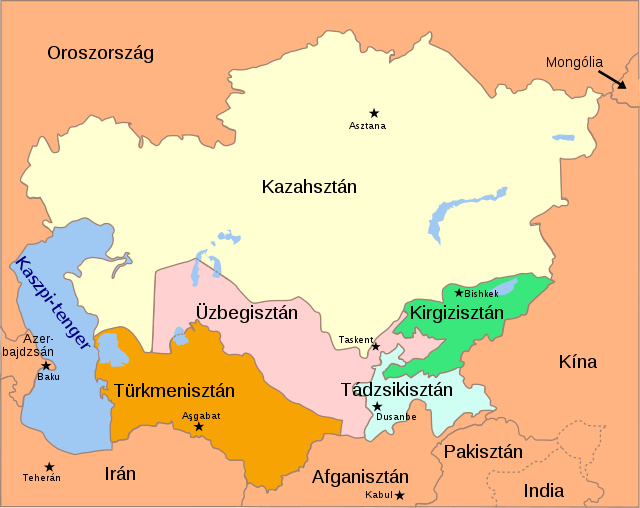
The drawing of the boundaries between these new states was not dictated by Moscow, which confined itself to laying down general principles and settling intractable disputes. The actual borders were worked out by local parties and specially designated commissions. Look at a map of the world and at the vortex of convoluted borders between Kyrgyzstan, Uzbekistan and Tajikistan: this was a result of bargaining between indigenous communists. What a contrast to the suspiciously straight lines we see in parts of the Middle East and Africa, drawn up by imperial officials rather than by people with on-the-ground interests and knowledge. (Hiro, 44)

Yes, I know it’s in Hungarian. But in any language you can see the convoluted tangle of borders

Muslim communists began to come to the fore. But the particular history of Soviet Central Asia also led to particular problems. As outlined above, chauvinism among Russian communists led to a ‘defensive nationalism’ among Muslim communists. This bred further conflict; many of the Muslim leaders who came to prominence in Soviet Central Asia entertained Pan-Turkic ideas as part of that ‘defensive nationalism,’ leading to disagreement between them and Moscow, a struggle which the former lost. (Mawdsley, 332) The Volga Tatar communist Soltangaliev was arrested in 1923, accused of complicity in a Pan-Turkist conspiracy with the Basmachi – an accusation that strikes me as improbable. He was expelled from the party and even jailed, but later released. (Smele, 333n43)

The history of the Soviet Union is sometimes presented as a monolithic story of dictatorship. Certainly the draconian security measures of the Civil War era and the 1921 ban on opposition should not be downplayed, and under Stalin from the late 1920s totalitarian rule was imposed. But as we have seen, even during the Civil War Soviet congresses made important decisions. The Civil War years in fact saw centrifugal tendencies – from Tsaritsyn to Toshkent, local officials turned their noses up at signed credentials from Lenin, and declared that they would do as they pleased. In the 1920s we see some of the potential of Soviet democracy shine through despite extraordinary difficulties such as post-war reconstruction. This is obvious in the case of Central Asia. Hiro writes: ‘the landless, poor and middle-income peasants forming the bulk of the population benefitted economically and politically’ from the extension of the October Revolution to their lands. ‘For instance, in the 1927 to 1928 elections to the Soviets in Tajikistan, the landless, poor and middle-income peasants accounted for 87% of the deputies.’

Conclusion

This post concludes my four-part miniseries Class War and Holy War, a spin-off from Revolution Under Siege. But I’m going to add two short posts to this series, one dealing with the fascinating guerrilla movement known as the Basmachi and another on the impact of Stalinist forced collectivisation and terror in Central Asia.

This series started out bleak and violent. Urban Russia, linked by rail and wire, transplanted the revolution from the Baltic Sea to the Silk Road with remarkable speed. But in Toshkent the Russian population was surrounded by a majority that was of a different religion and of many different nationalities. The workers’ leaders, almost none of whom were developed Bolshevik cadres, filtered the October Revolution through an approach that was at best crude, at worst brutally racist. Instead of combining the anti-colonial revolution with the workers’ revolution, they set the one against the other and risked creating what the Party’s Central Committee termed ‘a Russian Ulster.’

But the Toshkent Soviet did manage to survive a bitter military struggle against many diverse enemies, and from late 1919 the racist element was in retreat. What has been covered in this concluding post really is remarkable: the peoples of Central Asia tore down their ancient lords and shared their land out among the poor; they booted out the worst of the Russian settlers and shared out their land, too; women seized the day; minority languages were revived; the number of healthcare facilities, schools and libraries increased massively; for some years, the people enjoyed free creative expression, democratic rights and real representation; people of different nationalities settled their borders by debate and compromise. Such things really are possible, and in a revolutionary time they can happen quickly.

I’m not describing heaven on earth, and I’m sure the legacy of the Soviet period is disputed and complicated in the diverse countries of Central Asia today, and I understand why the events I have written about might be coloured more negatively in the eyes of people from the region because of later developments. This is a topic I have only begun to look at over the last six months or so, and I feel exactly how I imagine an Uzbek blogger writing about Irish history would feel. While I don’t want to get stuck into comment-section trench warfare, I welcome constructive criticism from people mpre familiar with the region. But it’s difficult for me not to be impressed and even moved, comparing the Central Asian revolution with today’s bitter and violent world with all its bigotry and its apparently intractable national and religious conflicts. Violence and horror are part of history – you didn’t need me to tell you that. But such things as we have described in this post are possible too, even against a background of hate and bloodshed, and they really did happen.

Note on ‘A Russian Ulster’

Speaking of which, here’s a final note about the phrase ‘a Russian Ulster.’ The phrase is inappropriate in important ways.

The first problem is that Central Asia is way bigger, more diverse and more globally significant than Ulster, but because of Anglo cultural hegemony nobody has ever uttered the phrase ‘Ulster is in danger of becoming a British Turkestan.’

Second, the Protestant population in Ireland are not ‘settlers’ but the descendants of settlers from centuries ago, and they have as much of an established place here as anyone. By contrast, the main mass of Russians in Central Asia dated only from the 1890s.

A scene from the Belfast shipyards in 1911

Third, while the sectarian division in Ireland has been and remains bitter and violent, the situation in Central Asia in the early 20th Century appears to have been much worse. I’m sure Northern Irish Catholics and Central Asian Muslims have no interest in competing in the oppression Olympics, but it’s necessary to clarify the limits of the comparison.

Fourth, before the 1920-22 ‘Troubles’ came the 1919 Belfast engineering strike – in which Catholics and Protestants stood together in a strike committee that virtually ran the city. One of several prominent socialist leaders, incidentally, was Simon Greenspon, a man of Russian Jewish background. Here was a glimpse of ‘a Russian Ulster’ in a very different sense.

Review: Legacy of Violence by Caroline Elkins

Legacy of Violence: A History of the British Empire by Caroline Elkins, Penguin, 2022

Legacy of Violence covers 200-plus years of the history of the British Empire, from the late 18th to the late 20th century, spending most of its word count in the early-to-mid 20th Century. Elkins refers positively to the anti-imperialist writings of Walter Rodney and Vladimir Lenin, but only to tell us that she will be coming at the subject from a different, though not contradictory, angle. This is primarily a book about repression and counter-insurgency in the British Empire. Economics, politics and sociology are part of the narrative but rarely to the fore.

Elkins focuses on key episodes, states of emergency and of exception, in which laws and human rights were suspended. There are far too many examples to list, but they include the revolt in Jamaica in the 1830s, the Boer War, the ‘Malaya Emergency,’ and the Troubles in Ireland. Questions of philosophy and law are traced through this diverse globe-spanning range of episodes. One thing that really impressed me was how she follows the careers of various British officials – for example, the Black and Tans who went from one brutal counter-insurgency in Ireland to an even worse one in Palestine.

The same themes and phrases keep coming up. For example, you could point to so many examples where the British military terrorised rebellious people into submission with killings, torture and bombing. From one continent and decade to the next, British officials and officers had the same pleasant phrase for this: ‘the salutary moral effect.’

What unfolds as you read through this book is a fascinating and globe-spanning story. Here are some of the things I did not know about, in vaguely chronological order:

  • The perpetrator of the infamous Amritsar Massacre in India in 1919, Brigadier-General Dyer, faced a controversy but ultimately got off the hook. But the politician who tried to make Dyer face some consequences was himself punished with the loss of his reputation and career – along with anti-Semitic abuse. Also, that Amritsar Massacre was not just a singular event – it was preceded and followed by a long reign of terror over the whole area where it took place.
  • The British prepared the ground for the Naqba, the ‘catastrophe’ in which Palestinians were ethnically cleansed from their country in 1948. Death squads of British commandos, supported by Jewish paramilitaries, suppressed Arab revolts with raids, bombings, assassinations and torture. One of the main British officers, the famous and eccentric Orde-Wingate, was motivated by vicious anti-Arab racism.
  • When these paramilitaries began an insurgency against the British Empire in the late 1940s, a wave of anti-Semitism swept Britain. Yeah, right after the Holocaust, Mosely and the British Union of Fascists made a comeback. (Though I had heard about this one in a fascinating book called The 43 Group).
  • Long before the Blitz of 1940, the British military pioneered the bombing of defenceless villages, for example in Iraq.
  • During and after World War Two, there were prisons in England and in Germany where torture of German detainees was widespread. This was the case tenfold in India, where Britain had to come up with elaborate means to re-establish control after the war.
  • After the war there were campaigns to get governments to recognise human rights laws. Britain saw that the Universal Declaration on Human Rights would be incompatible with the brutality required to maintain its empire, so it resisted for decades.
  • As Britain cleared out of India, clouds of smoke hung over the major cities; British officials were burning heaps of documents.
  • The rebellions in Malaya and Kenya in the 1950s were the most striking and educational parts of the book for me. These were popular rebellions with democratic demands and grievances, and they were put down with a variety of evil means. In Malaya we see the mass transfer of entire ethnic groups and populations. There and in Kenya we see huge torture camps. The reality is that torture was a completely normal practise in the British Empire, though the folks back home didn’t know about it and instead were fed rubbish about ‘hearts and minds.’

There is so much more I could say – if I’d taken notes, I could write in greater length and detail about all the above bullet points and as many again. That goes to show how much I learned from this rich volume. It’s really well-written, it’s obvious that a vast mass of research has gone into it, and there is a deep coherence and structure underlying the whole globe-spanning narrative. I’m grateful to have read this fascinating, disturbing and enlightening work.

Go to Home Page/ Archive